Category Archives: Radio History

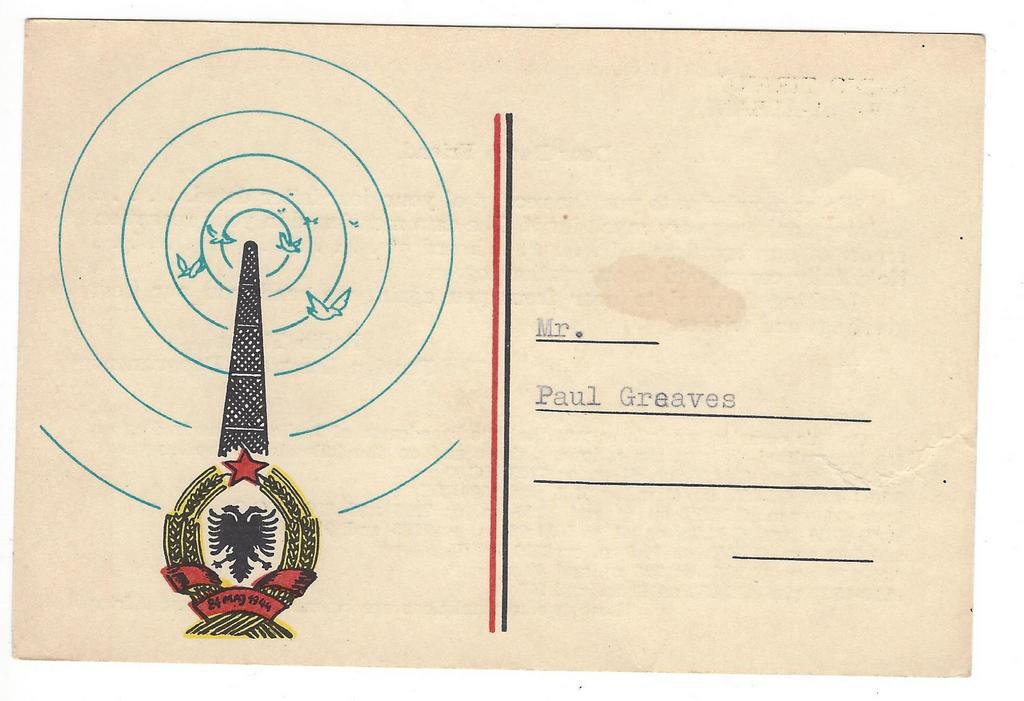
Radio Tirana memories: Who was the voice of “goodnight dear listeners”–?

I just received the following comment from Richard Levenson posted with this off-air recording of Radio Tirana on the Shortwave Radio Audio Archive:

Lots of fond memories listening to Radio Tirana, Albania going back to the late 1950’s. Their broadcasts back then were loaded with anti-West propaganda and more. Their interval signal is a classic to SWL people. Always remember the female announcer on the station. Her sign-off phrase was “and goodnight dear listeners.” This came after much in the way of negative propaganda. When she would say her sign off you got the idea she was tucking you into bed for the night. It had that quality and sincerity to it. Love to know who this person was or if she is still alive. Give you an idea how much SWL I did since around 1953 to present day.

Thank you for your comment, Richard! If you can identify this announcer with Radio Tirana, please comment with details!

Photo gallery of the Rampisham Down transmitting site in 2003

Many thanks to SWLing Post contributor, Dave Porter, who shares a link to the following site which contains an extensive galley of photos taken at the Rampisham HF transmitting site on October 11, 2003.

Click here to view the gallery.

Thank you for the tip, Dave!

Radio Bulgaria celebrates 85th anniversary

Many thanks to SWLing Post contributor, David Iurescia (LW4DAF), who shares the following feature from Radio Bulgaria who celebrates their 85th anniversary:

Speaking your language for 85 years

2021 marks the 85th anniversary of the Bulgarian National Radio’s foreign language service to the world. It all began on 16 February, 1936. One year after the Bulgarian radio was officially launched, what is now Radio Bulgaria went on the air. It was a Sunday when Radio Sofia’s full morning programme was launched, to reach Europe, North America and North Africa.

Now, 85 years later, Radio Bulgaria is still talking to the world about the country in English, German, French, Spanish, Russian, Serbian, Greek, Albanian, Turkish and Bulgarian.

Our special feature presents intriguing facts from the history of Radio Bulgaria, its golden voices, as well as reminiscences from the people who have worked at Radio Bulgaria through the years.

Click here to view Radio Bulgaria’s feature articles.

Thank you for the tip, David. This article reminded me to listen, once again, to the final shortwave broadcast of Radio Bulgaria. Seems like yesterday!

Radio Waves: A Perfect CME, FCC Construction Permit Auction, More Music On AM, and Virtual SWL Fest Reminder

Radio Waves:  Stories Making Waves in the World of Radio

Because I keep my ear to the waves, as well as receive many tips from others who do the same, I find myself privy to radio-related stories that might interest SWLing Post readers.  To that end: Welcome to the SWLing Post’s Radio Waves, a collection of links to interesting stories making waves in the world of radio. Enjoy!

Many thanks to SWLing Post contributors Eric McFadden, Mike Terry, for the following tips:


A “Perfect Coronal Mass Ejection” Could Be a Nightmare (ARRL News)

A new study in the research journal Space Weather considers what might happen if a worst-case coronal mass ejection (CME) hit Earth — a “perfect solar storm,” if you will.

In 2014, Bruce Tsurutani of Jet Propulsion Laboratory (JPL) and Gurbax Lakhina of the Indian Institute of Geomagnetism introduced the “perfect CME.” It could create a magnetic storm with intensity up to the saturation limit, a value greater than the Carrington Event of 1859, the researchers said. Many other spaceweather effects would not be limited by saturation effects, however. The interplanetary shock would arrive at Earth within about 12 hours, the shock impingement onto the magnetosphere would create a sudden impulse of around 234 nanoteslas (nT), and the magnetic pulse duration in the magnetosphere would be about 22 seconds. Orbiting satellites would be exposed to “extreme levels of flare and interplanetary CME (ICME) shock-accelerated particle radiation,” they said. The event would follow an initial CME that would “clear the path in front of it, allowing the storm cloud to hit Earth with maximum force.”

The Solar and Heliospheric Observatory (SOHO) has observed CMEs leaving the sun at speeds of up to 3,000 kilometers per second, and many instances of one CME clearing the way for another have been recorded.

The CME’s 12-hour travel time would allow little margin for preparation. The CME would hit Earth’s magnetosphere at 45 times the local speed of sound, and the resulting geomagnetic storm could be as much as twice as strong as the Carrington Event. Power grids, GPS, and other services could experience significant outages.

More recent research led by physicist Dan Welling of the University of Texas at Arlington took a fresh look at Tsurutani and Lakhina’s “perfect CME,” and given improvements in spaceweather modeling, he was able to reach new conclusions.

Welling’s team found that geomagnetic disturbances in response to a perfect CME could be 10 times stronger than Tsurutani and Lakhina had calculated, especially at latitudes above 45 to 50 °. “[Our results] exceed values observed during many past extreme events, including the March 1989 storm that brought down the Hydro-Québec power grid in eastern Canada, the May 1921 railroad storm, and the Carrington Event itself,” Welling summarized.

A key result of the new study is how the CME would distort and compress Earth’s magnetosphere. The strike would push the magnetopause down until it’s only 2 Earth-radii above Earth’s surface. Satellites in Earth orbit would suddenly find themselves exposed to a hail of energetic, and potentially damaging, charged particles.

Other research has indicated that phenomena such as the Carrington Event may not be as rare as once thought. A much weaker magnetic storm brought down the Canadian Hydro?Québec system in 1989.

Scientists believe a perfect CME will happen someday. As Welling et al conclude, “Further exploring and preparing for such extreme activity is important to mitigate spaceweather-related catastrophes.”

In July 2012, NASA and European spacecraft watched an extreme solar storm erupt from the sun and narrowly miss Earth. “If it had hit, we would still be picking up the pieces,” said Daniel Baker of the University of Colorado at a NOAA Space Weather Workshop 2 years later. “It might have been stronger than the Carrington Event itself.”

Click here to read at the ARRL News.

FCC To Auction Off 140 Radio Stations (Radio Ink)

The FCC has announced that on July 27th an auction will be held for 136 FM construction permits and 4 AM’s. In this auction, the 130 FM permits that were previously included in the March 2020 auction, that had to be canceled due to COVID, will be included plus an additional 6 permits. Anyone who applied for stations in the planned 2020 auction must reapply. All applications for the previous auction have been dismissed.

[…]You can see the FM stations to be auctioned off HERE.

The Commission is proposing a simultaneous multiple-round auction format. This type of auction offers every construction permit for bid at the same time and consists of successive bidding rounds in which qualified bidders may place bids on individual construction permits. Typically, bidding remains open on all construction permits until bidding stops on every construction permit.

Get more details from the FCC website HERE.[]

Why There’s More Music on AM Now (Radio Survivor)

by Paul Riismandel

A number of months ago I was scanning around the AM dial late in the evening from my Portland, Oregon abode. I stumbled upon a station playing hard rock, which I thought to be an unusual find. As the AM dial has become mostly the domain of conservative and sports talk, I rarely encounter music that isn’t a bumper or part of some leased-time foreign-language programming.

In fact, at first I thought perhaps the music was a lead-in to just another talk show, but eventually I heard a full set of three songs. The station identified itself as “The Bear,” but curiously gave an FM frequency, not one on the AM dial.

An internet search the next day confirmed that “the Bear” is indeed an active rock formatted station located in Merced, California. Its logo features 105.7 FM prominently, with the 1660 AM frequency tucked in the corner. Yet, the AM signal is actually the primary one – the FM is a 250 watt repeater (translator) station.

Here’s a quick aircheck of the Bear’s station ID, during a break in the syndicated hard rock “Loudwire” program.

Now, AM stations have been permitted to get FM translators for a few years now as part of the FCC’s so-called “AM revitalization” initiative. But mostly I’ve heard sports and news/talk stations get repeated on FM.

I filed away this experience in memory, but kind of considered it a one-off. That was until my recent vacation in the Wallowa Mountains of Northeastern Oregon. Stowed away and social distancing in a mountainside cabin with limited internet and no cable, I spent quite a bit of time scanning the AM and shortwave bands in search of interesting sounds. Continue reading at Radio Survivor…

Register for the 2021 34th “Virtual” Winter SWL Fest!

If you’ve thought about attending the annual Winter SWL Fest, but found it difficult to make the travel arrangements, this year you can get a taste of the Fest by attending virtually.

You’ll find the program below, but click here to view it at the Winter SWL Fest site, and click here to register (only $5 for both days including all presentations and the hospitality room).

The event takes place February 27-28, 2021.


Do you enjoy the SWLing Post?

Please consider supporting us via Patreon or our Coffee Fund!

Your support makes articles like this one possible. Thank you!

Radio Waves: Radio Tirana’s Global Communist Voice, Sounds of Community Radio, Morse Code Phishing, and the Mission of Vatican Radio

Radio Waves:  Stories Making Waves in the World of Radio

Because I keep my ear to the waves, as well as receive many tips from others who do the same, I find myself privy to radio-related stories that might interest SWLing Post readers.  To that end: Welcome to the SWLing Post’s Radio Waves, a collection of links to interesting stories making waves in the world of radio. Enjoy!

Many thanks to SWLing Post contributors David Shannon, Dennis Dura, and David Iurescia for the following tips:


Sources on Cold War Radio, Paradoxes, Maoism, and Noise (Wilson Center)

Radio Tirana emerged as a global Communist voice in the 1970s, reaching Brazilian guerillas in Araguaia, Maoist factions across Asia, Africa, and Latin America, and many other listeners around the world. Elidor Mëhilli explains how this came to be.

“Dear Radio Tirana,” the letter begins, “here in the Alps we can hear you well, and we are especially fond of your propaganda directed at the Italian Communist Party.” The letter is dated April 12, 1976 but its Italian authors are not named. After a final greeting “Viva Mao e Viva Stalin,” they have simply signed off “a group of true Communists.”[i]

Two months earlier, in Entroncamento, Portugal, someone has penned a letter to the same station. “Camaradas,” his note begins, “I am a worker (a porter) who listens regularly to your Portuguese-language broadcasts.” The letter then proceeds with complaints about the fate of Communism in Portugal, with questions about Albania’s foreign policy, about why Radio Tirana spoke so infrequently about Portugal, about sports, about whether a trip to the Balkans might be possible.[ii]

By March, in Arequipa, Peru, a thirty-year-old places the recipient’s address on a small envelope: Señor Director, Radio Tirana, Albania.

He is among early Peruvian intellectuals who have been drawn to Mao Zedong’s ideas. Having completed a thesis on the topic, he is on his way to becoming a professor within a few years. “Unfortunately, I have to tell you that it’s been over a year that I do not receive your broadcasts,” he writes, “I think that it might due to the interference of the imperialist Yankees or perhaps the Soviet social-imperialists.”[iii]

Once a modest station, Radio Tirana had become a global Communist voice by the 1970s, reaching Brazilian guerillas in Araguaia, teeny-tiny Maoist factions across Asia, Africa, and Latin America, far-flung dots scattered across oceans and seas. This turned the station into a kind “of superpower of its kind” as author Ardian Vehbiu has put it. Officials embraced this role, broadcasting in numerous languages—English, Arabic, French, Italian, Greek, Portuguese, German, Indonesian—and beaming anti-capitalist and anti-Soviet messages day after day.[]

World Wide Waves: The Sounds of Community Radio (BBC World Service)

We think we live in a digital age, but only half the world is currently online. Across the globe, small radio stations bind remote communities, play a dazzling array of music, educate, entertain and empower people to make change. Cameroon’s Radio Taboo, in a remote rainforest village 100 miles off the grid, relies on solar power; its journalists and engineers are all local men and women, and some of its audience listen on wind-up radios. In Tamil Nadu, Kadal Osai (“the sound of the ocean”) broadcasts to the local fishing community about weather, fishing techniques—and climate change. In Bolivia, Radio Nacional de Huanuni is one of the last remaining stations founded in the 1950s to organise mostly indigenous tin miners against successive dictatorships; its transmitters are still protected by fortified walls.

For World Radio Day, we visit community stations around the globe and celebrate the enduring power, possibilities and pleasures of the airwaves.

This program will be available shortly after broadcast on Feb 14, 2021. Click here for details.

New phishing attack uses Morse code to hide malicious URLs (Bleeping Computer)

A new targeted phishing campaign includes the novel obfuscation technique of using Morse code to hide malicious URLs in an email attachment.

Samuel Morse and Alfred Vail invented morse code as a way of transmitting messages across telegraph wire. When using Morse code, each letter and number is encoded as a series of dots (short sound) and dashes (long sound).

Starting last week, a threat actor began utilizing Morse code to hide malicious URLs in their phishing form to bypass secure mail gateways and mail filters.

BleepingComputer could not find any references to Morse code being used in phishing attacks in the past, making this a novel obfuscation technique

The novel Morse code phishing attack
After first learning of this attack from a post on Reddit, BleepingComputer was able to find numerous samples of the targeted attack uploaded to VirusTotal since February 2nd, 2021.

The phishing attack starts with an email pretending to be an invoice for the company with a mail subject like ‘Revenue_payment_invoice February_Wednesday 02/03/2021.'[]

Father Lombardi: Mission of Vatican Radio in service of the Pope (Vatican News)

We reproduce excerpts from an article written on the 90th anniversary by the former Director of Vatican Radio, which were published in the latest issue of La Civiltà Cattolica.

By Fr Federico Lombardi, SJ

On 12 February 2021 it will be exactly 90 years since Pope Pius XI inaugurated the new Vatican Radio Station – built at his request by Guglielmo Marconi and entrusted to the care of Jesuit Father Giuseppe Gianfranceschi as its first director. The “mission of Vatican Radio was clear from the beginning: to be an instrument at the service of the Pope for his ministry of proclaiming the Gospel in the world and guiding the universal community of the Catholic Church. This mission has been preserved over time and has been reaffirmed several times by the Popes, guaranteeing a strong identity of the institution. […]

The voice of the Pope
Vatican Radio […] was founded in 1931, in the context of the rapid establishment of the new Vatican City State […]. The radio station built by Marconi was at the forefront of the technology of the time, and was able to provide telegraphic and radio service completely independently from Italy. Thanks to short-wave technology, in an “ether” not yet overcrowded with countless transmissions, it was possible to be heard on other continents with a rather low power. At the beginning of its existence, Vatican Radio was the instrument thanks to which the Catholics of the world could hear the voice of the Pope directly for the first time. […]

The 1930s were years of the power of totalitarianism. Pius XI’s positions were courageous and, in the thickening of the storm, he looked to the Church with confidence. The demand for broadcasts in different languages to guide and support the faithful in European countries grew rapidly. Father Filippo Soccorsi, appointed to lead the Radio in 1934 (at 34 years old!), after the untimely death of Fr. Gianfranceschi, not only dedicated himself to improving the technical structures — such as the new antenna towering over the Vatican gardens, known as “The Pope’s Finger” — but promptly grasped the expectation to make the Radio grow also in the content of its programming. Thus, in 1936, the Vatican Broadcasting Corporation was accepted into the International Broadcasting Union with a recognition of its special nature, which authorised it to carry out radio activities without any geographical limitations. Because of the limited means available, Fr Soccorsi asked for the collaboration of Jesuit brethren from various countries for the editing and presentation of the texts. The German-language broadcasts were particularly important.

In the tragedy of war: for peace and solidarity with the suffering
[…] On the eve of the war, in 1939, there were regular broadcasts in Italian, French, English, German, Spanish, Portuguese, Polish, Ukrainian, and Lithuanian, and the station was able to be a point of reference for the Church in the immense tragedy, playing its role of denouncing violence, supporting victims and members of the resistance, and encouraging hope. The “Radio-messages” of Pius XII in wartime, eagerly awaited and listened to with great attention throughout Europe, remain famous. His was the loudest and most authoritative voice rising above the warring parties in those terrible years, calling for justice and peace.

During the war, however, Vatican Radio became famous for another service: it was in fact a fundamental instrument of the great commitment desired by Pius XII with the “Information Office of the Secretariat of State,” set up in 1939 to track down missing civilians and soldiers and prisoners; to provide information to their families and, if possible, to re-establish among them at least a link of greeting and remembrance. […]

Vatican Radio devoted specific broadcasts to requesting news about the missing and broadcasting short messages from the families to the prisoners, whose names were slowly spelled out by the “metallic” voice of the speakers. These broadcasts reached 70 hours per week, with peaks of 12-13 hours per day. Between 1940 and 1946, a total of 1,240,728 messages were broadcast in 12,105 hours of actual transmission time. In some cases, the transmissions were broadcast over loudspeakers in prison camps. The testimonies of gratitude for this service were numerous and moving. This is one of the most beautiful pages in the history of Vatican Radio.

A voice for the “Church of Silence”
With the end of the war, Vatican Radio accompanied with its broadcasts the climate of moral and spiritual reconstruction of the countries devastated by the conflict, while preparations were in full swing for the great Holy Year of 1950, a time of renewed vitality of the Church.

But in the meantime, most of Eastern Europe fell under the oppression of the communist regimes, and the Catholic Church became the object of harsh persecution in many countries. This was an historic challenge for Vatican Radio, which was practically the only way through which the faithful could nurture their bond with the Pope and the universal Church and receive support for their faith. Even with limited resources, programmes in the languages of Eastern European countries became more numerous and were given more airtime. At the end of the 1940s, the programme in Polish — which together with Italian, English, French, Spanish and German had always been one of the main languages of transmission — was joined by those in Czech, Slovak, Hungarian, Lithuanian, Latvian, Russian, Croatian, Slovenian, Ukrainian, Romanian, Bulgarian, Belarusian and, shortly afterwards, Albanian. For decades, throughout the time of oppression, the broadcasts of Vatican Radio offered a regular and sure appointment for the faithful, religious, priests and bishops deprived of the freedom to express and live their faith.

There would be countless stories to tell about those years. In certain countries and in certain periods of the harshest persecution, listening to Vatican Radio was absolutely forbidden and seriously dangerous: it could be the cause of serious penalties, up to imprisonment and even — in some cases — the death sentence. For some languages, such as Polish or Slovak, the audience was high, while for others, where Catholics were a minority, there were not many listeners. But the principle that guided the fathers of the Radio, according to the Pope’s intention, was not the vastness of the audience, but the situation of need of the listeners. That is why the languages of broadcasting to Eastern countries have always represented more than half of the languages used by Vatican Radio. When, after many years, the walls fell, the gratitude of the faithful and the people could finally express itself in moving forms, such as the more than 40,000 letters that arrived at the Ukrainian Section in the first year after the fall of the Soviet regime, or the bestowal of the award of the Albanian State for the work of Vatican Radio. […]

Communication for communion
In 1970 the editorial offices and studios of Vatican Radio moved to Palazzo Pio, in front of Castel Sant’Angelo, providing adequate space in what would become the main headquarters of the station for decades. In 1973 Father Roberto Tucci […] succeeded Father Martegani in the general direction. We were on the eve of the Holy Year 1975 and the Radio was completely mobilised. It was not only a matter of broadcasting live the great papal celebrations, audiences and events, and of giving adequate information in all languages so that the universal Church felt involved, but also of providing a service for pilgrims arriving in Rome from all over the world. […]

Pasquale Borgomeo, who would become a dynamic and creative director of programmes; and Father Félix Juan Cabasés, in charge of the “Central Editorial Office,” later the “Documentation Service”: The former would greatly cultivate the valuable international relations of the station, in particular with the European Broadcasting Union (EBU); the latter would leave a lasting mark in the organisation of documentation and editorial programming. […]

Vatican Radio thus reached maturity, with increasing professional and journalistic quality, which makes it not only the beating heart of daily communication in the universal Church — “communication for communion”, as the Council hoped — but also an active protagonist in the wider world of Catholic and lay communication in the life of the Church.[]


Do you enjoy the SWLing Post?

Please consider supporting us via Patreon or our Coffee Fund!

Your support makes articles like this one possible. Thank you!

Radio Waves: New Quantum Receiver, Virus and Distance Learning by Radio, BBC Woofferton Early Days, and Hello Morse

Radio Waves:  Stories Making Waves in the World of Radio

Because I keep my ear to the waves, as well as receive many tips from others who do the same, I find myself privy to radio-related stories that might interest SWLing Post readers.  To that end: Welcome to the SWLing Post’s Radio Waves, a collection of links to interesting stories making waves in the world of radio. Enjoy!

Many thanks to SWLing Post contributors Andrea, Kim Andrew Elliott, Dave Porter, and Phillip Novak for the following tips:


New quantum receiver the first to detect entire radio frequency spectrum (Phys.org)

A new quantum sensor can analyze the full spectrum of radio frequency and real-world signals, unleashing new potentials for soldier communications, spectrum awareness and electronic warfare.

Army researchers built the quantum sensor, which can sample the radio-frequency spectrum—from zero frequency up to 20 GHz—and detect AM and FM radio, Bluetooth, Wi-Fi and other communication signals.

The Rydberg sensor uses laser beams to create highly-excited Rydberg atoms directly above a microwave circuit, to boost and hone in on the portion of the spectrum being measured. The Rydberg atoms are sensitive to the circuit’s voltage, enabling the device to be used as a sensitive probe for the wide range of signals in the RF spectrum.

“All previous demonstrations of Rydberg atomic sensors have only been able to sense small and specific regions of the RF spectrum, but our sensor now operates continuously over a wide frequency range for the first time,” said Dr. Kevin Cox, a researcher at the U.S. Army Combat Capabilities Development Command, now known as DEVCOM, Army Research Laboratory. “This is a really important step toward proving that quantum sensors can provide a new, and dominant, set of capabilities for our Soldiers, who are operating in an increasingly complex electro-magnetic battlespace.”

The Rydberg spectrum analyzer has the potential to surpass fundamental limitations of traditional electronics in sensitivity, bandwidth and frequency range. Because of this, the lab’s Rydberg spectrum analyzer and other quantum sensors have the potential to unlock a new frontier of Army sensors for spectrum awareness, electronic warfare, sensing and communications—part of the Army’s modernization strategy.

“Devices that are based on quantum constituents are one of the Army’s top priorities to enable technical surprise in the competitive future battlespace,” said Army researcher Dr. David Meyer. “Quantum sensors in general, including the one demonstrated here, offer unparalleled sensitivity and accuracy to detect a wide range of mission-critical signals.”

The peer-reviewed journal Physical Review Applied published the researchers’ findings, Waveguide-coupled Rydberg spectrum analyzer from 0 to 20 GigaHerz, co-authored by Army researchers Drs. David Meyer, Paul Kunz, and Kevin Cox[]

Virus and distance learning by radio (1937, 1946) (AE5X Blog)

Six to eight decades ago polio was one of the most feared diseases in the US. In 1952 alone, 60,000 children were infected, 3000 died and many more were paralyzed.
The most severe outbreaks were in 1937 and 1946. My father was a victim of the 1946 epidemic, suffering minor paralysis in one leg as a child.

In 1937, many schools around the country closed, as did public pools, movie theaters and parks. But the Chicago public school system took an innovative approach.

During that period, 80% of US households contained a radio. This allowed 325,000 children in grades 3-8 to continue their education at home via radio lessons aired by six Chicago radio stations (WENR, WLS, WIND, WJJD, WCFL, WGN) that donated time for the purpose.

Program schedules for each day were printed in the morning paper. Home with more than one radio & more than one child often set up radios in different rooms so that each child could hear the appropriate grade’s lesson.

This continued for one month…until schools reopened in late September of that year.

Curriculum was developed by teachers and monitored over the air by school officials. After each episode, a limited number of teachers were available for phone calls. A large number of the calls were from parents distressed that they could not clearly receive the broadcasts.[Continue reading…]

BBC Woofferton Early Days (Ludlow Heritage News) [PDF]

Very few structures are left in the Ludlow area which can be traced back to the Second World War. However, look five miles south of the town towards the rise of the hills and a tracery of masts can be seen. Go closer, and a large building can be found by the road to Orleton, surrounded now by a flock of satellite dishes, pointing upwards. The dishes are a sign of the recent past, but the large low building was made for the war-time radio station aimed at Germany.

This little history attempts to tell the story of the British Broadcasting Corporation’s transmitting station at Woofferton near Ludlow in Shropshire during the first years of its existence. When and why did the BBC appear in the Welsh border landscape with a vast array of masts and wires strung up in the air? The story begins in 1932, when the BBC Empire Service opened from the first station at Daventry in Northamptonshire. Originally, the service, to link the Empire by wireless, was intended to be transmitted on long-wave or low frequency. But, following the discovery by radio amateurs that long distance communication was possible by using high frequency or short waves, the plan was changed. Later in the decade, the BBC expanded the service by also broadcasting in foreign languages. Although Daventry had a distinguished name in the broadcasting world, it was never technically the best place for a short-wave site, being on a hill and close to a growing town.

This article can be found in the Ludlow Heritage News: click here to download the full PDF.


Hello Morse: A collection of AI and Chrome experiments inspired by Morse code on Android Gboard (Google)

Developer Tania Finlayson found her voice through Morse code. Now she’s partnering with Google to bring Morse code to Gboard, so others can try it for accessible communication.

Morse code for Gboard includes settings that allow users to customize the keyboard to their unique usage needs. It works in tandem with Android Accessibility features like Switch Access and Point Scan.

This provides access to Gboard’s AI driven predictions and suggestions, as well as an entry point to AI-powered products, like the Google Assistant.[]


Do you enjoy the SWLing Post?

Please consider supporting us via Patreon or our Coffee Fund!

Your support makes articles like this one possible. Thank you!