Category Archives: Radio History

Update: Cold War Clandestine Radio from Greece

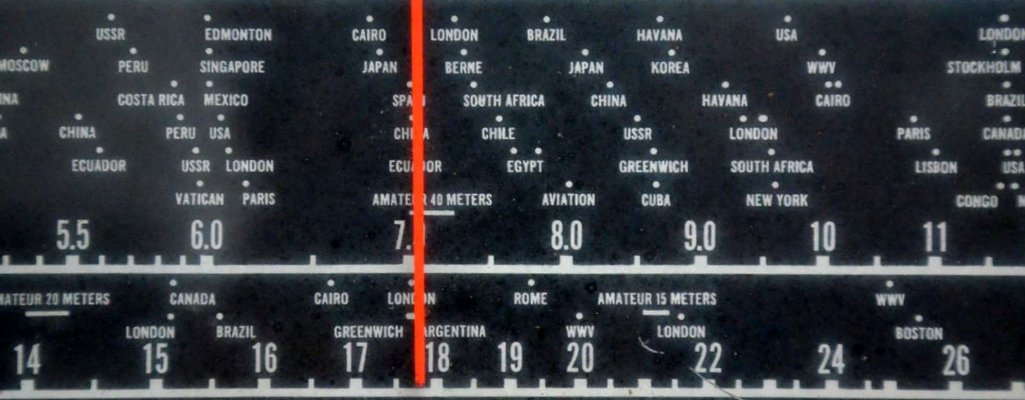
HalliDial

Saturday, I published a post referencing Cold War Clandestine Radio from Greece with links to Richard Cummings’ excellent website Cold War Radio Vignettes.

My post was written some time earlier and scheduled to publish Saturday while I was traveling. Unfortunately, the Cold War Radio Vignettes articles I had linked to were removed prior to Saturday.

I contacted Richard Cummings who has kindly assembled a small PDF booklet with the text from all of the posts I had referenced and is allowing me to share it here on the SWLing Post.

Richard asks that if any Post readers have information about these clandestine broadcasts and is willing to share it with him, he would me most thankful. His contact information is on the front page of the PDF.

Click here to download the PDF booklet.

Again, many thanks to Richard Cummings for making this free PDF booklet available to us!

Cold War Clandestine Radio from Greece

HalliDial

UPDATE: The links to Cold War Radio Radio Vignettes below became inactive just prior to publication. Richard Cummings has kindly assembled the texts I referenced and made a PDF booklet available for SWLing Post readers. Click here to download.

Many thanks to SWLing Post contributor Kim Elliott who (some time ago) shared a link to a series of posts by Richard Cummings from his website, Cold War Radio Vignettes.

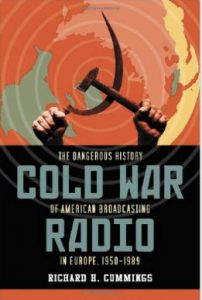
Cold-War-RadioCummings is the author of Cold War Radio: The Dangerous History of American Broadcasting in Europe, 1950-1989 and Radio Free Europe’s “Crusade for Freedom” Rallying Americans Behind Cold War Broadcasting, 1950-1960.

Cumming’s blog is updated frequently and features many fascinating historical “vignettes” regarding Cold War radio broadcasting.

Kim specifically mentioned a series of posts with a focus on Cold War American broadcasting from Greece, suggesting SWLing Post readers might enjoy this bit of Cold War history. I completely agree!

Below, I’ve linked to a total of six posts Cummings published on the topic. Enjoy:

Cold War American Clandestine Radio Broadcasting over the Iron Curtain from Greece

Cold War American Clandestine Radio Broadcasting over the Iron Curtain from Greece, to Ukraine

Cold War American Clandestine Radio Broadcasting over the Iron Curtain from Greece: “Future of Romania — Voice of National Resistance”

Cold War American Clandestine Radio Broadcasting over the Iron Curtain from Greece: Nasha Rossiya (Our Russia)

Want more?

If you enjoy Cold War radio history, I strongly recommend that you bookmark Cold War Radio Vignettes. I’m placing a permanent link in our sidebar.

Thanks again for the tip, Kim!

UPDATE: It appears the posts have been removed from the Cold War Radio Vignettes site.  I will contact the owner and see if they can be re-posted.

Secret life of village that helped crack WWII code

WWii-radio(Source: Southgate ARC)

Whaddon: Secret life of village that helped crack WW2 code

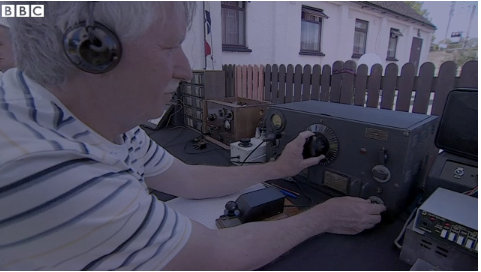
On May 9, 2016, Milton Keynes Amateur Radio Society members operated GB1SOE to establish contact with French special event station TM75SOE using WWII equipment

This was to commemorate the 75th anniversary of the first transmission sent back to Whaddon Hall, Buckinghamshire, by Special Operations Executive (SOE) agent Georges Begue. They operated from Whaddon Hall during Monday using a replica MKIII transmitter and HRO receiver,  on the French side a WWII B2 spy set was used.

The BBC report: The Codebreakers at Bletchley Park are well known for their top secret work which helped to change the course of the World War Two.

But the Buckinghamshire village of Whaddon, just a few miles down the road, has long been forgotten, despite the vital role it played. It was codenamed Section 8 and was a satellite station for Bletchley Park.

It is hoped a new memorial will give it its rightful place in history.

Watch the BBC TV report on the commemoration at Whaddon
http://www.bbc.co.uk/news/uk-36245666

A shorter version of the BBC report is at
http://www.bbc.co.uk/news/uk-36248874

Further information in the QRZ.com entries for TM75SOE and GB1SOE

Milton Keynes Amateur Radio Society (MKARS)
http://www.mkars.org.uk/

Night of Nights XVI: July 12, 2016

Chief Operator Richard Dillman at Position 1 (Source: Maritime Radio Historical Society)

Chief Operator Richard Dillman at Position 1 (Source: Maritime Radio Historical Society)

Update: Please read Brian’s update regarding frequencies.

SWLing Post contributor, Brian D. Smith, writes:

“Thought I’d forward you this information on the annual “Night of Nights” event on July 12 (U.S. local time)/July 13 UTC, which provides an opportunity for shortwave QSLs – assuming the listener understands Morse code!

I’m sure you’re familiar with this one-night-a-year happening, in which maritime radio stations rise from the dead and transmit Morse code messages again for a few hours.

As a guy who honed his CW sending skills by listening to these stations’ constantly repeating messages, I have a sense of nostalgia and gratitude toward these stations, which helped me obtain my first Novice license, WN9ICB, at the age of 15 … less than 2 months after I taped the WWV recording that I submitted.”

Many thanks for the notice and sharing your nostalgia! Brian also forwarded an announcement from the Maritime Radio Historical Society of America. The MRHS describe the event:

It’s that time of year again. Time to honor all those ops who came before us by preserving their skills, traditions and culture through on the air operations.

Why 12 July? Long time True Believers know the story. But it may be worth repeating for new arrivals and to remind everyone of the traditions we hope to keep alive.

On 12 July 1999 some very tough looking grizzled old radio pioneers had tears in their eyes as the last commercial Morse code radiogram was sent. It was the end of an era. And as the last beeps faded away into the static they witnessed the end of the career to which they had devoted their lives.

These men – and some women – had stood watch over the airwaves on shore and at sea. Theirs was mostly the business of maritime commerce. But when their ship was in peril they were called upon to send the most electrifying three letters in radio, S O S, knowing that all their fellow radio operators would press their earphones close to get every scrap of information and bring aid to their stricken ship.

Once, our coasts were dotted with great Morse code radio stations, all communicating with ships at sea. They’re all gone now… all except one, the one they called the Wireless Giant of the Pacific, located at Point Reyes.

On that sad day in 1999 another event took place. The Maritime Radio Historical Society (MRHS) was formed. We made it our life’s work to honor the men and women of wireless by restoring that wireless giant. One year and one minute later the giant’s voice once again spanned the oceas as we picked up the thread and kept the faith with our colleagues of the air.

Every year since, in an event that became known as the Night of Nights, Morse code station KPH has returned to the air, joined by KFS and the station of the MRHS, KSM.

This year our friends and colleagues at USCG station NMC have labored mightily to bring that storied call sign back to life on Morse code for the evening along with NMQ in Cambria, CA..

And station NMW in Astoria, OR will be on the air as well.

Stations WLO and KLB will join us again as hey have in years past.

This is a global and local event. Hundreds of listeners around the world will be waiting with their earphones on, waiting for the signals of the great station to once again arc over the dome of the Earth to their receivers.

You can be with us in person!

The frequencies for this event are numerous! I have listed the USCG (NMC) frequencies below, but please check the MHRS newsletter for MRHS and other maritime station frequencies.

Again, Brian, thanks for the heads-up!

Happy listening, everyone!


NMC (Transmit Bolinas, Receive Pt. Reyes)

Frequency            Transmitter                         Antenna

472.0                    Nautel ND2500TT/6           173′ monopole tower
500.0                    Nautel ND2500TT/6           173′ monopole tower
6383.0                  Rockwell-Collins RT-2200  Omni-directional
8574.0                  Rockwell-Collins RT-2200  Omni-directional
17220.5                Rockwell-Collins RT-2200  Omni-directional

Searchable archive of RFE/Radio Liberty broadcasts to USSR 1953-1995

RFE-RadioLiberty

Many thanks to SWLing Post contributor, Martin Kraft, who shares the following:

Here’s something for the history buffs, an online searchable archive of Radio Free Europe/Radio Liberty broadcasts to the USSR from 1953-1995:

http://www.radioworld.com/article/radio-liberty-munich-period-russian-broadcasts-available/278953

This is brilliant, Martin! I just started searching through the recordings at the Open Society Archives–an impressive collection. Thanks again!

Radio Botswana, 1987 Style

No seasoned shortwave DXer can forget one of the most distinctive interval signals ever–the “barnyard animals” which marked the beginning of the broadcast day of Radio Botswana, Gaborone, for decades.

On its long-time frequency of 4820 kHz, Botswana was an occasional catch for me from the Seattle USA area. I yearned for clearer, more reliable reception of this station and other Africans which my East Coast USA DXer pals enjoyed!

Zebras mingle with other animals at Chobe National Park, Botswana.

Zebras mingle with other animals at Chobe National Park, Botswana.

It was always fun–and a DXing challenge–to catch Radio Botswana’s interval signal and sign-on announcements, but it was typically mid winter for reception in Seattle. Propagation on 60 meters needed to be favorable to enjoy anything other than a weak, barely listenable signal. Imagine my surprise and excitement when on the evening of December 27, 1987 I came upon the following signal booming in on 4820 kHz, far, FAR better than any previous Botswana reception. Indeed, their signal that evening surpassed in clarity even the Papua New Guinea and Indonesian “regulars” I would hear on the tropical bands from the Northwest USA.


This recording begins with the famous barnyard animals interval, the beautiful Botswana national anthem (Fatshe leno la rona, or This is Our Land in English) and is followed by a full list of broadcasting frequencies and times in English and the (presumed) Setswana language. That information is followed by a flute instrumental version of the Christian hymn Beautiful Savior, which introduces a short devotional or scripture message. The 10 minute recording wraps up with an a cappella children’s choir.

Great Circle route from the Gaborone transmitter to Seattle receiver location.

Great Circle route from the Gaborone transmitter to Seattle receiver location.

My receiving setup for this 1987 recording was an ICOM IC-R70 and a 300 foot long random wire antenna. Such a long antenna is unusual for the middle of an urban area, but I took advantage of living in a 3rd floor apartment across from a small city park. One midweek day, while most folks were at work, I managed to string out this long antenna with very small diameter braided steel wire from the 3rd floor apartment balcony to a distant treetop. This “sloper” antenna had significant directivity to the northeast, which happens to be the bearing for many African stations heard from the Pacific Northwest USA. The small diameter wire was suspended so high that it was virtually invisible from ground level.

Antenna orientation for 1987 reception of Radio Botswana. I'm sure this urban location is plagued by QRM and radio frequency interference now in 2016! My ICOM IC-R70 receiver handled the strong signals from nearby MW & FM broadcasters surprisingly well with the addition of a Grove Tun3 Mini-tuner preselector.

Antenna orientation for 1987 reception of Radio Botswana. I’m sure this urban location is plagued by QRM and radio frequency interference now in 2016! My ICOM IC-R70 receiver handled the strong signals from nearby MW & FM broadcasters surprisingly well with the addition of a Grove Tun3 Mini-tuner preselector.

I continued to log Radio Botswana occasionally on 60 meters until the station eventually left the air (early 2000s I think), but I never heard them again with such a strong, clear signal as in late December 1987!

Guy Atkins is a Sr. Graphic Designer for T-Mobile and lives near Seattle, Washington.  He’s a regular contributor to the SWLing Post.

Shortwave Radio Recordings: KNLS test transmission circa 1983

A.4towers3antennas

We’ve just posted yet another excellent recording by Tom Laskowski to the Shortwave Radio Audio Archive. I thought a number of Post readers might appreciate this one.

Tom notes:

KNLS – Anchor Point, Alaska, from what I believe is a test transmission on August 1, 1983. According to Wikipedia, KNLS signed on the air July 23, 1983. The program consists of the sign-on ID in English and Russian then is mostly a mix of Big Band music. This recording is 31 minutes long.

Tom’s receiver was a Sony ICF-2001 and he started recording at 09:00 UTC on 11.820 MHz. His location, at the time, was South Bend, Indiana (USA).

Click here to download the recording as an MP3, or simply listen via the embedded player below:

You can listen to more archived shortwave recordings at the SRAA website, or by subscribing to the audio feed via iTunes. You can also listen to the archive on TuneIn radio.