Category Archives: Radios

Radio Nostalgia: Bob’s first radio

Many thanks to SWLing Post contributor, Bob Colegrove, who shares the following guest post:


My Very First Radio

By Bob Colegrove

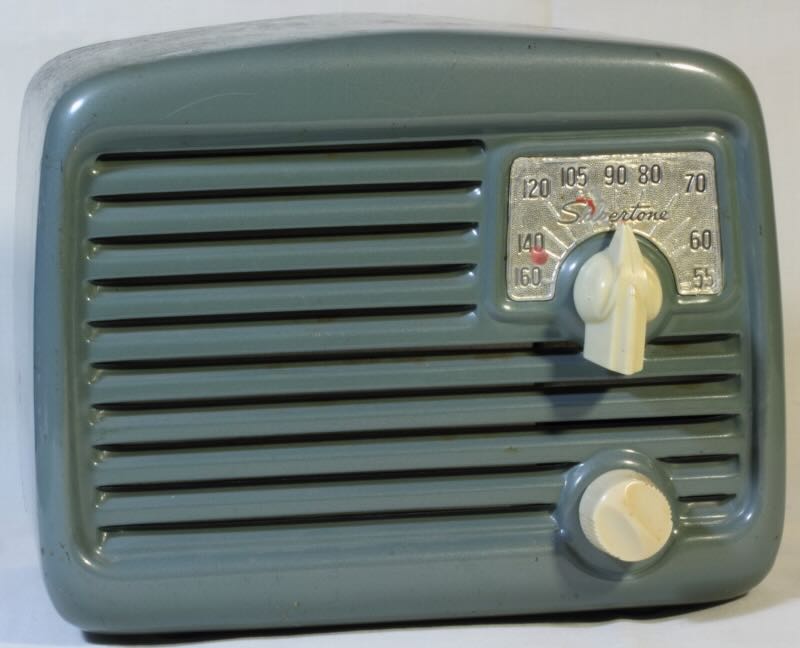
Sears and Roebuck Co., Silvertone, Catalog No. 8003, Model No. 132.818-1

I don’t remember much from 1949.  I was seven years old and still in the first grade.  I do remember being gifted a radio by my mom and dad on my birthday.  It was a Sears and Roebuck Co., Silvertone, Catalog No. 8003, Model No. 132.818-1.  I don’t really remember asking for it.  I’m sure mom and dad did not have a clue as to how consumed I would become with radio over my lifetime.  In truth, this was not the radio that got me totally absorbed, rather that function would be filled in 1958 by the Howard Radio Co. Model 308 combination MW/SW radio-phonograph console which had been relegated to the basement in favor of the TV set.

In 1949 television was on the cusp of success, and AM radio was still the one-way Internet of its time.  I recall my mother listening to countless soap operas during the afternoon.  The Howard was still in the living room and we listened to all the popular programs at night.  Anyway, the Silvertone was mine.  It took up residence in my room and I could independently explore the wonder of five local stations broadcasting in Indianapolis at that time.  There were no parental guidance settings on the Silvertone, nor was there any need.

The Silvertone was not a world-class radio with all the sensitivity, bells and whistles I would later desire.  Below WXLW, 950 kc it was deaf.  It was, in fact, one tube short of an “All American Five.”  However, one of its four tubes was dual function, if you counted the detector.  It was what was called an “ac-dc” radio.  This meant it could be powered by either 110 Vac or Vdc.  Granted, there were a couple communities in the US which were still serviced by dc power at this late date, but that fact certainly did not warrant advertising.  The whole thing always seemed to me no more than a marketing ploy on the part of manufacturers to cover for the lack of an expensive isolation transformer in the circuit.  Given the fact that electrical standards of the time did not provide for polarized outlets and power cords, these things could be quite hot, and it’s amazing so many tinkers, myself included, are around to talk about it.

One Tube Short of an “All American Five”  

The dial was very crude, and the tiny tuning knob swept all 107 available channels in a 180-degree twist of the variable condenser.  My mom, always handy with a paint brush, took to marking favorite stations  with a dab of nail polish.  1430 kc was WIRE and 1070 kc was WIBC.  Perhaps she got the idea from Bill Halligan who used little red dots on the controls to indicate the setting that would likely produce some noise.

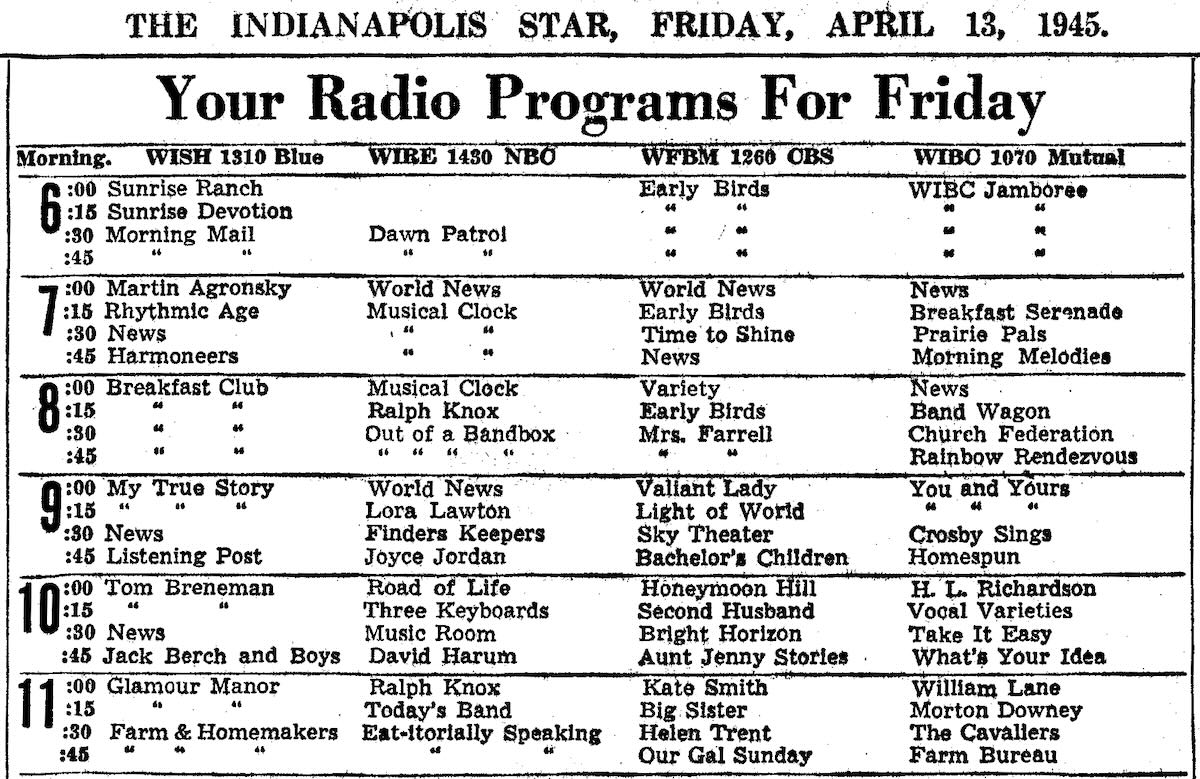
The printed media were sizeable and substantive in the 1940s.  The Indianapolis Star’s morning edition for Friday, April 13, 1945 was particularly mournful as the U.S. woke up to the news that the president had died the day before.  I was later given to understand that many stations broke from the normal schedule for a few days to play somber music.  Notwithstanding, the first section still bore the quintessential hourly radio program schedule from 6 am to midnight for each of the four local stations.  We always kept clippings of station logs for each day of the week.

My interest in baseball grew over the next couple years, and the Silvertone played an important role in my keeping up with the local AAA team.  The static on a summer night was atrocious.  Further, in those days, the broadcasters were not compelled to fill the air with chatter between pitches.  There were no recitations of mindless statistics and no color commentators to describe the nuances of sliders and curve balls.  Consequently, between pitches there were often long pauses of nothing but dead air.  If you happened to tune in during a pause you had little idea where WISH, 1310 kc was on a hopelessly crude dial.

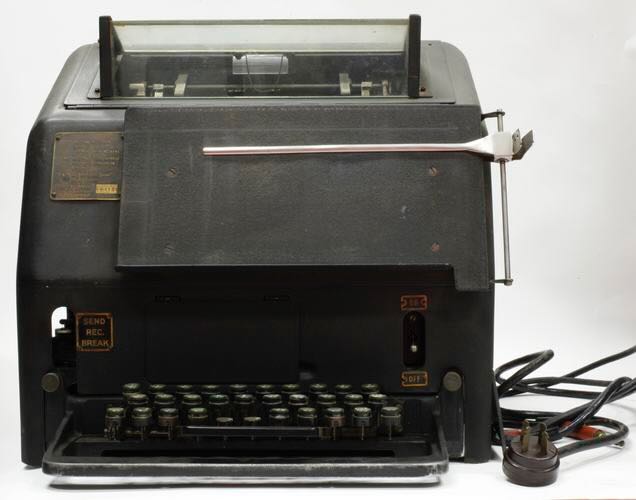
Most minor league broadcasters did not travel with the team.  When the team went on the road, they used an old Model 15 clickety-clack Teletype machine in the studio.  A local guy at the distant ballpark would observe a pitch or play, and quickly type a cryptic message on his Teletype.  On the radio you would first hear the receiving Teletype spring to life in the studio as the message came in.  The announcer would quickly interpret it, and then embellish the play with some excitement as best he could.

Teletype Model 15
Copyright Museums Victoria (Licensed as Attribution 4.0 International
https://creativecommons.org/licenses/by/4.0/)

During those times, it was not too uncommon for the Teletype to suddenly go down during the game.  What to do?  An announcer was suddenly left to his own creativity to fill in airtime.  Possible solutions were to describe the lengthy process of extricating a stray animal from the field, or a sudden cloudburst and consequential rain delay.  An intrepid announcer went on as nothing happened, making up the play-by-play over the interval.  Invariably, when the Teletype came back up, he found himself not quite in sync with the game and possibly a few runs behind.  At that point the challenge was to patch in the necessary play and go on to complete the game to the satisfaction of an otherwise unsuspecting audience.

Well, after 73 years, I’ve seen my share of radios.  In the meantime, the Internet has made it possible to DX the entire world at any time on a fifty-dollar Kindle – excellent fidelity, no interference, no noise, no fading.  But, after all these years, I still cherish those static-filled ballgames and teletype machines heard on the Silvertone a long time ago.

Quietly Waiting for the Next Pitch

The RADDY RF760: Light, Portable, Powerful

(Guest Post)

 By Robert Gulley K4PKM

(Note: This review was requested by Radioddity, who provided the in-production radio to the reviewer, with no strings attached or pre-approval.)

I confess to have been a little bit skeptical when Thomas asked me to review this radio, not because of past experience with RADDY, but because tiny radios in general don’t usually impress me, and I have had plenty of them over the years and considered most of them a novelty. There are a few exceptions, of course, such as the C.Crane Skywave or the Tecsun PL-368, but for the most part there are simply too many limitations to tiny radios for my listening style (this one can literally fit in a shirt pocket!). Upon opening the box I was still skeptical, despite the rather impressive packaging and extras. But hey, a little skepticism is a good thing, right?!
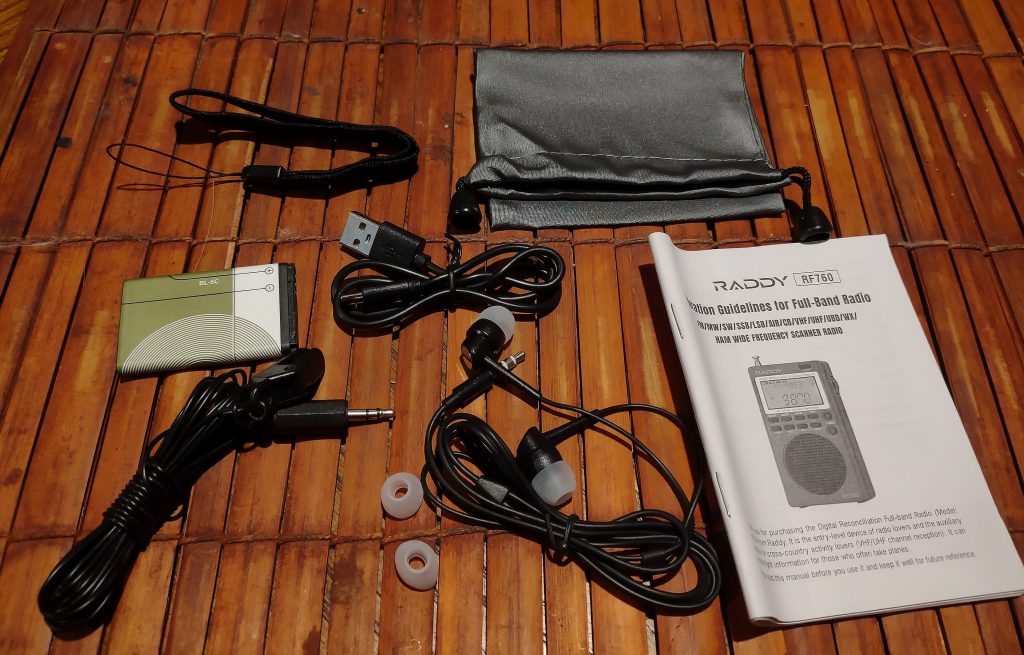
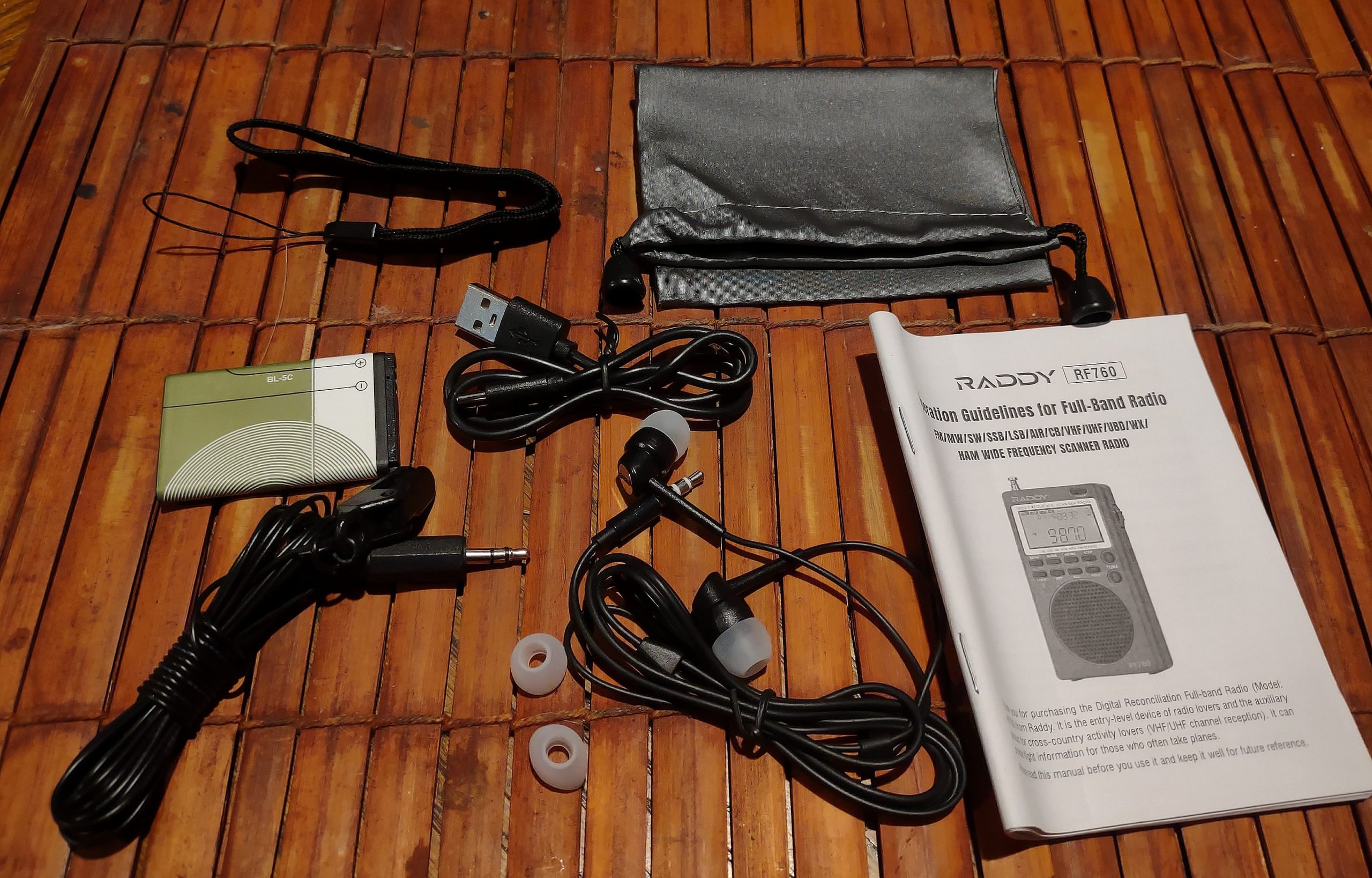
The radio comes with some nice accessories!

Accessories

The radio comes with a thin carry case to protect it from scratches, a rechargeable lithium battery, strap, earbuds and a wire antenna to improve shortwave reception. There is also a Type “C” USB cable for charging the battery. Oh, and a spare set of earbud covers – a nice touch!

Ergonomics

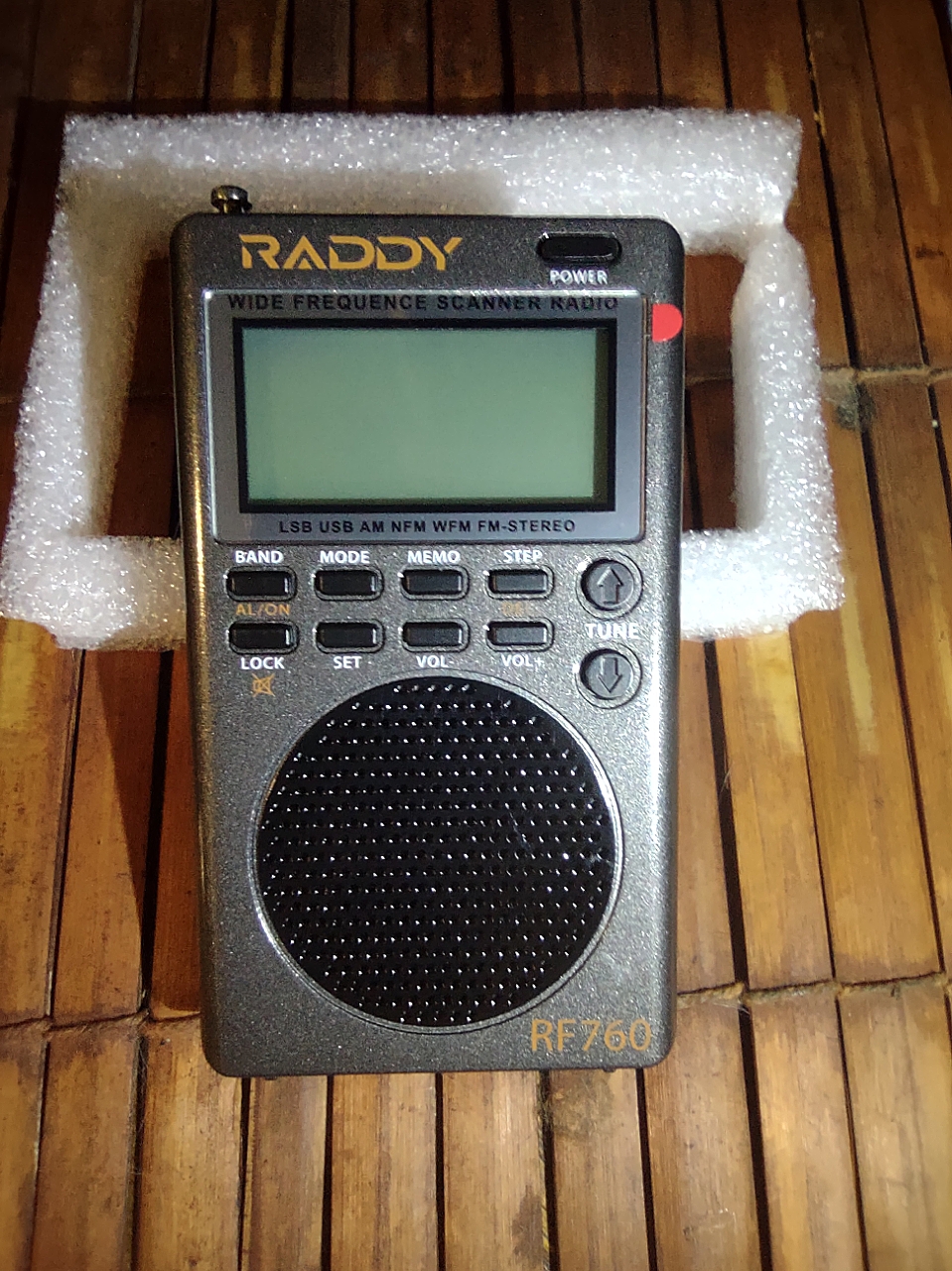
Picking up the radio I noticed right away it has a solid, comfortable feel to the unit. I start with that because most tiny radios feel very flimsy, and usually have something of a rough or hard plastic feel to them. This radio has a glossy feel to it, meaning it is comfortable and actually nice looking. Looks aside, I must admit the ergonomics of the radio impress me. I like the feel of it in my hand, and the controls are laid out well for one-handed operation. Being left-handed, that is not always the case, but the controls seem well thought out for either right- or left-handed folks.

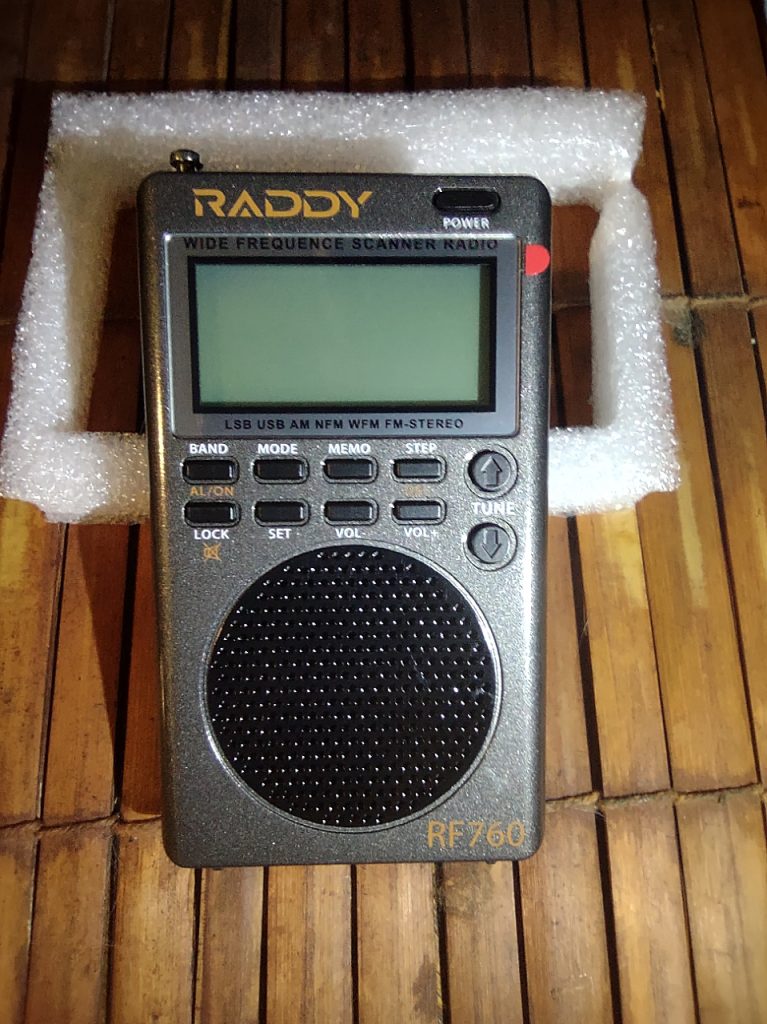
As you can see in the images there are two primary rows of buttons, as well as a tuning knob on the right side of the radio. There is also a belt clip on the back which is unobtrusive – I can’t speak to its longevity as I really never clip a radio to my belt, but for those who do, I suspect it will hold up well with a little care.
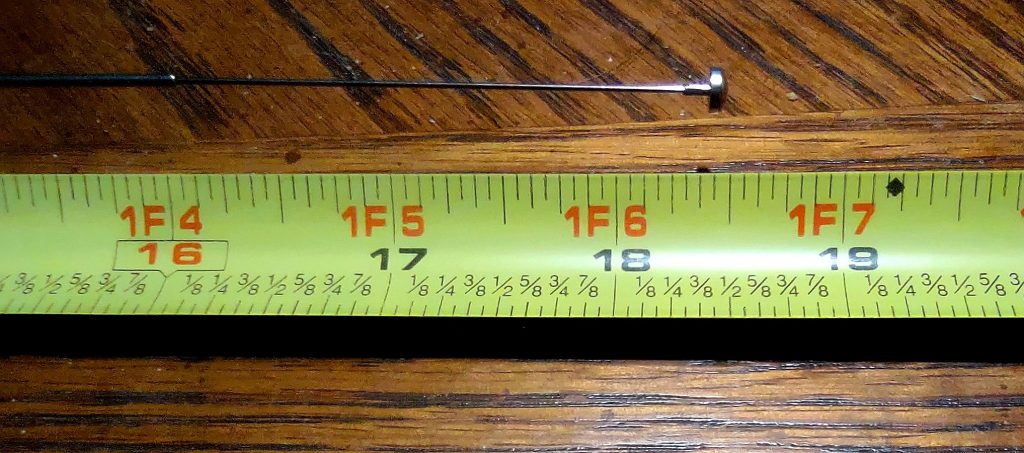
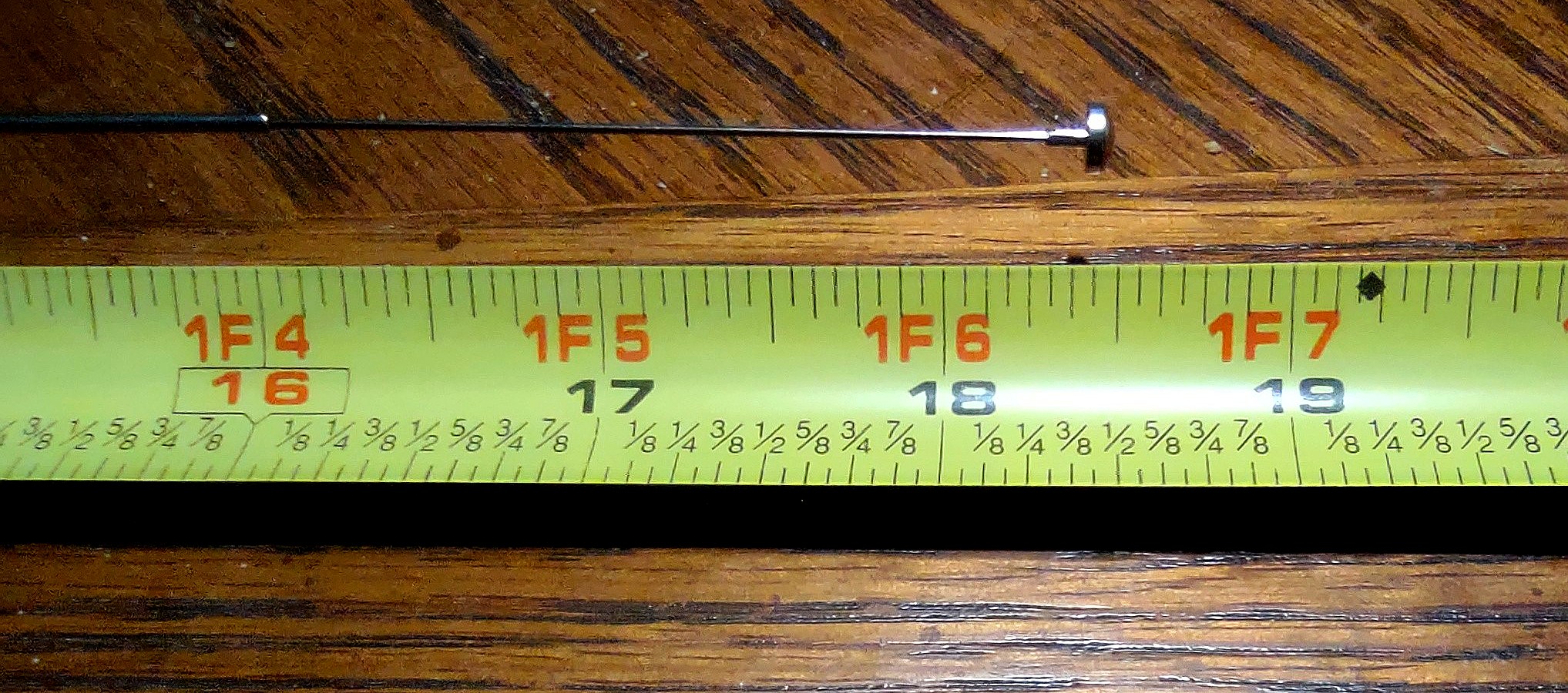
The telescopic antenna (fixed) is rather impressive as well, measuring ~18 inches in height when fully extended. As one might imagine, at this length the antenna is fairly fragile – I would not walk around with it fully extended while attached to my belt. For hand-holding it should be just fine, and standing upright on a table it does not tip over, but if out in an open-air environment with a strong breeze it will tip over, so a stand would be advisable.

The display is very readable, and the orange background light which pops on when making adjustments is quite nice. The light stays on for ~9 seconds after pushing any of the buttons. Another nice feature of the radio is a press of any button while the radio is off will turn on the display, indicating time, temperature, and battery strength. Yes, it has a built-in thermometer, and it seems quite accurate, at least on the unit I received.
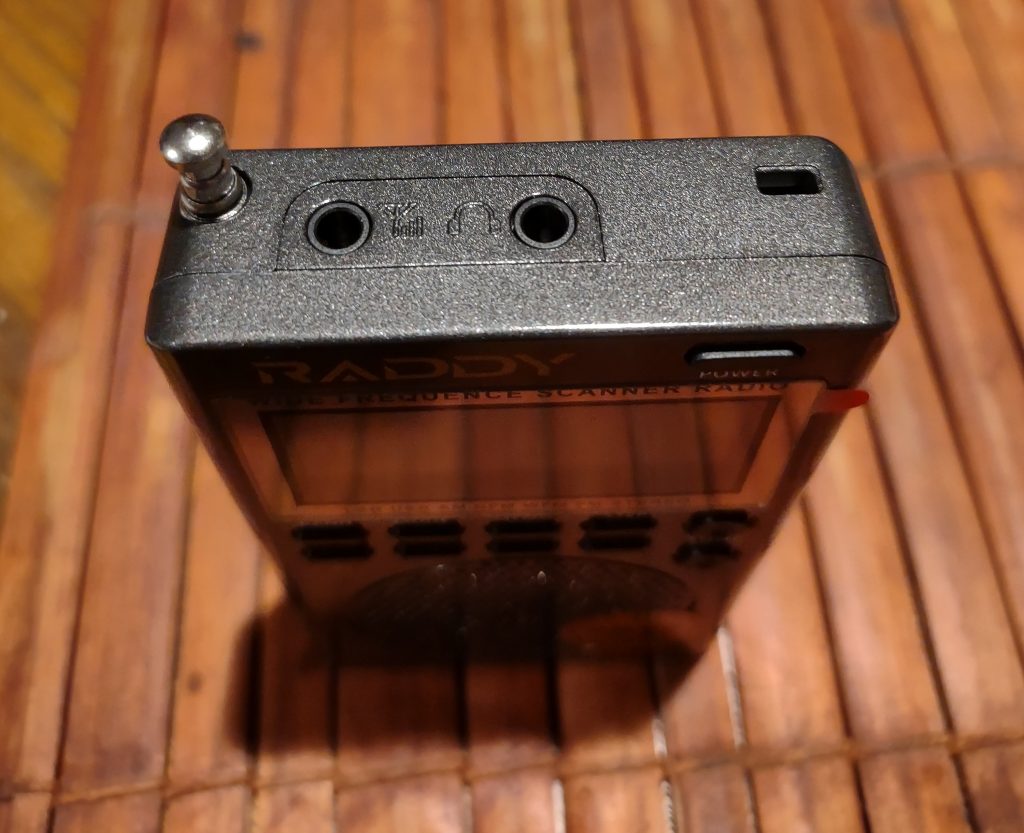
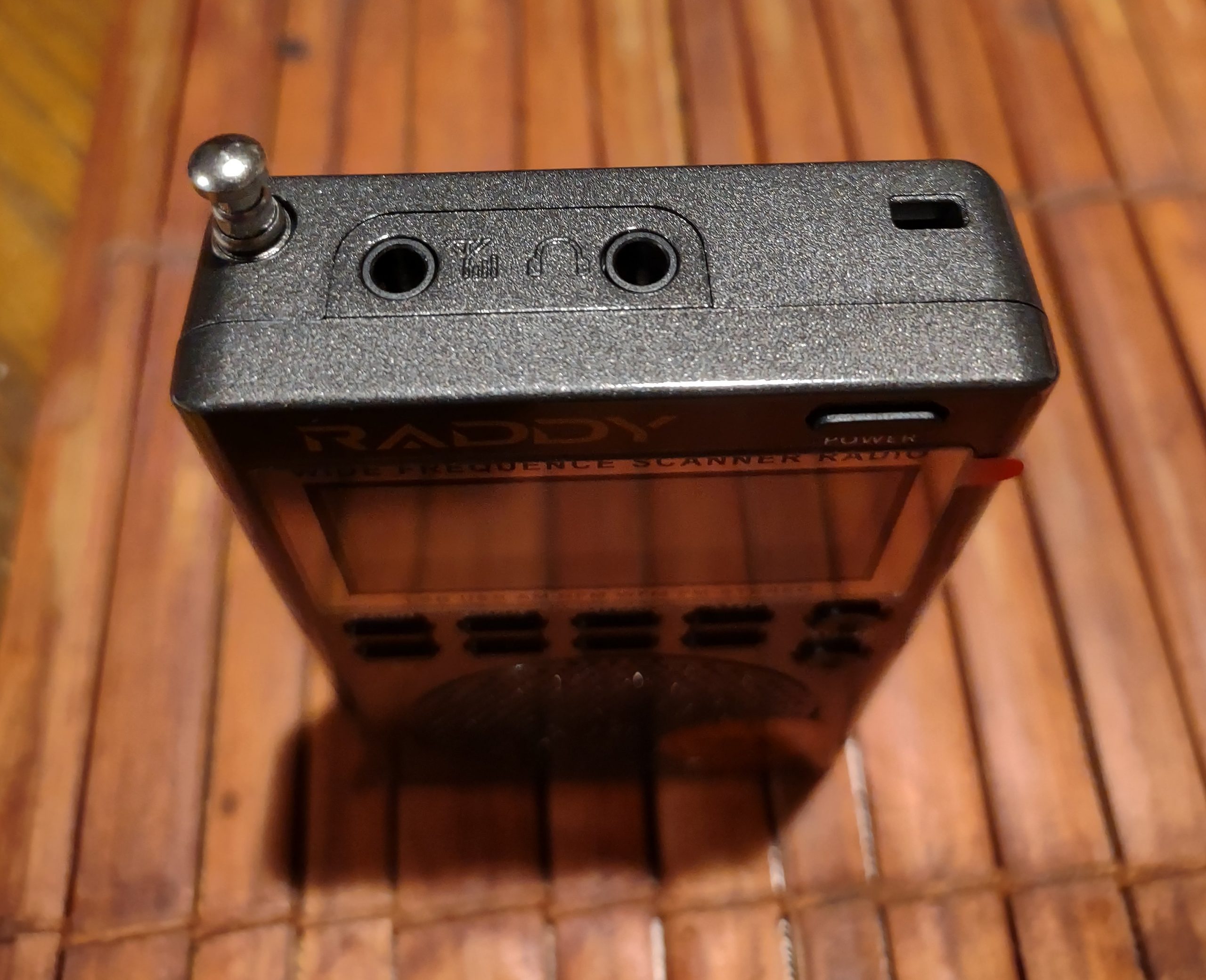
On top there is an external antenna jack, headphone jack, and slot for the strap.

Operation

For such a small radio it is literally packed with features. I will not go over all of them in this review, but I will cover some of the highlights as well as make mention of most features at least in passing. I was not expecting so many features in this little radio, so I was pleasantly surprised by some of the more advanced options.

Naturally the radio has AM/FM capabilities, as well as weather, air, VHF above the air band, SW and CB (yes, CB!). There is also a customizable frequency range setting for monitoring a desired set of user-selected frequencies. There are presets available for various modes listed in the manual, including predefined amateur radio bands and shortwave stations (always subject to change, of course!).

There is an attenuate function available if needed, as well as numerous step modes for tuning various modes. One interesting feature of the radio is two separate tuning methods, one by up and down buttons, and the other by a tuning knob on the side. These can be set independently of each other in terms of the step-change on a given band. This is particularly useful when scanning a band with the buttons after a station is found, because sometimes being slightly off frequency can produce a better signal – the scroll wheel can be used to make as little as 1 Hz changes.

Finally, there is a very useful bandwidth feature which can change between 3, 2.5, 2, 1.8, 1, and 6 kHz. Tuning is quite functional both with the scroll wheel and the tuning buttons. Holding down the tuning buttons will start a scan of the current band, and a longer press will speed up the scan if no stations are found initially. Unlike some scanning radios, when a signal is found, scanning stops and does not resume. I like that feature better than the alternative method of some radios restarting a scan after 5 seconds or similar. I want time to figure out what I am hearing, and a short stop does not really allow for that most of the time.
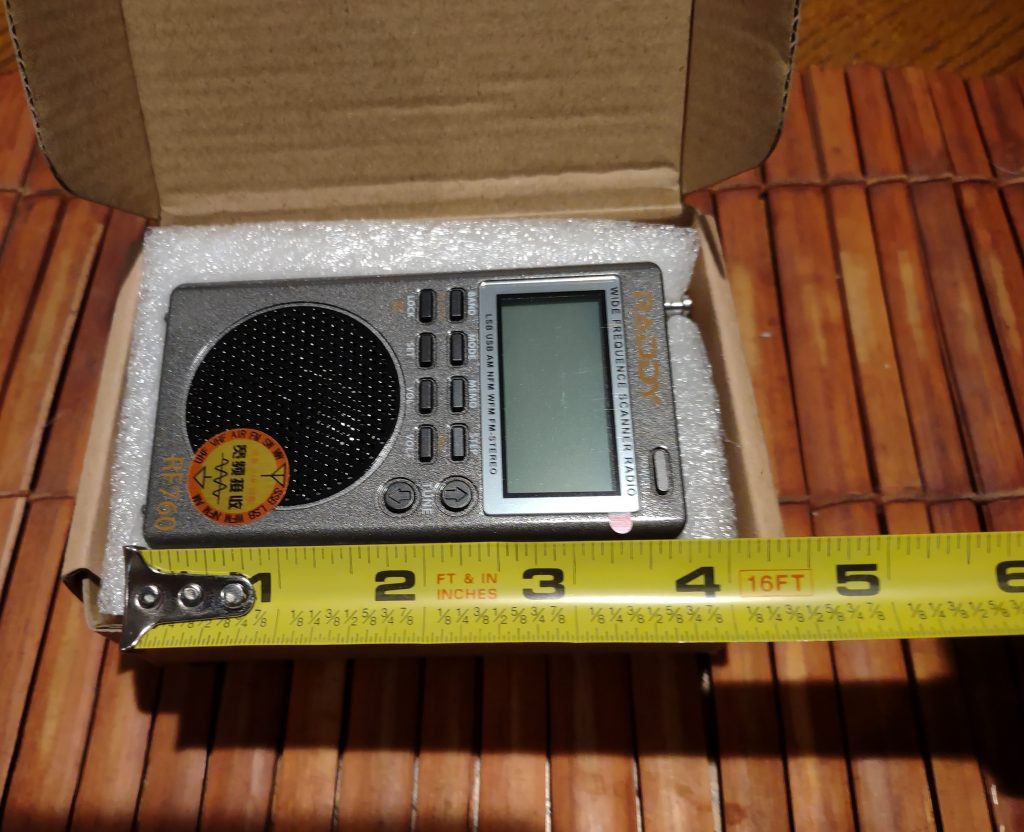
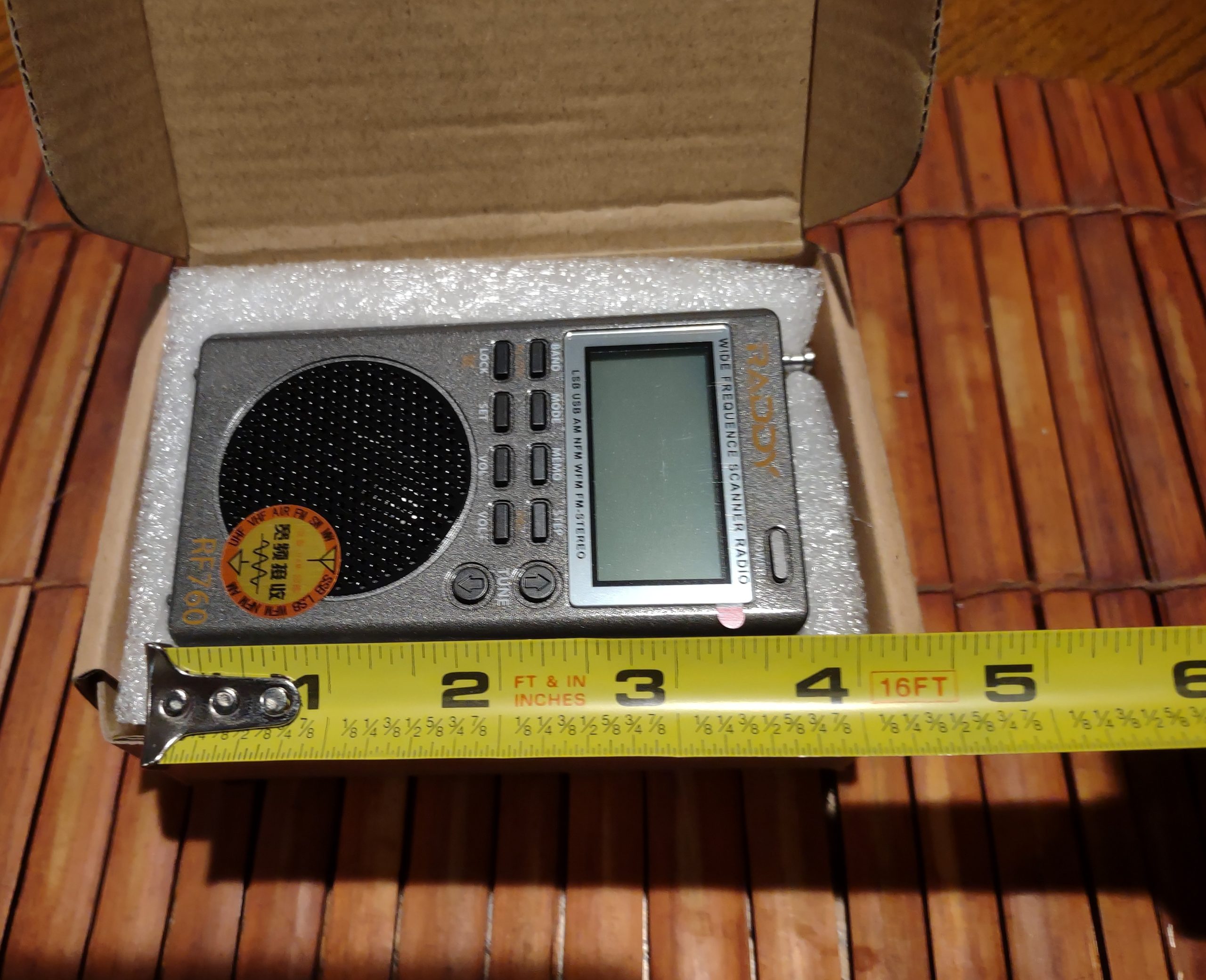
This is a very compact and lightweight radio!

Reception

I have to say I am impressed with this little radio. I have listened to amateur frequencies, shortwave frequencies, AM/FM, weather and tried airband (nothing close to me except a minor airfield). I live in a very quiet location in terms of local man-made interference, and this provides a great opportunity to really test out a radio’s sensitivity. My conclusion may surprise you as it did me. This is one sensitive radio, given its small form factor and limited antenna movement. (I did not test the external antenna option. While it has one, I felt it only fair to make tests using the built-in antenna on all the radios I compared it with, thus eliminating extraneous or otherwise hard to compare situations.)

Side by side with one of my favorite portables, the Sangean ATS-909X2, this little guy was right in there with difficult to receive stations. While the Sangean has a much larger speaker and therefore fuller sound, in terms of actual reception, most stations came in about equally. I even used an old, but very reliable Select-A-Tenna to boost AM reception on both radios, assuming the Sangean has a much larger ferrite rod given its size, and yet both performed equally well next to the passive antenna. Impressive!

On various shortwave and amateur stations the RADDY RF760 held its own again, picking up almost station for station what the Sangean and the Sony 7600 GR (another favorite of mine) did, in a package less than 1/3 the size of the Sony, and about ¼ the size of the Sangean. Am I going to dump my Sony and/or my Sangean? Of course not – there are many reasons I prefer those radios for my daily use. But if I were wanting to go extremely lightweight/portable, the RADDY is a keeper with impressive performance and most features one could want in a portable radio, all while still fitting in your shirt pocket. I truly do not know how one could get much better performance or features in another radio this size. It makes one wonder where can they go from here?

FM reception is also quite good, pulling in weaker stations while still being quite listenable. I have heard a few stations on this radio which I have not caught before, and this with some atmospheric noise due to storms in the region. Likewise, listening to AM while there were storms in the general area, still allowed for reasonable reception. As we all know AM broadcasts are highly susceptible to atmospheric noise, especially lightning, but this radio recovered nicely after each static crash. Some radios seem to linger longer in recovery after such events, but this radio was quick to bring back in the signals.

Negatives

In short, there really are not any glaring negatives to this radio, so allow me to point out some little things which are, after all more about personal preference than any deficiency in the radio. Your mileage may vary, as they say.

  • An articulating antenna would be a nice touch, but that might require an increase in size, and likely would make the antenna more susceptible to damage. Many times, being able to bend an antenna this way or that can improve a signal.
  • Changing the frequency steps can be a little fiddly at times, but that’s probably me
  • When powering on, the short press acts like pressing any other button, meaning the light comes on, the time, temp, and battery power indicator displays. A longer press brings up the sleep timer. Two short presses turns on the radio, but not too short of presses. This takes a little getting used to, and I would prefer one longer press to turn on the radio, with the two short presses activating the sleep timer, but that, I know, is getting really nit-picky!

Conclusion

If you are in the market for a small, lightweight, but solid radio – this RF760 is definitely one you should consider. It is so light as to be almost weightless, compact but with easily reachable and useful controls, and has more modes and features than almost any similar radio I have run across. As an old-timer I have to shake my head in amazement at what can be packed into such a small radio these days! This certainly isn’t your grandpa’s transistor radio (and it’s even smaller!). Cheers!

Check out the Raddy RF760 at Radioddity.

Servicing older Icom radios?

Many thanks to SWLing Post contributor, Mark Irish, who writes:

Icom America has indicated that it no longer services Icom radios manufactured after December 2010. Please let me know if you have a recommendation for someone who repairs older Icoms, preferably in DC metropolitan area or in North Carolina and in Virginia. Thank you, Mark

Thank you,

Mark Irish

Thank you for your question, Mark. You’re in luck because my friend Vlado (N3CZ) does repair Icom radios of pretty much any age.

He has extensive experience with Icom, but also routinely works on Yaesu, Kenwood, Elecraft, Sony, Panasonic, and numerous other brands. If it’s solid state (meaning, not vacuum tube or valve gear) he can fix it. 

Vlado lives in Asheville, NC, but he has customers all over the world. You can reach him through his website at: http://hamradio.repair

The fertilizer hits the fan radio kit

By Jock Elliott, KB2GOM

Murphy’s Law: If anything can go wrong, it will.

            1st corollary: Even if anything can’t go wrong, it still will.

            2nd corollary: It will go wrong in the worst possible place at the worst possible time.

            Most devastating corollary: Murphy was an optimist.

            “It’s tough to make predictions, especially about the future.” – Yogi Berra

 The Better Half thinks I am sick, and maybe she is right, but I am unrepentant: I like disaster movies and books. True stories are better than fiction, but I like both, and I am curious about how people, real or imagined, get through whatever Horrible Event faces them.

As I have written before–here, here, and here–that when bad stuff happens, radio can be a really useful tool.

It was a comment from a reader – Rob, W4ZNG – that got me thinking some more about this. He mentioned enduring three weeks without electricity on the Mississippi Gulf Coast as a result of Katrina. So we had a phone conversation about: What do you want in your radio kit bag when faced with a longer duration, more severe regional or national emergency?

Here’s some of the stuff we agreed upon.

Gathering Information

At the most basic level, you want a radio capable of receiving local AM or FM broadcasters, and it would be good to know ahead of time which local stations have local news staffs that can broadcast useful in formation in times of crisis. In addition, if you live in the US or Canada, I absolutely recommend the ability to receive NOAA weather radio. The ability to run off batteries is critical, in case the mains power is out. In addition, a generous supply of batteries, or a means to recharge batteries is in order. If you decide to go with recharging batteries, you need to think about your options now, not when the lights go out.

In Rob’s case, during Katrina, all of the local broadcasters were wiped out. There was a local low-power FM broadcaster who got permission to increase power to 1,000 watts and was broadcasting where to get food and water. There was a New Orleans AM station that was on the air, but all of its coverage was “New Orleans-centric.” After a few days, some local FM broadcaster, working together, cobbled together a station that they put on the air and began broadcasting news. Rob also began DXing AM stations at night to get additional news.

We agreed that shortwave broadcasters were not likely to be very useful in most cases, but a shortwave radio with the ability to hear ham radio single sideband networks might well be.

To scan, or not to scan, that is the question

Another potential source of information are local public agency radio transmissions in the VHF and UHF ranges that could be heard with a scanner. But – and this is a very big but – that depends a lot on whether your local government (first responders, etc.) transmissions are encrypted. You need to check a source like https://www.radioreference.com/db/ to see if Public Safety transmissions in your area are encrypted. If they are, you will be unable to decipher them, no matter what equipment you own. However, an inexpensive analog-only scanner may prove very useful for listening to ham transmissions VHF and UHF (2 meters and 440 primarily) as well as FRS and GMRS.

If your local Public Safety radio systems are not encrypted, the RR database will give the details of the radio systems used by those agencies, and that in turn will determine the level of sophistication of scanner that will be required to hear their transmission.

The Radio Reference database also includes a listing of national radio frequencies including a list of federal disaster frequencies such as might be used by FEMA. In addition, I have found that the folks at the Radio Reference forum are generous with their time and expertise: https://forums.radioreference.com/ . If all this sounds a bit daunting, there are scanners that have built-in databases of all available frequencies and radio systems, and all you need to do is put in your zip code and select which services you want to hear. I own one, they work well, but they are expensive.

Summoning Help

Assuming that the power is out, your cell phone may or may not work (during Hurricane Katrina, some people found that they could not make voice phone calls, but text messages would go through).

If the cell phones are not working, two-way radio may be useful to summon help and gather information. Again, some research on your part is in order. Perhaps there are 2-meter or 440 ham repeaters in your area with backup power, or maybe there is a robust GMRS repeater system. If so, get your ham or GMRS license and start participating! (It was his experience during Hurricane Katrina that prompted Rob to get his ham license, and when Hurricane Zeta hit, he was glad he had it.)

FRS bubble-pack radios are good for staying in touch while getting around the immediate neighborhood.  It’s also good to have a few spares to hand to neighbors if the need arises.  Often on sale (especially after Christmas) in multi-packs for less than $10 each.

Rob notes that great strides have been made in hardening cell phone towers since Katrina.  When Hurricane Harvey clobbered Houston in 2017, the cell net stayed up.  Even so, it would be prudent not to count on it!

The Bottom Line

At a bare minimum the ability to receive your local AM and FM broadcasters is essential, and NOAA weather radio is also very useful. At the next step up, depending upon your local situation, a scanner may help you to gather information. In addition, the ability to monitor ham transmissions may also add to your information gathering abilities. Finally, having a ham license and the ability to transmit on ham frequencies may be very valuable in a widespread or long-duration emergency.

Matt’s Rooftop Receiver Shootout: Round Two!

Many thanks to SWLing Post contributor, Matt Blaze, for the following guest post:


Matt’s Rooftop Receiver Shootout, Round Two.

by Matt Blaze

You may recall that back in April, I dragged eight of my favorite receivers up to the roof, hooked them up to a portable antenna, and compared their abilities to demodulate various signals at the same time. For the most part, the similarities between radios were more striking than their differences. I hinted that there’d be a second installment to come, including more receivers and more challenging signals, to further expose and highlight the practical real-world performance differences between the radios we use.

So, as promised, here we are with Round Two of my Rooftop Receiver Shootout.

This time around, I used approximately the same setup, but with a total of fifteen different radios. And once again, I took advantage of nice weather and brought a multitude of receivers, recording gear, cables, and an antenna up to my roof to listen to and record shortwave signals under the open sky.

Our fifteen receivers included everything from “dream radios” from the 1980’s to current-production desktop models to less expensive modern portables to high-performance bench-top lab measurement gear. I tried to curate samples of a wide range of radios you may be familiar with as well as some you probably aren’t.

The lineup consisted of:

  • Icom R-8600, a current production “DC to Daylight” (or up to 3 GHz, at least) general coverage communications receiver, with highly regarded shortwave performance.
  • AOR AR-ONE, another DC to 3 GHz general coverage radio, less well known due to the high price and limited US availability. Excellent performer, but a counterintuitive and awkward (menu-driven) user interface is less than ideal for shortwave, in my opinion.
  • Reuter RDR Pocket, a very cute, if virtually impossible to get in the US, small production, high performance SDR-based shortwave portable receiver. It’s got an excellent spectrum display and packs near desktop performance into a surprisingly small package.
  • AOR 7030Plus, an extremely well regarded mobile/desktop HF receiver from the late 90’s. Digital but retaining some important analog-era features like mechanical filters. Designed and (mostly) built in the UK, it’s got a quirky menu-driven user interface but is a lot of fun once you get used to it.
  • Drake R8B, the last of the much-beloved Drake receivers. Probably the chief competitor to the 7030+.
  • Drake R7A, an excellent analog communications receiver (but with a digital VFO) from the early 80’s. It still outperforms even many current radios.
  • Sony ICF-6800W, a top of the line “boom box”-style consumer receiver from the early 80’s. Great radio, but hard to use on SSB, as we saw in Round One.
  • Panasonic RF-4900, the main competition for the Sony. Boat-anchor form factor, but (improbably) can run on internal D-cell batteries. Generally impressive performer on AM, but, like the Sony 6800, difficult to tune on SSB.

You may remember the above radios from Round One back in April. The new radios this time were:

  • Tecsun 501x, a larger-format LW/MW/HF/FM portable released last year. As noted below, it’s a generally good performer, but regrettably susceptible to intermod when connected to a wideband external antenna (as we’ll see in Part One).
  • Tecsun PL-990x, a small-format portable (updating the PL880), with many of the same features as the 501x. Like the H501x, good performance as a stand-alone radio, but disappointing susceptibility to intermod when fed with an external antenna.
  • Sangean ATS-909x, a recent LW/MW/HF/FM portable with a good reputation as well as a few quirks, such as only relatively narrow IF bandwidth choices on HF. Excellent performance on an external antenna.
  • Sangean ATS-909×2, an updated, current production version of the ATS-909x that adds air band and a few performance improvements. Overall excellent, though I would prefer an addition wider IF bandwidth choice. My go-to travel receiver if I don’t want to take the Reuter Pocket.
  • Sony ICF-7600GR, a small-format digital LW/MW/SW/FM portable introduced in 2001 and the last of the Sony shortwave receivers. Showing its age, but still competitive in performance.
  • Belka DX, the smallest radio in our lineup, made in Belarus. You’ll either love or hate the minimalist interface (one knob and four buttons). If you’re going to secretly copy numbers stations in your covert spy lair, this is a good radio to use. Can be difficult to obtain right now due to sanctions.
  • Finally, a bit of a ringer: the Narda Signal Shark 3310, a high performance SDR-based 8.5 GHz RF spectrum and signal analyzer. As with most test equipment like this, demodulation (especially of HF modes) is a bit of an afterthought. But it has an excellent front end and dynamic range, intended for identifying, extracting, and analyzing weak signals even in the presence of strong interference. Not cheap, but it’s intended as measurement-grade lab equipment, not consumer gear. Demodulated audio is noticeably delayed (several hundred ms) compared with other receivers due to the multi-stage DSP signal path.


The antenna was my portable “signal sweeper” Wellbrook FLX-1530 on a rotatable tripod, using a power splitter and a pair of Stridsberg Engineering 8-port HF distribution amplifiers to feed the fifteen radios. So every radio was getting pretty close to exactly the same signal at its RF input. Continue reading

Radio Waves: Broadcast Tower Climbers, Sony ICF-SW1 Repair, Franken-FM Status, and Marconi in a Van

Radio Waves:  Stories Making Waves in the World of Radio

Welcome to the SWLing Post’s Radio Waves, a collection of links to interesting stories making waves in the world of radio. Enjoy!


Spotlight on Broadcast Tower Climbers in New Documentary (Radio World)

NATE, in collaboration with Storybuilt Media, has created a feature-length documentary titled “Vertical Freedom,” which highlights the professional and personal lives of six communications infrastructure workers in the United States.

Throughout the film, these cellular and broadcast tower climbers share what compels and excites them about their line of work. Plus, how to overcome every-day danger in order to connect us all.

Ky Nguyen is just one of the climbers featured in the film. He has worked with RIO Steel and Tower out of Alvarado, Texas for the last 10 years.

After the Great Recession, Nguyen wanted to move away from his job in construction and — while he is skilled at his craft now — he was initially hired onto the tower communication service’s team with zero experience.

“I started as a climber and then just kept working my way up,” he said. “Then I became foreman and began project managing. I’m one of those types of guys where, if you want it done a certain way, you have to be with them, showing them, leading by example – so I’m climbing every day.” [Continue reading…]

Repairing the Sony ICF SW1 Receiver — Used for Numbers Station Reception? Why no replacement for C-625? (Soldersmoke)

Ten years ago, my friend John gave me this tiny Sony receiver. It wasn’t working. I tried to fix it but quickly discovered that the tiny size of the device made repair difficult. All you needed to do was to swap out some leaking electrolytics, but they are surface mount electrolytics — replacing them is not for the faint of heart. Kits are available, but again, this is not easy.

In 2020 I got one of the kits, but didn’t try to use it until yesterday. It only supplied six of the electrolytics. In the video above, they discuss replacing seven electrolytics, including the one that seems to be placed in the round black holder. C-625. Why didn’t my kit include a replacement for that one? Could it be that this capacitor was not one of the leaky SMD caps?

Replacing these caps really wasn’t easy. At one point I inadvertently removed not just the bad cap, but also a nearby surface mount resistor. Luckily the schematic showed it to be 0 ohms. That was easily replaced. I lifted one of the pads on one of the other caps — I just slid it back into place and hoped for the best. [Continue reading at Soldersmoke…]

FCC Report 5/22: FCC To Consider Franken-FM Status And Whether To Expand Radio Service On Channel 6 (Radio Insight)

The FCC has introduced a proposal for rulemaking to determine whether to permanently approve the use the spectrum of television channel 6 for analog radio service on 87.75 MHz and will vote on whether to proceed with it at its June meeting.

In July 2021, all of the remaining analog low-power television stations were required to convert to digital, which would then lead to thirteen of them resuming analog audio transmission within their ATSC 3 broadcasts on an experimental basis. The rulemaking proposal seeks comments whether FM on channel 6 operations server the public interest and should be authorized to continue, whether they should be authorized as ancillary or supplementary services and if so subject to a new rule that permits their operation subject the certain technical and operational requirements, whether they can limit future channel 6 FM operations to those stations with active STAs, whether to consider a proposal to license additional non-commercials FMs on 82-88 MHz in areas where no television stations are operating, and whether to eliminate or revise the distance separation rules between television stations on channel 6 and radio licenses in the non-commercial band.

The full proposal can be read at this link.

The petition by Educational Media Foundation and antenna manufacturers Dielectric, Jampro Antennas, Radio Frequency Systems, and Shively Labs to allow FM antenna directional pattern verification by computer modeling was approved at the FCC’s monthly open meeting. [Click here to read the full article at Radio Insight…]

A mobile exhibition celebrating the work and legacy of Guglielmo Marconi

The Marconi Van exhibition tells the story of Marconi’s pioneering work and its scientific legacy in radio and microwave physics. The exhibition combines:

Engaging exhibits and interactive activities exploring the past, present, and future of radio and communications physics.

An exploration of historical objects from the History of Science Museum’s Marconi collection.

Virtual experiments you can try yourself. As restrictions ease we shall be inviting you to have a go in the laboratory!

The exhibition is housed inside a 1968 Morris Motor Traveller van built at the iconic Morris Motors plant in Cowley, Oxford. The objects an information available inside the van will evolve as the exhibition progresses… so just because you’ve seen it once doesn’t mean there isn’t more to see.

The Marconi Van project is a collaboration between the Institute for Digital Archaeologythe History of Science Museum, OxfordMagdalen College, OxfordOxford’s Department of Physics, and the Guglielmo Marconi Science Park, in Santa Marinella, Italy.


Do you enjoy the SWLing Post?

Please consider supporting us via Patreon or our Coffee Fund!

Your support makes articles like this one possible. Thank you!

The Satellit 800, the Tecsun PL-880, and two indoor antennas – an afternoon of experimentation

Many thanks to SWLing Post contributor, Jock Elliott, who shares the following guest post:


The Satellit 800, the Tecsun PL-880, and two indoor antennas – an afternoon of experimentation

By Jock Elliott, KB2GOM

A search for “shortwave listening antennas” on the internet landed me on the page for the Par EndFedz® EF-SWL receive antenna, which is a 45-foot end-fed wire antenna connected to a wideband 9:1 transformer wound on a “binocular core” inside a UV-resistant box. A link on the page invited me to check out the eHam reviews of this antenna, which are here. What struck me is that there are just page after page of 5 star reviews of this antenna. Hams and SWLs apparently just love it. (If you want to buy of these antennas, they are now sold by Vibroplex and can be found here.)

As I reached for my credit card, I remember that I had an LDG 9:1 unun transformer lying around and some wire left over from the Horizontal Room Loop project. Maybe I could create my own end-fed SWL antenna by wrapping the wire around the perimeter of the room, attaching it to the 9:1 unun and then by coax to the back of my Grundig Satellit 800.

So I did exactly that. The wire for new end-fed antenna travels the same route around the perimeter of the room as the horizontal room loop. The main differences between the two antennas are that the end-fed is not a loop, and it terminates in the 9:1 transformer, which, in turn, feeds the Satellit though a coax cable. But in essence, we’re talking about two indoor wire antennas that are the same length and laid out along the same path about 7 feet in the air around the interior of the 8-foot by 12-foot room that serves as a library and radio shack: the horizontal room loop and the indoor end-fed.


The Satellit 800 has three possible antenna inputs: the very tall built-in whip antenna, two clips on the back of the 800 where the horizontal room loop attaches, and a pl-239 coax connector where the new end-fed antenna attaches. In addition, there is a three-position switch that allows me to quickly switch from one antenna to another.

Tuning up on the WWV time stations on 5, 10, 15, and 20 MHz and sliding the switch on the back of the Satellit 800 among the three different positions, I quickly found that the whip antenna was the noisiest of the three choices and offered the poorest signal-to-noise ratio. The comparison between the horizontal room loop and the indoor end-fed antenna was very, very close. While the horizontal room loop was quieter, it seemed to me that the signal offered by the indoor end-fed antenna was the tiniest bit easier to hear, so I decided to leave the Satellit 800 hooked up to the indoor end-fed antenna.

The 100-foot indoor end-fed antenna

Then I did something I had wanted to do for quite a while: I disconnected the horizontal room loop from the back of the Satellit 800 and attached one end of the wire to the indoor end-fed. So now, I had a roughly 100-foot end-fed antenna wrapped twice around the room.

Before we proceed any further, you need to understand this: my comprehension of antenna theory is essentially nil. As the old-timers would have it: you could take the entirety of what I understand about antenna theory, put it in a thimble, and it would rattle like a BB in a boxcar.

Ever since the successful creation of the horizontal room loop, I had wondered: if 50 feet of wire wrapped around a room improves the signal, would 100-feet of wire improve the signal even more? Inquiries to several knowledgeable people produced the same result: they didn’t think so.

Guess what? They were right . . . entirely and completely right. Tuning to the time stations and attaching and detaching the extra 50 feet of wire from the indoor end-fed, I saw (on the signal strength meter) and heard no difference in signal strength or signal-to-noise ratio.

The PL-880 and Satellit 800 comparison

So now, the Satellit 800 is attached to the indoor end-fed antenna, and there is an extra 50 feet wire wrapped around the room on the same path as the end-fed. Wouldn’t it be nice if I could find a way to hook that extra wire up to my Tecsun PL-880?

An old auxiliary wind-up wire antenna from a FreePlay radio came to the rescue. It was an annoying piece of gear; the wire was difficult to deploy and even more difficult to wind up again, and it had languished in a drawer for more than a decade. But it had a really nifty clip on the end that was designed to easily snap on and off a whip antenna.

Pulling an arm-spread of wire out of the reel, I cut it off, stripped the wire, attached it to the end of what had been the horizontal room loop, and clipped it to the whip on the PL-880. Tah-dah . . . instant improvement to the signal coming into the PL-880.

Some time ago, a reader had asked whether I found the Satellit 800 a little deaf in comparison to the Tecsun PL-880. Now, with two indoor antennas of approximately the same length and routed along the same path, I could do the comparison on shortwave frequencies. Starting with the time stations and later with hams in single-sideband on the 20-meter band, I alternated between the two radios. Although the PL-880 has more bandwidth choices, and the two radios have a slightly different sound to them (probably, I’m guessing, due to differences in their circuitry), the bottom line is this: anything I could hear with the Satellit 800 I could also hear with the PL-800 . . . and vice versa. (Note: I did not do any comparison between the two on medium wave or FM.)

In my not-so-humble opinion, both offer worthy performance that is improved with the addition of a 50-foot wire antenna, even if it is indoors.

And that brings us to the final point.

A word of caution

If you decide to add a bit of wire to improve the signal coming into your shortwave portable or desktop receiver, do NOT, under any circumstances, EVER deploy the wire where it could come into contact with a powerline or fall onto a power line or where a power line could fall on it.

As Frank P. Hughes, VE3DQB, neatly put it in his wonderful little book Limited Space Shortwave Antenna Solutions: “Make sure no part of any antenna, its support or guy wires can touch a power line before, after, or during construction. This is a matter of life and death!

And when thunder and lightning threaten, make sure your outdoor antenna is disconnected and grounded.