Category Archives: Radios

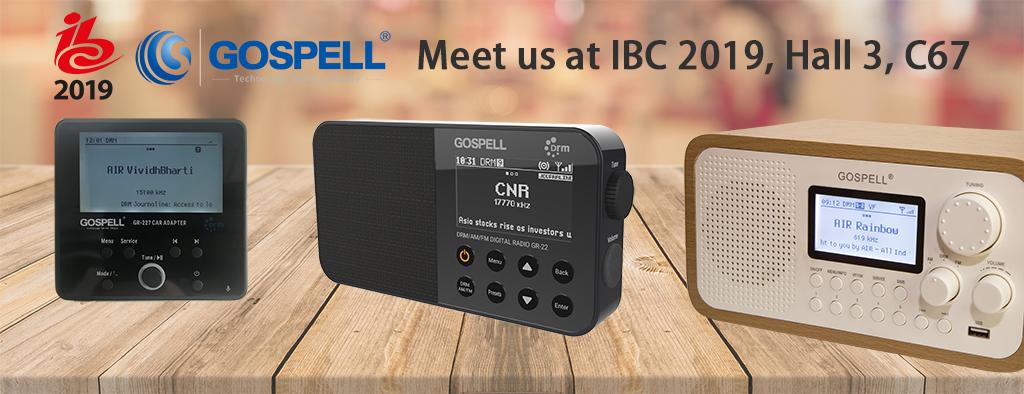
Gospell product lineup for IBC 2019 includes the GR-22 portable DRM radio

Many thanks to SWLing Post contributor, Ed, who writes:

SWLing Post readers might be interested in learning about Gospell’s newly-announced DRM receivers and active antenna products. The GR-22 “pocket-sized” “full-wave” receiver that’s supposed to be available for purchase by June 2020 seems especially interesting.

(Source: Gospell Press Release)

Gospell to announce the DRM monitoring system and imminent release of portable DRM receiver, and more

Chengdu, China – Gospell, a leading supplier of pay TV system and equipment, satellite TV receiving products and microwave products, announces its product lineup for IBC 2019. The company will debut several new products featuring DRM (Digital Radio Mondiale) for both consumer and industry market, including:

    • GR-22 – Portable DRM/AM/FM Receiver
    • GR-227 – DRM Car Adapter
    • GR-301 – DRM/AM/FM Monitoring Receiver
    • GR-310 – Audio Broadcast Monitoring Platform
    • GR-AT3 – High Performance Active HF Antenna

GR-22 is a sleek and classy portable radio from Gospell, the contemporary stylistics of exterior design fits in your personal style, crystal clear DRM digital radio and AM/FM brings practicality and comfort to your daily enjoyment. Despite its pocket-size, it’s a nifty full wave band receiver packed up in a tiny body that enables you to explore a wide variety of radio stations. It is also future-proofed for the next generation DRM-E technology. You have access to all the presets, station names, program details and even Journaline news on the easy to ready large LCD in a simple and intuitive way. Sleep timer set your radio to automatically switch off or wake up at your convenience. Listen to your favorite radio programs anywhere you like with 4 x AA batteries or connect it to mains. GR-22 is a multi-functional radio that is flexible to your listen habits. GR-22 will be available for purchase on Q2 2020.

GR-227 is a car digital radio adapter that utilizes most advanced interference and noise cancellation technology to receive digital radio in car while achieving the best audio quality and serve it to the car audio system over aux cable or by transmitting over an unused FM frequency. The receiver is fully compatible with DRM standard that is being deployed over the world, with its latest audio codec xHE-AAC. Based on software defined radio technology, GR-227 is ready for the emerging DRM-E standard that extends the DRM broadcast to FM band.

GR-301 is a high performance monitoring receiver that supports DRM, AM and FM. GR-301 supports the collection of key parameters of audio broadcasting, including SNR, MER, CRC, PSD, RF level, audio availability and service information. The collection and uploading of parameters meets DRM RSCI standards. The GR-301 can work independently or be deployed with other receivers to become a node in the service evaluation network. The GR-301 supports the xHE-AAC audio codec and is capable of handling the latest DRM-E standard through software upgrades.

GR-310 is a management platform designed for audio broadcast monitoring and receiver control purposes, it manages the geographically distributed GR-301 receivers. The platform can formulate receiving schedules, configure the receivers to perform receiving tasks, perform real-time browsing of the reception status, store historical data, and visualize the statistic data in a intuitive way. In addition to monitoring and analyzing data, the GR-310 platform also supports real-time audio monitoring and configuration of alarm conditions, alarms will be triggered when rules are met.

GR-AT3 is a high-performance active monopole antenna with reception frequency ranges from 0.3 to 50MHz. It is designed to work in harsh environments with respect to strong man-made noise and stern natural conditions. It is compact and easy to install, supplied accessories enable rapid installation. The antenna is comprised of a wide band amplifier in an IP67 waterproof aluminum body together with an active element made of a stainless-steel. The solid construction ensures durability and maintenance-free operation.

“We’re constantly working to ensure we’re bring the latest technology in our product”, says Haochun Liu, assistant to general manager, “These products underscore the Gospell’s commitment to providing easy access to high quality information at affordable prices. Both consumer and industry can benefit from it.”

Gospell will be exhibiting at IBC 2019 in the Amsterdam International Broadcasting Convention (IBC) Hall 3 C67, September 13-17. To schedule a meeting at IBC 2019 or access a sample of the featured IBC showcase, email [email protected]

About Gospell

Established in 2001, Gospell Digital Technology Co Ltd (GOSPELL). is a hi-tech enterprise with R&D, manufacturing, business consultancy and planning, trade, delivery, project implementation and after sales service, acting as a complete DTV and triple-play solution provider for Digital TV/OTT related projects. Headquartered in GOSPELL INDUSTRIAL PARK at Chenzhou, Hunan Province for CPE related production manufacturing, GOSPELL also has its office in Shenzhen for business/marketing management and administration, in Chengdu for R&D and headend/transmitter system production/debugging and Customer Service Center, and in 12 cities in China as well as international offices in India, Africa and Mexico.

Thank you for sharing this, Ed. Looking through the press release, I don’t see any DRM radios where they note shortwave reception, however, the GR-22 is being called a “full wave band receiver.” Perhaps “full wave” is their way of indicating shortwave reception?

It looks like the GR-22, and all of the products listed above, are squarely targeting the new DRM market in India.

The radio man of Kumartuli

Set against this unlikely backdrop, Amit Ranjan Karmakar’s little shop is easy to miss. In his mid-60s, the ‘radio man’ of Kumartuli sits surrounded by radio sets of all sizes and vintages. (Express photo: Shashi Ghosh)

Many thanks to SWLing Post contributor, Kim Elliott, who shares a link to this short but fantastic photo pdoc about Kumartuli’s radio man, Amit Ranjan Karmakar.

Click here to view at The Indian Express.

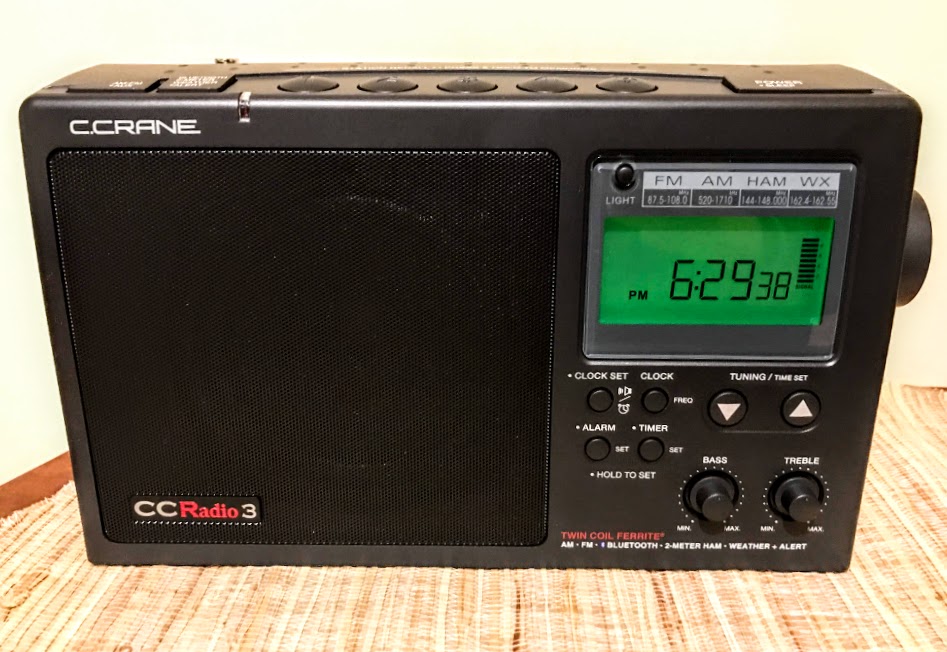
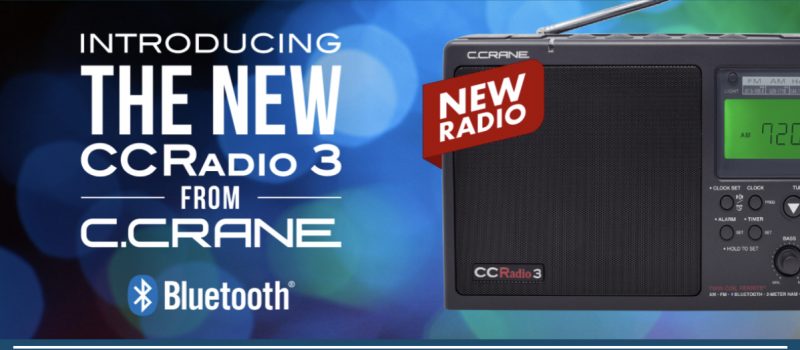
C. Crane CCRadio3 now shipping

Many thanks to SWLing Post contributor, Steve Lebkuecher, who notes that C. Crane is now shipping the CCRadio3:

Click here to read our review of the CCRadio3—a unit we consider to be one of the best full-sized AM radios currently on the market.

Click here to check out the CCRadio3 at C. Crane.

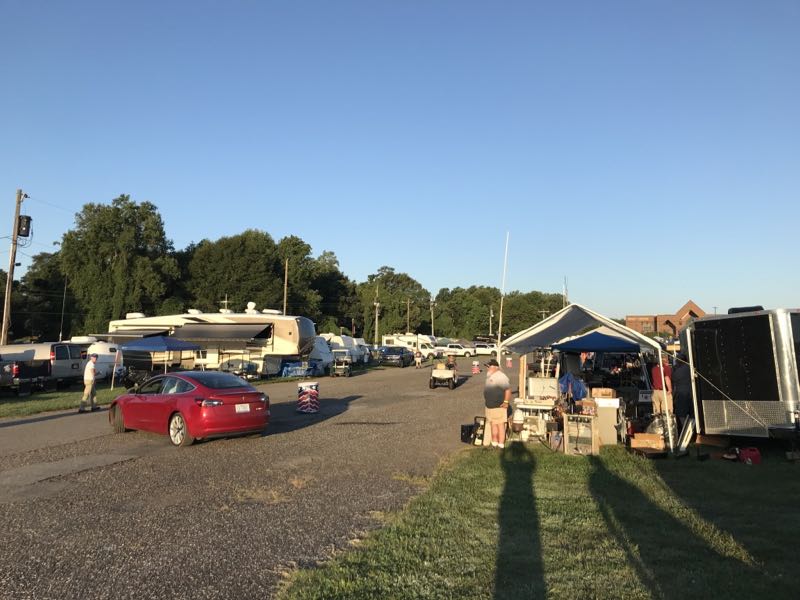
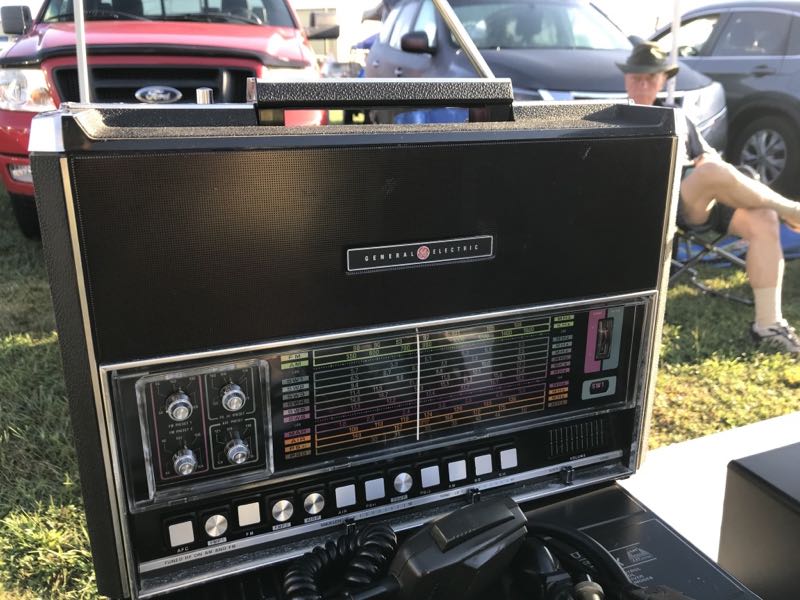
A photo tour of the 2019 Shelby Hamfest

My Labor Day weekend was free of travel this year, so I was able to make another pilgrimage to the Shelby (North Carolina) hamfest with my good buddy, Vlado (N3CZ).

The Shelby Hamfest–referred to, locally, as “The Grand-Daddy of them All”–has long been regarded as one of the largest outdoor hamfests in the southeast US. This is the fourth year I’ve made a concerted effort to publish a photo tour of the event.

Weather was ideal for the hamfest–clear skies, sunshine and a dry weekend. No doubt, this was one of the reasons I believe the hamfest was well attended.

Shelby Photo Gallery

Click on the thumbnails below to enlarge or comment on the photos:

Note that if you’re viewing this post via our email newsletter, the embedded gallery (above) might not be viewable. Click here to view via web browser.


Do you enjoy the SWLing Post?

Please consider supporting us via Patreon or our Coffee Fund!

Your support makes articles like this one possible. Thank you!

AirSpy HF+ Discovery: First Impressions on Medium Wave vs. Elad FDM-DUOr

The highly anticipated AirSpy HF+ Discovery SDR has been in the hands of early adopters for about two weeks–and I’ve seen nothing but positive comments!

After a long run (2007-2013) with a Microtelecom Perseus, my SDR of choice became the Elad FDM-S2, and more recently an Elad FDM-DUOr “hybrid” SDR receiver. The two Elads have the same core processing components and identical performance when the DUOr is connected via SDR software.

This week I’ve compared the HF+ Discovery ($169) against the FDM-DUOr ($899) using Studio 1 software and identical modes & settings. The following video features the radios’ performance on a crowded daytime medium wave band from suburban Seattle-Tacoma USA.

Click here to view on YouTube.

Notes:

  • Software used is two “instances” of Studio 1, version 1.06e
  • Antenna is an east-west oriented Wellbrook ALA1530LNP Imperium loop
  • Mode, filter bandwidth, AGC, etc. are the same for each radio
  • 768 kHz sampling bandwidth used for both receivers

Stations tuned are:

  • 1320 KXRO Aberdeen WA, 74 miles @ 5 kW (in-line with antenna)
  • 1110 Oak Harbor WA, 78 miles @ 500 watts (in antenna’s null)
  • 1040 CKST Vancouver BC, 147 miles @ 50 kW (in antenna’s null)
  • 1430 KBRC Mt. Vernon WA, 85 miles @ 5 kW (in antenna’s null)
  • 750 KXTG Portland OR, 118 miles @ 50 kW (in antenna’s null)

I purposely sought out signals difficult to hear in the presence of powerhouse stations. Only 1320 kXRO (in-line with my antenna) and 750 KXTG are what you might consider average or fair quality signals. Headphones are recommended for most of these, particularly 1040 kHz.

You’ll note that the pass band has been “pulled” over the edge of the carrier frequency by a few hundred Hertz. This is an excellent trick that can often reduce noise and/or improve intelligibility. It’s a feature unique to Perseus, Studio 1, and SDRuno software; it works in sideband modes and in selectable sideband Sync AM (SAM) mode.

After listening to the signal comparisons, what are your thoughts on the HF+ Discovery? Please leave your comments below.

Guy Atkins is a Sr. Graphic Designer for T-Mobile and lives near Seattle, Washington.  He’s a regular contributor to the SWLing Post.

A review of the Sangean PR-D17 portable AM/FM radio for the visually impaired

Photo of the Sangean PR-D17 AM FM Radio while tuned to 96.1 FM and showing RDS backlit display

Many thanks to SWLing Post contributor and producer, Peter Atkinson, who shares the following review of the new Sangean PR-D17 AM/FM radio:


Sangean PR-D17 review

by Peter Atkinson

I’ve been visually impaired all my life and a radio enthusiast for over 40 years.  I was intrigued when I learned that Sangean was offering a radio for the visually impaired.  I purchased one, and wanted to share my thoughts about the Sangean PR-D17 from the perspective of a visually impaired listener.

Photo of the PR-D17 box

For those readers who are mainly interested in the performance of this radio, please stay tuned, while I talk a moment about the features geared to the visually impaired.

Photo of the radio manual.

First of all: the manual, [see photo above] while it is comprehensive (as most from Sangean are), it is odd that it’s printed in the smallest type I’ve seen from this manufacturer.

Image of the PR-D17 tactile preset keys with Braille.

The yellow controls on a black radio are easily seen.  I like that the preset buttons on the bottom row of the front panel, are in Braille.  The raised symbols, however, on the upper row, may be too complicated to be easily discerned by touch alone.  The yellow-on-black motif, is reminiscent of my Sangean HDR-16.

When the 6 C batteries are first inserted, or AC power is connected, the radio announces that it has entered the setup menu.  The voice prompt menus (whose volume can be adjusted independently of the radios’ main volume but cannot be disabled) make setting up this radio somewhat straightforward.  The setup might have been easier, if the clock setting function was available as part of the menu system. The voice prompts are surprisingly comprehensive. The voice not only speaks the frequency, time & menu options, but will also tell you when something is connected to (or disconnected from) the AC input, headphone or AUX-IN jacks.

When the radio is turned on, it announces that the radio is on, the battery level & the frequency to which it is tuned.

When tuning, the voice gives the frequency at each change. It’s especially helpful when using the seek function, knowing where the next station was found.

Click here to download audio clip of tuning voice prompt.

When storing a station into a preset, the voice says exactly what frequency has been stored & at which present position.

Click here to download audio clip of tuning voice prompt.

The same information is given when recalling a preset. One quirk of the voice prompt, is that when announcing the time, it speaks full numbers (e.g. “twelve thirty-seven’), but when giving the frequency, each digit is spoken (e.g. “one two three zero” or “nine six point one”).

Click here to download audio clip of time voice prompt.

Finally:  Tuning time.  

Image showing that the HDR-16 and PR-D17 are identical in size.

Comparing the Sangean HDR-16 with the PR-D17

This radio is the same cabinet as the HDR-16.  Aside from the voice prompts, it operates similar to the PR-D5.  Therefore, I’m comparing its performance to that model. Like the PR-D5, the AM tuning steps can be set for 9 or 10KHz, but the FM tuning steps are fixed at 100KHz (0.1MHz).

Image showing right side of radio.

There are 5 presets per band. The display also shows RDS information for any FM station that transmits RDS. The clock can be set from the RDS signal, as well.  I’ve found several stations, in my area, that are sending the wrong time.

Audio

The sound from the twin 2-1/2” speakers is very balanced.  The bass is substantial, but not overpowering. The highs are good for definition, without being too brassy.  There are no provisions for customization, though.

Image showing left side of radio.

There is a 3.5mm AUX-IN jack for connecting an external sound source, such as an MP3 player or smartphone.

AM

While the AM sound is a bit muffled for my taste (the bandwidth cannot be changed) it makes for excellent selectivity.  There was no hint of my nearby 50KW 620, on 610 or 630. Like many Sangean radios, the noise floor is very quiet. The long 200mm internal ferrite bar antenna does a superb job at snagging those weak stations.  I was able to get a noisy, but readable signal on a 50KW station on 700, at 350 miles, during the day. That one is my benchmark for a great DX machine. The top end of the band is no slouch, either. Another benchmark station (10KW 1690 at 75 miles) came in loud and clear.  The long ferrite antenna also helps to better null unwanted signals. This is a greater benefit for nighttime DXing.

FM

The PR-D17’s performance on FM is stellar.  It has shown to be very sensitive, pulling in stations as well as my PR-D5 & PR-D9W.  I easily hear FMs at 60 miles. The selectivity is also amazing. I can listen to stations on 95.9 & 96.3, with a 6KW station on 96.1 less than 10 blocks from my window.  Even though the PR-D17 pulls in those weak stations with ease, it requires a stronger signal to receive stereo.

Close up of RDS display

The RDS is quick to display station information. It starts off by showing the 8-character PS information of the RDS signal, then switches to the scrolling display of the RT segment.

Summary

Overall, I am very happy with the Sangean PR-D17.  It is a superior radio, now with the added benefit of voice prompts.  Hopefully, this will alleviate some of the annoyances visually impaired listeners may have with operating a digitally-tuned radio.


Thank you so much for sharing your review, Peter and thank you for being an SWLing Post producer!

It looks like the Sangean PR-D17 is an excellent choice for those radio listeners who would appreciate voice prompts, high contrast controls and tactile keys. I’m also happy to hear you rate AM selectivity as excellent. When radios only have one chosen bandwidth, I’d rather give priority to selectivity than audio fidelity for the purposes of nighttime AM DXing. 

Sangean PR-D17 retailers:

Classic portables onboard a 1919 Great Lakes tugboat

Many thanks to SWLing Post contributor, Phil Ewing, who writes:

I know you’re always on the lookout for trips and visits so I thought of you when we were up in Wisconsin last week. There’s a maritime museum up in Sturgeon Bay, on the peninsula, that includes a 100 year-old tug. You can go aboard and climb all up and down…and they’ve got some great radios in the crew cabins as part of the displays of what life was like back when the ship was working.

There were a number of standard but interesting normal transistors but what really caught my eye were the Hallicrafters World Wave in the pilothouse and a fantastic pair of Trans-Oceanics in the cabins of the chief engineer and the captain.

The purpose of the visit really isn’t the radios — it’s about the working life of the Great Lakes and an old ship — so discovering them was a fantastic lagniappe.

[T]he appeal of shortwave in these circumstances is clear: Imagine you’re in the middle of Lake Superior towing a barge full of logs to be pulped, or some other unglamorous but essential Great Lakes cargo — maybe a barge full of big rocks to build a breakwater in, say, Sheboygan — and you come off watch in the middle of the night. Life on a ship can be deadly monotonous and deeply lonely but then picture yourself tuning in to the international band on your luxurious Zenith set … not bad since the iPad won’t be invented for another 40 or so years.

These pix also depict the engine order telegraph, which the captain in the pilothouse used to signal commands to the engine room. There was one for each of the two main engines, and duplicates in the pilothouse.

The captain moves the handle so that it indicates the speed he wants (e.g., Ahead Full) and the bottom needle on the telegraph in the engine room moves, ringing a bell. This is why an engineer might report he was ready to sail by saying he was standing by to “answer bells.” The engineers would select the speed on the engines and then move their own handle on their own telegraph to correspond with the captain’s order, signaling to the pilothouse they’d completed the instruction.

The engines are the white things pictured behind the telegraph and on which was stamped the brass plate also photographed here. The diesel engines were made by the Electro Motive Division of GM and replaced this ship’s original steam propulsion system. EMD is most famous for its pioneering and legendary freight locomotives, which led the way in “dieselization” after WWII in converting many railroads from their romantic but much less efficient and much dirtier steam power. But the company also made marine diesel engines as evidenced here and these served this ship for another three decades or so — just think about that. There also are still EMD GP30 locomotives from the 1960s still in service in some places in the U.S., according to what I read in this month’s Trains magazine.


Fascinating, Phil––what terrific vintage kit! Thanks for sharing those wonderful photos and descriptions with us. 

Yes, I can imagine SWLing would have been a vital entertainment outlet for those on working ships in the Great Lakes. No doubt they had access to a number of strong mediumwave stations on the coast, as well. What a way to while away the off-hours.

Click here to follow @PhilEwing on Twitter.