Category Archives: Radios

It’s not a travel radio if it doesn’t have an alarm clock

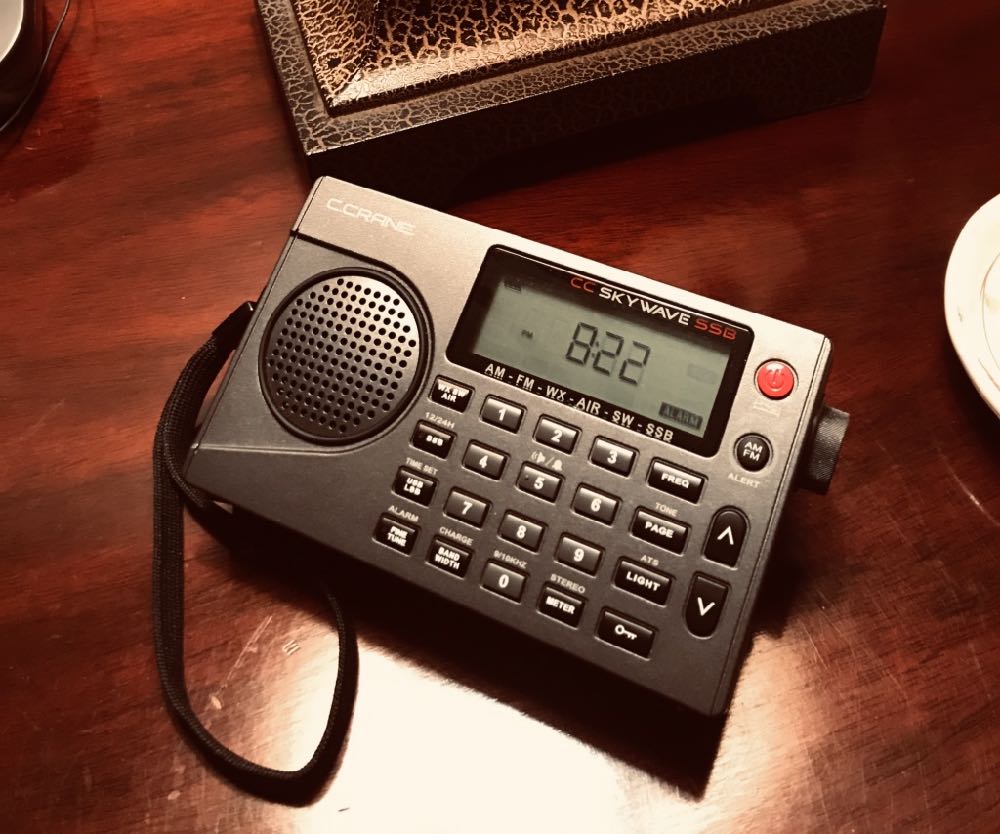
The CC Skywave SSB is set to wake me at 3:30 to catch a 5:30 flight.

I have a pretty accurate body clock. Regardless of when I doze off, I always wake up at the same time.

When I’m at home on my regular schedule, I trust my “internal chronometer” so much, I haven’t set an alarm in years.

When I travel, it’s a completely different story…

It’s a rare occurrence when a flight, train, or even road trip allow me to wake up at my normal time, so I rely on an alarm clock.

In fact, I’ll let you in on a little secret: I’m a nervous Nellie when I’m forced to break my sleep cycle to catch an early flight. My fear of missing a flight may even border on paranoia–I’ll wake up multiple times during the night in a panic unless I feel completely at ease that there’s an alarm system in place to wake me no matter what.

I recently told a friend about this fear and he asked, “Why not just set the alarm on your phone?!”

Simple answer: I don’t trust smart phones and tablets. They’re too complicated with so many nighttime settings, alarm/alert volume levels, short battery life, etc. etc.

Case in point…
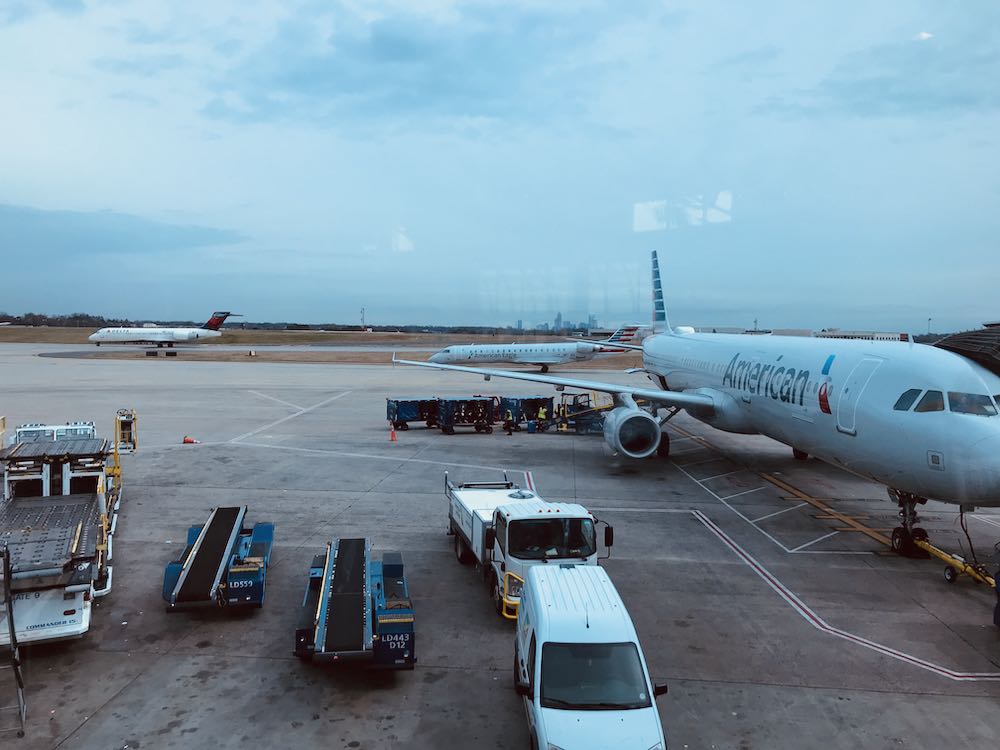
Earlier this year, I had to catch an early flight and needed to wake up at 4:00 AM, so I scheduled my iPhone and iPad to alarm at 4:00. (When at home, I try to have my iPhone/iPad wake me first, because the alarm is very gradual and doesn’t disturb my wife.) Of course, I also set my travel radio’s alarm clock for 4:10, as a fail safe.

Knowing I had a total of three(!!!) alarm clocks set, I slept like a baby.

At 4:10 AM, my travel radio alarm started beeping. The iPhone and iPad were completely silent.

Turns out, the iPad decided to do an operating system update during the night. For some reason, after rebooting, it simply forgot about the alarm. (Thanks, iPad!) And the iPhone? I’m still not sure how/why, but the mute switch on the side of the phone was engaged and if it vibrated to wake me, I never heard it rumbling on the night stand.

Thank goodness the travel radio had my back, else I would have missed that flight.

Travel radios: Never leave home without one!

I like to be a self-sufficient traveler even though I only travel with one bag and pack very lightly. I never rely on my destination to have a functioning alarm clock (with battery backup, of course) or effective wake up call service. Regardless of how minimally I pack, I always take a travel radio.

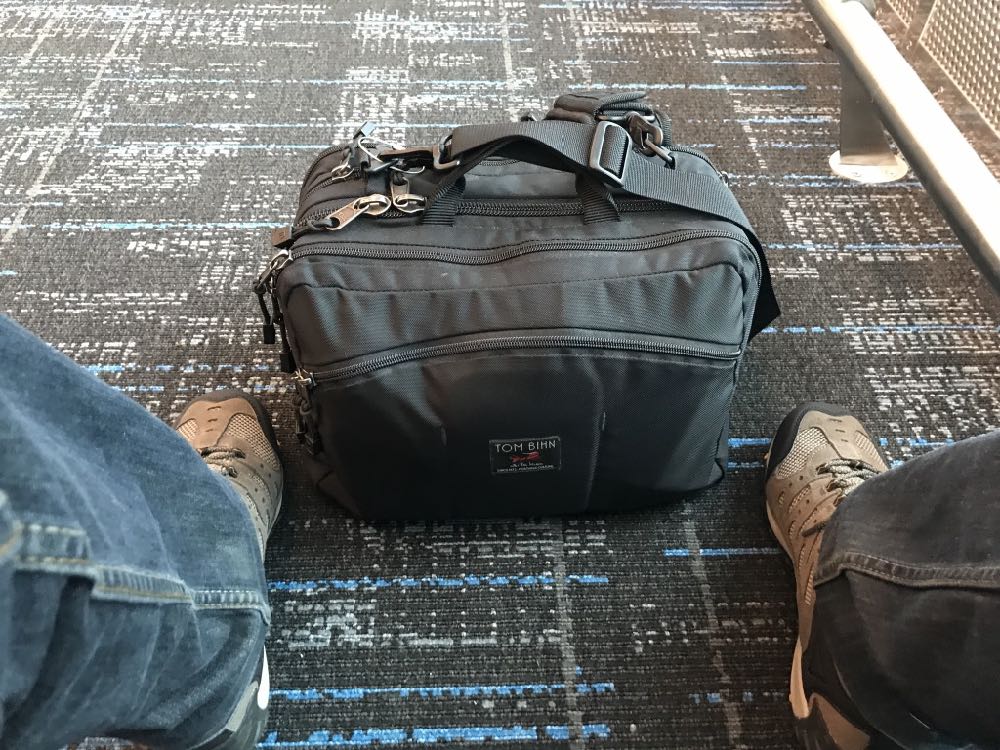
In February, for example, I travelled to Philadelphia for the Winter SWL Fest. Even though my trip was nearly a week long, to keep from paying a carry-on fee with Frontier airlines, I packed everything in a bag that met their strict “personal carry-on” bag size.

Regular readers know I’m a bit of a pack geek, so my bag of choice was the Tom Bihn Stowaway.  Here’s the bag fully packed out at my feet in the airport:
Here’s a photo of everything I packed in the Stowaway for that trip:
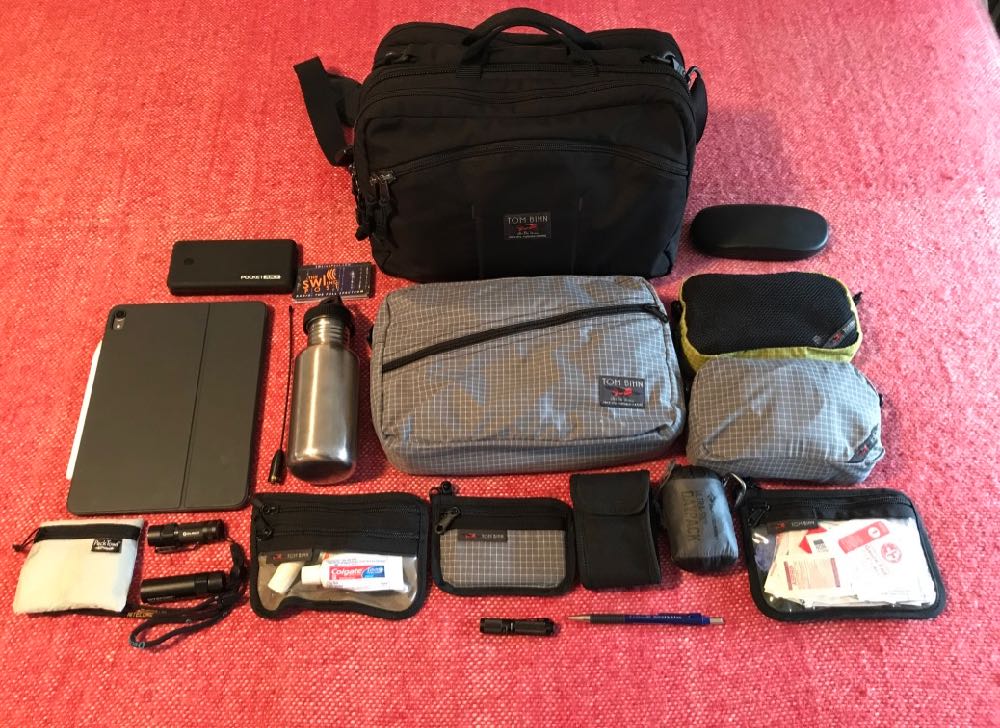
This particular trip really pushed the limits on my minimalist travel philosophy. Honestly? It was a fun challenge! I had to hone my pack contents down to only the essentials (don’t make fun of me for believing three flashlights were essential–the previous year, our hotel was without power for several days).

Still, I made room for one of the smallest travel radios in my arsenal: the County Comm Marathon ETFR:
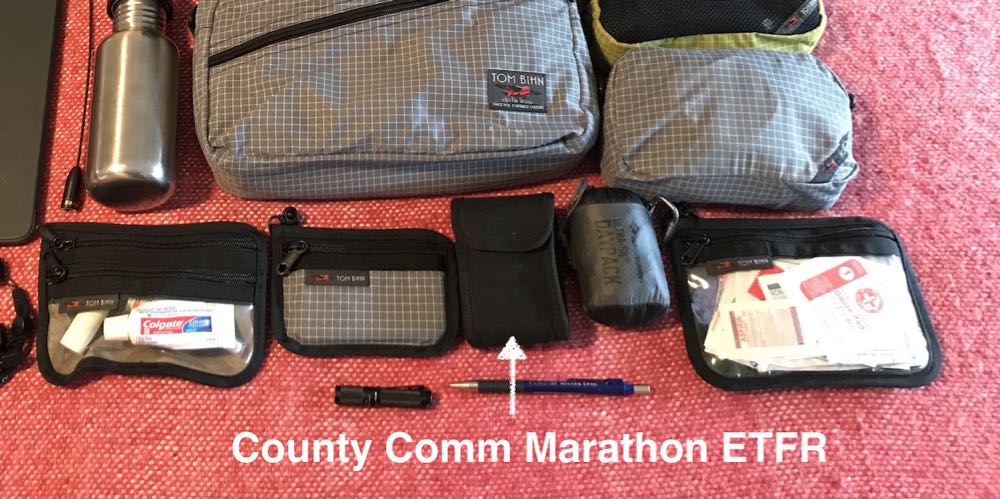
I chose the ETFR because it has a custom case that could attach to my belt or pack strap if interior space became too tight. The ETFR radio hasn’t been in production for a decade, but it’s an effective radio companion and the alarm works without fail.

Choosing a travel radio
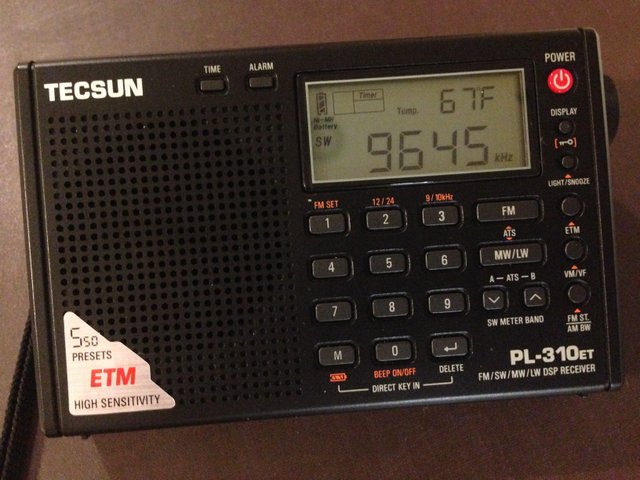
Most modern digital portables are based on DSP chips that have clock and alarm functions, so you might already own an effective travel radio.

With that said, I always prioritize radio features that benefit a traveler, of course; here are some that I look for:

  • Small size: Naturally, it’s sensible to look for a travel radio that’s small for its receiver class for ease in packing.
  • Overall sturdy chassis: Any travel radio should have a sturdy body case that can withstand the rigors of travel.
  • Built-in Alarm/Sleep Timer functions: We’ve already exhausted this topic, right?.
  • Powered by AA batteries: While the newer lithium ion battery packs are fairly efficient, I still prefer the AA battery standard, which allows me to obtain batteries as needed in most settings; a fresh set of alkaline (or freshly-charged) batteries will power most portables for hours on end.
  • Standard USB charging cable: If I can charge batteries internally, a USB charging cable can simply plug into my smart phone’s USB power adapter or the USB port on my laptop; no extra “wall wart” equals less weight and less annoyance.
  • ETM: Many new digital portables have an ETM function which allow auto-scanning of a radio band (AM/FM/SW), saving what it finds in temporary memory locations–a great way to get a quick overview of stations.  (As this function typically takes several minutes to complete on shortwave, I usually set it before unpacking or taking a shower. When I return to my radio, it’s ready to browse.)
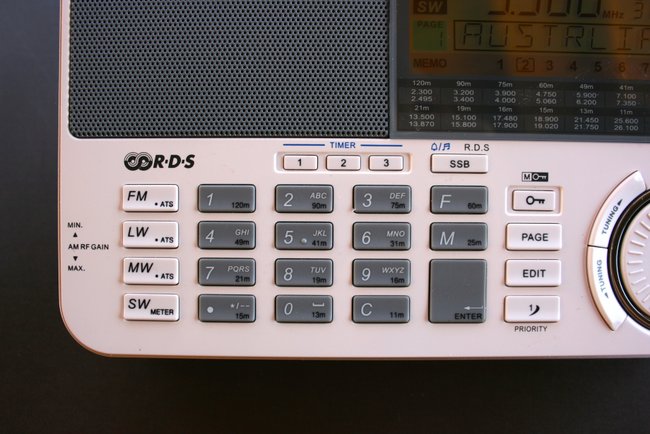
  • Single-Side Band: While I rarely listen to SSB broadcasts when traveling, I still like to pack an SSB-capable receiver–especially for longer trips.
  • RDS: Though an RDS (Radio Data System) is FM-only, it’s a great feature for identifying station call signs and genre (i.e., public radio, rock, pop, country, jazz, classical, etc.)
  • External antenna jack: I like to carry a reel-type or clip-on wire external antenna if I plan to spend serious time SWLing. Having a built-in external jack means that the connection is easy, no need to bother with wire and an alligator clip to the telescoping whip.
  • Tuning wheel/knob: Since I spend a lot of time band-scanning while travelling, I prefer a tactile wheel or knob for tuning my travel radio.
  • Key lock: Most radios have a key lock to prevent accidentally turning a radio on in transit–but with a travel radio, it’s especially important to have a key lock that can’t be accidentally disengaged.
  • LED flashlight: Very few radios have this, but it’s handy to have when travelling. Note that the County Comm ETFR (above) does!
  • Temperature display: Many DSP-based radios have a built-in thermometer and temperature display; I like this when I travel anytime, but especially when I’m camping.

While I don’t have a portable that meets 100% of the above travel radio wish-list, I do have several that score very highly.

Since this is a favorite topic, I’ve written a number of articles with reviews of travel radios. In my CC Skywave SSB review last year, I list a number of current favorites.
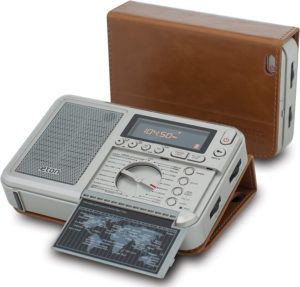
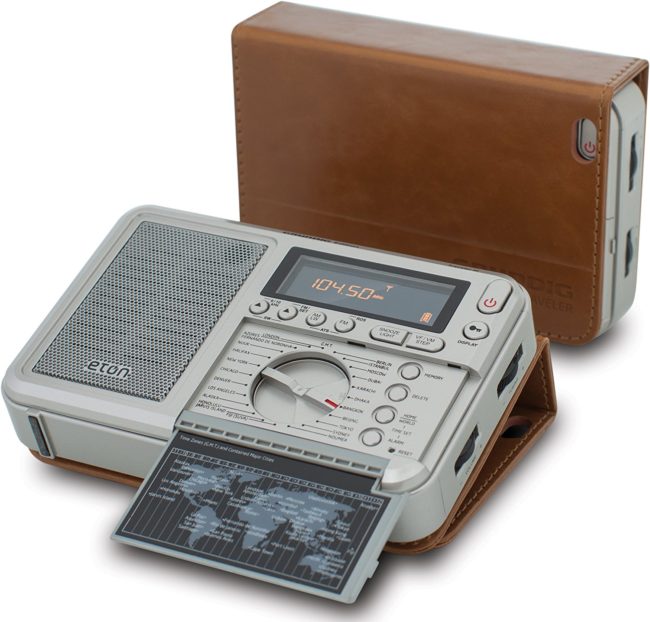
I should also mention that one great deal at time of posting is the Eton Executive Traveler.

It’s a brilliant little radio for $34.99 shipped (note this affiliate link supports the SWLing Post).

One of our readers has been following the price of this little radio for months–it’s being sold at an all-time low at present.

What’s in your travel pack?
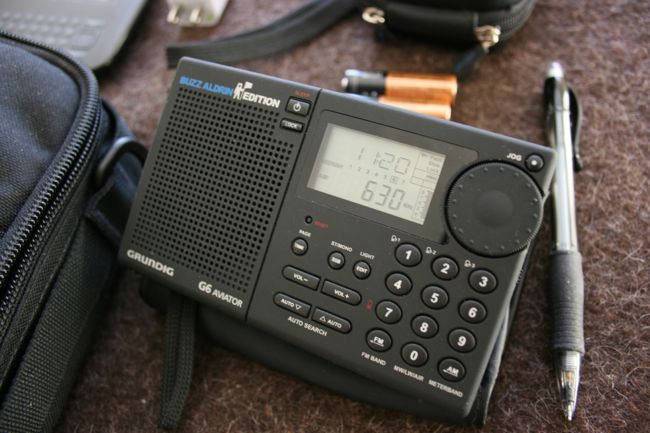
What’s your favorite travel radio? What features are important to you? Anyone else paranoid about missing early flights? 

Please comment!


Do you enjoy the SWLing Post?

Please consider supporting us via Patreon or our Coffee Fund!

Your support makes articles like this one possible. Thank you!

Jack’s Mediumwave Lazy Susan Mag Loop System

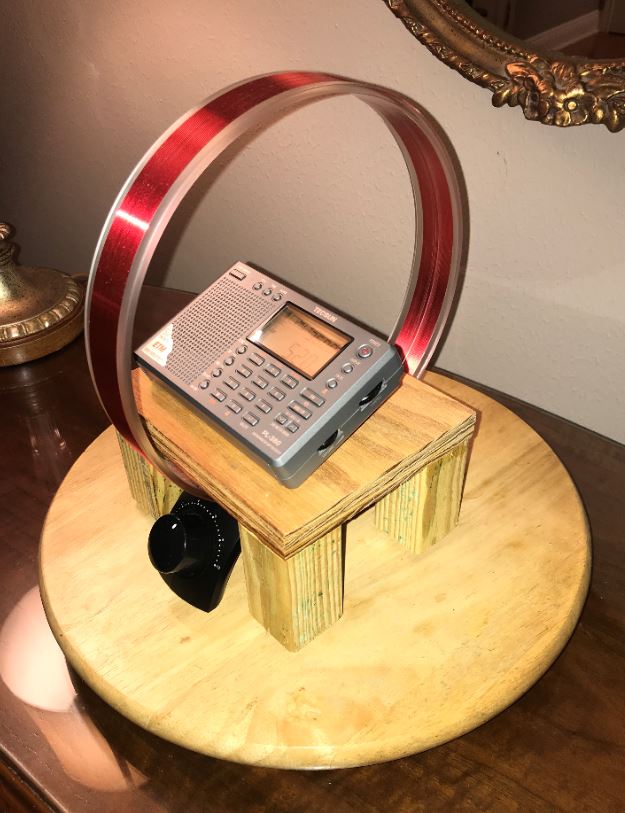
Many thanks to SWLing Post contributor, Jack Blanke (WB5LVP), who writes:

I stole this idea from another SWLing Post contributor and I hope he won’t mind.

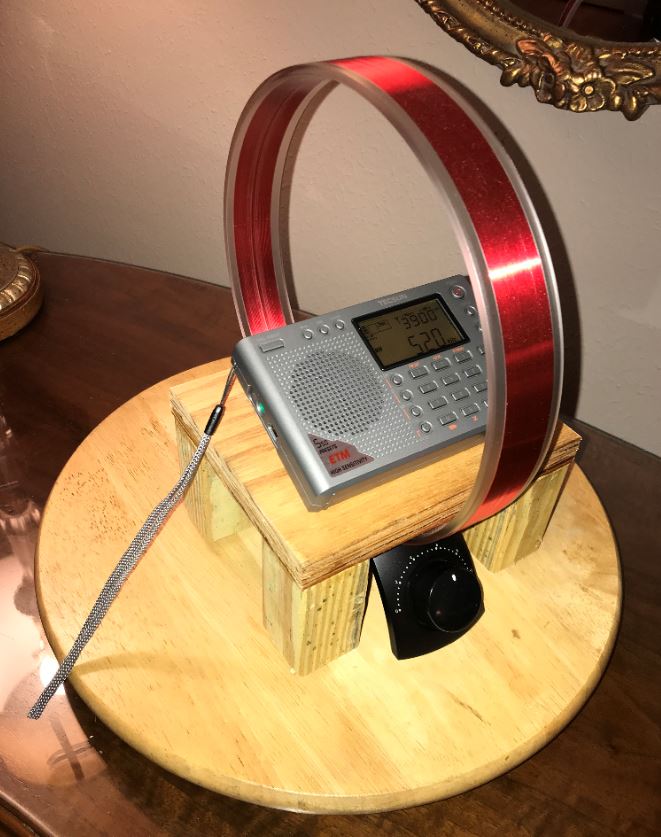
However, placing the Ferrite Antenna near the center of the loop does enhance its performance and the Lazy Susan was something I had been using long ago to quickly re-orient the radio azmuth to accommodate the signal source. But, like my mentor, minor improvements like this can really enhance performance of smaller portables on medium wave. He used cardboard and I used scrap wood from the work shop. Either way, not much money was involved in this minor enhancement.

These inexpensive additions to the listening post really make the PL380 and the AN200 combo provide hours of enjoyment from medium wave DXing. Now,if only I can find the gent’s name who came up with this little gizmo, I’d love to thank him!!

73’s!

Thanks for sharing your setup, Jack! I can assure you that Rich Stahl (WR3V) will be happy you “stole” his idea. That’s what it’s all about–helping each other! I love the little table/stand you built for the portable and how it perfectly accommodates the loop. Great job!


Do you enjoy the SWLing Post?

Please consider supporting us via Patreon or our Coffee Fund!

Your support makes articles like this one possible. Thank you!

A radio museum…in a subway

Many thanks to SWLing Post contributor, Paul Evans, who shares a link from Atlas Obscura featuring the Museo de la Radio in the Parque de los Venados station in Mexico City:

Upon entering the Parque de los Venados station of the Mexico City subway system, you may be surprised to find that you’ve also entered a museum. Here, the subterranean corridors double as the Museo de la Radio (Radio Museum), a small institution dedicated to the communication system’s history.

The museum’s exhibits display different radio-related devices such as lightbulbs, consoles, and microphones. The most prominent is the famous four-key xylophone with which the XEW—dubbed “the voice of Latin America”—announced its broadcasts during the golden age of the ’30s.

Other showcases contain collections of old radios, and still more highlight radio stars’ records. The display cards narrate some important events such as the first transmission, the birth of the digital radio, tidbits of curious data, and explain how the sound waves work.

The most interesting part of the museum is the radio booth, which actually broadcasts live shows. It was installed and opened in 2018, complete with the most advanced technology. One space is the speech booth, and another is the editing booth.[…]

Continue reading and view all photos at Atlas Obscura.

Photo of the new Tecsun PL-330, PL-990, and H-501

Many thanks to SWLing Post contributor, Lee, who writes:

Hi Thomas, I just found this photo [above] on Reddit of three new radios from Tecsun: the PL-330, the PL-990, and the H-501. I knew about the PL-990, but I didn’t realize there was a PL-330 or H-501. Any inside info? 73, Lee

Thanks for your message, Lee. I had not seen the photo of the PL-330 until you sent this one.

The PL-330, I assume, is the latest in the PL-3XX line which has primarily been DSP-based ultralight broadcast receivers. I believe only one model, the PL-365/CountyComm GP5-SSB, had SSB capabilities. The PL-330 appears to have dedicated LSB and USB mode buttons on the front panel (lower right in photo below).

Since both the Digitech AR-1780 and XHDATA D-808 both have selectable sideband, I’m not surprised the new PL-330 does as well. I’m very curious if the PL-990 will be priced competitively like PL-3XX models have been in the past–perhaps below $80 US.

The PL-330 certainly appears to have taken design cues from the PL-990 in terms of overall control layout.

The Tecsun H-501 is a new model that was previously referred to as the Tecsun S-9900.  I believe a pilot run has been made of the PL-990 and H-501–possibly the PL-330 as well.

I will be reviewing each of these radios as soon as they’re available here in the US.

Thanks for the tip, Lee!

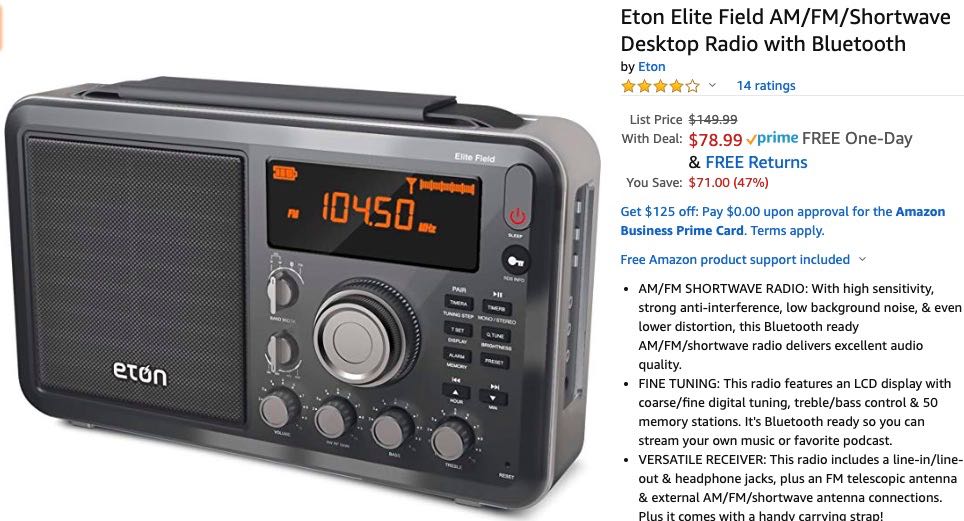
Amazon Price Drop: Eton Elite Executive Portable Now $129.99

The relatively new Eton Elite Executive, formerly Eton Executive Satellit, has dropped $50 USD on its Amazon page to $129.99:

This rather major price drop lowers the cost to just $20 more than Amazon’s price for the older, silver-cased Eton Executive Satellit. According to Jay Allen’s review the new radio has identical performance to the older model; only the color is updated.

Guy Atkins is a Sr. Graphic Designer for T-Mobile and lives near Seattle, Washington.  He’s a regular contributor to the SWLing Post.

Gospell product lineup for IBC 2019 includes the GR-22 portable DRM radio

Many thanks to SWLing Post contributor, Ed, who writes:

SWLing Post readers might be interested in learning about Gospell’s newly-announced DRM receivers and active antenna products. The GR-22 “pocket-sized” “full-wave” receiver that’s supposed to be available for purchase by June 2020 seems especially interesting.

(Source: Gospell Press Release)

Gospell to announce the DRM monitoring system and imminent release of portable DRM receiver, and more

Chengdu, China – Gospell, a leading supplier of pay TV system and equipment, satellite TV receiving products and microwave products, announces its product lineup for IBC 2019. The company will debut several new products featuring DRM (Digital Radio Mondiale) for both consumer and industry market, including:

    • GR-22 – Portable DRM/AM/FM Receiver
    • GR-227 – DRM Car Adapter
    • GR-301 – DRM/AM/FM Monitoring Receiver
    • GR-310 – Audio Broadcast Monitoring Platform
    • GR-AT3 – High Performance Active HF Antenna

GR-22 is a sleek and classy portable radio from Gospell, the contemporary stylistics of exterior design fits in your personal style, crystal clear DRM digital radio and AM/FM brings practicality and comfort to your daily enjoyment. Despite its pocket-size, it’s a nifty full wave band receiver packed up in a tiny body that enables you to explore a wide variety of radio stations. It is also future-proofed for the next generation DRM-E technology. You have access to all the presets, station names, program details and even Journaline news on the easy to ready large LCD in a simple and intuitive way. Sleep timer set your radio to automatically switch off or wake up at your convenience. Listen to your favorite radio programs anywhere you like with 4 x AA batteries or connect it to mains. GR-22 is a multi-functional radio that is flexible to your listen habits. GR-22 will be available for purchase on Q2 2020.

GR-227 is a car digital radio adapter that utilizes most advanced interference and noise cancellation technology to receive digital radio in car while achieving the best audio quality and serve it to the car audio system over aux cable or by transmitting over an unused FM frequency. The receiver is fully compatible with DRM standard that is being deployed over the world, with its latest audio codec xHE-AAC. Based on software defined radio technology, GR-227 is ready for the emerging DRM-E standard that extends the DRM broadcast to FM band.

GR-301 is a high performance monitoring receiver that supports DRM, AM and FM. GR-301 supports the collection of key parameters of audio broadcasting, including SNR, MER, CRC, PSD, RF level, audio availability and service information. The collection and uploading of parameters meets DRM RSCI standards. The GR-301 can work independently or be deployed with other receivers to become a node in the service evaluation network. The GR-301 supports the xHE-AAC audio codec and is capable of handling the latest DRM-E standard through software upgrades.

GR-310 is a management platform designed for audio broadcast monitoring and receiver control purposes, it manages the geographically distributed GR-301 receivers. The platform can formulate receiving schedules, configure the receivers to perform receiving tasks, perform real-time browsing of the reception status, store historical data, and visualize the statistic data in a intuitive way. In addition to monitoring and analyzing data, the GR-310 platform also supports real-time audio monitoring and configuration of alarm conditions, alarms will be triggered when rules are met.

GR-AT3 is a high-performance active monopole antenna with reception frequency ranges from 0.3 to 50MHz. It is designed to work in harsh environments with respect to strong man-made noise and stern natural conditions. It is compact and easy to install, supplied accessories enable rapid installation. The antenna is comprised of a wide band amplifier in an IP67 waterproof aluminum body together with an active element made of a stainless-steel. The solid construction ensures durability and maintenance-free operation.

“We’re constantly working to ensure we’re bring the latest technology in our product”, says Haochun Liu, assistant to general manager, “These products underscore the Gospell’s commitment to providing easy access to high quality information at affordable prices. Both consumer and industry can benefit from it.”

Gospell will be exhibiting at IBC 2019 in the Amsterdam International Broadcasting Convention (IBC) Hall 3 C67, September 13-17. To schedule a meeting at IBC 2019 or access a sample of the featured IBC showcase, email [email protected]

About Gospell

Established in 2001, Gospell Digital Technology Co Ltd (GOSPELL). is a hi-tech enterprise with R&D, manufacturing, business consultancy and planning, trade, delivery, project implementation and after sales service, acting as a complete DTV and triple-play solution provider for Digital TV/OTT related projects. Headquartered in GOSPELL INDUSTRIAL PARK at Chenzhou, Hunan Province for CPE related production manufacturing, GOSPELL also has its office in Shenzhen for business/marketing management and administration, in Chengdu for R&D and headend/transmitter system production/debugging and Customer Service Center, and in 12 cities in China as well as international offices in India, Africa and Mexico.

Thank you for sharing this, Ed. Looking through the press release, I don’t see any DRM radios where they note shortwave reception, however, the GR-22 is being called a “full wave band receiver.” Perhaps “full wave” is their way of indicating shortwave reception?

It looks like the GR-22, and all of the products listed above, are squarely targeting the new DRM market in India.