Category Archives: Radios

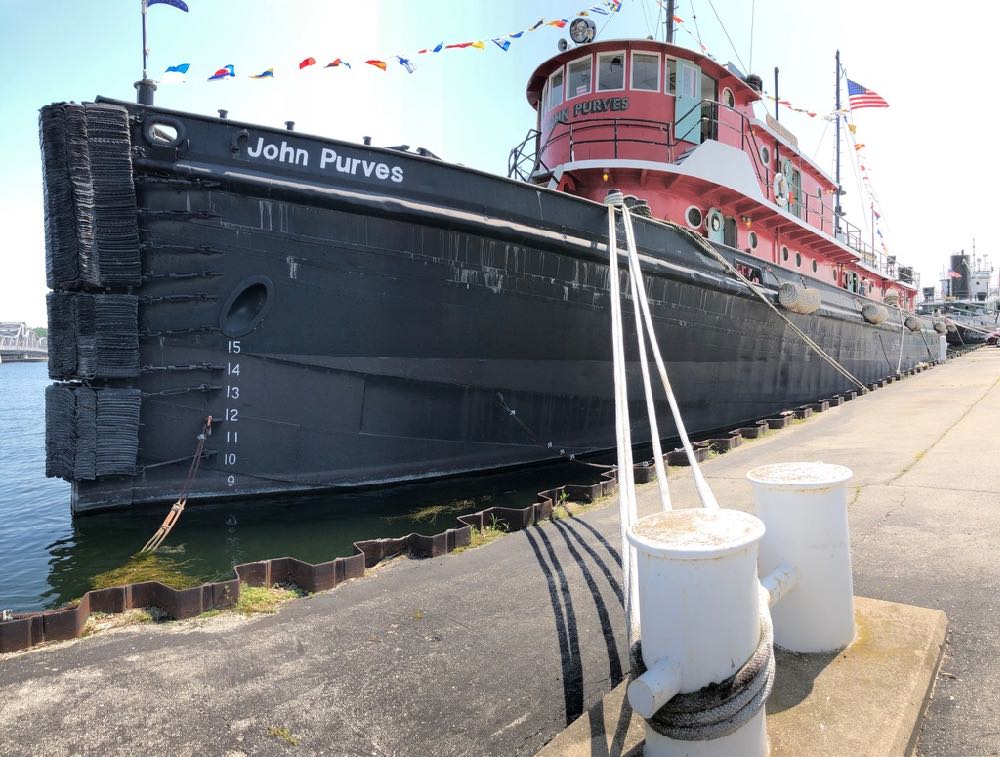
Classic portables onboard a 1919 Great Lakes tugboat

Many thanks to SWLing Post contributor, Phil Ewing, who writes:

I know you’re always on the lookout for trips and visits so I thought of you when we were up in Wisconsin last week. There’s a maritime museum up in Sturgeon Bay, on the peninsula, that includes a 100 year-old tug. You can go aboard and climb all up and down…and they’ve got some great radios in the crew cabins as part of the displays of what life was like back when the ship was working.

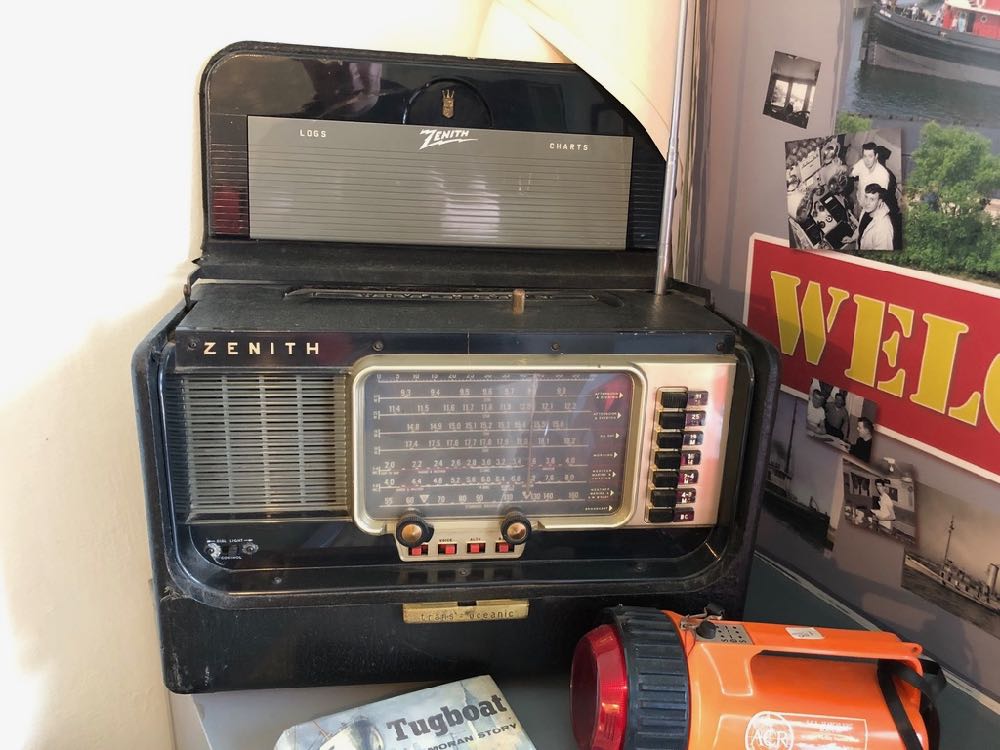
There were a number of standard but interesting normal transistors but what really caught my eye were the Hallicrafters World Wave in the pilothouse and a fantastic pair of Trans-Oceanics in the cabins of the chief engineer and the captain.
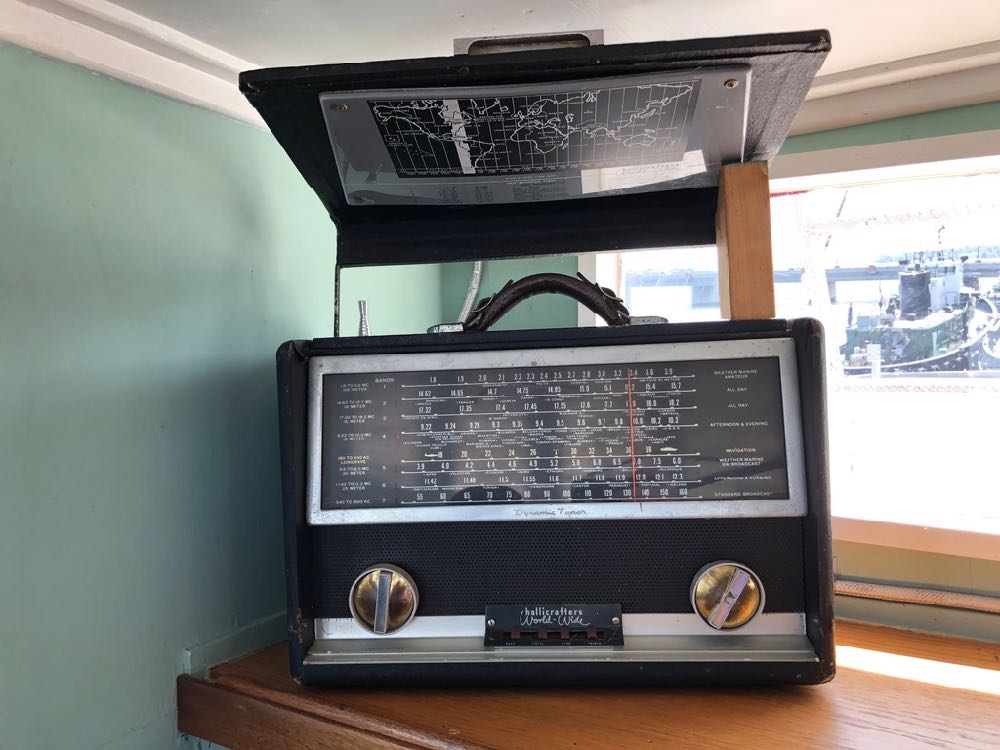
The purpose of the visit really isn’t the radios — it’s about the working life of the Great Lakes and an old ship — so discovering them was a fantastic lagniappe.
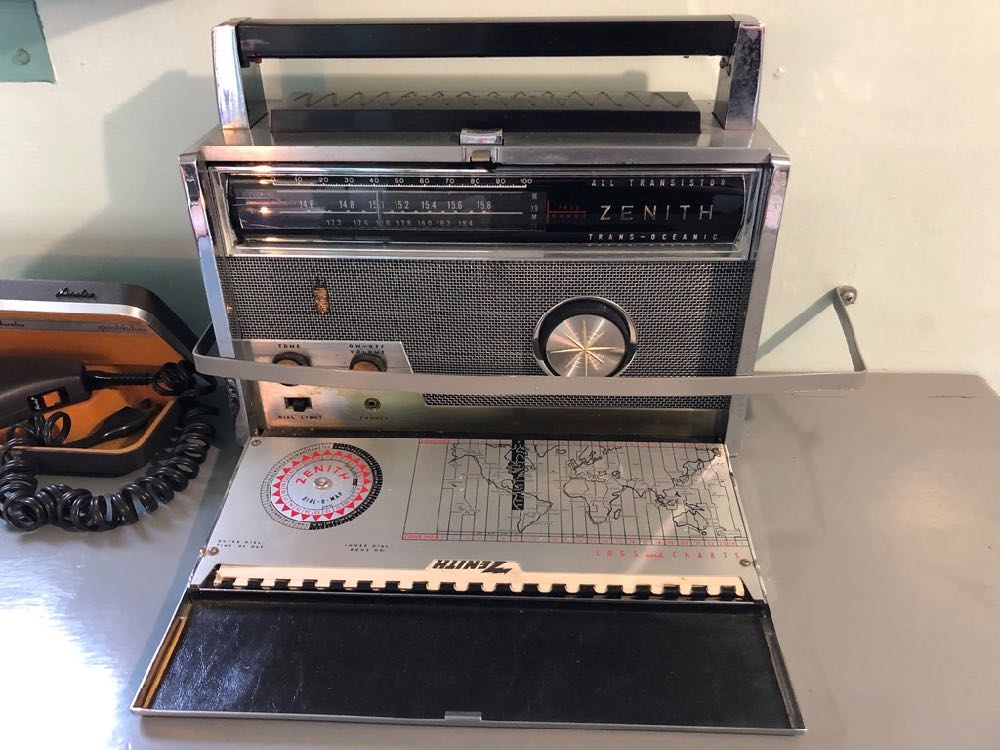
[T]he appeal of shortwave in these circumstances is clear: Imagine you’re in the middle of Lake Superior towing a barge full of logs to be pulped, or some other unglamorous but essential Great Lakes cargo — maybe a barge full of big rocks to build a breakwater in, say, Sheboygan — and you come off watch in the middle of the night. Life on a ship can be deadly monotonous and deeply lonely but then picture yourself tuning in to the international band on your luxurious Zenith set … not bad since the iPad won’t be invented for another 40 or so years.
These pix also depict the engine order telegraph, which the captain in the pilothouse used to signal commands to the engine room. There was one for each of the two main engines, and duplicates in the pilothouse.
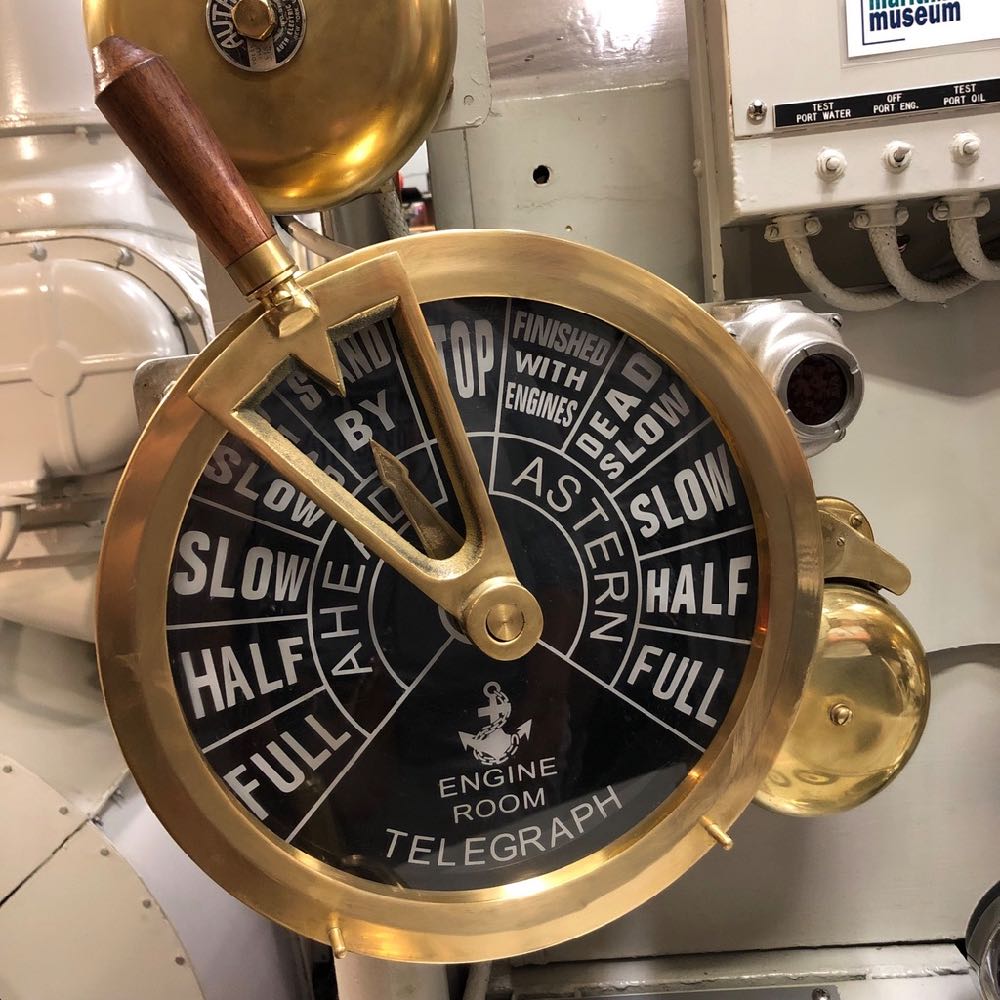
The captain moves the handle so that it indicates the speed he wants (e.g., Ahead Full) and the bottom needle on the telegraph in the engine room moves, ringing a bell. This is why an engineer might report he was ready to sail by saying he was standing by to “answer bells.” The engineers would select the speed on the engines and then move their own handle on their own telegraph to correspond with the captain’s order, signaling to the pilothouse they’d completed the instruction.
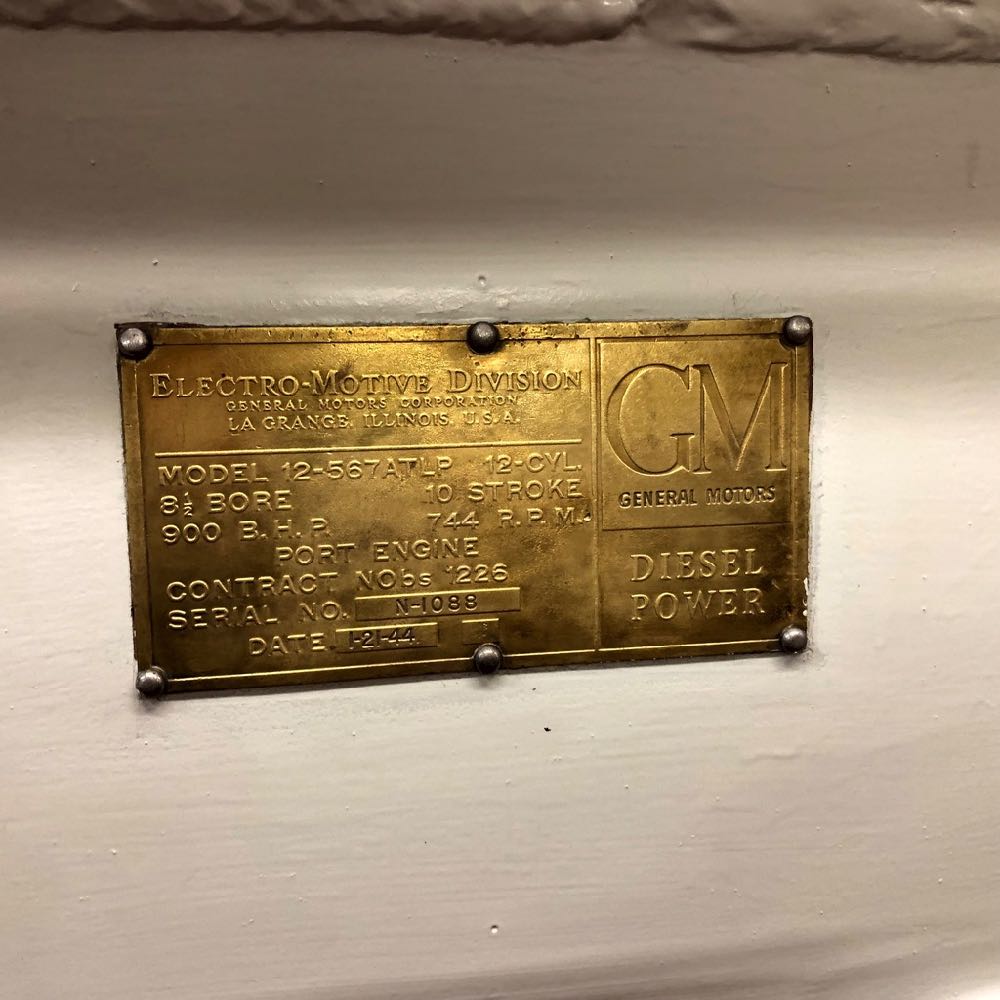
The engines are the white things pictured behind the telegraph and on which was stamped the brass plate also photographed here. The diesel engines were made by the Electro Motive Division of GM and replaced this ship’s original steam propulsion system. EMD is most famous for its pioneering and legendary freight locomotives, which led the way in “dieselization” after WWII in converting many railroads from their romantic but much less efficient and much dirtier steam power. But the company also made marine diesel engines as evidenced here and these served this ship for another three decades or so — just think about that. There also are still EMD GP30 locomotives from the 1960s still in service in some places in the U.S., according to what I read in this month’s Trains magazine.


Fascinating, Phil––what terrific vintage kit! Thanks for sharing those wonderful photos and descriptions with us. 

Yes, I can imagine SWLing would have been a vital entertainment outlet for those on working ships in the Great Lakes. No doubt they had access to a number of strong mediumwave stations on the coast, as well. What a way to while away the off-hours.
Click here to follow @PhilEwing on Twitter.

Tecsun PL-880: turning off backlight and one mystery function

Many thanks to SWLing Post contributor, John Carrod, who writes:

I took delivery of my PL-880 and have seen your notes on hidden features.

With the radio off, press and hold button 5, this disables/enables the light switch.

Pressing same button whilst on FM reveals information of which I’m unsure, I expect you or your readers will no doubt know what that’s about.

Thanks for sharing this, John. I’ve let a friend borrow my PL-880 so I don’t have it for reference. I’m hoping someone here can shed some light on the information display you’re seeing by pressing button 5 while in FM mode.

August 2019 Rockwork DXpedition

Many thanks to SWLing Post contributor, Gary DeBock, who shares the following guest post and update from the August 2019 Rockwork DXpedition:


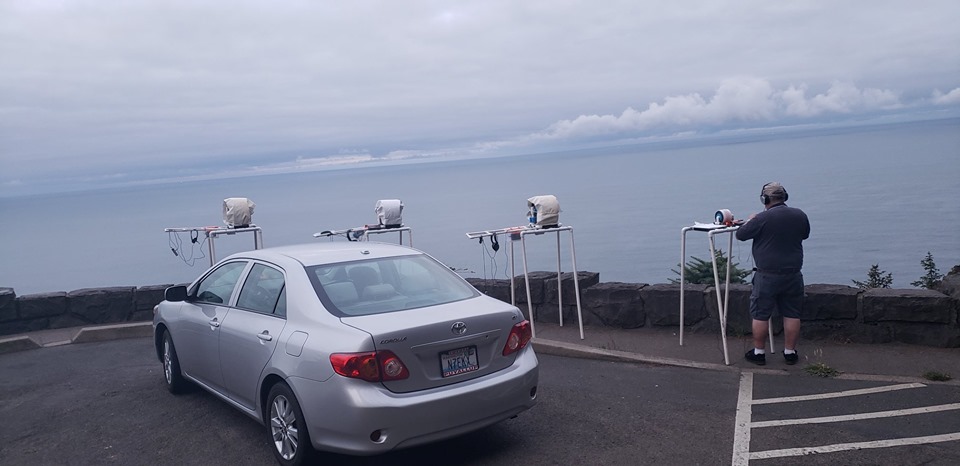
Gary DeBock DXing with Craig Barnes at the Rockwork 4 ocean cliff near Manzanita, Oregon, USA

Once again the largest FSL antenna collection on the planet made its way across the Columbia River bridge during an overnight trip to NW Oregon, finally being deployed at the original Highway 101 plunging cliff turnoff– Rockwork 4. There has been a drastic decrease in the squatter population, so that Craig Barnes and I were able to easily set up all four PVC bases for all-out DU-DXing at the dream site this morning (see photo). Unfortunately Chris Black came down with a health issue at the last minute, and needed to cancel out.

Craig and I had some excellent signals from the regulars (including 531-More FM, 558-Fiji and 1017-Tonga), although it wasn’t quite a stellar morning for rare DX. We were kind of spoiled last year with 1017-Tonga staying a S9 practically throughout the session, but this morning it was “only” at S9 for a few minutes at a time. This meant that as soon as I notified Craig of 1017’s potent status, the signal tended to nosedive. Maybe the cumulative effects of humidity and salt water exposure are beginning to take their toll on the Tongan big gun? 558-Fiji showed up with decent signals for a couple minutes at a time, which meant that Craig got the short end of the stick after I notified him of the potent signal. 531-More FM hit an awesome S9 peak around 1312 (including the usual split-second female ID), making it once again seem totally bizarre that no trace of the 2 kW modern rock station has ever been received at Grayland for the duration. The Rockwork Cliff is typically focused in like a laser on New Zealand, and this was a typical morning!

531 More FM Alexandra, NZ 2 kW Potent S9 modern rock signal from this Rockwork regular, with female “More FM” ID at 19 seconds:

Click here to download.

558 Radio Fiji One Suva, Fiji 10 kW Island music at temporary potent level at 1257; typically hit the skids after reaching this level:

Click here to download.

1017 A3Z Nuku’alofa, Tonga 20 kW Female Tongan speech at S9+ level at 1317:

Click here to download.

1017 Newstalk ZB Christchurch, NZ 10 kW Presumed the one under A3Z’s meltdown-level signal:

Click here to download.

73 and Good DX,
Gary DeBock (DXing with Craig Barnes at the Rockwork 4 ocean cliff near Manzanita, Oregon, USA)

DXpedition equipment:

7.5″ loopstick CC Skywave SSB and XHDATA D-808 Portables
15″, 15″ and 17″ Airport Unfriendly FSL antennas (see photos above)


Again, thank you so much for sharing your DX, Gary! I’m so amazed by the signals you snag each year with your homebrew loopstick antennas!

To read more of our posts by Gary DeBock, click here.

Backlit keys, headlamps, and radio listening in the dark…

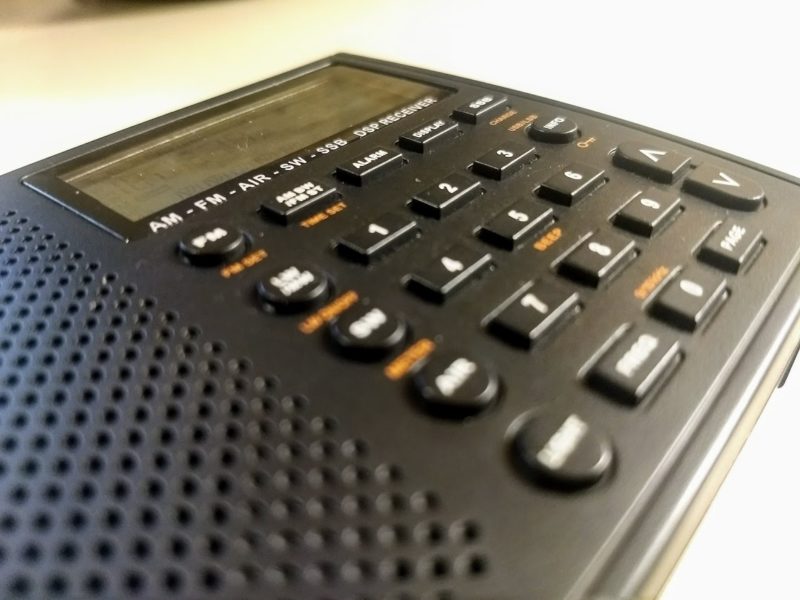
The Digitech AR-1780 has a very tactile button/key arrangement, but it is not backlit.

No less than two readers have contacted me this past week asking if I know of a shortwave portable that has backlit keys. Both of these guys, of course, are simply looking for a digital radio that’s a little easier to use at night in the dark.

Backlit keys would certainly make a lot of sense.

I’m going to look through my inventory of portables when I’m back home, but at the moment I’m drawing a blank. I can’t think of a single portable that has backlit keys, but I’m sure there are some out there in the wild. Can someone jog my memory–?

Readers: Please take a moment to comment with the make/model of any shortwave portables that have backlit keys! It would be nice to have a list to reference.

The indispensable headlamp…

I do quite a bit of portable shortwave listening in the dark. I especially like sitting on my porch at night to catch a little DX, pirate radio activity, or simply listen to one of my favorite broadcasters.  Even though I have much more capable radios in the shack–ones that are connected to large outdoor antennas–I love the simplicity of a potable for band scanning. Portables are especially fun for night time mediumwave DXing.

I also live in a relatively rural and remote area and one of the things I love about living here is the lack of light pollution at night. This also means that if I want to see when walking outside–and avoid walking into a visiting black bear (true story)–I’ll need some sort of flashlight/torch.

I’ve been made fun of before for carrying so many flashlights around (Mark Fahey, I’m looking at you–!), but frankly, these lighting tools have saved my bacon more than once.

I have an array of high-power portable flashlights, but the one I use the most is actually a headlamp. By using a headlamp, both hands are free to do work–especially helpful while tuning a radio.

These days, I never leave home without a headlamp. I always have one packed in my backpack, EDC bag, or luggage. Headlamps used to be heavy, expensive and sometimes used odd battery types. Today, headlamp prices are very reasonable, they’re lightweight, USB rechargeable, and they’ve become incredibly versatile.

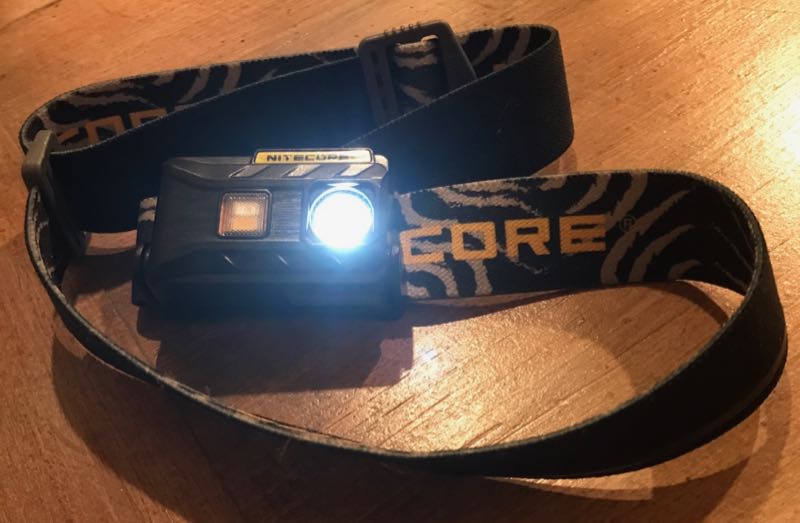
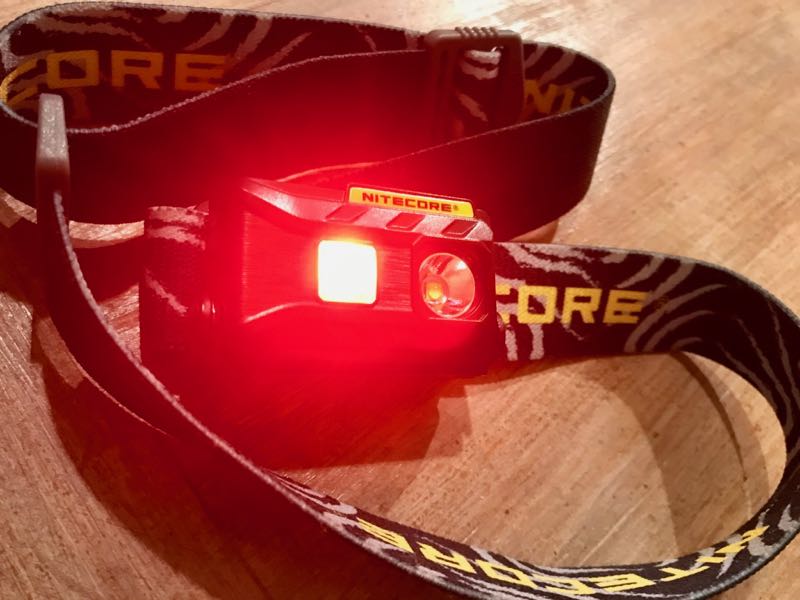
The Nitecore NU25

My favorite for performance vs. price is the Nitecore NU25. I’ve had this particular model for three months. The price is approximately $35 depending on the color you choose. It’s very lightweight and, best of all, USB-rechargeable.

The battery life is excellent; I use it all the time, yet I think I’ve only recharged it twice just to make sure the battery was topped-off.

I also like the Nitecore NU25 because it has an array of lighting options:

  • A primary light with up to 360 lumens (4 lighting levels)
  • A 20 lumen high CRI LED which better replicates soft sunlight
  • A 13 lumen red LED with two light levels and a flashing option

For radio listening, I often use the the CRI LED, or the brighter red LED setting which preserves my night vision.

If I’m reading a book, then I use the CRI LED which casts a very wide, comfortable, full spectrum light.

For walking, hiking, or doing DIY projects in the attic/basement, I use the main headlamp light which has a tighter beam and can cast light a significant distance.

The Nitecore NU25 is very compact and easy to take on my one-bag travels. I feel some sense of comfort knowing that if my hotel experiences a loss of power (again, true story) I’ve got a capable, multi-function light in my EDC pack.

Click here to check out the Nitecore NU25 on Amazon (affiliate link supports the SWLing Post).

There are actually a number of excellent headlamps on the market. Personally, I look for ones that are affordable, rechargeable, lightweight, compact, and have at least an auxiliary red LED (which I find most useful for astronomy). I considered the PETZL Bindi because it’s incredibly lightweight and a friend recommended it, but it lacks lighting options and is pricier than the Nitecore NU25. The PETZL Bindi is an excellent option for runners, however. The PETZL ACTIK CORE also came highly recommended, but it costs almost twice what I paid for the Nitecore NU25.

Of course, if you just want a simple, basic headlamp for SWLing, you can get away with this $15 Foxelli headlamp. It does almost everything the Nitecore does at less than half the cost. In fact, I’m tempted to buy one of these to keep in my truck.

Any headlamp/flashlight recommendations?

I know for a fact that there are some dedicated flashlight/torch enthusiasts in our community who are active members of the excellent Candlepower Forums. I’ve tapped into their knowledge more than once when purchasing flashlights. I hope they’ll chime in and comment with their recommendations!


Do you enjoy the SWLing Post?

Please consider supporting us via Patreon or our Coffee Fund!

Your support makes articles like this one possible. Thank you!

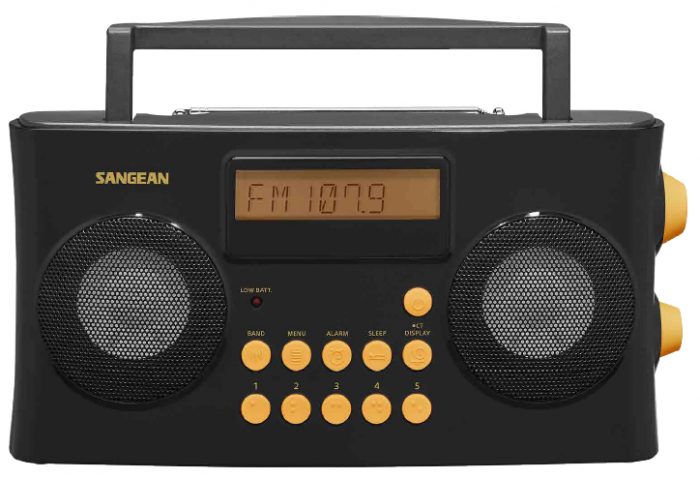
Sangean PR-D17 now shipping

I just received the following note from my contact at Sangean:

“We received our first [PR-D17] shipment yesterday and are starting to ship to our customers.”

After making an initial post about the PR-D17–a radio designed specifically for those who are visually-impaired– I’ve received several inquiries so I thought I’d share this status!

Click here to read about the PR-D17 at Sangean.

Click here to purchase the PR-D17 at Universal Radio.

Imre’s HanRongDa HRD-737 modification increases sensitivity

Many thanks to SWLing Post contributor, Imre Olajos, who writes:

Hi, HRD 737 lovers! I have a good news!

I  (became brave enough to) modify my HRD-737.

I tried reverse-engineering- but I gave up. No numbers on IC-s. I found specifications for the analog switches (one for each band ) and found information about the transistors around those analog switch IC-s. Nice, 1 GHz fT transistors, all surface mount, so I gave up that line.

I found an NPN SM transistor in a damaged TV remote. It is only a 300 MHz transistor but
I had no better than that, so I started to build a little antenna amplifier circuit, wide band and simple.

I lost a few SM capacitors during the soldering but I have plenty of those. So the 1/4 square inch circuit board was finished last week. I tested it with an external 3 volt battery and I found it good working. Today ( 07-27-2019 ) I opened up the HRD-737 and wired it into the radio.
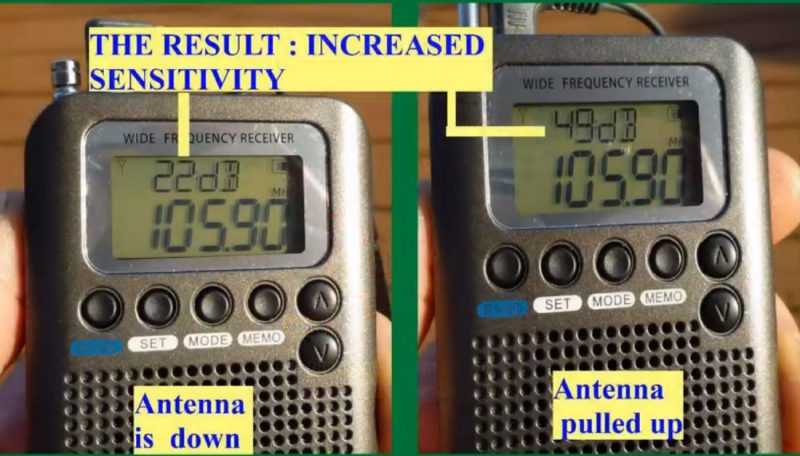
The results are much better than I expected. The HDR-737 became a good shortwave radio!

When I touch the built in antenna by my finger, radio is sensing the touch and station comes in. This effect was not there before. Radio became more sensitive on CB band than my Realistic DX392.

I have a YouTube channel [in the following video/slideshow] and I will show you the little ugly but great working circuit in the radio:

Click here to view on YouTube.

Later on next week I will try to record some video of the shortwave reception and post up it on the same YouTube channel.

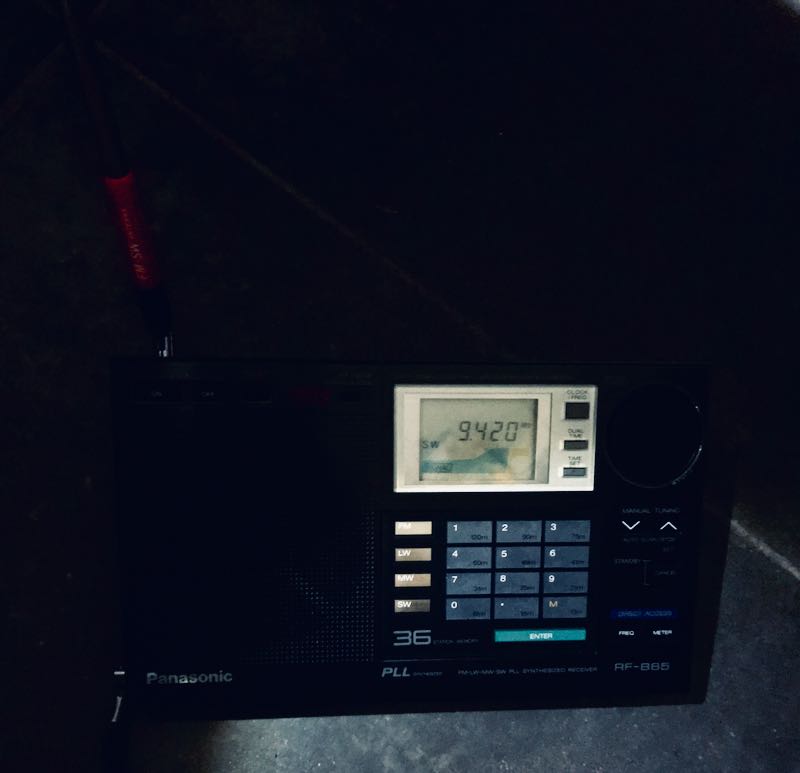
I am a shortwave lover since 50+ years and I will be very happy to share the good news with others. Now I can listen my Greek music on this little radio, on 9420 kHz. Yes, the radio became [more sensitive than I had hoped].

You can see my other shortwave radios on my YouTube channel too, Have fun and never give up the hope!

Many thanks, Imre, for sharing and documenting this modification. One of the lessons here, too, is that if you have an inexpensive radio like the HanRongDa HRD-737 and you feel tempted to try a modification, there’s little to lose. It’s not like modifying a $1000 transceiver–just dig into the little radio and give it a go. If you harm the radio, you’ve only invested $37 or so in the project. That’s a much better solution than letting it sit on a shelf collecting dust because it’s not sensitive enough! Well played, Imre!

A photo tour of the 2019 WCARS hamfest

Yesterday, I attended the WCARS hamfest in Waynesville, North Carolina, with my friend Sébastien (VA2SLW) who is currently on vacation in the area.

The WCARS hamfest is a smaller regional hamfest, but it attracts a lot of folks from the mountain regions of north Georgia, Tennessee, South Carolina, North Carolina, and beyond.

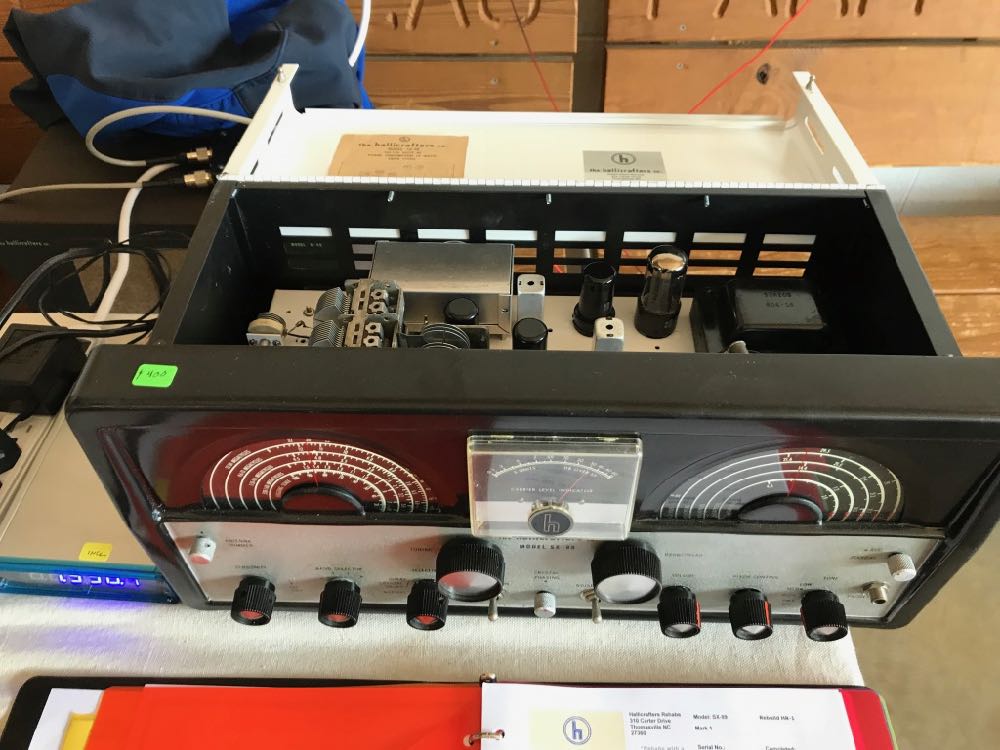
The WCARS hamfest flea market always has quite a variety of radios, including a number of great vintage models. I’ve been very lucky in the past finding excellent deals, too. This year, I (reluctantly) passed up a few deals knowing I’m also attending the Huntsville Hamfest in August and the Shelby Hamfest in September.

Below, you’ll find a selection of photos from the hamfest. Note that you can click on the image to enlarge it and I attempted to include price tags when possible:


Do you enjoy the SWLing Post?

Please consider supporting us via Patreon or our Coffee Fund!

Your support makes articles like this one possible. Thank you!