
Category Archives: Radios

Guest Post: Tracking High Seas Pirates on Shortwave Radio

Suspected pirates surrender to crew members of the CGC Boutwell. (U.S. Coast Guard photo)

Suspected pirates surrender to crew members of the CGC Boutwell. (U.S. Coast Guard photo)

Many thanks to SWLing Post contributor, Mario Filippi (N2HUN) for the following guest post:


Tracking High Seas Pirates on Shortwave Radio

by Mario Filippi (N2HUN)

(All photos taken by author–click to enlarge)

Ahoy! After spinning a radio dial for over a half-century, shortwave listening still provides a source of adventure and interesting intercepts. While major broadcasters continue to move to the Internet and dwindle in number, there nonetheless remains plenty of utility intrigue to be had; you just need to know where to look, and be comfortable with other modes of communication such as RTTY (Radioteletype).

RTTY remains on HF (3 – 30 MHz), albeit mostly encrypted, but there are some stalwarts of this mode that transmit important and interesting information for ships at sea. The information can take the form of weather broadcasts, hazards to navigation, information on ships lost at sea, and pirate activity. Yes, pirate activity but not radio pirates; real honest-to-goodness modern day pirates looking to loot, plunder and prey upon commercial ships making an honest living or other leisure watercraft just out having fun.
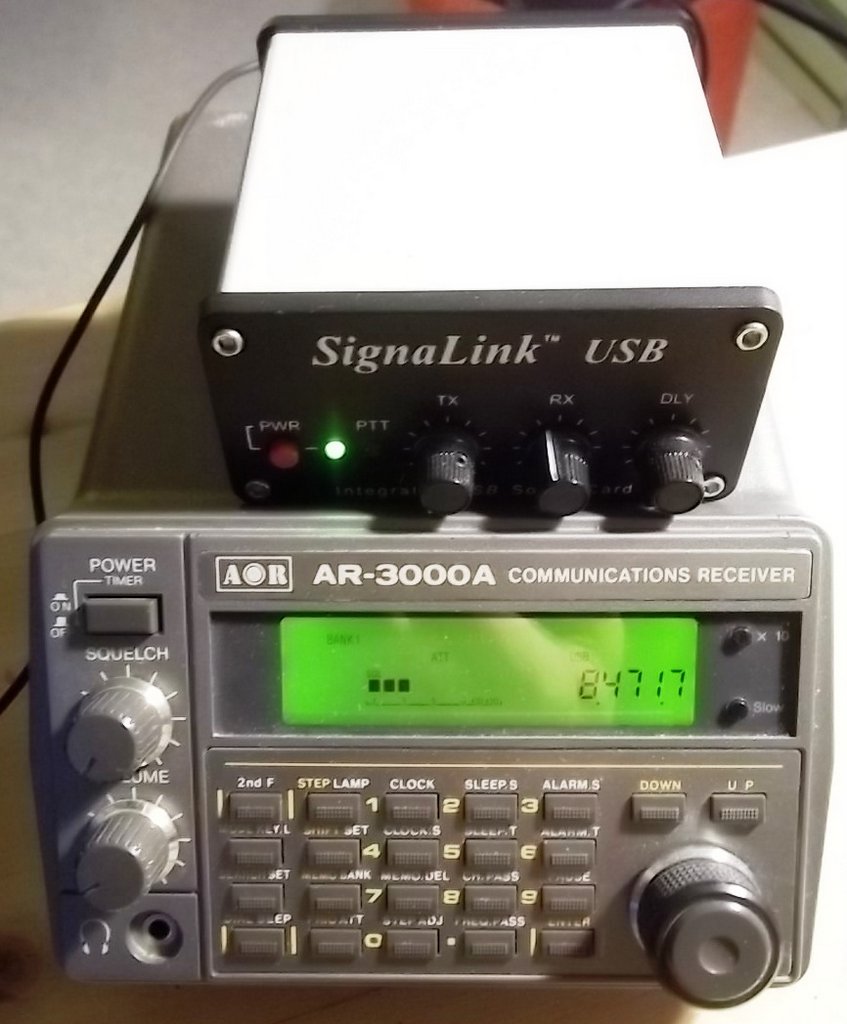
SignaLink-AOR

Who knows what dangers lurk behind that dial? Trusty AOR AR-3000 receiver and SignaLink™.

Has your interest been piqued? When avast mateys as I spin ya’ a yarn on how to find out where these sea-faring scoundrels lurk from the Caribbean all the way to the South China sea!

Pirate activity is not something of the past; it exists today and is a threat conducted by ragtag armed ragamuffin groups. To keep abreast of the action you’ll need the following gear: a shortwave radio with single sideband (SSB), a decent antenna, a means of decoding RTTY, and WLO, a station from Mobile, AL that transmits information to ships at sea.

You’ll do well to add WLO’s frequency to your receiver’s memory list as it’s a pretty active station that faithfully serves the sea-faring community and is one of the gems on HF.

First, tune your receiver using USB (Upper Side Band) to around 8.472 MHz and listen for that warbling sound. You will also need a way to pipe the audio from your shortwave receiver to a computer (I use a SignaLink™ USB) and a decoding program for RTTY, such as MMTTY.

To decode you’ll need to set the baud rate (45.45) and shift (170 Hz) on MTTY (or software program of choice) and tune your radio slightly up and down frequency until the software starts decoding.

You may have to press the “Reverse” or “Rev” selector at times. MMTTY is my favorite for RTTY decoding, and a picture of it is below.

WLO, Mobile AL, with RYRY idling loop, MMTTY decoder, 45.45 bauds, 170Hz shift, “Rev.”

WLO, Mobile AL, with RYRY idling loop, MMTTY decoder, 45.45 bauds, 170Hz shift, “Rev.”

MMTTY is available as a free download from Makato Mori, JE3HHT. I’ve used his program for over a decade and it performs well.

You can also use MultiPSK or FLdigi to decode RTTY so it’s the user’s choice as to which is a better fit.

Anyway, what are these pirates up to? Well the next few screenshots (click to enlarge) show some interesting activity as per WLO’s RTTY transmissions:

Pirates use element of surprise with guns and knives as armaments.
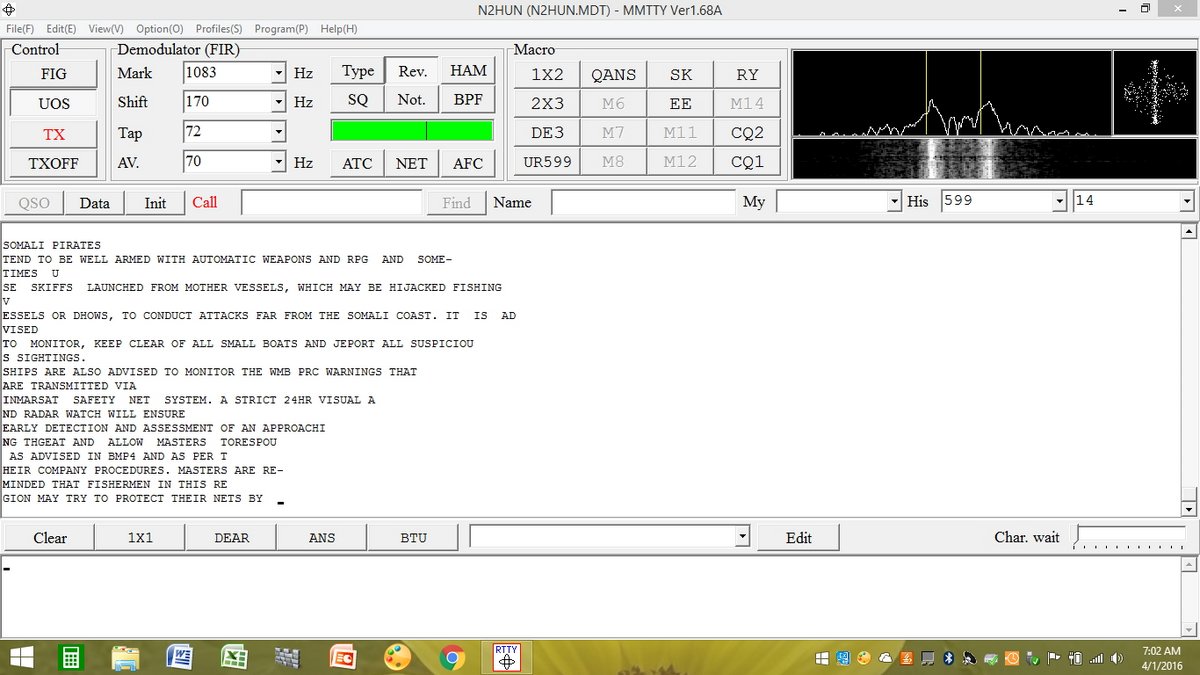
Pirates use element of surprise with guns and knives as armaments.

Somali pirates reportedly armed with automatic weapons and rocket-propelled grenades. Yikes!
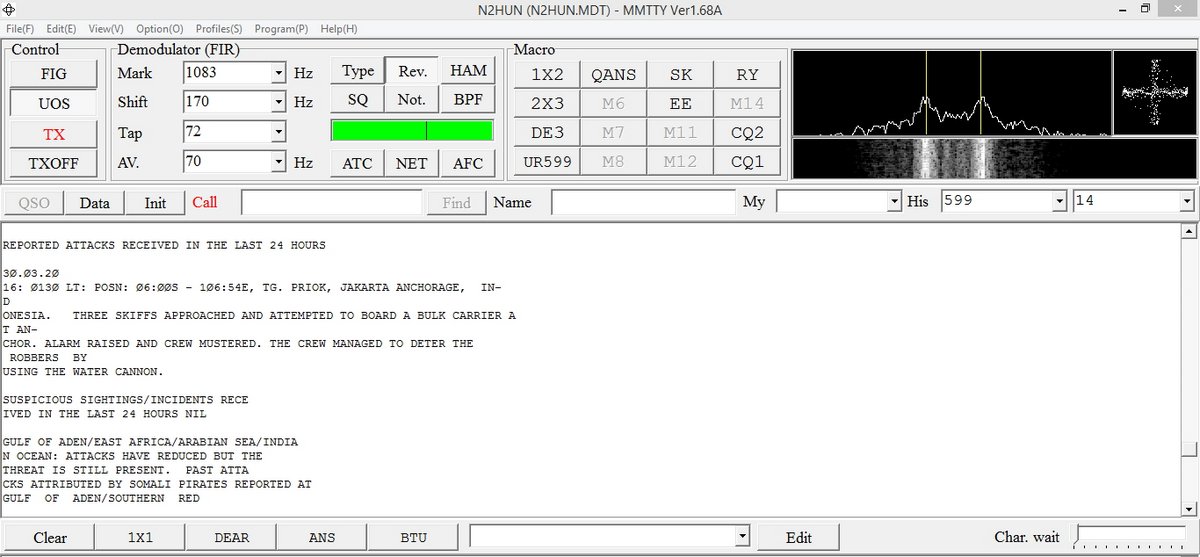
Somali pirates reportedly armed with automatic weapons and rocket-propelled grenades. Yikes!

pic5

Give ‘em hell boys! An alert bulk carrier crew aborted hijacking with teamwork and water cannon.

Ships are encouraged to report pirate activity via FAX or phone.

Ships are encouraged to report pirate activity via FAX or phone.

Well mateys that’s enough high seas adventure for now, so first shove off to the galley for some grub (or grog) and then head to the radio room, turn on that rig and get ready for action on HF, you’ll find plenty to choose from, it’s out there for you.

I would like to thank the operators of WLO for providing such a valuable service to mariners and for providing us radio aficionados with interesting reception! And thanks readers!

P.S. Note that WLO alternates from RTTY to Sitor B so just make sure you are listening to the RTTY broadcast. If the transmission is in Sitor B then you can use a NAVTEX (e.g. YAND) decoder instead.


Thank you so much, Mario, for sharing yet another fascinating aspect of our radio world! FYI: I’m planning on purchasing a SignaLink USB at the Dayton Hamvention this year.

Readers, you can read all of Mario’s posts by clicking or bookmarking this link.
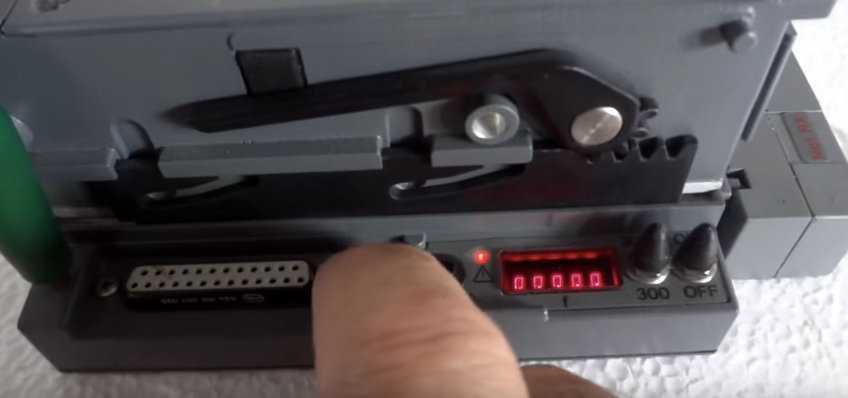
Cold War Spy Radio: Videos of the FS-5000

FS-5000-Spy-Radio

In response to Guy Atkin’s recent post, Psst, Buddy! Wanna Buy a Spy Radio?, @Cipherguerrilla comments via Twitter with the following videos of the FS-5000:

Click here to watch the FS-5000 being unpacked and assembled, and here to watch the FS-5000 in operation. I’ve also embedded both videos below.

Many thanks for sharing these videos,@Cipherguerrilla! The FS-5000 is certainly a fascinating purpose-built radio.  I’d love to have one.

A QS1R replacement in the works?

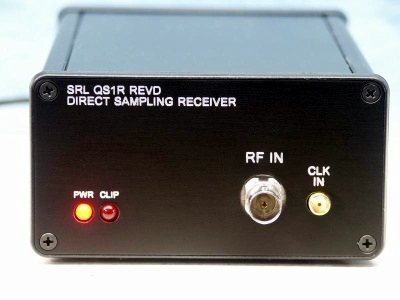
qs1r_front_sm1

Many thanks to SWLing Post contributor, Ken McKenzie, who noticed the following message from Phil Covington (of Software Radio Laboratory LLC) on the QS1R Yahoo group:

I am working on a replacement for the QS1R that will be less expensive, yet
use updated components. I am hoping to have them in production by the end of March.

Regards,

Philip A Covington
Software Radio Laboratory LLC
Columbus, Ohio
http://www.srl-llc.com

Ken noticed that the message was originally dated about one month ago, so I’ll follow-up with Phil and see how much progress has been made. The QS1R was a well-respected SDR that had been on the market for several years. It would be great to see an updated version on the market.

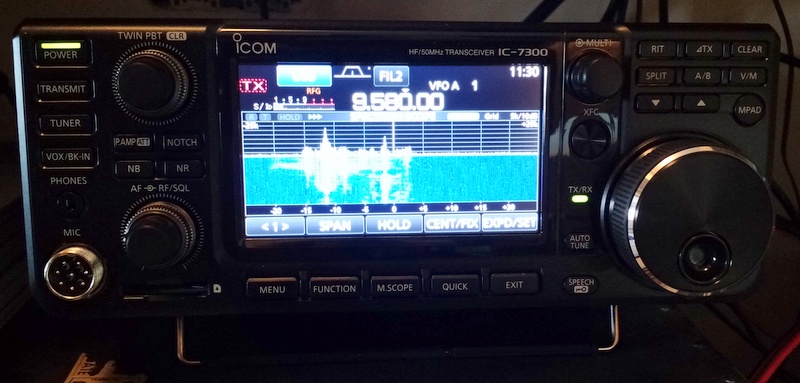
Look what just landed on my desk: the new Icom IC-7300 direct sampling transceiver

Icom-IC-7300-Front-2

[UPDATE: Read the full IC-7300 review–along with listener survey results–by clicking here.]

I have a new toy in the shack: the Icom IC-7300.

Last night, a good friend handed over his brand-spanking-new IC-7300 and is allowing me to evaluate it over the next week or so.

The IC-7300 is Icom’s first “entry level” RF, Direct Sampling System HF transceiver.

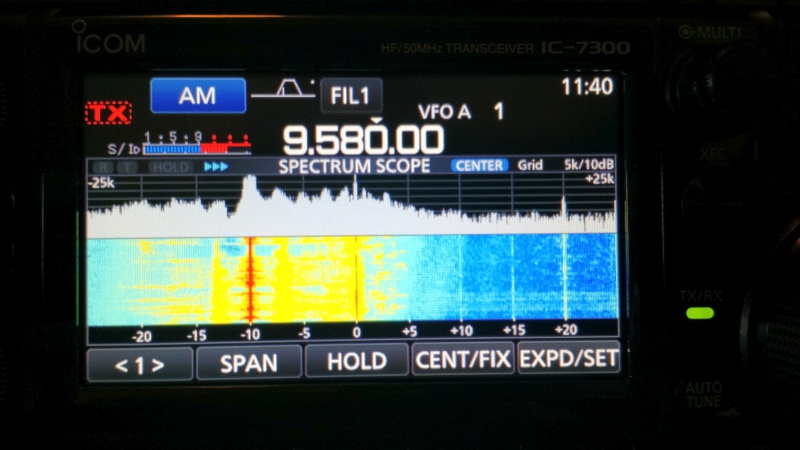
I’ve only had the IC-7300 on the air for a few minutes, so can’t comment about performance. I can say that it has one of the most intuitive interfaces I’ve seen on a transceiver with so many functions. I also love the spectrum display–small, but large enough to see all of the pertinent information:

Icom-IC-7300-Front-Display

It’s a slick machine, indeed!

Time permitting, I plan to post a few audio clips and get reader reactions much like I did for in the portable shoot-out.

I’ll compare the IC-7300 to my Elecraft KX3 and a few SDRs as well. Of course, I’m evaluating this during one of the busiest times in my life, so we’ll see how quickly I progress–!

Simply follow this tag for updates: IC-7300.

Psst, Buddy! Wanna Buy a Spy Radio?

This unusual Ebay posting is one of the most interesting I’ve seen in a long time: a genuine, new spy radio transceiver!

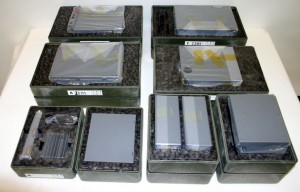
Given its rarity and new condition, the $1,900 asking price seems reasonable to me for what a well-heeled collector might pay. The set is referred to as a “FIELD SET MODEL FS-5000 SHORT WAVE SPY RADIO”.

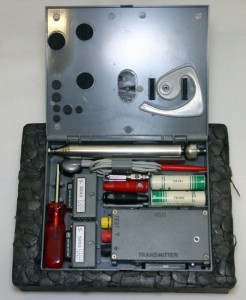
It comes as one carton containing four larger fiber boxes and three smaller fiber boxes, all containing modules that are combined to make a digital radio transceiver system.

spy_radio

spy_radio_xmtr

The seller says that the equipment (complete with shock-absorbing transit containers) bears no manufacturer marks, but was likely made in Germany by Telefunken. The various components look to be extremely well made, and the seller has provided these links for more information on this unusual 0.5-30 MHz transceiver:

http://www.cryptomuseum.com/spy/fs5000/index.htm

http://www.tuberadio.com/robinson/Information/FS5000/

http://www.prc68.com/I/FS5000.shtml

Be sure to check out all the clear photos provided by the Ebay seller of this fascinating transceiver.

Guy Atkins is a Sr. Graphic Designer for T-Mobile and lives near Seattle, Washington.  He’s a regular contributor to the SWLing Post.

One year with the TitanSDR

TitanSDR-VOG

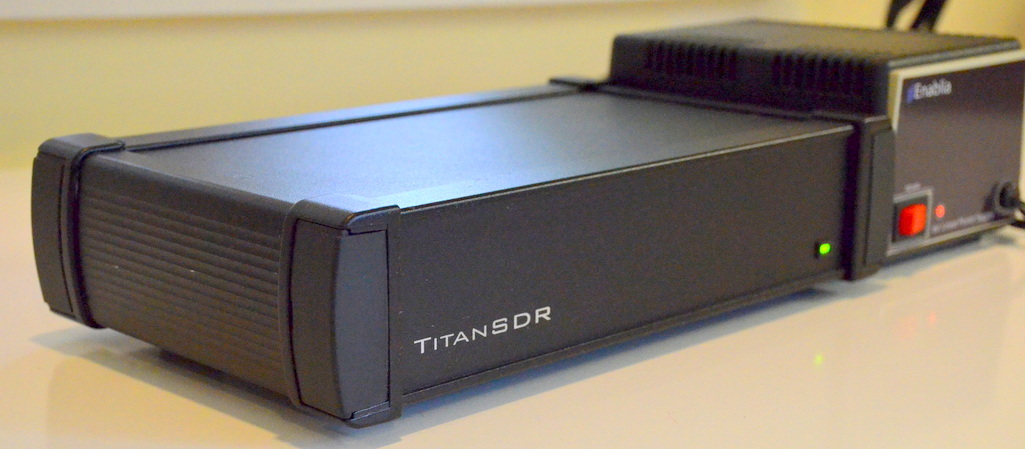
Last year, I reviewed the TitanSDR Pro by the Italian manufacturer, Enablia,. I was very impressed with not only this receiver’s performance, but also its accompanying application’s user interface. I also noted in the review that the TitanSDR is pricier than many other benchmark SDRs on the market ($1380-1970 EUR) but it is, after all, essentially a military-grade SDR that has been ported to the enthusiast/ham radio market.

I’ve been using and testing updates to theTitanSDR Pro for a year now, and I continue to be just as impressed with this receiver––and, especially, with the company who manufactures it, Enablia.

TitanSDRPro-3

I wondered at the time of my initial review how supportive Enablia might turn out to be; I knew time would tell.  Since my original review last year, Enablia has been regularly updating the TitanSDR application, adding many features requested by its users.  This shows a remarkable degree of responsiveness, and I now feel safe to say that that Enablia is an exceptional manufacturer with an exceptional product.

Only recently, I received an update which added two notch filters per narrowband channel, memories that retain AGC and notch filters settings, and sessions that retain AGC settings. I understand Enablia is also preparing updates that improve upon memory management, user interface, audio defaults, as well as offering a few tweaks to the existing feature set.

Overall, Enablia developers are certainly making this signal intelligence SDR cater to the ham radio and enthusiast market even better than before.

Though I use a number of SDRs, I reach for the TitanSDR any time there are multiple-band openings since it can record spectrum and audio across the entire LW/MW/SW landscape. Unlike my other SDRs, it’s not limited to an (already generous)  2-6 MHz recording/listening window.

For example, on Thursday night I had a lot on my listening/recording plate as there were a number of band openings. I had the TitanSDR tuned to:

  • the 31 meter band,
  • the 20 meter ham radio band,
  • the 49 meter band (specifically monitoring South American stations), and even
  • the mediumwave band.

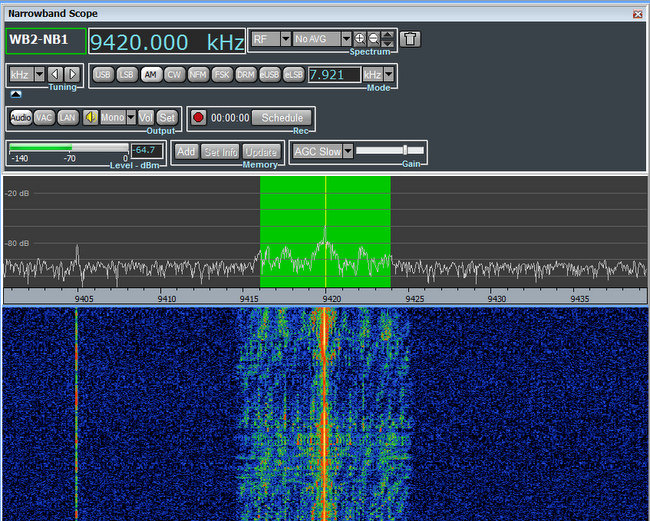
The TitanSDR was recording spectrum on the 49 meter band while I made this AF recording of the Voice of Greece on the 31 meter band (9420 kHz, starting around 00:26 UTC on April 8, 2016):

Surprisingly, all of this recording wasn’t taxing my PC, nor the TitanSDR.

The TitanSDR application is highly stable and uses resources efficiently. Indeed, in the past year, to my knowledge the TitanSDR application hasn’t crashed even once, despite my rigorous demands of it. Since it runs nearly 24/7 in my shack, on a four-year old PC (third generation i5 Win 7), that’s saying a lot.

SWLing Post reader, Tony Roper, is also a heavy TitanSDR user and recently posted this 30+ minute video demonstrating some of the TitanSDR’s new features. Note that his screen capture software produced fairly low audio, so you’ll need to turn up the volume to hear his commentary:

Click here to view on YouTube.

In short, I stand by my conclusions drawn last year in my TitanSDR review:  although pricey compared to the competition, for those who can afford the price tag, the TitanSDR is a worthy hard-core DX machine that is especially useful to need a receiver with a bullet-proof front end, to weak-signal DXers, and to radio archivists like yours truly.