Category Archives: Recordings

Carlos Shares Shortwave Art and Recordings of Ethiopian Jamming and BBC News Tigrinya

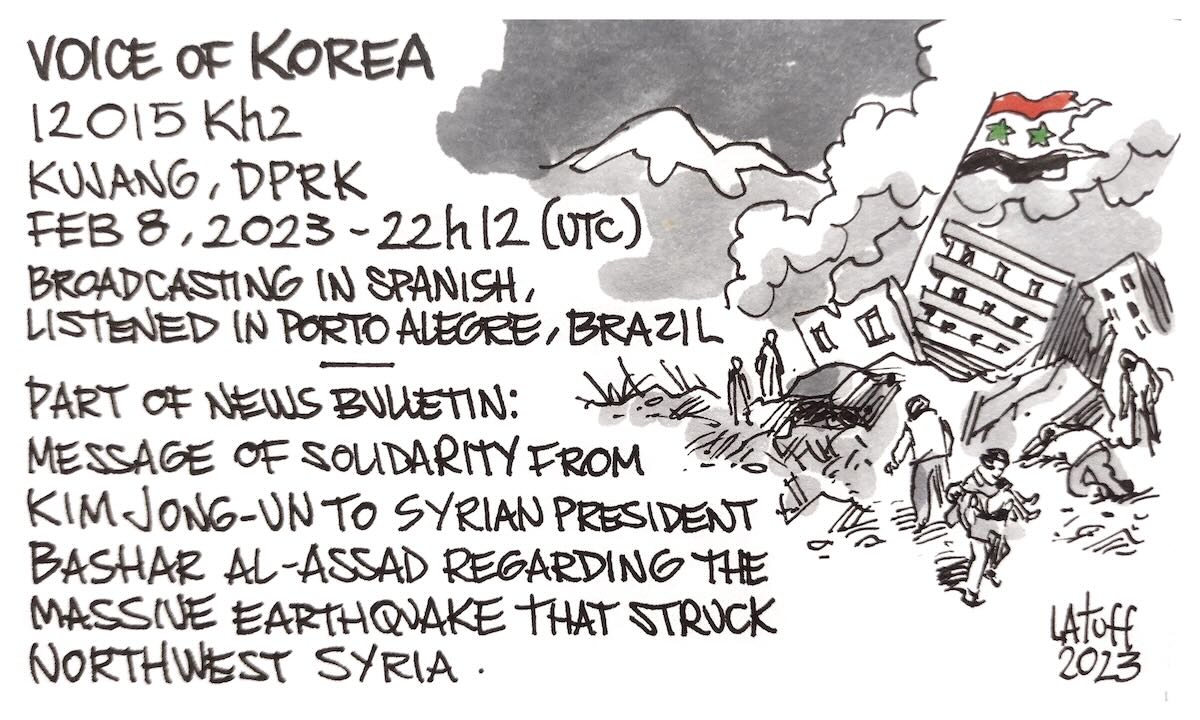
Many thanks to SWLing Post contributor and political cartoonist, Carlos Latuff, who has been exploring the world of clandestine radio, documenting the on-going conflict in Ethiopia via shortwave radio. The following are two examples of his radio log art, this time for documenting jamming of Dimtse Wegahta Tigray and BBC News Tigrinya. Carlos shares the following art and recordings:

Ethiopian Jamming

Characteristic noise of “jamming” (intentional interference), probably coming from the Ethiopian government, preventing reception of the signal from the clandestine broadcaster Dimtse Wegahta Tigray (Voice of the Dawn Tigray).

Dimtse Wegahta Tigray broadcasts daily to warring Ethiopia on the frequency of 15340 kHz, using the powerful transmitters of the company TDF (Télédiffusion de France) in Issoudun, France.

Captured at Parque da Catacumba, Rio de Janeiro, 12/29/2021, 2:36 pm (local time):

Click here to view on YouTube.

BBC News Tigrinya broadcasting from UAE to Ethiopia/Eritrea

BBC News Tigrinya, 12065 kHz, broadcasting from Al Dhabbiya, United Arab Emirates (UAE).

Excerpt from the news.
– Ethiopian party member EZEMA talks about the intention to form a cabinet in the government of Ethiopian Prime Minister Abiy Ahmed despite the war.
– US Embassy in Eritrea asks that country’s government to release political dissidents.

The BBC is among the news channels that are accused by the Ethiopian government of “spreading fake news”.

Signal received in Rio de Janeiro, 01/04/2022, at 3:14 pm (local time).

Thanks to yaredinho_r9 for the translation.

Click here to view on YouTube.

Recordings of WI2XLQ: 2021 Commemorative Fessenden Broadcast on 486 kHz

WA1ZMS’ 600 meter transmitter

Many thanks to SWLing Post contributor, Brian Smith (W9IND), who shares the following recordings and notes:

Since 2012, experimental radio station WI2XLQ in Forest, Virginia, has presented an annual Christmas Eve/Christmas Day transmission in honor of Canadian radio pioneer Reginald Fessenden. Operated by Brian Justin, WA1ZMS, the station transmits on 486 kHz, just below the American AM broadcast band.

Here are two short recordings of the 2021 broadcast that I made around 9 p.m. on Christmas Eve (Indianapolis time) or 0200 UTC Christmas Day.

No DXing feat on my part: Unable to receive the station in the Indianapolis area, I listened via the online SDR of K1RA in Warrenton, Virginia, about 120 miles northeast of WI2XLQ.

My recording equipment? Again, nothing to brag about — just my trusty Android cell phone, which captured 4- and 6-minute snippets of the broadcast.

Signal strength varied widely from inaudible to excellent — mostly in between — and not surprisingly there’s plenty of QRN (static). The repeating program consisted of two songs, including a violin rendition of “O Holy Night,” followed by a station ID.

For those who’ve never managed to hear WI2XLQ’s annual transmissions, I hope you’ll enjoy this sampling of what you missed.

NOTE: As even Justin acknowledges, these broadcasts commemorate a reputed 1906 event that may not actually have taken place. Despite Fessenden’s claim of achieving the first voice (and music) transmission, substantiation is lacking. Whatever the truth, Fessenden was unquestionably one of the foremost radio experimenters of his era.

Recordings:

Many thanks for sharing this, Brian!

Note that if you missed the WI2XLQ on Christmas, note than Brian Justin plans to repeat the Fessenden broadcast on New Year’s Eve and New Year’s Day!

Carlos’ Shortwave Art and Recording of Dimtse Wegahta Tigray (Voice of the Dawn Tigray)

Many thanks to SWLing Post contributor, Carlos Latuff, who shares the following recording of Dimtse Wegahta Tigray and notes:

Dimtse Wegahta Tigray (Voice of the Dawn Tigray), 15340 kHz, clandestine broadcast in the Tigrinia language from Issoudun, France, to warring Ethiopia.

    • Tigray regional government sends letter to UN Secretary General Antonio Guterres.
    • US emissary to Ethiopia says the withdrawal of tigray troops from Amhara and Afar will open the door to peace talks.
    • Ethiopian Prime Minister Abiy Ahmed speaks on peace talks as the fight against Tigray forces continues.

Signal received in Juiz de Fora, MG, 12/25/2021, 14:33, local time.
Thanks to Hamza Oromo, Habay11521925, and HizbiTigray for the translation.

Many thanks for sharing, Carlos!

Carlos’ Shortwave Art and Recording of Clandestine Republic of Yemen Radio

Many thanks to SWLing Post contributor and noted political cartoonist, Carlos Latuff, who shares another example of his radio log art, this time for clandestine station, Republic of Yemen Radio.

Carlos notes:

Republic of Yemen Radio, 11860 kHz, Saudi Arabia’s clandestine broadcaster broadcasting political propaganda to Yemen, a country that has been undergoing Saudi military intervention since 2015. Excerpt from a romantic song by the famous Yemeni singer Ayoob Tarish.

Signal picked up in Rio de Janeiro on Euro 12, 2021 at 6:03 pm. I thank Suhaila Abdel Latif for the kindness of the translation.

Guest Post: Don targets rare Norwegian stations during Newfoundland DXpedition

Photo by the Bjørnøya Meteorologiske Stasjon

Many thanks to SWLing Post contributor, Don Moore–author of  Following Ghosts in Northern Peru–for the following guest post:


The Rarest DX?

By Don Moore

In mid-October I received an invitation to attend the annual DXpedition in Cappahayden, Newfoundland with Jean Burnell, John Fisher, and Jim Renfrews. It didn’t take long for me to say yes. Newfoundland is one of the best places in the world to DX from and all kinds of amazing stuff has been heard there. I was excited at the prospect of great medium wave DX and being able to log low-powered European private and pirate shortwave broadcasters.

But something else was at the top of my try-for list. One of my many DX interests has always been logging coastal marine stations in the 1600 to 3000 kHz range. In preparation I started checking online sources to update my spreadsheet of schedules. In going through a recently added section on Marine Broadcasts in the DX Info Centre website I came across listings for twice-daily weather broadcasts from Hopen Island on 1750 kHz and Bjørnøya (Bear Island) on 1757 kHz.

I didn’t remember ever seeing anything about broadcasts from these remote islands in the Norwegian Arctic before. Were these stations actually on the air, I wondered. And if they were, could I hear them in Newfoundland? Continue reading

Carlos’ Shortwave Art and Recording of Radio Oromiya

Many thanks to SWLing Post contributor and noted political cartoonist, Carlos Latuff, who shares another example of his radio log art, this time for Radio Oromiya.

Carlos notes:

Radio Oromiya, 6030 kHz, broadcasting in Oromo language from Adis Abeba, Ethiopia. Presenter accuses Western media of spreading fake news about the war in #Ethiopia.

Signal listened in Arraial do Cabo, Brazil, December 6, 2021, 20h10 (UTC).
Thank you Mr. Hamza Oromo for the translation.

Click here to listen on YouTube.

Radio Preservation Task Force announces partnership with the Shortwave Radio Audio Archive and Radio Spectrum Archive

I’m honored to announce that the Shortwave Radio Audio Archive and the Radio Spectrum Archive are now partners of the Radio Preservation Task Force.

Click here to read the official press release.

To say that I’m enthused would be an understatement:  the Radio Preservation Task Force has, as of today, officially partnered with the Shortwave Radio Audio Archive and Radio Spectrum Archive.   

When I learned that the Library of Congress’s National Recording Preservation Board created the Radio Preservation Task Force (RPTF) in 2014, I became an enthusiastic contributor early on, having started a modest preservation project myself only a few years prior.  Then, a partnership like the one created today would have been one of dreams.

As many of you here know, I’m not only passionate about technologic innovations in our radio space, but also preserving our past.

Shortwave Radio Audio Archive

It was in 2012, in response to a round-table discussion at the Winter SWL Fest, that I created the Shortwave Radio Audio Archive (SRAA). Many of us in the radio community were concerned about the number of original, made-from-home, off-air shortwave radio recordings (airchecks) that we knew were in existence, yet were simply disappearing with the passage of time. We were well aware of members of our community who had either passed away or downsized, and many of their recordings––some of pivotal world events––were being tossed out by well-meaning loved ones or friends who simply didn’t understand their relevance. In addition, many of these recordings were captured on magnetic tape, which becomes brittle with time; we knew these recordings were literally turning to dust.  I felt I had to do something.  The SRAA was that something.

Fortunately for me, the SRAA’s mission has really resonated within our radio community. Today, we have thousands of off-air recordings, all freely available to everyone. The recordings can be downloaded directly from the archive, but many listeners simply subscribe to the SRAA Podcast and receive each recording automatically, as it is published.

Turns out, the archive also attracts the interest of individuals outside of our radio world including historians, musicians, and filmmakers. Indeed, the archive has even been reviewed in The Wire Magazine by a music critic as an audio resource for electronic musicians. At time of posting, the SRAA is the inspiration for artists in the latest Cities and Memory project Shortwave Transmissions.

The archive is not, nor has ever been, monetized; it has no commercial sponsorship, and is completely funded by its contributors. It is free and open to everyone.

I’m exceedingly grateful to our many contributors who continue to unearth absolutely amazing off-air recordings. Our SRAA contributors are true champions of preserving our radio heritage in a space that will long outlast us.  We’ve taken measures to ensure that multiple archivists have full access to the site, so its existence isn’t dependent on any one individual. We also actively seek organizations and educational institutions who can house redundant copies of the Archive.

And still it grows.

Radio Spectrum Archive

Compared with the SRAA, the Radio Spectrum Archive (RSA) is still in its infancy.  But it, too, is growing, and the reason for this steady and growth is the existence of its contributors and other supporters.

Of course, while audio recordings––like those in the SRAA––are relatively small (often between 2 – 120 MB), spectrum recordings are larger by orders of magnitude.

As you might imagine–even in 2021/2022–it is not a simple task to digitally archive and share/move 20GB to 2 TB collections. We are incredibly fortunate in that the Internet Archive supports the RSA and gives us valuable real estate on their servers to preserve and share recordings.

With time, this collection will grow and become a resource for everyone. Our hope is that we may even be able to built a web interface (much like those used by Web SDRs) to play back recordings without having to physically download them.

My wholehearted thanks…

Of course, none of this would have been possible without the many contributors from within our radio community. Thank you all so much for being a part of a movement that archives our amazing, and amazingly diverse, radio history. You have made this possible.

Finally, I’m so grateful to the Radio Preservation Task Force––not just for this empowering partnership and what it means to us today, but for the future potential it represents.  It’s clear that we’ve only just begun.

Thank you––thank you––thank you, all.

Thomas Witherspoon