Category Archives: Shortwave Radio

“Shortwave radio in Ukraine: why revisiting old-school technology makes sense in a war”

Many thanks to a number of SWLing Post contributors who’ve shared the following article from The Conversation:

Shortwave radio in Ukraine: why revisiting old-school technology makes sense in a war (The Conversation)

Shortly before access to the BBC News website was reportedly blocked in Russia a few days ago, the BBC announced that it was resuming the broadcasting of the BBC World Service via shortwave radio for four hours per day. It said that this was to ensure that people in parts of Russia and Ukraine can access its news service.

In a world with near-ubiquitous adoption of mobile phones, the use of early 20th century radio technology might seem unusual. But it makes sense for a number of practical reasons.

Shortwave radio is an old variant of what many people may remember as “AM” analogue radio, operating on low frequency radio waves to deliver audio services. Shortwave radio is far simpler than modern digital TV or telecommunications services: receivers are widely available (or can be built from spare electrical parts), and it works across long distances.

Traditional broadcast TV and radio fundamentally differ from modern internet-based services. Like Freeview TV received over an aerial, traditional broadcast radio services don’t require you to transmit anything to be able to receive a service. It’s transmitted once, and anyone with a receiver can listen or watch.

When someone uses a shortwave radio receiver, there’s no lasting trace of them using it. This makes it hard for an occupying force to find those listening to (perhaps banned) overseas media.

Conversely, when you browse the internet or use a mobile app, your device is requesting the content you wish to receive, and it’s being sent directly to your phone. This bi-directional communication means that when you browse the internet, various entities like your internet provider are able to see that you visited certain websites.

Internet-based services can also become overloaded, either as a result of high demand, or due to malicious attacks flooding a service with requests, aiming to make it unavailable.

There are a number of other technical reasons why shortwave radio can be very useful in crisis situations. Since it uses lower transmission frequencies, the signals can travel much further than TV or mobile phone signals – thousands of kilometres, rather than kilometres or tens of kilometres.

This means the BBC can broadcast from outside into a conflict zone without needing local physical infrastructure. And since low frequencies are used, the signals propagate better through buildings and the environment. If you’ve ever experienced poor mobile phone signal in the centre of an old building, you’ve experienced the challenges of radio propagation. Low frequency signals reach into buildings and basements better, even when transmitted from far away, which might be useful for people who are taking shelter.[…]

Click here to read the full article.

CIDX: Focus on Ukraine

Many thanks to SWLing Post contributor, Sheldon Harvey, who shares the following:

The Canadian International DX Club, Canada’s national radio monitoring club, has prepared a special 10-page feature article “Focus on Ukraine”, providing dozens of links to information sources on the conflict in Ukraine, including a lot of radio information. The feature is available through our webpage at https://cidxclub.ca/ukraine/

You can also request a free sample copy of the CIDX monthly publication “Messenger”. Simply send an e-mail to sample (at) cidxclub (dot) ca

As a member of the CIDX, I encourage you to check out this information page and also grab a sample of the CIDX newsletter for free. Become a member for as little as $10/year. Lots of great info in the Messenger!

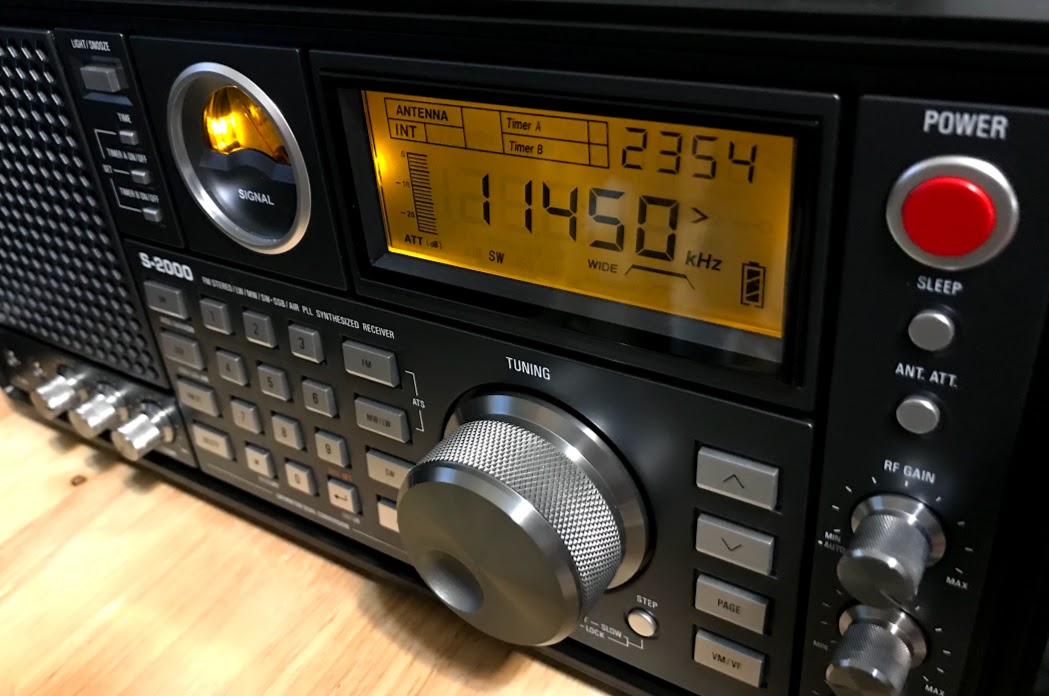
Rafael spots a Tecsun S-2000 in “The Captain”

Many thanks to SWLing Post contributor, Rafael Rodríguez R., who writes:

Greetings from Colombia!

In a Chinese film called “The Captain” (2019) or in its Spanish title “Terror in the Air” that recreates the situations experienced in 2018 by Sichuan Airlines flight 3U8633, when on their trip from Chongqing to Lhasa, they lost pressure due to a broken windshield on the passenger side.

In a scene where an aviation fan finds out about the situation of the plane, a Tecsun model S-2000 appears; which inherited the design and technology of the Grundig Satellit 750, and has also been produced under the Eton brand. It can be seen that the radio is tuned to the 11465 kHz frequency and although it is not a frequency assigned to air mobile traffic, it is very close to a range established for this purpose.

The film also shows what appear to be actual air traffic control centers in China and shows the deployment of airport emergency services in China under the administration of the CAAC.


A little error in the scene is that the radio does not have an external antenna connected, only the telescopic antenna is extended.

Thank you for sharing this, Rafael! Sounds like a great film, especially for us aviation geeks. 

Radio Exterior de España broadcasts to Ukraine and Russia via shortwave

Many thanks to SWLing Post contributor, Mangosman, for sharing the following press release from Radio Exterior de España. Please note that the original press release was in Spanish and can be viewed at RTVE Comunicación. What follows is a machine translation:


Radio Exterior de España transmits its programming on Short Wave from its broadcasting center in Noblejas (Toledo). Source: RTVE

Radio Exterior de España: The Short Wave service of REE reaches Ukraine and Russia

Radio Exterior de España, the international channel of Radio Nacional de España, offers an open window to truthful information in times of war through Short Wave. The Russian attack on the Kiev communications tower has silenced several television channels. The Internet and social networks are easily controllable, and the telecommunications infrastructure that provides Internet service is highly vulnerable to attack.

True to its commitment to public service, the Short Wave broadcasts of Radio Exterior de España, in Spanish and Russian, are the only Spanish ones that can publicize the reality of the invasion, its repercussions, the testimonies and the demonstrations of solidarity to the Ukrainian population directly. They can be easily received with affordable receivers and you cannot control who is listening to them, unlike online radio broadcasts.

Radio Exterior de España transmits its programming on Short Wave from its broadcasting center in Noblejas (Toledo) to Ukraine and Russia, thus preventing any type of control or censorship by the Russian army. Any citizen from the war zone can access a proven, serious, truthful and honest source of information.

With broadcasts in English, French, Arabic, Portuguese, Sephardic and Russian, Radio Exterior de España offers its listeners the transmission of all the national and international events that arouse the interest of world public opinion regarding the Russian invasion of Ukraine and its global consequences. A work that is enriched by the live testimony of the correspondents and special envoys of Radio Nacional de España to the conflict zone and its area of ??influence.

Radio Exterior de España’s short wave broadcasts for Ukraine and Russia are broadcast in Spanish from 5:00 p.m. to 1:00 a.m. Spanish time (4:00 p.m. to 12:00 a.m. UTC) and in Russian from 7:00 p.m. to 7:30 p.m., Spanish time (6:00 p.m. to 6:30 p.m. UTC time).

Click here to read the original press release in Spanish.

Guest Post: Keeping an ear on the US Coast Guard

Photo: US Coast Guard

Many thanks to SWLing Post contributor, Jock Elliott, who shares the following guest post:


Keeping an ear on the US Coast Guard

By Jock Elliott KB2GOM

Wandering the vast expanses of YouTube, I encountered an episode of “Coast Guard Alaska” on DangerTV’s Protecting Our Waters/Coast Guard Rescue Series playlist. One episode led to another, and before long, I was binge-watching the series.

Why? Because the courage, dedication and performance of the “Coasties” is just extraordinary. They dangle from hoist cables to pluck survivors from the water, injured sailors from the decks of ships, mariners from sinking vessels, and even incapacitated hikers from mountains. They medevac sick and injured men, women, and children out of remote Alaskan villages; provide medical support while flying them to higher levels of care, and intercept drug smugglers in southern waters. I stand in awe of these men and women. (And – woe is me – it turns out there are similar series for Coast Guard Pacific Northwest and Coast Guard Florida.)

So, I wondered, could I hear the US Coast Guard on the radio? The answer, it turns out is a mixed bag.

The U.S. Coast Guard ceased monitoring all High Frequency (HF) shortwave voice distress frequencies within the contiguous United States and Hawaii on 7 February 2022.  HF voice distress watchkeeping continues unaffected in Alaska and Guam. See below for the Alaska and Guam USB frequencies.

kHz SHIP STATION kHz COAST STATION Station and Schedule (UTC)
NOJ (Kodiak AK)
4125 4125 24 HRS
6215 6215 24 HRS
8291 8291 24 HRS
12290 12290
kHz SHIP STATION kHz COAST STATION Station and Schedule (UTC)
Guam
6215 6215 0900-2100Z
12290 12290 2100-0900Z

Note: 12290 kHz is available under NOJ upon request
Note: 16420 kHz is available at NOJ and Guam upon request

So, if you have a good radio capable of upper sideband (USB) reception, a decent antenna and your location and/or propagation favors you, you might have a shot at hearing USCG Alaska or Guam HF communications.

National Weather Service Marine Products via U.S. Coast Guard HF Voice

You have a much better chance of hearing the U.S. Coast Guard broadcasting National Weather Service high seas forecasts and storm warnings from six high seas communication stations. See table below for station locations and schedules. Transmission range depends on operating frequency, time of day and atmospheric conditions and can vary from only short distances to several thousand miles.

For example, I have heard a weather forecast from the US Coast Guard Communications Command in Chesapeake, including a forecast of tropical weather from the National Hurricane Center, on 4426 USB at my home in upstate New York.

Here are the schedules:

Chesapeake (NMN)
HF Voice Broadcast Schedule

4426, 6501, 8764 kHz (USB) 0330Z1 0515Z2 0930Z1
6501, 8764, 13089 kHz (USB) 1115Z2 1530Z1 2130Z1 2315Z2
8764, 13089, 17314 kHz (USB) 1715Z2
1 Offshore Forecasts, hurricane information

2 High seas Forecast, hurricane information

Broadcast of hurricane and other weather broadcasts from this station may on occasion be preempted, as the frequencies are shared with other USCG stations.

New Orleans (NMG)
HF Voice Broadcast Schedule

4316, 8502, 12788 kHz (USB) 0330Z1 0515Z2 0930Z1 1115Z2 1530Z1 1715Z2 2130Z1 2315Z2
1 Offshore Forecasts, hurricane information

2 Highseas Forecast, hurricane information

Broadcast of hurricane and other weather broadcasts from this station may on occasion be preempted, as the transmitters are shared with the radiofax broadcast.

Pt. Reyes (NMC)
HF Voice Broadcast Schedule

4426, 8764, 13089 kHz (USB) 0430Z 1030Z
8764, 13089, 17314 kHz (USB) 1630Z 2230Z
Broadcast of hurricane and other weather broadcasts from this station may on occasion be preempted, as the frequencies are shared with other USCG stations, and the transmitters are shared with the radiofax broadcast.

Kodiak (NOJ)
HF Voice Broadcast Schedule

6501 kHz (USB) 0203Z 1645Z

Honolulu (NMO)
HF Voice Broadcast Schedule

6501, 8764 kHz (USB) 0600Z 1200Z
8764, 13089 kHz (USB) 0005Z 1800Z

Guam (NRV)
HF Voice Broadcast Schedule

6501 kHz (USB) 0930Z 1530Z
13089 kHz (USB) 0330Z 2130Z

Coastal Maritime Safety Broadcasts on VHF

The other place in the radio spectrum where you might hear voice transmissions from the Coast Guard would be on the maritime VHF channels. Urgent marine navigational and weather information is broadcast over VHF channel 22A (157.1 MHz) from over 200 sites covering the coastal areas of the U.S., including the Great Lakes, major inland waterways, Puerto Rico, Alaska, Hawaii and Guam. Broadcasts are first announced over the distress, safety and calling channel 16 (156.8 MHz) before they are made. All ships in U.S. waters over 20m in length are required to monitor VHF channel 16, and must have radios capable of tuning to the VHF simplex channel 22A.

Although VHF signals are generally short range, here at El Rancho Elliott, I can clearly hear the announcement on channel 16 on a scanner and then I can switch to channel 22A to hear the broadcast, even though my location is at least 140 miles from the nearest large body of water.  In addition, propagation sometimes opens up so that VHF signals can be heard at long distances.

Radio Waves: Termination Event, Russian Propaganda in DC, Renewed Relevance, Circumventing Censorship, and Old-School Radio Sense

Radio Waves:  Stories Making Waves in the World of Radio

Because I keep my ear to the waves, as well as receive many tips from others who do the same, I find myself privy to radio-related stories that might interest SWLing Post readers.  To that end: Welcome to the SWLing Post’s Radio Waves, a collection of links to interesting stories making waves in the world of radio. Enjoy!


The Termination Event has Arrived (Space Weather Archive)

Feb. 26, 2022: Something big just happened on the sun. Solar physicists Scott McIntosh (NCAR) and Bob Leamon (U. Maryland-Baltimore County) call it “The Termination Event.”

“Old Solar Cycle 24 has finally died–it was terminated!” says McIntosh. “Now the new solar cycle, Solar Cycle 25, can really take off.”

The “Termination Event” is a new idea in solar physics, outlined by McIntosh and Leamon in a December 2020 paper in the journal Solar Physics. Not everyone accepts it–yet. If Solar Cycle 25 unfolds as McIntosh and Leamon predict, the Termination Event will have to be taken seriously.

The basic idea is this: Solar Cycle 25 (SC25) started in Dec. 2019. However, old Solar Cycle 24 (SC24) refused to go away. It hung on for two more years, producing occasional old-cycle sunspots and clogging the sun’s upper layers with its decaying magnetic field.  During this time, the two cycles coexisted, SC25 struggling to break free while old SC24 held it back.

“Solar Cycle 24 was cramping Solar Cycle 25’s style,” says Leamon. [Continue reading…]

The tiny radio station broadcasting Russian propaganda in D.C. (Washington Post)

For a few seconds every hour, WZHF-AM interrupts its round-the-clock schedule of talk to air a curious disclaimer: “This radio programming is distributed by RM Broadcasting on behalf of the Federal State Unitary Enterprise Rossiya Segodnya International Information Agency, Moscow, Russia. Additional information is available at the Department of Justice, Washington, D.C.” Continue reading