Category Archives: Shortwave Radio

Taking the checkered flag at Indy by racing and radio

By Brian D. Smith, W9IND

It’s Brickyard 400 week in Indianapolis, and the checkered flag awaits – not only for NASCAR drivers, but also for radio enthusiasts who’ve contacted all three of the 2025 special events staged by amateur radio station W9IMS. From now through the end of Sunday (Race Day), hams and SWLs who’ve already bagged the station during the two previous races at Indy can claim their Checkered Flag Award by working or tuning in W9IMS a third time.

The special events’ organizer, the Indianapolis Motor Speedway Amateur Radio Club, also offers new and unique QSL cards for each race, providing collectible consolation prizes for those who don’t complete the clean sweep (and welcome extras for those who do).

The month of May witnessed the first two steps toward the colorful certificate with a full week of special event operation devoted to each major race at the Speedway – the IndyCar Grand Prix and the venerable Indianapolis 500. Then came a two-month wait for the third race, the Brickyard 400, which will go green on Sunday, July 27. This week’s special event will continue through the end of Race Day, with midnight in Indy (0400 UTC Monday) marking the end of on-air activity for W9IMS until May 2026.

W9IMS operates almost exclusively on 20 and 40 meters (and occasionally 2 meters on Race Day morning for fans in the stands and locals). Preferred frequencies are 14.245 and 7.245 SSB, plus or minus QRM, and 146.52 simplex FM.

A few tips on locating W9IMS:

  1. Check DX Summit (www.dxsummit.fi) for spots listing the current frequency or frequencies of W9IMS. You can customize your search by typing “W9IMS” in the box at upper right.
  1. Go to the W9IMS web page (www.w9ims.org) and look for the heading, “2025 Operating Schedule.” Click on the “NASCAR 400 at the Brickyard” link, which opens into a weeklong schedule of individual operators and their reserved time slots. Although operators frequently get on the air at unscheduled times, your odds of catching the station improve significantly during hours with a listed op.
  1. Prime time for weeknight operations is 6 to 10 p.m. in Indy (2200-0200 UTC). That’s also your most likely shot at finding W9IMS active on two bands. However, operators may continue till 11 p.m. or later if band conditions allow. It can also be fruitful to check DX Summit during mornings and early afternoons.
  2. Remember that the published schedule can be shortened by adverse circumstances, such as local thunderstorms, a lack of calling stations, and solar anomalies. Don’t wait till the final hour to look for W9IMS.
  3. But if you still haven’t worked W9IMS by the final weekend, don’t give up too soon. Toward the end of the special event, W9IMS ops often call for “only stations that haven’t worked us this week” and/or switch to contest-style operations, exchanging just signal reports to put more calls in the log.
  4. Keep in mind that both hams and SWLs are eligible for QSL cards and the certificate. So if your ham station isn’t able to work W9IMS by Sunday night, you can combine your two previous QSOs with an SWL report to fulfill the requirement for three credits. Just copy down the basic details – such as date, frequency, UTC, and the callsigns of several stations you heard W9IMS working. SWL reports count as credits too, although the certificate will likely feature your name instead of your call.
  5.  Still have questions? Email [email protected] for answers.

You’d catch ’em surfin’ in the library

Greetings to all SWLing Post community, Imaginary Stations have got a couple of treats for you this week.

There’s more surfboard madness with SURF 3 on Saturday 26th July 2025 at 1100 hrs UTC on 6160 kHz and then again on Sunday 27th July 2025 at 0900/1300 hrs UTC on 6160 kHz and at 2000 UTC on 3975 kHz and 6160 kHz (via the services of Shortwave Gold).

Propagation may be choppy of late but there will be waves you can jump on to enjoy another hour of tunes about wearing fullsuits, watching out for corduroy approaching (that’s not the trousers and jacket combo, we mean “a series of swells marching in from the horizon”) and hopping on those party waves. Tune in and get surfing without getting soaked to the skin.

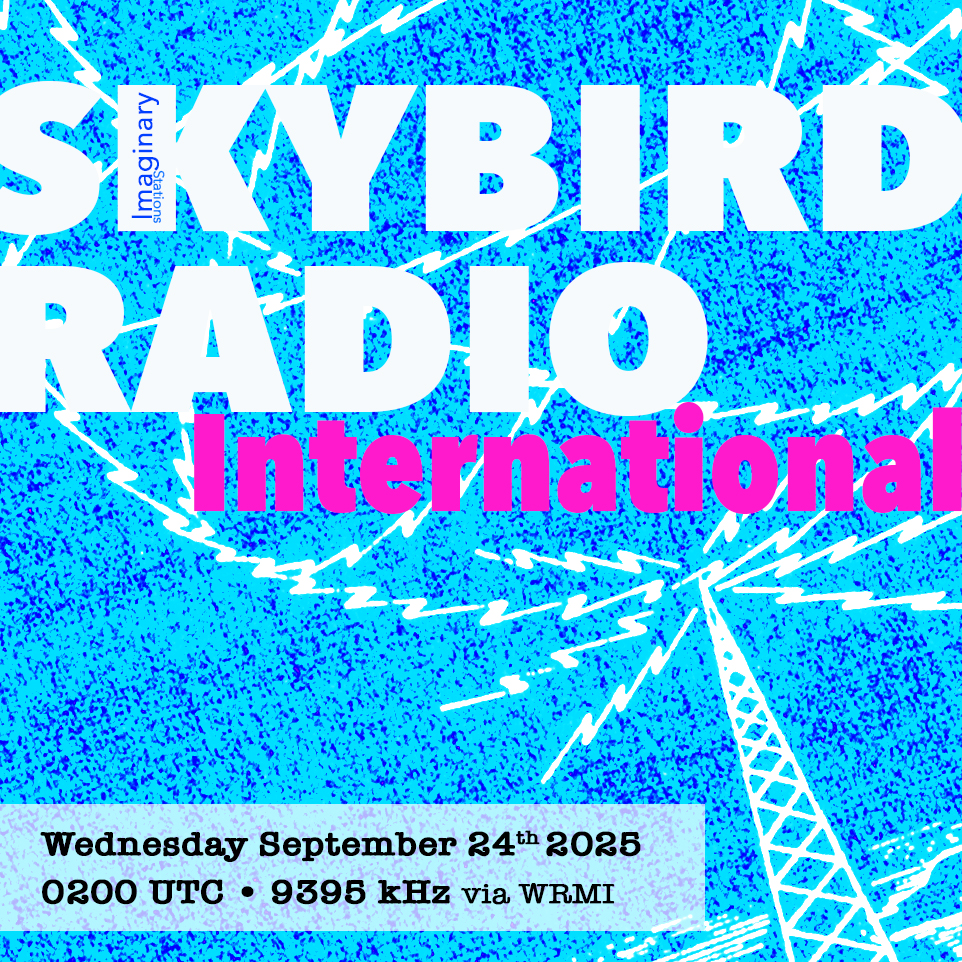
And we’ve a new episode of the interesting The Shortwave Music Library on Wednesday 30th July 2025 at 0200 hrs UTC via WRMI. Chief music librarian DJ Frederick is behind the reception desk picking out some eclectic tunes from his  collection. Expect all sorts of musical goodness from across all genres and we’d appreciated it if you could keep noise down to a minimum during the broadcast as it is a library after all.

Here’s more about the show.

For more information on all our shows, please write to [email protected] and check out our old shows at our Mixcloud page here.

FastRadioBurst 23

Carlos’ Illustrated Radio Listening Report and Recording of Radio Nacional and the Voice of Vietnam (July 21, 2025)

Many thanks to SWLing Post contributor and noted political cartoonist, Carlos Latuff, who shares the following illustrated radio listening reports of recent Radio Nacional and Voice of Vietnam broadcasts.


Carlos notes:

Brazilian Supreme Court backs ankle monitor, social media ban for former president Bolsonaro

Click here to view on YouTube.

Carlos notes:

Urgent mobilization in the face of the arrival of Typhoon Wipha

Click here to view on YouTube.

August 2025 Schedule Updates: From the Isle of Music & Uncle Bill’s Melting Pot

Many thanks to SWLing Post contributor, Bill Tilford, who shares the following update:

From the Isle of Music, August 2025

July’s program will be the third of several episodes featuring the best of Cubadisco 2025, Cuba’s most important discographic awards. This is the best of the best of Cuba’s new releases.
Friday, August 8:
6070 kHz at 1700 UTC
3955 kHz at 2100 UTC
Sunday, August 10:
9670 kHz at 1700 UTC using booster beam E to eastern Europe and Eurasia (repeat of August 8 episode).

Uncle Bill’s Melting Pot, August 2025

In August we will present music from Syria and the Syrian diaspora.
Friday, August 15:
6070 kHz at 1700 UTC
3955 at 2100 UTC
Sunday, August 17:
9670 kHz at 1700 UTC using beam E (repeat of August 15 episode).

**In addition to direct radio reception, we do honor reception reports using remote SDRs as long as the whole program is described and which SDR is specified.

Paul’s Treasure Trove of 1980s Shortwave Interval Signals and Idents

I recently received a fascinating message from long-time SWLing Post reader Paul, who has graciously shared a remarkable collection of shortwave radio recordings he made from his home near London in the 1980s. Here’s what he wrote:

Hi Thomas,
I have been following your excellent blog for many years. I have noticed that sometimes you feature archive recordings. I have some that might interest you.

During the 1980s I was listening to shortwave radio from my home near London, in the south east of England. I had a cassette recorder connected to the receiver and taped anything interesting that caught my ear. Little did I know that 40 years later the majority of these stations would have disappeared and I would have the opportunity to share these recordings with the world.

I have put together a collection of five audio files of recordings from many of these international shortwave broadcasters, consisting of IDs and interval signals. The majority of these recordings are in English. I’ve grouped the files geographically:

      • Western Europe
      • Eastern Europe and the USSR
      • Africa and the Middle East
      • Asia and the Pacific
      • The Americas

I have uploaded these files to the Internet Archive, under the user name Shortwave Memories.

There are no dates or frequencies but the recordings were made during the 1980s, the majority during the first half of the decade.

I hope you and your readers find this interesting. I certainly enjoy listening to these recordings and a reminder of how shortwave used to sound.

Best regards,
Paul

Listen to the Recordings

Paul has organized his recordings by region. You can stream them directly from the Internet Archive or download them to enjoy offline: https://archive.org/details/@shortwave_memories

I’ll also embed the audio players below with Paul’s notes:

Western Europe

AUSTRIA: Radio Austria International (0)
CYPRUS: Cyprus Broadcasting Company (1.40)
DENMARK: Radio Denmark (3.09)
FINLAND: Radio Finland (4.29)
FRANCE: Radio France Internationale (5.30)
GERMANY (WEST): Deutsche Welle (6.30)
GREECE: Voice of Greece (7.53)
ITALY: RAI (9.24)
MALTA: Radio Mediterranean (11.00)
NETHERLANDS: Radio Netherlands (12.21)
NORWAY: Radio Norway (13.34)
PORTUGAL: Radio Portugal (15.34)
SPAIN: Spanish Foreign Radio (16.32)
SWEDEN: Radio Sweden (18.17)
SWITZERLAND: Swiss Radio International (19.53)
Red Cross Broadcasting Service (20.38)
UNITED KINGDOM: BBC World Service (21.49)


Eastern Europe and the USSR

ALBANIA: Radio Tirana (0)
BELARUS: Radio Minsk (1.18)
BULGARIA: Radio Sofia (1.41)
CZECHOSLOVAKIA: Radio Prague (2.29)
ESTONIA: Radio Tallin (2.50)
GERMANY (EAST): Radio Berlin Int (3.49)
HUNGARY: Radio Budapest (5.22)
LATVIA: Radio Riga (6.31)
LITHUANIA: Radio Vilnius (7.14)
POLAND: Radio Polonia (8.30)
ROMANIA: Radio Bucharest (9.37)
UKRAINE: Radio Kiev (10.41)
USSR: Radio Moscow World Service (12.17)
Radio Station Peace & Progress (13.35)
Radio Station Rodina (13.59)
YUGOSLAVIA: Radio Yugoslavia (14.21)


The Americas

Bonaire: Trans World Radio (3.31)
Brazil: Radio Nacional do Brasil (4.32)
Canada: Radio Canada Int (6.58)
Chile: Voice of Chile (8.48)
Colombia: Radio Nacional (11.06)
Radio Sutatenza (12.00)
Cuba: Radio Havana (12.48)
Dominican Republic: La Voz del CID (14.20)
Radio Clarin (15.01)
Ecuador: HCJB (15.43)
Grenada: Radio Free Grenada (17.36)
Nicaragua: Voice of Nicaragua (18.42)
USA: Voice of America (19.54)
Radio Earth (20.33)
KCBI (21.39)
WHRI (22.13)
WRNO (22.38)
WYFR (22.49)
Venezuela: Radio Turismo (23.22)
Radio Tachira (24.06)
YVTO (24.41)


Asia and the Pacific

Afghanistan: Radio Afghanistan (0)
Australia: Radio Australia (1.55)
Bangladesh: Radio Bangladesh (3.18)
China: Radio Peking (4.23)
India: All India Radio (6.16)
Japan: Radio Japan (7.29)
Korea (North): Radio Pyongyang (9.02)
Korea (South): Radio Korea (12.26)
Malaysia: Voice of Malaysia (14.22)
New Zealand: Radio New Zealand (15.49)
Pakistan: Radio Pakistan (16.13)
Saipan: KFBS & KYOI (16.44)
Taiwan: Voice of the Free China (18.14)
Tajikistan: Radio Dushanbe (19.01)
Uzbekistan: Radio Tashkent (19.22)
Vietnam: Voice of Vietnam (20.16)


Africa and the Middle East

ALGERIA: Radio Algiers (0)
EGYPT: Radio Cairo (1.03)
IRAN: Voice of the Islamic Republic of Iran (2.33)
IRAQ: Radio Baghdad (4.17)
ISRAEL: Kol Israel (6.33)
KUWAIT: Radio Kuwait (8.00)
LEBANON: Voice of Lebanon (9.29)
LIBYA: Radio Jamariyah (10.18)
NIGERIA: Radio Nigeria (12.15)
QATAR: Qatar Broadcasting Service (13.53)
SAUDI ARABIA: Broadcasting Service of Kingdom of Saudi Arabia (14.21)
SOUTH AFRICA: Radio RSA (15.45)
SYRIA: Radio Damascus (17.37)
TURKEY: Voice of Turkey (18.40)
UNITED ARAB EMIRATES: UAE Radio (19.50)


Many Thanks to Paul!

A huge thank you to Paul for not only preserving these recordings, but also for taking the time to digitize and share them publicly. This is a nostalgic treat for many of us and a valuable reference for future generations of listeners.

If any readers have similar recordings they’d like to share, feel free to reach out. I’m always happy to help preserve and feature them on the Shortwave Radio Audio Archive.

— Thomas

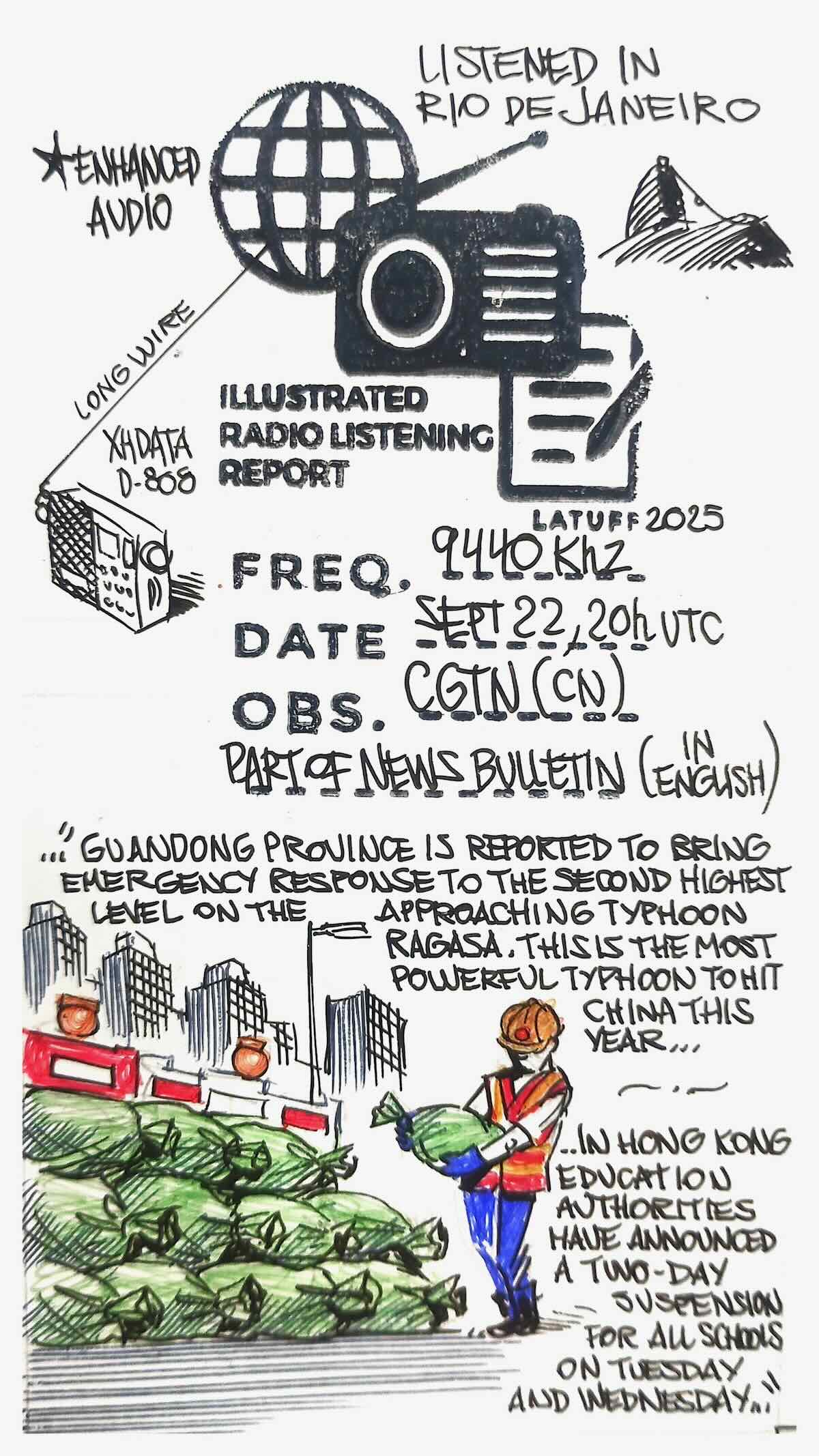
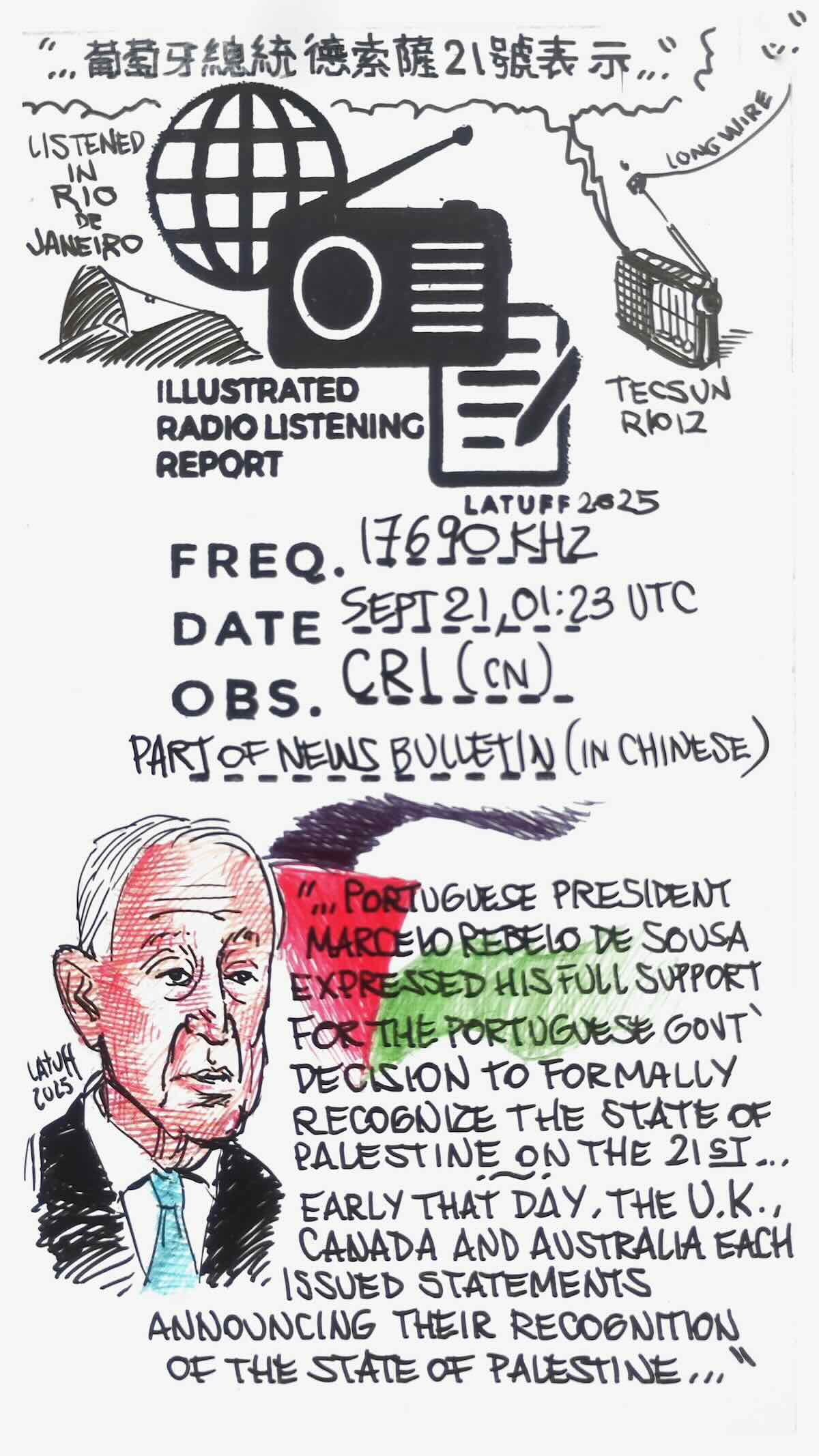
Carlos’ Illustrated Radio Listening Report and Recording of CGTN (July 20, 2025)

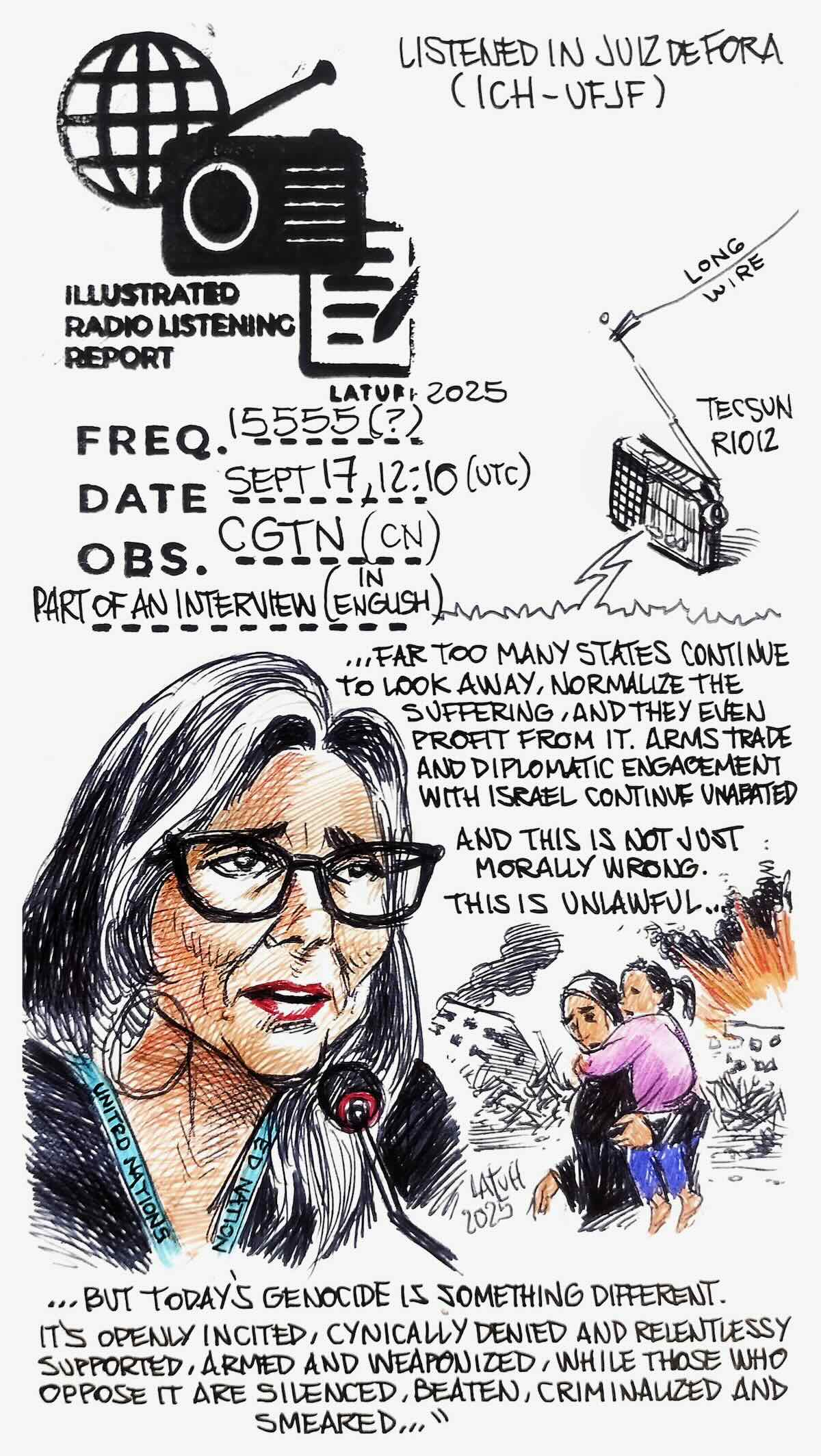
Many thanks to SWLing Post contributor and noted political cartoonist, Carlos Latuff, who shares the following illustrated radio listening report of a recent CGTN Radio broadcast.


Carlos notes:

Typhoon Wipha makes landfall in Southern China. CGTN Radio, 11770 kHz

Typhoon Wipha makes landfall in Southern China. CGTN Radio, 11770 kHz, listened in Porto Alegre, Brazil, on a Tecsun R-1012 receiver.

“…China’s Central Authorities are offering emergency relief supplies as typhoon Wipha makes landfall in Southern China. They include folding beds (…) for people who have to leave their homes. Guangdong and Hainan provinces are facing strong winds and heavy rain…”

Click here to view on YouTube.

Bob’s Radio Corner: The Last Radio I Really Needed

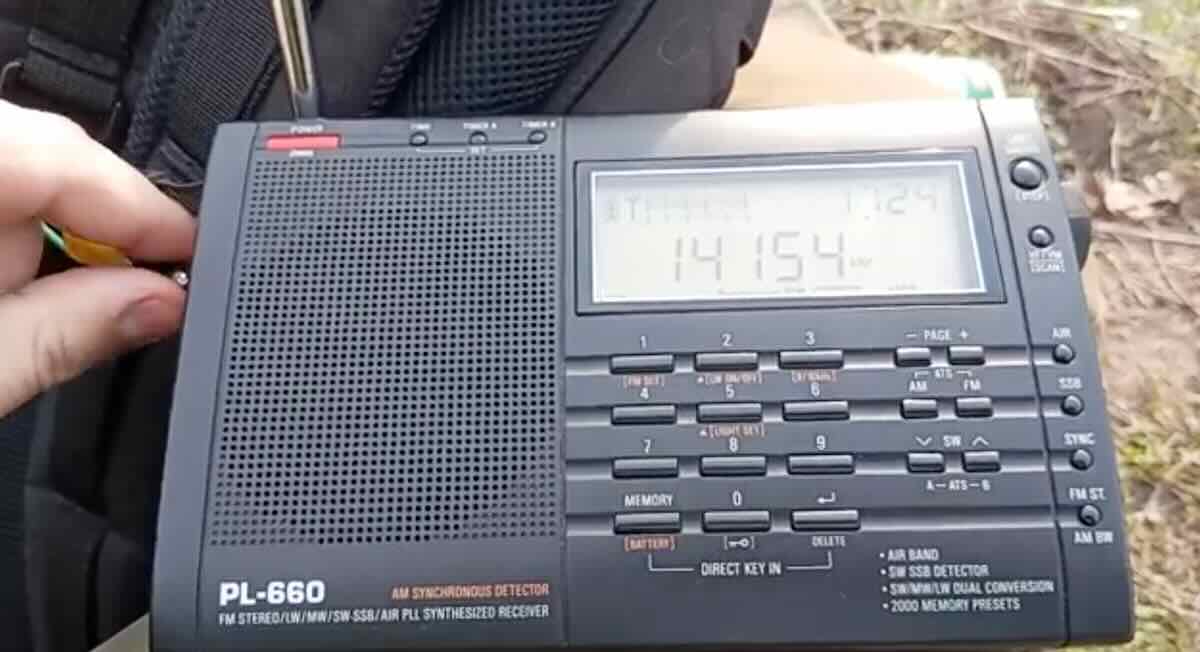
My original PL-660 has high mileage but still
has its original kick stand and whip antenna.

The Last Radio I Really Needed

By Bob Colegrove

Like most folks, I have a favorite radio.  My favorite radio is the one I happen to be listening to at the time.  Each radio has its own attractions.  The fact that one particular radio is turned on indicates that, at least for the moment, it is my favorite.

I also have a special radio.  It is special because, ever since I bought it, there has never been a compelling reason to buy another radio.  That said, there is no accounting for irrational behavior which has subsequently caused me to buy several more radios, always with the hope that the next radio would somehow provide better performance than my special radio.

My longstanding experience has been with vacuum tube radios.  I have used multiband radio consoles.  I have used everything from a Hallicrafters S-38 to a Collins R-390A and most everything in between.  I tried a couple of analog, multiband, solid-state portables in the 1960s and ‘70s.  I bought a Sony ICF-2010 early on and still have two of them fully functional.  For many years, the -2010s were my go-to radios.

Then, I happened to read the review of the Tecsun PL-660 in the 2012 WRTH.  The price seemed reasonable, and I decided to buy one.  From the very beginning, I was not disappointed.  Selectable sidebands and synchronous detection – not a Sony, but very good.  Further, the -660 was notably smaller and packed quite easily.  I could include a pair of earphones, a length of wire and this radio, set up away from the shack, and operate.

So why is this radio special?  It is not perfect.  But for LW, MW, SW, and FM, there is nothing I can hear on any of my radios that I can’t hear on the Tecsun PL-660.  Reception seems to be especially sensitive and clear.

I must qualify the claim above.  Normally I use external antennas.  External antennas are the great equalizers.  Properly matched they make a radio perform at its best.  Radio reviews and comparisons will often include judgements about sensitivity.  Unfortunately, many reviewers do not specify the conditions under which they tested the radio.  The reader must assume that these judgements are based on the use of stock internal antennas — most often the LW and MW ferrite loop and the SW and FM whip.  For portable radios this makes sense, as internal antennas are paramount to the radio’s transportable versatility.

Not Perfect

I will spare everyone yet another review of a radio now in its adolescent years.  I merely focus on a couple of picks I have with the PL-660.  There are others which are well documented.

Birdies

Probably the worst fault with the -660 is birdies.  There are a few along the LW spectrum but the worst by far is one which generally appears between 950 kHz and 1000 kHz in the MW band.  I have read where this is traceable to the DC-DC converter but have never found a remedy.  This nasty signal is very rich in harmonics and will replicate through the entire SW spectrum.  Further, the fundamental birdie and its harmonics tend to slowly drift upward for about an hour after the radio is turned on.  The drift accelerates with multiples of harmonics.  For example, while the fundamental birdie is creeping up 1 kHz, the second harmonic will travel 2 kHz, the third 3 kHz, and so forth.  There are many harmonics where no harm is done; however, the 4th harmonic will blaze a trail squarely through the 80-meter ham band.  Wait a while and it will drift onward but ultimately stop at some equally inconvenient location.

Poor Encoder

The PL-660 tuning encoder, as with its cousins in the -600 and the -680, is … well, very poor.  From the get-go it will jump erratically forward or backward.  This becomes worse over time, particularly with any prolonged periods of disuse.  I have not determined whether this is dirt, poor contact, or just poor design.  I have found that vigorous exercise forward and backward with the tuning knob is the best temporary remedy.  This will generally bring the encoder back to tolerable performance.

Replacement encoders are available at modest cost.  I went this route as a last resort but managed to lay up my -660 for several months having failed to make the replacement work at all on the first attempt.  A few months later with renewed determination, followed by a series of deep cleansing breaths, I reopened the radio and discovered that my mistake was just a solder bridge between two of the encoder pins.  Note to self: For the future, this surgery should only be performed by people with good vision and steady hands.  After several months of storage there was unbounded joy when the 12-year-old -660 came alive and began to tune perfectly – well as perfectly as it could.

My Mods

One of the reasons why the Tecsun PL-660 is special to me is that it is a tangible link to my tinkering past.  In former times, much satisfaction was obtained by aligning RF and IF stages, restringing dial cords, and replacing leaky capacitors.  For most tinkers, the advent of large-scale, solid-state integration and surface-mounted components has made tinkering virtually impossible.  Detailed data are scarce, parts much more specialized, and soldering skills more demanding.

The PL-660 came along at a point where vacuum tube tinkering was still within recent memory and the skills for maintaining and modifying high-tech radios had not become so intimidating.  To summarize, with just a few exceptions, today’s radios are for all practical purposes unrepairable, unmodifiable, and therefore more readily disposable.  What a pity.  The term “parted out” has entered our vocabulary, whereby a defective radio is cannibalized to provide its serviceable vital organs to its remaining siblings.

Dynamic Squelch

Briefly, the Tecsun PL-660 dynamic squelch function automatically adjusts the signal threshold based on its strength.  Ostensibly, this helps prevent the radio from being overwhelmed by noise when no signal is present while still allowing strong signals to be heard.  The “dynamic” part of the term refers to the feature turning itself on or off as the situation demands.  The downside is twofold:  a) weak signals may be totally blocked with squelch engaged; and b) the feature may oscillate on an off as a signal fades and then gets stronger.  There are several demonstrations of this on YouTube.

In 2012, a Russian radiofile managed to identify the transistor that switched the feature on and off.  By the simple expedient of grounding one of its leads, it could be permanently turned off, eliminating its drawbacks.  An optional further modification provided for the tone control switch to be repurposed to manually enable or disable the basic modification.

The relatively simple concept turned out to be rather involved surgery requiring a large metal circuit shield to be unsoldered and removed to access the transistor.  The old Yahoo PL-660 Group was abuzz with interest at the time.  Many folks were doing the modification.  Had it not been discussed so widely, I would likely have ignored it.  But being a wild, impulsive 70-year-old at the time, I had to give it a go and fortunately was successful.

Disablement of the dynamic squelch required removal of a shield on PCB

External LW and MW antennas

I do not like to be limited by the lack of an external LW/MW antenna connection.  The PL-660 has no means to switch one on.  You can easily inductively couple an AN-100/200 or Terk Advantage loop and get good results, but I wanted more.  I took the classic approach of winding a 5-turn transfer coil around the ferrite bar.  Initially I simply connected this to a twisted pair which ran out the unused hole for the wrist strap.  The twisted pair was connected to a phone jack and dangled out of the radio like a pig tail.

Pigtail used the hole in the case vacated by the wrist strap.

Sometime after my mod, Geir Laastad, LA6LU, published a paper with a much more elegant solution.  He discovered that the PL-880 used a stereo external antenna jack, the center (ring) terminal was not used, and the cumbersome pigtail could be eliminated by connecting the added transfer coil between this center terminal on the jack and the radio ground.  This necessitated use of a stereo plug to mate with the jack for connection of a LW/MW external antenna, but the jack could otherwise be used normally for SW.  I found that Tecsun used the same stereo jack approach on the -600, -660, and -680, and was able to connect the transfer coil to each radio the same way.  Geir’s paper is at https://groups.io/g/Tecsun-PL-880/files/_Tecsun_PL-880_LW_&_MW_Antenna_Mod.pdf, but you may have to request membership in the group to download it.

Enlarged fine tuning knob

One of the weak features of the -600, -660 and -680 is the fine-tuning pot.  Zero-beating a signal is a bit touchy.  The problem is exacerbated by a mechanical detent in the control’s center of rotation, that is, the point where zero beat is likely to be encountered.  I found a foam, doughnut-shaped packing spacer from a spindle of CDs had just the right internal and external diameters to slip over the fine-tuning knob and provide some added gear reduction.  By pressing the foam against the case, the effects of the detent could be mitigated.

Well, unfortunately, CDs are going the way of cassette tapes these days, so the availability of the packing spacers may not be so good.  It may be within the realm of possibility to fabricate one.

Wrist Strap

My final alteration is not so much a modification as it is a simple omission.  On the first disassembly of the -660 I omitted reinstalling the wrist strap.  IMHO, this piece of ribbon is no more useful than fender skirts on a ’57 Chevy.  Besides, it’s usually in the way.  Sometime in the murky past, this appendage made its appearance on a small portable radio.  Since then, nearly every manufacturer has felt compelled to include one.  I envision someone grabbing the radio by the strap and sashaying down the street with it dangling precariously by one’s side.  I have tried to imagine how its purpose might be inverted into a safety feature – perhaps first looping the strap around the wrist and then grabbing the radio with the hand.  But somehow, I can’t imagine anyone going to that trouble.  Maybe I’m missing something.

The wrist strap on this Realistic 12-714 AM/FM pocket radio from 1984 is hard to ignore.

The reader may be aware of other modifications to the PL-660, but mine are limited to those described above.

Epilogue

The old -660 has never been coddled.  Neither has it been subjected to the same vicissitudes as a soccer ball.  It remains a relatively handsome, finely crafted instrument still capable of soldiering on in the frontlines of the DX battle.

Is my old PL-660 a better-than-average “creampuff” off the Tecsun production line?  Does that make it special?  During the three or four months it was laid up with the encoder problem, I took the precaution of buying one of the last production units – this on the chance it might be my only opportunity of having an operational PL-660.  The newer one looks like its predecessor; it operates like its predecessor, even to the extent that it has the same birdies and the erratic encoder.  It does have the added feature of dial recalibration – a feature totally unnecessary on the original PL-660.  Somehow, it’s just not the old PL-660.  That one is special.

Maybe you have a special radio.