Category Archives: Shortwave Radio

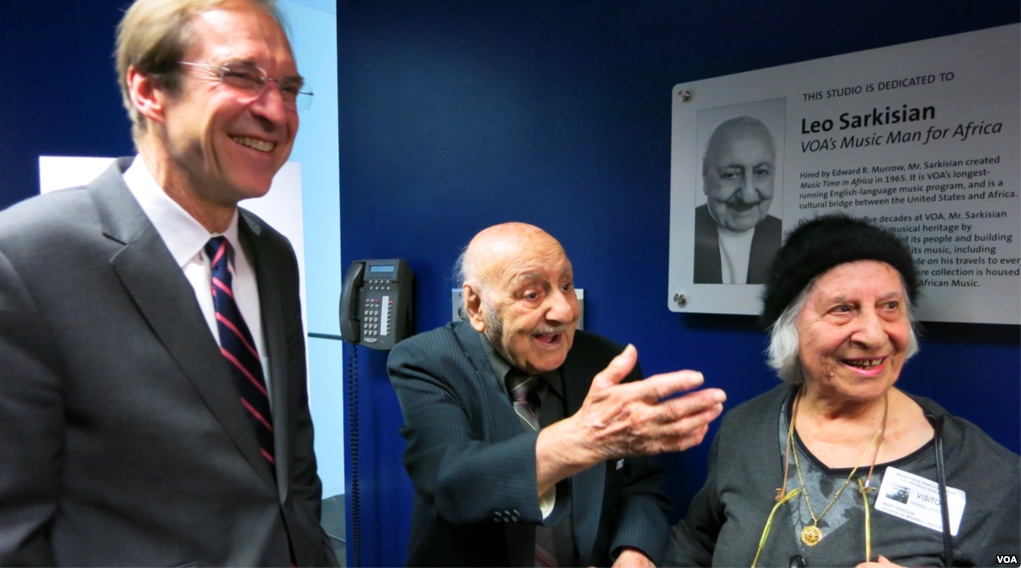
VOA’s Music Man For Africa, Leo Sarkisian, dies at 97

FILE – Leo Sarkisian, center, his wife, Mary, and VOA Director David Ensor smile during a celebration that followed the renaming of VOA Studio 23 in Sarkisian’s honor, Jan. 29, 2014. (Source: VOA News)

In February 2013, Leo Sarkisian and his sweet wife, Mary, invited me to their home and studio in Maryland and I recorded what turned into a 3+ hour audio interview.

Sitting with him, time seemed to disappear as I was absorbed by stories about his travels and experiences. He was so kind and gracious–he even insisted that I walk away with one of his amazing drawings which I’ve since framed for my office.

Leo passed away on June 8, 2018 at the age of 97. Rest in peace, Leo.

Here’s the story from VOA News:

(Source: VOA News)

Leo Sarkisian, the creator and longtime producer of The Voice of America’s “Music Time in Africa,” has died. He was 97.

Known by his fans as the “Music Man of Africa,” Sarkisian spent a half-century traveling Africa, listening to local musicians and capturing their performances. Those recordings became the basis of VOA’s longest-running English program.

“Leo always left you feeling like you were special. He didn’t treat anyone less or greater based on their social standing or age or anything, it seemed. He was a true gentleman and optimist and lover of the beautiful things in life,” said Heather Maxwell, an ethnomusicologist who succeeded Sarkisian as the host of “Music Time in Africa.”

Meeting Murrow

Sarkisian arrived in Africa as a soldier in the U.S. Army. In 1961, a fateful encounter changed the course of his life. Edward R. Murrow, newly minted as the director of the U.S. Information Agency, came to Sarkisian’s apartment in Conakry, Guinea, and asked if he’d like to join The Voice of America. Four years later, he went on the air with “Music Time in Africa.”

He spent the next 47 years traveling the continent with his wife, Mary, whom he married in 1949. Together, they met thousands of local musicians and gave their art a global stage.

Sarkisian’s travels put him at the vanguard of African music. Maxwell said a favorite recording from Sarkisian’s collection was of Nigerian musician Fela Kuti, before he developed the Afrobeat style that would become his world-famous trademark.

Sarkisian was himself a musician and artist. He sketched performers, audience members and dignitaries. Some of his illustrations can be found in “Leo Sarkisian’s Faces of Africa,” a collection of portraits of people he met in his travels.

But his greatest legacy will perhaps be the original collection of about 10,000 recordings that he curated, representing every African country. In 2014, the University of Michigan acquired the collection from VOA on long-term loan. Their work involves digitizing the collection and preserving it for generations to come.

‘I feel as if I’m just beginning’

Sarkisian retired in 2012, when he was 91.

“I feel as if I’m just beginning,” he told VOA’s Vincent Makori in an interview that year.

When asked what African music meant to him, Sarkisian said, “It’s been my entire life. It’s from my childhood right up to today, and maybe into the future. I’ll still be doing my art, and I’ll be dancing with my music. What else? It is passion.”

Sarkisian’s parents emigrated to the U.S. from Turkey in the early 1900s, according to The Washington Post. Born in 1921, Sarkisian studied art and drew maps for the Army, the Post reported.

Sarkisian lived by Murrow’s “last three feet” motto, Maxwell said. That meant the most important part of communication, even across international borders, came from a personal, human connection.

“We still care about Africa,” Sarkisian said in 2012. “We care about them. We love the African culture. And in turn, of course, we have their love, also. And that is the satisfaction of our work.”

Leo and Mary Sarkisian, after spending most of their lives living in Africa, settled in Boston. Leo Sarkisian died June 8 and will be buried in North Andover, Massachusetts, with full military honors.

Click here to read this story at VOA News.

Australian Gov’t reviewing media services (including loss of shortwave) in the Asia-Pacific

Many thanks to SWLing Post contributor, London Shortwave, for sharing the following Have Your Say review of Australian Broadcasting Services in the Asia Pacific:

Review of Australian Broadcasting Services in the Asia Pacific – Terms of Reference

The Government is undertaking a review of Australian media services in the Asia Pacific, including the role of shortwave radio. The review is being conducted jointly by the Department of Communications and the Arts and the Department of Foreign Affairs and Trade.

Purpose

The objective of the review is to assess the reach of Australia’s media in the Asia Pacific region, including examining whether shortwave radio technology should be used.

Scope

The review will analyse the:

  • coverage and access of existing Australian media services in the Asia Pacific region; and
  • use and value of Australian shortwave technology in the Asia Pacific region.The review will cover:
  • all media distribution platforms (i.e. television, radio and online);
  • commercial, community and publicly funded services; and
  • different types of technologies such as analogue, digital and satellite radio and television services and online services.

Have your say

Interested stakeholders in Australia and overseas are encouraged to contribute to this review. Submissions on any aspect of the review should be uploaded to the review website by 3 August 2018.

Timeframe

The review is expected to report to the Government in 2018.

Background

In September 2017 the Government agreed to conduct a review of Asia Pacific Broadcasting Services as follows:

“The Department of Communications and the Arts and the Department of Foreign Affairs and Trade will conduct a review into the reach of Australian broadcasting services in the Asia Pacific region, including examining whether shortwave radio technology should be used. The review will include public consultation and the report of the review will be made public.”


Consultation Period:
June 04, 2018 09:00 AEST to August 03, 2018 17:00 AEST

The Australian Broadcasting Corporation ceased shortwave broadcasting in the Asia-Pacific region in January 2017 ahead of a transition to FM transmission.

The review is assessing the reach of Australia’s media in the Asia-Pacific region, including examining whether shortwave radio technology should be used.

All media distribution platforms – television, radio and online – are being examined including commercial, community and publicly funded services.

The review is also looking at different types of technologies such as analogue, digital and satellite radio and television services and online services.

Click here to view this information and participate via the Have Your Say website.

Shortwave Trading Part II

Last month, we posted a link to an article that explained why traders might use shortwave radio for high-speed, faster-than-optical-fiber communications. The article by Bob Van Valzah originally appeared on the blog, Sniper in Mahwah & Friends where they’ve just posted part two in the series:

I have previously claimed that trading over shortwave radio is real and presented the story of the first evidence I found of it. It was pleasantly surprising to see the story picked up by IEEE Spectrum, Hacker News, Hackaday, and others. But since I hadn’t anticipated such a diverse audience, I didn’t provide details needed to understand shortwave trading in context so a lot of questions were raised. I’ll provide some background here, answer the questions, and also document two other shortwave trading sites I’ve found around Chicago. Traders can skip ahead while I fill in the broader audience.

Why is there a latency race? Isn’t it just a waste of money?

Electronic trading technologist just take the latency race for granted, but it’s important to think about why it exists and what it means to the average person. When you want to fill your car with gasoline, you have the choice of going to the nearby gas station and accepting their price or perhaps comparing prices at stations a little farther away. We would all spend a lot more time comparison shopping if we didn’t have pretty good confidence that the prices at our local stations were competitive. But what keeps those prices competitive?

The analogy between your local gas station and electronic markets is admittedly imperfect, but I think it is helpful in understanding why latency matters and how you benefit. Nobody can buy a tanker of gasoline in New York and immediately sell it in Chicago. The laws of physics prevent us from economically moving such a heavy load over a long distance quickly. But a share of Apple stock weighs nothing. The Chicago price and the New York price can be compared and changed in an instant. Well, about 4 milliseconds is how long it takes for an updated price to make the trip. Prices can make about 250 one-way trips in a single second.

So when buying or selling Apple shares, you don’t have to shop around for the best price. Electronic trading companies have an incentive to build the fastest networks linking financial centers so that prices can move quickly between them. Buyers and sellers benefit because their local market has electronic traders who know the best prices on other markets and will be happy to do a local deal at the best global price (it’s market making). It doesn’t take a rocket surgeon to see the business opportunity in this type of trading, so high-speed traders have to be efficient because they’re competing against each other. The latency race has to happen for each market to have the best price. Competition between electronic traders limits their spend to the benefits that come with better pricing.

Why does radio help win the latency race?

Traders use radio because it can move prices faster than optical fiber.

I won’t bore you with the physics, but I will remind you of this elementary school experiment where a pencil appears to bend in a glass of water. This happens because light moves more quickly through air than it does through water. In the same way, radio waves move more quickly through air than light can move through an optical fiber. In trading parlance, radio is lower latency than fiber over a given distance.

But radio is also faster because it almost always covers a shorter distance. Fiber paths tend to follow roads and property lines that may not go exactly in the desired direction. Radio towers may be inconvenient, but they give the advantage that the signal can take the shortest-possible path allowed by physics, not the kinky path dictated by rights of way.[…]

Continue reading the full article on the blog, Sniper in Mahwah & Friends.

June 13: Spectres of Shortwave film screening and simulcast via German Shortwave Service

(Source: Amanda Dawn Christie)

Coming up this summer:

Spectres of Shortwave /
Ombres des ondes courtes

June 13 juin
Film Screening / Projection @ 7pm / 19 h
Cinémathèque Québécoise
Montréal, Québec

Radio Simulcast @ 23:00 UTC in Europe
German Shortwave Service – 3895 kHz

A film about radio waves, relationships, landscape, and loss.
This experimental documentary film about the Radio Canada International (RCI) shortwave radio towers, presents the site through four seasons, leading up to, and including, its demolition in winter of 2014. Images captured on 35mm film accompanied by personal stories from by people who lived with the site, interwoven with field recordings made by placing contact microphones onto the towers themselves.

Screenings of this film are accompanied by a radio simulcast, so that while viewers watch the film on a big screen in one part of the world, listeners can hear the sound track over radio waves in another part of the world. This Montreal screening is accompanied by a shortwave simulcast in Germany.

1 hour 53 minutes, colour, 5.1 sound
www.spectresofshortwave.net
http://www.amandadawnchristie.ca
Cinémathèque website and info
facebook event

Bruce discovers a bit of Morse Code in “Picnic At Hanging Rock”

(Image source: IMDB)

Many thanks to SWLing Post contributor, Bruce Fisher, who writes:

I recorded this short piece of the soundtrack from the 3rd episode of the Picnic at Hanging Rock mini series– it’s being used as a part of the music to an eerie scene, and there is no telegraph or radio related visual corresponding to it. It certainly sounds like Morse Code to me, but I haven’t decoded it. Anyone?

(If you can’t see the embedded player above, click here to listen.)

Many thanks, Bruce! You certainly have sharp ears and are correct in assuming this is Morse Code. The spacing and cadence are a little awkward and jittery, however. I did a decode myself, but I’m curious what others might have heard.

Post readers: Please comment with what you heard in this code!

Guest Post: Tom’s Backpack Shack 3.0

Many thanks to SWLing Post contributor, TomL, who shares the following guest post:


Backpack Shack 3 – Amplified Whip Antenna

by TomL

So, having enjoyed using the Ferrite Sleeve Loop I created last year, I have wanted something a little more sensitive and less bulky.  I will eventually create a much BIGGER FSL antenna on the order of 2 feet long and perhaps 18 or 24 inches in diameter for indoor/attic use.  But that is not a priority at the moment.

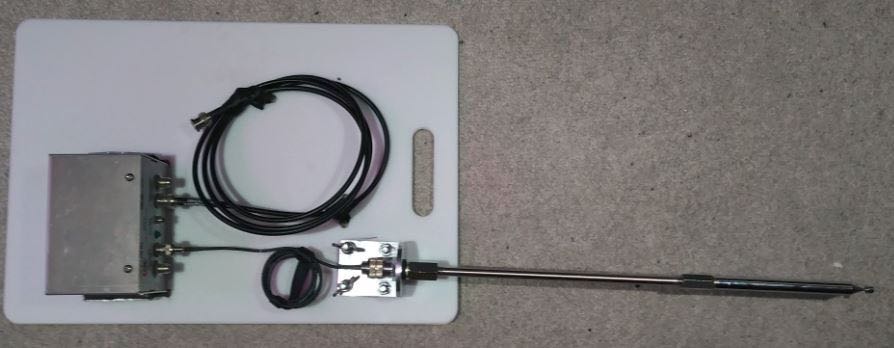
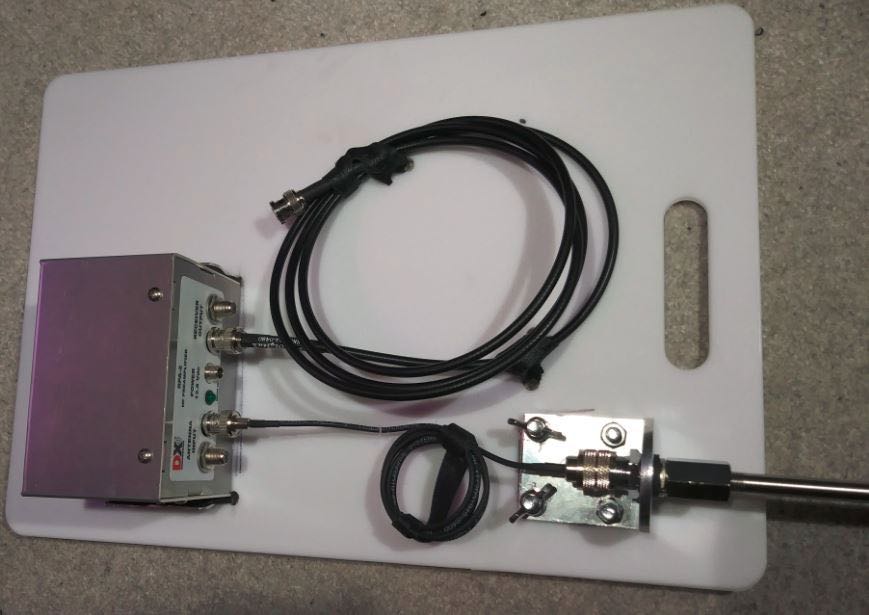
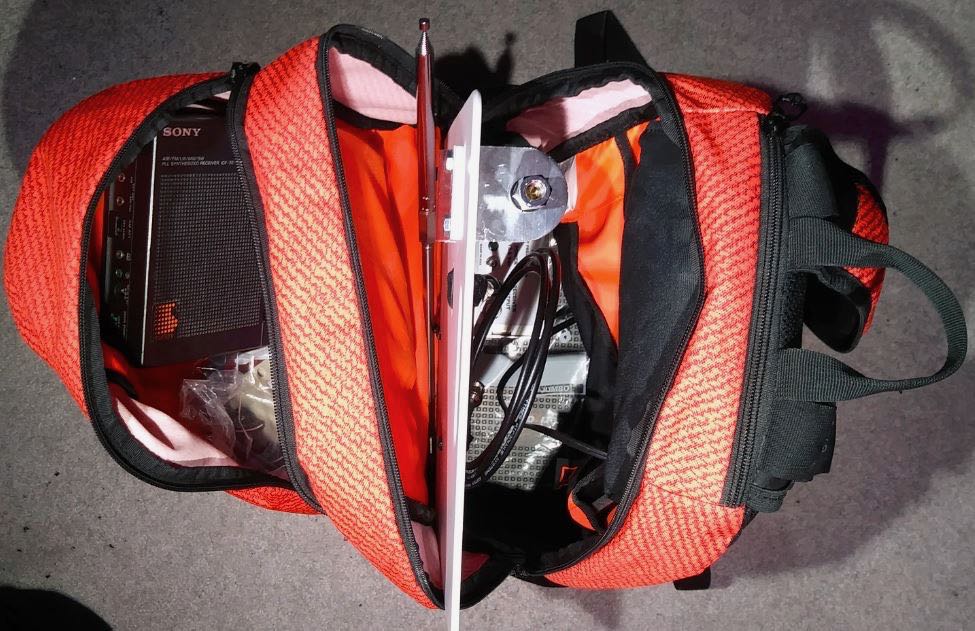
Since I already have the DX Engineering Pre-Amplifier and the very nice Cross Country Preselector from the loop project, I thought it might be useful to create an active whip antenna for it.  And the cool looking Solar Red backpack needed something to do!

Power

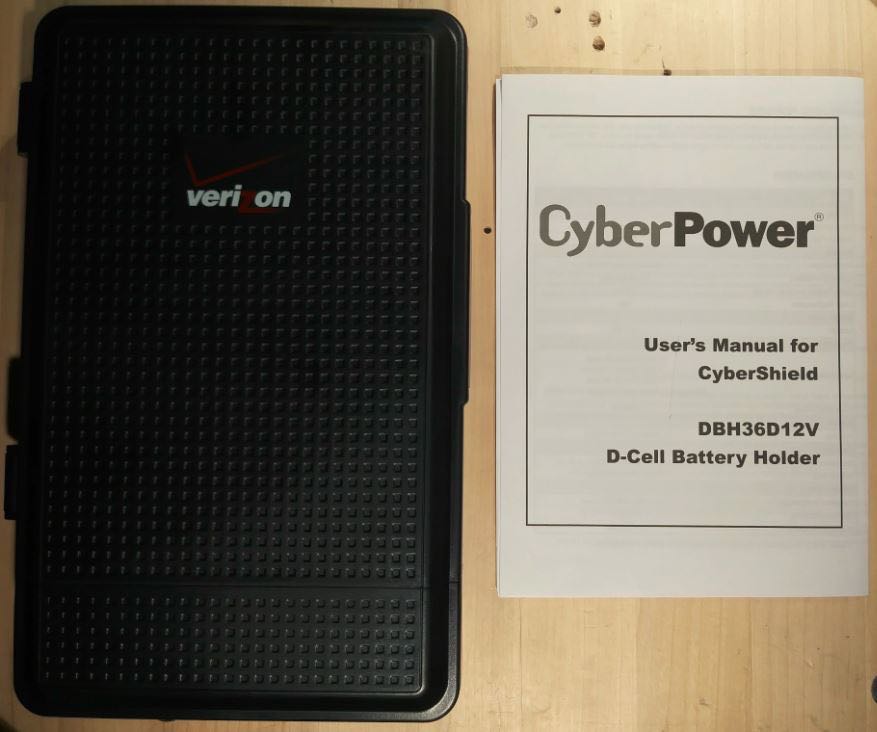
Now that the bulky loop was not taking up the main compartment of the backpack, I could think about what else to put in there, like a larger power pack.  I scoured FleaBay for ideas and stumbled upon this contraption for backup power to network systems, the CyberPower CyberShield for Verizon.

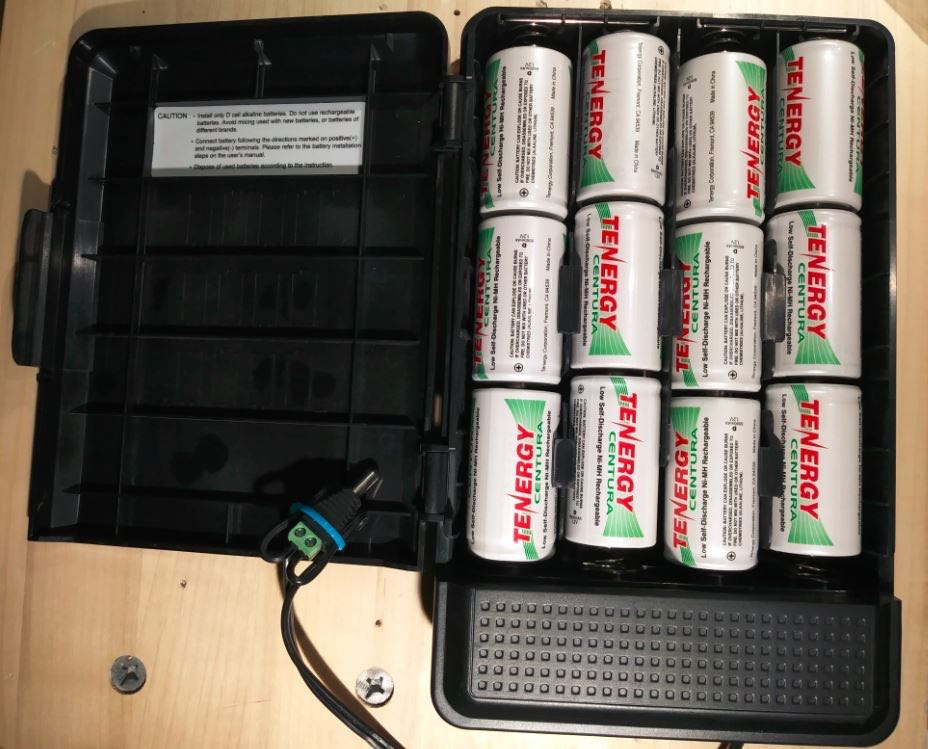
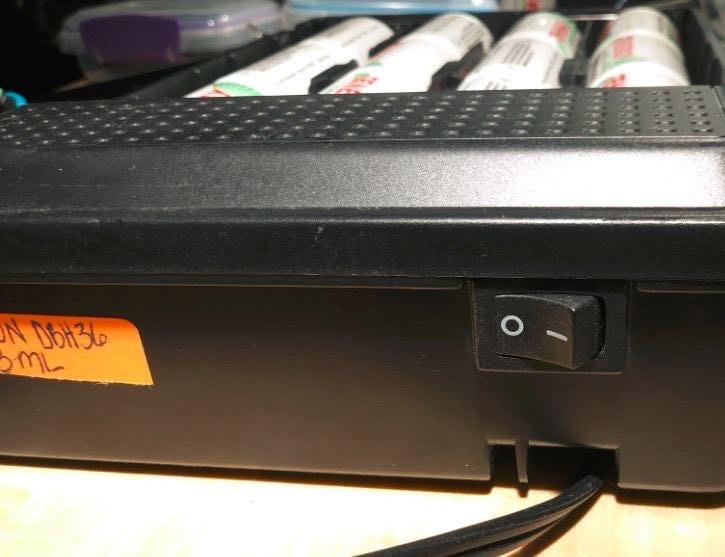
This has 12 spaces for D-cell batteries and was mounted inside the demarcation terminal to provide backup power for things like cable systems and Copper-to-Ethernet networks.  It is not waterproof, so would be inside the premises of the customer getting the internet/cable service. But my Pre-Amp needs 12-18Volts and would love to have nearly unlimited power.  So, I bought a used one, cut the end off of the power lead and put on my own 2.1×5.5mm plug (carefully glued down and tie-wrapped). Then I filled it with 1.2Volt Tenergy D-cells.

Everything was just fine until I forgot to double check the polarity of the plug that I had wired onto the end.  Plugged it into the DX Engineering Pre-Amp, flipped the power switch and fitzzz…. The Pre-Amp light went on, then off (permanently!).

So, my expensive mistake is that I start using the FREE multimeter I got from Harbor Freight and check the polarity before I connect homemade battery packs to anything!!

DX Engineering charged me $60 to fix my mistake and it is working fine now after I swapped the wires on the plug. Yes, their Pre-Amp is NOT reverse-polarity protected! Disappointing, since the price tag for that device is $148!!!  The CyberShield now sits comfortably inside the bottom of the backpack.

Antenna

Now that the drama was over regarding the Power pack, I could think about the whip.  I did not want a wimpy whip! (No one should rightly aspire to this, in my opinion). More FleaBay searches found me looking at Trucker parts.  Loaded whips, magnetic mounts, 10 foot tall MFJ telescoping whips, etc was looking a bit expensive.

Besides that, I cannot fit a 10 foot tall telescoping whip into the backpack, I am limited to at most 18 inches (and that is at an angle to fit it in there).  But I found an old-fashioned mirror mount that looked promising since it had a nice SO-239 connector at the bottom and standard CB antenna fitting on top of 3/8”-24.

Then I found the 44 inch SuperAntenna with the same threads; then found the replacement Stainless Steel Shafts for a Wilson antenna in different lengths (I ordered the 10 inch version to test).  With a couple of rod coupling nuts and I was ready for testing!

Test Locations

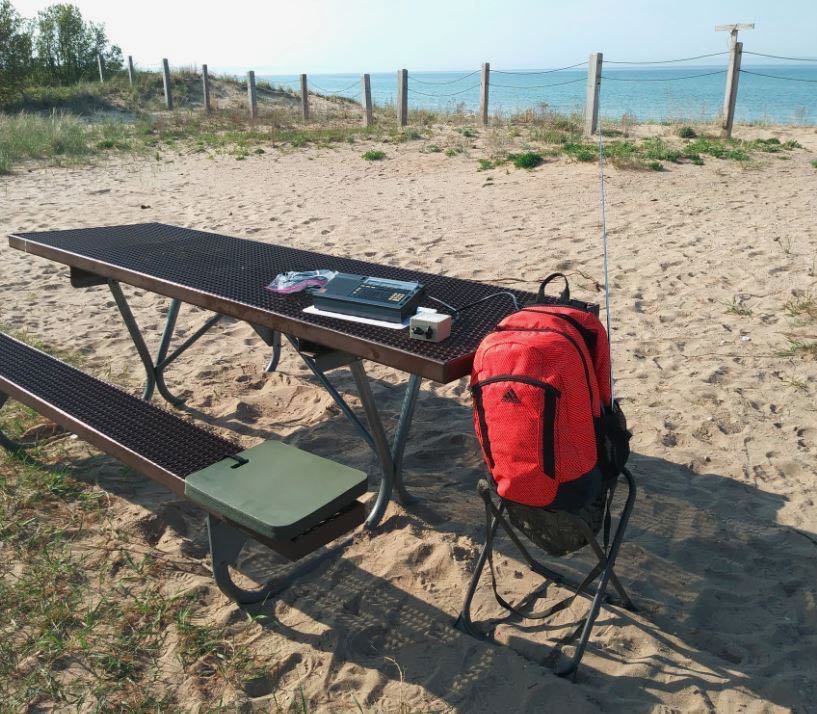
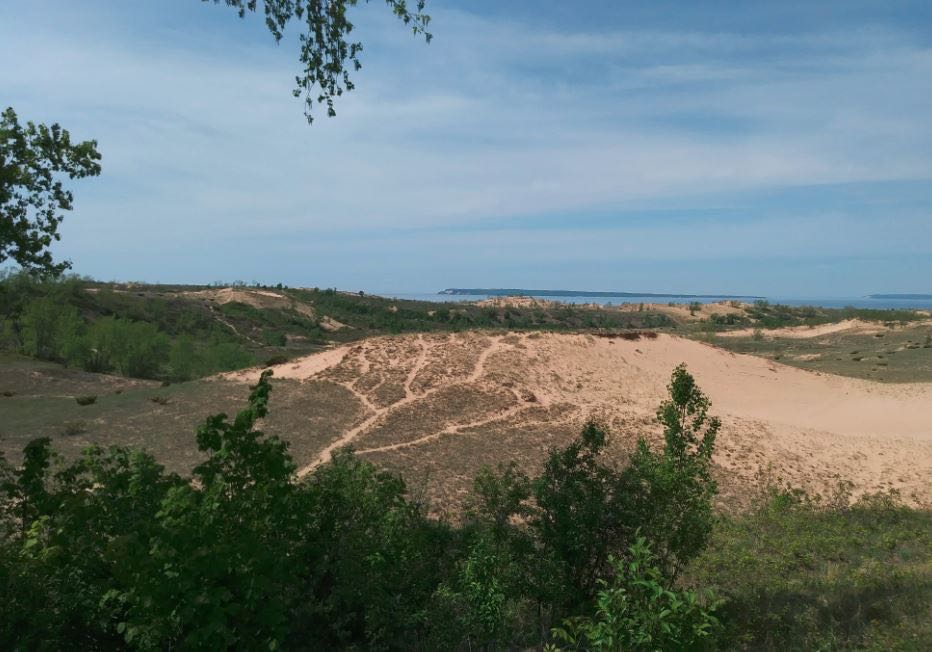
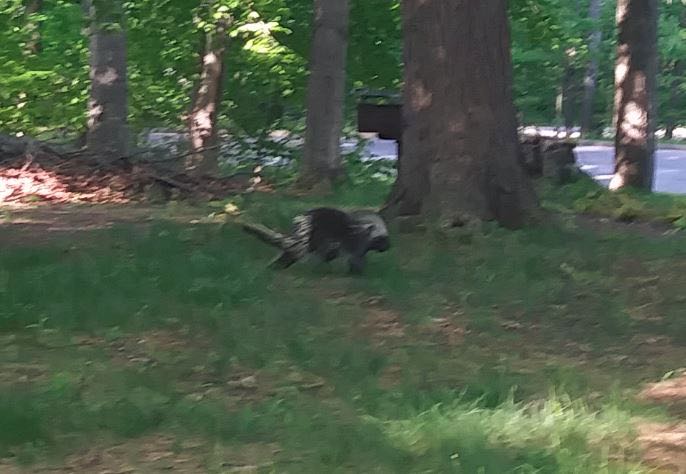
I had already scheduled a short vacation to Sleeping Bear Dunes on the thumb of Northwestern Michigan, so I took this test setup with my Sony ICF-2010. This area is a very nice remote National Lakeshore with minimal noise.  I tried a beach setting and a couple of hilltop picnic areas (including meeting a local Porcupine) and had very nice reception at all locations. The hilltop locations are approximately 400 – 600 feet above the Lake (yes, the Dunes are THAT big there!).

Meeting a local Porcupine

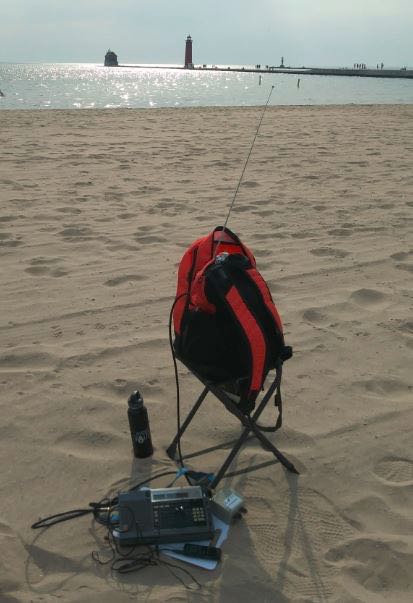
Later on, I went to Grand Haven, MI on the way home and stopped at their very lovely beach.

Reception was just as good as the hilltop locations at Sleeping Bear! In both areas, I was next to a large body of water (in this case, Lake Michigan) and makes for an advantageous place for DXing!  I had also stopped at a Rest Area off the highway and that was a terrible place even though it was electrically quiet but nowhere near the big Lake. I guess the rumors are true about being near a large body of water somehow enhances reception of weak signals–?

I will submit recordings later since I lost the mini-B cable for the Sony digital recorder and had to order a replacement.  However, this was a nice project that freed up some space inside the backpack. I will add an 18 inch extension to the whip that will give me a total length of 72 inches.  Plus, it is mounted 12 inches up on the poly cutting board and I place the backpack on a small hunters folding chair that is about 24 inches tall. So, the tip will be about 9 feet off the ground.

Not pictured but I was also able to easily fit inside a used CCrane Twin Coil Ferrite antenna for mediumwave use that also performed very well.  I noticed that the picnic benches at some locations are made of metal, so that gives me a future idea of trying to leverage that to use as a ground plane somehow.  The battery pack is heavy but also gives great ballast to the backpack and will not tip over. Cannot wait for the Tecsun S-8800 to arrive so I can try leaving the radio inside the bag and just use the remote control to tune!

Happy Listening,

TomL

Parts List


As always, I’m so impressed with your spirit of radio adventure, Tom! I love the fact that your goal is to make a field-deployable DX kit that isn’t cumbersome or time-consuming to set up on site. I imagine you only need a couple of minutes to open the pack and have it on the air. 

Those DXing spots are stunning! I had no idea one could find 400-600′ dunes in NW Michigan–! With that said, I’ve heard that part of the state is one of exceptional natural beauty.  If you could somehow turn the lake into a body of salt water–thus increasing ground conductivity–you’d really enhance that already impressive reception! I’m guessing that sort of project would be a bit outside your budget! Ha ha!  That and the freshwater fish might protest!

To me, there is no better way to enjoy radio than finding a nice RF quiet spot in the great outdoors…no matter where you live in the world. On top of that, Tom, you’re constantly building, experimenting, documenting and sharing your findings–you’re a true radio zealot! Huzzah!

Post readers: Read Tom’s past contributions and articles by clicking here

Click here to read Backpack Shack 3 – Part 2.

BBC Witness podcast features Caversham Park

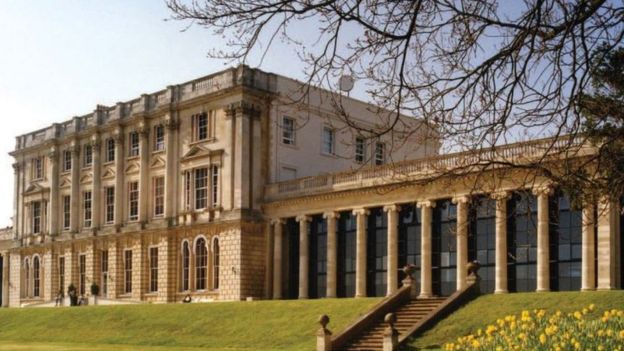
Caversham Park (Photo source: BBC)

(Source: BBC World Service via Julie M)

For 75 years the BBC ran a monitoring service based in an English stately home. Its job was to listen to foreign broadcasts from all around the world. But in 2018 the BBC decided the building was no longer needed. David Sillito spoke to veterans of the monitoring service before Caversham closed its doors.

Click here to listen via the BBC World Service website.