Category Archives: Shortwave Radio

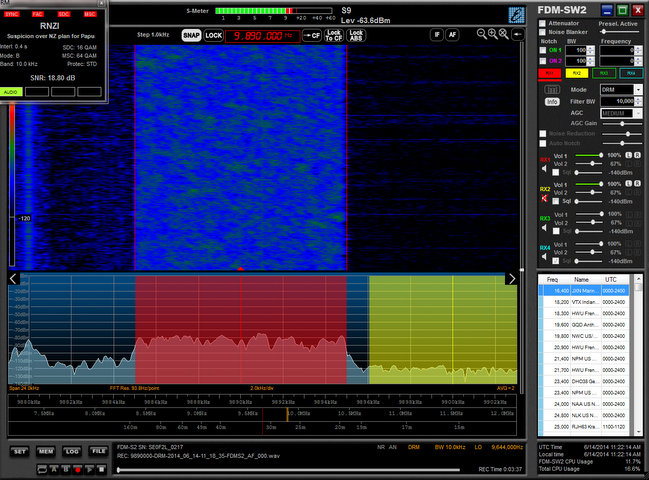
DRM feeds RNZ Pacific relays

(Source: Radio World via Mike Hansgen)

RANGITAIKI, New Zealand — Radio New Zealand Pacific, the official international arm of Radio New Zealand, is using Digital Radio Mondiale digital radio transmission/reception equipment to feed studio-quality audio to some of its 20 relay stations in the Pacific Ocean region. The others use satellite feeds or web downloads.

The locations being served by DRM include the Cook Islands, where RNZ Pacific’s programs are rebroadcast locally in analog mode by Aitutaki 88FM, the islands’ only broadcaster. RNZ Pacific also serves Tonga, Samoa, and the Solomon Islands using DRM; among others. Previously, RNZ Pacific had fed its relays using analog AM shortwave radio, with that transmission mode’s limited audio range and interference issues.

“When DRM became available to us in 2005, we saw it as a great opportunity to provide high quality audio to Pacific radio stations that relayed our news broadcasts from our AM transmitter,” said RNZ Pacific’s Technical Manager Adrian Sainsbury. “As a platform to deliver good quality audio to remote island FM stations, it has been a great success.”[…]

Click here to read the full article at Radio World.

As the article points out, RNZ has been using DRM as a feed for quite a few years. I think this is a brilliant use of the technology. Of course, those of us in the rest of the world can snag RNZ DRM broadcasts as well.

An unusual 1990s reception report from North Korea

Many thanks to SWLing Post contributor, Richard Langley, who spotted this fascinating account in The Mayo News:

Michael Commins on his remarkable communication from inside North Korea

THE Korean peninsula dominates world news coverage this week.

[…]Around 1988, after becoming engrossed in the hobby, I also bought the acclaimed Sony 2001D shortwave radio from Padraig Gilmore of Gilmore Electrical in Claremorris. Padraig was a genius when it came to radios and he also had a huge interest in shortwave listening.
I recall listening to the last broadcast of Radio Berlin and tuning in on a weekly basis to some favourite shows on The Voice of America, Radio Netherlands, Radio Havana (still broadcasting on 6000khz), Radio Prague, Radio Moscow (with their powerful transmitters on numerous frequencies), Radio Canada International, HCJB from Quito in Ecuador, Vatican Radio, and a host of the stations from around the world.

[…]On a few occasions, I managed to pick up the English language broadcast of Radio Pyongyang from North Korea (Democratic People’s Republic of Korea). I posted some reception reports to them and got back their radio schedules and QSL cards as well as some cultural material.

One day in the 1990s, I received an extraordinary letter from a person at the international radio station in North Korea. It was smuggled out of the country and posted in Japan. There was no internet and no Facebook back then. Shortwave radio was the only way to get news broadcast across thousands of miles.

Today, for the first time I reveal some of the contents of the letter but am still reluctant to state the date I received the letter (which I wrote on the back of it) … just in case.

Here are some extracts:
“I am writing this letter to tell you we are tired of repeating the same programs all the year round. We may deal with fresh information when we air the news about foreign countries, but when we are told to air radio commentaries we in most cases try to search similar programs we had once aired previously.

“This is the safest way to be faithful to our duty because we are told to quote some phrases from the remarks of our Great Leader Kim II Sung or Dear Leader Kim Jong II whenever we draft the manuscript of the commentaries. This is why we have been repeating the same tones for years.

“No freedom of speech nor of association exists in my country. You will never notice any dark side of our society when you listen to our radio programs.

“The reality of my country is that the people, especially those living outside of Pyongyang are suffering from the severe shortages of food and daily commodities. They are urged to engage in the campaign to take two meals, instead of three meals, a day.

“I don’t think our closed-door policy will last forever, and sometime, in the future and all of a sudden the people will rise up against the government. I think now is the time for the intellectuals to come to the rescue of our fatherland”.

This letter has been kept safe and sound over the years, between the covers of ‘The Moscow Correspondents’, a fine book by Whitman Bassow, former Moscow Bureau Chief of Newsweek, which provides wonderful insights into the USSR over generations.[…]

Click here to read the full story at The Mayo News.

Grimeton Radio / SAQ Transmission on July 1st, 2018

Many thanks to SWLing Post contributor, Evandro Stanger, who writes:

Good news. Grimeton Radio will be on air again on July, 1. See the link below:

(Source: The Alexander Association)

Grimeton Radio / SAQ Transmission on July 1st, 2018.

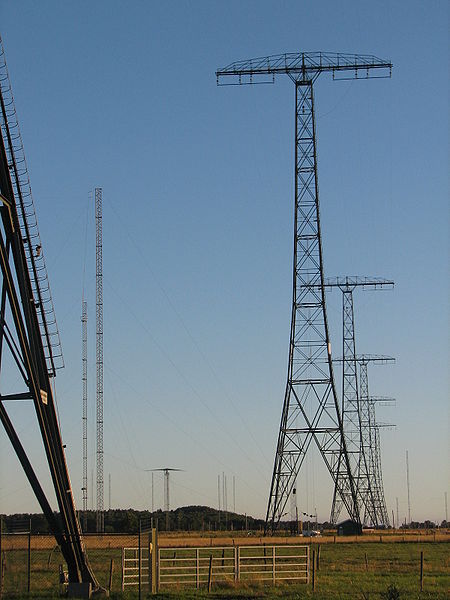
The annual transmission on “Alexanderson Day” with the Alexanderson alternator on VLF 17.2 kHz with the call SAQ will take place Sunday, July 1st, 2018.

This year, three transmissions are scheduled as follows:

1. Startup of tuning at 10:15 (08:15 UTC) with a transmission of a message at 10:45 (08:45 UTC).
2. Startup of tuning at 12:15 (10:15 UTC) with a transmission of a message at 12:45 (10:45 UTC)
3. Startup of tuning at 14:15 (12:15 UTC) with a transmission of a message at 14:45 (12:45 UTC)

All three transmission events will be broadcasted live on our YouTube Channel.

Amateur Radio Station with the call “SK6SAQ” will be QRV on the following frequencies:
– 7.035 kHz CW or
– 14.035 kHz CW or
– 3.755 kHz SSB

Two stations will be on the air most of the time.

QSL-reports to SAQ and SK6SAQ are kindly received via:
– E-mail to: [email protected]
– or via: SM bureau
– or direct by mail to:

Alexander – Grimeton Veteranradios Vaenner
Radiostationen
Grimeton 72
SE-432 98 GRIMETON
S W E D E N

The station will be open to visitors between 10.00 am to 4.00 pm.

WELCOME!

World Heritage Grimeton Radio station and The Alexander Association

For further details, se grimeton.org or alexander.n.se

Excellent news!  Thanks for the tip, Evandro!

Guest Post: Backpack Shack 3.0 – Part 2

Many thanks to SWLing Post contributor, TomL, who shares the following guest post as a his Backpack Shack 3 evolves:


Backpack Shack 3 – Part 2

by TomL

Wanting MOAR options for my recent amplified whip antenna experiment, I decided to add a second antenna input to the kitchen cutting board (can I call it a “Breadboard”? – Ha, that’s an electronics joke!).  The idea behind it came from realizing that I might not want to spend all my time outside at a picnic table or on the beach, especially if it is drizzly and windy. And I still wanted a better ground for the antenna.  So, I thought I could use more Trucker Parts and put an antenna on top of the roof of my vehicle so I could listen in the relative comfort and safety of my small SUV (or even a friend’s car).

Breadboarding

Here is the crowded “Breadboard” with some extra items added.
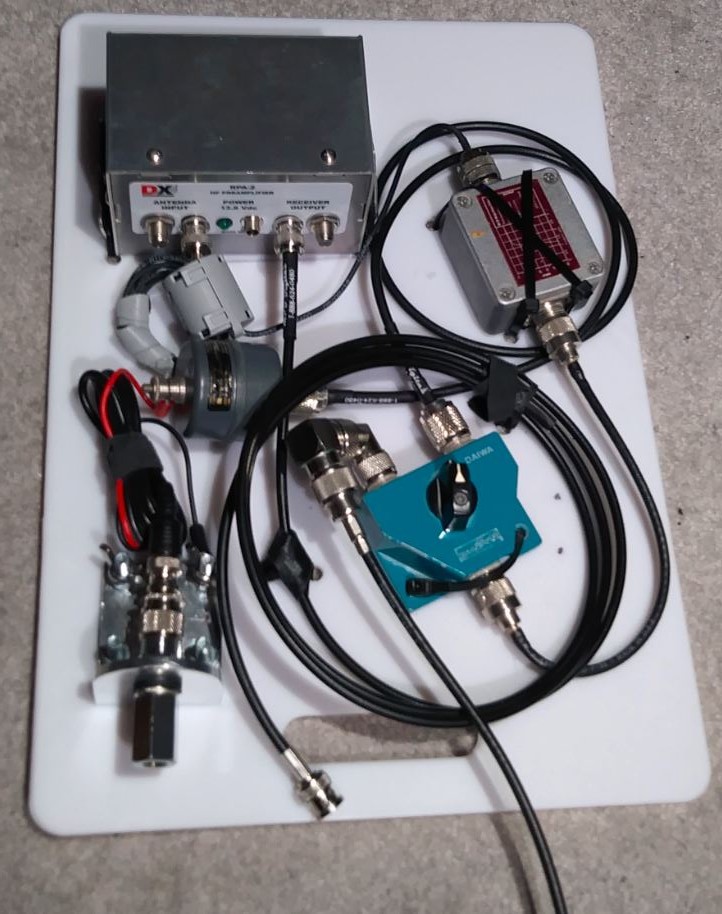
I thought of the vertical antenna as a short longwire and had an old, original RF Systems Magnetic Longwire Balun.  That device allows for an improvement in signal/noise ratio (in theory) if used on a longwire. Perhaps it works on this, too??  You can see the gray cylinder connected right beneath the trucker mirror mount on the left (this will not be tested at this time, see External Antenna below).  The output goes to a greenish Daiwa switch on the right.

A large amplified antenna has the real possibility of overloading the amplifier.  With the Magnetic Balun, I am hoping the VHF band is attenuated enough to preclude any problems because its response naturally tapers off past 40MHz.  But Mediumwave is well within its bandpass. I remembered an old Kiwa Electronics Broadcast Band Rejection filter not being used for a long, long time, so I connected that right after the Daiwa switch (the metal box with red plate).

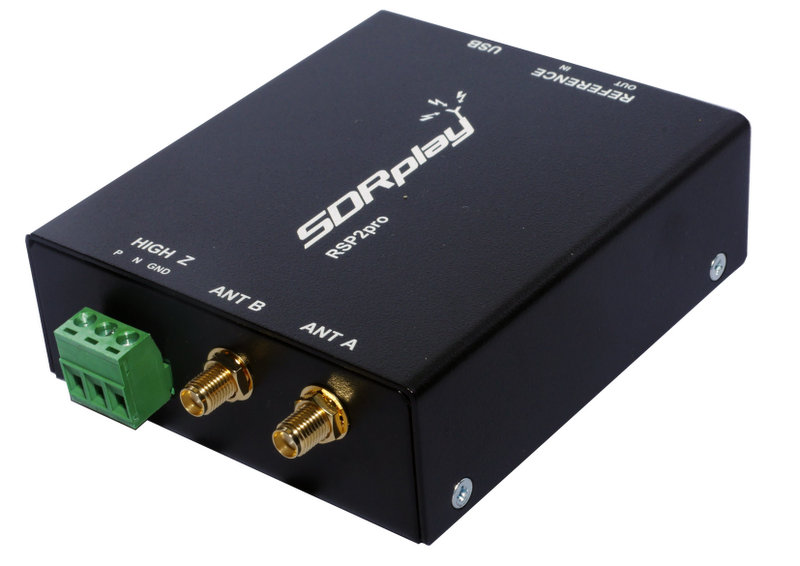
This output then goes to an RF choke just before entering the pre-amp.  I figure I will be using my SDRPlay RSP2 and noisy laptop and wanted to try to reduce any interference traveling on the outside coax braid before it gets amplified.

External Antenna

OK, now for the other Daiwa switch selection.  The external antenna will be connected and disconnected as often as I use it.  I attached two right-angle coax adapters to be the connection point for the antenna.   This is so that the physical switch threads do not have to handle that wear-and-tear. You can see it as the fuzzy out of focus thing sticking up out of the left side switch position.

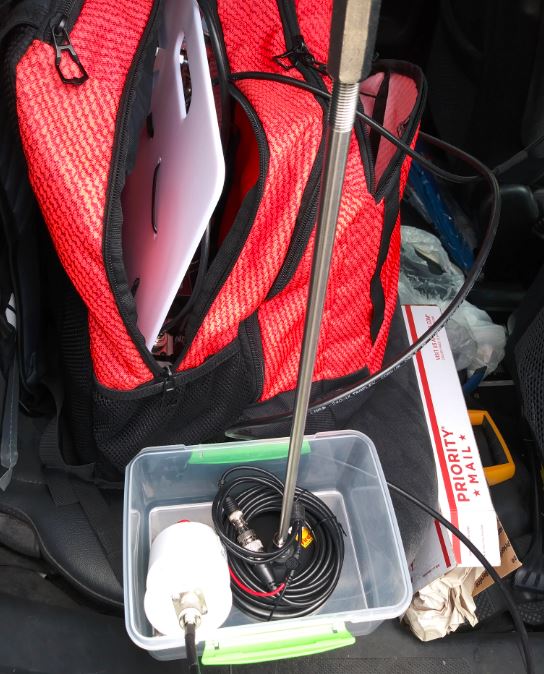
The wire going out the top of the Breadboard goes to a Firestik K-11 magnetic mount placed on top of the roof of the SUV.  I also wanted this to be connected to a magnetic balun. I just happened to have a nearly unused Palomar Engineers Magnetic Longwire Balun.  It has its own ground lug for use with a counterpoise. Temporarily, I left the 18 feet of wire that came attached to the K-11 Mount and attached an adapter and BNC test lead; on the other end is connected the spade lugs to the Balun (red wire to the lanyard nut, black wire to the ground lug).  It all fits neatly inside a Sistema 3 liter container.
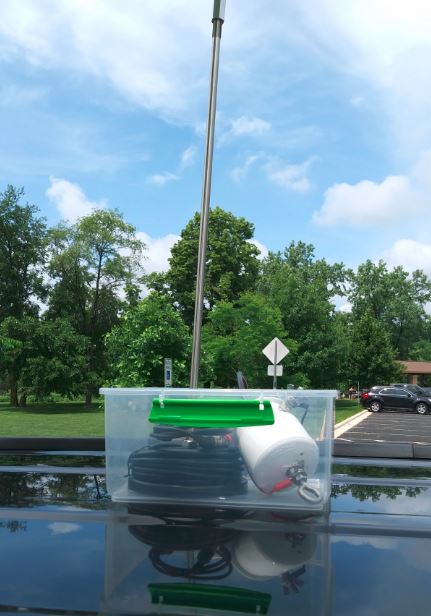
The magnet and box self-clamp easily onto the roof of the vehicle.  I added a new 18 inch section to the Trucker Antenna Shafts creating a full 72 inch antenna, complete with mag mount, ground plane (car body), and magnetic balun.  It is very easy to put up and take down and the box helps keep everything contained.

I am pushing things a bit here.  Magnetic Baluns are not really meant to be used on vertical antennas.  It probably breaks some sort of Cosmic Electrical Law somewhere that causes electromagnetic waves to get very confused and die a horrible, twisted, circular death.  But I figure that it is an unbalanced “line” similar to a longwire antenna; it’s just a little short and goes straight up instead of horizontal! I like the idea, so I am going to run with it.

Warnings!

It goes without saying that the Antenna Shafts, magnet mount, and magnetic balun are weatherproof (but NOT lightning proof!).  Take proper lightning precautions and take it down.  Even so, I might add a small drainage hole to the box since it did rain a tiny bit during testing.

Secondly, this setup is ONLY FOR STATIONARY VEHICLES!!!!  DO NOT TRY TO DRIVE DOWN THE ROAD OR HIGHWAY!!!! The magnetic mount will NOT stay on the car and will damage your vehicle and maybe a vehicle travelling next to you!

Performance
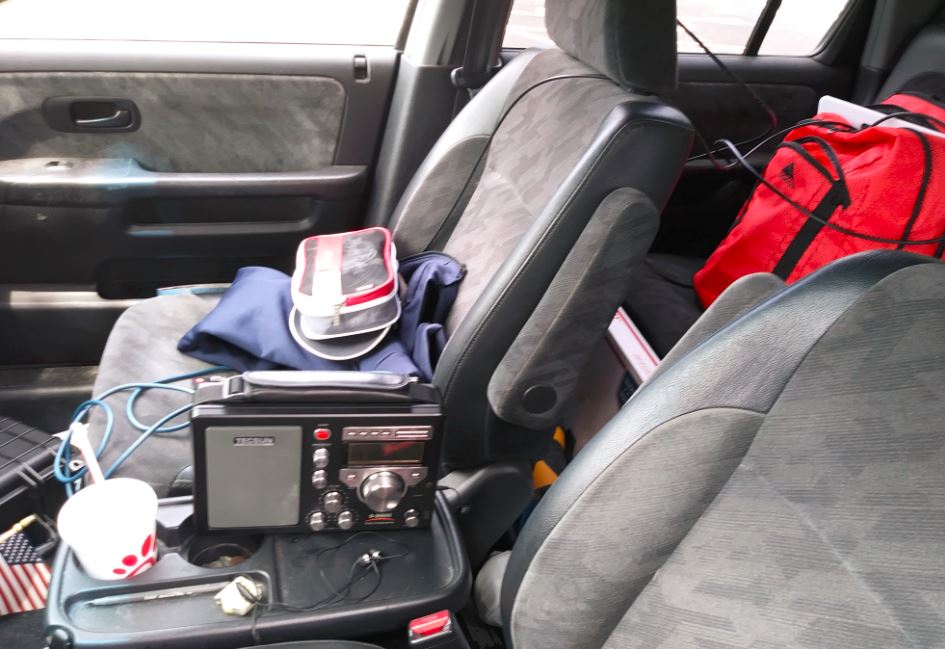
As you can see from the picture, my new Tecsun S-8800 is getting a workout while connected to the Cross Country preselector (not shown behind it) and to the backpack next to the back seat window.  The Tecsun S-8800 is a nice radio. My copy has a couple of quirks that I might have to send it back (the AM band tunes incorrectly 2 kHz lower than it should and the SW SSB tunes 140 Hz higher than indicated and I have to compensate using the fine-tuning dial for these modes–FM seems correctly tuned).

Other than this, the actual performance is really quite good!  DSP does have sharp cutoffs to the IF bandwidth (especially resolving strong station interference when selecting 3 kHz vs. 4 kHz).  With all my filters/balun/choke, I did not notice any MW or FM breakthroughs and signals on those bands were nicely contained and “normal”.  Interference from my cell phone while looking up internet frequency listings was minimal – seems like the cable shielding, choke, and car roof are doing a good job.

The audio output jacks have very thin clearance between the jacks and the housing of the radio. So for the second time, I will not have recordings since the cable I wanted to use has home theater style construction with very thick plug outer connectors and will not fit!

From an RF-quiet “Forest Preserve” (County park), there were a variety of stations received from the 25 through 19 meter bands (Local time 11am-1:30pm). A few stations I have never heard before until now:

  • Radio Free Asia in Korean on 11985 KHz (Tinian Island)
  • Radio China International in Esperanto on 11650 KHz (Xian China)
  • Radio Farda in Persian on 12005 KHz (Wooferton England) – broadcast opposite my direction
  • Radio Bible BCI in Somali on 15310 KHz (Nauen Germany) – Strange sounding but interesting  Christian Somali music
  • Radio Free Asia in Chinese on 13675 KHz (Dushanbe Tajikistan)
  • Voice of Hope Africa in English on 13680 KHz (Lusaka Zambia) – had to use ECSS USB to get away from strong interference from RFA on 13675, fairly good intelligibility (including music)!  I wish there was a 6 KHz option for SSB mode since the audio was slightly muffled and could not compensate much with the tone controls. That kind of feature usually comes with radios costing 3X more, however.
  • Voice of Korea in French (Kujang North Korea) being squashed by Radio China International (Kashi China) in English on 13760 KHz

It was so nice not to be on a beach and have people walk by STARING at me with my weird radio/antenna setup.  And I was dry and comfy sipping a cool drink while there was a drizzle of rain pelting the windshield. Downside might be that the car setup cannot always be located optimally if I want to be next to that Very Large Body of Water (Lake Michigan) to help enhance reception but this is not a bad alternative.   The next test will have to be during early evening when signals are booming into my location and see if performance holds up under those conditions!

Happy Listening,

TomL

Modified Parts List

Parts Repeated from Part 1 article


As always, Tom, a most impressive setup powered by home-grown ingenuity! Thanks so much for sharing the evolution of your field kits with all of us here at the SWLing Post!

By the way, you still have me chuckling about your use of the term, “breadboard!” 🙂

Steve Andrew’s spectrum analyzer software for SDRplay SDRs now available for download

A few weeks ago, we posted an announcement that spectrum analyzer software was being developed for the SDRplay RSP software defined radio series. Many thanks to Andy, at SDRplay, who shares the following announcement:

We are pleased to announce the availability of the first cut of Spectrum Analyser software developed by Steve Andrew specifically for the RSP line of products. Please note that this is first alpha software and so it is still very much in development and some features are still to be added. Currently supported are:

  • RSP1
  • RSP2/RSP2pro
  • RSP1A

This first alpha release gives a good idea as to the look and feel for the software. The main functional limitation is that sweeps of greater than 10 MHz are not currently supported. Steve is currently re-working the algorithms for providing wider sweeps than 10 MHz to improve sweep time and remove the issue of the DC spike in ZIF mode, so please bear with him.

We recommend using the software with AGC turned off and use manual control of the gain for better display stability.

Please see the Spectrum Analyser webpage: https://www.sdrplay.com/spectrum-analyser

Best regards,

SDRplay Support

BBC Monitoring: “spotting fake news” since WWII

(Source: BBC Blog)

BBC Monitoring is a specialist part of BBC News, part of the World Service group. We have experienced journalists and linguists who follow and track international media in foreign languages, in over 150 countries and about 100 languages.

We monitor that information, we report and analyse it, and we work on a subscription website basis. All our content is available to the BBC and to the UK Government and we also have commercial customers.

The service has been through a lot of changes in the last couple of years, and was delivered a savings target which we had to incorporate. We’ve changed the structure of the personnel and the organisation, we’ve changed the delivery platform, updated the technology, and we have new products, new customers and users.

We’ve moved from Caversham House, in Berkshire, which was an absolutely beautiful place to work, but it was expensive to run, and we were at a distance from a lot of our users in the BBC but also in the UK Government. Coming into Broadcasting House gives just that extra sense of being part of News.

[…]BBC Monitoring was set up to counter propaganda from Nazi Germany in the war, explaining propaganda and spotting messaging in media. Verification – and then the reporting of stories where fake news is part of the media, is still part of what we do.

I’m pleased that the World Service is pulling together all its coverage of fake news. Monitoring is a central part of that, and we’re also developing a small team that is solely going to be dedicated to disinformation and the manipulation of messaging in the media in certain parts of the world.

We already work with all parts of News, for example our Iran team work very closely with the Persian service. During the Iranian elections last year some of our team were embedded with the Persian service to help them with their coverage.

We’re constantly following the media in over 150 countries, so when you’re talking about a big, complex, international story we’re able to broaden the lens and say ‘Well, here’s the view from this part of the world’, and ‘Here’s what this other country is saying.’[…]

Click here to read the full story on the BBC blog.

North Korea Summit: Voice of Korea English language shortwave frequencies

Photo of Singapore skyline by Mike Enerio.

Many thanks to SWLing Post contributor, DanH, who writes:

I recorded and edited clips from two Voice of Korea SW broadcasts in English at different times earlier today (UTC). The radio clock in this video is fairly accurate and is set to UTC. The VOK announcer reads a list of VOK English language broadcast times and frequencies near the end of the video. Happy listening! Propagation conditions aren’t that bad.

Click here to view on YouTube.

Thank you for sharing this, Dan. I’m travelling at the moment but will certainly listen via one of my favorite WebSDRs. I’m hoping some listeners will submit recordings to the shortwave archive!

I’ve copied the times and frequencies below for reference:

  • To Europe on 13650 and 15245 kHz
    • 15:00-16:00 UTC
    • 18:00-19:00 UTC
    • 21:00-22:00 UTC
    • 13:00-14:00 UTC
  • To North America on 9435 and 11710 kHz
    • 15:00-16:00 UTC
    • 13:00-14:00 UTC
  • NE Asia on 7620, 9445, and 9730 kHz
    • 4:00-5:00 UTC
    • 6:00-7:00 UTC