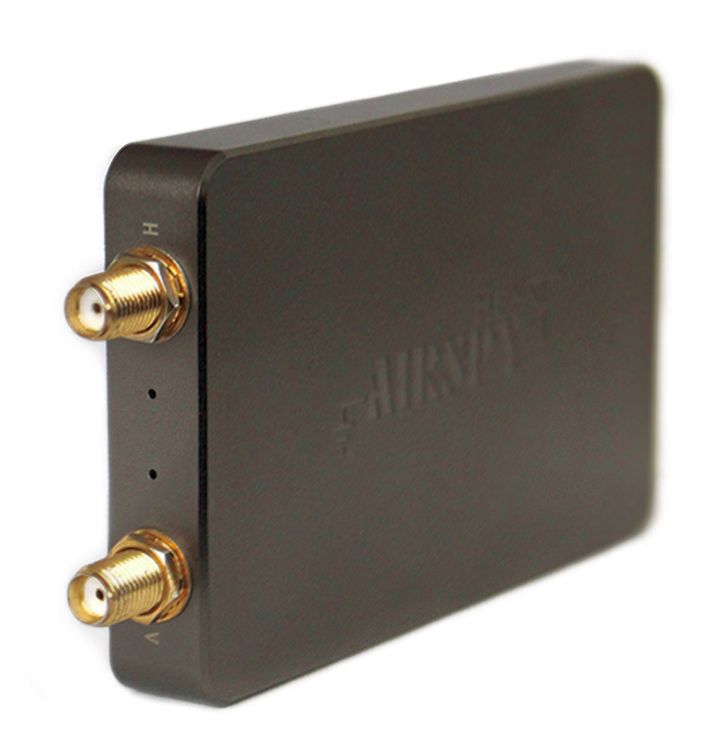
SDR manufacturer, Airspy, has a new product shipping “really really really soon” (per their website). The Airspy HF+ promises improved frequency agility through the use of high-performance passive mixers with a polyphase harmonic rejection structure. Airspy states that no external band filters are required as they are with many budget SDRs.
There are many other improvements over their previous iterations. Here’s the product information copied from the Airspy HF+ page on Airspy’s website:
(Source: Airspy)
The Software Defined Radio revolution brought great flexibility in VHF and UHF reception. Today we offer the best wide band receivers which address these needs. We also provide a high performance extension for weak-signal wide band reception on HF – something other competing solutions fail to address efficiently.
Airspy HF+ is a paradigm shift in high performance HF radio design. It is a joint effort between Airspy, Itead Studio and a top-tier semiconductor company to build a state of the art SDR for HF and VHF bands.
Like most high-end HF receivers, the HF+ uses very high dynamic range ADC’s and front-ends. But unlike the current offerings in the market, it also brings more frequency agility by using high performance passive mixers with an excellent polyphase harmonic rejection structure. No external band aid filters are required like the lower end HF receivers, which makes it the ideal companion for light portable high performance operation.
Both the architecture and level of integration achieved in this design allow us to bring top performance reception at a very affordable price.
All the major SDR software is supported. Check the download page.
State of the Art SDR streaming technology!
We concentrated state of the art DSP and networking techniques into our SpyServer software to allow multiple users to stream high quality IQ data from the same receiver at the same time. No compromises in the quality were made like it is usually done in Web SDR interfaces. You get actual IQ data you can process with your plugins and extract the last bit of information out of it.
The server software is highly scalable and can run on computers as small as the $7 Orange Pi Zero to top end 64bit servers with multiple cores/cpus, including the popular Raspberry Pi series.
HF Tuner
Airspy HF+ achieves excellent HF performance by means of a low-loss band filter, high linearity LNA, high linearity tunable RF filter, a polyphase harmonic rejection (HR) mixer that rejects up to the 21st harmonic and multi-stage analog and digital IF filtering.
The 6 dB-stepped AGC gain is fully controlled by the software running in the DSP which optimizes the gain distribution in real time for optimal sensitivity and linearity. Harmonic rejection is a key issue in wide band HF receivers because of the large input signal bandwidth of the input signal. The output of the IF-filter is then digitalized by a high dynamic range sigma delta IF ADC for further signal processing in the digital domain.
VHF Tuners
Excellent VHF performance is also achieved by using optimized signal paths composed of band filters, high linearity LNAs with a stepped AGC, a polyphase harmonic rejection mixer and IF filters optimized for their respective bands.
The amplifier gain is switchable in 3 dB-steps and fully controlled by the AGC running in the DSP. The RF signal is converted to baseband by a high linearity passive mixer with a polyphase harmonic rejection structure. The low-IF signal is then converted into the digital domain by the same IF ADC used in the HF chain.
IF Sampling
The IF analog to digital converter (ADC) is a 4th order multi-bit noise shaping topology; it features very high dynamic range and linearity. The IF-ADC sampling rate is determined by a control algorithm running in the embedded DSP. This advanced technique adjusts the sampling rate depending on the tuning frequency with the goal of avoiding the disturbances and spurs generated by the switching discrete-time sections of the IF-ADC.
Digital Down Converter
Once the IF signal is digitalized, the high sample rate I/Q stream is then frequency translated and processed with cascaded CIC and FIR decimation stages. After every stage, the sample rate is reduced and the resolution increased. The final signal at the output has 18bit resolution and an alias rejection performance of 108 dBc. The data is then scaled to 16bit and sent to the Micro-Controller for streaming over USB.
Architectural Advantages
The main advantages over techniques from the legacy super-heterodynes up to the now mainstream direct sampling is that the whole receiver chain is well protected against out of band blockers while still relaxing the RF filtering constraints, making it simple and cost effective.
The natural filtering of the sigma-delta ADC combined with the excellent linearity and sensitivity of the analog chain reaches an unprecedented level of performance and integration.
Use it over the network!
Connect as many SDR applications as needed to the HF+, over the Internet or in your own local network with near zero latency thanks to the new SPY Server software.
This setup basically brings all the flexibility of Web based SDRs while still benefiting from the full power of desktop applications. The IQ data is processed in the server with state of the art DSP and only the required chunk of spectrum is sent over the network. What is sent is the actual IQ signal, not compressed audio. This means you can use all your favorite plugins to process the IF, eliminate noise and perform heavy lifting of the signals as you are used to do with locally connected SDR’s.
We have a tradition of building multi-tools, so we made sure the SPY Server runs on 32/64bit Windows and Linux on Intel and ARM processors without any compromises. Low cost Raspberry Pi 3 and Odroid boards are in the party.
Technical specifications
- HF coverage between DC .. 31 MHz
- VHF coverage between 60 .. 260 MHz
- -140.0 dBm (0.02 µV / 50 ohms at 15MHz) MDS Typ. at 500Hz bandwidth in HF
- -141.5 dBm MDS Typ. at 500 Hz bandwidth in FM Broadcast Band (60 – 108 MHz)
- -142.5 dBm MDS Typ. at 500 Hz bandwidth in VHF Aviation Band (118 – 136 MHz)
- -140.5 dBm MDS Typ. at 500 Hz bandwidth in VHF Commercial Band (136 – 174 MHz)
- -139.0 dBm MDS Typ. at 500 Hz bandwidth in the upper VHF Band (> 174 MHz)
- +15 dBm IIP3 on HF at maximum gain
- +13 dBm IIP3 on VHF at maximum gain
- 110 dB blocking dynamic range (BDR) in HF
- 95 dB blocking dynamic range (BDR) in VHF
- 150+ dB combined selectivity (hardware + software)
- 120 dB Image Rejection (software)
- Up to 660 kHz alias and image free output for 768 ksps IQ
- 18 bit Embedded Digital Down Converter (DDC)
- 22 bit! Resolution at 3 kHz channel using State of the Art DDC (SDR# and SDR-Console)
- +10 dBm Maximum RF input
- 0.5 ppm high precision, low phase noise clock
- 1 PPB! frequency adjustment capability
- Very low phase noise PLL (-110 dBc/Hz @ 1kHz separation @ 100 MHz)
- 2 x High Dynamic Range Sigma Delta ADCs @ up to 36 MSPS
- No Silicon RF switch to introduce IMD in the HF path
- Routable RF inputs
- Wide Band RF filter bank
- Tracking RF filters
- Sharp IF filters with 0.1 dB ripple
- Smart AGC with real time optimization of the gain distribution
- All RF inputs are matched to 50 ohms
- 4 x Programmable GPIO’s
- No drivers required! 100% Plug-and-play on Windows Vista, Seven, 8, 8.1 and 10
- Industrial Operating Temperature: -45°C to 85°C
Typical Applications
- High Performance Networked HF/VHF Radio
- Ham Radio (HF + 2m)
- Short Wave Listening (SWL)
- AM DX
- FM DX
- VHF-L TV DX
- Remote Telemetry Radio Receiver
- Low Bands IoT
Supported Operating Systems
- Windows Vista, 7, 8, 8.1 and 10
- Linux
- *BSD
- OSX
Supported Hardware
- Intel compatible PC
- Raspberry Pi 2 and 3
- Odroid C1, C2 and XU4
- Many other Single Board Computers (SBC)
Minimum hardware requirements
- 1GHz Pentium or ARM
- 1GB of RAM (to run your own OS, HF+ barely needs 1MB of memory)
- High speed USB 2.0 controller
Supported Software
Developer API
- Open source, multi-platform user mode driver libairspyhf on github
No price point has yet been made public–at least, none that I have discovered. Of course, we’ll post shipping and pricing details when they become available. Follow the tag AirSpy for more. Check out the Airspy website for full details and documentation.