Category Archives: Shortwave Radio

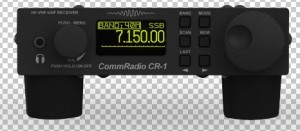
CommRadio is introducing the CR-1, a new tabletop shortwave receiver

The CommRadio CR-1

The CommRadio CR-1

US-based CommRadio is introducing a new tabletop, SDR-based, shortwave receiver this year: the CR-1. Their website has a few specifications and the video I’ve embedded below.

The CR-1 receives the full medium wave and shortwave spectrum (.5-30 MHz), plus some portions of VHF and UHF (FM broadcast band, Aircraft, Marine, NOAA weather radio, GMRS and FRS services).

The receiver architecture is a dual conversion super-heterodyne design with low-IF , I-Q digital sampling, 16 bit DSP with digital audio CODEC.  Their website also mentions DSP algorithms for all demodulation: DSB-AM, SSB, CW, WBFM, NBFM and channel filtering.

Other impressive features:

  • Can be powered from USB or a 6-18 VDC power source (from a separate 2.1mm jack).  The CR-1 possibly has the most flexible power source I’ve ever seen in a shortwave receiver!
  • The knobs are black anodized machined aluminium and front panel is powder coated machined aluminium; case is 20 gauge powder coated steel
  • Three antenna inputs
    • BNC for HF/MW
    • 3.5 mm audio jack (rated at 1000 Ohm, for roll-up antennas or telescoping whip),
    • BNC for VHF and UHF
  • Very portable size!

Full specs are available on their website: commradio.com

We will also keep you posted with any future updates.

The truth about portable amplified shortwave antennas

In the past week, I have had no less than 3 email inquiries from readers regarding which amplified antenna to purchase for their portable shortwave radio.  My short answer? None.

In my opinion, there’s one fatal flaw with amplified antennas: they amplify noise just as much as they do the signal you wish to hear.
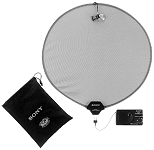
The Sony AN-LP1 is the best amplified antenna I've ever used, but that's not saying a lot.The only portable amplified antenna I’ve had any results with is the Sony AN-LP1 (now only available in Japan), and I attribute this success mainly to the fact that a suction cup, mounted at the top of the loop, allows it to be mounted on a window. Even then, results are often only marginally better than with the telescopic whip.

There may have been a time when portable amplified antennas made sense–a time prior to noisy AC adapters, flat screen TVs, and other consumer electronics which spew RFI (Radio Frequency Interference), polluting our shortwave bands. Today, however, you’ll be disappointed with the results of one of these, particularly if you travel–turning on the amplified antenna in a hotel room will increase the noise you hear two-fold, while weak broadcasters will remain lost in the static.
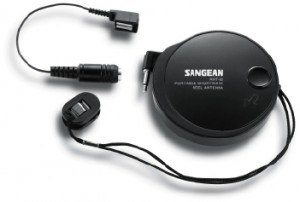
RollUpAntennaReelSangean

The Sangean ANT-60 is inexpensive and vesatile

So what can you do to improve the performance of your portable while traveling or at home? I’m still a fan of the roll-up antenna; like the Sangean ANT-60.  They’re inexpensive ($12 US), packable, and versatile–the clip on the end of the reel allows the antenna wire to be clipped to curtains and blinds. Place it near a window, or even hang it outside. Antennas love being outside–just take it down when not in use.

In lieu of buying a roll-up antenna, you could simply attach an alligator clip to the end of a 20′ (6 meters) length of wire.  The alligator clip can then attach to the end of your telescopic antenna, and you now have the same properties of a roll-up antenna for pennies. This is possibly the most cost-effective way to improve the performance of your portable shortwave radio. One note of caution: don’t get too generous with the length of your antenna wire. Some portable radios lack a robust front-end and a wire that’s too long could actually overload the receiver. Some Grundig G5’s were even sensitive to static discharges over a wire antenna. If uncertain, I would not exceed 20 feet in length (6 meters).
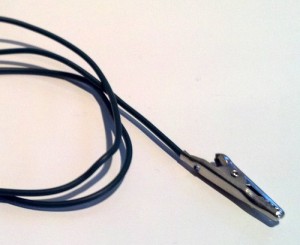
An alligator clip offers serious bang-for buck--especially if you already have the parts lying around

An alligator clip offers serious bang-for buck–especially if you already have the parts lying around!

I’ll never forget:  one of the first email questions I received on SWLing.com was from a fellow listener in Washington state who wanted to hear stations better on his Sony portable. I suggested the alligator clip/antenna wire. He wrote back enthusiastically, “This is the most cost-effective improvement I have ever made to anything!” He was so encouraged with the performance improvement, he invested in a tabletop and a proper outdoor antenna with grounding.

So, I urge you to try a roll-up antenna or the alligator clip antenna before you waste money on a portable amplified antenna.  Just my two cents.

WRTH : B12 updates are now available for download

WRTH2013(Source: WRTH Editorial Team)

A few hours later than planned, the B12 broadcast schedules update file is now available from the WRTH Website: http://www.wrth.com (and follow the links) the file is in PDF format and requires Acrobat 6 or greater to open it. The file contains updates to the International and Clandestine/Target broadcast schedules published in WRTH2013. We hope you find this a useful accompaniment to the printed book.

Best wishes / 73 from WRTH Editorial team.

Shortwave Radio Recordings: Voice of Greece music

TheParthenonAthensFor your listening pleasure: 193 minutes of music, and a little Greek commentary, from the Voice of Greece. Recorded on Friday, January 18th–starting around 22:30 UTC–on 9.42 MHz.

Click here to download the MP3 of the recording, or simply listen below:

Attend the 26th Annual Winter SWL Fest

For those of you readers who often feel you’re alone in your enthusiasm for radio, I highly encourage you to attend the NASWA-sponsored SWL Fest in Plymouth Meeting, Pennsylvania this year. The ‘Fest is jam-packed with radio-related information and attended by many radio kindred spirits.  Forum topics this year will include the following :

  • From the WBCQ Archives – Larry Will

  • The Annual Pirate Forum – George Zeller
  • QRP: Operating and Listening at Low Power – Skip Arey
  • Economically Enhancing Your Collection thru Auctions and Flea Markets – Ed Mauger
  • Defeating Jammers with Text By Shortwave – Kim Andrew Elliott/Thomas Witherspoon
  • The Shortwave Shindig – David Goren (Friday night confirmed)
  • The Other Side of Satellite Monitoring – Dave Marthouse
  • More! All About Loop Antennae – Jef Eichner

If you’re interested in attending the SWL Fest, too, go to the official website and register!

Shortwave Radio Recordings: Radio Romania International

RRI-RadioRomaniaInternationalRadio Romania International is on of my favorite international broadcasters. I routinely listen to their broadcasts in English and French. With the demise of Radio Bulgaria in 2012, I turn to RRI for news not only about Romania, but Eastern Europe in general.

I do fear for the future of Radio Romania International on the shortwaves as so many broadcasters are pulling out of the spectrum and putting all of their faith into online “broadcasting.” If you enjoy RRI as much as I do, consider submitting a reception report and letting them know that you’re listening.

Tuesday, I recorded RRI’s English broadcast from Tiganesti on 9.435 MHZ (21:30 UTC)–quite an easy and reliable catch in eastern North America. You can click here to download the recording as an MP3, or simply listen via the embedded player below:

The Mighty KBC testing fast digital modes this weekend

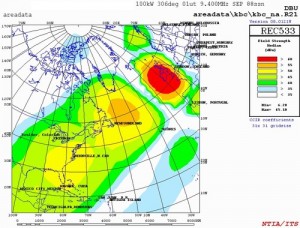
KBC Propagation Map (Source: The Mighty KBC)

KBC Propagation Map (Source: The Mighty KBC)

The Mighty KBC will broadcast this Sunday (January 20) on 9,450 kHz between 00:00-02:00 UTC (that’s Saturday night in North America from 19:00-21:00 EST). Details below:

(Source: The Mighty KBC)

We will try some fast text modes this weekend on The Mighty KBC, to see if they can survive the rigours of shortwave.

This will be during the North America broadcast at 0000-0200 UTC 20 January on 9450 khz. At about 0130 UTC, 4XPSK63R will be centered on 1000 Hz and MFSK64 centered on 2000 Hz. (For 4XPSK63R, use Fldigi 3.21.65 or newer: OpMode > PSKR > MultiCarrier > 4XPSK63R.) At just before 0200 UTC, MT63-2000 (long interleave) will be centered on 1500 Hz, and PSKR250 on 2800 Hz. This will be an Flmsg formatted transmission, with html. Fldigi and Flmsg can be downloaded from www.w1hkj.com.