Shortwave listening and everything radio including reviews, broadcasting, ham radio, field operation, DXing, maker kits, travel, emergency gear, events, and more
Many thanks to SWLing Post contributor, Skip Arey (N2EI), who shared the following video on Facebook:
Any electrical spark creates radio waves and acts as a transmitter. You hear sparks on a radio as interference. That’s why lighting makes radios crackle, and even the tiny spark in a switch is enough to make a noise on the radio when turning on a light./blockquote>
It’s been a while since I posted a video on my YouTube Channel (but I’ve gotten the urge to make several more videos as I’ve been recently comparing my equipment – 16 portable receivers & many antennas).
I try to tune in to Radio Prague via WRMI on many weekday East Coast USA mornings from 1300-1325 UTC. Yesterday I encountered bad propagation but today was much better. The video linked to this post is from today – 30JAN2019 recorded around 1310 UTC.
Without repeating the debate, just take a look at this one example. As stated, reception was pretty good today off the little whip – but – there is an improvement using an amplified antenna. My question: is there a difference between the two amplified antennas? And if so, is the difference worth the price?
My TG34 is a clone of the DE31MS – purchased from Tquchina Radio & Component (ebay user: Tao Qu … they used to have an eBay store “Sino Radios” if I recall, but they stopped selling on eBay when the Post started cracking down on shipment of batteries – I actually exchanged an email with a frustrated Tao Qu when they closed the store).
I paid about $21 if I recall for my TG34 (the DE31MS is available today on eBay for as little as $17.28). I paid over $100 for the Sony AN-LP1 (out of production now and can be listed for as high as $300 on eBay). So … $21 versus “over $100”. Is there a difference – and if so – is it 5x the difference – 5x better?!
You be the judge.
P.S. Just a quick slightly over 1-minute video recorded inside my house (sitting in my breakfast nook) … typically “okay” reception but not my usual Listening Post.
Many thanks to SWLing Post contributor, Dennis Dura, who shares a link to this short video highlighting amateur radio at the 2017 Fort Wayne Field Day:
YouTube description: A 10 minute documentary investigating why people still do ham radio. Shot at the Historical Fort Wayne in Fort Wayne, Indiana, during ARRL Field Day in 2017.
Many thanks to SWLing Post contributor, Jennifer Waits, who notes that The Massachusetts Institute of Technology Radio Society (W1MX) and the Department of Electrical Engineering and Computer Science (EECS) are presenting a series of radio-related lectures covering a wide array of topics, “from the design of modern wireless communications systems and 5G, to software defined radio and satellite communications, to shortwave radio propagation, space weather, Radio Astronomy and more.”
After Thanksgiving Day (here in the States) my family took a little camping trip on the coast of North Carolina. We spent a few nights near Holden Beach and Oak Island–some of my favorite parts of the NC coast.
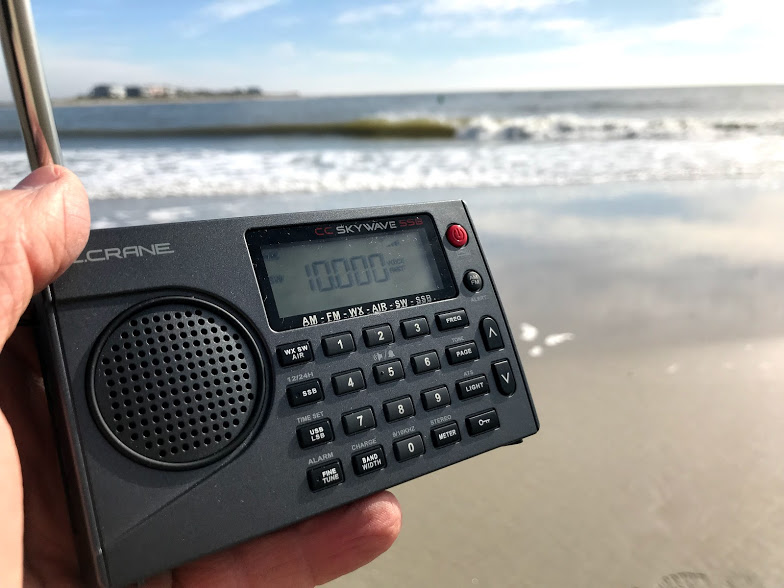
Weather was splendid on Sunday, so we took a long walk on the beach and, of course, I packed a portable radio–this time, the CC Skywave SSB.
The Skywave SSB is a pricey portable, but it has certainly become my choice travel radio as it covers so many radio bands (AM/MW, FM, SW, AIR and WX). It’s also incredibly portable and can hang with the best in terms of sensitivity and selectivity.
I didn’t check propagations conditions on Sunday, but there were signals booming in from everywhere. I took a few short sample videos:
Being away from sources of radio interference and standing next to (and occasionally in—!) the Atlantic Ocean certainly helped a great deal with reception.
I had planned to put my Elecraft KX2 on the air while here, but simply didn’t have the time to fit it in with family activities.
Post readers: Do you have any radio vacations on the horizon?
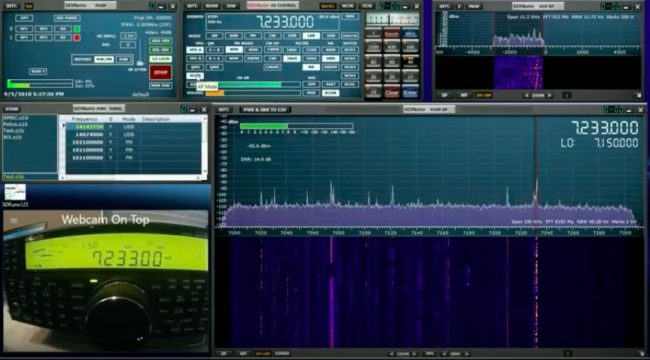
We have released a new YouTube video which covers some items that have been asked about by our users. First up we talk about synchronizing VFO A and VFO B between SDRuno and the rig. This leads into a discussion of using the band switches in SDRuno and use of the LO LOCK button.
Then we cover how to use an RSPduo as a panadapter and a couple of configurations that can be used to expand ease of use and flexibility.