VOA Radiogram features EasyPal digital images this weekend

VOARadiogram(Source: VOA Radiogram)

During the past weekend, EasyPal digital images were received successfully throughout Europe and North America. You can see a gallery of some of the received images here:

voaradiogram.net/post/51385444401/voa-radiogram-easypal-images-received-100-or-0

Reviewing the advantages of EasyPal versus MFSK32:

EasyPal:

1) When received successfully, the picture is perfect.

2) Takes less time to transmit than MFSK32 and most SSTV images of the same size.

3) No problems with slant if soundcards are not calibrated.

MFSK32:

1) If the signal drops below a certain level, or if interference exceeds a certain level, no EasyPal image will be received at all. Under similar reception conditions, MFSK32, which uses an analog frequency shift keying system for images, will allow the an image to be seen, even if the quality is not perfect.

2) MFSK32 images allows images of different heights and widths, including small images which can be transmitted quickly. The gray tone MFSK32 image option allows even faster transmission.

3) MFSK32 images can be decoded by more than one software program under more than one operating system. There is only one EasyPal program, and it works only under the Windows operating system.

I welcome your comments and suggestions about the transmission of images via shortwave broadcast. Weighing all of the above factors, I am inclined to adopt MFSK32 as the primary image mode for VOA Radiogram. However, the EasyPal images are so impressive that I will continue to include some in future programs.

On VOA Radiogram for the weekend of 1 and 2 June 2013, we will continue to compare MFSK32 and EasyPal images. Here is the lineup for the program:

3:44    MFSK16: Program preview
3:17    MFSK32: VOA News story about Olympics wrestling
3:16    MFSK32: VOA News story about 2013 hurricane season
1:10    MFSK32: File image of Atlantic hurricane
2:53    MFSK32: VOA News story about colliding galaxies
1:04    MFSK32: Image of the colliding galaxies
1:21    MFSK32: Introduction to MFSK64 and EasyPal
1:30    MFSK64: Same VOA News story about colliding galaxies
:39     EasyPal text: Same VOA News story about galaxies
2:38    EasyPal image: Colliding galaxies
2:38    EasyPal image: Soyuz capsule being moved to launch site
1:09    MFSK16 closing announcements
:29     Surprise mode of the week

To decode EasyPal text and images, download the 4-May-2013 version of the program from vk4aes.com.

To decode the MFSK modes, use Fldigi from w1hkj.com or another digital decoding program.

VOA Radiogram transmission schedule
(all days and times UTC)

Sat 1600-1630 17860 kHz
Sun 0230-0300 5745 kHz
Sun 1300-1330 6095 kHz
Sun 1930-2000 15670 kHz

All via the Edward R. Murrow transmitting station in North Carolina.

Please send reception reports to [email protected]

And visit voaradiogram.net (where any schedule or frequency changes will be posted)

Twitter: @VOARadiogram

Kim

Kim Andrew Elliott
Producer and Presenter
VOA Radiogram

Shortwave Radio Recordings: Radio Australia’s Jazz Notes

Sydney_opera_houseIf Radio Australia ever stops broadcasting on the shortwaves, one program I will certainly miss is Jazz Notes.

Jazz Notes showcases the best in Australian jazz, often featuring new and original recordings made in ABC’s studios. The show is hosted by Ivan Lloyd and has been offered on Radio Australia for several years.  I listen to the show Wednesday mornings at 9:30 am EDT.

Click here to download the full recording of Jazz Notes as an MP3, recorded yesterday (May 29, 2013) or simply listen via the embedded player below:

Radio Vacation

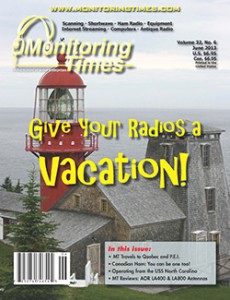
MTCoverMay13

The front cover of MT features a photo I took at Pointe-à-la-Renommée lighthouse and Marconi station in Quebec, Canada. Without a doubt, one of the most beautiful lighthouses I’ve ever seen.

Some of you may remember that I took an extended vacation last year in the maritime region of Canada.

Monitoring Times Magazine just published an article I wrote about the vacation which includes a visit to Sackville, New Brunswick, four weeks in an off-grid cabin in eastern Prince Edward Island and a trip through the Gaspe region of Quebec.

Looking back, it’s amazing how much radio time I packed into that trip.

Read the full article in the June 2013 issue of Monitoring Times magazine.

PCJ Radio International moves to 11,835 kHz

pcj(Source: PCJ Media)

Due to co-channel interference on 11750khz we will change frequency for this Sunday. The new frequency is 11835khz. Your comments and reports about this new frequency are important. So tune in this Sunday and let us know.

June 2nd – 1300 to 1400UTC

June 9th – 1300 to 1400UTC

June 16th – 1300 to 1400UTC

June 23rd – 1300 to 1400UTC

June 30th – 1300 to 1400UTC

July 7th – 1300 to 1400UTC

Frequency: 11835khz (25 meter band)
Target Area: East and Southeast Asia
Power: 125kw

Check out the AFRTS Archive

AFRTSMany shortwave listeners are familiar with the Armed Forces Radio and Television Service (AFRTS); we’ve mentioned them before and the wide variety of programming they offer via several transmission sites.

I recently discovered the AFRTS Archive, an excellent blog that posts archived audio and memories from the AFRTS. The AFRTS Archive is actively updated and chock-full of nostalgia.

It’s Memorial Day here in the States and found this a fitting time to dig through the AFRTS Archive.

Of course, you can still listen to the AFRTS on shortwave–here are the frequencies:

AFN/AFRTS Shortwave Frequencies (note: all broadcasts are in USB)

  • Diego Garcia:
    • 12,579 kHz daytime
    • 4,319 kHz nighttime
  • Guam:
    • 13,362 kHz daytime
    • 5,765 kHz nighttime

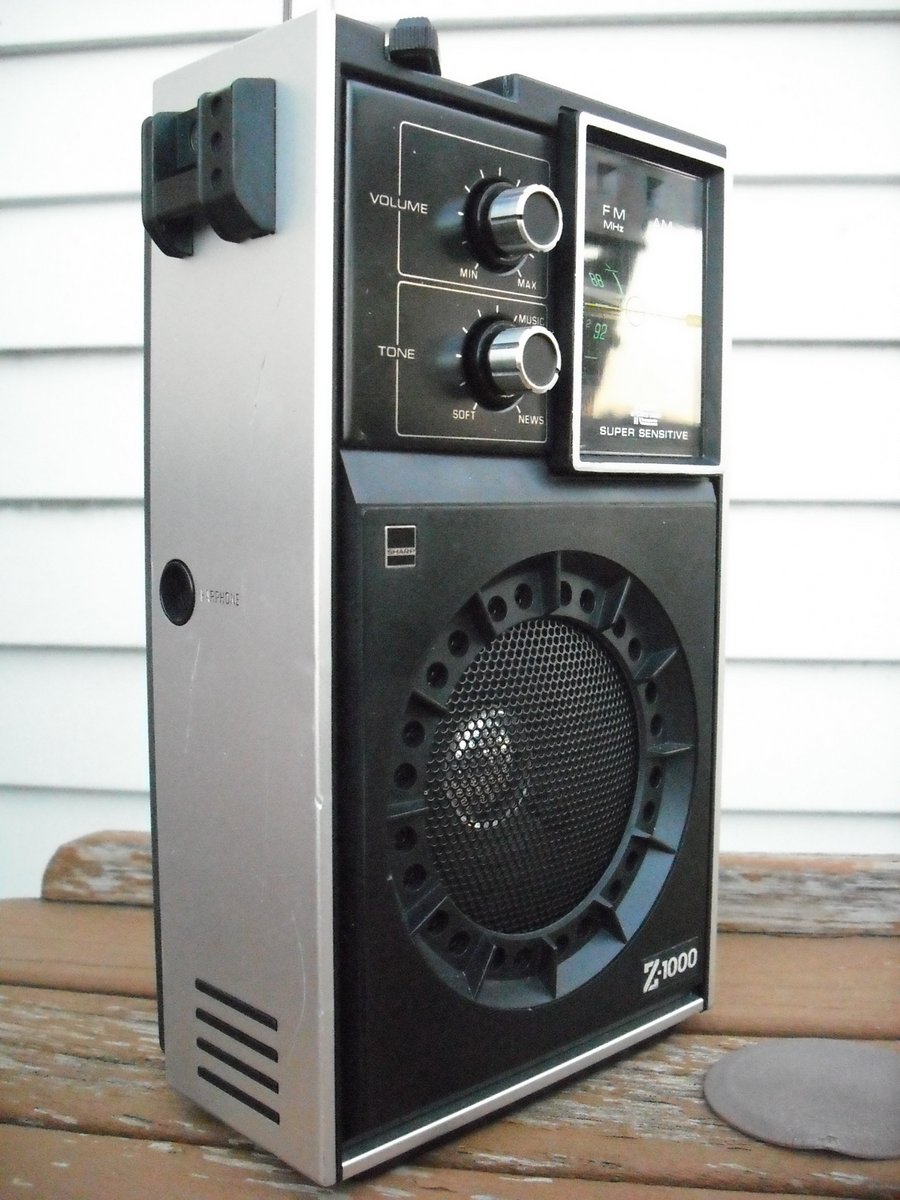
Chris’ Hamvention find: a Sharp Z-1000

Chris' Sharp Z-1000

Chris’ Sharp Z-1000 AM/FM radio (Click to enlarge)

I had the pleasure of seeing SWLing Post reader, Chris, again this year at the 2013 Hamvention.  Chris has enjoyed remarkably good luck in the flea market/tailgate section of the Hamvention; in fact, last year he found a Zenith Transoceanic 1000 and a Transoceanic Royal 7000. (I have a special affinity for the Royal 7000, as it this was the first radio on which I cut my teeth, and which I still fire up from time to time.)

Chris just sent a photo of his find from this year’s Hamvention: a Sharp Z-1000. The name was familiar…and when he sent a photo, I knew where I had seen it. Earlier this year, Jeff at the Herculodge posted a link to a Z-1000 on eBay.

Chris reports that the Z-1000 audio is pleasant and that FM and especially AM reception are impressive. Great find, Chris!

This BBC radio adapts programming to match your environs

Thank to SWLing Post reader Mike for passing this along. The possibilities of adaptive radio broadcasts in distance learning alone are most inspiring:

(Photo: BBC Technology; Greg Povey)

(Photo: BBC Technology; Greg Povey)

(Source: BBC Technology)

A radio that is able to change a broadcast depending on where you are and what you are doing has been demonstrated by the BBC.

The Perceptive Radio, produced by the corporation’s Future Media North Lab, is thought to be a world first.

The team produced a computer-generated radio drama where the script altered depending on factors such as weather.

The device was shown off at the Thinking Digital Conference in Gateshead.

The proof-of-concept drama, which used a computer-generated voice for one of the characters, could adapt on the fly according to data pulled from external sources.

For instance, it could make reference to local places which would differ depending on where in the world you were.

Or it would mention weather conditions that were dependent on what was happening in the real world – such as replacing the phrase “it’s sunny outside” with “it’s raining”.[…]

Continue reading on BBC Technology.