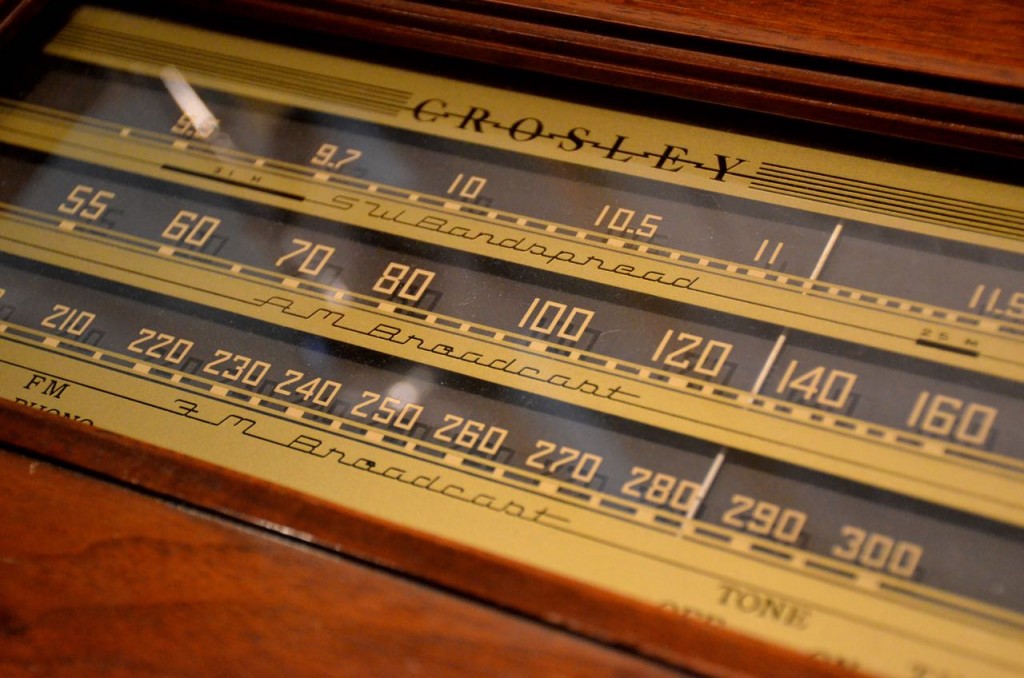
Encore – Classical Music on Radio Tumbril – US Transmissions to cease.

EUROPE:
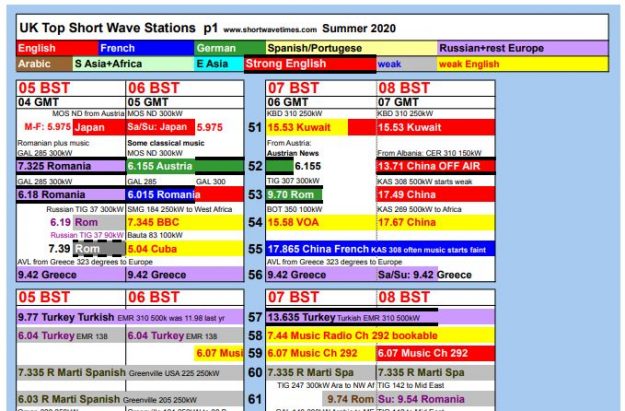
This weekend Encore – Classical Music on Radio Tumbril will be broadcast again at the NEW TIME in Europe of 11:00 UTC on SATURDAY on 6070 kHz by Channel 292.
There is much less interference from adjacent channels at this time.
There are two repeats – 19:00 UTC Friday on 6070 kHz and 09:00 UTC on Sunday on 7440 kHz by Channel 292.
NORTH AMERICA:
WWCR Nashville will broadcast the Encore on Saturday at 21:00 UTC as usual on 9350 kHz. The propagation is very good over the US and much of Canada and the signal carries to parts of western Europe too.
WBCQ Maine will send out the show on 7490 kHz at 01:00 UTC Monday to the US. (Early evening Sunday local US – obviously.)
Sadly – the US  broadcasts of Encore are going to have to stop at the end of February.
As many folks know – Radio Tumbril is a one-man operation existing without sponsorship.
Even with the generosity of WBCQ and WWCR – in keeping costs to a minimum – it requires hundreds of dollars a month to broadcast Encore to North America and the money to pay for the electricity will run out when Radio Tumbril is one year old.
The last transmission with WBCQ will be 01:00 UTC Monday 2nd March. The last transmission with WWCR will be Saturday 29th February 21:00 UTC.
The European broadcasts are of much lower power – and, naturally, much less costly. Radio Tumbril will continue on Channel 292 for the foreseeable future.
In the meantime – many thanks to everyone in The US, Canada, and beyond (India for instance) who have been listening regularly and enthusiastically to the broadcasts of Encore from WBCQ and WWCR. I’m very sorry they have to come to an end.
But not quite yet…
So do let us know how well you can pick up Encore at your location by emailing to [email protected]. We try to reply to all emails and will send eQSL cards for full reports – though a brief report is fine.
This week’s programme will start with the first movement of a harp concerto by Handel. It will be followed by a chamber piece – The Passing – by Stefania de Kenessey.  Beethoven next – the achingly beautiful Cavatina from his last string quartet. Nagoya Marimbas by Steve Reich follows and then we have Presto from Death and the Maiden by Schubert. The programme finishes with more Schubert – two songs from Winterreise, and An Orkney Wedding with Sunrise by Peter Maxwell Davies.
The playlist is on the website and will be updated soon after Saturday’s broadcast of the new show by Channel 292 at 11:00 UTC – but probably not until Sunday evening.
Both Channel 292 and WBCQ as well as WWCR can be pulled live off the internet if the reception is poor in your location. Easy to find their sites with a google search.
In the meantime – thank you for spreading the word about Encore – Classical Music on Shortwave. And thank you to everyone for letting us know how well the signal is received where you live.
Brice Avery – Encore – Radio Tumbril – www.tumbril.co.uk
Regular Broadcast times are:
11:00 – 12:00 UTC Saturday on 6070 kHz and repeated 19:00 – 20:00 UTC Friday on 6070 kHz Channel 292 (Germany) and 09:00 UTC Sunday on 7440 kHz.
21:00 – 22:00 UTC Saturday on 9350 kHz WWCR (Nashville).
01:00 – 02:00 UTC Monday on 7490 kHz WBCQ – (Maine).

Radio Waves: RNZ Cuts Classical, Australian EmComm Plan, BBC Funding, and NHK Viewing Fees

Radio Waves:  Stories Making Waves in the World of Broadcasting 

Because I keep my ear to the waves, as well as receive many tips from others who do the same, I find myself privy to radio-related stories that might interest SWLing Post readers.  To that end: Welcome to the SWLing Post’s Radio Waves, a collection of links to interesting stories making waves in the world of radio. Enjoy!

Many thanks to SWLing Post contributors Troy Riedel and Michael Bird for the following tips:

RNZ set to cut back Concert and launch new youth service (Radio New Zealand)

In the biggest overhaul of its music services in years, RNZ is planning to cut back its classical music station RNZ Concert and replace it on FM radio with music for a younger audience as part of a new multimedia music brand. Mediawatch asks RNZ chief executive Paul Thompson and music content director Willy Macalister to explain the move.

The broadcaster is proposing to remove RNZ Concert from its FM frequencies and transform it into an automated non-stop music station which will stream online and play on AM radio.

It would be replaced on FM by a service aimed at a younger, more diverse audience as part of a new multimedia “music brand”.

RNZ Concert would be taken off FM radio on May 29 and the youth platform would be phased in ahead of its full launch on August 28.

RNZ’s music staff were informed about the proposed changes this morning in an emotional, occasionally heated meeting with the RNZ music content director Willy Macalister, head of radio and music David Allan, and chief executive Paul Thompson.[]

[Australian] Senate to vote on National Emergency Communications Plan (ABC Friends)

Today Senators can vote to recognise and support ABC Emergency Broadcasting Services and start to plan for a National Emergency Communications Plan.

[…]The motion comes after ABC Friends surveyed bushfire affected communities, with 95% of the 750 respondents indicating that they wanted to see a national plan of additional essential communications infrastructure.

More information to come once the motion has been moved.[]

UK government, at odds with media, eyes BBC funding change (AP)

LONDON (AP) — Britain’s government announced Wednesday it is considering a change in the way the BBC is funded that would severely dent the coffers of the nation’s public broadcaster.

Prime Minister Boris Johnson’s Conservative government — which is increasingly at odds with the country’s news media — said it would hold a “public consultation” on whether to stop charging people with a criminal offense if they don’t pay the annual levy that funds the BBC.

The broadcaster gets most of its money from a license fee paid by every television-owning household in the country, which currently stands at 154.50 pounds ($201) a year. Failing to pay can result in a fine or, in rare cases, a prison sentence.

In 2018, more than 121,000 people were convicted and fined for license fee evasion. Five people were imprisoned for not paying their fines.

The BBC is Britain’s largest media organization, producing news, sports and entertainment across multiple TV, radio and digital outlets. The BBC’s size and public funding annoy private-sector rivals, who argue the broadcaster has an unfair advantage.[]

NHK Asked to Cut Viewing Fees Further (Jiji Press)

Tokyo, Feb. 5 (Jiji Press)–Japanese Internal Affairs and Communications Minister Sanae Takaichi asked Japan Broadcasting Corp. (NHK) on Wednesday to cut television-viewing fees further.
The request was included in a set of proposals compiled by Takaichi. The proposals were approved the same day at a meeting of the Radio Regulatory Council, which advises the minister.

After expected cabinet approval, the proposals will be submitted to the ongoing session of the Diet, Japan’s parliament, together with NHK’s fiscal 2020 draft budget.

The public broadcaster has already decided to cut viewing fees and expand the scope of fee exemptions by the end of fiscal 2020, in order to reduce viewers’ burdens by the equivalent of 6 pct of its fiscal 2018 fee revenue.[]

Best portable radio for LW and NDB reception?

Many thanks to SWLing Post reader, Ian Harling (G7HFS), who writes:

I have been a SWL for about 50 yrs and also hold an amateur radio license, but here is where I need some advice.

Can you recommend a portable radio that performs well longwave and also NDB reception? I do have a Datong VLF converter that I can use but I’m looking for a dedicated portable set that works well on frequencies between 100 and 500 kHz. Any suggestions?

Good question, Ian. While I always do a basic check of longwave performance on shortwave portables–checking regional NDBs–I have never done a proper comparison test or used them for longwave listening or DXing sessions.

I know there are some dedicated LW DXers and listeners in the SWLing Post community, so my hope is someone can chime in with their radio suggestion in the comments section. Thank you in advance!

Guest Post: Radiofreunde NRW’s DXpedition-grade signal distribution system


Many thanks to SWLing Post contributor, Joachim von Geisau (DH4JG), for the following guest post:


Signal distribution at SWL camps: The new JK-1000 HF distributor

by Joachim von Geisau (DH4JG)

The Friends of Radio NRW – an independent group of shortwave listeners and radio amateurs in Germany – have been organizing 2-3 SWL camps per year for a number of years, where they meet as far away as possible from electrical noise in order to listen to shortwave together.

To distribute antenna signals, we have previously used an RFT AVV01 antenna distributor.

At an SWL camp there are high demands on signal distribution. Both very weak and strong signals should be distributed well, un-distorted, without noise and other interference. The signal levels are approximately between 0.2 ?V (S1) to over 5 mV (S9 + 40 dB), with a frequency range of at least from 150 kHz to 30 MHz, thus broadcast bands from LW to SW are covered, also all amateur radio bands from 160 m to 10 m.

Popular among listeners are RFT AVV01 RF distributors from the former GDR, at least 30 years old. However, the use of an AVV01 has several disadvantages: high power consumption, difficulties in getting spare parts, high upkeep with corroded contacts and the like. In addition, the transmission of the LW/MW range drops, which is a disadvantage especially for MW listeners. The NV-14 system from Rohde & Schwarz from the late 1960s has the same weaknesses.

Two years ago, the desire arose to develop a concept for the replacement of the RFT system.
The following aspects were important:

  • Frequency range at least 100 kHz – 30 MHz, as linear as possible
  • frequencies below or above desirable
  • Running on 12 V DC or integrated noise-free power supply
  • Remote power supply for active antennas
  • Robust structure
  • Versatility
  • Hobby friendly budget

The amateur radio market offers several products for RF signal distribution (e.g., ELAD, Bonito et al.), but no solution to distribute 6-8 antennas to 10-12 receivers. It was clear from the beginning that DIY development was inevitable.

The starting point of the considerations was to integrate remote power supply for active antennas, an amplifier stage and a distribution network.

Such a distributor is able to distribute an antenna signal to several receivers; several antennas require several such distributors, which led to the decision to implement the project in plug-in technology.

With OM Frank Wornast DD3ZE (www.dd3ze.de), known e.g. for his converters, filters and the like, a well-known RF developer could be won, who took over the implementation of the concept based on the detailed specifications. OM Wornast first produced a prototype without remote power supply, which already did an excellent job of RF signal distribution.

A “hardness test” at an SWL camp showed that this distribution module easily fulfilled our requirements: Frequency range 10 kHz – 50 MHz (also usable with a few dB loss above 50 MHz). Supplemented by a switchable remote power supply and a 90V gas discharger at the antenna socket, the final PCB layout was created, representing the core of the new HF distribution system of Radio Freunde NRW

The distribution block consists of the following components:

  • Input with 90V arrester & 100 kOhm MOX resistor to dissipate static interference
  • Remote power supply, switchable, 10-14 V, max. 350 mA
  • Amplifier stage with 14-14.5 dB
  • Resistor network for distribution

The device is characterized by a very smooth frequency response and has a very low inherent noise. It offers the possibility of using levels of -120dBm with very good SNR
to process up to strong levels of up to + 14dBm. In addition, the reception on VLF is now possible, which did not work with the previous system.


The PCB is designed in a very practical way: series resistors for LEDs are integrated as well as fixing points for coaxial cables. The remote power supply can be switched separately, but can also be used permanently by means of a jumper.

With this concept, the distribution block can be used universally: use on an active or passive antenna with distribution to several receivers, by means of a step switch in front of it also for several antennas; if you leave the remote feed path unconnected, the block can also be used as a simple distributor, so it is almost universal for hobby purposes.

For use on SWL camps, we decided to install them in 19 “rack-mount technology. A standard rack can thus accommodate 4 distributors and a power supply, allowing  distribution of 4 antennas to 12 outputs each. An example of the installation is shown in the following picture: Parallel to the input is another BNC socket, which is connected via a C 100 nF where the input signal can be used DC-free for measurement purposes or the like. The distribution unit is installed in a transport case. The components themselves are mounted in slide-in housings which are provided with a corresponding front panel: Such front panels might be obtained from CNC manufacturers.

On the back + 12V DC must be supplied as operating voltage. For the power supply units, we opted for linear power supplies because we have made the best experience with these without interference. For a distribution unit with 4 slots, a power supply with 12V 1A is sufficient – each distribution block takes about 55 mA, an active antenna up to 150 mA, so even with “full load” a power supply with 1 A is sufficient. The distributor was tested with various well-known active and passive antennas, including a PA0RDT MiniWhip, active loops, long wires and T2FD.

Due to the wide input voltage range, the module can handle nearly any antenna. The cost for a distributor for 4 antennas amounts  (depending on the version: housing, sockets, switches, power supply, etc.) to about 700-1000 €. That may seem a lot at first glance. However, taking into account that a simple 5-gang distributor from mass production costs already around 250 ¬, the cost of the distribution of 4 antennas to each up to 12 outputs are not that much. The Friends of Radio NRW use two of these distribution units for SWL camps.

If you are interested in building one, please contact the author ([email protected]) for further information. The development history of the distribution unit is also available at www.dx-unlimited.eu.


Wow!  What a beautifully engineered antenna distribution solution, Joachim!  I love how you worked together to sort out all of the requirements for your system then build it for ultimate performance and flexibility.  No doubt, you and your colleagues at  Radiofreunde NRW posses a lot of design and engineering skills!  Simply amazing and thank you for sharing your design with the radio community!

Contact Joachim for more details and check out notes and discussion at www.dx-unlimited.eu (may require registration).

Radio Marti now on DRM: Seeking your listener reports!

Many thanks to Edward R. Murrow Transmitting Station Chief Engineer, Macon Dail, who shareds the following announcement regarding their Radio Marti broadcasts:

We just powered up our 50 kW transmitter using DRM.

We are on a frequency of 7345 kHz and will be on daily from 1700-0200 UTC. We would love hearing from anyone that is able to copy and decode our transmissions.

The broadcast contain two audio programs.

Post Readers: If you successfully receive and decode a Radio Marti DRM broadcast, please send your detailed listener report to:  [email protected] This is certainly a unique opportunity to log a North American DRM broadcast!

Ian’s portable setup for SSB and maritime weather monitoring

Photo by Jonathan Smith

Many thanks to SWLing Post contributor, Ian, who shared the following response to our post regarding the best shortwave receiver for you boat or yacht:

An icom M802 package can be had for less that $3k… but the installation may run up anywhere up to $5k hence the OP’s ~$8k cost and request for alternatives. The bulk of cost (for pretty much anything in a boat) is always in installation…not the cost of electronics, as boats have unique issues regarding their ground.

As a sailor, when faced with a budgetary issue of installing a marine SSB radio system, IMO the answer is most definitely not “get a ham radio and your license”…the answer is most definitely “get a good SSB portable with an external antenna input”.

To get valuable weather resources such as Chris Parker (www.mwxc.com), weatherfax and eavesdop on atlantic nets, a quality portable SSB receiver is all that is required, provided that some sort of external antenna is used.

In my case, in the Bahamas, a 25ft length of wire semi permanently rigged to the flag halyard presented a strong and clear enough signal to reliably get the morning weather, and any weatherfax data I needed (along with the laptop).

My radio back then was the Satellit 800, and this year that behemoth will be replaced with a Tecsun PL-880… such a setup is ALL that is required.

Thank you for your input, Ian! It’s been seven years since we originally posted that article about HF receivers and transceivers on boats and yachts. I’m curious if any other readers might have suggestions they would care to share. What has works for you? Please comment!

FTIOM & UBMP, Feb 9-15


From the Isle of Music, February 9-15:
This week, a Cuban dance party (no interviews)
The broadcasts take place:
1. For Eastern Europe but audible well beyond the target area in most of the Eastern Hemisphere (including parts of East Asia and Oceania) with 100Kw, Sunday 1500-1600 UTC on SpaceLine, 9400 KHz, from Sofia, Bulgaria (1800-1900 MSK)
If you don’t have a shortwave radio or are out of range, you can listen live to an uplink from a listening radio in the Netherlands during the broadcast at
http://websdr.ewi.utwente.nl:8901/?tune=9400am
2. For the Americas and parts of Europe, Tuesday 0100-0200 UTC (New UTC) on WBCQ, 7490 KHz from Monticello, ME, USA (Monday 8-9PM EST in the US).
If you don’t have a shortwave or are out of range, you can listen to a live stream from the WBCQ website here (choose 7490): http://www.wbcq.com/?page_id=7
3 & 4. For Europe and sometimes beyond, Tuesday 1900-2000 UTC and Saturday 1200-1300 UTC on Channel 292, 6070 KHz from Rohrbach, Germany.
If you don’t have a shortwave radio or are out of range, you can listen live to an uplink from a listening radio in Europe.
Visit our Facebook page at https://www.facebook.com/fromtheisleofmusic

Uncle Bill’s Melting Pot, February 9 and 11:
Episode 151 features Mongolian Metal with The Hu and Hanggai.
On WBCQ only, there is a second half-hour featuring the very first episode of our show in 2017.
The transmissions take place:
1.Sundays 2300-0000 UTC (6:00PM -7:00PM Eastern US) on WBCQ The Planet 7490 KHz from the US to the Americas and parts of Europe
If you don’t have a shortwave or are out of range, you can listen to a live stream from the WBCQ website here (choose 7490): http://www.wbcq.com/?page_id=7
2. Tuesdays 2000-2030 UTC on Channel 292, 6070 KHz from Rohrbach, Germany for Europe.
If you don’t have a shortwave radio or are out of range, you can listen live to an uplink from different web SDRs in Europe.
Visit our Facebook Page at https://www.facebook.com/UncleBillsMeltingPot