The C. Crane Skywave SSB: A sneak peek!

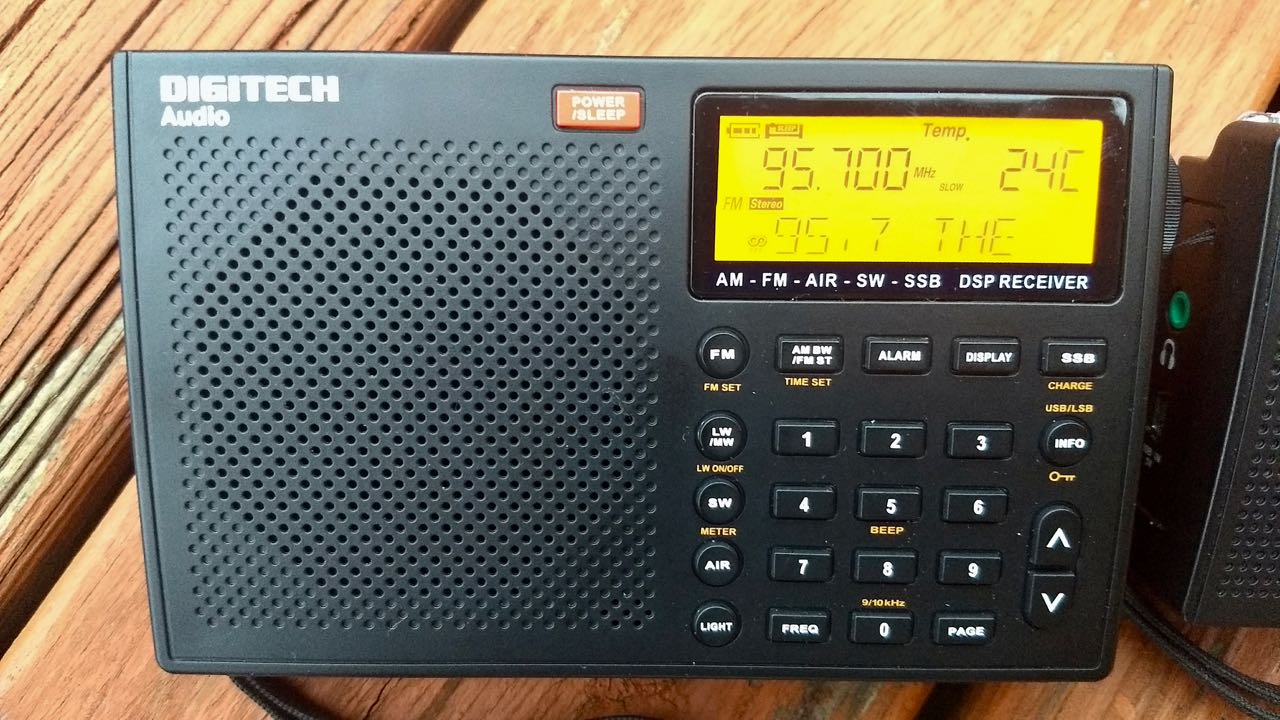
Tuesday afternoon, I took a number of portable radios to the field: the Tecsun S-8800, Tecsun PL-880, Digitech AR-1780, C. Crane CC Skywave and the new C. Crane CC Skywave SSB.

Last week, I received a pilot run (pre-production) CC Skywave SSB from C. Crane to test and provide feedback. My unit, of course, is still subject to cosmetic changes and engineering tweaks.

Since this is not a final iteration of the product, I won’t comment or review performance other than to say that if you like the original CC Skywave, you should love the new CC Skywave SSB.

C. Crane has kindly given me permission to post a few preview photos.

CC Skywave SSB Photos

First thing you’ll notice is that the CC Skywave SSB is essentially identical to its predecessor in size and shape.

Indeed, the CC Skywave SSB fits the original Skywave’s carry case perfectly. If you’ve purchased a custom protective case–like this one— for the original Skywave, it’ll fit the CC Skywave SSB like a glove.   As you can see above, the front panel design has changed, though. The CC Skywave SSB accommodates four additional function buttons and sports a re-designed speaker grill (similar to the CC Pocket Radio).  Nice touch! C. Crane thought to use that little piece of real estate behind the backstand.

As many of you know, I’m a one-bag-traveler-kind-of-guy who never leaves home without a shortwave radio. On one bag travels, of course, I only carry one full-featured portable. Space is too precious to carry two.

Listening to the 2016 BBC Midwinter Broadcast to Antarctica while traveling in Canada with the CC Skywave.

The original CC Skywave has pretty much been my go-to travel radio since it was released. I’ve taken it everywhere.

I’ve also taken the amazing Sony ICF-SW100 and the full-featured Grundig G6 (which even includes the AIR band) on trips when I wanted access to single sideband mode–something the original CC Skywave lacked. (Note that both of these radios are now discontinued.)

But when traveling in North America or by air, I really appreciate the Skywave’s excellent NOAA weather radio and access to aviation frequencies on the AIR band. Very handy features for the traveler who likes to stay informed.

By adding single sideband mode to an already capable ultra-compact travel radio, C. Crane has created a welcome radio traveling companion indeed.

Image shows the extent of human radio broadcasts

Click to enlarge (Image credit: Adam Grossman of The Dark Sky Company)

(Source: Popular Mechanics)

Carl Sagan’s famous line from his 1990 speech about the Pale Blue Dot image—”Our planet is a lonely speck in the great enveloping cosmic dark”—is an understatement. We might consider our Milky Way, with its estimated 100 to 400 billion stars, a significant fixture in the cosmos. But there are some 100 billion galaxies just like it in the observable universe. It’s a daunting reality to consider when we’re thinking about the possibility of making contact with any intelligence that might be out there.

This map designed by Adam Grossman of The Dark Sky Company puts into perspective the enormity of these scales. The Milky Way stretches between 100,000 and 180,000 light-years across, depending on where you measure, which means a signal broadcast from one side of the galaxy would take 100,000 years or more to reach the other side. Now consider that our species started broadcasting radio signals into space only about a century ago. That’s represented by a small blue bubble measuring 200 light-years in diameter surrounding the position of the Earth. For any alien civilizations to have heard us, they must be within the bubble.[…]

Continue reading at Popular Mechanics online…

Variety: Legacy Radio “Faces a Grim Future”

(Source: Variety)

Traditional Radio Faces a Grim Future, New Study Says

A new study published today by the head of New York University’s Steinhart Music Business Program casts a sobering outlook on the future of terrestrial radio.

In the 30-page report, Larry Miller argues that traditional radio has failed to engage with Generation Z — people born after 1995 — and that its influence and relevance will continue to be subsumed by digital services unless it upgrades. Key points made in the study include:

*Generation Z, which is projected to account for 40% of all consumers in the U.S. by 2020, shows little interest in traditional media, including radio, having grown up in an on-demand digital environment;

*AM/FM radio is in the midst of a massive drop-off as a music-discovery tool by younger generations, with self-reported listening to AM/FM radio among teens aged 13 and up declining by almost 50 percentage points between 2005 and 2016. Music discovery as a whole is moving away from AM/FM radio and toward YouTube, Spotify and Pandora, especially among younger listeners, with 19% of a 2017 study of surveyed listeners citing it as a source for keeping up-to-date with music — down from 28% the previous year. Among 12-24 year olds who find music discovery important, AM/FM radio (50%) becomes even less influential, trailing YouTube (80%), Spotify (59%), and Pandora (53%).

*By 2020, 75% of new cars are expected to be “connected” to digital services, breaking radio’s monopoly on the car dashboard and relegating AM/FM to just one of a series of audio options behind the wheel. According to the U.S. Department of Transportation, the typical car in the U.S. was 11.6 years old in 2016, which explains why radio has not yet faced its disruption event. However, drivers are buying new cars at a faster rate than ever, and new vehicles come with more installed options for digital music services.[…]

Continue reading at Variety online…

WWII Radio: Truman and the Scott Radio Labs RBO-2

Many thanks to SWLing Post contributor, Kim Elliott, who recently shared the photo above of President Harry S. Truman via @RealTimeWWII.

If I’m not mistaken, that is a Scott Radio Labs Model RBO-2.

I’m guessing that’s also the speaker mounted on the wall directly above the receiver.

Scott Radio Labs marine receivers were shielded to the point that they had very low local oscillator radiation. This design prevented detection of the ship via the enemy’s use of radio direction finding gear.

I have a commercial Scott Marine Radio Model SLRM–it is my favorite receiver and I use it daily.

Post readers: Anyone else have a Scott Radio Labs receiver in their shack? Please comment!

Leaving a comment? reCaptcha is back…for now…

Seriously…we know you’re not a Robot!

If you’ve been an SWLing Post contributor for a few years, you’ll recall that we used to use Google’s Captcha system to prevent SPAMbot comments on our site.

A few readers complained about how difficult the Captcha system was at the time (and I agreed with them), so we removed Captcha. At the same time, I implemented a stronger backend system for flagging SPAM comments. You’ve likely noticed many of your normal comments are moderated automatically–we try to approve them within a couple of hours.

Spambots are a real pain: they attempt to leave phony comments on our site in an effort to link back to their target site (some of which are loaded with malware).

How many SPAM comments do we get from Spambots and other Spammers?  Here are the statistics from our anti-SPAM system:

After we removed Captcha, the more clever SPAM comments would still make it through the various filters and fall in a moderation pile. At first, this amounted to, perhaps, a dozen or so comments to moderate each day. Lately, the number has become overwhelming–closer to 12+ per hour falling in the moderation queue among legitimate comments.

“Separating the wheat from the chaff” has become a full time job. 🙂

Until I can find a user-friendly solution to this, I’ve implemented Google’s latest system called reCaptcha. It has its quirks and presents interesting challenges, but I believe if you’ve used it on other sites and proven you’re not a robot, Google remembers and all you have to do to prove yourself is check/tick the box next to “I am not a robot.”

Anyway, I just ask for understandnig as I sort out a more simple solution to SPAM-proof our site!

Hurricane Harvey: Mike stresses the importance of local AM radio

Earlier this week, I received a message from my good friend, Mike, who lives south of Houston in Galveston County, Texas. Mike noted:

Here in Texas, we’re still dealing with the impact of hurricane Harvey.

[…]The absolute best hurricane information came from AM 740 KTRH Houston. A 50,000 Watt AM transmitter that covers a major portion of the gulf coast.

I’m learning that the Corpus Christi AM news station was evacuated and secured operations. KTRH kicked in and served the listening public very well.

I haven’t heard from Mike in a couple of days and, since then, Harvey has caused unprecedented levels of flooding in south Texas. I hope he’s doing okay and hope to hear from him soon.

Indeed, I hope SWLing Post readers in the affected area, their friends and family have all made it to safety.

Click here to listen to KTHR via iHeart Radio’s portal.

Video: Shortwave shootout with the Tecsun S-8800

After enjoying an afternoon testing the Tecsun S-8800 on the Blue Ridge Parkway this past weekend, I decided to return to the parkway yesterday and test the S-8800’s shortwave performance.

I carved out about two hours of my afternoon and spent the entire time comparing the S-8800 to the Tecsun PL-880 and the Sony ICF-SW7600GR. I tested the radios on several shortwave bands and in both AM and SSB modes.

On Sunday, we discovered that mediumwave performance is lacking on the S-8800. Not so on shortwave! Check out this short video:

Click here to view on YouTube.

In my comparisons, the Tecsun S-8800 has consistently outperformed the PL-880 and Sony ICF-SW7600GR on the shortwave bands. The AGC is pretty stable and sounds much like that of the PL-880 when QSB (fading) is present. Sensitivity is better than the PL-880, though, so the S-8800 can dig those signals out of the noise a little better.

Note, too, I had to pick up both the PL-880 and ‘7600GR  in my hand to obtain the best performance–that additional grounding gave each a slight boost. Quite common for portables. The S-8800 didn’t require this.

After I returned home yesterday, it struck me that perhaps a longer telescopic whip gave the S-8800 an advantage. Turns out, it’s only three inches longer than the PL-880’s whip.

Next, I need to spend a little time with the S-8800 mapping out any birdies on HF–a tedious process. I hope to start on that today.

To follow updates on this yet-to-be-released receiver, follow the tag: Tecsun S-8800.

UPDATE: Click here to read our full Tecsun S-8800 review.