Shortwave listening and everything radio including reviews, broadcasting, ham radio, field operation, DXing, maker kits, travel, emergency gear, events, and more
Many thanks to SWLing Post contributor, Dan Robinson, who writes:
BULLETIN !!! KUWAIT
As heard by Rich Nowak and posted on the Gary J. Cohen SWL Group
on Facebook, then confirmed here in Maryland, it appears that Kuwait
is back on shortwave, heard from 2000 UTC on 15540. While the signal
level does not approach what we all remember from Kuwait, it is definitely
there, with pop music, and seemingly some local ads. I have not heard an
ID, as of 2023 UTC.
Very cool! Thank you for sharing the tip and confirming, Dan! I’ll add 15540 to my listening schedule again–I’ve always loved listening to Radio Kuwait.
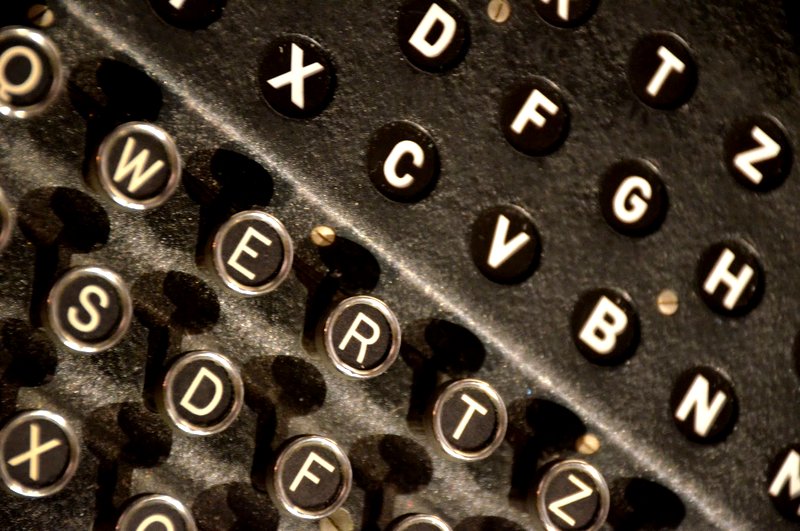
On Friday, April 7 the amateur radio station DLØHNF transmitted an Enigma encrypted message on 7036 kHz to Bletchley Park
DLØHNF is the club station at the Heinz Nixdorf Museum in Paderborn, Germany. The encrypted telegraphy message they transmitted was received at the home of the World War Two UK Codebreakers in Bletchley Park. There the message was fed into a replica of the Turing Bombe which enabled the encryption to be cracked.
The message read: “Paderborn greets the Codebreakers at Bletchley Park”
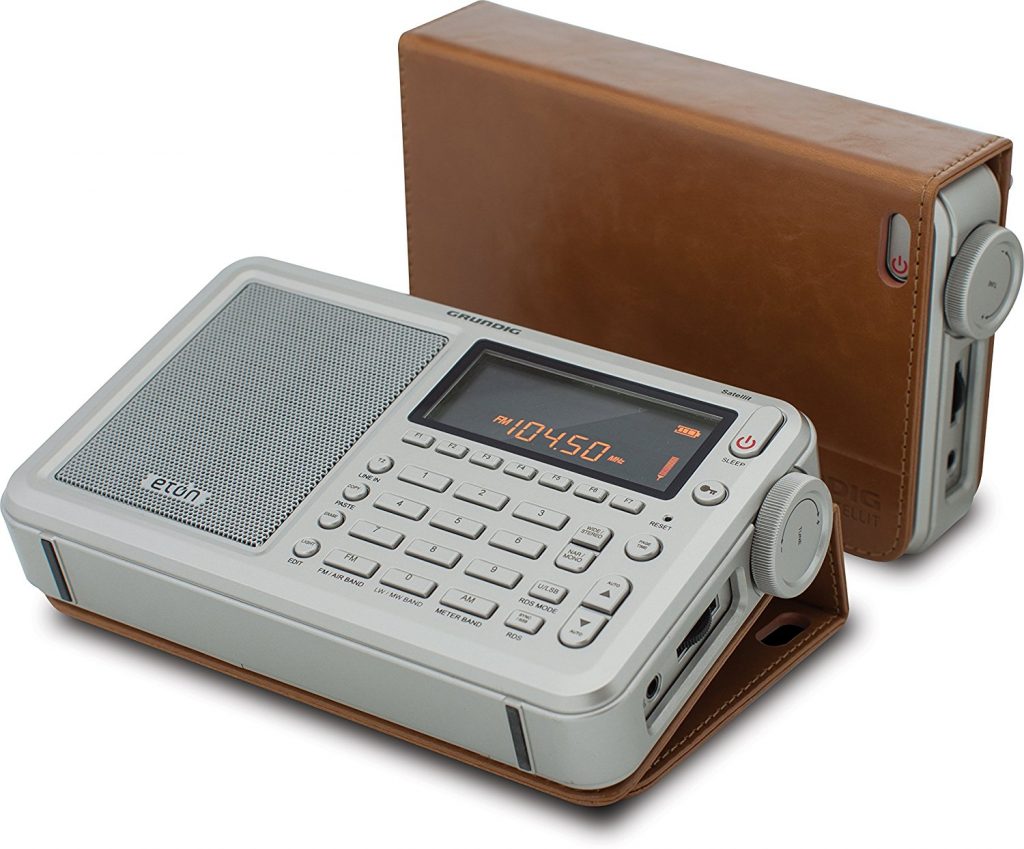
Many thanks to SWLing Post contributors, Troy, Ron and Steve, who note that Jay Allen has just posted a review of the Grundig Executive Satellit on his website.
The upshot? Jay found the performance identical to the previous (non-Executive) version of the Satellit which is to say that it has excellent AM performance and built-in audio.
“Ultimately, I have to strongly recommend this portable to anyone interested in DXing and in particular those that embark on DXpeditions.”
He embedded a number of videos from the field in his review (click here to view).
And, of course, our buddy Tom Stiles also reviewed the Executive Satellit on his YouTube Channel.
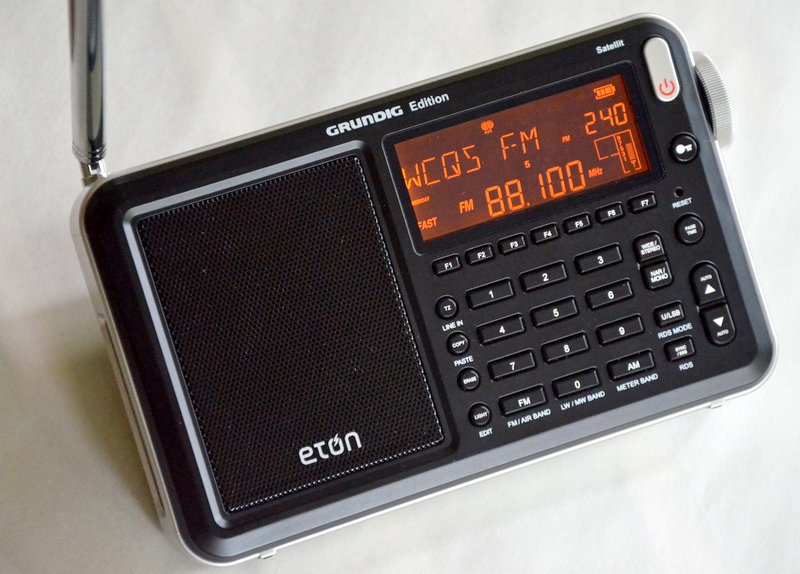
The original Eton Satellit
Like Clint, I own the original non-Executive version of the Satellit–since performance is identical, I’m not going to “upgrade” to the Executive version (though I do really like the executive case).
After Clint’s review in February, I stated taking the Satellit with me on travels more often and have been most pleased with its performance. While it took me a while to get used to its amber display at night, I must say it is a fantastic performer, has superb built-in audio and is overall a wonderful full-featured radio travel companion.
I often forget to mention the Satellit when readers ask for portable radio recommendations–perhaps this is because the Tecsun PL-880 simply overshadowed it in my mind. Not anymore.
Speaking of the Tecun PL-880, SWLing Post contributor Charles Rippel recently ordered the Executive Satellit–he plans to compare it with the Tecsun PL-880 and share his findings with us. Stay tuned!
From the Isle of Music, Week of April 9-15, 2017
This week, special guest Pablo Menéndez, former member of GESI and current leader of Mezcla, returns to discuss Mezcla (in English), one of Cuba’s most important Fusion ensembles. We also listen to music by other former GESI members such as Silvio Rodríguez, Pablo Milanés and Emiliano Salvador.
Four opportunities to listen via shortwave:
1. For Eastern Europe but audible well beyond the target area in all directions with 100Kw, Sunday 1500-1600 UTC on SpaceLine, 9400 KHz, from Kostinbrod, Bulgaria (1800-1900 MSK)
2. For the Americas and parts of Europe, Tuesday 0000-0100 UTC on WBCQ, 7490 KHz from Monticello, ME, USA (Monday 8-9PM EDT in the US)
3 & 4. For Europe and sometimes beyond, Tuesday 1900-2000 UTC and Saturday 1200-1300 on Channel 292, 6070 KHz from Rohrbach, Germany.
Uncle Bill’s Melting Pot, April 13, 2017 Episode 7 of Uncle Bill’s Melting Pot, a semi-clandestine musical variety program that features genres from A-Z, will air on WBCQ the Planet, 7490 KHz, Thursday, April 13 from 2300-2330 UTC (7:00pm-7:30pm EDT in the Americas). Brought to you by Tilford Productions, which also brings you From the Isle of Music.
(It isn’t showing on the WBCQ website yet, but it’ll be on.)
Uncle Bill seldom admits what he’s up to, but with both Easter and Passover coming, it’s a safe bet that there will be a least a little something related to those. Whether it will be normal or weird is what is hard to predict.
Many thanks to SWLing Post contributor, David Goren, who shares the following (via Facebook):
Short Waves / Long Distance Repository
The Short Waves / Long Distance Repository is now online. Comprised of selected works from submissions to the highly competitive open call Short Waves / Long Distance, these 38 works exploring the sonics of the shortwave radio spectrum (2-30 mHz), and the experience of long distance listening. The Repository features the following works:
a lagoon, considered against its archival image, Sally Ann McIntyre (Radio Cegeste)
All the News All the Time, Dafna Naphtali
an electrical discharge, a sea of burning oil slicks, Sally Ann McIntyre (Radio Cegeste)
Argent Discovery, Jed Miner
CODEX: Post-Human Speech Sounds, Tom Miller (a.k.a. Comrade Squelch)
Caller, Ed Osborn
Chasing Waterfalls, Sam Rowell
Crimean Snow, John Roach
Elegy for RCI, Lee Rosevere
Fringe Area, William Basinski
Fuzz, Ricardo Paraíso Silvestre
Ghostwave, Jacques Foschia
Hellschreiber, Acoustic Mirror
I listened to the buzzer for hours and nothing happened (edit), D.N.P vs Mutate
Körper, Antonio D’Amato
L’abolition de la Croix, Meira Asher
Let’s Absorb The Waves As We Hold On For Dear Life, Nicholas Knouf
Michael Sedore, ND2Q, Dominique Ferraton
Modulation I, Javier Suarez Quiros
Ondes Simultanee et Perturber, Patrick Harrop
Oracle, Edward Ruchalski
Orbital Lullaby, Craig Dongoski
Over the Horizon, Pietro Bonanno
öö and ää, Evangelos Makropoulos, Gosha Hniu, Victor Math, and Horace Prawn
Short Waves, So Beast
Shortwave Radio, South Africa, IV, Gregory Kramer
Shortwaves trip, Paolo Pastorino
Spectres of Shortwave: Falling Towers (excerpt), Amanda Dawn Christie
St Columb Major – transmission received, Mark Vernon
Staubrauschen (Dusty Noise / Media Dirt), Timo Kahlen
Strange Sonars, Linda Dusman & Alan Wonneberger
Stratocode from nowhere, Flaub
The Perfect Storm, Stephen Bradley
Three Steppes Forward Two Steppes Back, Jeff Gburek
through the shortwave, part one, Spasmodular sounds from Steve’s shortwave
TransSonic Awakenings in D, Douglas Hedwig
Many thanks to SWLing Post contributor, Edward Ganshirt, who writes:
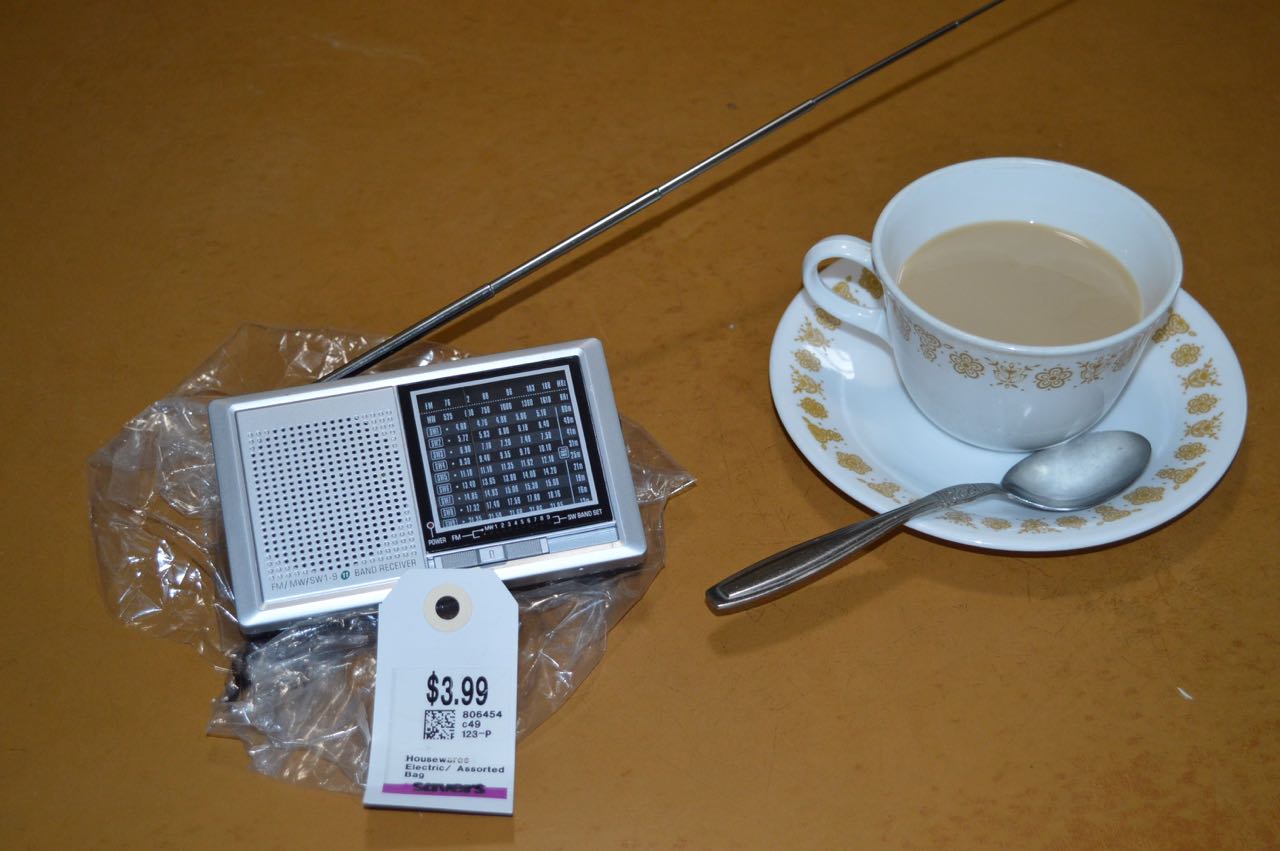
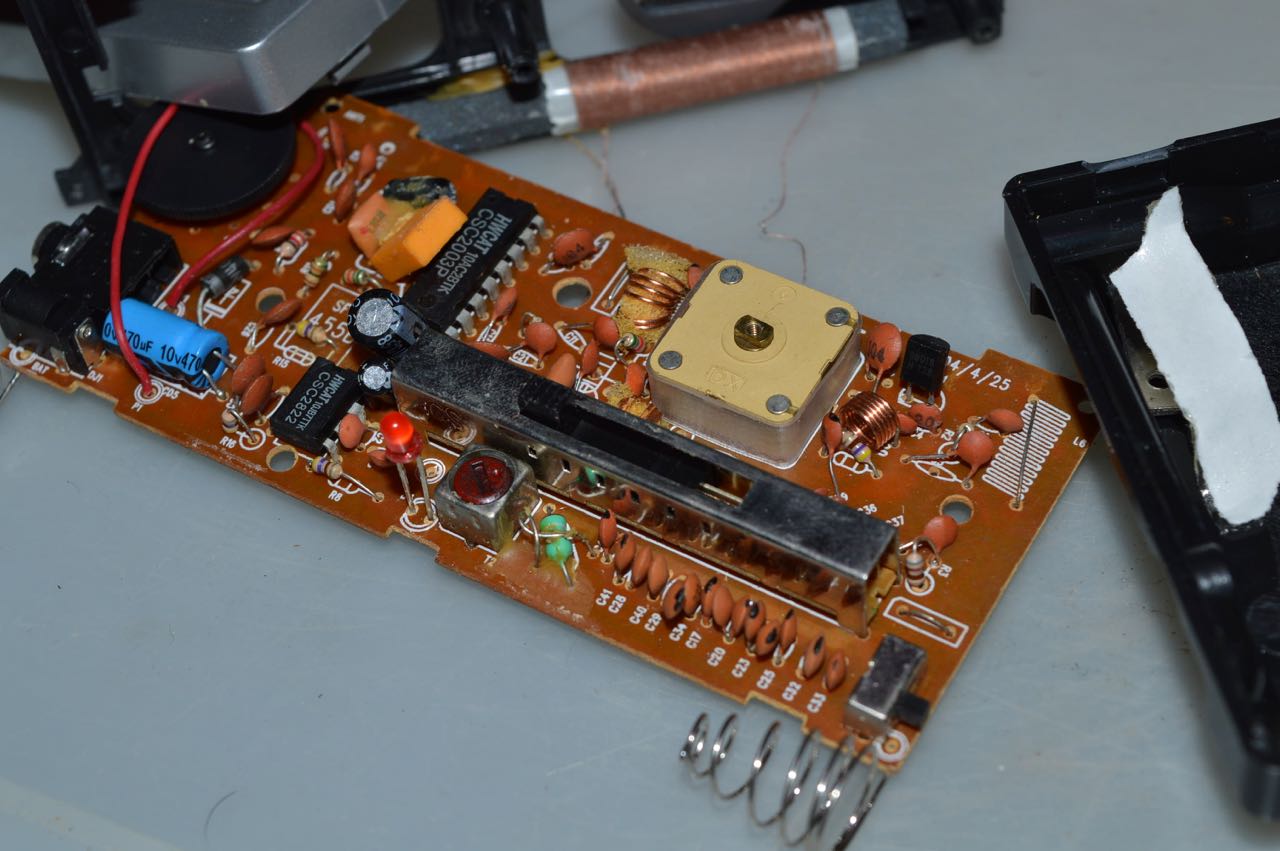
I spotted this “keychain” radio [pictured above] at a Savers thrift shop. Savers is a chain of thrift stores in the Northeast that is an outlet for Goodwill and possibly others. What caught my eye is (in addition to price) an 11 band radio: AM, FM and 4.75 to 21.85 Mhz in 9 short-wave bands. It has no brand markings (or FCC id) and of course made in China. I purchased it for less than a latte at Starbucks and brought it home.
It uses 2 AA penlight batteries and has a 14″ telescoping antenna. Turning it on demonstrates its low performance.
It has ample sensitivity on FM but difficult to tune clearly. AM band is better. Shortwave is a different story.
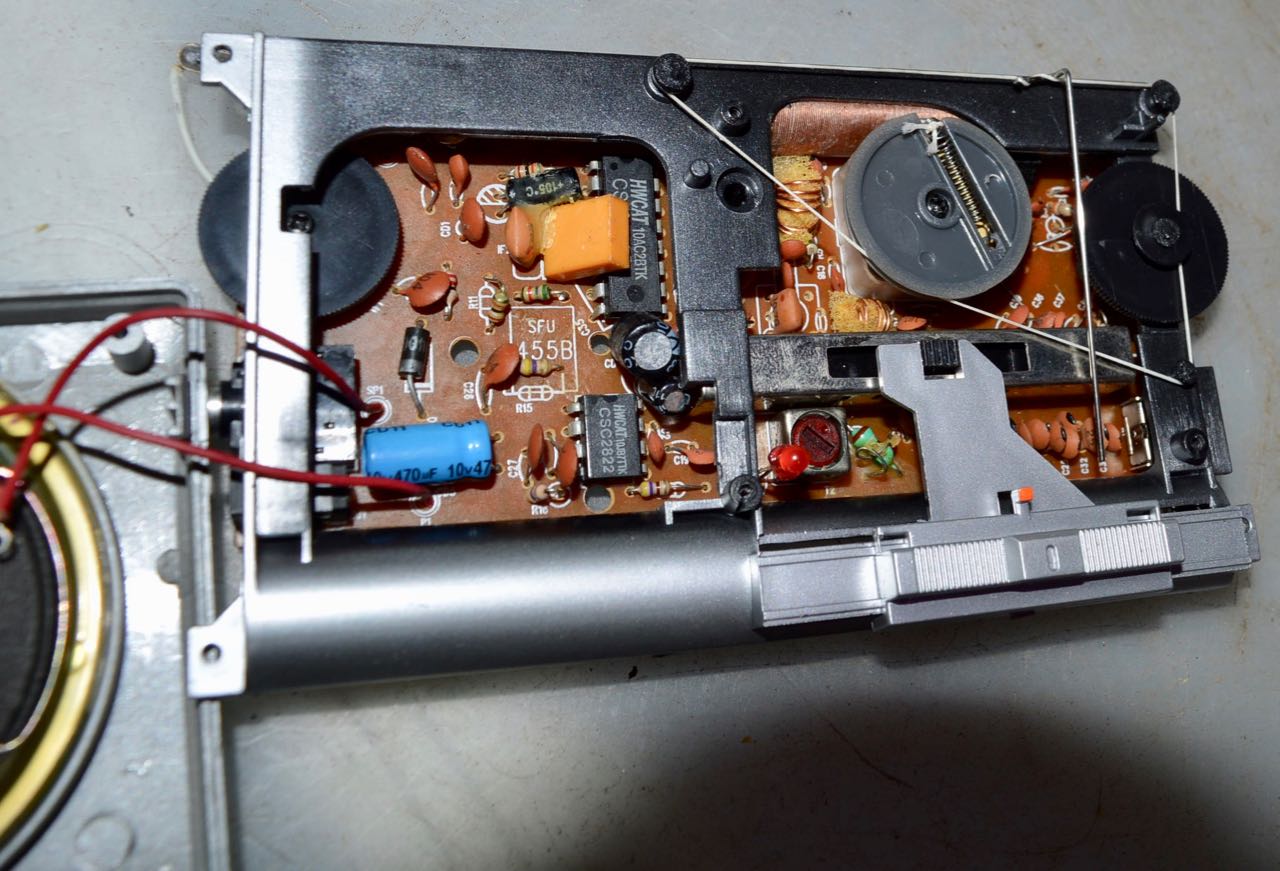
At night I get several shortwave stations, difficult to tune in. Connecting an external antenna demonstrated its weakness. I picked up the entire AM band and every other station below 30 MHz no matter what setting the tuning knob was set to, with varying signal strength , depending what short-wave band setting selected. I live less than 4 miles from a powerhouse radio station on 680 KHz that bleeds through the IF filter. Deconstructing the radio reveals its design shortcomings
It contains 2 chips: A CSC2822 stereo audio 8 pin dip and a 16 pin CSC2003P “jungle” chip. Comparing app notes to the receiver reveals short cuts in the design. Just absolute minimalist component count–only one 455KHz IF filter.
Fortunately, it has a ferrite loopstick antenna. (That explains why it works on AM. There is less IF bleed-through on AM).
Using a signal generator, on shortwave reveals non existent image rejection, beat notes on harmonics of the local oscillator (yes it is a superheterodyne).
This is a radio to take to the beach. If the tide grabs it and washes it into the ocean or a sea gull snatches it, you would not be disappointed.
In my opinion it was a bit steeply priced. You don’t win them all but I will still go to Savers in the future for other buys as they present themselves.
Thank you for your report, Edward. I think what is highlighted here are the shortcomings of inexpensive–truly “cheap”–radios. They have only the most basic components, regardless if they resemble a quality radio aesthetically. Edward listed the hallmarks of a cheap analog receivers: overloading, stiff inaccurate tuning controls, mediocre sensitivity/selectivity, poor audio, and poor shielding.
Thanks for pulling this one apart and taking a look inside, Edward.
Taking it to the beach, Ed? Let us know if it floats or–better yet–if a seagull decides to grab it–! Who knows, they may tune through the FM and find one of their favorite 1980s songs:
(Sorry, couldn’t help the reference–it is Friday after all.)

 Many thanks to SWLing Post contributor, Dan Robinson, who writes: