Tag Archives: Guest Posts

Guest Post: More Anti-Noise Ideas

In a previous guest post, SWLing Post contributor TomL, shared his “Evolving, Morphing, SW Listening Station” where he detailed the many ways he’s trying to fight heavy radio interference at his listening post. The following post is TomL’s update:


More Anti-Noise Ideas

(Continuing the hunt for better reception in a foul RFI environment)

by TomL
toml-radios

I have made the following changes:

  • Created a prototype mini-loop based on a crossed-parallel idea from VE1ZAC (Jeff).
  • Added a balun from LNR Precision (Parfitt’s EF-SWL) in an experimental configuration.
  • Added to the balun, an outdoor amplifier – Wellbrook ALA-100M.
  • Added a noise canceling unit (MFJ-1026).
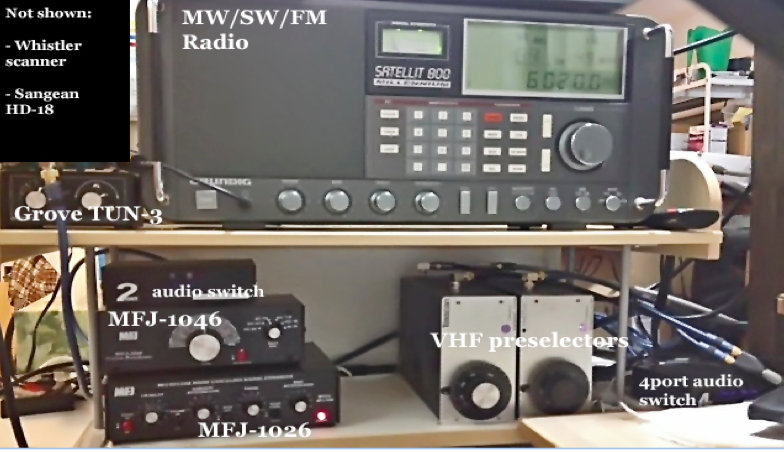
  • Added 2 preselectors, an old Grove TUN-3 connected to the main loop feed and an MFJ-1046 connected to the ground connection of the balun. Both feeds go into the MFJ-1026.
  • Added BHI Compact In-Line DSP filter and two switch boxes to cut it in/out as needed.
  • Added a medium wave noise canceling unit that I have not figured out how to use yet. (Quantum Phaser). The MFJ unit does not work on medium wave without modification.
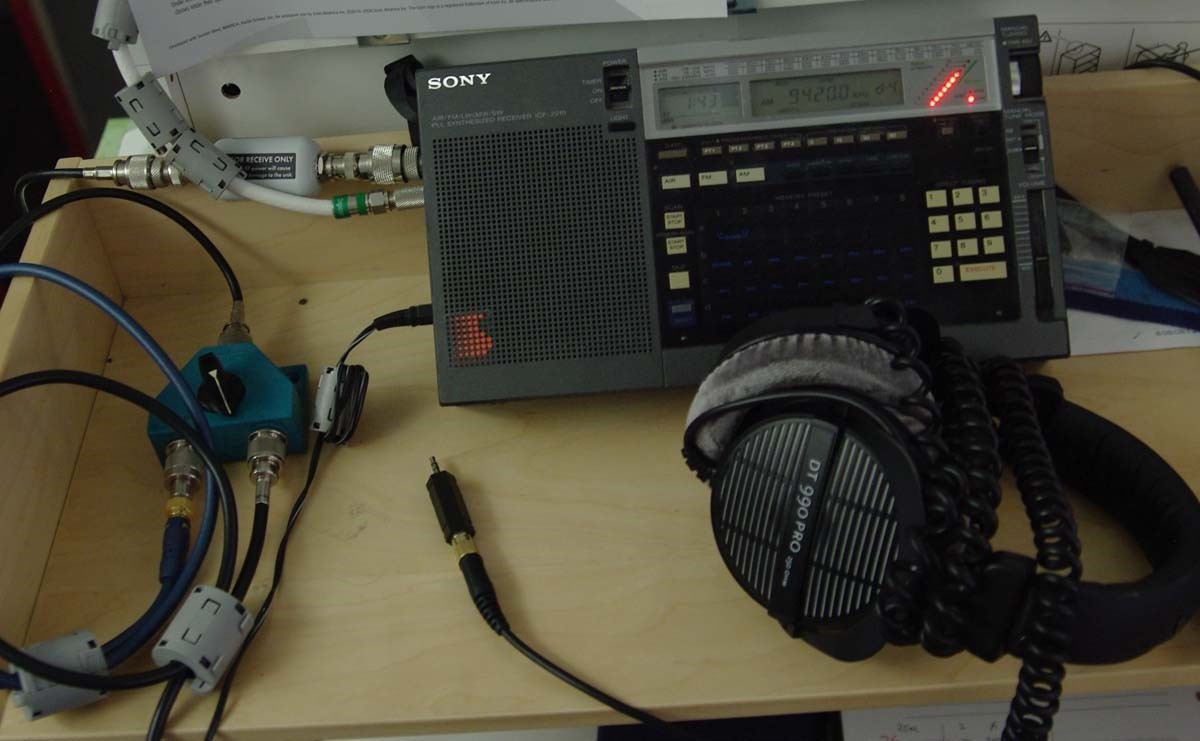
  • Purchased from eBay a used Grundig Satellit 800, a somewhat more robust fixed-station receiver to replace my aging Sony ICF-2010.
  • Other non-related (not shown): Whistler digital scanner + UHF over-the-air TV + FM broadcasts + an AM/FM HD digital radio + high pass filters from MiniCircuits.com – (audio from all these sources is passed to an existing high fidelity stereo power amp and NHT Super One speakers on the computer desk for near-field monitoring). Associated antennas are also hidden on the outside deck (shhhhh!).
  • Large charge card balance!!

So, here are some pics for the crossed-parallel loop. VE1ZAC web site has all the references if you want to explore further or google him. Mine is purely a prototype and not finished. And should eventually be placed on a rotor (but how to keep my Nazi-like condo association from finding out?!?!?!?).
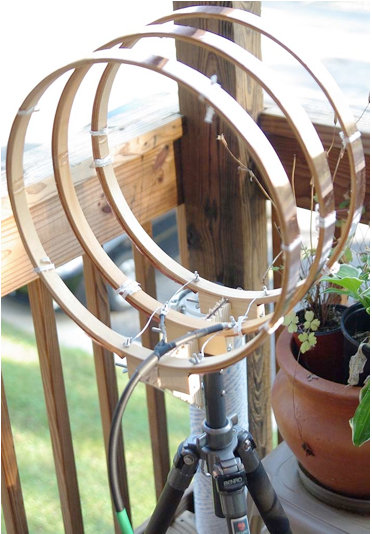
loops

It is three 14 inch quilters hoops from Joann Stores plus some 1-inch copper strips cut from a small 2 meter roll of thin copper from eBay. Then, it is wired in parallel with silver-plated aviation wire on each side with a feed in the middle. Not an optimal placement of the feed, (should go straight down along the pipe). Will fix things up whenever I get some more time.
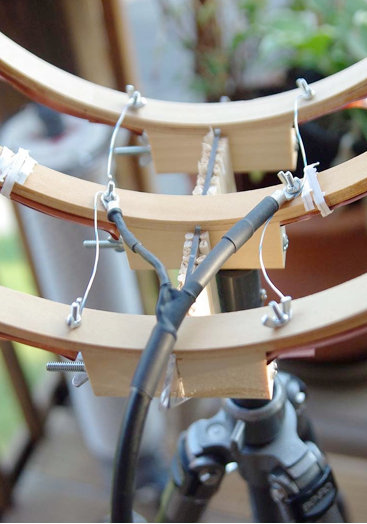
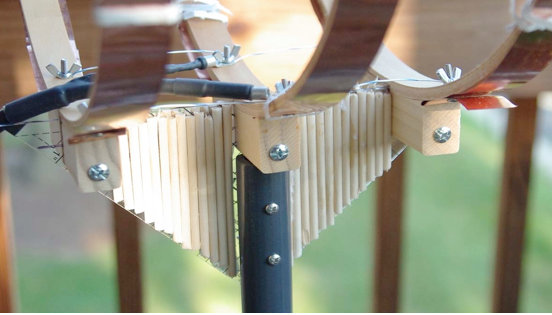
loops-closeup

loops-closeup2
Seems to be an efficient way to prototype small loops. It is now mounted on a short ¾” inside diameter PVC pipe into a cheap plastic sand-filled deck-umbrella stand. Loops are light and somewhat flimsy, so I mounted the three loops on a plastic triangle ruler and dowel sticks glued to the sides for some extra strength. Good enough for now.

The EF-SWL balun is also in an experimental configuration. Since I read somewhere that loop antennas have a very low impedance at the feed point (like, 10 ohms or lower), I thought I might try a balun that is meant to lower the impedance and mount it backwards. I don’t have a picture of it but the SO-239 output is facing the loop and the screw terminals are facing the direction of the radio. My feeble brain thinks since it is a passive device of coils on ferrite, it should work bidirectionally for receive only applications like this. It seems to work but I have the excuse that I really don’t know what I am doing! 🙂
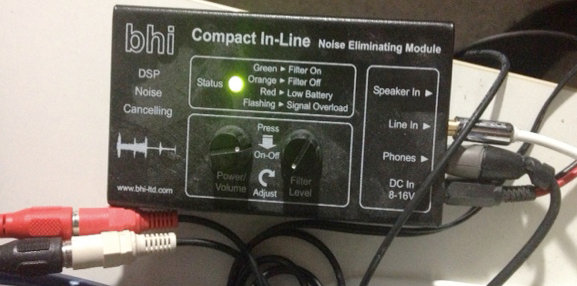
bhi

BHI unit in action.

The BHI DSP filter is useful in some circumstances but I find it fatiguing to listen to. The audio from the Sattelit 800 is so nice, I mostly like it without the DSP. The DSP narrows the bandwidth significantly, somewhere around 4 kHz or less from my hearing. I like that the Grundig has two tone controls. And it also has a stable SSB and on very strong signals with clear audio, I like to listen with SSB lower or upper sideband. But the DSP is useful at times for hash-like noisy signals; it is not quite as good on buzzing noise and I wish the Satellit 800 had a noise blanker, but that would have been a more costly purchase, like a Drake R8A.

So, in a nutshell, I have a discovery about noise here: it is all around me and ubiquitous, like the air I breathe!

I find it hard to null and also worry about peaking a station signal at the same time. However, I do have a lower noise floor with the experimental loop sitting outdoors, especially on medium wave (the Wellbrook amp + loop works great on the lower frequencies – am able to get eight different medium wave stations carrying Major League Baseball games at night – it would be nine to get WFAN for the New York Mets but the local Chicago Cubs station covers the adjacent frequency with horrible digital hash! ***Bleeping*** digital junk!).

Also, the signal level is noticeably lower using the loop. Then, add in the effect of the MFJ Noise Canceling unit, the usable signal gets even weaker.

The bottom line is, I can now finally enjoy listening to many SW broadcasts, BUT only the strongest signals. Anything else is still hopelessly lost in the noise. So, gains are limited.

On the other hand, and something else I learned by doing is that, any 1 or 2 dB signal/noise ratio improvement will help with the final audio output in the end product. Using low-noise amps, loops, noise canceler, preselectors, grounded connections, ground isolators at the input of every receiver, high quality stereo amplifier and speakers, tone controls, SSB vs. AM Sync, weird antenna configurations, etc, etc. It all helps in the end to some degree.

Tinkering is an art that involves a lot of thinking/doing iterations! And high quality parts must be used all along the chain or it could degrade the signal.

Below are some audio samples, not very well recorded, but can give some idea of the incremental improvement with each enhancement (turn up the volume). NOTE: other people may get better or worse results depending upon individual situations, type of antennas used, etc, etc.

Recording 1: R. Marti. First 10 seconds an indoor antenna with no noise reduction, second 10 seconds the outdoor loop without the MFJ-1026, the third 10 seconds with the MFJ-1026, then switched off and on to hear the difference.

Recording 2: R. Marti. MFJ -1026 is ON. Last 15 seconds is SSB, very thin sounding. Really only good for strongest signals. I liked the AM Sync better (Satellit 800 is really a Drake SW8 in disguise with a quality AM Sync). But, SSB can sound excellent with very clear voices with a steady and strong signal (The Satellit 800 does NOT have IF-shift or a BFO to fine tune an SSB reception, so the station must be exactly transmitting on the kHz mark, which most are nowadays).

Recording 3: R. Marti. MFJ-1026 is ON. Last 20 seconds you hear me switch in the two audio switches and the BHI DSP is on its lowest setting. Narrower and clearer with some reduction of background noise. I find I only like going up to about 4 on the DSP dial, after that the audio fidelity starts getting more choppy with digital artifacts that sound like dripping water. I tend to like higher fidelity. One nice thing about the BHI DSP is a faux-stereo that helps a little with voice intelligibility by helping the brain naturally filter the noise. Faux-stereo is ON even when the noise reduction circuit is manually turned off (power must be on and bandwidth still sounds narrowed).

Recording 4: R. Nacional Brazilia. First without MFJ-1026, then ON, then OFF, then ON, then with the BHI kicked for the last 20 seconds.

Recording 5: Greece. Switching the MFJ-1026 on and off every 5 seconds. In this particular case, the signal was weak and fading a lot. The MFJ OFF was also weaker than with it turned ON. That is interesting behavior, usually it is opposite. It pays to play with the settings a little. At other times, and less frequently, the MFJ unit turned OFF sometimes sounds better than with it ON and tuned for less noise. Go figure!

After all the tweaking is done, and I cannot get any more performance out of this, I will probably have to move to a nice, quiet neighborhood and setup a nice antenna farm!!

In the meantime, I do enjoy listening to the stronger stations from North America, Cuba, Brazil, Europe, and Australia with less noise than before.

73’s

TomL from NOIZEY Illinoiz


Once again, Tom, thanks for sharing your RFI elimination journey!

I love how you take on this noisy problem by experimenting and seeing it more as a challenge than an obstacle to enjoying your hobby.  Great job! 
Guest Post: My Evolving, Morphing, SW Listening Station

Many thanks to SWLing Post contributor, TomL, for the following guest post:


Sony-2010

My Evolving, Morphing, SW Listening Station

by TomL, May 26, 2016

My interest in radio listening has been rekindled after a long hiatus in parallel to my dwindling interest in Mainstream Media.  It is now about 8 years without cable TV and I seriously do not miss it, especially with the evolving nature of discovery with respect to other forms of media.  SWL radio was important to me in my formative years during the Cold War; fascinating were the many ways governments used shortwave radio to influence populations, each with their own brand of propaganda!  Young people today know nothing about the endless (and entertaining) tirades of East German editorial commentaries denouncing the evil, decadent West.  Or, of the free, large-sized envelopes full of travel and promotional brochures, pennants, bumper stickers, and booklets sent from the government broadcasters such as Poland, Hungary (yes, communist countries!), Australia, Netherlands, etc. just for sending in one simple QSL report!!!

I quickly realized that those days are gone forever, consigned to a period of history where radio was THE main method of disseminating copious amounts of government propaganda to very large swaths of humanity.  Now, the internet and cable TV fulfill that function in a much more CONTROLLED manner, both technically and socially (Big Brother like).  So, I have diversified my interests and have an unusual listening station.  It is multiple things in one small space.  You see, I live in a very small condo in a noise-plagued environment with only a 2nd floor wooden deck (owned by the Condo Association!) in which to put up any outside antennas.  Only a single “Dish” type antenna is allowed.  So my shortwave antenna needs to be well hidden.  Same for the TV antenna, since I also have a north-facing deck, I cannot have any line-of-sight to the Southern sky for a Dish.

The first wire antenna strung from the top and brought inside was a dismal failure receiving nothing but noise.  I gave up for a couple of years.  I built a loop TV antenna and mounted an FM antenna instead since those were less susceptible to noise issues.  Also recently added to this station are two cheap 4G antennas with wires into a single Verizon USB aircard plugged into my computer and getting up to 14 mbps performance.

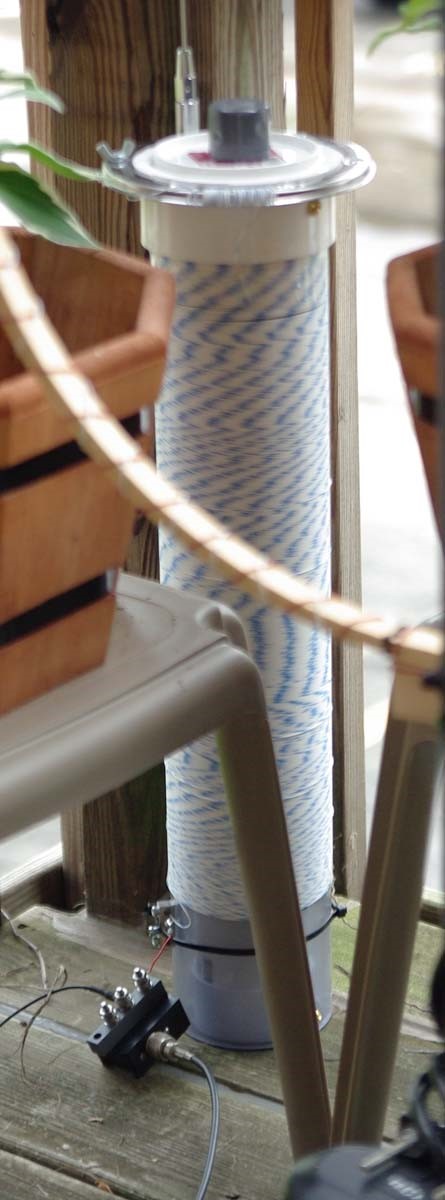
But, I still wanted to try shortwave radio again (and medium wave too) but the noise issues were very, very discouraging.  S9 noise on some bands.  Tried preselector, a noise “phaser”, different lengths.  Nothing worked.  However, I read something from an amateur radio operator in Northern California who had a space problem.  He put up a helically-wound-vertical (HWV) antenna with radials for 160 meters (John Miller HWV antenna).  I also read about various “broomstick” antennas.  So, I tried my own version with an old RF Systems Magnetic Longwire Balun I still owned and NO radials.  Put it together with a 2 foot long, 4 inch schedule 40 PVC pipe wrapped in 200 feet of 18 awg magnet wire.  Well, still noisy but, at least now I had a portable antenna!

So, I went camping in March of this year!  Holy Cow, was it cold out but the helical antenna performed well enough to hear All India Radio for my very first time, a small 1kw Mexican station in the 49 meter band, and various others from Asia that were elusive for me in the distant past.  I was finally encouraged again to continue my research.  I did this a few more times and finally got tired of going camping just to listen to a radio!  NOISE at home was still the big bugaboo to kill (and it still is).

I read up on Common-mode noise travelling on ground and shield components of antenna systems.  So I bought a bunch of toroid ferrites of different types to cover different frequencies (something about initial permeability….) to make my own homemade “Super RF Choke” to cover all frequencies made on a Home Depot Homer bucket lid, winding the coax 5 or 6 times through all the toroids, the full diameter of the lid.

Measurements by Jim Brown published on the web (RFI-Ham.pdf), pages 32-33) indicate good choke performance using coax with these larger-sized coils.  I still hoped to salvage the use of the HWV antenna.  So, added the choke and noticed some improvement across most bands (less noise).  Medium wave broadcast was not effective and decided that I did not want to keep tuning an antenna that HAD to sit outside to get away from the noise inside my listening station.

I also shut off the power to my condo and found out which noise sources were mine vs. other noise that came from all the neighbors (very important step to do!!!).  For instance, I did not know before that USB charging adapters are PURE RF-NOISE EVIL in an innocently small package?!?!?!  I rearranged wiring to shut off certain devices and power strips when I want to listen to the radio!

So, I kept reading.  Found out about another magnetic balun from Palomar.  Tried it but not impressed –  performance was too lossy compared to the good old RF Systems MLB (what a great product that was back then!).  Kept reading and found out good things about the EF-SWL from PAR electronics (product is now made and sold by LNR).  The ground connections on it (and the Palomar) intrigued me.  So, I decided to go to Hamvention for the first time, even though I was skeptical of finding anything useful, I told myself, I could at least buy the EF-SWL on sale (which I did).

Installed EF-SWL to the HWV but no difference compared to the RF MLB. The antenna did perform better outside on the deck in the far corner, so there it still sits.  Then, I hooked up the wire they gave me with the EF-SWL to the ground and it resulted in MORE noise.  Then, took off the jumper (which connects the coax shield to the ground side of the balun) and connected only the middle post (balun ground) to the ground wire and a lot LESS noise resulted along with a small reduction in radio signal level!!!  Finally some progress – the wire seems to be acting like an old-fashioned “counterpoise”, which is misunderstood these days.  Apparently, back in the 1930’s-1950’s, people involved in radio knew the differences between an “earth ground”, a “radial system”, and a “counterpoise”.  Technically, they are all different and their use is different as a result.  Now, people moosh all these concepts together interchangeably which risks creating very ineffective antennas.

Photo of installed EF-SWL at the bottom of the HWV with coax at the output, the red magnet wire input on top, the middle post for the counterpoise wire, and the coax shield post is unused. 

Photo of installed EF-SWL at the bottom of the HWV with coax at the output, the red magnet wire input on top, the middle post for the counterpoise wire, and the coax shield post is unused.

The HWV antenna now has 600 feet of 26 awg teflon wire on the outside PVC, an inside 3 inch PVC “sleeve” with 102 Russian ferrite rods, a 56 inch stainless steel whip at the top, and one inch hole through the center to accommodate the 7 foot PVC mount to my carbon fiber photo tripod when I take it camping again.

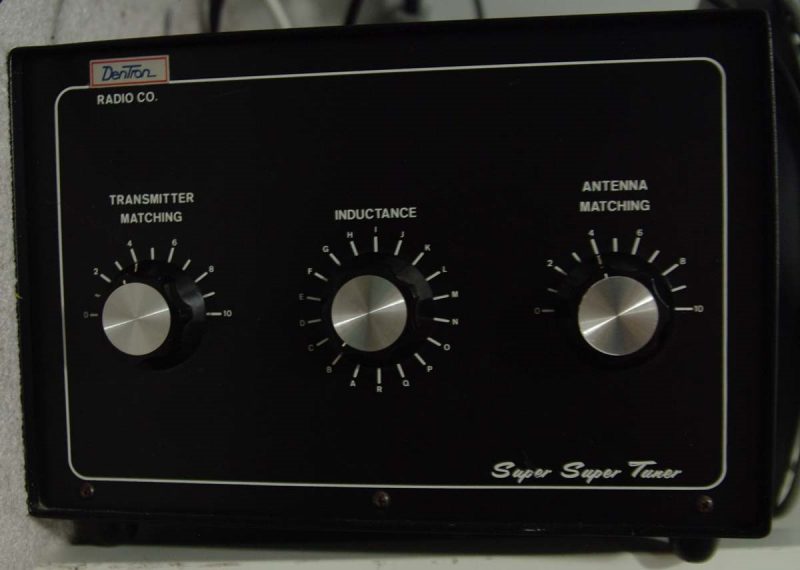
So, I am on a new quest to understand counterpoises, how to actually TUNE them and, hopefully, how to use them to increase the performance of shortened antennas like my HWV (something about reducing the dB loss incurred by shortening….).  A second result I hope will be how to use the counterpoise to keep signal-to-noise ratio high at the same time (maybe with this used $100 Dentron Super Tuner bought at Hamvention?).

Transmatch

Also bought at Hamvention (thanks Thomas W. for the tip!!) and installed Bonito’s Galvanic Antenna Isolator GI300.

If input directly to the input of the radio, led to more reduction in noise and signal!!  Too much actually, so I took off my Super RF Choke and now I had a better result compared to the EF-SWL with the RF Choke (slightly cleaner sound with less hissy noise).  Apparently, the GI300 completely isolates the coax shield, better than my homemade choke!  The requirement is to use coax from the feedpoint and not bare wire.  I then placed a few clamp-on ferrites I bought from eBay to help with slightly higher frequency choking of the shield at various places on the feedline.

Bonito-Galvanic-Isolator

Photo of GI300 on radio with NO extra coax lead into the radio at right (Thanks to Dennis Walter of Bonito for that tip)

Before Hamvention, I wanted to try out AM broadcast.  I wanted to know more about this “FSL” antenna a well-known eccentric from Ireland (Graham Maynard FSL) developed before he passed away a few years later.  So read up and bought a whole bunch of ferrite rods and tried different configurations.  Well, my particular design did not work all that well because I did not follow directions for winding wire into a balanced design.  So, I added all those ferrite rods to the 2 foot HWV (inside a 3 inch thin-walled sewer PVC pipe).  The antenna is louder down to about 3 MHz with a stronger signal (including noise) than without.  I do not have measurements, and find it too time consuming to document.  Maybe one day, I will compare and document by sliding the ferrites out on the 3 inch PVC and measure actual signal levels.  The ferrite sleeve seemed to pick up MORE noise and radio signal than without it.  So, if you need more signal strength in a small package below 7 MHz, then the idea seems to have merit.  But since it increased noise as much as radio signals, it has limited usefulness to me.  I do have another project where I will put ferrite bars onto a tuned medium wave loop antenna (Tecsun AN100) that is much more portable and directional.  The bars and loop were both relatively inexpensive from eBay.  The ferrites change the tuning lower, so I have to figure out how to make it tune higher again…….

Photo of unfinished MW loop project.

Photo of unfinished MW loop project.

Summary

Evolving understanding of dealing with major problems like overwhelming noise and limited space have led to unexpected additions to my SW Listening Station:

  • A 2 foot long, 4 inch diameter helically-wound-vertical antenna (HWV) with way too much wire on it (and now inserted with 102 160mm Russian ferrite rods on a 3 inch diameter “sleeve”). Originally built because of its portability.  Can now be mounted on a carbon fiber photo tripod with a 7 foot 3/4” PVC pipe through the center length
  • A magnetic balun from LNR (designed by Parfitt) attached at the feedpoint of the antenna
  • A proprietary galvanic isolator from Bonito attached right at the radio’s antenna terminal
  • A “boat anchor” Dentron Super Tuner attached to the HWV feedline to help tune it
  • An unfinished MW loop antenna with more ferrite bars
  • An unused, homemade toroidal Super RF Choke
  • Clamp-on ferrites everywhere in proximity on wires and power leads
  • Re-arranged power strips and wires as needed for easier shutoff in functional groups

For shortwave, I still pick up mostly noise on many bands.  With the uncalibrated S-meter on the ICF-2010 – 49 meters is around S1 (before about S3).  31 meters is MUCH improved and is now listenable to stronger stations (S2 instead of S7 noise!).  Even 19 and 16 meters is improved from S6 to S7 down to about S3 now – noise still too annoyingly loud to understand any language being spoken however.  And forget about DXing from this location!  Will have to go camping again soon.

BUT, listening now to Voice of Greece, Radio Nacional Brasilia, or Radio Romania International is a much cleaner sounding experience than just a couple of months ago.  They are there to re-discover and appreciate, even though many speak a foreign language and I do not understand a word they are saying!  Also, there is the odd observation (like just this morning), that I can actually learn to enjoy listening to Country Music if it is the unique sounding Australian flavor!!

Do I miss cable TV??  Not a bit!!

Future investigations

  • Employ the Dentron Super Tuner in various configurations to find any improvements (currently attached to the coax of main feedline from the EF-SWL, it is helping tune different SW bands (not sure why it helps, does not make sense, must be a mismatch between coax and balun)
  • Obtain old book(s) on counterpoises
  • Get a Linear DC power supply for use with all the EVIL RF-spewing devices that use 5 volts. Maybe this one:  (Tekpower 3Amp Linear)
  • Replace any cheap/old RG58 cables with LMR-240 or similar
  • Finish the AM loop w/ferrites so I can take it places
  • Perhaps an ultra low-noise outdoor amplifier for the HWV, depends on counterpoise experiments: (Wellbrook ALA100M-2)  (I don’t want to spend that much money now)
  • Somehow use a noise antenna with a better phaser: (DX Engineering NCC-1) (gulp, don’t want to spend THAT much money now also!!!)
  • Get some relief from background noise using a really robust noise blanker. I don’t want to spend on the portable radio, would rather get something like the Bonito 1102S or an ELAD model both supposed to have excellent audio quality and excellent DSP noise blankers.  But that means getting a cheap laptop to run it and replacing the Sony.  MOAR big bucks…. but not right now
  • Maybe a real loop antenna, BUT it has to be remotely tunable and remotely turnable and small enough to HIDE. MOAR big bucks, sigh….

TomL from noisy Illinois, USA


Many thanks for sharing your experiences, Tom! Also, it was great meeting you at the Hamvention this year.

I must say that there is something to be said for brute-force experimentation when it comes to mitigating radio interference. I hope you keep us posted as you continue to experiment and improve upon your unique listening system.

Guest Post: Communications Service Monitors – A Radio Hobbyist’s Perspective

SX-99-Dial-Nar

Many thanks to SWLing Post contributor, Mario Filippi (N2HUN) for the following guest post:


Communications Service Monitors – A Radio Hobbyist’s Perspective

Mario Filippi, N2HUN

(All photos courtesy of author)

Over the past few decades I lusted after a communications service monitor for my radio hobby but prices were always prohibitive; several thousands of dollars for a new model and tens of thousands for high-end ones. Not being a working professional in the communications field made it difficult to justify purchasing a piece of equipment whose price tag rivaled a down payment on a house. So, fast forward a few decades later and now life and times have fortunately changed for the better; the house is paid for, the job is secure, the income is finally steady, life is good financially, and to boot many of these older service monitors manufactured by Ramsey, Motorola, Wavetek, IFR/Aerotek, Cushman etc., are currently being sold on the pre-owned market at a fraction of their original decades-ago hefty prices. These service monitors are finally in financial reach of electronics hobbyists who will find many uses for these former electronic workhorses that toiled many years in the industry and now, in their golden years are being retired and becoming available for a second life via reuse/reincarnation/repurposing/reinvention.

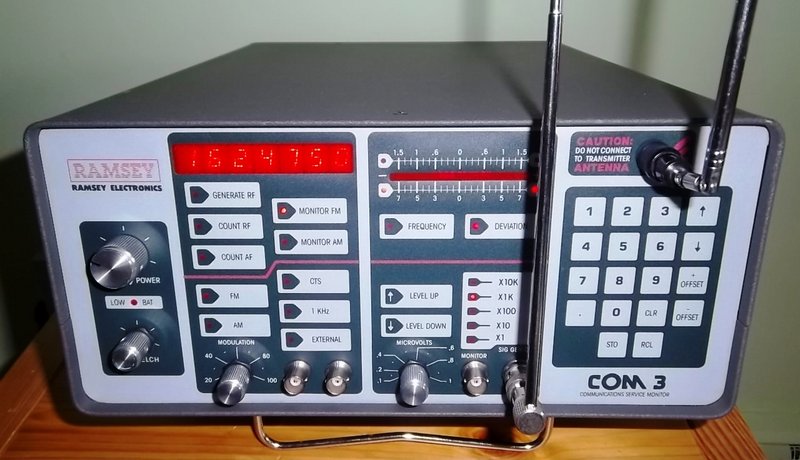
Work of Art: Author’s Ramsey COM3 Service Monitor

Work of Art: Author’s Ramsey COM3 Service Monitor

So what exactly is a communications service monitor, or “service monitor” as the folks in the trade refer to? Well it is an instrument for servicing AM and FM radio equipment, although some units also have the ability to service SSB equipment. The service monitor is basically a highly accurate and precise receiver and low-power signal generator all in one allowing a technician (or electronics hobbyist) to perform service, repair, or alignment of radio equipment. Most of us have had the experience of owning a malfunctioning radio whether it is an AM or FM broadcast radio, two-way radio such as a CB (Citizen’s Band) radio, pager, or a ham radio transceiver, and that is where a service monitor proves its value and utility because now you, the hobbyist, can perform the work yourself.

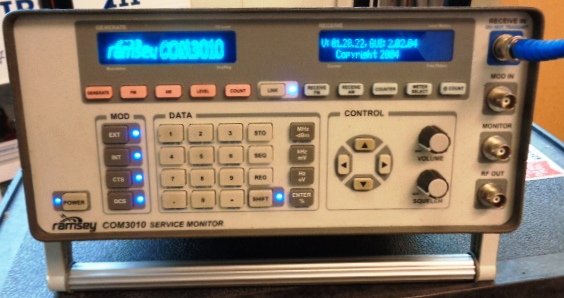
My Friend’s Ramsey COM3010 Service Monitor, Big Brother of the COM3

My Friend’s Ramsey COM3010 Service Monitor, Big Brother of the COM3

As a radio enthusiast (shortwave, ham radio, satellite communications) for over half a century, I’ve definitely owned more radios than shoes; everything from AM, FM, shortwave receivers to CB radios to ham transceivers, all in different stages of health and vintage. For years I relied on standalone RF signal generators, audio generators, frequency counters, and CTCSS decoders to aid in rehabbing, troubleshooting, and aligning each of the many units that paraded past my radio shack. Then one day a friend showed me his service monitor, the Ramsey COM3010, another venerable workhorse still in production, and it was a defining moment; the time had come to invest in one.

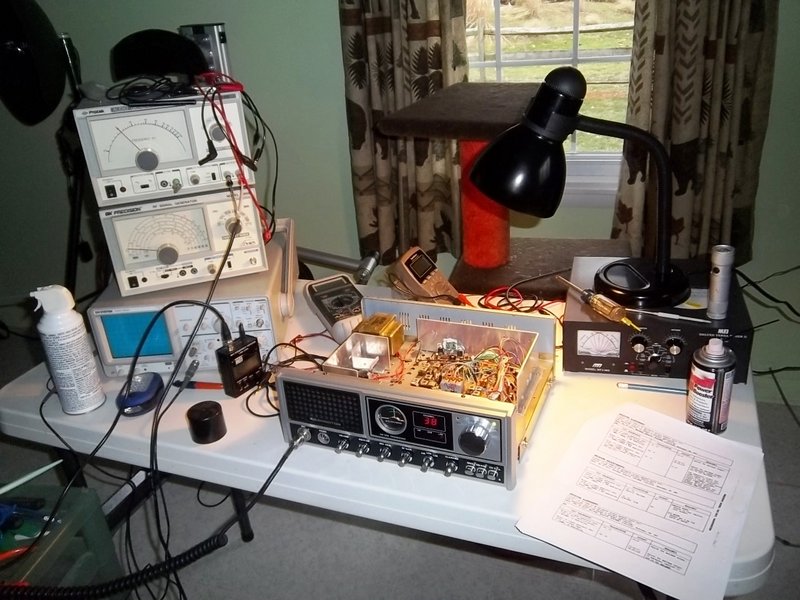
Aligning a Uniden President Washington CB Radio Prior to Owning a Service Monitor

Aligning a Uniden President Washington CB Radio Prior to Owning a Service Monitor

My Ramsey COM3, purchased second-hand from an Internet auction site for $400.00 is a no frills, basic unit without the features found in more sophisticated service monitors having built-in oscilloscopes, spectrum analyzers, frequency sweeping ability, and frequency scanning ability. The COM3 was in production from the late 1980’s to around 2003 at a price of around $2500 (ca. 1989) and was considered a workhorse in its time, weighed 13 pounds with the internal battery, and was easily luggable from site to site. It covers from 100 KHz to 999.999 MHz and has become an invaluable tool in my radio shack for measuring a transmitter’s operating frequency and deviation, measuring receiver sensitivity, S meter calibration, and checking CTCSS tones on my two way VHF/UHF radios. My unit evidently had an easy former life as the only needs were to replace the internal battery, perform an external cleaning, check transmitter and receiver accuracy and check accuracy of the internal audio generator. Interestingly, Ramsey Electronics (www.ramseytest.com) still services and calibrates COM3s.

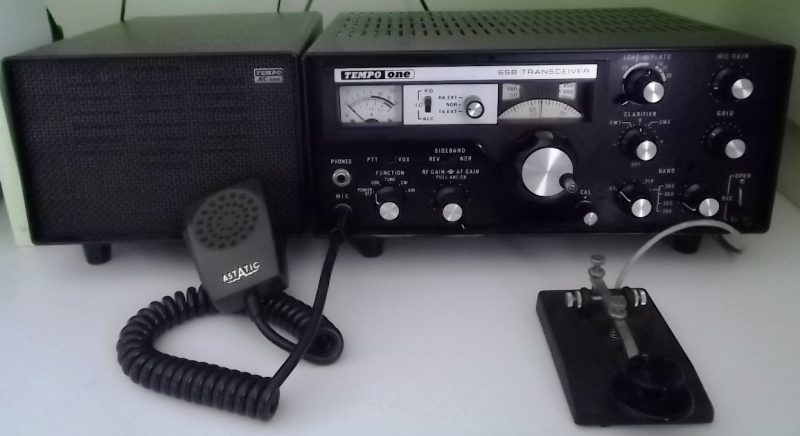
Vintage Tempo One Transceiver Restoration Was Made Easier with the COM3 on the Bench

Vintage Tempo One Transceiver Restoration Was Made Easier with the COM3 on the Bench

So, if you’ve been dreaming of owning your own communications service monitor either as a hobbyist or small repair radio shop proprietor then start looking as there are plenty of used units out there; you’ll pay top dollar when buying from a commercial vendor but at least you’ll get some form of warranty. If instead you travel the same road I did, via an Internet auction site, there’s lots more risk involved, but the plus is you’ll save big if you do your homework by checking past auctions, seller feedback scores, and determining what price the market is bearing by looking at the winning bids. In closing, the COM3 owner’s manual is available on line by doing a simple search, and a review of the Ramsey COM3 by Larry Antonuk which appeared in the August 1989 issue of 73 Amateur Radio Magazine is also available as a free download.


Mario, thank you for another brilliant guest post! I always learn something new from your articles. By the way: I have that same Nye Viking straight key–it obviously pairs beautifully with the Tempo One!

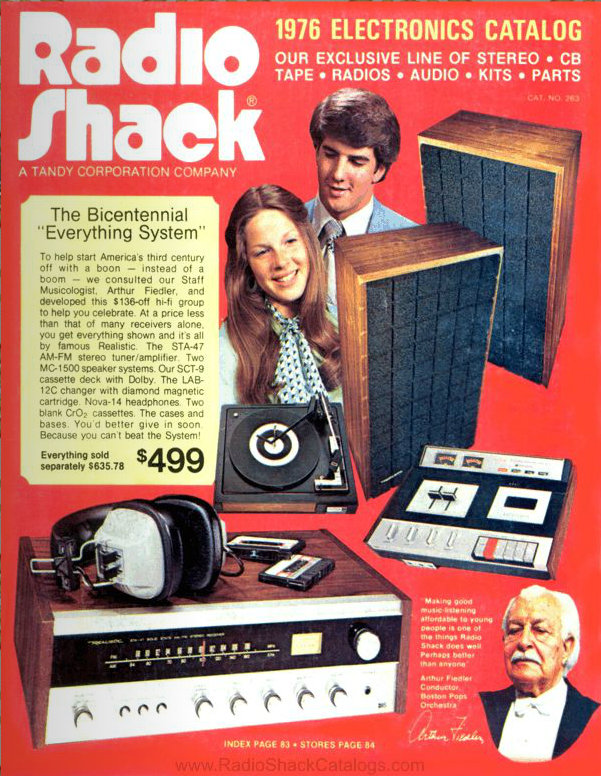
Guest post: Trip Down Shortwave Memory Lane via Vintage RadioShack Catalogs

RadioShack-CatalogMany thanks to SWLing Post contributor, Mario Filippi (N2HUN), for the following guest post:


Trip Down Shortwave Memory Lane via Vintage RS Catalogs

-Mario Filippi (N2HUN)

Attached is a wonderful website containing archived Radio Shack catalogs and sales flyers going back to 1939, surely of interest to SWLs, hams, and other electronics hobbyists. Most of us have fond memories growing up and visiting our local Radio Shack when it was the place to go for ham, shortwave, and scanner radios. My hometown Radio Shack was located on North Avenue in New Rochelle, NY and I purchased an electric guitar (could not afford a Fender) from them in the late 60’s which had three pickups and included a case for $29.95!

Radio Shack Catalogs

You see, back then Radio Shack had a much more diversified line of products, including musical instruments, power tools and even scientific stuff like microscopes and slide rules. These archived catalogs are a treasure trove of information not only from a historical perspective, but for anyone who is interested or who is contemplating purchasing vintage equipment such as shortwave radios, because you can look up the original sales info in the RS catalog which contains the original price, photo, description, and accessories available at that time.

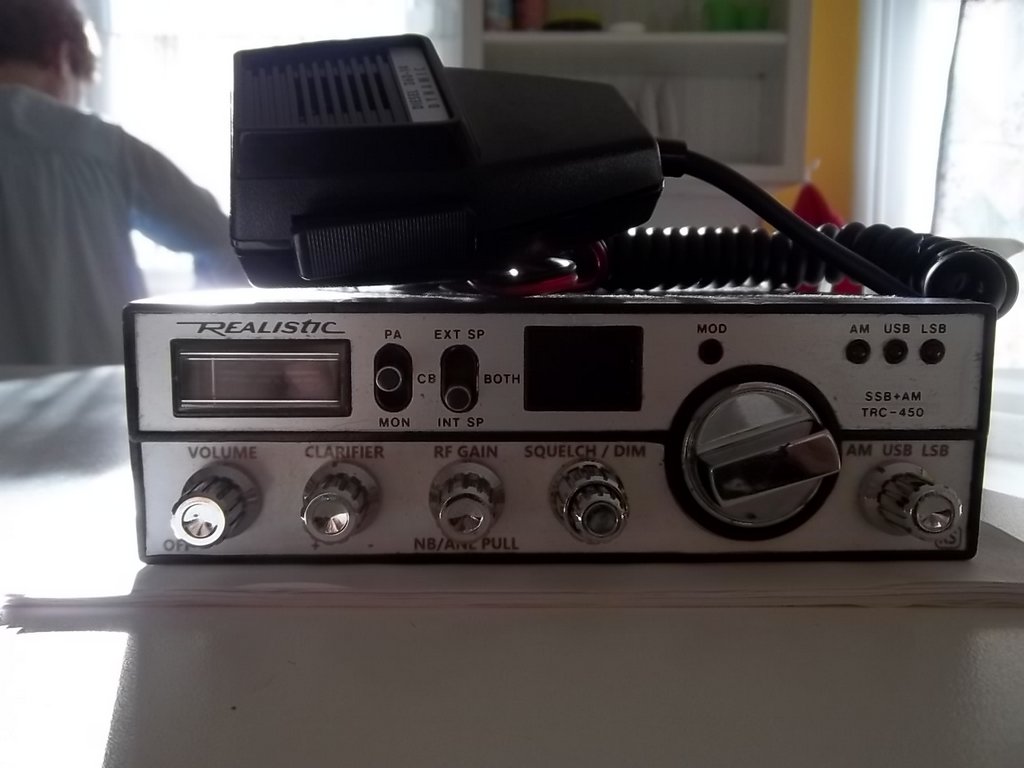
For example, last year I purchased a “tech special” Realistic TRC-450 AM/SSB CB radio on Ebay that needed LED repair, so I looked up the original sales ad and got the price, photo (this helps to see original condition), and product description. Below is a picture of my restored Realistic which originally sold in 1980 for $269.95!

RadioShack-TRC-450

The classic Realistic TRC-450 AM/SSB CB radio. (Photo: Mario Filippi)

Nowadays most people don’t realize how expensive electronics were a few decades ago. A comparable new AM/SSB CB radio sells for about half that price nowadays!

Lastly, as one progresses chronologically through the catalogs, you can see technology (and even fashion) trends – the large 8 track tape decks of the 60’s and 70’s progressed to smaller cassette players of the 80’s and 90’s, then DVD/CD players made their entrance, ultimately giving way to higher tech forms of entertainment such as satellite radio and Internet-based entertainment. Well I hope you enjoy this totally entertaining and informative website and I thank the individual who took the time and effort to preserve for perpetuity these priceless annual time capsules for everyone to enjoy.


Mario, many thanks for this trip down memory lane!

As you state, these catalogs are actually an excellent reference source when trying to determine pricing and features of RS radios found on the used market.

I think they’re also so much fun to flip through as they’re chock-full of nostalgic value. When I was a kid, I could care less about toy store catalogs–the RadioShack catalog was my toy store!

Indeed, when I open the online catalog copies at Radio Shack Catalogs, I can almost smell the ink on the pages! Am I the only one?

Guest Post: A Late Summer Visit to Howard Mills’ Radio Restoration

Many thanks to former VOA correspondent and noted DXer, Dan Robinson, for the following guest post:


DSCF7551

A Late Summer Visit to Howard Mills’ Radio Restoration

-Dan Robinson

The end of summer is a wistful time, as we begin to mourn the passage of warm days and anticipate the arrival of autumn.

For those of us in love with shortwave, even in these waning days of HF broadcasting, August brings changes in propagation that herald the approach of improved reception, thoughts of getting antennas in shape, and preparing receivers for the new DX season.

It’s also a time when Hamfests are winding down for the year — for me, it’s still great fun to attend these and see what equipment is available.

A few months ago, I and fellow Washington, DC area SWL Dave Malick took the opportunity to visit a couple of Hamfests. At one of these, in Berryville, VA, I ran across someone who over the years has become somewhat of a legend in the field of radio restoration — Howard Mills.

Howard lives in rural West Virginia, at a point about equidistant from Harper’s Ferry and Sheperdstown. That’s about an hour or so from DC and the immediate Maryland suburbs. From DC, you drive out Rt 270 to Frederick, Maryland and then up Route 15 and 340.

It’s beautiful country — on the way you pass through small towns, past farms, and in late summer, roadside stands selling huge ears of corn and about every type of vegetable, along with peaches and apples of every type and size.Rack mounted equipment

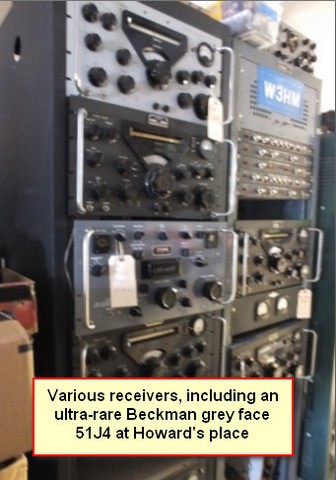
Back in the late 1990’s I first became aware of Howard Mills when I brought my Collins 51J4 to him for refurbishing.   Howard is one of the few persons remaining in this country capable of going through classic tube receivers from top to bottom.

A visit to Howard is an experience everyone should have at least once in a lifetime. Restoration activities take place in the lower/ground level of his home.

Outside there are some amazing antennas, long wires, and beams which support both his amateur radio and receiver activities.
DSCF7558Under a porch, covered in tarps, are some of his latest equipment and parts acquisitions, from thousands of tubes to some of the rarest radios and transmitter items one may ever see.
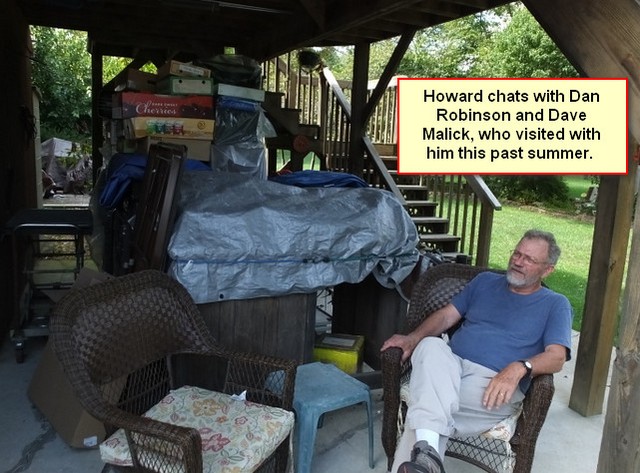
Howard at his home in WVA

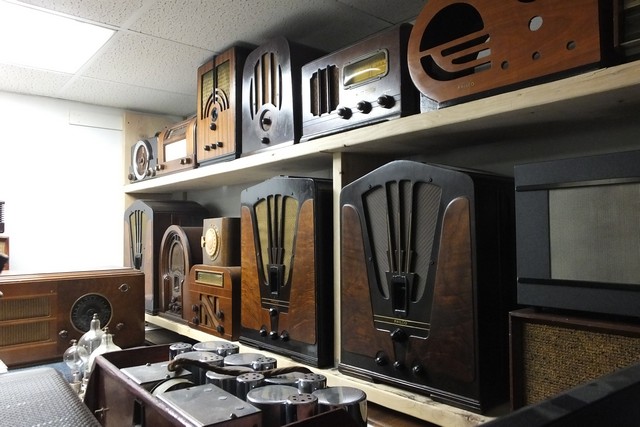
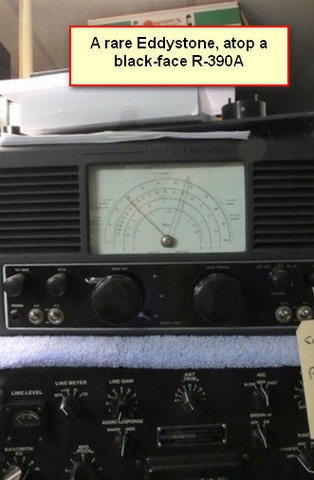
Inside, you find a wonderland of receivers. You name it, Howard has it. In racks, there are specialized Beckman 51J4s, SP-600s, AR-88s and R-390/As, Eddystones, and others. In another room, you see some of the most beautiful, and collectible and valuable, American and foreign-made radios dating back to the earliest days.

Rare Eddystone

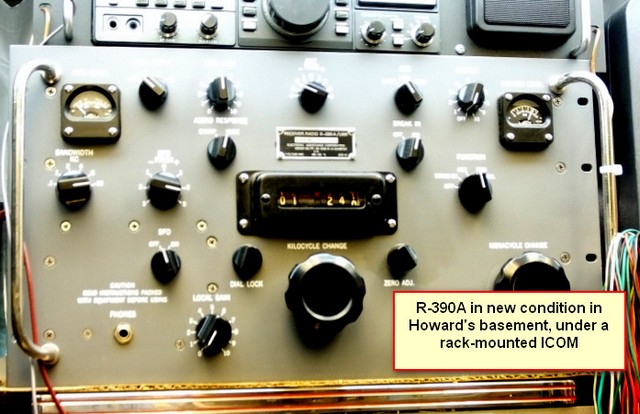
On tables in one portion of the basement of Howard’s place, you find several R-390s in various stages of refurbishment. One, he notes (probably among his “keepers” ) was found still new in its original crate (how I would love to have that one!).

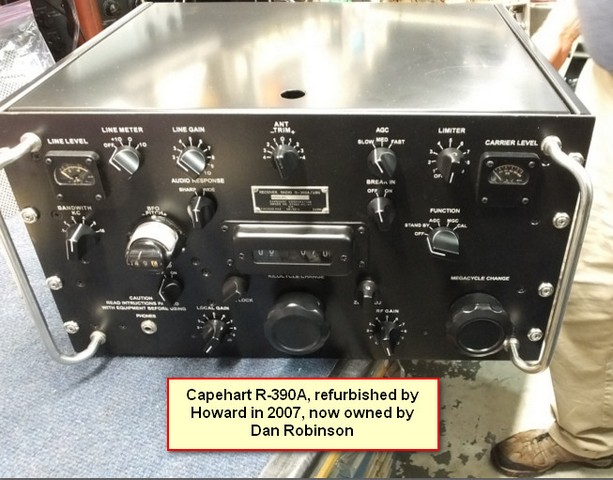
On the day Dave and I visited, the purpose was to pick up one of the most beautiful R-390s I have ever seen — a Capehart that was refurbished by Howard in 2007 and placed in a custom cabinet, complete with an easy-left-off top, similar to the HQ-180 design. This black beauty is now sitting in my shack at home.

R-390A Capehart

Howard has been at it for many decades, as I said. A conversation with him is a voyage through radio history, punctuated by references to a range of major radio manufacturers. He clearly loves what he does, though one wonders how much longer he will be at it.

Howard emphasizes by the way that his work is in restoring TUBE radios — he doesn’t get into solid state. There are a few well-known receivers in his place — I noticed an ICOM IC-R72 and a JRC NRD-535– but most of what you see are the classics that we have all come to know and love.

DSCF7529

His primary specialty appears to be the 51J series. A link to him on the Collins site notes that his main focus is on A line equipment, J series, and 32V series, but he is certainly capable on a number of models, including as I saw, HQ-180s and AR-88s (http://www.collinsradio.org/howard-mills/)

I was able to take some photos of Howard’s operation and offer them to SWLing Post readers here. At this point, Howard remains in business. He has had customers from all over the U.S. and I assume around the globe.

For each refurbishing job, Howard provides an extensive print out of every single modification and component replacement he does, along with the results of sensitivity and calibration tests done for each set.

Please do note that Howard makes clear that basically as long as it takes him to refurbish a radio — is as long as it will take.   If you give him one of your radios, you basically agree to it being with him for several months if not longer. He does have a backlog.

R390A New

Things like sandblasting front panels for R390s (I am not certain to what extent he does this himself or out-sources this particular aspect) also takes time.   And the detail with which he approaches a breakdown of an R390/A, evidenced by the sets I saw in process, is quite extraordinary and time-consuming.

Howard gets mostly superb reviews from those who have used his services. If you look him up on the Internet, and he has time for you to visit, it’s an experience you will always remember, though it’s not that I would suggest a crowd descend on him.

Hope everyone enjoys the photos — I had intended to get this article to Tom much sooner than October. Keep in mind, of course, that though Howard is one of the last to do this kind of work, there are a few others, including Chuck Rippel in Virginia.

We are indeed lucky to have anyone still doing this work. We know they do it not just as a business, but out of a love for this wonderful old equipment.

Photo gallery

This slideshow requires JavaScript.


Many thanks, Dan, for taking us on this virtual tour of Howard Mills’ collection and workshop!

Your Capehart R-390A is absolutely gorgeous; Howard, no doubt, brought it back to mint status through loving, considerate restoration. What a great addition to your collection, Dan.

Thank you, again,  for sharing your guest post.