Tag Archives: Kim Elliott

VOA Radiogram: Battle of the 100 wpm modes, this weekend!

VOARadioGramIf you like the VOA Radiogram, don’t miss this weekend (March 29-30)–a one year mile marker for the VOA Radiogram service on shortwave radio.

I’ve copied details of the broadcast below, but please bookmark or subscribe to the VOA Radiogram website to see the results of the 100 wpm battle and details of all future broadcasts.

(Source: VOA Radiogram)

This weekend, 29-30 March 2014, will be program 52 of VOA Radiogram. This means that VOA Radiogram has survived one year of shortwave broadcasting.

VOA Radiogram has been successful because of its audience: tuning in, decoding, experimenting, and sending in reports.

We will mark one year of VOA Radiogram with a “battle of the 100-word-per-minute modes.” The same VOA News story will be transmitted using four modes that have a speed of more-or-less 100 words per minute.

Here is the lineup for VOA Radiogram, program 52, 29-30 March 2014:

  •  1:51  MFSK32: Program preview
  •  3:28  PSKR125 (110 wpm): VOA News re Ethiopia
  •  7:42  MT63-1000L (100 wpm): Same VOA New story
  • 12:34  Thor25x4 (100 wpm): Same VOA News story
  • 17:58  MFSK32 (120 wpm): Same VOA News story, with image
  • 23:55  MFSK32: US international broadcasting FY2015 budget
  • 25:58  MFSK32: Closing announcements, with image

Each mode will be preceded by 5 seconds of silence, followed by the RSID, 5 more seconds of silence, and the RSID again.

Please send reception reports to [email protected]

VOA Radiogram transmission schedule

(all days and times UTC)

  • Sat 0930-1000 5745 kHz
  • Sat 1600-1630 17860 kHz
  • Sun 0230-0300 5745 kHz
  • Sun 1930-2000 15670 kHz

All via the Edward R. Murrow transmitting station in North Carolina.

(Many shortwave broadcast frequencies will change on 30 March with the beginning of the A14 season, but the VOA Radiogram frequencies stay the same, for the time being.)

The Mighty KBC, via Germany, will again transmit a minute of MFSK64 Saturday at about 1230 UTC on 6095 kHz and Sunday at about 0130 UTC on 7375 kHz. (KBC’s change from 7375 to 9925 planned for this weekend has been postponed until May.) STF Radio International will also have a minute of digital modes during the same hour (simultaneous MFSK32 streams at 1500 and 2100 Hz).

Dear BBG: Take note of the Radiogram!

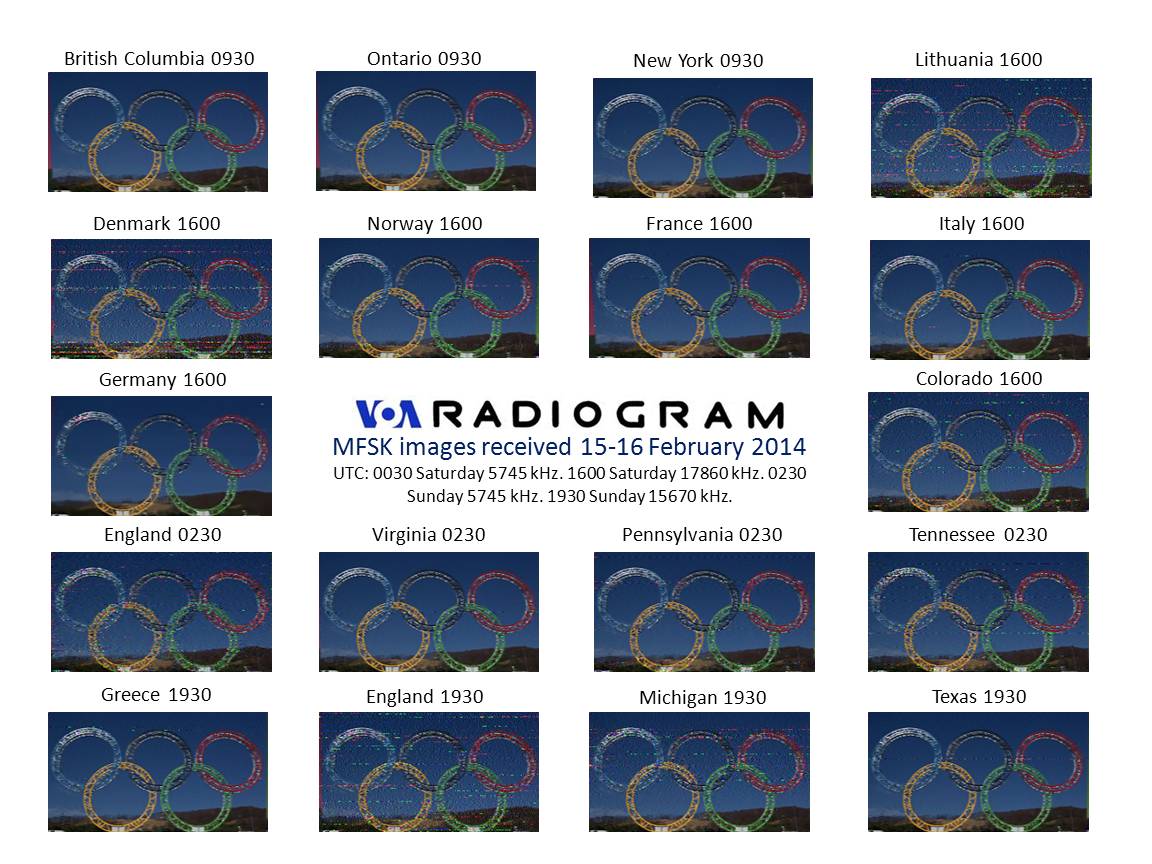
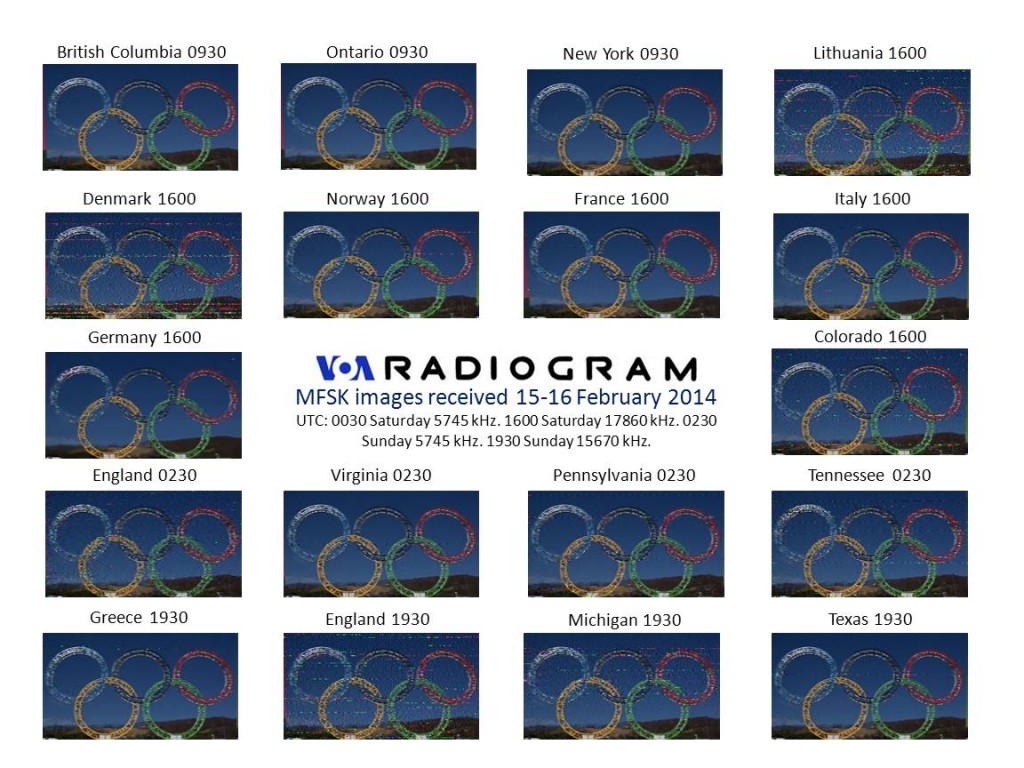
VOARadiogramImagesMany thanks to my friends, Bennett Kobb (AK4AV) and Christopher Rumbaugh (K6FIB) who wrote a letter to the BBG regarding the relevancy of shortwave radio. They make a strong point as this article in Radio World puts it: “Hey, don’t forget about Radiogram!

I also made a case for the VOA Radiogram in my letter to the BBG, but I think Benn and Chris sum it up better. Click here to download their letter to the BBG as a PDF document–I’ve also pasted it below:

Response to BBG Shortwave Committee Request for Comment

March 14, 2014

The BBG has spearheaded ‘Radiogram’ (voaradiogram.net), an entirely novel form of international high-frequency broadcasting. Radiogram is soundly premised on modern digital techniques and mitigates longstanding impediments to HF transmission. Users around the world have documented reception of fifty VOA Radiogram programs in more than a thousand YouTube videos.

BBG must not allow its own pioneering developments to wither, but should advance them toward operational status.

Radiogram should not be confused with Digital Radio Mondiale (DRM), which employs digital modulation for sound broadcasting. Radiogram broadcasts web content via robust, interference-resistant, error-detecting/correcting AM tone modulation, using standardized formats widely practiced in the Amateur Radio Service.

The user’s ordinary shortwave receiver, tuned to a Radiogram transmission, feeds its audio to a user device. These could include mobile phones, tablets, laptop and desktop computers and the new ARM-based miniature computers and embedded devices. The user device decodes the tones and displays text and imagery despite propagation impairments and intentional interference — and without Internet connection.

Placing the radio near the phone or computer is normally sufficient. No hardwire connection is required. By adding a simple audio cable between receiver and user device, however, reception can be silent and covert. No specialized hardware is needed, and the software platform for decoding is long in the public domain.

A more advanced, yet still inexpensive setup would use existing “dongle” technology that places a software-defined radio (SDR) inside a small USB enclosure. Such units are available today for a few tens of dollars and widely used by experimenters. The operating system and decoding software could also be incorporated into the device, which could boot the computer, eliminating the need to install any PC software.

The user need not be present at the time of transmission to receive content. He essentially receives a web magazine updated at will and always ready for use. The user can redistribute it by printing, USB storage, SMS, E-mail etc.

Naturally, the audio tone transmission can be recorded for later playback. Even when buried well under music or noise, the nearly inaudible recorded broadcast can nevertheless deliver 100% copy upon decode.

Radiogram’s transmission methods provide text at 120 WPM (near to the speed of spoken English) along with images. Additional languages have been proven, including non-Roman alphabets.

Sent over regular broadcast transmitters (no modifications needed), this approach effectively extends the reach of the transmitter. In other words, the digital text mode will decode in locations where the audible speech over the same transmitter would be too low for aural intelligibility. The audio recorded or captured could be replayed over another transmitter to even further extend the reach of the broadcast.

Recommendations

BBG should:

1. Capitalize on Radiogram as a circumvention tool, readily consumable by mobile devices. It should integrate Radiogram into its media strategy and networks.

2. Retain, but reconfigure as necessary its HF facilities in view of the potentially lower costs and greater efficiency of Radiogram when compared to conventional sound broadcasting.

3. Support the development and wide distribution of simple, usable, open-source Radiogram decoding applications for popular mobile devices and platforms (Android, iOS, Windows, Mac, Linux), derived from the free Fldigi software used worldwide.

About the Respondents

Bennett Z. Kobb, M.S., SMIEEE, is the communications director for an Arlington, Virginia trade association.

Christopher Rumbaugh, MLS, is a library manager and web publisher in Salem, Oregon.

The views expressed herein are the authors’ own.

Again, many thanks to Benn and Chris for submitting such an articulate letter to the BBG and for sharing with SWLing Post readers.

If you would like to decode a VOA Radiogram yourself, simply visit VOAradiogram.net for details on broadcasts targeting your part of the world.

Shortwave Radio Recordings: The Mighty KBC

"Dad, that's The Mighty KBC! Turn it up!"

“Dad, that’s The Mighty KBC! Turn it up!”

Sunday at 00:00-02:00 UTC, I tuned to 7,375 kHz to listen to The Mighty KBC. This was the first time I tuned to their winter frequency this season and wasn’t sure how strong their signal would be on a relatively noisy night on the bands.

KBC’s signal was blowtorch strength into North America. It could have been easily received on even the most simple of portable radios.

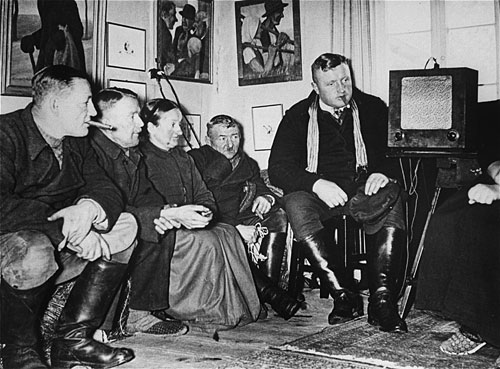
As we’ve come to expect, the Mighty KBC’s Giant Jukebox of music has a lot of rock-n-roll and Euro-pop variety, spanning the decades; DJ, “Uncle Eric” knows how to entertain and spin the tunes! Uncle Eric includes Kim Elliott’s digital text modes in this broadcast–if you missed the live broadcast, you can even decode the messages from the recording below.

Click here to download the recording as an MP3, or simply listen via the embedded player below. Enjoy:

VOA Radiogram this weekend includes Greek and images in MFSK64 and 128

VOARadioGram(Source: VOA Radiogram)

VOA Radiogram for the weekend of 21-22 September 2013 is produced using Fldigi3.21.76AB. For best results, use this version, available from www.w1hkj.com/alpha/fldigi/v3.21/

One improvement in 3.21.76AB is that it can send images in MFSK64 and MFSK128. Previously, MFSK32 was the fastest MFSK mode for sending images without the pictures appearing skewed (off center). Images do not transmit more quickly in MFSK64 and MFSK128, but they do have higher resolution.

If your decoded MFSK64 and MFSK128 images are still slanted or skewed, calibration of the receive codec might be helpful. One such method for doing this is described here: www.w1hkj.com/FldigiHelp-3.21/DigiWWV.html.

Our non-Latin alphabet of the week is Greek. You will need the UTF-8 character set for the Greek and for some of the punctuation in the English items. I forgot to change some of the typographic apostrophes ’ to typewriter apostrophes ’ , so they will not display correctly if you do not have the UTF-8 character set. In Fldigi, that adjustment is made in Configure > Colors & Fonts.

This weekend’s program includes an English VOA News item in Flmsg format. When all the text is received, the story will render, or pop up, as a new web page on your browser, suitable for saving or forwarding. To make Flmsg work with Fldigi (both can be downloaded from w1hkj.com), in Fldigi: Configure > Misc > NBEMS — Under Reception of flmsg files, check both boxes, and under that indicate where your Flmsg.exe file is located.

Much of the show this weekend is in the MFSK64 mode, which might be a bit optimistic if reception conditions are less than ideal.

Here is the lineup of modes for VOA Radiogram, 21-22 September 2013:

2:53 MFSK16: Program preview
2:40 MFSK32: Sample of Greek text
:49 MFSK32 image: VOA Greek Service logo
3:01 MFSK32: “Need to Protect the Internet”
1:45 MFSK64: Radio Free Sarawak/Discovery Channel
2:23 MFSK64 image: “Duck Commander”
:27 MFSK128: CNBC Saracens deal
:48 MFSK128 image: CNBC logo
:45 MFSK32: E-mail address
4:40 MFSK64: BBC Worldwide, Giglio TV, Voice of Greece, All India Radio
2:55 MFSK64/Flmsg: VOA News re Voyager Golden Record
2:17 MFSK32 image: Voyager Golden Record
:33 MFSK32: Closing announcements

VOA Radiogram transmission schedule
(all days and times UTC)
Sat 1600-1630 17860 kHz
Sun 0230-0300 5745 kHz
Sun 1300-1330 6095 kHz
Sun 1930-2000 15670 kHz
All via the Edward R. Murrow transmitting station in North Carolina.

Please send reception reports to [email protected]

A photo tour of the VOA radio shack, K3VOA

Last week, I visited my friend and fellow radio enthusiast, Dr. Kim Elliott, at the Voice of America headquarters in Washington DC. Kim gave me a tour of K3VOA, the ham radio club station of the Voice of America. K3VOA has a full ham shack, QSL card gallery, an SWLing station, some vintage gear and they even run a repeater site. Kim also took me on the roof to view the K3VOA antenna farm; not only is it impressive, but so, too, is the view of the Capitol Building.

Here is a gallery of the photos I took–click on the image to enlarge:

VOA Radiogram, 7-8 September 2013: Fldigi, Flmsg, Flamp, RSIDs, MFSK

VOARadioGram(Source: VOA Radiogram)

VOA Radiogram for the weekend of 7-8 September 2013 will include more experiments with RSIDs, the brief signals that automatically switch your decoding software to the correct mode.

For best results, please install Fldigi 3.21.75 from w1hkj.com. When you have 3.21.75 installed, go to Configure > ID > RsID, and adjust Errors to 0 (zero). This will prevent Fldigi from flipping to another mode while decoding our MFSK transmissions. For more information about this, seewww.w1hkj.com/FldigiHelp-3.21/ConfigID.html

Please also download the latest versions of Flmsg and Flamp (2.1.00) from w1hkj.com.

This weekend’s VOA Radiogram will include another transmission in MFSK128. This will be done mainly to see if the RSID works. However, to improve the chances for a successful decode of the very fast MFSK128, it will be in Flamp format. A paragraph will be divided into seven blocks of 64 characters each. And it will be transmitted three times, with the second and third passes filling in any blocks with incorrect checksums. Make sure Flamp is running before the MFSK128 transmission begins; it does not turn on automatically like Flmsg.

The foreign language for the weekend will be Spanish, with brief VOA news items in both plain text and Flmsg formatted. Please turn off and restart Fldigi before each of this weekend’s VOA Radiogram broadcasts to ensure the accented Spanish letters display correctly. You will need the UTF-8 character set. The adjustment can be found via Configure > Colors & Fonts.

In the Flmsg-formatted Spanish news story, you will see several html codes such as í for the accented characters. They might look like decoding errors, but the story should look OK when the web page renders.

To make Flmsg work with Fldigi, in Fldigi: Configure > Misc > NBEMS — Under Reception of flmsg files, check both boxes, and under that indicate where your Flmsg.exe file is located.

Here is the lineup for VOA Radiogram, 7-8 September 2013:

3:55  MFSK16: Program preview

2:09  MFSK32: VOA Spanish news re old iPhones

3:41  MFSK32/Flmsg: VOA Spanish news re new iPhone model

2:29  MFSK64: VOA News re Al Jazeera in Egypt

2:48  MFSK32: YouTube screen capture of Al Jazeera

:50  MFSK32: Introduction to MFSK128 item

1:30  MFSK128/Flamp: Brief description of VOA

:45  MFSK32: Introduction to MFSK64

2:55  MFSK64: VOA News re LADEE moon mission

2:56  MFSK32: Artist’s rendition of LADEE spacecraft

1:11  MFSK16: Closing announcements

:41  MFSK32: VOA Radiogram logo

:20  Surprise mode of the week

Please send reception reports to [email protected].

VOA Radiogram transmission schedule

(all days and times UTC)

Sat 1600-1630 17860 kHz

Sun 0230-0300 5745 kHz

Sun 1300-1330 6095 kHz

Sun 1930-2000 15670 kHz

All via the Edward R. Murrow transmitting station in North Carolina.

There will also be a minute of MFSK32 on The Mighty KBC, via Germany, Saturday at approximately 1130 UTC on 6095 kHz, and Sunday at approximately 0130 UTC on 7375 kHz (Saturday evening 9:30 pm EDT).

Also check out their post:  Base64 VOA logo via MFSK128: a few unexpected successes. Fascinating!

VOA Radiogram 31 August/1 September 2013 includes Vietnamese and Russian

VOARadioGram(Source: VOA Radiogram)

This weekend’s VOA Radiogram will include sample text in Vietnamese and Russian. Vietnamese has all sorts of diacritics, and Russian uses a Cyrillic alphabet, so this will be a real workout for your decoding software. Your character set should be UTF-8. In Fldigi, this adjustment is via Configure > Colors & Fonts.

The program will also attempt to improve the performance of RSID (Reed-Solomon Identification), the brief signal at the beginning of a digital mode transmission that automatically switches decoding software to the correct mode and audio frequency. I produced the program using Fldigi 3.21.74AB. You will need Fldigi 3.21.73 or newer for the MFSK64 and MFSK128 RSIDs to work correctly. If you have a previous version of Fldigi, or another decoding software, I have provided time for the mode to be changed manually.

Here is the lineup for VOA Radiogram, 31 August/September 1 2013:

2:55  MFSK16: Program preview

3:10  MFSK32: Vietnamese and Russian text samples

2:58  MFSK32: Discussion of RSIDs

1:50  MFSK64/Flmsg: VOA News re dung beetles*

:56  MFSK32: Image of dung beetle

3:07  MFSK128/Flmsg/Base64: VOA blue logo*

2:16  MFSK64: VOA News re China hack attack

2:38  MFSK32: VOA Khmer radio photo contest

2:31  MFSK32: Image of submitted radio photo

1:10  MFSK16: Closing announcements

:15  Surprise mode of the week

*To make Flmsg work with Fldigi, in Fldigi: Configure > Misc > NBEMS, under Reception of flmsg files, check both boxes, and under that indicate where your Flmsg.exe file is located.

VOA Radiogram transmission schedule

(all days and times UTC)

Sat 1600-1630 17860 kHz

Sun 0230-0300 5745 kHz

Sun 1300-1330 6095 kHz

Sun 1930-2000 15670 kHz

All via the Edward R. Murrow transmitting station in North Carolina.

Please send reception reports to radiogram (at) voanews.com