Shortwave listening and everything radio including reviews, broadcasting, ham radio, field operation, DXing, maker kits, travel, emergency gear, events, and more
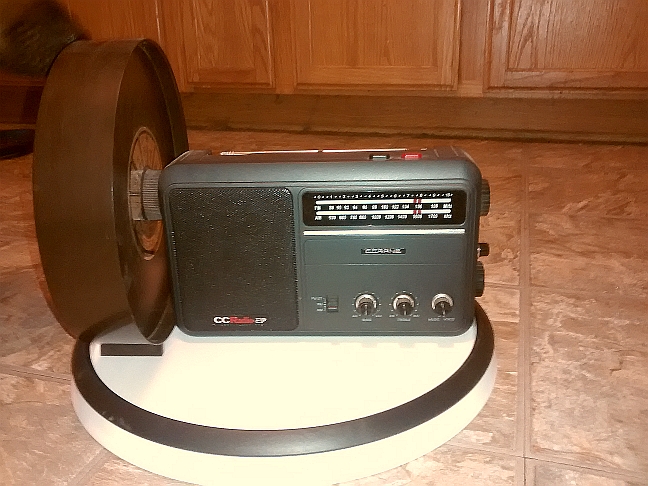
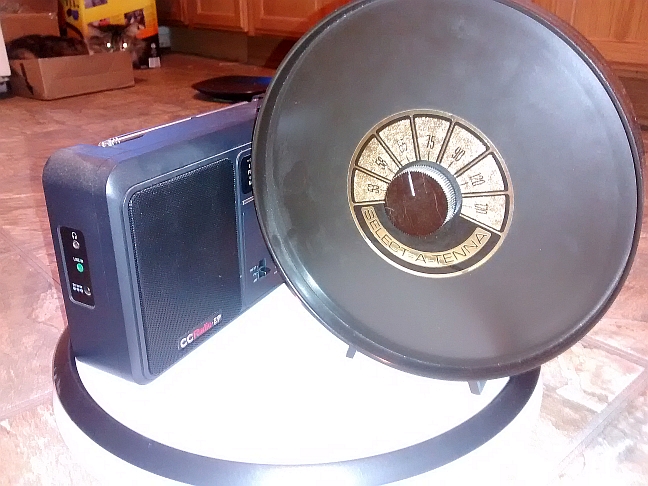
I recently purchased an Oxo Good Grips Turntable, 16” from Amazon. As the photos show, the size of the turntable can hold a fairly large radio (CC Radio EP and Select-a-tenna) on the turntable in almost any configuration. (Of course the CC Radio EP doesn’t need the Select-a-tenna, just used for illustration purposes for size.)
At $16.99 I think it is a good bargain, and seems quite capable of turning smoothly even with this amount of weight.
Many thanks, Robert! I think that turntable is large enough to hold pretty much any portable radio; thanks so much for the photos (especially the one your kitty cat photo bombed, above!). I have several OXO products in my kitchen and have never been disappointed with quality, so I expect this turntable will last you a very long time.
Readers: If you haven’t checked out Robert’s radio blog, All Things Radio, I encourage you to do so!
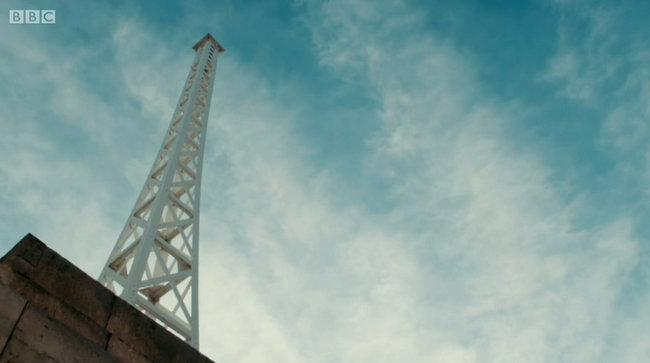
BBC director general, Tony Hall, said the corporation will become an “open BBC for the internet age”.
While Hall was quick to add that funding cuts would equate to “the loss or reduction of some services” he also highlighted several efforts that would include shortwave and mediumwave broadcasts, including:
“Significant investment” in the BBC World Service, including a daily news programme for North Korea and more broadcasts to Russia, India and the Middle East
A news service for Ethiopia and Eritrea on medium wave and short wave
Of course, we can expect more cuts to BBC World Service shortwave broadcasting over the next ten years even if it wasn’t specifically mentioned in Hall’s speech. If we’re lucky, the BBC will continue to broadcast into those parts of the world that still rely on shortwave. Specifically mentioning North Korea, Ethiopia and Eritrea appears to be a nod in that direction.
“Just a quick question to anyone at the SWLing Post:
Is the practice of sending a reception report to a AM broadcast station in return for a QSL card still accepted in the age of the internet ?
So many stations are broadcasting online now that I wonder if they have QSL cards at all?
I just want to keep up with the times and not bother busy people at radio stations and look out of date, yet at the same time would like to confirm report of reception.
Any information would be greatly appreciated.”
Thanks for your question, Paul! I’m no expert on AM broadcast QSLing, but I’m pretty sure many mediumwave stations still respond to listener reports. Indeed, I believe there are even radio enthusiasts who act as QSL managers of larger clear channel stations (CFZM comes to mind).
Readers: Can you help answer Paul’s question? Please comment. Also, if you have some AM broadcast QSL cards, please contact me as I would love to post some.
Tuning in: Making a small world bigger and the big one smaller
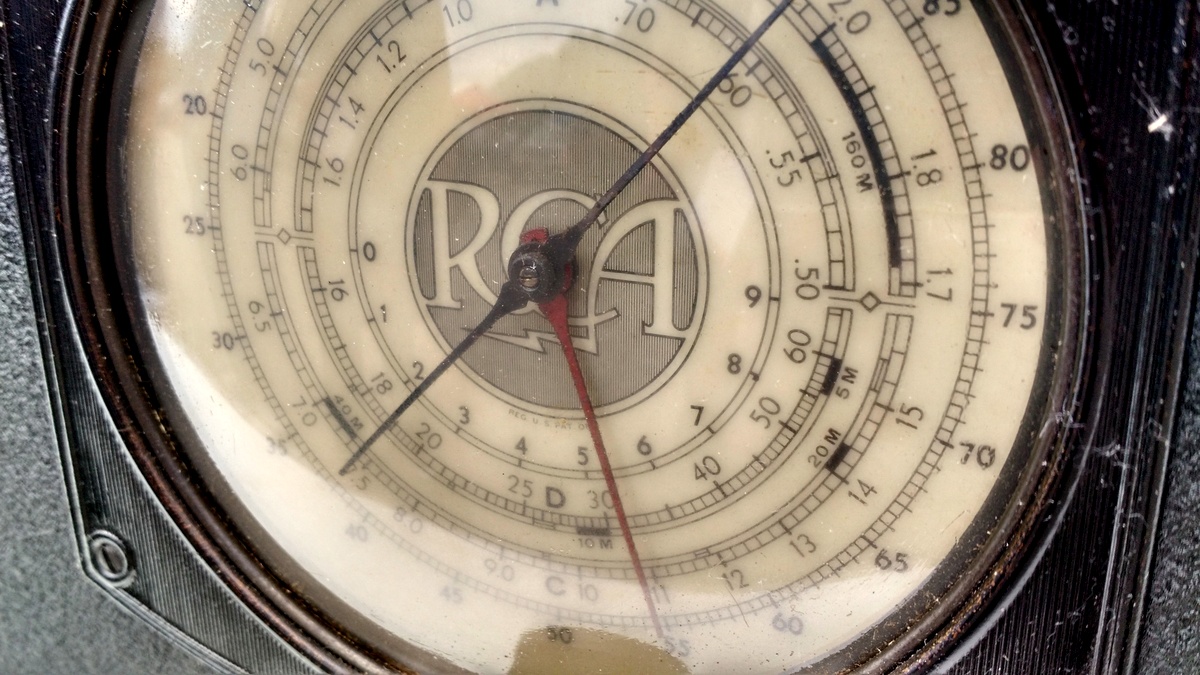
So much of happiness, I’ve realized, depends on getting tuned in. When he was a young married, my father used to tune in the console radio in the living room of the Krohe family mansion on Manor Avenue to the live broadcasts of big-band music “from the beautiful Blue Room in the Roosevelt Hotel” in downtown New Orleans. He was able to be in two places at once thanks to WWL-AM, whose 50,000-watt clear channel signal was beamed north. For all I know, while he tapped his toe on the sofa in Springfield, Inuit couples were jitterbugging on the tundra.
For Springfield teens in the 1950s and ’60s, getting a chance to listen to what kids in bigger cities had already decided they liked was important. WCVS-AM was just crawling out of its cocoon, having crawled into it as a country station and emerging as a rock station – although in the late ’50s there wasn’t that much difference. “Rock ’n’ roll” was, in stations like WVCS that catered to mostly white markets, rockabilly and pop-ish country ballads. (Geezers will recall when Brenda Lee was, briefly and laughably, marketed as a rock artist.)
For Top 40 music, as for so many other things, if you wanted to get the really good stuff you had to go to the big city. Around here that meant WLS-AM, WCFL-AM out of Chicago (whose Ron Britain made Soupy Sales look, or rather sound, like Noel Coward), and KXOK-AM out of St. Louis. George Lucas’s American Graffiti brilliantly captured the ways that car radios, transistors, radio stations blaring over PAs in drive-ins, permeated the bubble in which teenagers then lived.
Later I learned I could hear WBZ out of Boston if I acted as the antenna on my transistor. (“Turn on, tune in, drop out” to me meant losing the signal when I lighted a smoke.) WBZ was one of the first stations with the newest 45s from Britain, which allowed us yokels to hear The Yardbirds while the records were still on their way to Midwest stations by stagecoach from Boston harbor.
Many thanks to David Goren for sharing a link to this excellent map of Cuba mediumwave locations. Check out the map along with Bruce Conti’s list of frequencies, transmitter data and more at his website: http://www.bamlog.com/cubalist.htm
The BBC World Service has confirmed that MW transmissions to Israel and other parts of the Middle East will resume for 10hrs per day on 1323kHz starting on Friday 7 June.
This will give listeners breakfast listening and then drive-time and evening coverage from about 4pm to 10pm.
The morning hours are as 02:59:30 to 06:59:30 GMT and the evening schedule will be 12:59:30 – 18:59:30 GMT.
Steve Titherington, World Service Commissioning Editor, says: “We had a huge response to the end of MW transmissions in Israel and we are responding positively to listeners’ demands for a return to of the BBC broadcasts. Cutbacks mean we can’t return to a full day-long schedule, but we will broadcast at times when we hope audiences are most likely to listen. We want to thank our listeners for their feedback and would welcome any further comment they have about how suitable these new broadcasting times are for tuning into the BBC World Service.”
As previously announced four hours per day of World Service English will continue on 720kHz until 22:59:30 on 21 June.
A few years ago, I heard a lot of buzz in AM/Mediumwave radio circles about a small, inexpensive radio called the Sony SRF-59. Discussions were focused on the incredible performance of this diminutive low-cost radio and how it held it own against some real benchmark receivers. Out of curiosity, I did a search on the radio to see what it looked like–I expected some Tecsun PL-like unit–and found that, much to my surprise, it’s a simple, analog, totally unassuming AM/FM walkman. Say, what?
The far biggest surprise came with my price search, however. The SRF-59 is easy to find at $14.95 US. Really, you ask? Oh, yes–and it’s readily available at many online and big box stores.
So–carefully counting my pocket change–I took the plunge, and bought one.
The radio came in a basic plastic blister pack, and it also included headphones. I can’t comment on the headphones as I didn’t even bother unpacking them; instead, I plugged my new SRF-59 into my favorite Sony earbuds.
I have to admit, the AM band on this little radio does indeed shine. Not only is the receiver sensitive and relatively selective (meaning, I don’t hear adjacent signals when tuned in), but it also has excellent audio. Amazingly, it lives up to all of the praise I had heard about it. I’m quite amazed, in fact, at how well this little unit can null out stations by rotating the radio body a few degrees. Most impressive.
Though I’m no major FM radio listener, I can also vouch for its FM performance, which is quite good.
Pros:
lightweight–indeed, one can safely say, “ultralight”
very inexpensive, by comparision
operates almost indefinitely on one AA cell
simple design, durable construction
AM (Mediumwave) sensitivity and selectivity comparable to $100 shortwave portables
because tuning is analog, it works in North America just as well as in Japan (see cons)
Cons:
tuning is analog, thus no stations can be saved to memory and there is a noticeable amount of receiver drift if listening over long periods of time
no fine-tuning mechanism means that tuning in weak stations takes precision skill on the SRF-59’s very small dial
no built-in speaker (this is a Walkman, after all)
In summary, you will regret not purchasing this radio should Sony pull it from the market without warning. While it is a walkman with the above listed limitations, it’s nonetheless a first-rate AM/MW receiver and might be a great avenue into the fun hobby of ultralight DXing.
In short, the Sony SRF-59 is a real gem. But don’t take my word for it, either–go check one out for yourself!