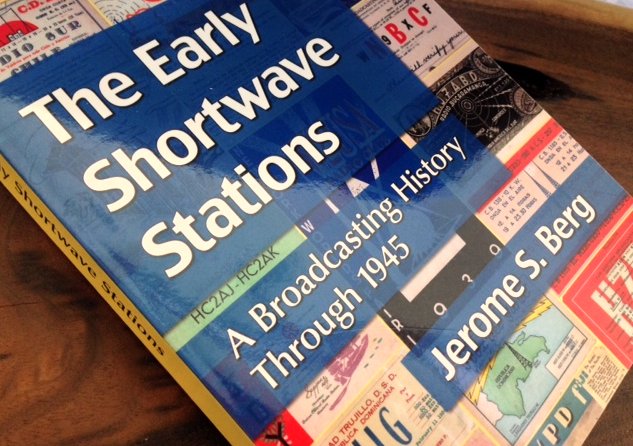
 As a life-long student of the history of technology–radio or otherwise–I appreciate well-written, authoritative works of history on the subject. That is exactly what you’ll find in Jerome S. Berg’s The Early Shortwave Stations: A Broadcasting History Through 1945. In these days during which shortwave is often viewed only as a legacy technology, it’s particularly fascinating to read about the days during which shortwave was new on the scene, exerting a disruptive influence, and threatening the established technology.
If you’re a shortwave radio enthusiast, you may already know of Jerome (Jerry) Berg; he is, without a doubt, one of the foremost historians of shortwave radio broadcasting and listening. His knowledge, moreover, grew out of his passion for the radio medium, and it shows in his writing. Berg has authored a series of history books on the subject on the subject of shortwave broadcast and listening, which this latest work joins:
I’m not sure how Berg manages to convey his vast store of knowledge in such a readable form, but he does so, and very successfully. As with the other works in this series, The Early Shortwave Stations is chock full of details all entirely relevant, and Berg manages to weave this complex and multifaceted history into a very comprehensive, comprehensible, and rich story that the reader will enjoy.
Moreover, I like the manner in which Berg presents the chapters in The Early Shortwave Stations: the first chapter sets the stage, covering radio broadcasting up to the point of the invention of shortwave; the chapters then coincide with a decade-by-decade account of shortwave broadcasting, e.g., chapter 2 covers the 1920s, chapter 3 the 1930s, and chapter 4 covers 1940-1945 (where Berg’s Broadcasting on the Short Waves, 1945 to Today picks up). Furthermore, each decade and chapter is covered year by year. This obviously makes for easy future reference: should you like to know was happening in shortwave broadcasting in 1931, simply turn to chapter 3 (page 82) to find out.
Berg also draws insightful conclusions in his summary and in chapter 5, which only made me want to buy his next volume, Broadcasting on the Short Waves, 1945 to Today.
I can say that I learned an extraordinary amount of radio history from The Early Shortwave Stations, and have enjoyed every minute of it. I’ve had this book for a little while now, and it soon became my bedside reading. Indeed, it’s been wonderful capping off each day (or even starting it) with early shortwave history. I find that it puts many of the changes that are happening in the industry currently into perspective.
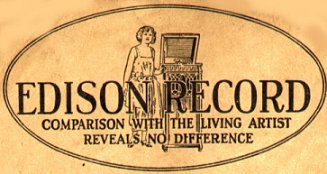
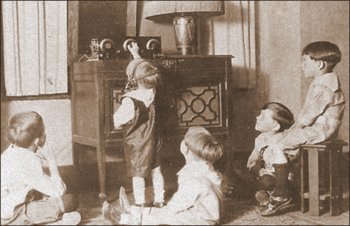
And I would be negligent if I didn’t mention the numerous illustrations and stunning images in The Early Shortwave Stations: there are enough QSL cards, radio ads, and other print nostalgia within its pages to make for good coffee table reading, too. Although its pages are printed in black and white, the photos and illustrations are sharp and of high quality.
The publisher of Berg’s books, McFarland–a leader in publishing academic and non-fiction works–prints in relatively small quantities, hence the price tag per volume is about $45.00. But I assure you that it’s a bargain for a book which so completely encapsulates early shortwave broadcasting history. It’s a book that you will likely want to reference, and (if you’re like me) not only read, but read again and again.
The real test? I’ve placed The Early Shortwave Stations on the same shelf with my WRTH.
The Early Shortwave Stations: A Broadcasting History Through 1945 can be purchased directly from the publisher, McFarland, by clicking here or by calling their order line (800-253-2187). I’m pleased to say that The Early Shortwave Stations is also available via the Amazon Kindle format at $16.12 US, possibly the best purchasing option for those living outside North America. Enjoy!
Jerry Berg also maintains the excellent website, On The Shortwaves. This one’s been in our list of links for many years, do check it out if you haven’t already.