Tag Archives: Radio History

George Stein’s connection to the 1906 Fessenden Christmas Eve broadcast

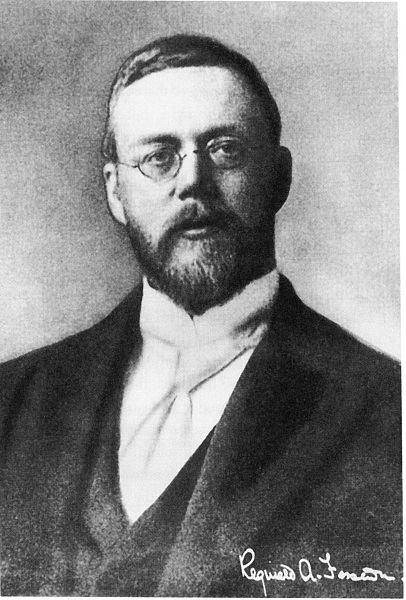
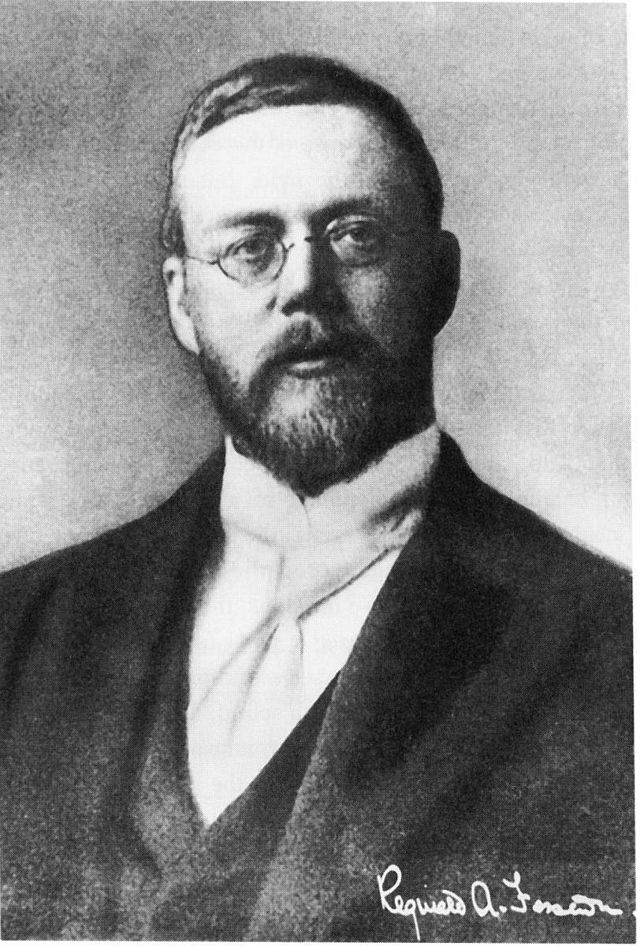
Reginald Aubrey Fessenden (October 6, 1866 – July 22, 1932)

Reginald Aubrey Fessenden (October 6, 1866 – July 22, 1932)

Some of you may recall that last year, I posted an announcement about WG2XFQ; this station annually airs Brian Justin’s longwave broadcast honoring Reginald Fessenden’s famous Christmas Eve’n 1906 AM voice transmission. I had been lucky enough to capture a recording of this commemorative event on WG2XFQ in 2013.

Just yesterday, I was contacted by SWLing Post reader, George Stein (NJ3H), who had just discovered my recording–and, in turn, shared his own recording of the WG2XFQ transmission. In George’s message, he casually mentioned that he has a close family link to the original Fessenden Christmas Eve broadcast, which I find of great interest. George writes:

“My grandfather, Adam Stein, Jr., was Fessenden’s chief engineer and was present for the Christmas Eve broadcast from Brant Rock, Mass in 1906. He is also mentioned in the Fessenden biography by Helen Fessenden, of which I have a copy…

In scientific journals from that time…it was reported that my grandfather’s voice was the first heard across the Atlantic (Machrahanish, Scotland) in Nov/Dec 1906. This occurred during testing at Brant Rock and was picked up by Fessenden’s man in Scotland.”

All I can say is, Wow! This is an amazing bit of history. Of course, I sent a reply to George asking for more information and permission to post this, which he kindly granted. George continues with an excerpt from S. Belrose, Communications Research Centre Canada:

“In November 1906, Fessenden and colleagues were conducting experimental transmissions using his newly-developed HF alternator, between stations at Brant Rock and Plymouth, Massachusetts. The station at Brant Rock was modulated by a carbon microphone connected in series with the antenna lead.

About midnight, on an evening early in November, Mr. Stein was telling the operator at Plymouth how to run the dynamo. His voice was heard by Mr. Armor at the Macrihanish, Scotland station with such clarity that there was no doubt about the speaker, and the station log book confirmed the report.

Fessenden’s greatest triumph was soon to come. On 24 December, 1906, Fessenden and his assistants presented the world’s first radio broadcast. The transmission included a speech by Fessenden and selected music for Christmas. Fessenden played Handel’s Largo on the violin. That first broadcast, from his transmitter at Brant Rock, MA, was heard by radio operators on board US Navy and United Fruit Company ships equipped with Fessenden’s radio receivers at various distances over the South and North Atlantic, as far away as the West Indies. The wireless broadcast was repeated on New Year’s Eve.”
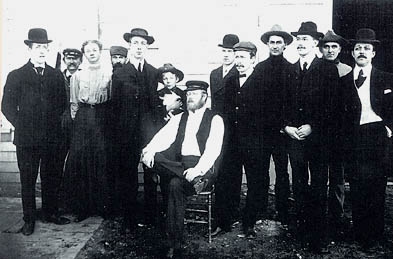
Fessenden Staff Brant Rock

The Brant Rock staff and operators: Fessenden is seated in the middle and to his right is his son (Reginald Kennelly), holding Mikums, his cat. Mr. Pannill is on the far left. Standing next to him is Jessie Bent, the secretary. Mr. Stein is on the far right. (Radioscientist)

[Above] A picture of Fessenden’s team at Brant Rock, Mass in 1906.  Radio pioneer Charles Pannill is shown in the picture.  My grandfather, Adam Stein, Jr., who was Fessenden’s chief engineer, is also shown in the picture.
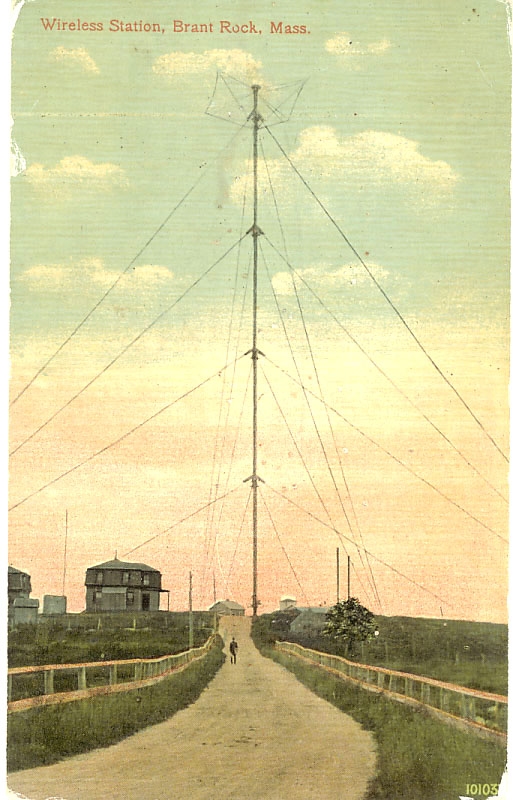
A postcard showing Fessenden’s wireless antenna in 1906 at Brant Rock.

A postcard showing Fessenden’s wireless antenna in 1906 at Brant Rock.

George continues:

In December 2006, a special event amateur radio station, W1F, was on the air from Brant Rock to commemorate 100 years since Fessenden’s Christmas Eve and New Year’s Eve broadcasts. Stephan Barreres, K2CX, put a team together for the special event. I was fortunate to be included with the fine team he had assembled.

All that remains of the Fessenden antenna is the tower base.
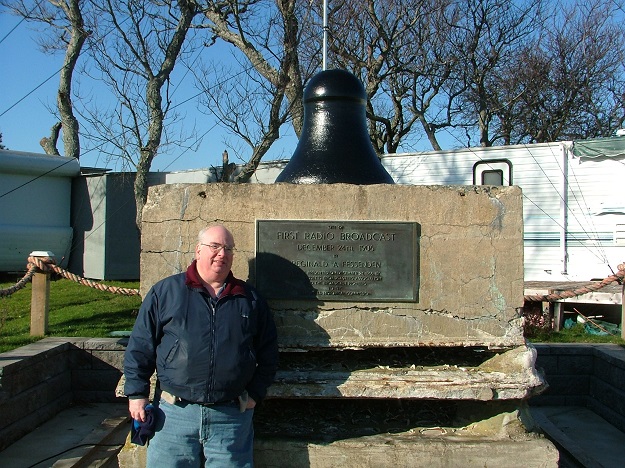
Tower Base

The picture was taken in Dec 2006, with NJ3H standing in front.
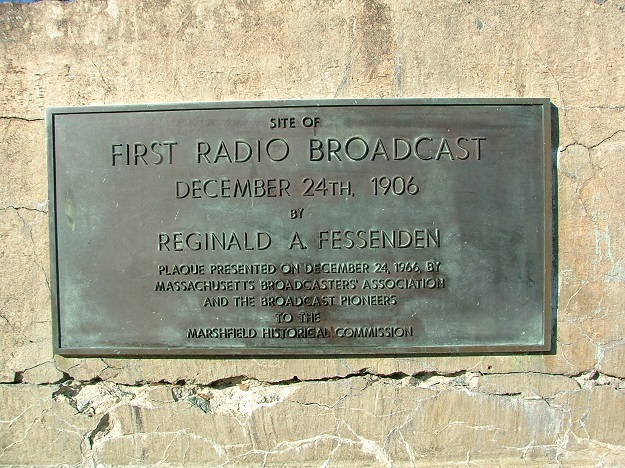
Plaque

The plaque on the base was provided on the 60th anniversary of the 1906 broadcast.
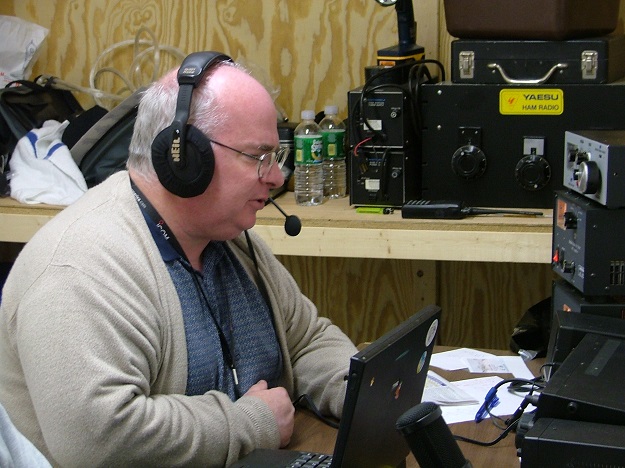
NJ3H at the operating position of W1F, 30 December 2006

NJ3H at the operating position of W1F, 30 December 2006

The following is George’s audio and screen cast while he received the Christmas Eve reenactment broadcast on 25 December 2013; WG2XFQ broadcast from Forest, VA by WA1ZMS, this recording was made by George in Stephens City, VA on a Microtelecom Perseus SDR and a Wellbrook loop.

For those of you not familiar with Reginald Fessenden, I encourage you to read about him;  he was a Canadian inventor who performed pioneering experiments in radio, including the use of continuous waves (CW) and the early—and arguably the first—radio transmissions of voice and music.  Check out some of our archived posts on Fessenden and read more about him at this online Fessenden museum.

George, again, many thanks for sharing a little history about your grandfather and your own way of honoring his work.
Jonathan reminds us that history keeps repeating itself

1-RadioListening2Current events in the Ukraine and Crimea remind Jonathan Marks that history–especially as broadcast over the airwaves–repeats itself:

“History keeps repeating itself, both on the ground and on the radio. The theatre going on in Crimea and Ukraine at the moment remind me of other situations. But there is a difference. The programmes below [click here] were all made when the Russian’s had an external broadcasting service called Radio Moscow, later renamed as Voice of Russia. Just as Voice of America shouted at the Russia, so Voice of Russia shouted back.”

Continue reading Jonathan’s full article, complete with audio and video clips, on his blog Critical Distance.

More 1968 recordings on the Shortwave Radio Audio Archive

IMG_0135I’ve now added a total of five recordings by David Firth, circa 1968, to the SW Radio Audio Archive. Click below for direct links:

Note that you can subscribe to the SW Radio Audio Archive as a podcast via iTunes or by using the following RSS feed: http://shortwavearchive.com/archive?format=rss

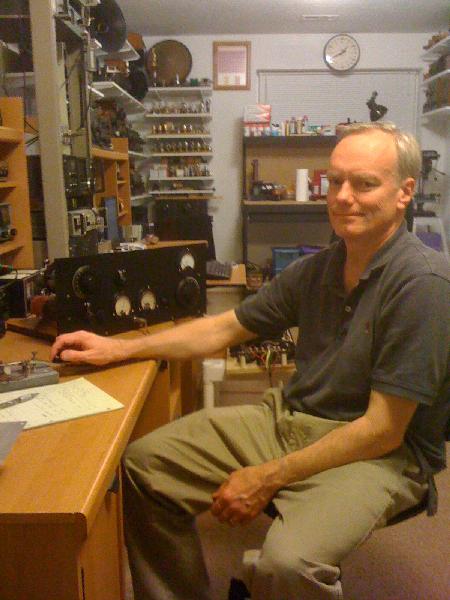
WAMU Metro Connection visits the Mid-Atlantic Antique Radio Club

MAARC-ClubMany thanks to SWLing Post reader, Paul, who points out this episode of WAMU’s Metro Connection where reporter Rebecca Sheir visits the Mid-Atlantic Antique Radio Club (MAARC).

You can listen the report on Metro Connection, or simply click here to download the whole podcast (MAARC is the first piece).

Click here to check out the MAARC website.

Longwave Radio Recordings: WG2XFG

Brian Justin with his homebrew transmitter (Source: http://w4dex.com/500khz/wd2xsh31.htm)

Brian Justin with his homebrew transmitter (Source: http://w4dex.com/500khz/wd2xsh31.htm)

A few weeks ago, I posteded an article about Brian Justin’s holiday longwave broadcasts commemorating Reginald Fessenden’s Christmas Eve 1906 AM voice transmission.

I don’t spend a lot of time in the longwave portion of the radio spectrum, so this special event station gave me an excuse to venture a little lower on the radio dial.  Fortunately, LW propagation was in my favor, and Justin’s signal made it the 215 miles to my home. While it’s not armchair listening, it’s most impressive, especially considering the transmitter used is “home-brewed” with modest output power.

This recording of WG2XFG was made when the signal seemed to be at its strongest on December 26th, 2013 starting around 12:40 UTC (Christmas evening, EST). Click here to download the recording as an MP3, or simply listen via the embedded player below:

WG2XFQ: Brian Justin’s holiday longwave broadcasts

Reginald Fessenden: "The Father of Radio Broadcasting" (Source: Wikipedia)

Reginald Fessenden: “The Father of Radio Broadcasting” (Source: Wikipedia)

SWLing Post reader, Tom, recently shared a link to an article on the ARRL news page which describes this annual longwave broadcast:

“As he has over the past several years, Brian Justin, WA1ZMS/4 — an active participant in the ARRL’s WD2XSH 600 meter experimental project — will transmit voice and music on 486 kHz as WG2XFQ on Christmas Eve and Christmas Day and again on New Year’s Eve and New Year’s Day. Transmissions will begin at 0001 UTC and end at 2359 UTC.

Justin, who may be better known for his microwave exploits on ham radio, will use an AM audio loop modulating his vintage-style, homebrew transmitter to honor Reginald Fessenden’s Christmas Even 1906 AM voice transmission.”

Since I’m a sucker for radio history, I contacted Brian Justin and he kindly answered a few questions:

Brian Justin with his homebrew transmitter (Source: http://w4dex.com/500khz/wd2xsh31.htm)

Brian Justin with his homebrew transmitter (Source: w4dex.com)

SWLing: How did you first become interested in longwave (LW)?
Justin: Always had an interest in history of radio since becoming a ham at age 11. Early wireless had emphasis on LW and so it was a good trail to follow in my years as a ham.

SWLing: Is the process of getting a license to broadcast complicated?
Justin: Yes and No. What I hold is not a broadcast license as a TV or FM or AM station would have. I hold an FCC Part 5 license which is for The Experimental Radio Service. The LW and MF spectrum is formally US Govt spectrum that is managed by the NTIA (the US Govt Agency version of the FCC). So before the FCC can issue any license that is in non-FCC regulated bands the NTIA must first approve any license Grant. A good number of people who are involved in radio today don’t always understand the difference between FCC and NTIA spectrum. But licenses can be granted if you have the willingness to wait and know how the application process works. It’s not all that difficult once you know the context of what one is asking for.

SWLing: What is the best time to listen for WG2XFQ and how can listeners improve their chances of hearing you?
Justin: The transmissions are only a few times each year to mark historical dates in radio history. I try to make at least two each year, one for Fessenden and one for the Berlin Radio Treaty. I also ran one on the 100th Aniv of the sinking of the Titanic since wireless played a big role in the tragic event.

A loop antenna is a good antenna to try as one can at least null any loud noise source. But simple E-field probe antennas have worked for many in years past.

Anyone who copies WG2XFQ is encouraged to submit a logging of it at 500kc.com.

Thank you and good DX to all this Holiday Season. I hope I can deliver a tiny DX gift to all if the band is in good condition this year.


Many thanks, Brian!

I will be listening for WG2XFQ on 486 kHz on December 24th and 25th, then again on December 31st and January 1st. With any luck, and if conditions are favorable, perhaps I’ll hear a little longwave DX commemorating Reginald Fessenden’s Christmas Even 1906 AM voice transmission.

Readers, be sure to check out Brian Justin’s web page and the ARRL 600 meter experimental group’s website. Please log your WG2XFQ listener reports at: 500KC.com

If you would like to learn more about Reginald Fessenden, check out Fessenden.ca.

Whether fearsome or forgettable, The War of the Worlds left us with a gift

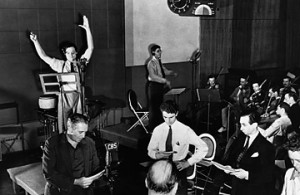
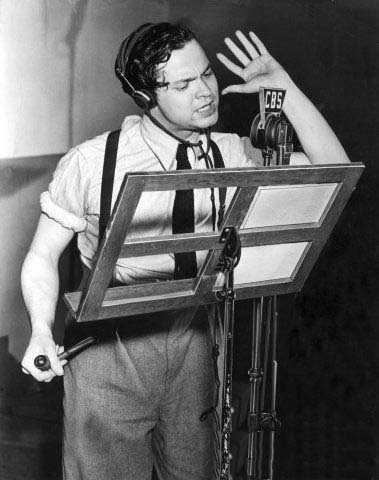
orson_wellesWithout a doubt, one of the most famous broadcasts in radio history––indeed, in American history––was Orson Welles’ radio production of the H. G. Wells’ classic sci-fi novel, The War of the Worlds.  A Halloween radio drama from the The Mercury Theatre on the Air series from the Columbia Broadcasting System (CBS)The War of the Worlds aired on October 30, 1938–exactly 75 years ago, today. And it’s still creating a stir…
Memorable legend?

The Welles’ production of The War of the Worlds invariably receives a side note or breakout in US history texts because of the unprecedented panic it incited in unsuspecting radio listeners during the tense period just prior to World War II, when radio was truly king of mass media and information.  Listeners reportedly took to the streets upon hearing the Mercury Theatre’s seemingly credible “accounts” of monsters from Mars invading New Jersey.

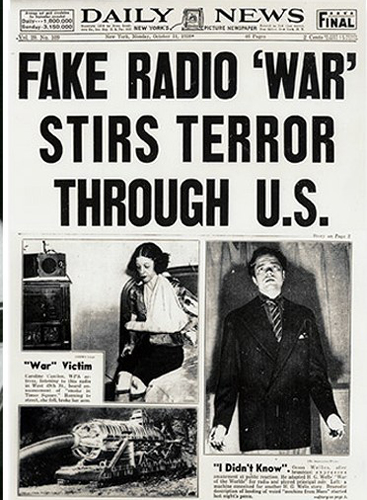
dailynews-WOTW-PanicBecause many listeners tuned in the production without hearing the Welles’ introduction to the drama, they heard what sounded like a live news report of Martians attacking our planet.  While it seems dubious today, what made Welles’ production so convincing was his innovative use of mock news breaks, and what listeners described as a “deafening” silence after a supposed “eyewitness report.” It sounded, in short, terribly authentic, and therefore convincing.

Few believe Welles was intentionally trying to trick his audience; rather, sources suggest he was attempting to treat his listening audience by infusing what would have otherwise been a fairly staid radio drama with imagination, creating a captivating thriller.

The result? By most accounts, Welles’ succeeded. Without doubt, The War of the Worlds propelled this young theatrical director into the public spotlight, onto the big screen, and made his name known the world over.

Last night I had the pleasure of viewing a brilliant documentary about The War of the Worlds on PBS’s American Experience. It told, in detail, of the events leading up to the production, the very convincing reasons why it had the impact it did, and offered entertaining listener accounts from letters sent to CBS. If you missed it,  you can watch it, too, by clicking here.

NPR’s RadioLab also devoted their most recent show to Welles’ production of The War of the Worlds. You can listen to their broadcast on their website, or via the embedded player below:

…Or forgettable myth?

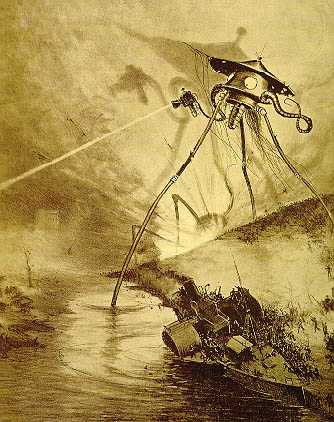
War-of-the-worlds-tripodThen this morning, I read a rather provocative article by  and  in Slate; their mutinous view of the impact of Welles’ The War of the Worlds broadcast flies in the face of the American Experience and RadioLab documentaries and, indeed, every history textbook which devotes space to Welles. These authors claim:

“The supposed [War of the Worlds] panic was so tiny as to be practically immeasurable on the night of the broadcast. Despite repeated assertions to the contrary in the PBS and NPR programs, almost nobody was fooled by Welles’ broadcast.”

The authors go on to explain that the myth of Welles’ mass hysteria was fabricated:

“How did the story of panicked listeners begin? Blame America’s newspapers. Radio had siphoned off advertising revenue from print during the Depression, badly damaging the newspaper industry. So the papers seized the opportunity presented by Welles’ program to discredit radio as a source of news. The newspaper industry sensationalized the panic to prove to advertisers, and regulators, that radio management was irresponsible and not to be trusted.”

I encourage you to read the full Slate article, however, as it goes into much greater detail supporting the author’s assertions, which I find both logical and compelling.

But that’s not all.  This afternoon, while writing this post, NPR published a new article about The War of the Worlds, highlighting the Slate piece and the American Experience and RadioLab productions, but drawing no conclusions of their own. Click here to read the full NPR post.

Strangely, nothing I’ve read so far about The War of the Worlds mentions what I feel to be most obvious.

So, what came of it?

welles-war-of-the-worldsI believe Welles’ controversial radio production did something for radio listeners regardless of the level of panic it may––or may not––have engendered. Welles’ Halloween production left them (and us) with a gift. How so?

Prior to the dense radio propaganda surrounding World War II, The War of the Worlds undoubtedly made radio listeners, from that point forward, seriously question what they were hearing over the air. It forced them to listen with a skeptical ear, to realize that no matter how “real” a report might sound, not to assume its authenticity just because it was broadcast on the radio––or, for that matter, printed on the page of a newspaper. This was to become an invaluable tool in the coming days of American involvement in the war, especially for GIs desperate for news from the home front while propaganda seized the media.  Whether during Welles’ thrilling production or in the news frenzy that followed,  radio’s power had been publicly highlighted, and that power was sure to have an enormous impact on the coming world war.

In conclusion, perhaps we need another such event in this age of television and Internet. All too many people no longer question what they see, read, or hear from either source; these readers/viewers accept reporting of any stripe with blind faith, swallowing news bites and opinion pieces like digital candy. Then they tweet…and re-tweet.

Indeed, this is a common complaint I hear from many shortwave radio listeners.  I suspect this is because we, in contrast, tend to be motivated by hearing the many differing voices on the air and allowing our grey matter––our brains––to discern fact from fiction.

We owe Welles a debt of gratitude.

But don’t take my word for it…

RadioListeniningRegardless:  whether Welles created widespread or merely local panic, or whether you even buy my theory that this production taught us to question what we hear, it’s difficult to deny that the Orson Welles’ production of The War of The Worlds was a brilliant, ground-breaking radio drama.  And, I would add, great seasonal entertainment. Fortunately for us, almost 75 years later (nearly to the minute!), we can listen to archived recordings of the original CBS production.

If you would like to hear the original, simply click here to download the broadcast as an MP3, or listen via the embedded player below.

Happy Halloween!  Enjoy (and keep your hat on, folks):