Tag Archives: SDR

Recording the 2014 World Cup Final

WorldCupBall-001Sunday was the FIFA World Cup Final, and not only was I looking forward to the game, but (to tell the truth) I was also looking forward to recording the game via the BBC World Service for the Shortwave Radio Audio Archive. Due to the BBC WS cuts, part of me fears this may be a last chance to capture this radio and sports history.

If you would like to hear the recordings of the World Cup Final, skip to the bottom of this post. But if you want to know how I managed to make the recordings, and why I made the choices I did, feel free to continue reading…Warning: full-on radio geek tech ahead!

Making the recording

I had two SDRs (software defined radios) at my disposal: the Elad FDM-S2 and my trusty WinRadio Excalibur.  To record this match, I choose to use an SDR rather than a tabletop receiver for several reasons, namely:

  1. I wanted to make a spectrum recording so that I could record more than one frequency at a time;
  2. SDRs make recording radio content on the fly much easier than using a tabletop receiver, which must be connected to an external audio recorder, and I wanted ease of use so I could enjoy the game, too.

Propagation was rather mediocre Sunday, and there were only three feasible BBC World Service English frequencies I could tune in mid-afternoon, none of which, of course, were targeting North America:

  • 11,810 kHz from Ascension Island
  • 13,660 kHz from Woofferton, UK
  • 15,400 kHz from Ascension Island
  • 9,915 kHz from Woofferton, UK (starting at 20:00 UTC)

My hunch was that either 13,660 or 15,400 kHz would be my best bet for the early part of the match (pre-game starting at 18:30 UTC, half time at 20:00 UTC), however, I knew they would drop off after the first half of the game. And 11,800 kHz would be my best bet in the latter part of the game, unless 9,915 kHz happened to be stronger.

In the past, 11,800 had served me quite well for afternoon BBC listening, but yesterday there was an unscheduled religious broadcaster on 11,825 that was causing interference a full 30 kHz on either side of their carrier! During my pre-game check of the frequency, each attempt I made to block this broad interference was unsuccessful–very frustrating.

Which SDR?

The FDM-S2 is a fine SDR, and I was very tempted put it to the test.  But while the Elad FDM-S2 is quite capable of making very wide spectrum recordings (up to 6 MHz) and could easily record all four frequencies on four different meter bands at the same time, I decided to use the WinRadio Excalibur, instead.

Why? If 11,800 kHz was my only viable frequency option in the latter half of the game, I needed a receiver that could sync to the less noisy lower sideband of 11,800 kHz. While Elad plans to add USB/LSB selectable synchronous detection in the next version of their SDR application, it currently does not have this capability.

I suppose, too, I feel more comfortable with the WinRadio Excalibur; I’ve been using it now for well over two years. If something were to go wrong during the broadcast, I knew I could diagnose it quickly on the Excalibur.

In addition, the Excalibur can do both a spectrum recording and up to three individual AF recordings at the same time (though limited within a 2MHz bandwidth). I’m not sure if Elad has plans for this in their next SDR.

Setting up the Excalibur

The Excalibur only has a 2 MHz bandwidth for spectrum recordings. I knew if I focused on the middle frequency of 13,660, I would be able to record it and either 15,400 or 11,810 at the same time, but not all three.

The first half of the match, I recorded both 13,660 kHz and 15,400 kHz in a 2 MHz wide spectrum recording. At the same time, I recorded the audio (an AF recording) from 13,660 kHz, which was consistently the stronger of the two frequencies.

Half time

By 20:00 UTC, I knew both 13,660 and 15,400 kHz would stop transmitting and I would need to either hop to 11,810 kHz or 9,915 kHz.

While maintaining a good audio recording of 13,660, I stopped the 2 MHz spectrum recording and moved it to encompass 13,660 and 11,810 kHz. A quick check proved that 11,810 was the strongest station. Fortunately, the interference above 11,810 had quieted somewhat at that point, and by using the LSB sync lock, this noise was successfully mitigated a bit.

Still, I could hear a chuffing sound coming from the splatter 11,825 was producing. So I enabled the notch filter and widened it to 2 kHz. By shifting it around in the upper side band, I was able to find the “sweet spot” where most of the splatter noise was canceled. I then started the audio recording on 11,810 a few minutes prior to 20:00 UTC, making a little audio overlap with simultaneous recording on 13,660.
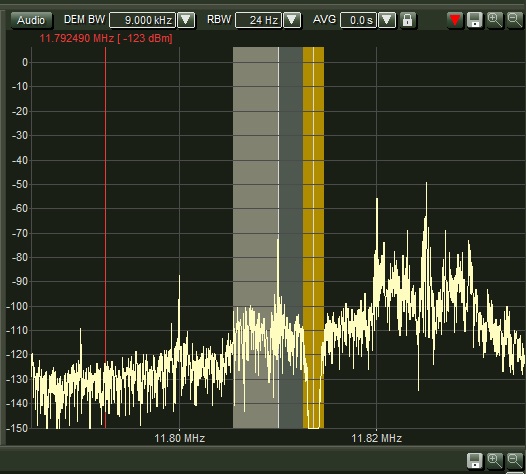
Syncing on the lower sideband and using the notch filter in the upper sideband mitigated most of the interference.

Syncing on the lower sideband and using the notch filter in the upper sideband mitigated most of the splatter interference.

In the end, I was very pleased with the results of the recordings. While capturing the BBC World Service isn’t exactly like snagging rare DX, I felt I had a lot riding on this recording, so pre-game preparations were necessary, especially since the Excalibur couldn’t record spectrum from 9,915 to 15,400 kHz.

And in theory, had I used the Elad FDM-S2, I could have recorded the entire chunk for three hours and then revisited the material later to make audio recordings from the AF.

The recordings

For your listening pleasure: the full 2014 World Cup final via the BBC World Service. This broadcast is broken into 3 sections: pre-game and the first half, second half, and extra time. Enjoy!
Pre-game and first half (13,66o kHz):

Second half (11,810 kHz):

Extra time and game wrap-up (11,810 kHz):

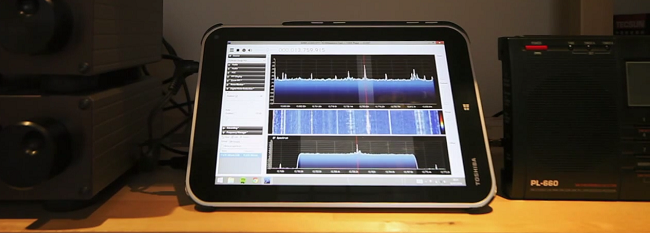
SDR# on a Toshiba Encore tablet PC

SDRSharp-ToshibaEncore-LondonShortwaveSWLing Post reader London Shortwave recently moved the Software Defined Radio (SDR) application SDR# (“SDR Sharp”) off of his MacBook Pro and onto a Toshiba Encore 8″ tablet PC. He recently posted this video of SDR# running his FunCube Dongle Pro+ on the Toshiba Encore tablet:

His reception of the Voice of Korea’s Spanish service is most impressive, especially considering the high level of RFI (radio noise) he must cope with at his home in London, England.

Click here to follow London Shortwave on Twitter.

SDR# now has AM synchronous detection

LondonShortwave-Park

SWLing Post reader, London Shortwave writes with a remarkable story about the free SDR application, SDR#(or, “SDR sharp”). He writes:

“Two days ago, I emailed Youssef (SDR# developer lead) to ask if he would consider adding synchronous AM detection to his software at some point.

To my great surprise he e-mailed me back the same day and told me that it wouldn’t take him long to write the necessary code. A few hours later he sent me a preview copy of the software with the feature included (all I had to do was to swap one .dll file in the version I had installed at the time). The following day, he integrated it into the latest release!

With the new sync detector the software is rapidly becoming my favourite SDR application.

Here’s a demo video I made for Youssef (and everyone else!) to show how I’ve been getting on with it:

This is amazing–what’s especially impressive is that a first iteration of AM sync should be so well implemented.  I love the way you can use the IF shift to block out interference within a sideband, much like USB/LSB selectable sideband. There are paid and OEM SDR applications that can’t do this.

London Shortwave: you’ve convinced me to see if SDR# will drive any of my receivers. Many thanks!

Testing SDR#’s noise reduction in a London park

LondonShortwave-ParkSDR

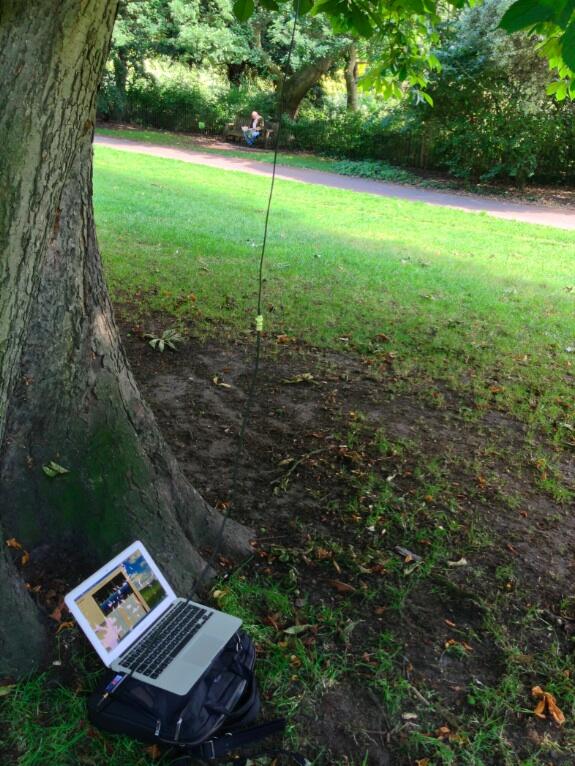
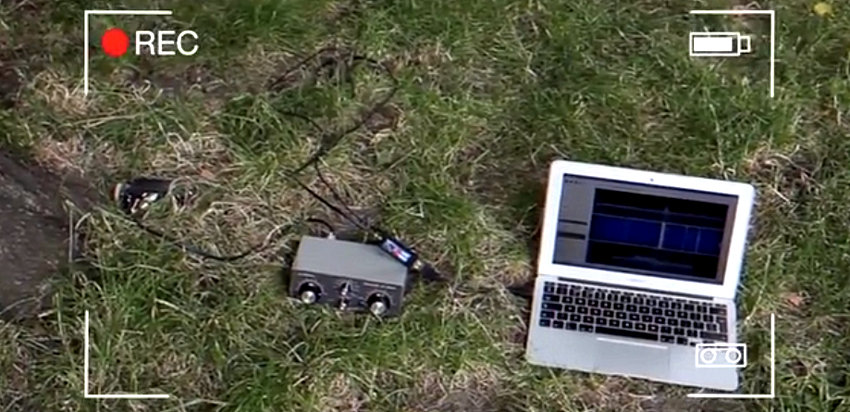
Yesterday, SWLing Post reader London Shortwave took his laptop, FunCube Dongle Pro+, and 6 meter long wire antenna to a local park where he tested SDR#‘s new IF noise reduction.

He made the following screencast/video where he toggles the IF noise reduction feature while receiving the BBC World Service’s Pashto language service on shortwave:

Most impressive! Indeed, I believe SDR#’s noise reduction might rival that of OEM applications. While I’m not the biggest fan of noise reduction for everyday use (due to inherent digital artifacts) it is a valuable tool when noise levels are high.

 Click here to follow @LondonShortwave on Twitter.

If you would like to experiment with SDR#, click here to download your free copy. SDR# has a number of additional plugins and dedicated users/developers who communicate via this this Yahoo! Group.

Many thanks to @LondonShortwave.

Any other readers using SDR#? Please comment.

Looking forward to the 2014 Dayton Hamvention and FDIM

Each year, I attend the Dayton Hamvention and much of the QRP conference, Four Days in May.  This year, I’ll be working our Ears To Our World table again, along with other volunteers, at booth 411 in the Ball Arena (BA411). Please stop by and introduce yourself!

What I love about the Hamvention (besides the massive outdoor flea market) is that it is a one-stop-shop for innovations appearing in our radio world.

Here are a few of the companies I’ll be following at the Hamvention this year:

Ten-Tec

Ten-Tec-AlphaTen-Tec announced yesterday that it will merge with Alpha Amplifiers under the flag of RF Concepts. I plan to stop by Ten-Tec’s booth Friday and learn more about the merger. Personally, I believe the merger with Alpha Amplifiers is a good move. Both of these companies are known for great customer service and quality US-based design and manufacturing.

I know Ten-Tec is introducing a new open-source product to their line, the Patriot, because I’ve been beta testing one (check QRPer.com for details later this week).

Icom

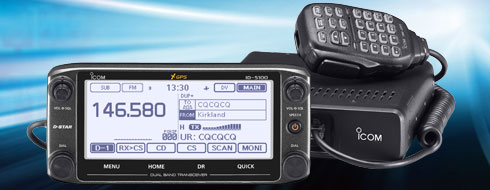
Icom-ID-5100Icom will showcase their new ID-5100 D-star, dual band, mobile with built-in GPS. While I’m more of an HF guy, this radio does intrigue me. You see, for almost one year now, I’ve been very pleased with my Icom ID-51A, dual-band, D-Star handie talkie (HT).

I find D-Star to be a very flexible digital mode and I’m amazed with how many interesting mom-and-pop companies have produced products for the D-Star mode. I’m surprised neither Yaesu nor Kenwood has adopted the D-Star standard (it’s not proprietary to Icom–indeed, read about the CS7000 below).

The new ID-5100 is a mobile version of my ID-51a. What I love about this radio is that it can store repeater frequencies and dynamically load them based on your geographic location. Perhaps my largest gripe with mobile VHF/UHF rigs is their inability to adapt to the repeater “landscape” when you travel. The ID-5100 may change this and push other manufacturers in the same direction.

Connect Systems

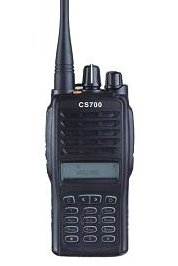
CS700_WEBIn less than a year, Connect Systems has become a household name among ham radio enthusiasts who love VHF/UHF and digital modes.

This Connect Systems is developing an HT–the CS7000–which will be the first non-Icom radio to have the D-Star digital mode. Whatsmore, in addition to D-Star, the CS7000 will also pack DMR.

I don’t think Connect Systems will have a working prototype at the Hamvention (I could be wrong), but there is a possibility that they will be taking early orders.

Elad

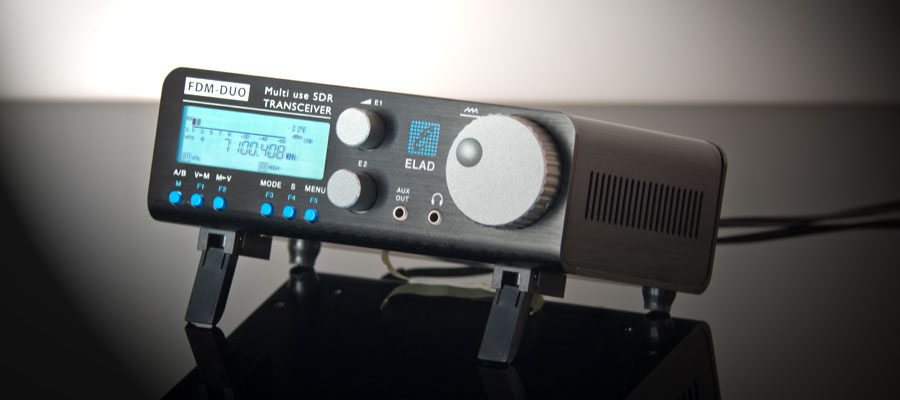
FDM-DUO-openingI’ve been intrigued by the Elad line of Software Defined Recievers. This year, they will attend the Dayton Hamvention. I look forward to checking out the new FDM-DUO tabletop SDR. I plan to review some of the Elad product line in the near future.

Palstar

Last year, Palstar showcased a prototype QRP transceiver with touch screen interface. To my knowledge, this would be Palstar’s first transceiver (though they’re well known for antenna tuners and their shortwave radio receiver, the R30A).

Last year, I was told that the new Palstar transceiver would be available this year and would retail between $1,600 – 2,000 US (a rather steep price for a transceiver with 20 watts output). One of the transceiver’s designers assured me that the receiver would “be worth the price.”

Bonito

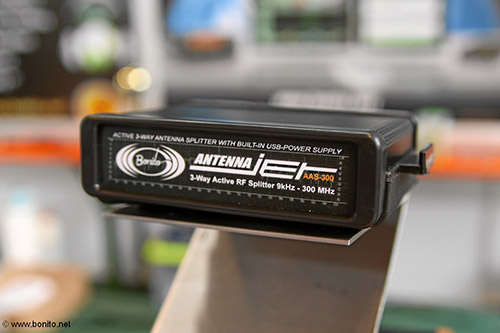
antennajet_front_hamradio2013I’ll stop by Bonito’s booth to check out their new AntennaJet ASM300.  I’m curious how it works and what the Hamvention price will be.

Though pricing is a little steep, I might bring one home as I often would like to share one antenna with two receivers simultaneously.

Elecraft

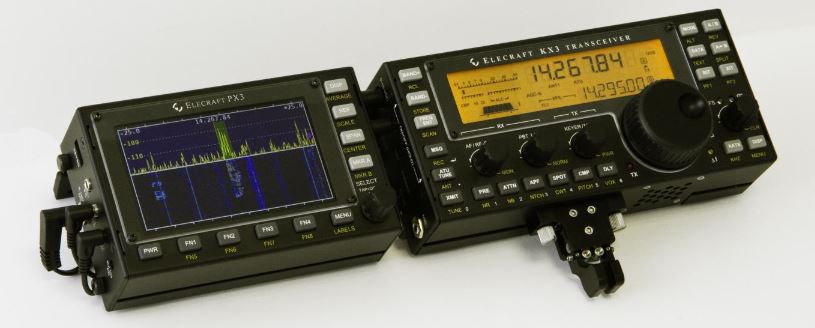
PX3The only new product I know of from Elecraft is the PX3 Panadapter for their Kx3 transceiver. Reviews of the larger P3 Panadapter for the Elecraft K3 are excellent, so I imagine this will be a great product. I hope to check out the PX3 at the Elecraft booth–I believe they’ll have a prototype on display.

SDRs

For the past three years, the market for software defined radios has been growing rapidly. I’ll be on the lookout for anything new–especially improvements on current 3rd generation SDRs.

Did I miss something?

Please comment if there’s something you’d like me to check out at the Hamvention–I’ll try to include it!

Again, if you’re attending the Hamvention, please stop by and introduce yourself at our booth: 411 in the Ball Arena (BA411).

Cross Country Wireless introduces an HF Upconverter

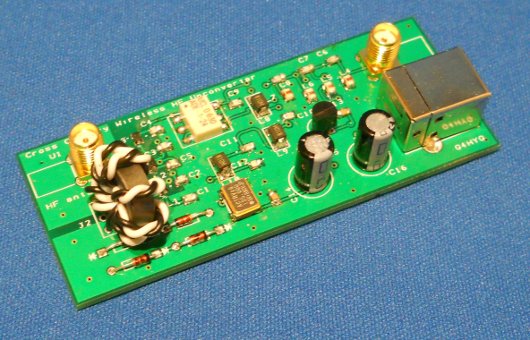
The CCW HF Upconverter (Photo: Cross Country Wireless)

The CCW HF Upconverter (Photo: Cross Country Wireless)

(Source: Southgate ARC)

Cross Country Wireless have just released a HF Upconverter. This will allow HF or VHF SDR receivers such as the RTLSDR dongles, Funcube or our own SDR-4+ receiver to work on HF, LF and VLF.

Unlike other upconverters currently available we have added the RF protection features from our SDR-4+ receiver including an antenna isolation transformer and RF over-power protection. This protects the SDR receiver or dongle and the attached PC from damage caused by static electricity charges on the antenna or nearby high power transmitters.

There are two versions of the Upconverter. One has a 125 MHz local oscillator and the frequency range is 12 kHz to 45 MHz. This is intended for use with the RTLSDR and Funcube dongles.

The other version has a 10 MHz local oscillator and is designed for use with the SDR-4+. This has a frequency range of 12 kHz to 1.6 MHz.

Here are some of the specifications Cross Country Wireless  has published for the HF Upconverter:

Technical data – 125 MHz version for RTLSDR and Funcube dongles

  • Frequency range: 12 kHz to 45 MHz
  • Input impedance: 50 ohms
  • IF rejection: > 60 dB
  • Local oscillator frequency: 125 MHz
  • Local oscillator level at antenna socket: < -50 dBm
  • Gain: -6 dB
  • RF connectors: SMA female
  • Power connector: USB B

Technical data – 10 MHz version for SDR-4+ receiver

  • Frequency range: 12 kHz to 1.6 MHz
  • Input impedance: 50 ohms
  • IF rejection: >100 dB
  • Local oscillator frequency: 10 MHz
  • Local oscillator level at antenna socket: < -60 dBm
  • >Gain: -6 dB
  • RF connectors: SMA female
  • Power connector: USB B

Also, from CCW on YouTube:

“This is a video of a Cross Country Wireless HF Upconverter used with a CCW SDR-4+ receiver to listen to VLF and LF transmissions using a half wave dipole cut for the 80m amateur band.”

(Click here if you are unable to view the video above.)

There are 20 second samples of the following stations:

  • BBC Radio 5 Live on 693 kHz AM
  • BBC Radio 4 on 198 kHz AM
  • GYN2 Skelton on 81 kHz FSK
  • MSF Anthorn on 60 kHz time signal
  • GQD Anthorn on 22.1 kHz Anthorn
  • GQD Anthorn on 19.6 kHz

This version of the Upcoverter uses a 10 MHz local oscillator so the frequency displayed is 10 MHz higher than that received i.e. 10.693 MHz = 0.693 MHz = 693 kHz.

Click here for more information on CCW’s website.

Video: Build your own SDR

(Source: HamRadioNow via the Southgate ARC)

“Need that title decoded? MDSR = Modulator/Demodulator Software Radio. DIY = Do It Yourself (DOH! I knew that), and SDR… can you guess? Yes! Software Defined Radio. OK?

So, in this episode, Alex Schwarz VE7DXW will tell you about doing SDR on the cheap, using stuff you already have (a conventional SSB radio and your computer), plus their inexpensive interface. You pull RF out of your radio’s IF (some are easier to get into than others), run it thru their board, and into your computer for demodulation, filters… all the usual SDR stuff. And they’re just introducing the Transmit side of the equation.

Their web site is: http://users.skynet.be/myspace/mdsr

Watch HamRadioNow Episode 116 from the DCC: MDSR (DIY SDR)”