Shortwave listening and everything radio including reviews, broadcasting, ham radio, field operation, DXing, maker kits, travel, emergency gear, events, and more
Radio Waves: Stories Making Waves in the World of Radio
Because I keep my ear to the waves, as well as receive many tips from others who do the same, I find myself privy to radio-related stories that might interest SWLing Post readers. To that end: Welcome to the SWLing Post’sRadio Waves, a collection of links to interesting stories making waves in the world of radio. Enjoy!
Many thanks to SWLing Post contributors Marty, Dennis Howard, Dennis Dura, Kris Partridge and Richard Langley and for the following tips:
A device that uses electricity generated by plants as its power source has communicated via satellite—a world first.
[…]The device can inform farmers about the conditions of their crops to help increase yield, and enable retailers to gain detailed information about potential harvests.
It transmits data on air humidity, soil moisture and temperature, enabling field-by-field reporting from agricultural land, rice fields or other aquatic environments.
The extremely low power device sends signals at radio frequencies that are picked up by satellites in low Earth orbit. It was developed by Dutch company Plant-e and Lacuna Space, which is based in the Netherlands and the UK, under ESA’s programme of Advanced Research in Telecommunications Systems (ARTES).[…]
This edition of Eccentric Engineer tells the story of the BBC Time Signal and how, over the years, it has just got more complicated.
Every engineer needs to know the time, if only so as to not miss lunch. Since 1924, many Britons have been checking their watches against the BBC time signal, known affectionately as ‘the pips’.
The history of the ‘pips’ is almost as long as the history of the BBC itself. The first transmissions from what was then the British Broadcasting Company began in late 1922 and soon afterwards there were suggestions of broadcasting a time signal under the control of the Royal Observatory at Greenwich – then the arbiter of time in the UK.
No one seems to have seen a need for this degree of precision, but early broadcasts did use their own ad hoc ‘pips’, marking the 8pm and 9pm news programmes with a time signal consisting of the announcer playing the Westminster chimes on a piano and later a set of tubular bells. This proved rather popular with listeners, who could now adjust their clocks and watches daily, so the BBC decided to invest in some more high-tech clocks from the Synchronome Company. These provided audible ‘ticks’, which the announcer then simply counted down.[…]
A joint effort is necessary to bring the digitization of radio to a successful end
Analog shortwave will celebrate about 100 years of existence in 2028 when many hope 5G will have been properly defined, tested and applied, though broadcasting is low on its long list of perceived advantages.
It’s true that shortwave was typically a medium of the Cold War that peaked in 1989 and that afterward its listenership dwindled. Many international broadcasters gave up on it as the post-war transmitters got rustier and the energy bills kept mounting.
After all, when budget cuts are needed, no transmitter will go on strike or write to the press, as happened when the BBC World Service tried to unsuccessfully close its Hindi shortwave transmissions in 2011. In 2020 these broadcasts stopped, when committed BBC Indian listeners, writers and thinkers who opposed it in 2011 did not protest too much.
The slow death of shortwave has been blamed on the internet and satellite. As technology and content are inextricably linked, shortwave created its type of content that is no longer favored by the savvy FM listener, internet user and cellphone obsessed.[…]
A casual observer might think that wireless systems consist primarily of filters connected by the occasional bit of circuit! Block diagrams of transceivers often include as many filters as any other function. This is true at the system level, just as it is at the circuit level — and many circuits behave in a filter-like way, whether intended to be a filter or not! That makes understanding filter basics important for wireless success.[…]
Many thanks to SWLing Post contributor, Brian (W9IND), who writes:
I want to thank you for stirring a memory that I never thought I’d relive – even though it still doesn’t solve the mystery of what the heck I was listening to in the first place!
Back in the early 1970s, I was a teenage SWLer with a curiosity for the worldwide signals that emanated from the speaker of my shortwave radio. Bitten by the SWLing bug after stumbling across Radio Nederland’s Bonaire relay station, I spent many a happy hour twirling the dial in search of fresh game to hear and QSL.
But on one such occasion (I’m going to guess it was in 1971), I was surprised and fascinated by what sounded like a snake-charming horn playing notes at random. Stranger still, the transmission would seemingly go off the air for a couple of seconds and then return to play the strange melody again. I chalked it up to one of the countless beeps, hums and other electronic noises that often appeared on utility frequencies in those days.
I never recorded it, I never had a clue what it was, and I never heard it again.
A couple of weeks ago, while looking for old shortwave interval signals from the 1970s, I saw a recording marked “Unidentified interval signal 1” listed right after the interval signals of Deutsche Welle and Radio Nederland.
“OK,” I thought. “Sounds like a challenge. Maybe I can even help figure out what it was.”
Then it played … and I almost fell off my chair! I literally sat with my mouth open as the long-lost sounds of the “snake-charming horn” played again. Could it indeed have been an interval signal – and if so, for what station?
So I remain mystified, probably forever. But it sure was fun hearing that weird recording again! Thanks for the memories.
Let’s see if an SWLing Post reader can help, Brian!
I know of at least a dozen readers who are experts on all that is interval signals, so hopefully someone can listen and ID this one.
I’ve embedded audio from this SRAA recording below. Note that the unidentified interval signal can be heard between time marks 1:27 – 2:07 in the following recording:
Can you positively ID this interval signal? If so, please comment!
Many thanks to SWLing Post contributor, Dan Robinson, who provides this update to his article on the Belka DSP receiver. Dan writes:
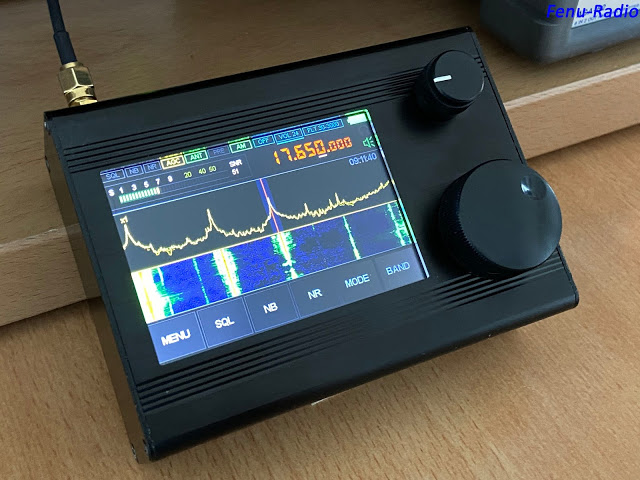
One of the other DSP radios shown being demonstrated on YouTube is this one by Georgy Yatsuk, presumably from somewhere in Russia. In his comments posted on January 14th, Fernando Duarte who runs the FENU site says:
“This little gem makes a name for itself. Everyone wants it. But it is still difficult to get. Georgy Yatsuk (RX9CIM) developed this small portable SDR with two of his colleagues. What this little guy offers is simply phenomenal! -Frequency range: 50KHz-2GHz -All important types of operation -160KHz wide waterfall & spectrum display zoomable -Noise reduction adjustable -Noiseblanker adjustable -Equalizer for adjusting the timbre – Controllable via PC -Control via CAT -etc, etc … Because the firmware is still in full development, certain functions will definitely be added. A test and a detailed presentation will be available on my website in the near future. Stay tuned !!”
As of this moment there is no additional information as to whether this seemingly excellent receiver will ever become available and in what numbers.
Many thanks for this update, Dan! We published a post about the Malahit-DSP in November on a tip from H. Garcia (PU3HAG). I have put in an inquiry to purchase one to evaluate here on the SWLing Post as well. This does look like a fascinating portable SDR!
Many thanks to SWLing Post contributor, Dan Robinson, who shares the following guest post:
An Initial Review of the Belka-DSP Shortwave Receiver
by Dan Robinson
A few weeks ago, during daily online excursions, I ran across the Belka-DSP receiver. This is not really a new receiver. Demonstrations have appeared on You Tube going back into 2019.
The Belka has a price of only about $120 U.S. I felt this was a fairly easy purchase, so I went to the website of Alex Buevky (EU1ME).
The receiver has a tuning range of 1.5 – 30 MHz – note that this is a revision from the description on the Belrig site, which still had a range starting at 3.5 mhz as of the time I am writing this.
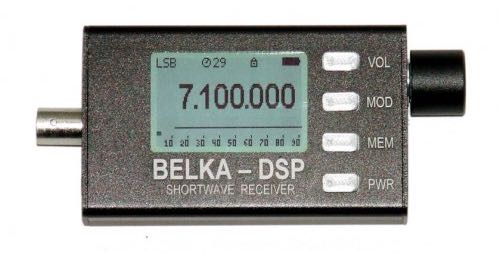
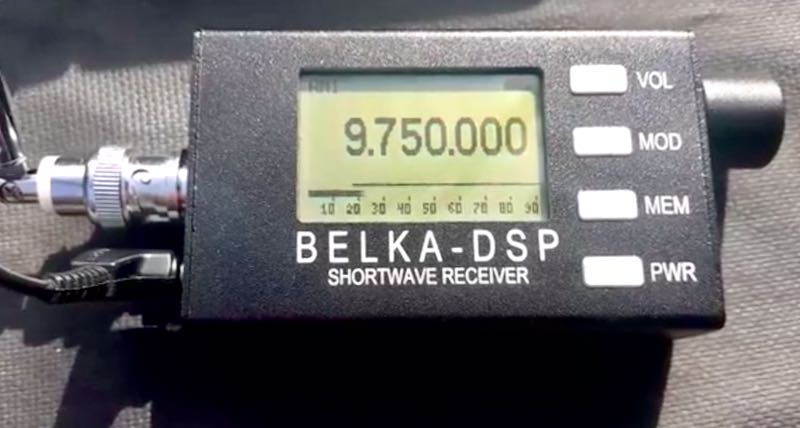
The Belka is contained in a small heavy duty metal box – the size reminds one of a few boxes of matches put together – 85x50x20 mm with weight of about 100 grams. Indeed, the diminutive size is quite striking.
While the menu system appears to be a bit confusing, once you start using the receiver you get used to the logic of it. From the description of the SDR:
“It is possible to adjust the frequency band both from above, from 2.4 to 4.7 kHz, and from below from 50 to 300 Hz. In telegraph mode, the frequency band is constant, about 300 Hz, and its center is regulated from 500 Hz to 1 kHz.
The settings of the favorite radio stations can be stored in any of 32 memory locations.
The receiver does not have a built-in speaker, but there is a rather powerful VLF bridge that provides sufficient volume when working with an external speaker, speaker or headphones.
The built-in LI-Ion battery lasts for 24 hours of total operating time on the headphones.
In addition to the built-in battery, the receiver can also work from an external DC voltage source of 5 V.”
The Belrig site is English and Russian, which makes ordering easier. However, be aware that when you hit purchase using a major credit card you may receive a security alert from the card company. Once I confirmed, the process completed and I received a verification email from Belrig – quite quickly and efficient.
Communications with Alex has been excellent – he is very responsive to suggestions and input.
The SDR arrived in an excellent small heavy cardboard box wrapped with the typical packing tape for the Belarus postal system. The receiver itself and a telescopic antenna with BNC connector were wrapped in bubble wrap. No paper instructions – those are available directly at the Belrig site [click here to download PDF manual].
The only other item on the Belrig site is a Panoramic Adapter:
“designed for use as part of a radio receiving path of a transceiver/receiver jointly with a personal computer (PC) and SDR software” according to Belrig. This Pan@SDR “allows you to visually see the RF spectrum in a band up to 200 kHz as well as to receive and decode different modulation types (depending on a software type). . . [and] may be used without a transceiver as SDR-receiver with fixed oscillator (similarly to SoftRock RX), for example, to listen to amateur and broadcasting stations, to decode and to record telegraph stations with CW skimmer, to control signal quality, to calibrate frequency. It may be used as well as a selective millivoltmeter.”
An unboxing video of the Belrig SDR can be seen here:
Initial impressions
My house in Maryland is notorious for high noise levels – located on a corner, we are surrounded by electric wires on four sides. My attempts to overcome this with my many main premium receivers involve W6LVP, Wellbrook loops and one PAR-FED long wire located outside, with ANC-4 and other noise reduction efforts in my basement radio shack inside.
When I use various portable receivers upstairs in the den of my home, I usually have to keep them well away from incoming Xfinity/Verizon cable TV and Internet lines.
Usually, I am unable to hear much using portables such as SONY SW-55s and Panasonic RF-B65s while sitting on the sofa in the middle of this large family room due to noise from all of these cable lines.
However, interestingly – using the Belka-DSP receiver I was able to get decent reception at this spot. I attribute this to the metal construction of the receiver, compared to portables with plastic cases.
Certain portables, notably the CountyComm/Tecsun GP5/PL-360-365 are extremely sensitive to being handled, with substantial signal loss once your hand is removed from the cabinet. The Belka-DSP exhibits sensitivity to touch, but not as much signal loss as there is when you take your hands off a Tecsun PL-365.
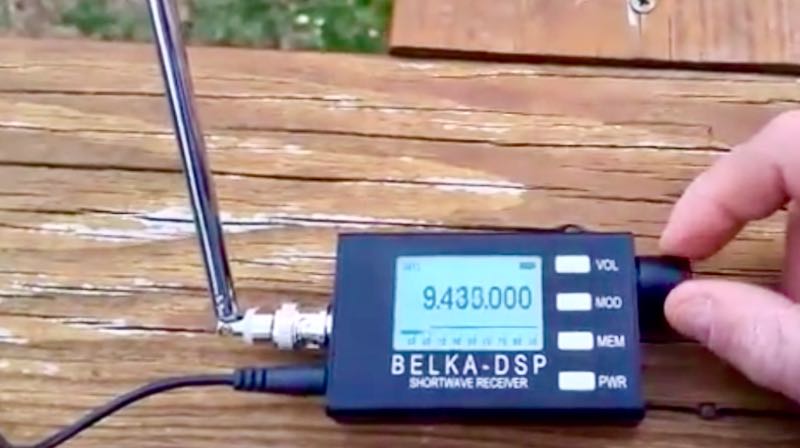
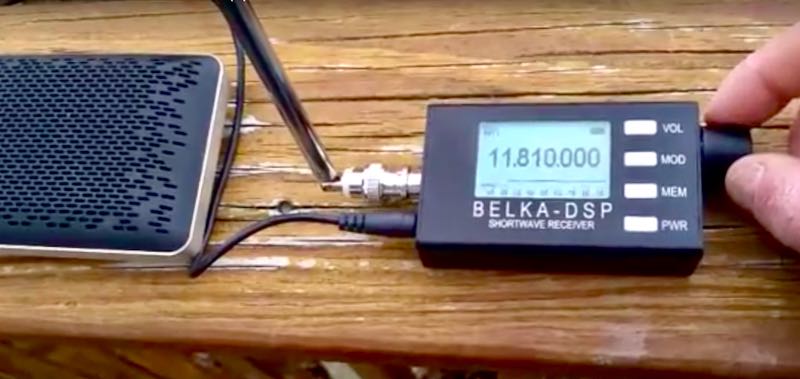
I did notice a few frequencies on the Belka where there are digital artifacts – one occurs at or around 11,810 kHz, the BBC frequency. You can see that in the accompanying video as I tuned up from 11,810.
Others are noticed at various points all the way up through the receiver’s top tuning range of 30 MHz, though thankfully most are not in major SWL bands.
Digital audio artifacts are seen on portable receivers using IC chips, notably the XHDATA D-808 which has several annoying digi-burps on some key frequencies occupied by stations. On my D-808 for example, 9,650 kHz has a digital artifact that interferes with reception of Guinea.
Tuning on the Belka is simple once you get used to the steps. The knob on the right serves for tuning, selection of tuning steps, volume, high-low sensitivity, the various audio “cut-off” modes which essentially function as DSP selectivity. There are 32 memories. Modes are: LSB, USB, CW, NFM, AM1, AM2. For AM mode, AM1 is the most useful, as AM2 seems to be quite harsh in its various DSP audio modes.
The Belka is very sensitive to the type of speaker it is plugged into, assuming you are not using a bluetooth dongle. Connecting via a 3.5 mm cable to a basic Brookstone speaker that has bluetooth produced audio overloads on the Belka, requiring careful placement of the speaker in proximity to the radio.
Whether this had anything to do with the quality of 3.5 mm cable I was using, I am not sure. These audio overload issues were not present using the DSP only with a pair of quality SONY studio headphones. I have not tested the Belka yet with a bluetooth dongle. So be prepared to do some experimenting with speakers and cables.
As mentioned by one person on SWLing Post, the surprise when I received the Belka was that the tuning range is actually 1.5 to 30 MHz rather than 3.5 MHz shown on the Belrig description and in the video there.
This certainly makes the small Belka more attractive, though one wonders why it could not include the full medium wave band.
Also unclear is whether the Belka will have the capability in future for firmware updates, and addition of any new features such as bluetooth though I have to think that adding bluetooth would impact battery duration.
I posed four questions to Alex, including why he made the decision to have the battery soldered in rather than easily user replaceable with battery terminals, whether he is considering adding bluetooth capability, adding capability for firmware updates, and whether he is thinking about extending coverage to include the full medium wave band.
Alex thanked me for my “interesting questions” adding:
“Now Belka-DSP is a final product in this regard no updates or modifications are planned in the near future. We do think about the way how to improve this receiver, how to make it even more user friendly, but I can not say exactly which changes will take place and when. Looking forward for your future questions.”
Alex says that the Belka receivers ship out with batteries not fully charged to comply with post office regulations.
For me, the battery issue is a bit annoying. Similar to cellphones with built-in batteries this means that when the Li-Ion cell does deteriorate you are stuck with a bit of soldering to replace it – and I am not good at soldering.
Another example of this practice is the Pocket SDR made by Gerhard Reuter in Germany which uses flat Li-Ion batteries that are soldered in. If you have no problem using soldering irons, then none of this is a concern.
I can live without on-board Bluetooth, since dongles are available online. But I would like to see coverage of the full medium wave band and it would certainly be nice to have FM band coverage. Obviously the ability to update the radio’s firmware would be a welcome addition.
Another suggestion I would make to Alex would be to provide some way to quickly move from band to band, similar to the capability seen on most regular portables. Having to constantly press the side knob to switch to rapid 50 kHz slewing to move say, from 49 meters to 19 meters, involves too much fiddling.
It would be interesting to see the internals of the Belka radio – four Philips screws are located on the left and right sides of the receiver, so that should not be difficult, though I have chosen not to go exploring inside mine.
Summary
Overall, I am very impressed with the Belka. This seems to be an amazingly quiet and sensitive little receiver. It’s obviously similar to the CR-1a in that it has a display, but much smaller and perfect for Dxing on the road, with a BNC connector that enables connection of any amplified antenna, loops or longwires.
I have included a video made outside my house using only the BNC telescopic antenna with the Belka, showing reception at about 1800 to 1830 UTC of some major stations in the SW bands.
This demonstration shows how sensitive the Belka is in broad daylight hours (also shown is my SONY SW-1000T).
A search of YouTube shows at least two other handheld DSP receivers being demonstrated in 2019, both with full scope screens, seemingly experimental units and on Russian YouTube channels. There is some discussion of availability, but as of early 2020 these units do not seem to be available.
It’s unclear whether any of these units ever made it to production on any scale. Comparing the features on these to the Belka – including AGC, Noise Reduction, Squelch, etc – it seems there might be quite a bit of space on the open market for SDRs that far exceed the capabilities of the Belka.
On the other hand, inclusion of larger scope displays would clearly have implications for battery life, which is one area where the Belka SDR – with its claimed 24 hour duration – obviously excels.
I will be interested to read other user reviews of the Belka-DSP – for now, it appears to be the only receiver of its kind and size being produced in significant numbers, so I certainly want to thank Alex for bringing it to the market.
Thanks so much, Dan for sharing your review of the Belka-DSP. I agree that likely the reason the Belka-DSP is less prone to the effects of holding and grounding is because it has a metal case and is probably better shielded. I agree that there should be an easy way to move between the various meter bands. Including features like this is always a concern in terms of ergonomics for small radios with simplified controls.
It is a fascinating and unique little receiver. Since it’s designed and produced by a “mom and pop” company, I imagine upgrades won’t happen unless there’s a new version produced at some point. With that said, this engineer obviously has the know-how to make a capable receiver!
Thanks again, Dan, and we look forward to any/all updates you wish to share!
SWLing Post contributor, Robert Gulley (K4PKM–formerly AK3Q) recently posted two excellent articles on his website about the “care and feeding” of electronic equipment. Here’s the description from Robert’s blog, All Things Radio:
Just a quick note to let you know there are two new articles published in the Reviews and How-Tos section dealing with simple checks and preventative care of electronic equipment. Over the years I have learned some important lessons for keeping computers and radios working properly, with the goal of having as little downtime as possible. The two articles were originally published in The Spectrum Monitor June and August issues, respectively. (If you have not subscribed to this magazine, you really should check it out – it is in my opinion the best radio magazine on the market today, and not just because they occasionally publish my articles!)
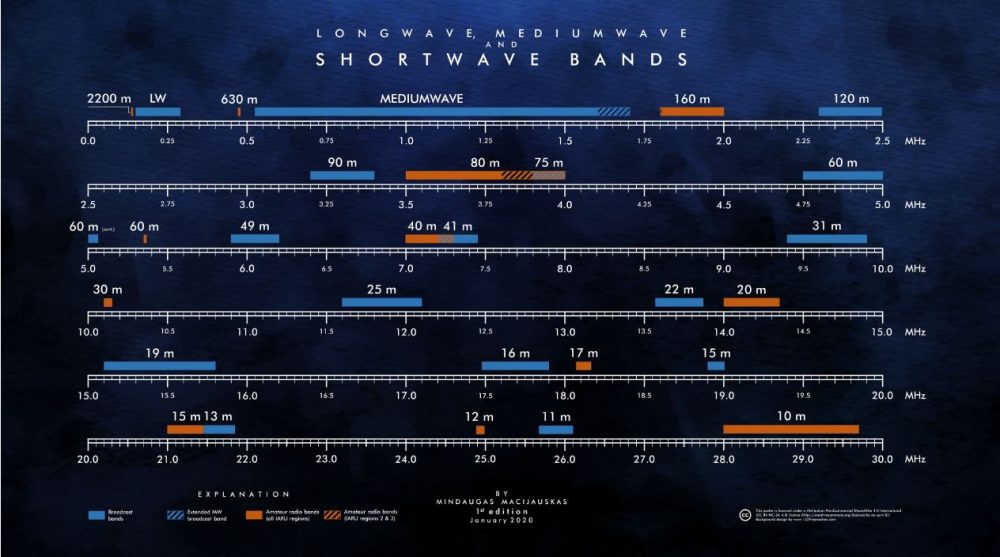
Radio enthusiast, Mindaugas Macijauskas, has recently shared a graphics project he’s been working on for quite a few months. Mindaugas writes (on Facebook):
Few months ago I’ve started my little spare time project – “Longwave, mediumwave & shortwave bands” poster. So, I’m happy to announce that poster & wallpaper are ready to download!
This is initial, 1st edition so some errors might occur. In that case – please PM me.
Currently it’s a bit simpler version, than I’ve initially intended to create. But for this one decided to use “less is more” philosophy.
Had some issues with PDF making, so not all sizes currently are available. I’ll try to fix this within a week or so. On the other hand – tried to print 30×40 cm (12X16 inch) jpeg file at photo lab – and this went exceptionally well.
If you like my my work – you can support it via PayPal. Link is in website.
Very well done, Mindaugas! This is a gorgeous poster and is now the wallpaper on one of my PC monitors.
Many thanks to SWLing Post contributor, Harald Kuhl (DL1AX), who shares the following announcement from the NDR regarding the annual Gruss an Bord Christmas Eve broadcast. Harald notes:
This year on December 24 Norddeutscher Rundfunk (NDR) will again broadcast its program “Gruss an Bord” on shortwave.
They verify reception report by a detailed QSL card.
Press release below (translated via Google) with schedules and frequencies:
“Greetings on board”: How to receive the broadcast
It has tradition and exudes a very special pre-Christmas mood: On Christmas Eve greetings are sent to the seafarers around the world from 8:05 pm – 10:00 pm and from 11:15 pm – midnight on NDR Info. And on the most different channels and technical ways, so that the greetings and messages can be guaranteed to be received on all seven seas.
The ship’s crews have several options to receive the program “Greeting on board”. Also the shortwave belongs to it.
The livestreams of the program (20.05 to 22 clock and 23.15 clock to 24 clock MEZ) can be found here: NDR Info and NDR Info Special. In addition, there is the possibility to listen to the program via the NDR radio app. NDR Info can also be received via FM, DAB + and DVB-S radio, NDR Info special only via DAB + and DVB-S radio.
So that all crew members on board – on the seas or in the harbors – can receive the traditional program, the NDR radio has also rented shortwave frequencies:
From 19:00 to 21:00 UTC (20:00 to 22:00 CET), the shortwave transmits over the following frequencies (UTC is the abbreviation for Universal Time Coordinated):
“Greeting on board” via shortwave
Frequency target area
6.080 kHz Atlantic – North
11,650 kHz Atlantic – South
9,800 kHz Atlantic / Indian Ocean (South Africa)
9,740 kHz Indian Ocean – West
9,570 kHz Indian Ocean – East
6.030 kHz Europe
Between 21:00 and 23:00 UTC (22:00 – 24:00 CET) the shortwave transmits over the following frequencies:
“Greeting on board” via shortwave
Frequency target area
6.145 kHz Atlantic – North
9,830 kHz Atlantic – South
9,590 kHz Atlantic / Indian Ocean (South Africa)
9,740 kHz Indian Ocean – West
9,675 kHz Indian Ocean – East
6.155 kHz Europe
NDR Info sends the “Greeting on board” from 20:05 to 22:00 CET. This is followed by the transmission of the Christmas Mass from the church of St. Mary Magdalene in Bochum-Wattenscheid from 22 to 23.15 CET. Then you will hear the second part of “Greetings on Board” until midnight CET.
Please support this website by adding us to your whitelist in your ad blocker. Ads are what helps us bring you premium content! Thank you!

 Radio Waves: Stories Making Waves in the World of Radio