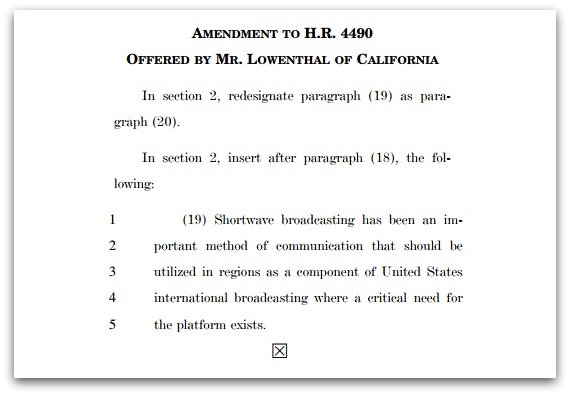
Earlier today, I contacted Letitia King, Spokesperson for the Broadcasting Board of Governors (BBG). I asked her for details regarding the cuts to shortwave services that were recently announced.
Ms. King has just sent me the following list, with notes, which includes all shortwave reductions under the BBG:
Facts and Figures on Shortwave Broadcast Reductions
June 30, 2014
U.S. international media must optimize program delivery by market. We are ending some shortwave transmissions. We continue shortwave to those countries where these transmissions are still reaching significant audiences or where there are no reasonable alternative platforms at a lower cost to the BBG.
The shortwave reductions will save U.S. taxpayers almost $1.6 million annually.
There are no reductions in staff or programming – these are transmission platform reductions only. Programming continues to be available through other media.
Shortwave transmissions continue in many languages including to key shortwave markets like North Korea, Nigeria, Somalia, Horn of Africa, and elsewhere. (List enclosed below). Transmissions also continue on other platforms including AM, FM, TV and online.
VOA Azerbaijani
- Cuts: 30 minutes SW
- Continuing Distribution: Satellite TV (HotBird)and satellite audio (TurkSat); Multimedia web and mobile sites & social media
- SW is used by just 2% of adults weekly in Azerbaijan, and does not yield significant audiences for the service (0.4% weekly reach on radio in BBG’s most recent survey). By contrast, satellite dish ownership is widespread, at 56%, and 18% use the Internet weekly. The service has both satellite and online products, which are far more likely to reach audiences in Azerbaijan.
VOA Bangla
- Cuts: 1 hour SW
- Continuing Distribution: 1 hour MW(AM); FM and TV affiliates; Multimedia web and mobile sites; Social media
- SW is not widely used in Bangladesh (just 2% weekly), and the majority of the service’s audience comes to its programming via FM and TV affiliate networks in the country.
VOA English (in Asia)
- Cuts: 6.5 hours SW (2 hours of programming that was repeated)
- Continuing Distribution: Some MW; Multimedia web and mobile sites & social media
- Outside of sub-Saharan Africa, English speakers are rarely users of shortwave radio. They are more likely to be educated and affluent, and to have access to a broad range of media. Years of BBG research questions on consumption of VOA English on shortwave have failed to find any significant audiences outside Africa, in large part because usage of shortwave radio in other regions is mostly very low.
VOA Lao
- Cuts: 30 minutes SW
- Continuing Distribution: 30 minutes MW; 7 affiliates in Thailand on Lao border, with reach into Laos; Multimedia web and mobile sites; Social media
- SW is very little-used in Laos – less than 1% of adults report listening to SW radio weekly. In BBG’s most recent research in Laos, no surveyed listeners reported using the SW band to access VOA content. A strong majority (66%) hear VOA on FM, through affiliate stations on the Thai border that carry VOA content (Laos is so small that border FM stations have decent penetration into the country).
VOA Special/Learning English
- Cuts: 5.5 hours SW
- Continuing Distribution: Learning English programs continue on SW on English to Africa. 30 minutes MW; Multimedia web and mobile sites, including special interactive teaching products; Social media, including social English lessons
- BBG audience research indicates strong interest in learning English, but very limited shortwave listenership to VOA Learning English, outside a few select markets. The service is working more closely with other VOA language services to create English learning products for distribution on more popular channels. And Learning English offers a variety of digital products that are increasingly popular, including a Skype call-in show, videos on YouTube, and a website featuring both audio and transcripts for online audiences to follow as they listen.
VOA Uzbek
- Cuts: 30 minutes SW
- Continuing Distribution: Satellite audio and TV (HotBird); FM and TV affiliates in neighboring countries; Multimedia web and mobile sites (with circumvention tools deployed); Social media
- SW is not widely used in Uzbekistan (just 2% weekly), and does not yield significant audiences for the service (0.3% weekly). Adults in Uzbekistan are much more likely to own a satellite dish (13%) or use the internet (12% weekly) than to use SW, so the service provides content on those platforms. Uzbekistan is an especially difficult market to penetrate with USIM content, but SW is not an effective platform for the country.
RFE/RL Persian (Farda)
- Cuts: 1 simultaneous SW frequency for 6 broadcast hours
- Continuing Distribution: SW on multiple frequencies for all 24 broadcast hours remains on, in addition to 24 hours daily MW; “Radio on TV” on VOA Persian stream; 24 hours daily satellite audio with slate plus 24 hour Audio on 4 other satellites including Hotbird, the most popular satellite in Iran; Multimedia website (with circumvention tools deployed); Social media; mobile app with anti-censorship proxy server capability built-in.
- This is only a reduction to the number of simultaneous frequencies during some of the broadcast day. SW radio, with 5% weekly use in 2012, is considerably less popular than other platforms on which audiences can access Farda content, such as MW (10% weekly use), satellite television (26% own a dish, and 33% watch satellite television weekly) or the internet (39% weekly use).
RFA Lao
- Cuts: 2 hours SW
- Continuing Distribution: 5 FM radio affiliates in Thailand provide cross-border coverage; Multimedia web & mobile sites; Social media
- SW is very little-used in Laos – less than 1% of adults report listening to SW radio weekly. RFA Lao’s listeners come overwhelmingly via FM stations on the Thai border – 94% of past-week listeners report hearing RFA on FM. (Laos is so small that border FM stations have decent penetration into the country).
RFA Vietnamese
- Cuts: 2 hours SW
- Continuing Distribution: MW coverage of all broadcast hours remains on; Multimedia web and mobile sites (with circumvention tools deployed) include webcasts and other videos; Social media
- · SW radio is very little-used in Vietnam – less than 1% of adults report any weekly use of the waveband, and RFA reaches just 0.2% of adults weekly on radio. MW is slightly more popular, but the future for USIM in Vietnam is likely online: 26% of Vietnamese use the Internet weekly now (with much higher rates among certain populations, like the young and the well-educated), and three in four personally own a mobile phone. While Vietnam attempts to block access to sensitive sites, Vietnam is actually the most active country in our most popular Internet Anti-Censorship tools with almost 600 million hits per day.
Languages that continue on Shortwave
VOA
- Afan Oromo/Amharic/Tigrigna to Ethiopia and Eritrea
- Bambara
- Burmese
- Cantonese
- Dari
- English to Africa
- English to South Sudan
- French to Africa
- Hausa
- Khmer
- Kinyarwanda/Kirundi
- Korean
- Kurdish
- Mandarin
- Pashto (to FATA and Afghanistan)
- Portuguese to Africa
- Somali
- Swahili
- Tibetan
- · Shona/Ndebele/English to Zimbabwe
OCB
- Spanish to Cuba
RFE/RL
- Avar/Chechen/Circassian
- Belarusian
- Dari
- Pashto (to FATA and Afghanistan)
- Persian
- Russian
- Tajik
- Turkmen
- Uzbek
RFA
- Burmese
- Cantonese
- Khmer
- Korean
- Mandarin
- Tibetan
- Uyghur
MBN
- Arabic (Afia Darfur to Sudan/Chad)