Tag Archives: Voice of America

BBG Watch: VOA coverage of H.R.4490 “lacks balance”

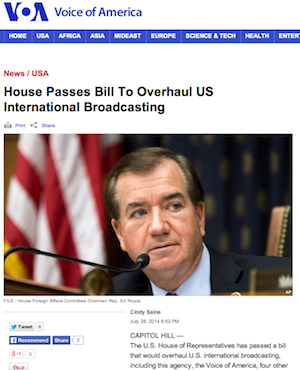
VOA-Screen-Shot-2014-07-28-at-9.53PM-EDT(Source: BBG Watch)

“It took Voice of America a few hours to post a report, which includes quotes by two outside opponents of the bill: former VOA deputy director Alan Heil and Reporters Without Borders Secretary-General Christophe Deloire, but has no quotes from any outside supporters of the bill, including human rights NGOs, U.S. community leaders, and former Voice of America journalists who wrote a letter to President Obama in support of the legislation.

So much for balance in Voice of America news reporting as required by the VOA Charter.

For an alternative view, see BBG Watch report and commentary on the House passage of H.R. 4490, called the U.S. International Communications Reform Act of 2014.

If VOA English News quotes non-congressional critics of the bipartisan bill — there was no criticism of the bipartisan bill voiced today in Congress since it is widely supported as essential for saving Voice of America from mismanagement — VOA English News should have also quoted non-congressional supporters of the bill.”

Continue reading…

Hat tip to SWLing Post reader, Dan for sharing this post.

US House passes H.R. 4490

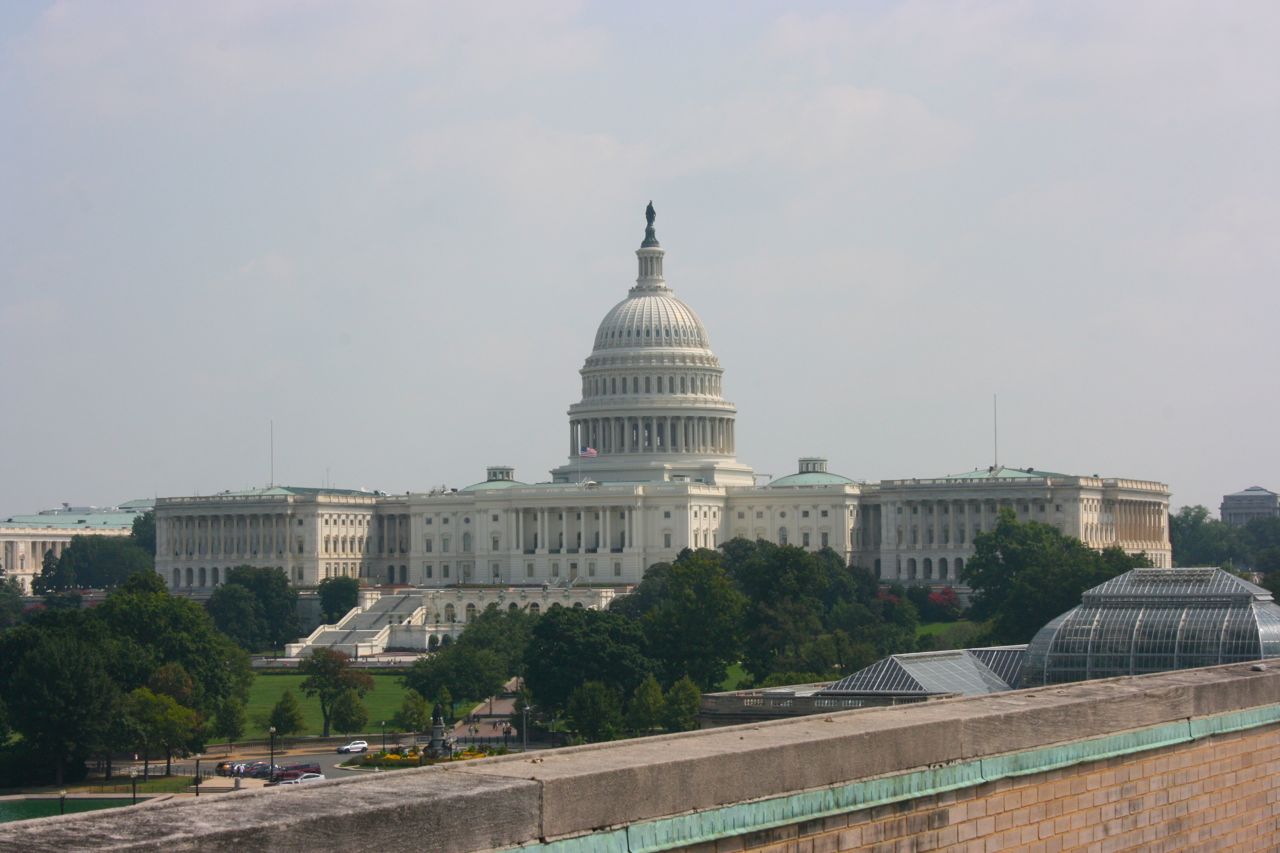
View of the Capitol Building from the roof of the Voice of America on 330 Independence Ave., S.W.

View of the Capitol Building from the roof of the Voice of America on 330 Independence Ave., S.W.

The United States International Communications Reform Act of 2014 (H.R. 4490) has just passed the the House today, next it will go before the US Senate.

This bill proposes major changes to the overall structure of US international broadcasting. Click here to read previous posts about the bill and read the press release below for more information.

We will update the SWLing Post with news about H.R.4490 as it is presented before the Senate–follow the tag HR4490.

(Source: House Committee On Foreign Affairs)

Washington, D.C. – Today, Rep. Ed Royce (R-CA), Chairman of the House Foreign Affairs Committee, applauded House passage of bipartisan reform legislation to improve the missions, objectives, and effectiveness of U.S. international broadcasters, such as the Voice of America (VOA), Radio Free Europe-Radio Liberty (RFE/RL), Radio Free Asia (RFA), and the Middle East Broadcasting Network (MBN).  The legislation, the United States International Communications Reform Act of 2014 (H.R. 4490) was unanimously passed by the Foreign Affairs Committee in April.  Chairman Royce and Rep. Eliot Engel (D-NY), the Committee’s Ranking Memberintroduced the legislation in April.

On House passage of H.R. 4490, Chairman Royce said:  “For many years, our international broadcasting has been broken and ineffective.  While strongmen, despots, and terrorists are working overtime on their public disinformation campaigns, the U.S. Broadcasting Board of Governors, which oversees our international broadcast efforts, meets once a month.  The status quo is a recipe for failure on the critical information front.  The legislation the House passed today provides serious reforms to U.S. international broadcasting, allowing for a strong, effective tool in the fight against censorship and harmful misinformation.”

H.R. 4490 reforms U.S. international broadcasting, including in the following ways:

Fixes Well-documented Management Problems — Currently, five U.S. international broadcasting entities report to the Broadcasting Board of Governors (“BBG”), a group of 9 part-time individuals, who meet once a month to make management decisions. Important decisions can languish if the Board does not have a quorum, which is often the case. This legislation would establish a full-time, day-to-day agency head and reduce the role of the Board to a more appropriate advisory capacity. These changes have been recommended by the State Department’s Office of the Inspector General and are widely recognized as needed reforms.

Clarifies the Mission of the Voice of America (VOA) — The VOA charter states that VOA will provide a “clear and effective presentation of the policies of the United States.” Over time, VOA has abandoned this mission and adopted a mission of the so-called “surrogates” to provide uncensored local news and information to people in closed societies. This legislation makes clear that the Voice of America mission is to support U.S. public diplomacy efforts.

Consolidates “the Freedom Broadcasters” — Radio Free Europe-Radio Liberty (RFE/RL), Radio Free Asia (RFA), and the Middle East Broadcasting Network (MBN) have the same mission – to provide uncensored local news and information to people in closed societies – with different geographic reach. Consolidating these organizations into a single, non-federal organization will achieve cost savings, allow for closer collaboration, and improve responsiveness. While the consolidation would mean shared administrative staff and other economies of scale, they would retain their distinct “brand names.”

For information of Chairman Royce’s efforts to reform international broadcasting, visit www.foreignaffairs.house.gov/broadcasting.

VOA and RFA via homemade radios in North Korea

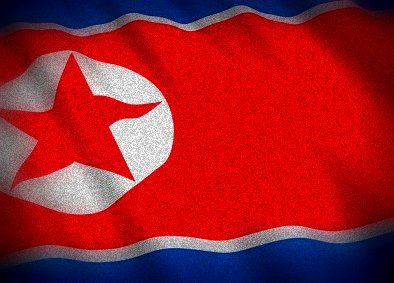
FlagNorthKoreaMany thanks to SWLing Post reader, Anil, for sharing this article regarding the importance and inspiration radio provides to many North Koreans. This comes from our favorite North Korea independent news site, NK News.

Here’s a quote from the article from a North Korean defector known as “Park”:

“I have been listening to the North Korea Reform Radio and other outside radios since 13 years ago,” he said.

Using this homemade radio, Park could access VOA, RFA, NKRR, VOP, RFC and ONK over the past five years.

“Frankly, the ideological education in North Korea is so strong that many people including myself could not believe the content of the outside world radio,” he said of his first experience listening with the device. “I was once certain that this radio signal was sent by someone who was trying to deceive us.

“But this radio played strong role in motivating me to escape North Korea. My friends and I used to regularly listened to NKRR and other radio programs inside the underground hideout.

“Many told me to quit listening to those radio signals and start making money for myself, but with the help of this radio, I finally decided to escape the North.”

Read the full article, including a description and photos of Park’s homemade radio at NK News.

In addition, note that North Korea is the theme of this year’s San Fransisco Hackathon.

To follow other posts about North Korea, please note the tag: North Korea

VOA Radiogram this weekend, July 5/6

VOARadioGram(Source: VOA Radiogram)

VOA Radiogram this weekend will include news about reductions to the shortwave transmissions of VOA and other stations of US international broadcasting. These cuts were effective on 30 June.

Fortunately, VOA Radiogram remains on shortwave, at least for now.

Here is the lineup for VOA Radiogram, program 66, 5-6 July 2014 (all in MFSK32 except where noted):

1:33 Program preview
2:45 Major reductions to US shortwave broadcasts, with image
8:10 Car fumes affect pollinating insects
10:10 Test of Mars landing craft a success, with image
14:23 India launches satellites at low cost, with MFSK64 image
20:32 Spanish: Triple black hole discovery, with image
25:59 Closing announcements

Please send reception reports to [email protected]

VOA Radiogram transmission schedule
(all days and times UTC):
Sat 0930-1000 5745 kHz
Sat 1600-1630 17860 kHz
Sun 0230-0300 5745 kHz
Sun 1930-2000 15670 kHz
All via the Edward R. Murrow transmitting station in North Carolina.

The Mighty KBC will transmit a minute of MFSK64 Saturday at about 1130 UTC on 6095 kHz, and Sunday about 0130 UTC (Saturday 9:30 pm EDT) on 9925 kHz. Both frequencies via Germany. Reports to [email protected].

NY Times: Journalists “at Odds With Union” over VOA’s role

nytLogo

The New York Times, in a  recent article, describes a growing split between the VOA Union (American Federation of Government Employees Local 1812) and VOA journalists over the proposed changes to the VOA mission (via H.R. 4490), which would make it an active voice of American policy. (Many thanks to SWLing Post reader, Marty, for sharing this relevant article).

Below is an excerpt from The Times; click here for the full article:

WASHINGTON — Voice of America journalists who are fighting to maintain what they say is their editorial independence are now at odds not only with Congress, but also with their own union.

The union, the American Federation of Government Employees Local 1812, recently endorsed a bill that would change language in the charter for the 72-year-old news agency and require it to actively support American policy. That came as a surprise to some Voice of America employees, who said the legislation would make them mouthpieces for government policy. They want the union to withdraw its letter of support.

“A lot of us would welcome change and reform, but not at the cost of undermining V.O.A.’s journalistic credibility,” said Jim Malone, a senior national correspondent at the government-financed news agency who is not a member of the union.

In its letter, union leaders said the agency’s managers had lost sight of their mission and were trying to turn the “V.O.A. into something they envisioned as a global variant of CNN.”

“In the end, some of the currently entrenched senior management represent a far greater threat to V.O.A.’s journalistic independence, indeed to the very existence of the V.O.A.,” the union wrote.

The danger, said the union’s president, Tim Shamble, is that the government could withdraw its financial support if the agency continued its current course. The federation represents about 40 percent of all Voice of America workers and 11 percent of the journalists in the central news division.

Continue reading…

For other posts about this topic, please follow the tag: HR4490

What if shortwave radio had been invented today?

SX-99-DialSWLing Post reader, Walt, comments on the recent cuts to VOA’s shortwave radio service:

“Having spent many years as a VOA Foreign Service Officer and radio engineer, I can personally attest to the effectiveness of shortwave broadcasting and it’s ability to reach oppressed people around the world. The “new” technologies like the internet are so easily filtered and controlled, all the proxy servers in the world can’t get around all the blocking software that these oppressive countries’ can put in place.

If shortwave broadcasting was invented today it would be regarded as a modern wonder of technology. To bad that the IBB board of governors are so out of touch with conditions outside of the USA. Not everyone in these oppressed countries has internet access. They all have radios!”

Many thanks for your comment, Walt. I’ve often thought the same thing.

If shortwave would have been discovered in the Internet age, would be working on ways to use it as a digital communications medium in earnest; “targeting” people across the globe with digital information, without using the Internet? Quite possibly.

No other broadcast or communications medium crosses borders at the speed of light and has no regard for who is in power, nor who is receiving the information; shortwave is anonymous and accessible.

Details of shortwave reductions to VOA, RFE, RFA

Voice_of_America_HeadquartersEarlier today, I contacted Letitia King, Spokesperson for the Broadcasting Board of Governors (BBG). I asked her for details regarding the cuts to shortwave services that were recently announced.

Ms. King has just sent me the following list, with notes, which includes all shortwave reductions under the BBG:


Facts and Figures on Shortwave Broadcast Reductions

June 30, 2014

 U.S. international media must optimize program delivery by market. We are ending some shortwave transmissions. We continue shortwave to those countries where these transmissions are still reaching significant audiences or where there are no reasonable alternative platforms at a lower cost to the BBG.

The shortwave reductions will save U.S. taxpayers almost $1.6 million annually.

There are no reductions in staff or programming – these are transmission platform reductions only. Programming continues to be available through other media.

Shortwave transmissions continue in many languages including to key shortwave markets like North Korea, Nigeria, Somalia, Horn of Africa, and elsewhere. (List enclosed below). Transmissions also continue on other platforms including AM, FM, TV and online.

VOA Azerbaijani

  • Cuts: 30 minutes SW
  • Continuing Distribution: Satellite TV (HotBird)and satellite audio (TurkSat); Multimedia web and mobile sites & social media
  • SW is used by just 2% of adults weekly in Azerbaijan, and does not yield significant audiences for the service (0.4% weekly reach on radio in BBG’s most recent survey). By contrast, satellite dish ownership is widespread, at 56%, and 18% use the Internet weekly. The service has both satellite and online products, which are far more likely to reach audiences in Azerbaijan.

VOA Bangla

  • Cuts: 1 hour SW
  • Continuing Distribution: 1 hour MW(AM); FM and TV affiliates; Multimedia web and mobile sites; Social media
  • SW is not widely used in Bangladesh (just 2% weekly), and the majority of the service’s audience comes to its programming via FM and TV affiliate networks in the country.

VOA English (in Asia)

  • Cuts: 6.5 hours SW (2 hours of programming that was repeated)
  • Continuing Distribution: Some MW; Multimedia web and mobile sites & social media
  • Outside of sub-Saharan Africa, English speakers are rarely users of shortwave radio. They are more likely to be educated and affluent, and to have access to a broad range of media. Years of BBG research questions on consumption of VOA English on shortwave have failed to find any significant audiences outside Africa, in large part because usage of shortwave radio in other regions is mostly very low.

VOA Lao

  • Cuts: 30 minutes SW
  • Continuing Distribution: 30 minutes MW; 7 affiliates in Thailand on Lao border, with reach into Laos; Multimedia web and mobile sites; Social media
  • SW is very little-used in Laos – less than 1% of adults report listening to SW radio weekly. In BBG’s most recent research in Laos, no surveyed listeners reported using the SW band to access VOA content. A strong majority (66%) hear VOA on FM, through affiliate stations on the Thai border that carry VOA content (Laos is so small that border FM stations have decent penetration into the country).

VOA Special/Learning English

  • Cuts: 5.5 hours SW
  • Continuing Distribution: Learning English programs continue on SW on English to Africa. 30 minutes MW; Multimedia web and mobile sites, including special interactive teaching products; Social media, including social English lessons
  • BBG audience research indicates strong interest in learning English, but very limited shortwave listenership to VOA Learning English, outside a few select markets. The service is working more closely with other VOA language services to create English learning products for distribution on more popular channels. And Learning English offers a variety of digital products that are increasingly popular, including a Skype call-in show, videos on YouTube, and a website featuring both audio and transcripts for online audiences to follow as they listen.

VOA Uzbek

  • Cuts: 30 minutes SW
  • Continuing Distribution: Satellite audio and TV (HotBird); FM and TV affiliates in neighboring countries; Multimedia web and mobile sites (with circumvention tools deployed); Social media
  • SW is not widely used in Uzbekistan (just 2% weekly), and does not yield significant audiences for the service (0.3% weekly). Adults in Uzbekistan are much more likely to own a satellite dish (13%) or use the internet (12% weekly) than to use SW, so the service provides content on those platforms. Uzbekistan is an especially difficult market to penetrate with USIM content, but SW is not an effective platform for the country.

RFE/RL Persian (Farda)

  • Cuts: 1 simultaneous SW frequency for 6 broadcast hours
  • Continuing Distribution: SW on multiple frequencies for all 24 broadcast hours remains on, in addition to 24 hours daily MW; “Radio on TV” on VOA Persian stream; 24 hours daily satellite audio with slate plus 24 hour Audio on 4 other satellites including Hotbird, the most popular satellite in Iran; Multimedia website (with circumvention tools deployed); Social media; mobile app with anti-censorship proxy server capability built-in.
  • This is only a reduction to the number of simultaneous frequencies during some of the broadcast day. SW radio, with 5% weekly use in 2012, is considerably less popular than other platforms on which audiences can access Farda content, such as MW (10% weekly use), satellite television (26% own a dish, and 33% watch satellite television weekly) or the internet (39% weekly use).

RFA Lao

  • Cuts: 2 hours SW
  • Continuing Distribution: 5 FM radio affiliates in Thailand provide cross-border coverage; Multimedia web & mobile sites; Social media
  • SW is very little-used in Laos – less than 1% of adults report listening to SW radio weekly. RFA Lao’s listeners come overwhelmingly via FM stations on the Thai border – 94% of past-week listeners report hearing RFA on FM. (Laos is so small that border FM stations have decent penetration into the country).

RFA Vietnamese

  • Cuts: 2 hours SW
  • Continuing Distribution: MW coverage of all broadcast hours remains on; Multimedia web and mobile sites (with circumvention tools deployed) include webcasts and other videos; Social media
  • · SW radio is very little-used in Vietnam – less than 1% of adults report any weekly use of the waveband, and RFA reaches just 0.2% of adults weekly on radio. MW is slightly more popular, but the future for USIM in Vietnam is likely online: 26% of Vietnamese use the Internet weekly now (with much higher rates among certain populations, like the young and the well-educated), and three in four personally own a mobile phone. While Vietnam attempts to block access to sensitive sites, Vietnam is actually the most active country in our most popular Internet Anti-Censorship tools with almost 600 million hits per day.

Languages that continue on Shortwave

VOA

  • Afan Oromo/Amharic/Tigrigna to Ethiopia and Eritrea
  • Bambara
  • Burmese
  • Cantonese
  • Dari
  • English to Africa
  • English to South Sudan
  • French to Africa
  • Hausa
  • Khmer
  • Kinyarwanda/Kirundi
  • Korean
  • Kurdish
  • Mandarin
  • Pashto (to FATA and Afghanistan)
  • Portuguese to Africa
  • Somali
  • Swahili
  • Tibetan
  • · Shona/Ndebele/English to Zimbabwe

OCB

  • Spanish to Cuba

RFE/RL

  • Avar/Chechen/Circassian
  • Belarusian
  • Dari
  • Pashto (to FATA and Afghanistan)
  • Persian
  • Russian
  • Tajik
  • Turkmen
  • Uzbek

RFA

  • Burmese
  • Cantonese
  • Khmer
  • Korean
  • Mandarin
  • Tibetan
  • Uyghur

MBN

  • Arabic (Afia Darfur to Sudan/Chad)