Author Archives: Thomas

Radio Waves: SpaceX Encrypts Falcon 9 After Ham Downloads Data, Postcard From Titanic Op at Auction, History of Sound Art, and WNYC’s Early Recording

Radio Waves:  Stories Making Waves in the World of Radio

Because I keep my ear to the waves, as well as receive many tips from others who do the same, I find myself privy to radio-related stories that might interest SWLing Post readers.  To that end: Welcome to the SWLing Post’s Radio Waves, a collection of links to interesting stories making waves in the world of radio. Enjoy!

Many thanks to SWLing Post contributors Ulis (K3LU), Chris Walter, and Ron James  for the following tips:


SpaceX Encrypts Falcon 9 Telemetry After Amateur Radio Operators Download Data (Extreme Tech)

SpaceX doesn’t operate like a traditional aerospace company. For one, the CEO is usually hamming it up on Twitter during launches and providing details that would usually go in a press release. SpaceX also live streams almost all of its launches, even the prototypes that have an unfortunate tendency to blow up lately. It wasn’t even encrypting the Falcon 9 telemetry feed… until now. Unfortunately, some digging by amateur radio tinkerers seems to have convinced SpaceX to step up its security.

It all started a few weeks ago when several Redditors managed to lock onto the 2232.5 MHz telemetry downlink from a Falcon 9 upper stage. Right away, they were able to pull out a few interesting plaintext snippets from the unencrypted feed. With a little more work, the radio enthusiasts were able to capture some amazing images from the spacecraft’s cameras.

After that discovery was public, other SpaceX fans tried to grab some data from the Starship during its prototype tests. However, SpaceX had chosen to encrypt that data. Even with the right wireless equipment, the decoded signal was just noise. Now, it appears the same thing is happening with the Falcon 9. When attempting to pull data from the most recent Falcon 9 launch, the original signal snoopers discovered it had also been encrypted. A series of tweets from SpaceX engineers suggest the decoding of the telemetry signal was the reason for the change.[]

Postcard from Titanic’s radio operator is being sold at auction (Stars And Stripes)

BOSTON — A postcard written by the Titanic’s senior radio operator just weeks before the ocean liner sank in the North Atlantic in 1912 has been put up for auction.

The card, with a glossy image of the ill-fated ship on the front, was written by Jack Phillips to his sister, Elsie Phillips, in March 1912 while awaiting the ship’s first sea trials, according to RR Auction in Boston.

“Very busy working late. Hope to leave on Monday & arrive Soton Wednesday afternoon. Hope you quite OK. Heard from Ethel yesterday,” he wrote. It’s signed “Love Jack.”

It is postmarked Belfast, where the Titanic was built, and has a canceled halfpenny stamp.

“Soton” is a contraction of Southampton, the English port city from where the Titanic departed on its maiden voyage. It sank in the early morning hours of April 15.

Phillips, who turned 25 on board, stayed at his post after the Titanic struck an iceberg to send calls for assistance to other ships in the area until water was lapping around his feet, according to RR Auction.

He made it off the ship after being told by the captain that he had done his duty, according to his biography in the British National Archives, but died of exposure in the frigid North Atlantic, according to RR Auction.

The postcard is being sold by the estate of Vera and John Gillespie, longtime members of the Massachusetts-based Titanic Historical Society, said Bobby Livingston, executive vice president at RR Auction.[]

Radio Survivor Podcast #292: The History of Sound Art (Radio Survivor)

What is sound art? And what do we know about its origin story? We explore this question and more with our guest this week, artist and educator Judy Dunaway. An adjunct professor in the History of Art Department at Massachusetts College of Art and Design, Dunaway’s recent article, “The Forgotten 1979 MoMA Sound Art Exhibition,” is a fascinating look at the history of sound art and highlights important contributions by female artists. In our wide-ranging discussion, we also hear about Dunaway’s own artistic practice, from her work with latex balloons to transmission art to a “phone improv” show over BlogTalkRadio a decade ago.

Click here to check out this piece at Radio Survivor.


Overcoming the Limitations of Time (From the January/February 1940 WNYC Masterwork Bulletin)

A MATTER OF RECORD: Mighty useful gadgets are WNYC’s four new recording machines. They were used in a variety of interesting ways during the past year, so we decided that the how and the why of recording would be an appropriate subject for this, the third of our Behind the Microphone series dealing with the technical side of things at the Municipal Station.

One of the most valuable uses of the recording units is that they have partially enabled us to overcome the limitations of time — have made it possible to make available to our listeners important evening programs which we could not broadcast directly because of our fluctuating time allotment.

For instance, we could not pick up the ASCAP Music Festival Concerts from Carnegie Hall last Fall because WNYC was not on the air after 8:30 P. M.[1] What to do? The recorders to the rescue! The concerts were “broadcast” over our regular Carnegie Hall lines to the Municipal Building where they were transcribed on our two standard studio-type recording machines. Each transcription[2] was put on the air on the afternoon following the original perfor

Similarly, our two mobile recording units made possible an afternoon broadcast of the official opening of La Guardia Field which took place at midnight. Recording equipment is also used frequently to transcribe major programs “off the air” so that they may reach a larger audience through rebroadcast. There was the time, for example, when the Mayor’s office was the scene of a final report on the new Police and Fireman’s pension plan. Official reports on the balloting were recorded and rebroadcast at a time when the majority of the policemen and firemen affected could listen in.

We used to think recording an easy job: Just put the recording needle on the disk, turn a few buttons, and let ‘er go. After watching one of our expert recording engineers at work, we realized that it’s a delicate task, requiring special training and long practice.

Click here to read the full piece at WNYC.


Do you enjoy the SWLing Post?

Please consider supporting us via Patreon or our Coffee Fund!

Your support makes articles like this one possible. Thank you!

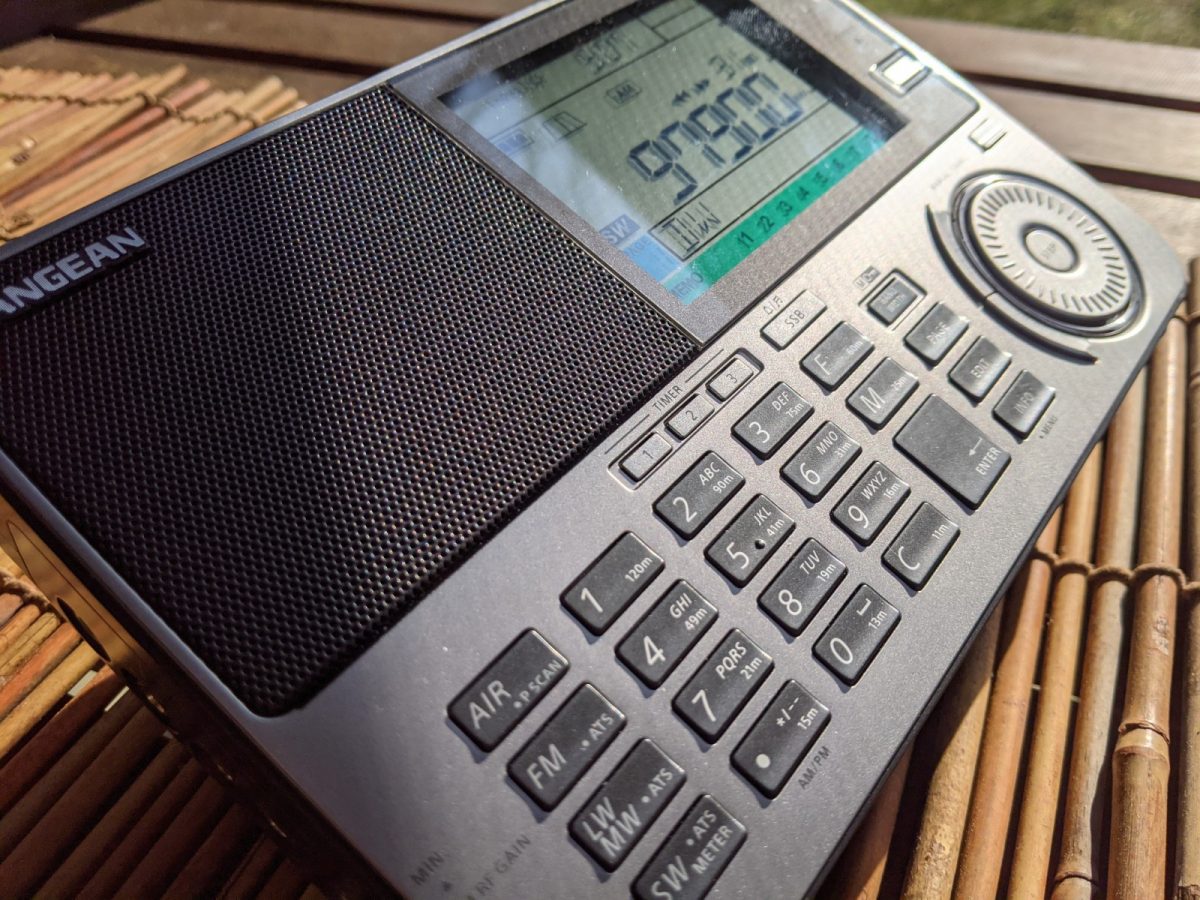
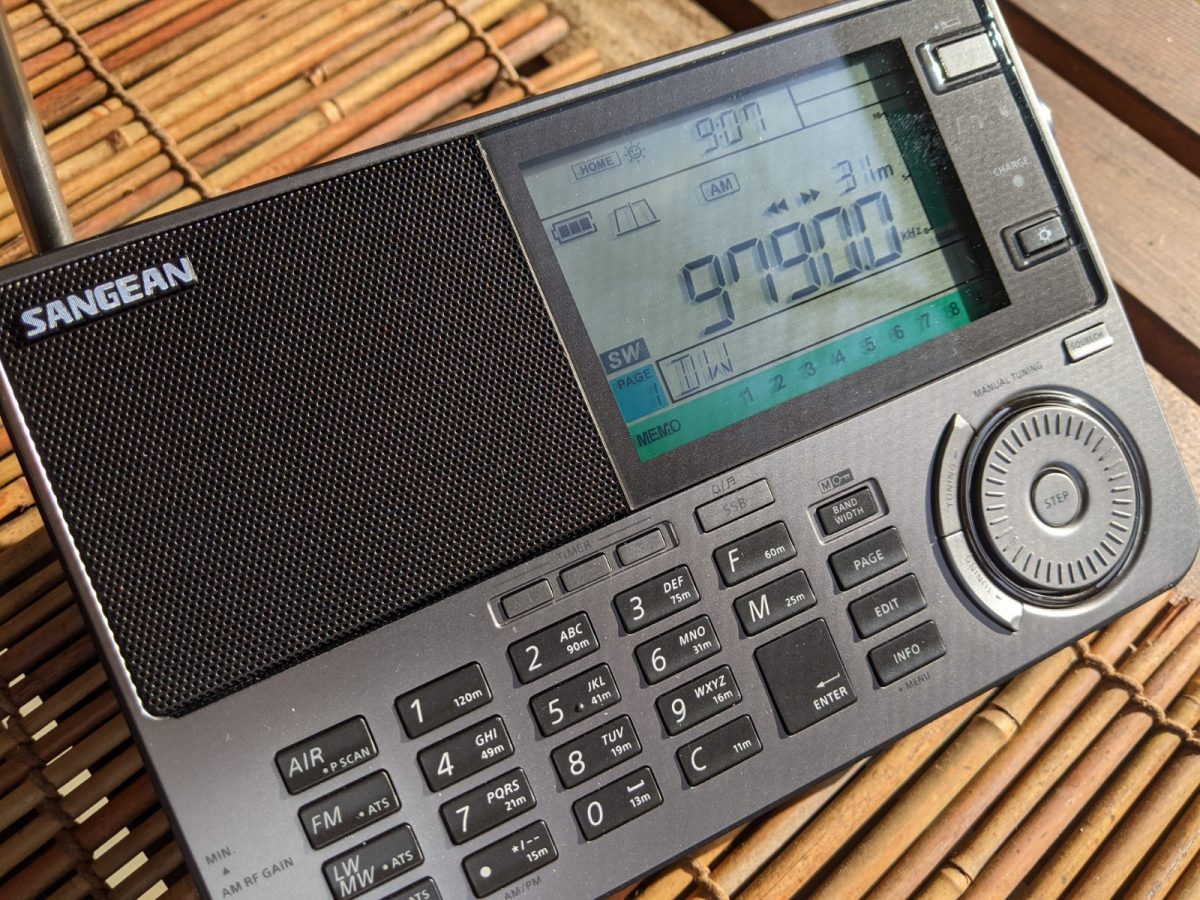
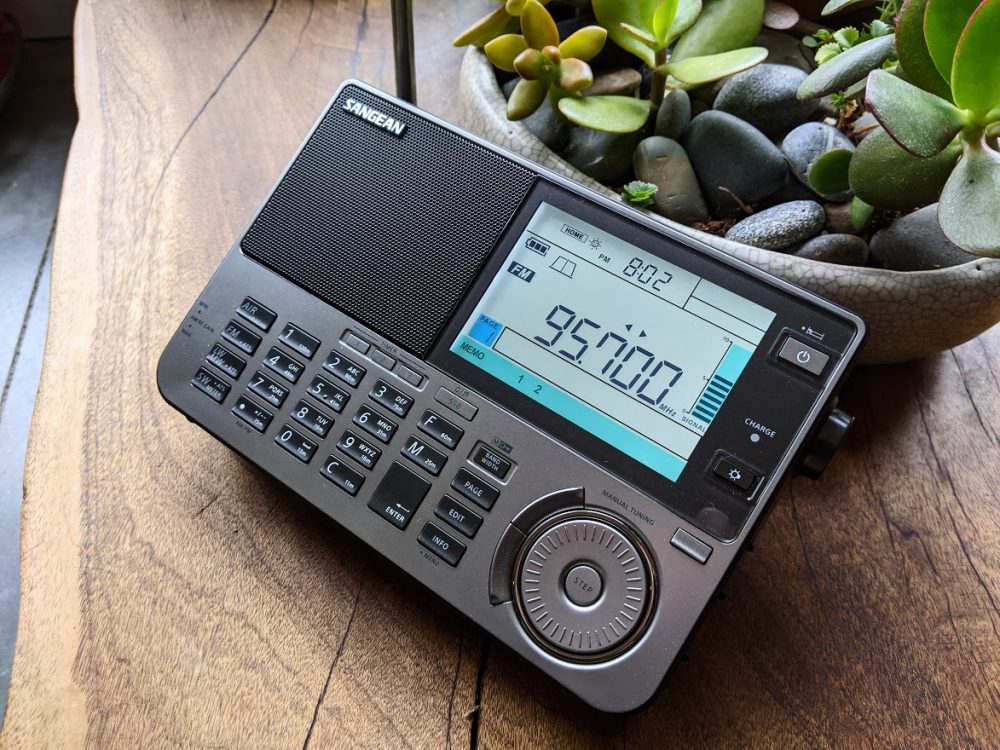
Dave’s review of the Sangean ATS-909X2

Many thanks to SWLing Post contributor, Dan Robinson, who notes that Dave (N9EWO) has posted his review of the Sangean ATS-909X2. Click here to view.

I must admit: as I put the Sangean ATS-909X2 through the paces, I’m impressed with this fine machine. While no radio is perfect, the ‘909X2 has enthusiast-grade characteristics.

The ATS-909X2 truly smacks of a shortwave portable from the 1990s–the halcyon days of digital portables, in my opinion. I personally love the ergonomics, display, audio, tactile front panel, numerous connections, and the quality chassis. It’s a pleasure to operate.

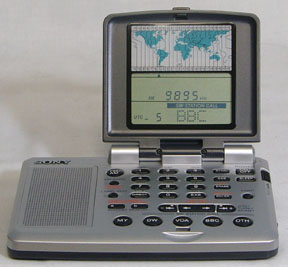
Would a Sony ICF-SW07 outperform a modern DSP radio?

Many thanks to SWLing Post contributor, William, who asks:

Hello,

Firstly thank you for the blog – I have been reading occasionally for several years – it’s really interesting.

I live in the UK. I own (was given as a gift many years ago) a Sony ICF-SW07 and have been playing with it for the first time in the while.

I’m wondering if you remember it or ever used it, and if you can give me a rough idea if a new radio, such as the latest Tecsun, have considerably better sensitivity – for SW and MW – or not?

Many thanks.
William

Thank you for your question, William!

To my knowledge, I’ve only used a Sony ICF-SW07 once and it was from a hotel room at a radio convention, so not ideal for really gauging anything other than economics and superficial qualities. I do know that my friend held it in high regard.  My inclination would be to say that the ICF-SW07 should hold its own and potentially even outperform many modern (late-model) portable receivers.

I do know this, William: in good condition, that ‘SW07 will fetch top dollar. I’m not sure I’d ever let go of it!

Sony ICF-SW07 owner comments and feedback?

SWLing Post readers: If you own the ‘SW07 and would like to share your thoughts with William, please comment!

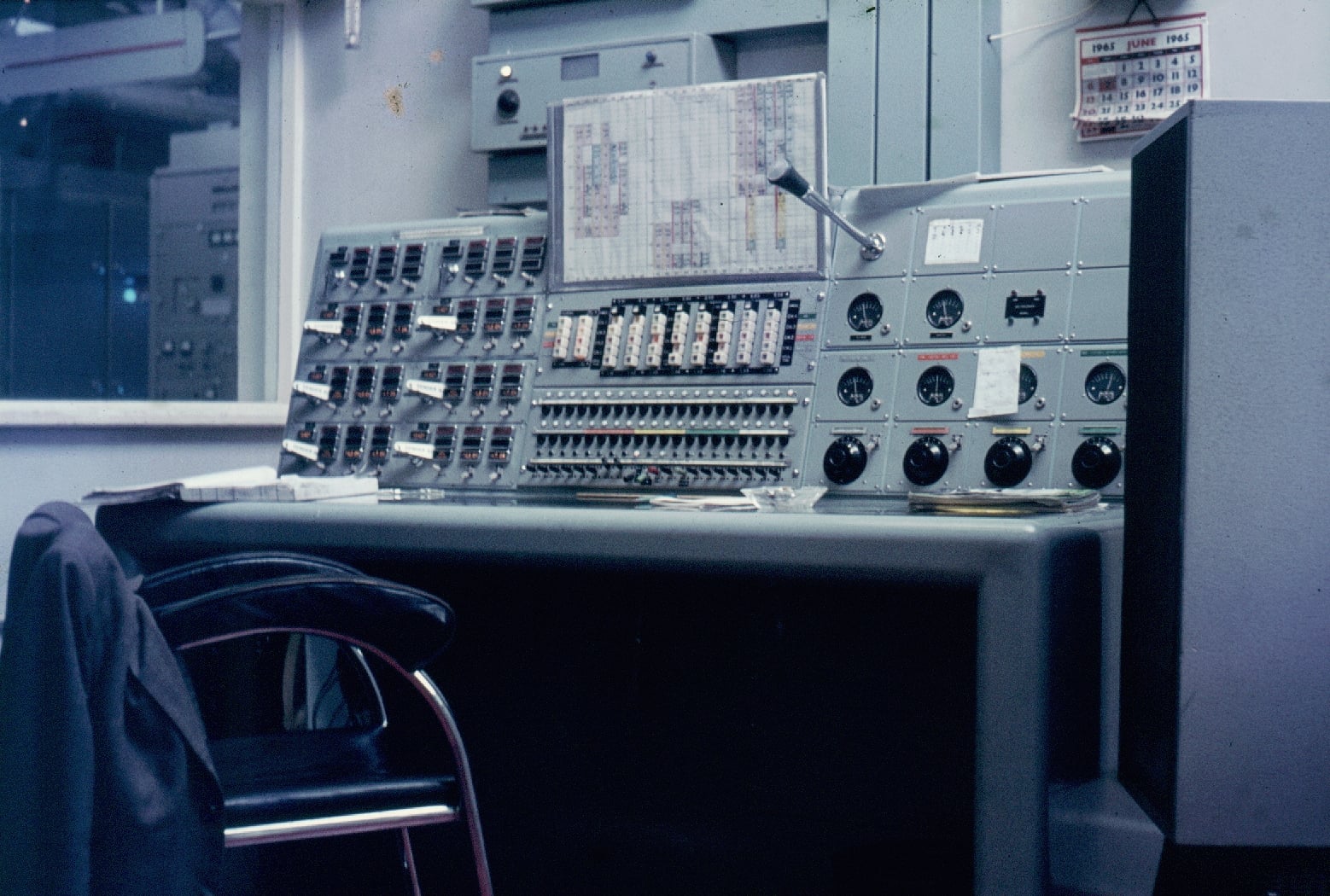
Woofferton Control Desk circa 1965

Many thanks to SWLing Post contributor, Dave Porter (G4OYX), who writes:

Thought you might like to post this pic (above) just in from Phil Brooks who used to be an engineer at Woofferton.

In front of the operator on the desk is what was described as “The External Services Operational Schedule”.

The WOF version was chopped into three eight hour periods. Where there is print the senders are ON. There are eight vertical columns and they correspond to Sender 91 to Sender 96. There are two blank columns on the RHS corresponding to Sender 85 and Sender 86 that were available but not scheduled.

Assuming that they chopped the schedule from midnight to 0800, 0800 to 1600 and 1600 to midnight then it appears that VoA services start up at 0100 and run through to 0630.

Similarly for end of night shift there is BBC starting at 0730 to cover for the maintenance break at Daventry and off at 0900. VoA resumes at 1300 and carries on until 2330 throughout day and evening shift.

WOF has a maintenance break 0900 to 1300.

The six “white flags”are the “Crater keys” and are an interlock device such that if the key is removed then the sender associated with it can’t be powered so that antenna switching can take place.

The view from the window shows part of Sender 92 in the actual sender hall.

The six Peak Programme Meters PPM (UK version of VU – but much better) show the audio on the sender output or input if selected.

This desk ran from 1963 to 1981. It was replaced when automation with a Control System (the WATCH) was installed. That ran from 1981 to 2008.

Thanks so much for sharing this, Dave. We always appreciate the context you add with a career in transmitting informing you!

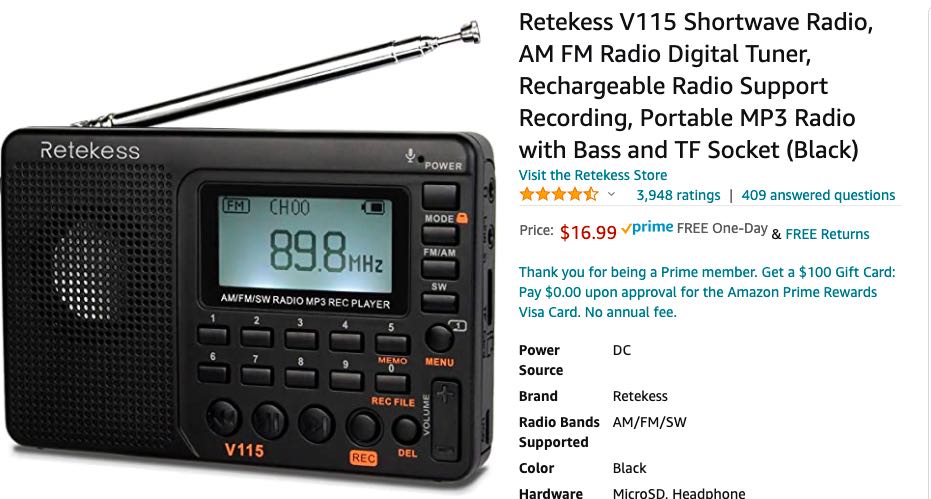
Retekess V115 on sale for $16.99 shipped

Many thanks to SWLing Post contributor, Christian, who writes:

Hi, Thomas, I just discovered that the Retekess V115 is currently $16.99 shipped on Amazon with free freturns. You might wish to mention this to your readers because this is a low price for this very inexpensive radio. As I mention with any Amazon sale, pricing is dynamic and can change at any time.

Thank you, Christian, for the tip! Readers: click here to read our previous reviews of this radio.

Click here to check out the Retekess V115 on Amazon.com (affiliate link).

Radio Waves: Mahboob Radio Service, AméricaTeVé owner to buy Radio Caracol, Tele-medicine via HF, and Battleship USS IOWA Radio Tour

Radio Waves:  Stories Making Waves in the World of Radio

Because I keep my ear to the waves, as well as receive many tips from others who do the same, I find myself privy to radio-related stories that might interest SWLing Post readers.  To that end: Welcome to the SWLing Post’s Radio Waves, a collection of links to interesting stories making waves in the world of radio. Enjoy!

Many thanks to SWLing Post contributors Kris (G8AUU), Tracy Wood, and Dan Robinson for the following tips:


Aging brothers in Hyderabad run last radio repair shop in southern Indian state (Arab News)

NEW DELHI: “Mahboob Radio Service,” reads the faded panel on a small repair shop near the 16th-century Charminar mosque in the heart of the old town of Hyderabad.

The shop, which has been open since 1948, is filled with thousands of radio sets stacked in the small space where two aging brothers have been repairing radios for as long as they can remember.

The brothers, Mohammed Mujeebudin, 82, and Mohammed Moinuddin, 71, learned the craft from their father, who started selling and repairing radios in the 1920s after a trip to Bombay, where he bought his first set.

“My father started Mahboob Radio Service from Dabeerpura in Hyderabad before moving to the present location in Chatta Bazar in 1948,” Moinuddin said.

He remembered his father’s most prominent customers, such as Viceroy Mir Osman Ali Khan, who ruled Hyderabad until the princely state’s merger with India.

“He was our client, and we would repair his radios. Once the work was done, we would deliver the radio to the palace and receive some 20 or 30 rupees,” Moinuddin recalled.[]

TV station owner AméricaTeVé owner exits Chapter 11, to buy radio station (Bizjournals.com)

The companies that own the AméricaTeVé and Teveo television stations have exited U.S. Bankruptcy Court and are preparing to make an acquisition.

America-CV Station Group, Caribevision Holdings, America-CV Network and Caribevision TV Network all filed Chapter 11 reorganization in 2019. The Hialeah-based companies own local stations WJAN (Channel 33 AméricaTeVé) and WFUN (Channel 48 Teveo), along with WJPX (AméricaTeVé Puerto Rico) in San Juan, Puerto Rico, and WPXO in New York.

[…]”América Teve has exited its Chapter 11 reorganization ahead of schedule and has paid off all of its debtors,” said attorney Marcell Felipe, who represents the company. “The company was recapitalized with new equity funded by Carlos Vasallo and the refinancing with Abanca of its valuable real estate holdings.”

Felipe confirmed that the company signed an agreement to purchase Radio Caracol 1260 AM in Miami to create a synergy between the radio station and its TV stations. The Spanish news/talk radio station was being sold by Grupo Latino de Radio, a subsidiary of Spanish media conglomerate PRISA.[]

SWLing Post contributor, Tracy Wood, notes: “An interesting medium wave note for SWLing Post readers. AM 1260 WSUA in Miami (50kw day / 20kw night) has been used in the past to relay Radio Martí for a few hours at night.”

GBT Completed Prototype Design of its Long-Range Radio Mobile System (Intrado GlobeNewswire)

SAN DIEGO, April 08, 2021 (GLOBE NEWSWIRE) — GBT Technologies Inc. ( OTC PINK: GTCH ) (“GBT” or the “Company”), completed its prototype design of its long range radio mobile system. The prototype mobile unit will be a high-performance radio transceiver system that is designed for data and voice applications. It is expected to enable data and voice communication for long range applications targeting telemedicine support for the Company’s qTerm vital device including audio.

The design of the prototype mobile unit includes a transceiver targeted for systems to operate under licensed/unlicensed radio frequency bands, enabling ultra-long-range applications. The unit is designed to communicate in the HF (High Frequencies) frequencies bands to establish connection with a base unit transceiver through repeater unit(s) to reach ultra-long range. High clarity, signal reliability and security is expected to be achieved through the implementation of advanced circuitry within the system’s components. The design includes embedded software to manage the data and audio communication including data transfer to a backend server to process data. The design also provided for the mobile unit’s design, size and interface, taking into consideration performance and mobility. The operation of the mobile unit is expected to be done via an LCD touch screen providing user’s friendly interface and ease of use. Upon getting team’s FCC certification, an extensive mobile unit’s testing will start. GBT plans to test the entire system within a large city limits and national ranges.

“We are glad to announce that we completed the design of our prototype long range radio mobile unit. The prototype mobile unit is a key component since it is targeted to be portable aiming to bring modern life services around the globe. The design contemplates an acceptable physical size to be carried coupled with a high-power energy source and long range capability. As the system is targeted to work with the qTerm vital device, the design contemplates users being able to send vital information to professional health authorities for quick review and recommendations. In addition, the design has incorporated a voice communication will be available to discuss further steps and actions. We believe that in our days and age everyone should have access to modern amenities and the key is global communication. For us, the most important contribution of such system is the capability to save lives by enabling health and emergency services anywhere on earth” stated Danny Rittman, the Company’s CTO.

There is no guarantee that the Company will be successful in researching, developing or implementing this system. In order to successfully implement this concept, the Company will need to raise adequate capital to support its research and, if successfully researched, developed and granted regulatory approval, the Company would need to enter into a strategic relationship with a third party that has experience in manufacturing, selling and distributing this product. There is no guarantee that the Company will be successful in any or all of these critical steps.

Mobile unit prototype: https://www.globenewswire.com/NewsRoom/AttachmentNg/36d838e9-eb3a-423e-8b1a-058c420549a8[]

Battleship USS IOWA Museum: IOWA’s Radios – Part 1 (YouTube)


Do you enjoy the SWLing Post?

Please consider supporting us via Patreon or our Coffee Fund!

Your support makes articles like this one possible. Thank you!
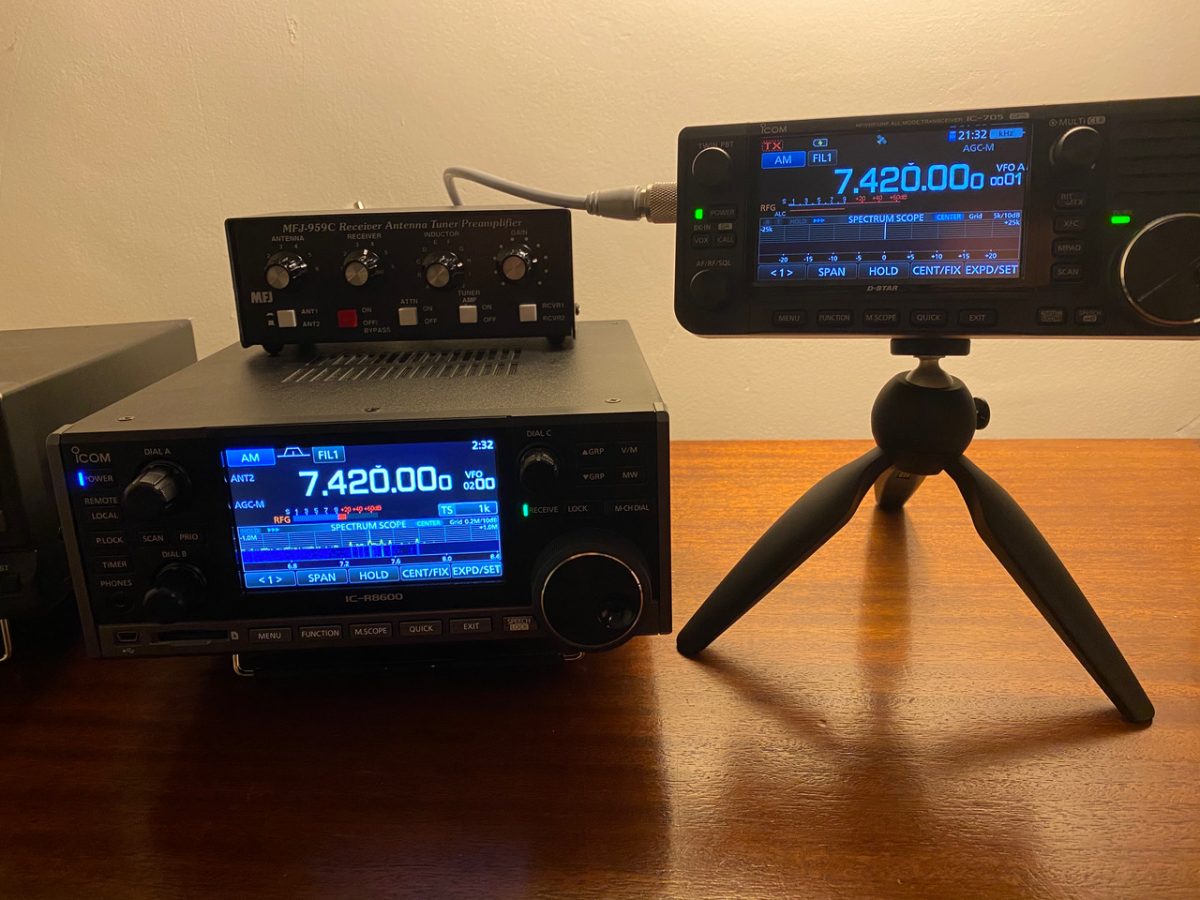
Giuseppe compares the Icom IC-R8600 with the IC-705

Many thanks to SWLing Post contributor, Giuseppe Fisoni, who reached out a few weeks ago noting that he was very impressed with the Icom IC-705‘s receiver performance even compared with his Icom IC-R8600 wideband receiver.

I asked Giuseppe if he would perhaps write up a short informal report to share here on the SWLing Post. He just sent me the following notes:


Hi Thomas,

[…]Consider this more of a qualitative comparison – just S meter readings with a few brief notes.

My overall impression is that the IC-705 is a fantastic SW receiver, as you’ve already made clear on all your posts. In most cases, it holds up well against the IC-R8600, and even performs better in some cases. I have some notes below, which you are welcome to share with your readers if you’d like. For a while I also had two IC-705s in my hands, so I even got to test “replicas” with the 705 (there was no major difference but it was still fun to do).

A few things about my comparisons:
1. All tests were done using a 50’ long wire antenna (house to tree) with an un-un.
2. The IC-R8600 was operated using an ICOM AC adaptor (creating a disadvantage), while the IC-705 was run on battery. However, I tried to only compare stations where the noise floors were comparable and the 8600 didn’t have any RFI.
3. I tried my best to normalize the RF gains on each radio, but this became somewhat difficult. I’m not sure if they are on the same scale (i.e. does 80% RF gain mean the same thing on both radios?). Also, I very quickly noticed that turning up the RF gain on the 8600 only increased the S meter reading and apparent noise floor on the waterfall spectrum, but it did not actually make the audible signal or noise audibly stronger. This was especially true from 50% and up on the RF gain. In contrast, the RF gain on the 705 operated as you’d expect – the more you turned it up, the higher the gain on the signal (and noise), evenly across 0-100%.

Test #1

2021.02.08
0211 UTC
3,330 kHz CHU

IC-705: weak signal but audible, S6
IC-R8600: no signal!

Winner: clearly 705. Shocked the 8600 couldn’t pick up CHU!

Test #2

2021.02.08
0219 UTC
3,215 kHz WWCR Nashville

IC-705: S9+20
IC-R8600: S9+20 to S9+40.

Winner: Tie – although the 8600 had a stronger signal on the S meter, it didn’t really sound any better than the S9+20 on the 705.

Test #3

2021.02.18
1958 UTC
9,690 kHz Radio Espana Exterior

IC-705: S9 to S9+10
IC-R8600: S9+20

Winner: Another tie – the stronger signal didn’t make much of a difference. The 8600 only sounded slightly better because of its speaker, not the receiver, so I’m calling it a tie.

Test #4

2021.02.18
2001 UTC
10,000 kHZ WWV

IC-705: S3, very weak
IC-R8600: S7 to S9 but high atmospheric noise

Winner: 8600

Test #5

2021.02.18
2006 UTC
11,820 kHz Radio Riyadh

IC-705: S1, barely detectable
IC-R8600: S5 to S7, intelligibility unstable

Winner: 8600

Test #6

2021.02.18
2012 UTC
15,000 kHz WWV

IC-705: S3 to S5
IC-R8600: S9, slightly clearer and crisper tones

Winner: 8600, but not by much

Test #7

2021.02.18
2015 UTC
15,580 kHz VOA Selebi-Phikwe, Botswana

IC-705: S1 to S3, in and out with fading
IC-R8600: S9, much more stable signal

Winner: 8600

Test #8

2021.02.19
00016 UTC
7,780 kHz WRMI Slovakia International

IC-705: S9 solid, stable signal
IC-R8600: S9, same

Winner: Tie

Test #8

2021.02.18
0022 UTC
6,604 kHz USB Gander VOLMET

IC-705: S5 to S7
IC-R8600: S9

Winner: Tie, no real difference

Test #9

2021.04.09
2335 UTC
11,940 kHz Radio Exterior Espana

IC-705: S5 to S9 solid signal with some fading
IC-R8600: S9

Winner: Tie – no obvious difference

Test #10

2344 UTC
9,420 kHz Helliniki Radiophonia, Greece

IC-705: S9 +20. Excellent signal
IC-R8600: S9+ 20-30. Excellent signal

Winner: Again, a tie. But the wonderful Greek music reminds you again how much better the speaker is on the 8600.

Overall

Here’s the important thing: even though in most cases the IC-R8600 pulled in a much higher S meter reading, it often didn’t matter unless the difference between the two radios was a lot. In cases where it mattered, I could have turned up the RF gain or preamp on the 705 to match the signal on the 8600 (unless it was really weak on the 705), but I was trying to avoid that for the sake of having some baseline for comparison. How comparable are RF gain levels across ICOM radios?

IC-705 pros/cons take aways for me:

    • High level of portability and ability to operate on battery
    • Has desktop-like features and controls
    • Ability to use tripod or custom stand offers custom ergonomics (I found it easier to look at and interact with than the 8600, which has a lower angle of display)
    • All-in-one package: SWR + HF/VHF/UHF transceiver
    • Built-in audio speaker leaves a lot to be desired, definitely not desktop receiver audio quality
    • No stereo headphone jack

My verdict

I am quite impressed with the IC-705! I am looking to downsize my radios and these comparisons have convinced me that the 705 can really check a lot of boxes for what I am looking for in a radio. I think it really offers a lot in a small footprint, which I find very impressive. So, since I have no use in monitoring anything above UHF, I will be looking to sell the IC-R8600, even though it is also a very great radio.

All the best,
Giuseppe


Fascinating report, Giuseppe! Thank you so much for taking the time to perform these comparisons and sharing them with us.

Like you, I believe the IC-705 could replace a number of my other radios. I originally purchased it for my review and planned to sell it after, but quickly realized there’s no way I’m selling it. In fact, it could convince me to sell other radios it effectively makes redundant.

For SWLs who have limited space for a listening post in their home and who like to take their radio to the field, the IC-705 is a no-brainer. It’s an investment at $1,300 US, but I believe it’s a quality rig and certainly an outstanding, feature-packed unit.

I’ve found that the IC-705’s performance on HF and Mediumwave is truly DX-grade. I imagine its FM performance is as well.

It’s funny that you mention the IC-705 front-facing speaker as a con, because I often tout it as a pro. Thing is, I’m most often comparing the IC-705 with other field-portable QRP transceivers. Compared with them, the IC-705 speaker is amazing.  But compared to the IC-R8600 or, say, a Drake R8B or SW8? Yeah, I agree with you 100%–it’s just not in the same league with those tabletop receivers. Of course, you can port out the audio to a better speaker if needed. (Indeed, the IC-705 even has built-in Bluetooth!)

Thanks again for sharing your notes with us, Giuseppe!