Shortwave listening and everything radio including reviews, broadcasting, ham radio, field operation, DXing, maker kits, travel, emergency gear, events, and more
Many thanks to SWLing Post contributor, Jack, who writes:
Greetings,
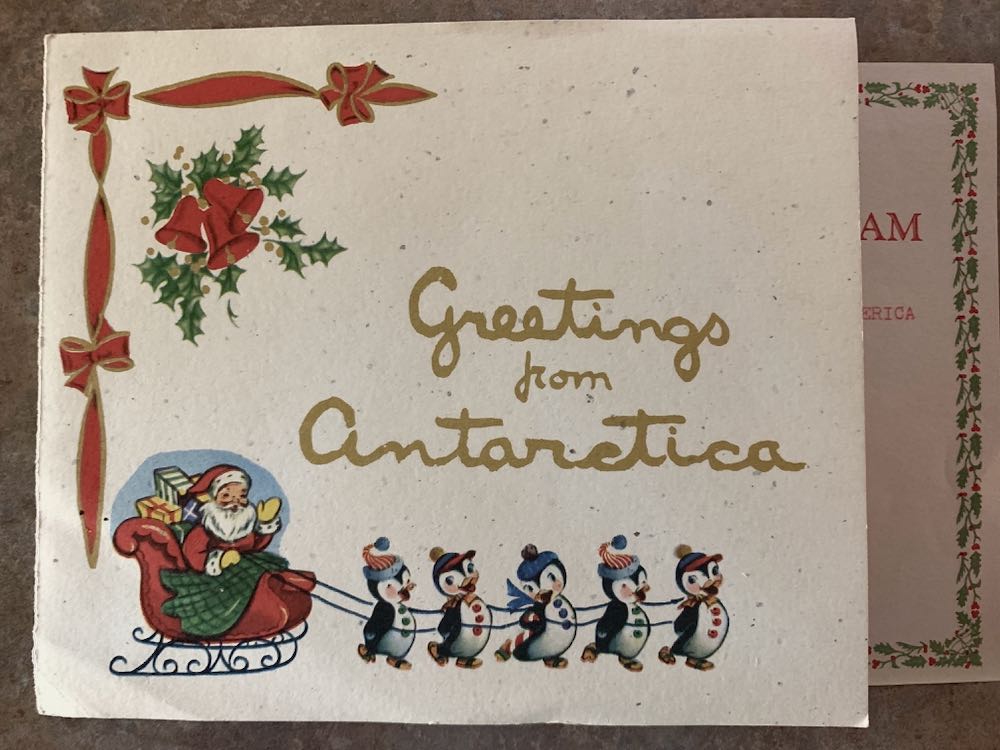
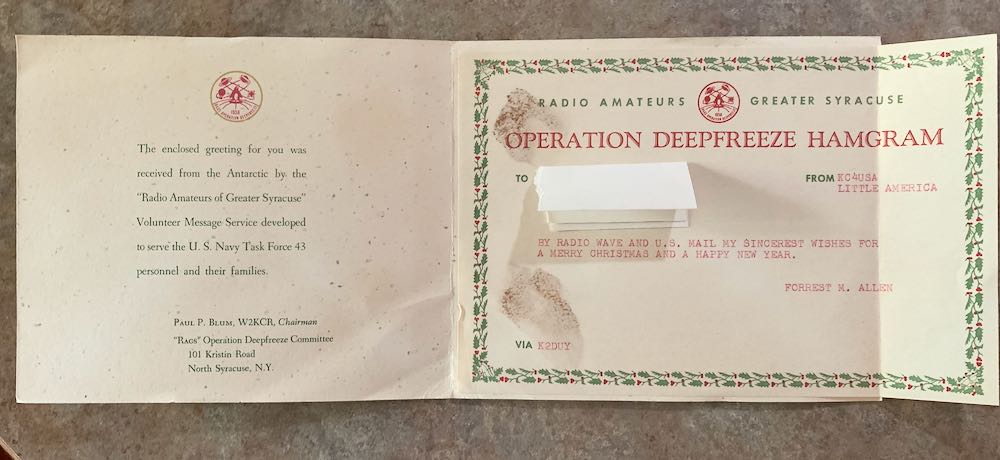
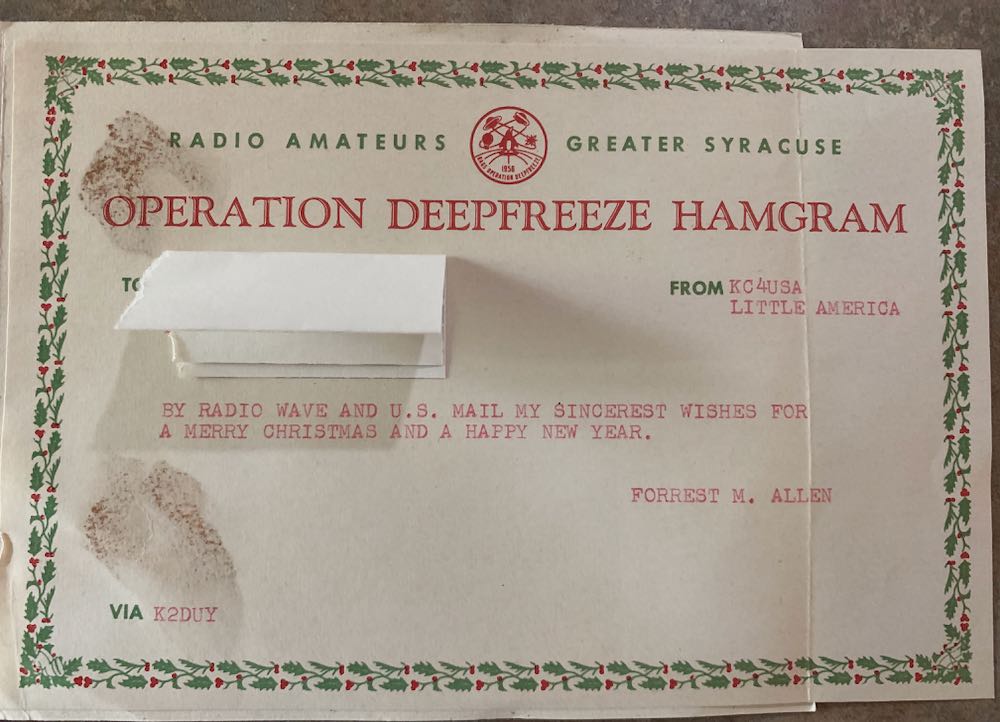
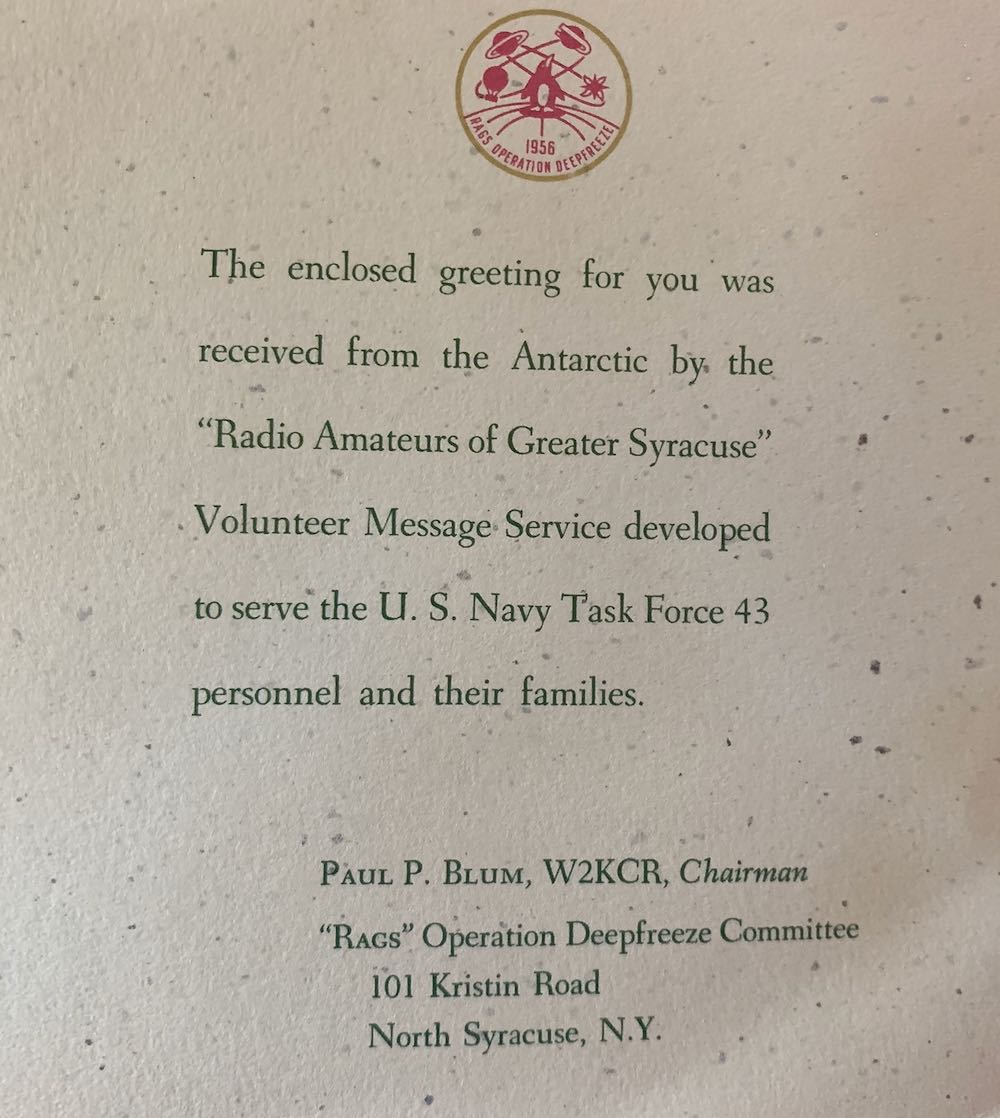
I was going through some old paperwork that belonged to my father-in-law, and I found a Christmas Greeting Card postmarked December 1956.
The card contains greetings from the Antarctic, received by the Radio Amateurs of Greater Syracuse, then forwarded to my father-in-law at his posting at NAAS Barin Field in Foley, Alabama.
I thought you might find this old piece of amateur radio history to be interesting. I attached images of the card.
I am new to the SW listening world, and I have found your blog to be very helpful. My Tecsun PL-660 is keeping me quite busy.
Regards,
Jack
Photos
(Click to enlarge)
Wow! Thank you so much for sharing this, Jack! I think we all need a little “Christmas in July” cheer right about now!
I’m so happy to hear you enjoy the SWLing Post and happy that Tecsun PL-660 is serving you well. It’s a great little radio!
Radio Waves: Stories Making Waves in the World of Radio
Because I keep my ear to the waves, as well as receive many tips from others who do the same, I find myself privy to radio-related stories that might interest SWLing Post readers. To that end: Welcome to the SWLing Post’sRadio Waves, a collection of links to interesting stories making waves in the world of radio. Enjoy!
Many thanks to SWLing Post contributors Tony, Mike Terry, and the Southgate ARC for the following tips:
Sealand is an unrecognized micronation off the coast of England, established in the 1960s and issuer of stamps, passports and occasional offshore business shenanigans (“BECOME A LORD“). But Sealand is also a rotting sea fortress in need of constant maintenance. Atlas Obscura met the two caretakers who spend two weeks at a time doing what they can to keep the statelet running smoothly. Dylan Taylor-Lehman’s feature article is a great introduction to the place, if you’re not familiar with it or its wild history.[…]
Understanding bitcoin is difficult. And so we cast around for the perfect metaphor. Bitcoin is email. Digital gold. eCash.
Here’s a new one. Bitcoin is ham radio.
Bitcoin is old-fangled. It takes days to download the Bitcoin blockchain, just like it took forever to download software back in 1994. In an age of instant email and real-time Zelle payments, a bitcoin transfer takes 60 minutes to safely settle. It’s more volatile than gold, a relic of our previous monetary system. Thousands of computers are constantly replicating each others’ work, making it vastly inefficient. And lastly, there’s no privacy. Like a medieval marketplace, everyone can see everybody’s holdings.
All of these features are anachronistic. But they do sum up to something unique. What exactly is that thing?
A ham radio allows its operator, otherwise known as an amateur radio operator, to use certain bands in the radio spectrum to communicate by voice or code. This is an old technology. Italian inventor Guglielmo Marconi became the first ham radio operator in 1897 when he transmitted Morse code across Salisbury Plain in England.
It seems odd that something as archaic as ham radio continues to exist in a world with email, Snapchat, iPhone and Facebook. A ham transmission can only be used over a couple of kilometers. No emojis. No video. No gifs. Forget about privacy! Anyone can listen into your radio conversation.
Yet, ham radio is a very active niche. Associations all over the world keep the hobby going. According to the American Radio Relay League, there are some 764,000 ham radio operators in the U.S. Japan has more than a million. The International Amateur Radio Union pegs the global number of amateur radio licensees at 3 million.
Like ham radio, Bitcoin is for hobbyists. I’m not talking here about all of the frenetic speculators who keep their coins at Coinbase. I’m talking about users who can run a full node, use Lightning, securely store their own coins and make frequent transactions with the stuff. This pool of bitcoiners is tiny. It’s probably smaller than the number of active licensed ham radio operators.[…]
In this video Howard WB2UZE and John K2NY of the Long Island CW Club talk to David W0DHG about their CW training program
The club started in 2017 offers over 45 hours of CW classes EACH week, and has grown to over 600 members from all 50 states and 15 countries all over the world.
On July 4, 1970, the countdown started. Originally hosted by Casey Kasem, American Top 40 played “the best selling and most-played songs from the Atlantic to the Pacific, from Canada to Mexico,” as he stated on the first program broadcast 50 years ago as of tomorrow.
On any given week, American Top 40 could feature a ballad, next to a country song, next to a funk song, next to a rock song. The show became a national obsession but 50 years ago, it was considered a risky idea.
“You remember, at the end of the ’60s, Top 40 was not the most popular format,” Casey Kasem told NPR in 1982. “And here we were coming along with a show called American Top 40, and people said, ‘You must be nuts!’ “[…]
Many thanks to SWLing Post contributor, Pete Madtone who shares the following announcement from Radio Lavalamp:
Can you pass the ham radio test?
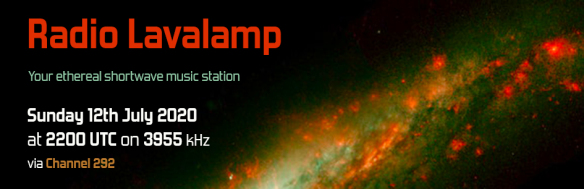
Tune in to DJ Frederick’s Radio Lavalamp on Sunday 12th July at 2200 UTC (11pm UK time) on 3955 kHz via Channel 292. The transmission will feature amongst other things One Deck Pete with a mix called The Purple Nucleus of Creation 001 featuring Carlos Pizzetti, Zane Moss, Julie Østengaard, Mahamboro, Blundetto and this great tune below from 100th Monkey.
Tune in to Radio Lavalamp, your ethereal shortwave music station on 3955.
#shortwavesnotdead #radiolavalamp #Thepurplenucleusofcreation001
Radio Northern Europe International #6 & TIAEMS July 2020 annoucement!
Hello everyone,
This is just a little announcement post for the next instalment of RNEI!
Our show for July 2020 will have a few pop, traditional and dance songs for you to enjoy!
We are also trialling a digital text system using MFSK16 that could potentially run throughout next show. It’s a little above 5K audio so to decode it you will need to adjust your equipment to receive it!
A reminder to go to https://rnei.org/stereo/ to learn how to decode the stereo in our broadcasts.
Just in time we managed to get the TIAEMS segment into the final show file and I’ve literally just finished listening to it and I can confirm it is good so hopefully you stick around for that!
Schedule
Sunday the 5th of July 2020, 18:00 UTC, 6070 kHz, Zone 1+2
Saturday the 11th of July 2020, 18:00 UTC, 6070 kHz, Zone 1+2
Friday the 17th of July 2020, 10:00 UTC, 6070 kHz, Zone 1
Saturday the 25th of July 2020, 00:00 UTC, 6070 kHz, Zone 2+
Sunday the 26th of July 2020, 18:00 UTC, 6070 kHz, Zone 1+2
The current list of speakers and their topics looks interesting (click here to read), and I thought you and other readers of the SWLing Post might be interested as well.
Thank you so much for the tip, Franco. I’ve been meaning to post an announcement about this online event. It seems to have attracted a lot of vendors and at least early bird registration for the show is free. Vendors do pay fees to host virtual booths at the events.
There are a number of great presentations in the line-up, so I would highly encourage readers to check out the presentation schedule and register for the expo.
Many thanks to SWLing Post contributor, Kris Partridge, who shares the following article that notes the UK will not follow a Norway-style digital switch-off. Rather, broadcasters will be allowed to switch off individual AM (and eventually FM) transmitters once they determine it is no longer a cost-effective strategy.
Analogue commercial radio licences to be given ten-year renewal
Analogue commercial radio licences due to expire in the next couple of years will be given a 10-year extension under new government plans.
During a consultation, the Department for Digital, Culture, Media and Sport had originally proposed either 5 or 8 year extensions, but in light of the Coronavirus pandemic’s impact on commercial radio revenues has decided to offer stations an extra 10 years.
[…]Minister for Media and Data John Whittingdale said: “As we move into an increasingly digital world we’re making sure the licensing landscape for radio is fair and up-to-date and allows audiences to enjoy a wide range of high-quality stations.
“Today’s step ensures there is no disruption for loyal listeners of treasured FM and AM radio services such as Classic FM, Absolute Radio and TalkSport over the next decade.
“We will soon be turning our attention to providing similar long-term certainty to support the future growth of digital radio.”[…]