Author Archives: Thomas

Using Adobe on Android to read The Spectrum Monitor magazine

Many thanks to SWLing Post contributor, Bill Hemphill, who writes:

I was very happy to see your post about The Spectrum Monitor magazine. Like you, I am a big fan of it and have subscribed for several years and have purchased the archived years.

Usually, I am not a fan of digital magazines. They either are in special formats requiring special programs or even special versions of Acrobat. Like you, I was happy to see that it is in standard PDF format.

But that still brought up a problem. With my eyesight, I need to zoom in on the page to read it, even when using a 10” tablet and definitely if using a smaller screen such as my phone. Normally it means panning around the page, reading column one down and then going back to the top of the page to read the second or third column.

But there is some good news that many people may not be aware of. The Acrobat Reader app on the Android system allows for a mode called “Reading Mode”. What reading mode does is stack the columns up into a single column thus allowing for reading straight down – no more scrolling back to the top of the next column. And you can tap on the screen to enlarge the text and the text will reformat in a larger font to fit the margins of the screen.

I took some screen shots of TSM using Adobe Reader on my Android phone.

On the left is the complete page, on the right I have tapped on the page and while it enlarged it, I now need to scroll around to read it:

Following screen shot shows the “View Setting” Settings and “Page-by-Page” is the default setting.

What you want do is change this to “Reading Mode”:
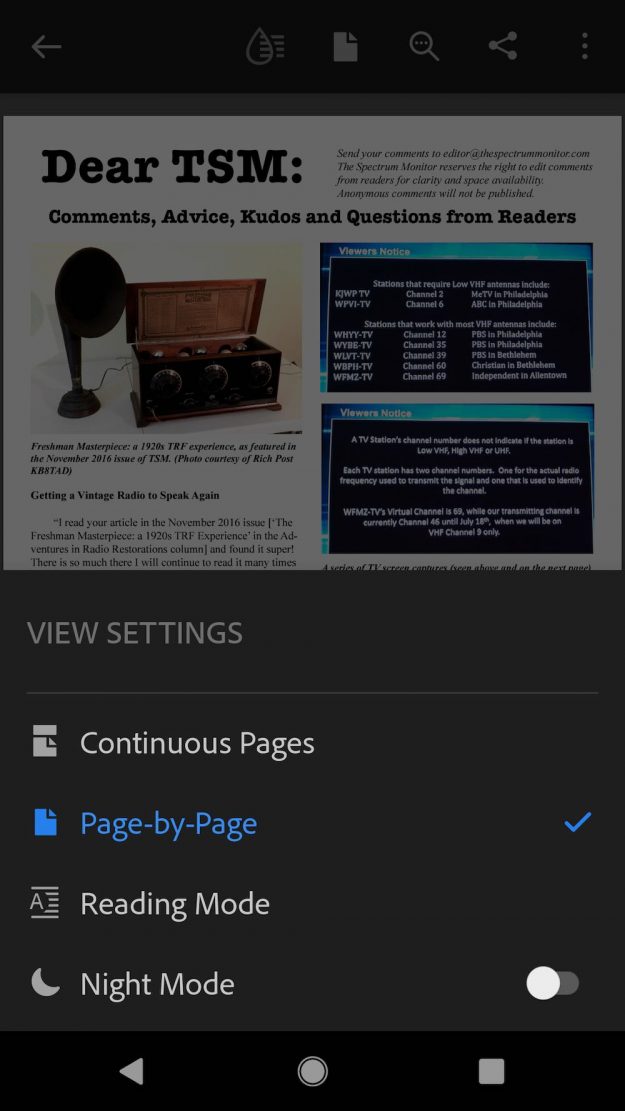
Once you have selected “Reading Mode” you will find that the columns are now stacked vertically and you can read my just scrolling down. No more going back to the top for the next column. Also, taping on the text will enlarge it and reflow it to fit the device screen.

Left screen shot is after selecting “Reading Mode” and right is after tapping the screen to enlarge the text:

With Reading Mode, I find I can even read TSM on my Cell Phone Screen as well as my tablets.

Note: Reading Mode only works with PDF’s that have been created with this is mind. It obviously won’t work with PDF’s created from scans.

Unfortunately, while there is a “Read Mode” in Acrobat Reader DC for Windows, it does not stack the columns like the Android version does. I’m not sure if the Acrobat Reader for iPhone works the same way as Android.

Hope this is of help to others.

73
Bill Hemphill
WD9EQD
Smithville, NJ

Thank you so much, Bill, for sharing your tip! You make a really good point, too, that PDF publications give you the flexibility to change text size and adjust layout through Adobe Reader so that it’s quite easy to read even on a small device. I’m also a huge fan of PDF documents and wish other radio publications would consider adopting the PDF format instead of replying on proprietary readers and apps.

Click here to check out The Spectrum Monitor magazine. 

Spectres of Shortwave: Amanda Dawn Christie’s film about RCI Sackville now streaming

IMPORTANT UPDATE – Amanda Dawn Christie notes:

“Unfortunately [this video] was never supposed to be public – it was an accident on my part. The film will be viewable soon though, for seven days. May 26 to June 1. It is being hosted by a gallery in Montreal. That upload was only a test for them, and should never have been public. I was in a hurry, trying to get it uploaded before I packed my hard drives before I moved and I guess I didn’t check all the settings. Sorry about that. I appreciate the enthusiasm though.”

SWLing Post friend and filmmaker, Amanda Dawn Christie, has just uploaded a version of her film Spectres of Shortwave to Vimeo where it can be viewed free of charge:

Click here to watch on Vimeo.

Finding local Emergency Alert Stations in the US

Many thanks to SWLing Post contributor, Mario Filippi (N2HUN), who shares the following guest post:


Emergency Alert Stations: A great source of local information

by Mario Filippi

During the pandemic a source of local information for residents in certain areas of the country can be found on Emergency Advisory Radio stations that dot the country and provide 24/7 information pertinent to a community.  Not all communities have these stations, which can be found from 1610 – 1710 kHz and operate at varying power outputs.

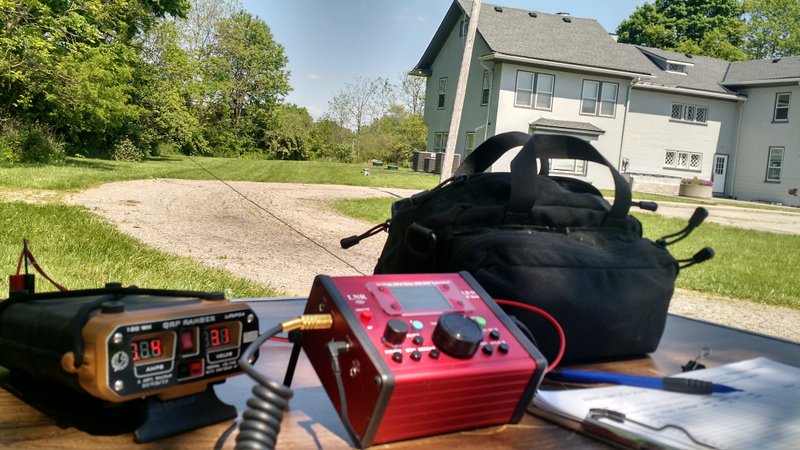
Author’s Yaesu FRG-100 tuned to EAS station

For example, a station I regularly hear is WRBX655 about 12 miles away in Franklin Township, NJ operating on 1630 kHz : https://www.franklintwpnj.org/Home/Components/News/News/6384/1130?cftype=News

At the moment it is broadcasting information on COVID-19 from the Center for Disease Control.  Every EAS  station has a call sign and wattage generally is from about 10 – 50 watts. However some stations do not necessarily announce their call signs so you can check theradiosource at: http://www.theradiosource.com/resources/stations-alert.htm

Now some of these stations are part of the HAR (Highway Advisory System) that broadcast on major roadways and usually have prominent road signs announcing where to tune your car’s AM radio for latest traffic conditions.  These stations were also termed TIS (Traveler’s Information Stations) at one time and were the precursors of HAR.  However, over the years the FCC allowed more leeway on what information could be broadcast and as a result these EAS stations appeared in communities and even state parks.

You can look up the locations of these stations to ascertain if one serves your community but the best way is to tune regularly from 1610 – 1710 kHz.  The optimal time to listen is during daylight hours as propagation changes greatly after dark and you’ll hear commercial AM radio stations coming in and overpowering most EAS.  As for range, I’ve heard HAR stations as far away as 40 miles depending on ground wave conditions which can vary greatly. QSB is common. Many of these stations will rebroadcast NWS weather information when no pertinent emergencies exist and that is another way to spot them. Some highway stations I’ve heard will begin each broadcast loop with a tone, they’re all different in their approach.

Attached [at the top of the page] is a picture of the author’s Yaesu FRG-100 tuned to WRBX655 from Franklin Township, New Jersey. For an antenna I’ve used a 31 foot vertical and a loop and success will depend on using an outdoor antenna but when away from the home QTH, I’ve heard many of these stations while traveling on the roadways of America, They’re a good break casual AM radio listening.  Give it a try.


Thank you, Mario! I must admit that when I travel, I often hunt down EAS transmitters via my car’s AM radio. Besides being a good source of local information, I do know some DXers who’ve identified and logged an impressive number of distant stations when conditions were ideal. 

If you live outside the US, do you have similar networks for local information? Please comment!

BBC: “How amateur radio is connecting people during lockdown”

Many thanks to SWLing Post contributors, Kris Partridge and Mark Hirst, who share the following article from the BBC:

Coronavirus: How amateur radio is connecting people during lockdown

By Vanessa Pearce
BBC News

Amateur radio use in the UK has seen a “significant” rise during the coronavirus lockdown as people seek new ways of staying connected. The national body that represents users – the Radio Society of Great Britain (RSGB) – has said many people who formerly enjoyed the hobby are also returning to it.

Mark Rider’s social life before the coronavirus lockdown consisted of the occasional trip to the pub, rehearsing with musician friends and visiting his wife in her care home.

“But when I knew that wasn’t going to happen any time soon I decided to dust off my amateur radio equipment to seek out some other social interaction,” he says.

Mr Rider, a retired engineer from North Warwickshire, said “ragchewing” – or chatting to people on the airwaves – “has become one of the highlights of my day”.

“Because I live on my own, and because of lockdown, I knew I couldn’t do what I used to do, which wasn’t going to be very good for me or my mental health.”

The 67-year-old says keeping in touch with others has been more important since his wife was taken into care after a stroke.

“Just speaking to somebody else in the same situation is very rewarding,” he says.

The RSGB defines amateur radio as a “technical hobby for people who want to learn about, use and experiment with wireless communications”, like Mr Rider, who uses his radio kit to speak to others using designated radio frequencies.

Steve Thomas, RSGB general manager, says the organisation has experienced a threefold increase in the number of people asking to sit licensing exams since social distancing rules came into place. There are currently about 75,000 licensed users in the UK.

“Across the country, clubs and individual radio amateurs are supporting one another by setting up ‘nets’, or online meetings,” Mr Thomas says.[…]

Continue reading the full article at the BBC.

Thank you for sharing this excellent article! A number of readers have been commenting about how much more activity there is on the ham radio bands these days. I concur! With everyone at home, ham radio certainly does provide a way to reach out and be a part of a larger community.

Pete seeks rechargeable battery pack options for his Wellbrook loop antenna

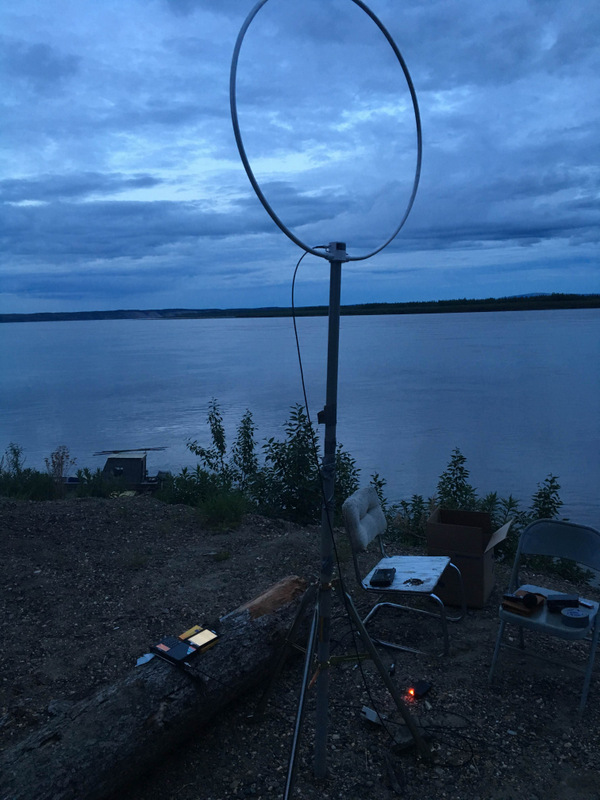
Paul Walker’s battery-powered Wellbrook antenna in remote Alaska.

Many thanks to SWLing Post contributor, Pete Jernakoff, who writes:

[…]I’m hopeful that one of your readers might be able to suggest a solution to my problem.

I have an older Wellbrook Communications active loop antenna that is powered by a 12 v AC-to-DC, center pin negative, plug-in power supply (Stancor AC Adapter, was supplied with the antenna).

I’d like to power the antenna from a rechargeable battery in order to make the antenna portable and to eliminate any noise that might be emanating from said power supply (which, as an aside, runs very warm when in operation).

My problem is that I cannot find any rechargeable batteries (lithium ion preferred) with a center pin negative output. All of the ones that I can find online have center pin positive outputs (such as the TalentCell 12V/6000mAh rechargeable battery that I’ve purchased to power my other, more recently produced, Wellbrook Communications active loop antenna whose amp needs a center pin *positive* input).

Thanks in advance for consideration of my request. Btw, love your blog! I’ve been an avid reader of it for quite some time now.

Post readers: If you have any suggestions for Pete, please comment with any relevant links to help him make the purchase. I’m guessing Pete isn’t interested in re-soldering a coaxial plug for negative tip polarity at this point.

By the way, I used a photo of Paul Walker’s Wellbrook at the top of this post because I recall that when he lived in Alaska, he powered his Wellbrook loop with a rechargeable pack (and during the winter, I also recall he struggled to keep it warm enough to provide power for any length of time!). Perhaps Paul can comment.

I’m so glad you enjoy the SWLing Post, Pete!

NBC Logos throughout the years

A member of the Old Time Radio Lovers group recently shared the image above that includes all of NBC’s logos dating back to 1926. Some of these are truly iconic.

Of course, versions of the rainbow peacock have been used most of my lifetime, so they’re immediately identifiable. I also like the NBC “snake” logo used between 1959-1975.

But if I had to pick my favorite, it would be the 1942 logo.

How about you? What is your favorite logo?  Please comment!

Ted inherits two vintage receivers and a 1959 UK Receiving License

Many thanks to SWLing Post contributor, Ted Lampert, who writes:

I was given some old radios belonging to a family member who passed a few years back.

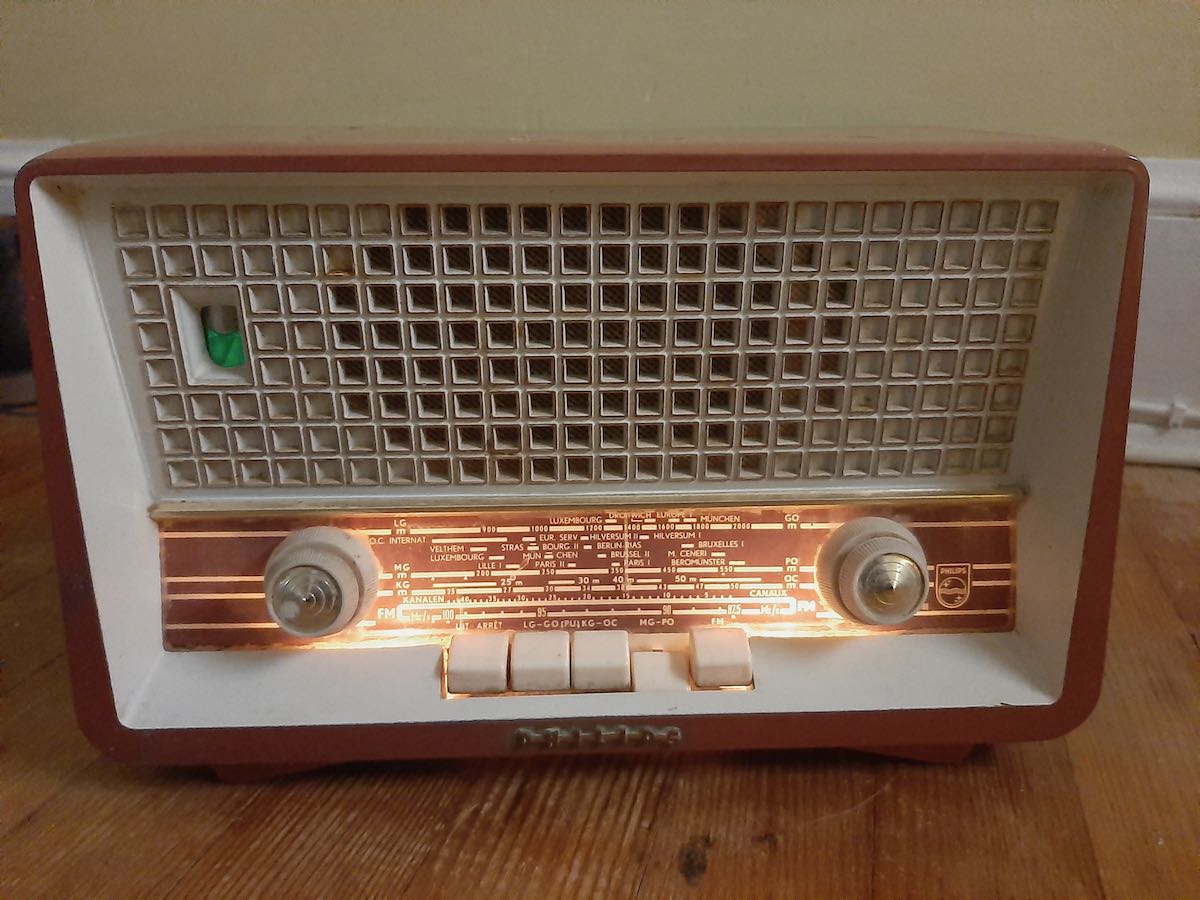
A couple of them really sweet, a Philco 46-420, and a Philips B3X82U (see photo above).

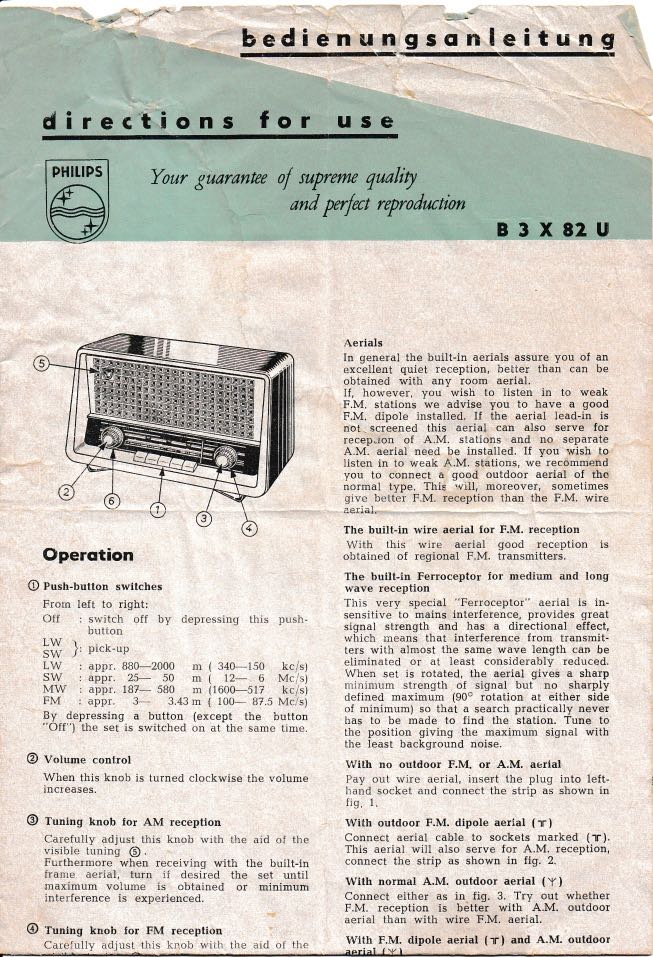
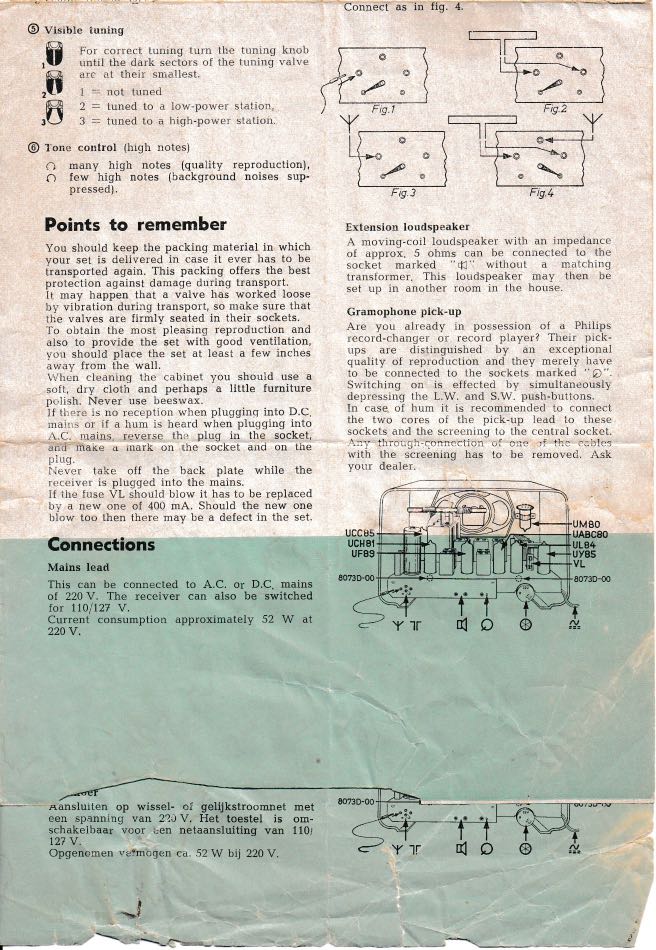
Included was an envelope with some papers in it. One was the instruction booklet for the Phillips B3X82U, in multiple languages:

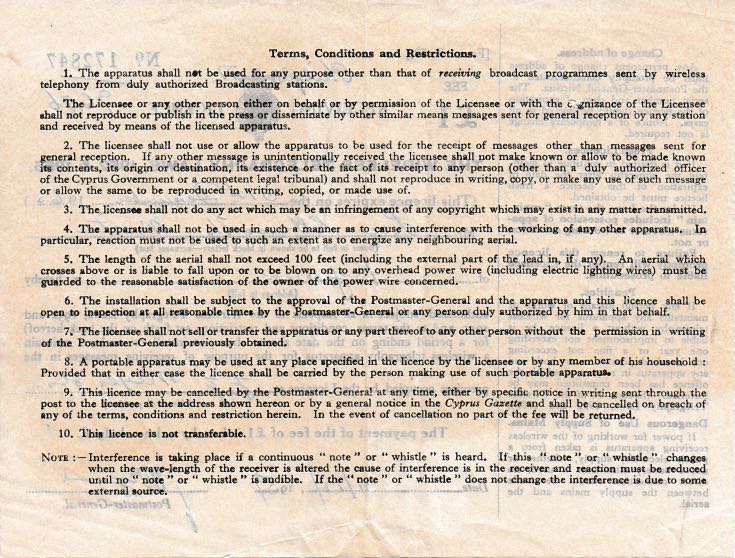
Another was a receiving license.

Without outing him too much, the original owner did government work and was stationed overseas quite a bit. The license looks like it was good for 1960, and I’m guessing you went to the post office to get it. It references the wireless telegraphy laws 1952 & 1955. Have you seen one of these before and do you know much about these receiving licenses?

The Philips is the radio I believe would have been probably what he got this license for since it says Philips at the top of it.

[…]Anyway, going through stuff recently, saw the license and started wondering about it.

Keep up the good work, seeing almost daily new articles on your site played a big part in keeping me inspired to get my own license, not a receiving one, but an amateur. Got general on the first try back in the fall of last year!

First of all, congratulations on snagging your General license last year!  Well done!

Both the Philips and Philco are gorgeous receivers! What treasures! Ted, you had mentioned elsewhere in your message that you plan to recap them and I’m very pleased to hear this.

Like you, I was not aware of that receiving licenses were issued in the UK at the time. Perhaps this was implemented during or after WWII and was simply a requirement during the Cold War?

My hope is that a knowledgeable SWLing Post reader can shed some light on the Receiving License. Please comment with details!


Do you enjoy the SWLing Post?

Please consider supporting us via Patreon or our Coffee Fund!

Your support makes articles like this one possible. Thank you!