Category Archives: Broadcasters

Steve notes the end of The Mighty KBC on 6,095 kHz

MightyKBCTruck

Many thanks to SWLing Post contributor, Steve Yothment, who writes:

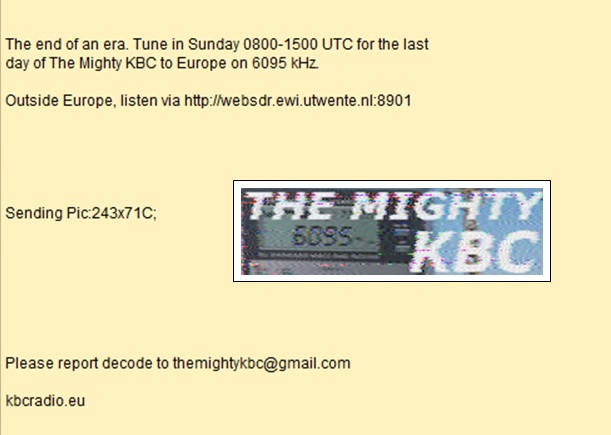
[Below, you’ll find] my reception report for the digital decode of the Fldigi message by Dr. Kim Elliott on The Mighty KBC (6040 kHz) Saturday night:

noname

I took Kim Elliott’s suggestion and listened to The Mighty KBC on 6095 kHz on Sunday morning using the Utwente WebSDR which receives signals in Enschede, in the Netherlands.

The Mighty KBC finished their last broadcast on 6095 kHz at 11:00AM our time. I recorded their program, but the file is big. So, attached is the last 4 minutes of their program (click here to download), as received by the WebSDR:

It’s too bad that The Mighty KBC is shutting down!

Many thanks for both your decoded message and your recorded audio, Steve! I agree: it is too bad the KBC had to shut down their 6095 kHz broadcast.

Note that The Mighty KBC will continue on their AM frequency, DAB and streaming. Check out the KBC website for details.

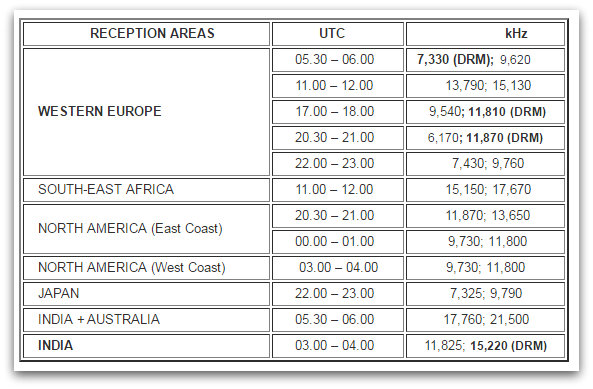
Radio Romania International 2016 Summer Broadcast Frequencies

RRI-RadioRomaniaInternational

Many thanks to SWLing Post contributor, David Iurescia (LW4DAF), who notes that Radio Romania International has published their updated English language broadcast frequencies:

RRI Summer Broadcast Frequencies valid March 27 to October 30, 2016

RRI-Schedule

Source: http://www.rri.ro/en_gb/rri_summer_broadcast_frequencies-2544502

BBG’s Fiscal Year 2016 Congressional Budget Request

BBG-Budget-Request

Many thanks to SWLing Post contributor, Richard Langley, who shares a link to the Broadcasting Board of Governor’s Fiscal Year 2016 Congressional Budget Request.

Click here to download as a PDF.

I’ve read key portions of the request.

Regarding shortwave, the BBG are asking for budget reductions in almost all of the BBG shortwave broadcasting arms, with a few exceptions.   They acknowledge, in each case, that shortwave broadcasting is not as cost-effective as other means of distribution (including FM, Internet and satellite). The do acknowledge that shortwave broadcasting is still needed in some strategic markets. Here is, perhaps, the most telling quote I found:

“To serve audiences in less developed areas of the world, BBG must continue to broadcast via traditional technologies such as shortwave and maintain capability on these platforms by replacing antiquated equipment. But to stay relevant in competitive news markets and serve current and future audiences, BBG must invest in new cutting-edge technology. In areas where ownership and usage of shortwave radio has declined significantly, the Agency has evolved away from broadcasting in shortwave.”

A few specific highlights from the request:

Page 19

4) ENHANCE HIGH FREQUENCY TRANSMISSION CAPABILITY ($2.8M)
BBG will continue the shortwave realignment project that began in FY 2014, which increases shortwave transmission capability at its Kuwait Transmitting Station. This enhancement provides improved coverage to underserved areas of the world and
reduces operating costs by decreasing reliance on external leases. All aspects of
this proposal focus on improving transmission capability, while continuing
to reach audiences in Africa, Afghanistan, Pakistan, Iran, Tibet and
Western China. The added capacity will support broadcasts for RFE/RL, RFA and
VOA.

At $2.00 per broadcast hour, Kuwait provides the highest return on investment in the BBG transmitting station portfolio. Thus, BBG began expansion of the facility in FY 2014 with
the construction of a new high frequency antenna and design of the transmitter building expansion. The proposed investment, extending through FY 2018, will bring the Kuwait
Transmitting Station up to the maximum capability allowed by the country agreement and will enable the Agency to decrease overall operating costs for the foreseeable future. When the realignment project is completed, the Kuwait station will have ten shortwave transmitters with associated antennas.[…]

Page 22:

Reduce Shortwave Costs [-$2.90M] The Office of Technology, Services, and Innovation (TSI) will eliminate less effective transmission frequencies and realign transmissions to end high cost leases. TSI will realize additional reductions to antiquated technologies by reducing transmissions to Afghanistan, Pakistan, Burma, and Kurdish-speaking regions and eliminating shortwave to Russia, the Caucasus, Belarus, Laos, Cambodia, Rwanda, and Burundi. Audiences in these countries access news and information on more efficient,[…]

Page 69

STRATEGY BASED ON AUDIENCE
MEDIA HABITS
Using research on audience media habits, TSI will continue to move away from less effective legacy shortwave and medium wave transmissions toward other technologies, where appropriate, to reach larger and younger audiences. Where shortwave remains important, TSI is building a more cost-effective transmission infrastructure to support broadcast requirements. Of particular note are efforts at the Kuwait Transmitting Station. Because of the station’s strategic importance and low operating costs, TSI is installing a new shortwave antenna that is expected to be operational in FY 2015 and will expand the station’s transmitter building in FY 2016 to accommodate future transmitter build-outs.[…]

Page 109

To serve audiences in less developed areas of the world, BBG must continue to broadcast via traditional technologies such as shortwave and maintain capability on these platforms by replacing antiquated equipment. But to stay relevant in competitive news markets and serve current and future audiences, BBG must invest in new cutting-edge technology. In areas where ownership and usage of shortwave radio has declined significantly, the Agency has evolved away from broadcasting in shortwave.
BBG has closed transmission stations, repurposed equipment and invested these savings in platforms that the audience has shifted to, primarily in digital media technology and other high-priority programming.

Click here to download the full request as a PDF.

Radio Prague: Underground agents and plots in the Cold War broadcasting war

HalliDial

Many thanks to several SWLing Post readers who shared the following story from Radio Prague:

Underground agents and plots in the Cold War broadcasting war

In this week’s Czech History we look at one aspect of the Cold War, the use of secret agents to spy on and disrupt the enemy’s propaganda services. In particular, we focus on the circus that surrounded the return of a Czechoslovak double agent Pavel Mina?ík 40 years ago in 1976 which was aimed at discrediting the US financed and Munich-based broadcaster Radio Free Europe.

Click here to read the full article and listen to the radio documentary on Radio Prague’s website.

Radio Martí: an uncertain future with the “thaw” in US/Cuba relations

Havana, Cuba (Photo: Wikimedia)

Havana, Cuba (Photo: Wikimedia)

(Source: PRI)

RadioMartiOn first impression, Radio and TV Martí looks and feels pretty much like any other newsroom. Emilio Vazquez shows me around, and we stop and watch two radio broadcasters behind a thick pane of glass.

“We have a morning show known as ‘El Revoltillo,’ which is like an on-air swap market type of show, where people call in and offer different products and services for sale on island,” says Vazquez.

But here’s what’s different about this call-in show: It’s illegal for its listeners to call in, or even to listen. That is, if they even can — the Cuban government tries to jam broadcast signals coming from Florida. Vazquez said they’re always trying to stay one step ahead.

“We have various methods of transmission. We have medium-wave transmission on AM frequency, we have our short-wave transmissions as well.”

Those change frequencies throughout the course of the day.

Radio and TV Martí has been delivering news and information to Cuba since 1985, an intense period of the Cold War. The Cuban American National Foundation, a powerful lobbying group of Cuban exiles in Miami, helped persuade the Reagan Administration to create the stations, which fall under the Broadcasting Board of Governors, a US government agency.

[…]Still, critics of the Martís question if Cubans are getting the best information from the government news agency. They call the programming one-dimensional, conservative and a mouthpiece of American policy. Gamarra says he’s staunchly disagreed with many editorials broadcast by the Martís over the years.

“But I think the criticism of them, that because they’re conservative, they’re not good journalists, doesn’t follow. They still have some value,” says Gamarra. “I think [the Martís] has an expiration date though.”

As part of the US government, Radio and TV Martí works out of large compound in Miami fortified by barbed wire, guards, and airport-type screening. As part of the US government, Radio and TV Martí works out of large compound in Miami fortified by barbed wire, guards, and airport-type screening. Credit: Jason Margolis
When that expiration date should be is the big question. With a thaw in US-Cuba relations, some say the time is now. Democratic Congresswoman Betty McCollum of Minnesota introduced a bill to end the Martís. It’s called the: “Stop Wasting Taxpayer Money on Cuba Broadcasting Act.” The Martís cost US taxpayers $27 million a year.

President Barck Obama wants to turn the Martís into an independent non-profit, but still funded by the government. It would be called a “grantee.”

Many conservatives say that would weaken the government’s commitment, and that the Martís still provide an invaluable service exposing human rights abuses in Cuba.

Malule González says her operation is more important than ever, even with President Obama on the island today.

“Don’t be confused by people shaking hands, that doesn’t mean that the Cuban people have any freedom,” says González.

Read the full article on PRI’s website…

North Korea intensifies shortwave jamming

FlagNorthKorea

(Source: DailyNK via Andrea Borgnino)

North Korea has been from the beginning of March continually signal jamming radio broadcasts on the shortwave frequency used by the South Korean non-profit broadcaster Unification Media Group (UMG). Given the present situation, in which North Korean residents might be influenced by outside information condemning the regime and explaining the purpose of the sanctions imposed by the United Nations, the regime has showed the will to block sources of outside information that might cause unrest.

The shortwave frequency […] in question, 7515 [kHz], has been actively jammed starting on March 1st making it extremely difficult for North Korean listeners to tune in. On the 15, UMG organization began using three receivers to test out reception at that and adjacent frequencies on a daily basis and was able to confirm that the exact signal is being jammed.

The blocking effort is being concentrated on the time period from 10pm- midnight. Specifically, from 10-11pm the jamming is very strong. The signal jamming is undetectable from midnight to 1am. The signal blocking became weaker at midnight on March 15, from which point onward the entire three hour broadcast was audible. Starting on the 17, UMG moved the frequency, but the jamming operators seemed not to notice because the interference continued on the old wavelength.

Continue reading at the DailyNK online…

Update: From the Isle of Music

ftiomfromomar212016Many thanks to SWLing Post reader, Bill Tilford, who shares this From The Isle of Music update:

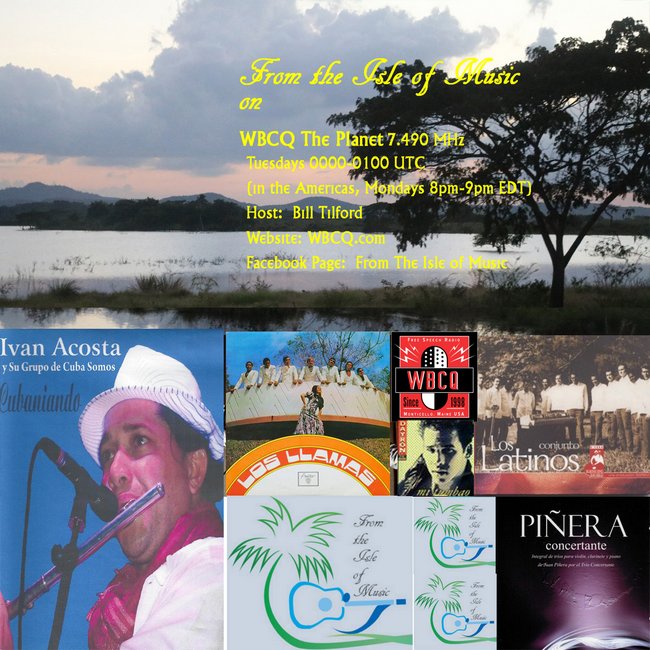
March 21 in the Americas (March 22 in Europe, Asia, Africa and Oceania), our very special guest will be Ivan Acosta, leader of the Jazz ensemble Grupo de Cuba Somos in Santiago de Cuba, along with 3 songs by his ensemble. Also, more of Piñera Concertante, some vintage 1970s hits by Los Latinos and Grupo Los Llamas and some Timba from Dayron y El Boom.

*** Every Monday night from 8pm-9pm EDT in North, Central and South America (Tuesday morning from 0000-0100 UTC in Europe, Africa, Asia and Oceania) on the short waves on WBCQ The Planet, 7.490 MHz: From the Isle of Music, a new radio program dedicated to the music of Cuba – Jazz, Fusion, Timba, Nueva Trova, Son, Classical, Folklorica, interviews with musicians, even a little history of the music now and then. Partly in English, en parte en español. “Like” our page to keep informed about what we will bring you. (For those without shortwave or outside of viable signal range, there are also a couple of ways to stream the frequency via Internet; see the instructions in our NOTES section).