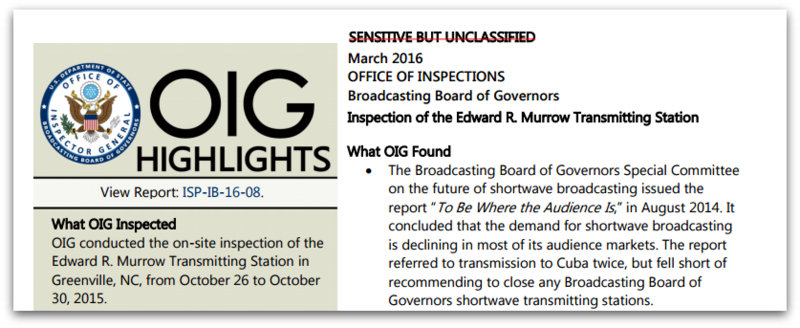
I’ve just received a copy of the Office of Inspections (OIG) report on the VOA transmitting station in Greenville, NC. The full OIG report is now in the public domain as a PDF.
Here are a few highlights…
A summary of what OIG found:
- The Broadcasting Board of Governors Special Committee on the future of shortwave broadcasting issued the report “To Be Where the Audience Is,” in August 2014. It concluded that the demand for shortwave broadcasting is declining in most of its audience markets. The report referred to transmission to Cuba twice, but fell short of recommending to close any Broadcasting Board of Governors shortwave transmitting stations.
- The Edward R. Murrow Transmitting Station reports to the Office of Cuba Broadcasting and Office of Technology, Services, and Innovation. The dual reporting structure has not affected operations negatively.
- Administrative operations for the Edward R. Murrow Transmitting Station were effective, except in management of human resources. Specifically, the station
manager’s position description was outdated and the performance evaluations record keeping did not comply with Federal regulations. - The Edward R. Murrow Transmitting Station had effective internal controls processes in place. The Edward R. Murrow Transmitting Station management were
cognizant of internal controls and provides effective oversight of operations. - The Edward R. Murrow Transmitting Station complied with the Broadcasting Board of Governors and applicable Federal regulations for contracting, property management, and safety. The Edward R. Murrow Transmitting Station complied with the Broadcasting Board of Governors review processes for unliquidated obligations and the purchase card program.
- The security and emergency preparedness at the Edward R. Murrow Transmitting Station met the Interagency Security Committee, Office of Security, and Office of
Technology, Services, and Innovation policies and standards. The employees participated in emergency drills and complete required insider threat training
annually.

The Edward R. Murrow Transmitting Station’s mail building, located in the center of the 2800 acres campus. (Click to enlarge)
Regarding the future of the station:
BBG has not evaluated the return on investment of the Station’s operations to determine its effectiveness in advancing the U.S. international media strategies. The BBG’s Special Committee report refers twice to transmissions to Cuba but falls short of recommending to close any BBG shortwave transmitting stations. Congress continues funding the Station’s budget even though on February 1, 2010, the BBG FY 2011 budget request proposed the closure of the Station.
Futhermore, in FY 2011, the Senate Committee on Appropriations asked BBG to submit a “multiyear strategic plan for broadcasting to Cuba to include an analysis of options for disseminating news and information to Cuba and a report on the cost effectiveness of each.”
The Office of Management and Budget’s Global Engagement Resource Guidance for FY 2015 and for FY 2016 address the need to modernize U.S. International media by “transitioning away from the use of shortwave radio where this platform is ineffective, toward more widely used media platforms like mobile, television, and the internet.” The United States International Broadcasting Act, Public Law 103-236, Section 303(a)(1) and (7) states that BBG has the responsibility to “be consistent with the broad foreign policy objectives of the United States” and “to effectively reach a significant audience.” Section 305(a)(7) states the Board is also authorized to “ensure that all broadcasting elements receive the highest quality and cost effective delivery services.” Given BBG’s limited resources and changes in technology as well as the significance of Cuba to U.S. national security objectives, BBG risks missing an opportunity to engage with Cuban audiences in a digital media environment.
Recommendation 1: The Broadcasting Board of Governors should prepare a written
cost/benefit evaluation of the Edward R. Murrow Transmitting Station to determine its
efficiency and effectiveness for continuing, reducing, or eliminating operations. (Action: BBG)
The full report:
Click here to download the full report as a PDF.
For a little context, this is the same station I’ve visited multiple times and even posted a photo tour of (click here to view) several years ago.