Category Archives: Broadcasters

Guest post: The future for radio broadcasting in Australia

Many thanks to SWLing Post contributor, Phil Brennan, who shares the following guest post–an article he originally authored for the Australian DX News:
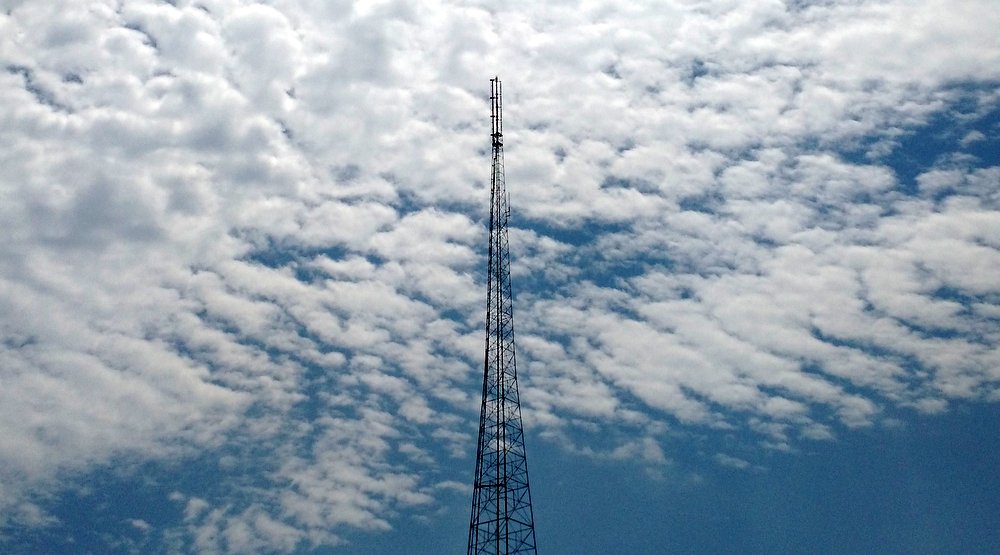

WHKY-AM-Radio-Tower

What Future for Radio Broadcasting in Australia?

By Phil Brennan, Darwin, NT

As we witness the worldwide decline in long wave, medium wave , shortwave and indeed FM broadcasting, it can be at times a slightly depressing exercise to ponder the future of our hobby.  As I write, just last week Radio France announced that it will soon cease all LW broadcasting.  There’s an on-line petition to save the service: this morning it had collected 770 signatures after one week. It was 769 until I sent my modest click across the universe L.

On the domestic front we’ve seen the pointy-headed bean counters in Canberra and their political masters take the knife to our national broadcaster to the point where Radio Australia now seems to be little more than a relay station for the ABC with barely any in-house production tailored for its audience.

With all this doom and gloom it was with some trepidation that I spied a recent Australian Government report entitled Digital Radio Report [1] which arrived via my email in-box through the excellent Australian Policy On-line resource.  The report was published in July 2015 by the Department of Communications and was conducted by the Minister for Communications under the Broadcasting Services Act and the Radiocommunications Act. Note: the Minister for Communications then was Malcolm Turnbull who is now Australia’s Prime Minister.

The report makes for an interesting read (for nerds like us) and provides some great insight into the bureaucracy’s thinking on the future of radio broadcasting in this country.  So while the report ostensibly considers the current and potential state of digital radio in Australia, in so doing it looks at the other forms of radio broadcasting and gives us a peek into the future.

The report broadly considers the following issues:

  • The current state of digital broadcasting and alternative forms, eg streaming services through the interwebs
  • Whether Australia should set a digital switchover date and close off analogue services; and
  • The legal and regulatory framework for digital services.

Like you would have dear reader I quickly scrolled through the report to see if it was recommending a full switchover to digital.  The good news is that this won’t happen anytime soon and perhaps not ever.  Phew! It seems Australia’s geography and sparse population works in our favour (for once).  Anyway, more on that later.

So what does the Australian radio broadcasting landscape look like at present?  Well for lovers of analogue radio it’s still looking pretty strong and it’s likely to remain that way for some time to come.  In the five big cities the 2014 average weekly audience for commercial radio services grew by 4.13 per cent to 10.1 million people.  That’s pretty impressive given the quality of the stuff they serve up each day.  Aunty’s (that’s the ABC to foreign folk) radio service reached a record 4.7 million people in 13/14, an increase of 155,000 listeners on the previous year. Well done Aunty!

All up there are 273 analogue commercial radio services (104 on AM, 152 FM and 12 outside the broadcasting service bands.  Community radio is going strong with 357 analogue services (13 AM and 344 FM) plus 244 narrowcasters (33 AM and 211 FM).  There’s lots of stuff still out there it seems.  Perhaps too much as the FM band is becoming very crowded in the major metropolitan areas.

There are 142 commercial digital services in the big capitals plus the two trial sites in Canberra and Darwin.  Interestingly a good proportion of the digital services are simulcast analogue services, for example 11 out 29 of the commercial digitals in Sydney.  Listenership of digital radio is growing slowly and steadily, reaching 25 per cent in the first quarter of 2015, primarily due to the growth of receivers in motor vehicles.

Streaming services are rapidly gaining ground with services like Spotify, Pandora and the new Apple Music picking up new subscribers each week.  The move by Aunty and the Special Broadcasting Service’s (SBS) to mobile apps for streaming content is also showing good growth. It would appear that to some extent this growth has been at the expense of terrestrial digital services, but audience data in this area is pretty sketchy it seems.

So what of the future for digital radio? Well it seems that for the present the public does not show a preference for digital radio over other forms. And while some European countries such as Norway with near total digital coverage are looking to switch off their FM services, some countries such as the UK have postponed their planned switchover to digital due to slow uptake by the listening public.

In Australia there are big interests such as SBS, Commercial Radio Australia and Broadcast Australia pushing for a switchover to digital as soon as possible.   Thankfully the report’s authors have listened to other bodies that advocate for a multi technology approach.  Significantly the report notes that while digital could match FM for coverage with a similar number of transmitters, it will struggle to match the coverage provided by the medium and high powered AM transmitters that reach the remaining population.  Digital Radio Mondiale and satellite digital radio technologies could increase digital’s coverage but are not considered viable.

Internet based services are not seen as a realistic alternative in the medium term due to high data costs, restricted wifi coverage, likely interruptions in high traffic areas and poor battery life on mobiles.  It’s likely that this will be a niche medium for some time.

So what does the report conclude and recommend?  Well, digital radio was only ever introduced as a complimentary technology and that will continue to be the case.  In saying that the report makes a series of recommendations to free up the rules so broadcasters can take up the digital option more readily.  DAB+ is the preferred technology so don’t go ordering a DRM set anytime soon.

Perhaps most interestingly, the report makes a major finding that there may be an opportunity to consider how analogue terrestrial radio coverage can be improved pending the roll out of digital radio.  This includes further research into how AM coverage can be improved in metropolitan areas and whether the FM spectrum can be made available in regional areas for new analogue services or switching existing AM services over to FM, potentially in lieu of the rollout of digital services.  For us lovers of analogue radio this is certainly good news, particularly if more high powered AM broadcasters hit the band.

Does this actually mean that analogue radio services are safe?  Well, governments have been very good at ignoring reports advocating for the public good and succumbing to the commercial interests with other agendas, particularly when it comes to media.  That said, it doesn’t make a lot of sense for the government to pull the plug on analogue anytime soon given the coverage issues in regional Australia.  However, when it comes to governments, the sensible thing to do is often viewed as the last option.

[1] © Commonwealth of Australia


Thank you, Phil, for your article and opinions! I agree–in a country with such vast expanses, analog radio still has advantages over other mediums. Comments?


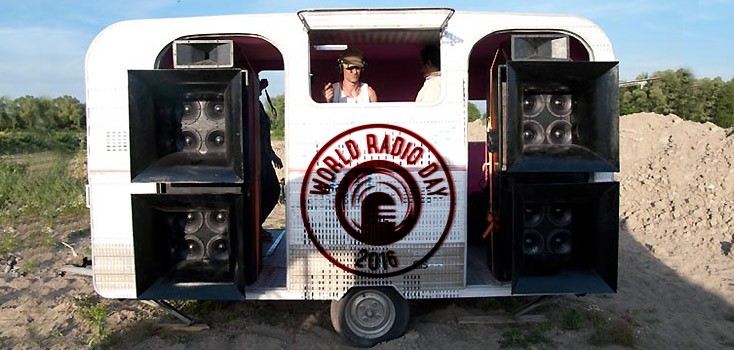
World Radio Day

WRDThis was posted on the European broadcasting Union page:

To mark World Radio Day (13 February), the European Broadcasting Union (EBU) is organizing a ‘Musical Caravan’ from east to west in partnership with other broadcasting unions across the globe.

Listeners will be taken around the world in a little over two hours.

This special compilation submitted by EBU Members, Associates and its sister unions (ABU, ASBU and CBU*) and coordinated by the EBU Music Unit in Geneva consists of songs representing the musical heritage of 34 countries.

The broad list of contributions include a Richard Strauss lied recorded by Bavarian Radio, an Indonesian song for peace and friendship, a folk tune from India and carnival music from the Caribbean.

The EBU will also share key facts about radio listening compiled by the organization’s Media Intelligence Unit in the week leading up to World Radio Day 2016 on its Facebook page and Twitter account.

Another highlight of the EBU’s contribution to World Radio Day 2016 will be a special performance of Beethoven’s Ninth Symphony by the NHK Symphony Orchestra of Tokyo and the Kunitachi College of Music Chorus. An interview with conductor Paavo Järvi can be found here.

EBU Head of Radio Graham Dixon said: “Radio plays a very significant part in all our lives. On average, we will listen to nine years of radio in a lifetime – more than any activity except breathing and sleeping!  Radio provides a convenient way to encounter new ideas, new music and new ways of thinking, and also provides valuable company to counter isolation and loss.  Nine years of an average lifetime is indeed an impressive figure, but the real personal impact of radio cannot be quantified. World Radio Day provides a great opportunity to reflect on the power of radio.“

– See more at: http://www3.ebu.ch/news/2016/02/ebu-takes-listeners-on-a-global

Robert Gulley, AK3Q, is the author of this post and a regular contributor to the SWLing Post. Robert also blogs at All Things Radio.

The Mighty KBC is seeking sponsorship

DX-402-KBC-2

Many thanks to SWLing Post reader, Mike Nikolich (N9OVQ), who writes:

Hi, Tom:

Uncle Eric mentioned [this past weekend] on The Mighty KBC (6040 kHz) around 0145 UTC that they will be leaving the airwaves if they cannot attract enough advertising revenue.

I would really miss this radio station if it left the air. 

[…]I’m sure Kenwood, ICOM, Ham Radio Outlet and C Crain have enough discretionary funds to advertise on this station and I can’t imagine a more targeted ad buy for shortwave listeners than The Mighty KBC.

Thanks for the message, Mike! Yes, I would also miss The Mighty KBC if they left the air–their music program, “The Giant Jukebox” is one of my favorites.

If you have any sponsorship leads or ideas, please contact The Mighty KBC via their website.

Paul schedules new shortwave broadcasts via WRMI, WBCQ and Channel 292

SP600Dial3

Many thanks to SWLing Post reader, Paul Walker, who writes:

I will be doing another broadcast on Shortwave and it’s going to be even bigger and better right now.

Tentatively, this is how the broadcast schedule times/frequencies work out to be:

  • WBCQ 5110khz and 9330khz Friday March 11th, 2016
    10pm to 12midnight Eastern (which is 0300 to 0500 UTC Saturday March 12th)
  • WRMI 11580khz Thursday March 10th, 2016 Thursday March 10th, 2016
    8pm to 10pm Eastern (which is 0100 to 0300utc on Friday March 11th)
  • Channel 292, 6070khz (Germany transmitter site) Friday March 110th, 2016
    10pm to 12midnight UK time (which is 5pm to 7pm eastern, not that Channel 292 can be heard in the US… just giving you a frame of reference)

I am in the process of booking all this time, so something could change in terms of times/dates between now and the broadcast dates.

I’ll be doing 2 hours of rock n roll and country music .. no commercials, no pleading for money, no asking for donations.. just me, playing the music I like.. because. well I want to and I can.

I’m paying for time on all 4 of these stations out of MY OWN POCKET, again for no reason, other then I want to.

So many complain about what radio lacks, wether am, fm or sw and lament about the old days or suggest what would work today.. but want it done with other people’s money.. they won’t put up and shut up. What I do won’t change radio or make much of a difference in the grand scheme of shortwave radio, but I can have fun and share my love of radio and music with others.

I am trying to secure an hour or two on a United Kingdom area AM station as well if it is affordable and I can find one to sell me time.

Writing to you from an apartment only 500 feet from the frozen Yukon river in Alaska’s interior region.

Excellent news, Paul! Please keep us informed as I’m happy to post any updates you may have. We’ll be listening!

China Radio International’s overwhelming AM bandwidth via Havana

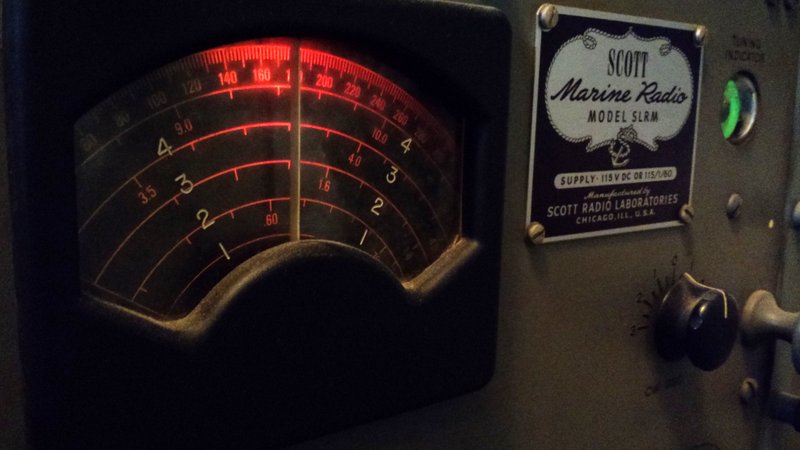
Scott-Marine-SLR-M-Dial

This morning, I listened to Radio Australia on 9,580 kHz with my WWII era Scott Marine Radio SLR-M (above).

Radio Australia provides a reliable, strong signal into North America every morning and it’s where I typically tune for the morning news at the top of the hour.

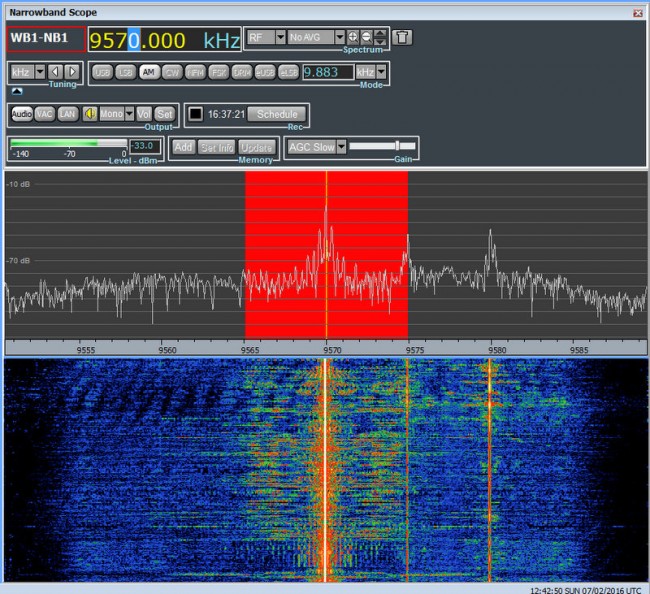
China Radio International also fires up on the adjacent frequency of 9570 kHz around 1200 UTC–their signal is also incredibly strong here as it’s relayed from Radio Havana Cuba at 250 kW. CRI’s bandwidth is almost always wider than 10 kHz–indeed, it’s often 20 kHz–which means that it completely wipes out any average adjacent signal.

Indeed, when I’m testing selectivity on portable shortwave radios, I’ll often tune to Radio Australia and wait for CRI to fire up on 9570 kHz. If the portable radio can still lock onto Radio Australia after CRI is on the air–or, better yet, if an upper side band sync lock can eliminate all traces of CRI–I know the receiver has decent selectivity.

This morning, when CRI began transmitting at 1200 UTC, their signal completely wiped out every trace of Radio Australia. Though the SLR-M’s narrow AM filter is still quite wide, it can typically cope with the adjacent CRI carrier.

I fired up the TitanSDR to see what CRI’s signal looked like on a spectrum display–here’s what I found:

China-Radio-International-Bandwidth

CRI’s AM bandwidth was 30+ kHz wide! 

In my book, that was an abusive use of the band.

This was, by no means, an isolated event. It was just particularly annoying for me this morning as I was enjoying a good cup of coffee and the morning ABC news.

I’ll send a message to CRI and RHC about this, but I have my doubts anyone will take action.

Okay–sorry about the rant!

Live365 is no more

Live365_logo

As of February 1, 2016, the Internet radio pioneer Live365 has closed shop.

I imagine many SWLing Post readers are familiar with Live365, especially if you have a WiFi radio with the Live365 app.

While I’ve never been an avid listener of Live365, I have certainly enjoyed a wide variety of independent Internet radio stations via the platform.

Why did Live365 close shop? Here’s what Forbes.com suggests:

“It is rumored that the service is being forced into early retirement because of new royalty rates that digital radio producers now need to adhere to. Late in 2015, the Copyright Royalty Board handed down its decision about what internet radio services will need to pay per stream, and it apparently hurt Live365 so much that it can no longer afford for the rights to play music. Companies like Pandora lobbied hard for the court to lower royalty rates for the next five years, and while certain kinds of streams will cost internet radio stations and services less, it will cost platforms more overall to continue to play music. This may not be the only reason why Live365 is going out of business, but it appears to have been a factor.”

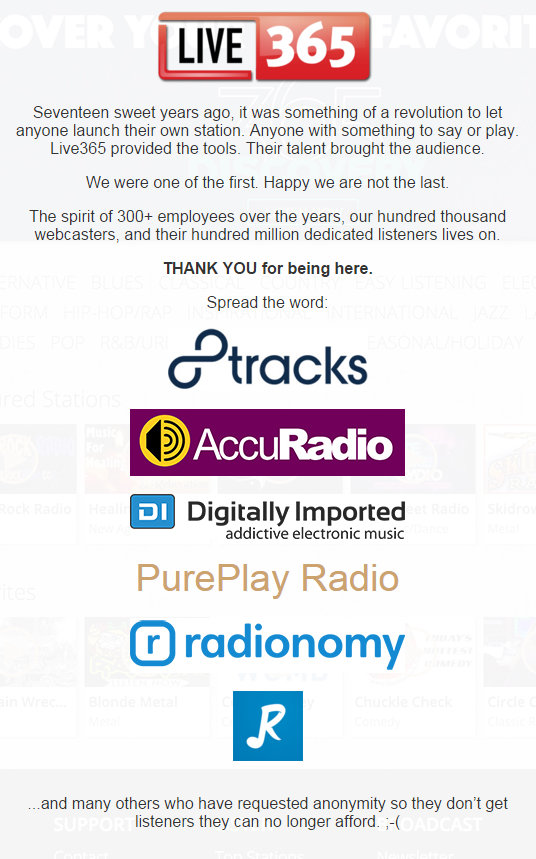
I’m sure the new royalty rates had had a major influence on the decision to close down. Here’s a screen capture of the parting message from Live365’s web site:

Live365-Message

That is the conundrum of Internet streaming services: the more listeners, the more it costs to broadcast due to both bandwidth and royalties. Your success–especially when the music industry moves toward higher costs and more restrictions–might very well lead to your demise.

Perhaps this is where traditional over-the-air radio still has a small advantage–though the barrier of entry is much higher than Internet broadcasting.

Terry recommends the Public Radio Fan portal

PublicRadioFan

Many thanks to SWLing Post reader, Terry (VE7TEB) who writes:

You may have already posted this, but if not here is an excellent Public Radio resource, perhaps worthy of another mention: http://www.publicradiofan.com/

Indeed, Terry! Public Radio Fan is a fantastic resource–especially for SWLs who enjoy listening to public broadcasters who are no longer on shortwave. The site makes it easy to search for broadcasters; it has a very simple and responsive user interface.

Public Radio Fan was created in 2001 and is maintained by its creator, Kevin Kelly. I don’t know where he finds the time to curate this database, but I’m glad he does!

Definitely worth the mention. Thank you, Terry!

Click here to go to Public Radio Fan.