Category Archives: Broadcasters

Voice of Greece on shortwave throughout the night, despite ERT shut down

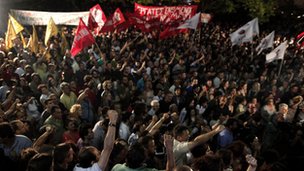
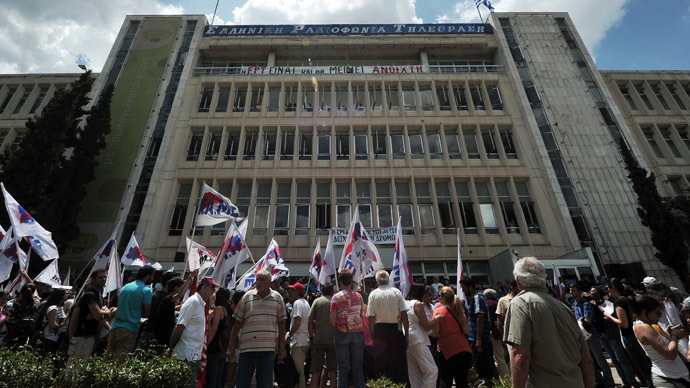
Thousands of protesters gathered outside ERT's headquarters in Athens (Source: BBC News)

Thousands of protesters gathered outside ERT’s headquarters in Athens (Source: BBC News)

If you listened to the Voice Of Greece in the wake of the Greek National TV & Radio (ERT) shut down last night, you were in for a bit of radio history.

I published several posts yesterday as the story developed; I knew if ERT was being silenced, the Voice of Greece would as well. But that’s not what happened.

The Voice of Greece went off the air, like its national radio and TV counterparts, well before the announced midnight deadline. But around 22:44 UTC, the VoG came back on the air–at first with a few audio/technical glitches–and broadcast ERT protest coverage throughout the night.

This morning, I searched for news sources and could only find one–BBC News–who noticed that the Greek broadcaster was live online and on shortwave radio.

In case you missed it hearing it live, you can listen to a short off-air recording of the moment the Voice of Greece was taken off the air, (on 15.65 MHz).  I believe this happened around 18:56 UTC (11 June 2013):

Then later, on 9.42 MHz, around 22:44 UTC, the Voice of Greece began transmitting audio again. Here’s a recording beginning only a few seconds beforehand:

Follow the tag ERT Cuts for further updates.

The Voice of Greece on air: comments about live protest coverage

vogCheck out the comments in our previous post regarding the Voice of Greece–Ron and Kevin share informative links, including this live stream of the protests.

Marty Delfin, from Madrid, Spain, also shares this message with us:

We are hearing the ERT (Voice of Greece) right now at 2340 UTC June 11 in Spain packing in a powerful signal. There is a lot of commentary — the little Greek that I can understand — trashing the conservative government for the shutdown. Hopefully, they say, the shortwave service will continue until further notice. Lots of reaction from listeners being broadcast. You are right— went on the air at 2100 UTC with just a carrier— came on the air about 45 minutes later—

Here’s the latest from the English language version of the Kathimerini daily from Athens— PM gambles on ERT closure and EBU expresses dismay on closure —

http://www.ekathimerini.com/4dcgi/_w_articles_wsite1_1_11/06/2013_503960

http://www.ekathimerini.com/4dcgi/_w_articles_wsite1_1_12/06/2013_503982

Such a stark contrast: the Voice of Greece (who “should” be off the air) covering ERT protests live, while the Voice of Turkey has barely mentioned the wide-spread Gezi Park demonstrations taking place throughout Turkey.

The Voice of Greece: off the air, then on

VoiceOfGreece

Screenshot of my WinRadio Excalibur receiver with frequency centered on the Voice of Greece.

The Voice of Greece did go off the air earlier today in conjunction with the closure of ERT, (Greek State TV and Radio).

As we monitored Voice of Greece frequencies, we noticed that their AM carrier was still present well past 21:00 UTC (midnight in Greece), though we heard no audio.

It’s currently 23:10 UTC and I’ve been hearing Greek commentary on 9,420 kHz for almost thirty minutes. I’ll post the recording later.

I know this: I wish I understood Greek right about now…

Greece shuts down their state broadcasting arm, ERT

vogI cannot confirm whether this will have an impact on The Voice of Greece, but I strongly suspect so.

We will know after midnight in Greece (21:00 UTC) today:

(Source: BBC News)

The Greek government has announced that it will shut down the radio and TV services of the state broadcaster ERT.

A government spokesman said transmissions would cease early on Wednesday.

More than 2,000 employees will be suspended until the company reopens “as soon as possible.”

[…]An engineer at the broadcaster’s multimedia department who gave his name as Yannis said: “The government announced that channels will shut down at midnight – after that the screens will go black.

“According to the government, from tonight I will be unemployed. It is a complete shock. In four hours’ time I will not have a job.”

ERT is funded by a direct payment by of 4.3 euros added monthly to electricity bills.

Many thanks to Mike and Andrea Borgnino for the tip!

Update (18:00 UTC): RT has a report worth checking out.  Many other news sources are picking up the story.

After listener feedback, BBC World Service restores MW service to Israel and Middle East

Antennas-001SWLing Post reader David commented on June 8 that he heard the return of the BBC World Service on 1,323 khz BBC Zygi, Cyprus relay.

The BBC Media Centre confirms:

The BBC World Service has confirmed that MW transmissions to Israel and other parts of the Middle East will resume for 10hrs per day on 1323kHz starting on Friday 7 June.

This will give listeners breakfast listening and then drive-time and evening coverage from about 4pm to 10pm.

The morning hours are as 02:59:30 to 06:59:30 GMT and the evening schedule will be 12:59:30 – 18:59:30 GMT.

Steve Titherington, World Service Commissioning Editor, says: “We had a huge response to the end of MW transmissions in Israel and we are responding positively to listeners’ demands for a return to of the BBC broadcasts. Cutbacks mean we can’t return to a full day-long schedule, but we will broadcast at times when we hope audiences are most likely to listen. We want to thank our listeners for their feedback and would welcome any further comment they have about how suitable these new broadcasting times are for tuning into the BBC World Service.”

As previously announced four hours per day of World Service English will continue on 720kHz until 22:59:30 on 21 June.

The Gezi Park Protests: don’t look to the Voice of Turkey for information

On shortwave, sometimes it’s what’s not heard that speaks volumes.
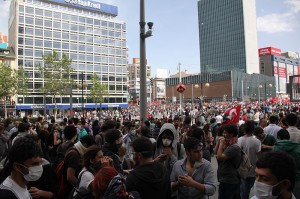
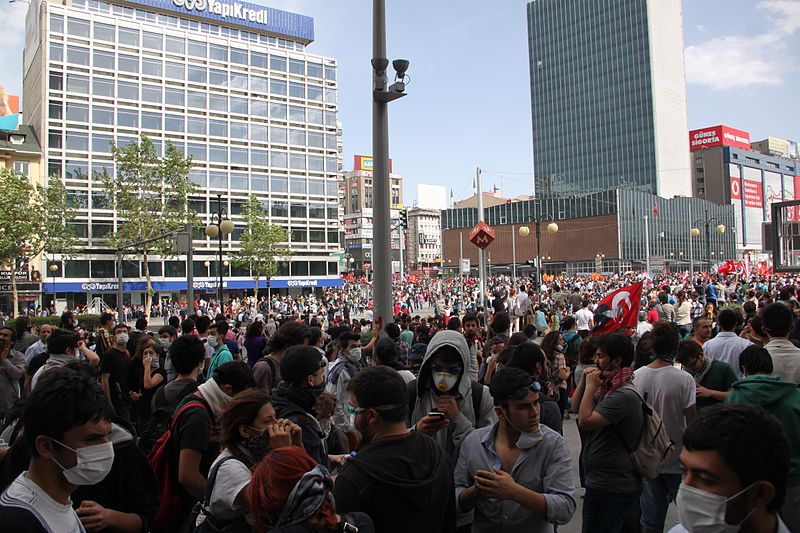
Gezi protest in K?z?lay Square, Ankara (Source: Wikimedia Commons)

Gezi protest in K?z?lay Square, Ankara (Source: Wikimedia Commons)

Turkey has been in the world headlines now for well over a week. In case you’re not up-to-date, here’s a summary of what has happened:

On May 28, 2013,  about fifty environmentalists led a small protest in Istanbul to oppose the replacement of Taksim Gezi Park with a reconstruction of the Taksim Military Barracks.  The protests escalated when the group occupying the park was attacked with water cannons and tear gas by the Turkish police. This event led to riots, which were soon widespread; the protests, meanwhile, broadened their scope into full-fledged anti-government demonstrations across the country and even into the Turkish diaspora across the globe.

Yesterday, I turned to the Voice of Turkey on shortwave radio to hear about the active protests currently ongoing throughout the country…

But what did I hear? The only mention I heard of the Gezi Park protests in the Voice of Turkey’s English language service were in a passing Turkish press report on the reaction to the protests by the US Secretary of State, John Kerry. The item, moreover, was completely buried in their broadcast and certainly not something upon which they elaborated in the least (listen, beginning at 12:50 below).

I’ve always loved listening to the Voice of Turkey, but events like this remind me of the simple fact that many international broadcasters are still very much the mouthpieces of their governments.
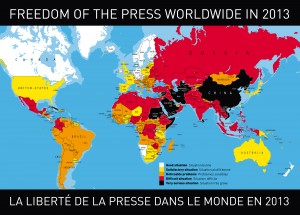
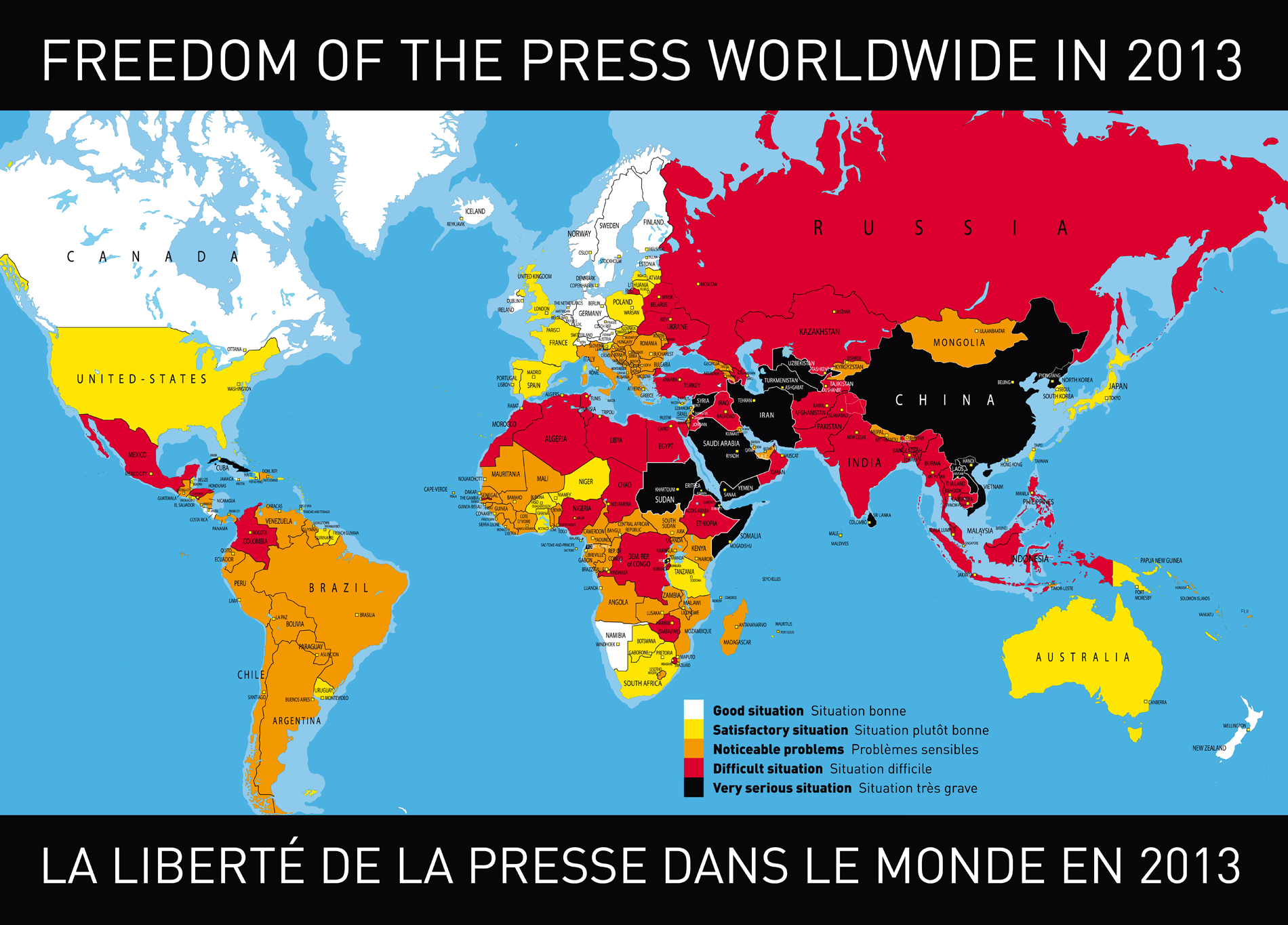
Click to enlarge (Source: Reporters Without Borders)

Click to enlarge (Source: Reporters Without Borders)

Of course, Turkey certainly would not win an award for press freedom; not even close. Reporters Without Borders list Turkey as a country with a “Difficult Situation” with regards to press freedoms, ranking them 154th out of 179 countries in their 2013 Press Freedom Index. To put this in perspective, Finland and the Netherlands occupy the top two spots as models of press freedom, the USA is number 32, and North Korea and Eritrea occupy the bottom spots (numbers 178 and 179, respectively) obviously countries without press freedoms.

I’d like to think that the news readers at the Voice of Turkey would rather give this news the attention it deserves, or at least offer the Turkish government’s perspective on the demonstrations. Instead, what we heard was…nothing.  And we heard that loud and clear.

Indeed, the world is paying attention to the lack of news coming out of Turkey right now. Time Magazine posted this article article yesterday, which begins:

As epic clashes between anti-government protesters and riot police turned downtown Istanbul into a battle zone last weekend, the country’s two main news channels had, well, not much to report. One ran a documentary on penguins. The other, a cooking show. To many Turks, their silence was symptomatic of the self-censorship Turkey’s media have practiced under Prime Minister Recep Tayyip Erdogan’s tightfisted 10-year rule. Penguin T-shirts, penguin jokes and penguin costumes now abound — the bird has become a symbol of protesters’ frustration with the mainstream media.

VoiceOfTurkeyOne of the most amazing things about shortwave radio is that by really listening, you can hear the unfiltered voices of regional broadcasters, the clandestine organizations, and the media representatives of their respective countries.

If this story had broken twenty years ago, moreover, I would have heard it as a headline from every respected international broadcaster. Then, upon turning to the in-country “news source,” as I attempted to do yesterday when I tuned in the Voice of Turkey and was subjected to a total lack of news, I would therefore be instantly made aware of what the Turkish government didn’t want me to hear.

Unfortunately I feel we’ve lost a bit of this comparative news consumption, not just because of the exodus of many trusted radio broadcasters from the field, but because we’ve been trained to consume news in (palatable) bites. Our attention spans and interest seem to have diminished to the point that we now often rely on our news sources to interpret for us.  A sad fact…especially considering politically-evolving countries like Turkey still need our attention, interest, and thoughtful support.

Listen to the same Voice of Turkey broadcast I heard yesterday, by downloading the off-air recording or by listening via the embedded player below:

Introducing The Shortwave Radio Audio Archive

I used a photo I took of the large slewable curtain antenna at the Edward R. Murrow Transmitter Site for the iTunes cover art of the Shortwave Radio Audio Archive.

I transformed this photo I took of the large slewable curtain antenna at the Edward R. Murrow Transmitter Site into the iTunes cover art for the new Shortwave Radio Audio Archive.

SWLing Post Readers,

I am very happy to announce a project to share and archive our shortwave radio recordings: The Shortwave Radio Audio Archive.

Many of you probably already know that I believe archiving our shortwave radio broadcasts is vital now.  Many broadcasters are leaving the air, and many target areas are being removed altogether. Meanwhile, over the past two years there have been new broadcasters coming on the air, often doing test transmissions before beginning broadcasting in earnest. These, too, are significant in radio history.

I have already populated the site with more than eighty recordings, most of which I’ve posted here over the past two years. I still have thirty or more to add. Already in the archive: Radio Bulgaria (now silent), Radio Netherlands Worldwide, The BBC WS special broadcast of the Diamond Jubilee, and a very interesting Vatican Radio broadcast announcing the selection of the new pope.

If you subscribe to the SW Radio Audio Archive’s podcast, you’ll be able to see and download the entire existing collection and new recordings as they are added.

To make this project work, we need your participation!   You can help in two ways:

  1. Share your shortwave radio recordings! Simply create an Archive.org account, upload your recording, and share the link with us (we have a nifty web form for submissions). Full details are available on this page.
  2. Simply subscribe to the podcast, download the recordings…and save them.  By doing this, you’ll be making an archived copy of all of the recordings. Here are two ways to subscribe to the podcast:

Donations and radio-related, commercial sponsorships are also welcome.

On the site, we state that “Multiple archives in multiple storage locations ensure the integrity of this collection over time.”  This is very true of all archives: the more forms of back up, the better. Especially since archive-quality digital storage does not yet exist. Safety and integrity come with redundancy.

Remember, this project is a collective, community effort, so I hope you will consider sharing your recordings with the rest of the world!

Feel free to share this post and the site http://shortwavearchive.com via social media, your radio groups and message boards. Thank you!