Shortwave listening and everything radio including reviews, broadcasting, ham radio, field operation, DXing, maker kits, travel, emergency gear, events, and more
The United Nations cultural agency UNESCO has marked World Radio Day by calling for more freedom of expression and wider access to information in times of emergencies and disasters.
While digital technology dominates the modern means of transmitting information, UNESCO said on Saturday that radio remains the primary source of information for most people in the world.
“Radio still remains the medium that reaches the widest audience worldwide, in the quickest possible time,” the UNESCO statement said.
According to the UN, an estimated 44,000 radio stations broadcast to at least five billion people, representing 70 percent of the population worldwide.
“Radio is a platform that allows people to interact, despite different educational levels, so somebody may be illiterate but still be able to call in a show to give a testimony and participate in radio, Mirta Lourenco, a UNESCO spokesman, told Al Jazeera.
“This is not the same if the person wants to read a newspaper.”
[…]In developing countries, an estimated 75 percent of households have access to a radio, making it an essential and reliable part of disaster and emergency response, UNESCO said.
In India, the biggest advantage of radio is that it is cheap, making it accessible to 99 percent of the population, Dilip Cherian, radio commentator at Radio One India, told Al Jazeera’s Jane Dutton.
The arrival of mobile phones has changed the consumption habits of millions, but many come with built-in radio chips and this has helped keep the radio industry effective, more than 120 years after the first radio broadcast.
[…]”It’s very local, very community-driven, so people feel that they can really relate to presenters and the conversations on the radio,” Amy O’Donnell, a spokesman for the aid organisation Oxfam, told Al Jazeera.
“It’s actually a very participatory mechanism in local communities for people to have their say and have their voices heard.”
Many thanks to SWLing Post contributor, Phil Brennan, who shares the following guest post–an article he originally authored for the Australian DX News:
What Future for Radio Broadcasting in Australia?
By Phil Brennan, Darwin, NT
As we witness the worldwide decline in long wave, medium wave , shortwave and indeed FM broadcasting, it can be at times a slightly depressing exercise to ponder the future of our hobby. As I write, just last week Radio France announced that it will soon cease all LW broadcasting. There’s an on-line petition to save the service: this morning it had collected 770 signatures after one week. It was 769 until I sent my modest click across the universe L.
On the domestic front we’ve seen the pointy-headed bean counters in Canberra and their political masters take the knife to our national broadcaster to the point where Radio Australia now seems to be little more than a relay station for the ABC with barely any in-house production tailored for its audience.
With all this doom and gloom it was with some trepidation that I spied a recent Australian Government report entitled Digital Radio Report[1] which arrived via my email in-box through the excellent Australian Policy On-line resource. The report was published in July 2015 by the Department of Communications and was conducted by the Minister for Communications under the Broadcasting Services Act and the Radiocommunications Act. Note: the Minister for Communications then was Malcolm Turnbull who is now Australia’s Prime Minister.
The report makes for an interesting read (for nerds like us) and provides some great insight into the bureaucracy’s thinking on the future of radio broadcasting in this country. So while the report ostensibly considers the current and potential state of digital radio in Australia, in so doing it looks at the other forms of radio broadcasting and gives us a peek into the future.
The report broadly considers the following issues:
The current state of digital broadcasting and alternative forms, eg streaming services through the interwebs
Whether Australia should set a digital switchover date and close off analogue services; and
The legal and regulatory framework for digital services.
Like you would have dear reader I quickly scrolled through the report to see if it was recommending a full switchover to digital. The good news is that this won’t happen anytime soon and perhaps not ever. Phew! It seems Australia’s geography and sparse population works in our favour (for once). Anyway, more on that later.
So what does the Australian radio broadcasting landscape look like at present? Well for lovers of analogue radio it’s still looking pretty strong and it’s likely to remain that way for some time to come. In the five big cities the 2014 average weekly audience for commercial radio services grew by 4.13 per cent to 10.1 million people. That’s pretty impressive given the quality of the stuff they serve up each day. Aunty’s (that’s the ABC to foreign folk) radio service reached a record 4.7 million people in 13/14, an increase of 155,000 listeners on the previous year. Well done Aunty!
All up there are 273 analogue commercial radio services (104 on AM, 152 FM and 12 outside the broadcasting service bands. Community radio is going strong with 357 analogue services (13 AM and 344 FM) plus 244 narrowcasters (33 AM and 211 FM). There’s lots of stuff still out there it seems. Perhaps too much as the FM band is becoming very crowded in the major metropolitan areas.
There are 142 commercial digital services in the big capitals plus the two trial sites in Canberra and Darwin. Interestingly a good proportion of the digital services are simulcast analogue services, for example 11 out 29 of the commercial digitals in Sydney. Listenership of digital radio is growing slowly and steadily, reaching 25 per cent in the first quarter of 2015, primarily due to the growth of receivers in motor vehicles.
Streaming services are rapidly gaining ground with services like Spotify, Pandora and the new Apple Music picking up new subscribers each week. The move by Aunty and the Special Broadcasting Service’s (SBS) to mobile apps for streaming content is also showing good growth. It would appear that to some extent this growth has been at the expense of terrestrial digital services, but audience data in this area is pretty sketchy it seems.
So what of the future for digital radio? Well it seems that for the present the public does not show a preference for digital radio over other forms. And while some European countries such as Norway with near total digital coverage are looking to switch off their FM services, some countries such as the UK have postponed their planned switchover to digital due to slow uptake by the listening public.
In Australia there are big interests such as SBS, Commercial Radio Australia and Broadcast Australia pushing for a switchover to digital as soon as possible. Thankfully the report’s authors have listened to other bodies that advocate for a multi technology approach. Significantly the report notes that while digital could match FM for coverage with a similar number of transmitters, it will struggle to match the coverage provided by the medium and high powered AM transmitters that reach the remaining population. Digital Radio Mondiale and satellite digital radio technologies could increase digital’s coverage but are not considered viable.
Internet based services are not seen as a realistic alternative in the medium term due to high data costs, restricted wifi coverage, likely interruptions in high traffic areas and poor battery life on mobiles. It’s likely that this will be a niche medium for some time.
So what does the report conclude and recommend? Well, digital radio was only ever introduced as a complimentary technology and that will continue to be the case. In saying that the report makes a series of recommendations to free up the rules so broadcasters can take up the digital option more readily. DAB+ is the preferred technology so don’t go ordering a DRM set anytime soon.
Perhaps most interestingly, the report makes a major finding that there may be an opportunity to consider how analogue terrestrial radio coverage can be improved pending the roll out of digital radio. This includes further research into how AM coverage can be improved in metropolitan areas and whether the FM spectrum can be made available in regional areas for new analogue services or switching existing AM services over to FM, potentially in lieu of the rollout of digital services. For us lovers of analogue radio this is certainly good news, particularly if more high powered AM broadcasters hit the band.
Does this actually mean that analogue radio services are safe? Well, governments have been very good at ignoring reports advocating for the public good and succumbing to the commercial interests with other agendas, particularly when it comes to media. That said, it doesn’t make a lot of sense for the government to pull the plug on analogue anytime soon given the coverage issues in regional Australia. However, when it comes to governments, the sensible thing to do is often viewed as the last option.
Thank you, Phil, for your article and opinions! I agree–in a country with such vast expanses, analog radio still has advantages over other mediums. Comments?
Lately, I’ve been spending a lot of time with WiFi radios.
You see, I’ve been preparing a three part series about WiFi radios for The Spectrum Monitor magazine (Part 1 will appear in the April 2016 issue). Not only have I been evaluating and reviewing several radios, but also station aggregators: the curated databases of radio stations to which WiFi radios link.
Internet radio = Local radio discovery
Internet (or Web/WiFi) radio is a fantastic platform for discovering small, even semi-isolated, community radio stations that, until the Internet, had never broadcast signals beyond their local communities. With Internet radio, we can enjoy these stations as if we, too, are locals. Local becomes international.
As I travel, I try to note the callsigns of AM/FM radio stations I enjoy.
Sadly, not all of my favorite local radio stations stream online as it’s a major expense for a small broadcaster and yields very little in the way of ad revenue. After all, who in South Africa is going to buy auto parts from a store in Homer Alaska? It’s a conundrum for sure, and one shared by private shortwave broadcasters.
Still, there are a number of stations that do manage to have a reliable streams online.
In no particular order, here’s a short list–a handful–of some of my favorite stations that stream (click on the callsign to listen to the station live):
WTZQ Everything from Glenn Miller to Steve Miller (Hendersonville, NC)
Parliament Confirms Rejection of DAB Radio in Sweden [updated]
Public radio continues on FM and will push for extending its remit to include digital radio online.
The Constitutional Standing Committee (KU) in Riksdagen (the Parliament) has processed the government missive regarding the 2015 National Audit review of digital radio in which the proposal for a transition from FM to DAB+ in 2017-2022 was rejected. After a short debate and without objection from any of the eight political parties Riksdagen today appended the missive to the protocol. This marks the end of 24 years of efforts to replace FM with DAB in Sweden.
Already in June 2015 the Government took the decision to reject the proposal for a digital transition for terrestrial radio. In November this was piggy-backed in the budget proposal to the Parliament.
——————–
This vote in the committee did not come as a big surprise as there has been an increasing skepticism in most parties against closing the FM band. A year ago in the consultation round the proposal was put into question or rejected by most qualified state institutions as PTS the telecom authority, KTH Royal Institute Of Technology, the Armed Forces, the Transport Agency and the Competition Authority as well as organizations as Royal Swedish Academy of Engineering Sciences, Ericsson and the Community Radio Assn.
——————–
KU has been listening to the arguments for DAB+ from the two commercial networks and the public radio Sveriges Radio (SR) as well as critical comments by the Public Service Council. KU notes that the Government in its missive says that it cannot be ruled out that the question of digitalization of terrestrial radio will be on a future agenda. KU is satisfied with the Government plan to observe international developments. However, there was no other comments by the committee other than the missive should be appended to the protocol.
——————–
This marks the end of 24 year period of futile efforts to introduce the DAB technology in Sweden. SR started testing DAB in Stockholm continuous since 1992 and officially went on air 1995 the same year as BBC introduced DAB in the UK. 2005 DAB was rejected for the first time by the social democratic government. Program have been broadcast in an inofficial mode via DAB and DAB+ transmitter in four major cities but few listeners are reported.
——————–
Today up to a third of all listening on the public radio channels are on-line. This is much due to the high smartphone usage on 3G/4G LTE networks in Sweden. While forced to leave the DAB agenda SR will now request that the politicians will include its Internet activities in the next public service remit 2018.
——————–
The two commercial radio networks Bauer and MTG still hold licenses to start DAB+ broadcasting later this year. But they are not expected to go DAB alone without having the public radio onboard. 60 % of the radio audience in Sweden is listening to SR. In the consultation round the DAB proposal was rejected by the community radio organisations.
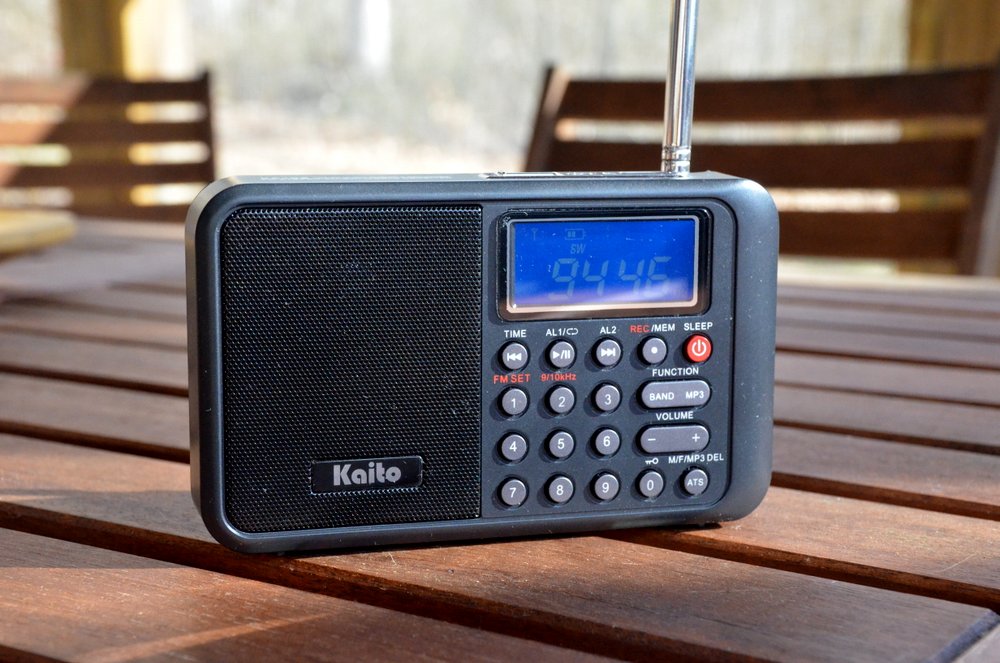
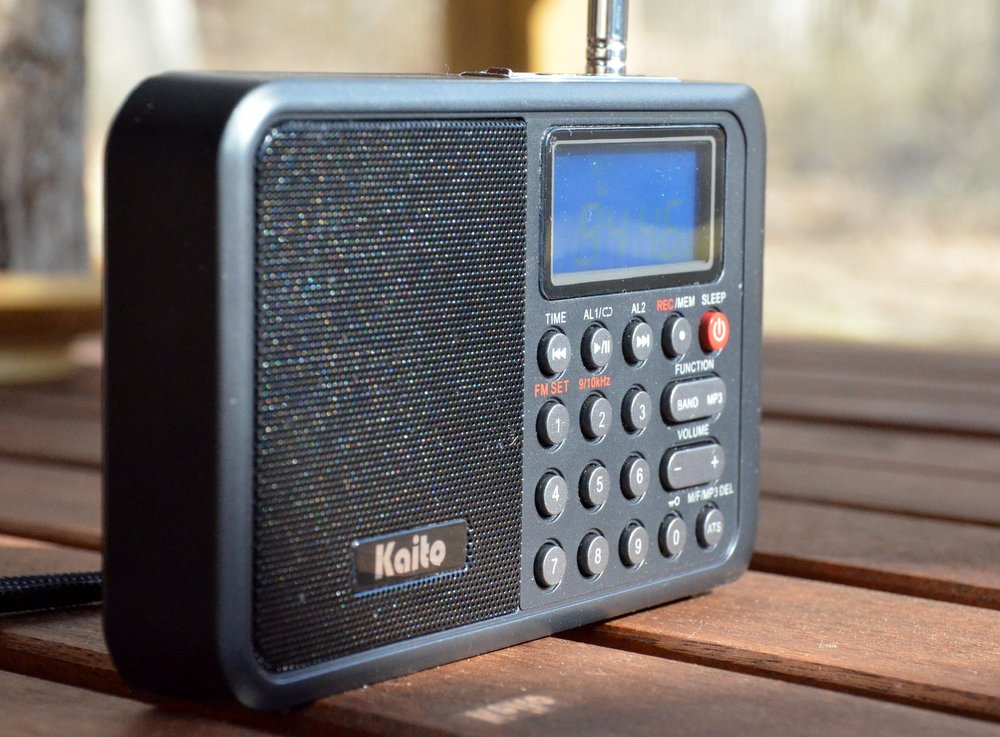
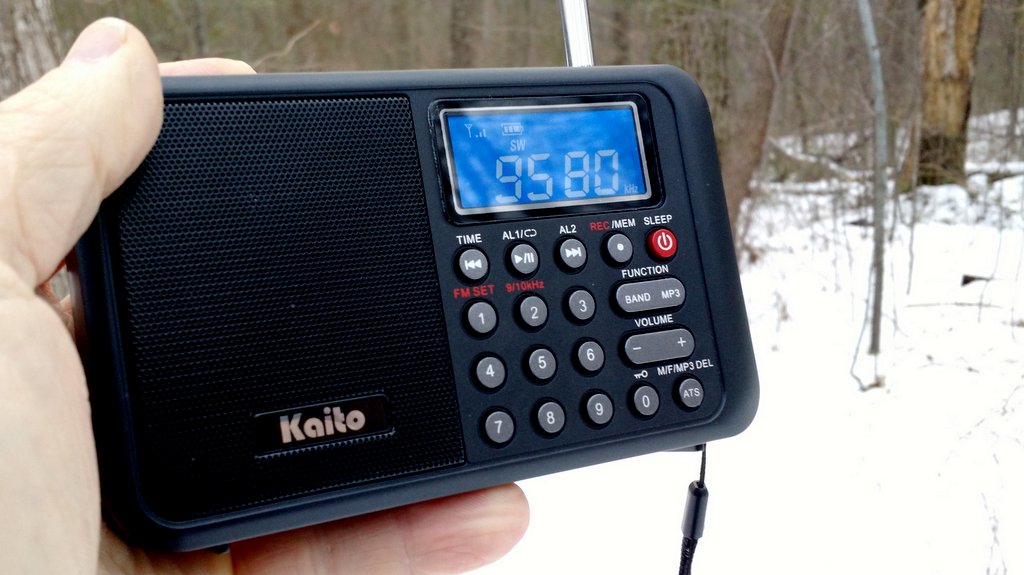
Recently, I learned about a new portable by Kaito Electronics: the Kaito KA108. While there are a number of compact portables on the market, the KA108 really caught my attention because it features a built-in digital recorder. Which is to say, you can listen to a station on shortwave, press a button, and the KA108 will record it to a MicroSD card. Pretty cool, right? It’s also the first shortwave portable I’ve ever known that offers a scheduling feature for recordings.
In the past there have been a few shortwave portables with digital recording capabilities, but most of these have been plagued with poor performance. So this time, I had my fingers crossed that Kaito might have produced a winner.
Having used the KA108 for several days now, my initial review follows, with a focus on shortwave as well as mediumwave performance.
User’s Manual
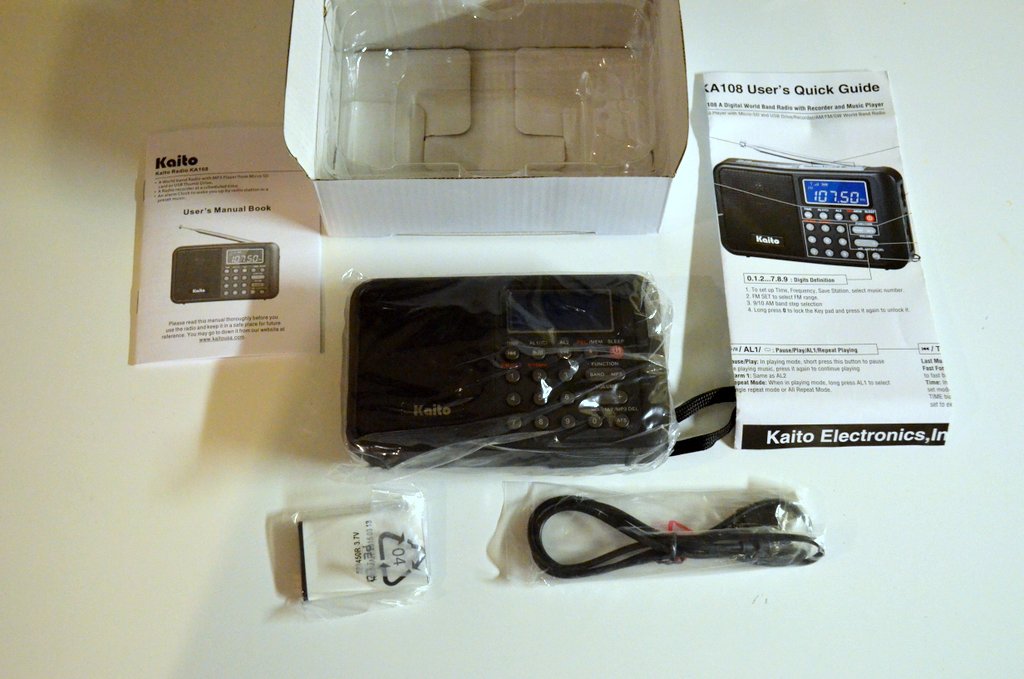
The KA108 actually ships with two manuals: a quick start reference guide and a proper highly-detailed user’s manual.
The manual is written in English and is quite descriptive, despite a number of spelling and grammar errors that should have been caught before going to print. It’s obvious that Kaito didn’t hire a native English speaker/professional editor to check their copy. (I don’t understand why a company would go to the expense to produce a manual without having it professionally edited…Kaito, please take note!) Fortunately, these spelling and grammar errors, while annoying, can be overlooked and/or deciphered by most English-speaking readers.
Tuning
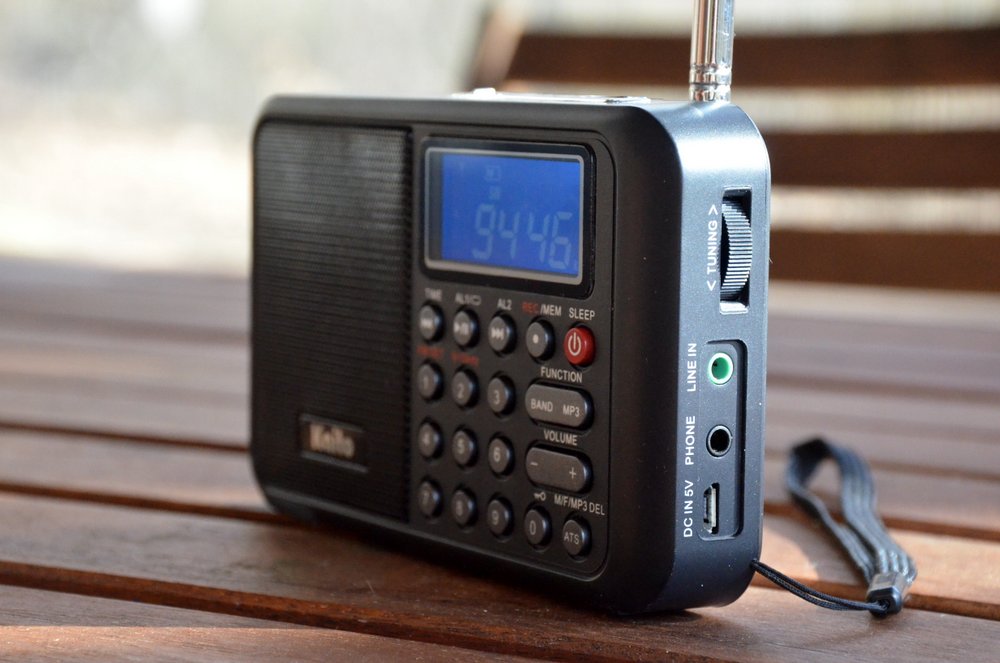
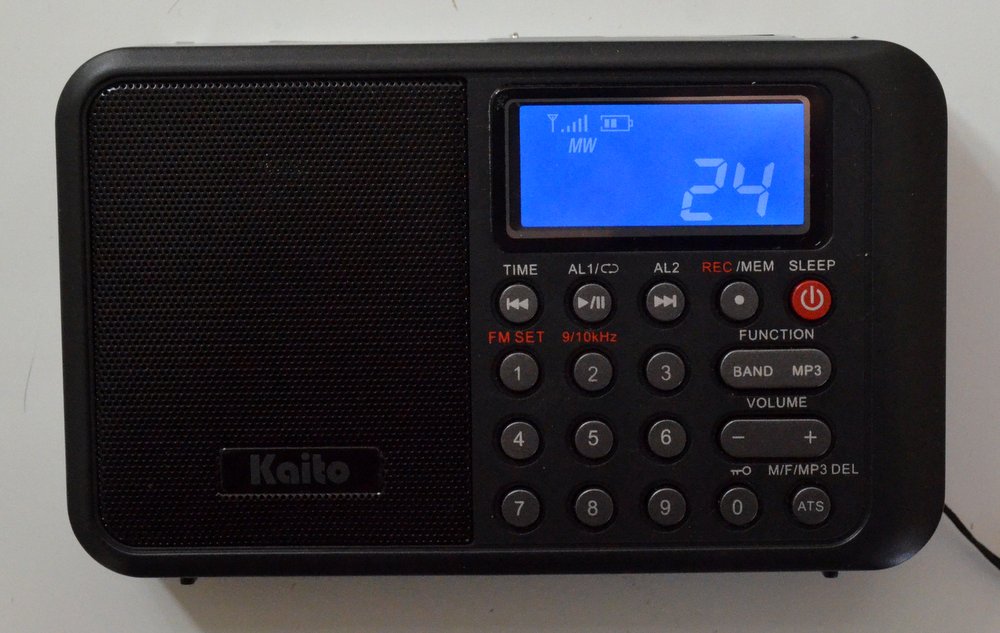
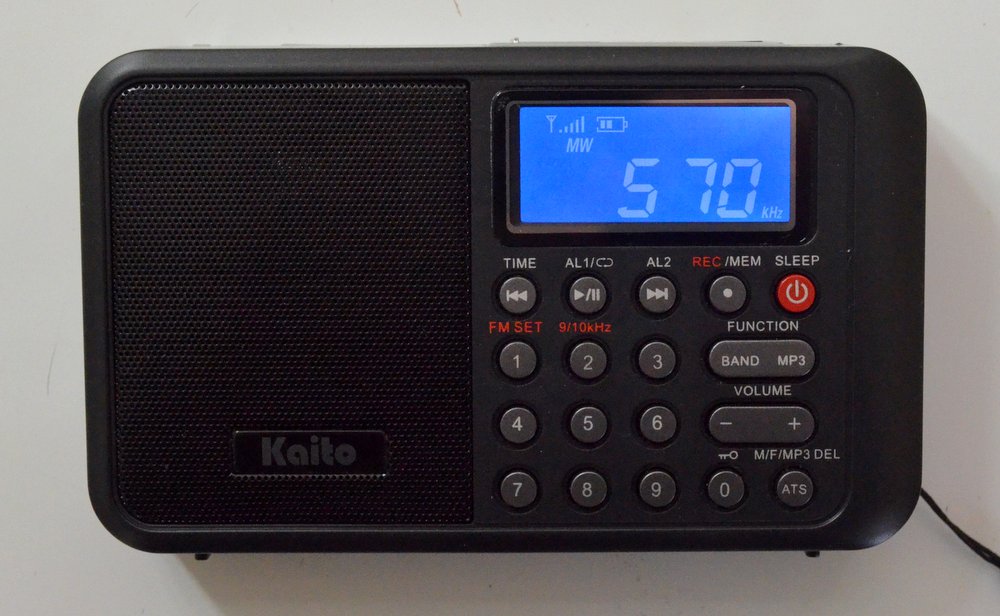
On the plus side, the KA108 sports a full number keypad for direct frequency entry. This makes tuning to a known frequency a very simple process––with one exception (see below). There’s also a tuning wheel on the right side of the radio.
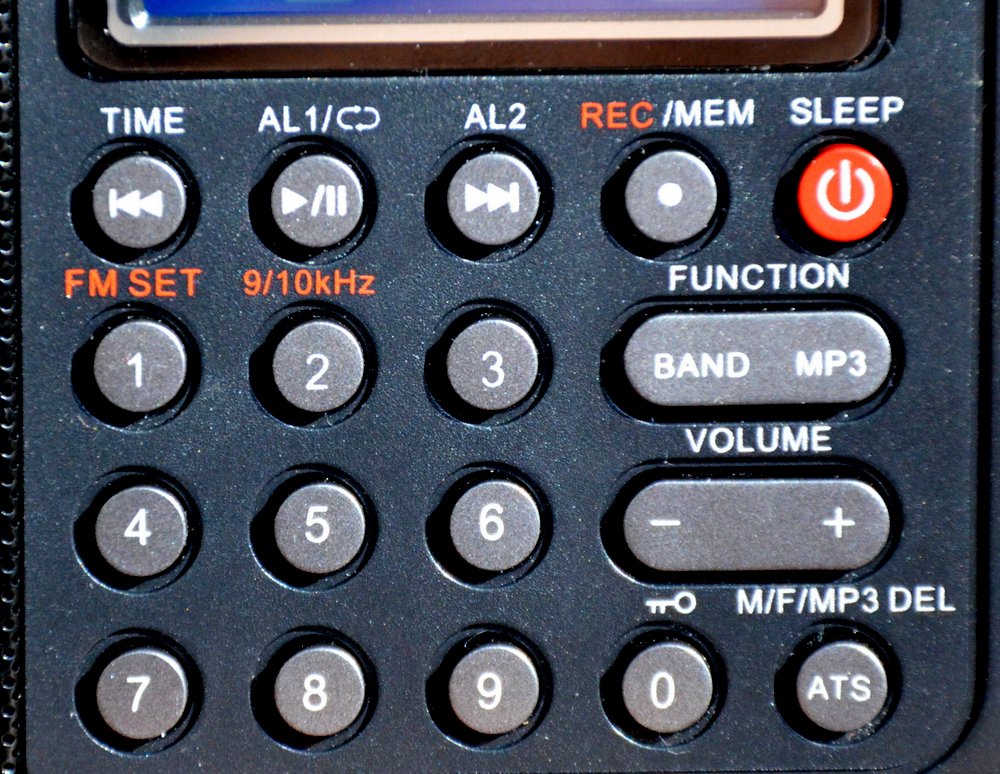
Note where the “0” is placed on the keypad: why the change?
Using the keypad requires some getting used to, however. Most of us––myself included––are familiar with traditional numeric keypads, but the KA108 inexplicably changes the game plan: as you can see above, the “0” button is located on the lower right side of the main keypad. So it took me a few hours of use before I could reliably key in a frequency without looking at the radio.
In my humble opinion, Kaito should have moved the number pad up one row, positioned the “ATS” button to the lowest row on the left, the “0” button to its immediate right, and completed the bottom row with the “Rewind/Play/Fast-Forward” buttons.
Another annoyance––and this is a big one for me–-is that the KA108 has extended muting between frequency changes. It makes band-scanning a frustrating experience. I made a short video demonstrating this:
Audio
The KA108 is designed around a very innovative small speaker with an acoustic chamber that significantly boosts bass response. This is the same speaker used in the Melson S8 that I reviewed some time ago.
The audio fidelity is excellent on FM, and when playing back a full-fidelity digital recording. Unfortunately, when tuned to the AM broadcast (mediumwave) band or to the shortwave bands, the KA108 falls short; the bass response actually becomes an impediment to listening.
In a nutshell: the KA108 audio has issues. A further explanation of the KA108’s audio is described in the performance notes that follow.
FM Performance
On a positive note, the Kaito KA108 has respectable FM reception. I was able to receive all my benchmark FM stations with little trouble, and the KA108 maintained a strong lock on all signals.
And as mentioned above, KA108 audio via the built-in speaker is much better on FM than on any other band. Indeed, on FM, the KA108 produces rich, full-fidelity audio that can easily fill a room. Audio is similar to that of the Melson M7 and the Melson S8.
If you’re seeking a nice FM portable with robust audio, you’ll enjoy the KA108.
Shortwave Performance
I’m quite disappointed with the KA108’s shortwave performance.
Almost immediately after unboxing the KA108, I inserted a battery, walked outdoors, and tuned through the 31 meter band.
Other than a couple of blow-torch North American private broadcasters, I heard…nothing. It was during this first band scan that I realized how annoying the tuning mute could be. And the audio, meanwhile, sounded muffled and garbled: I assumed that there was some local interference, and simply turned the radio off, hoping the following day would produce a change for the better.
The following day, I spent a great deal of time with the KA108 on the air, and compared it with the Eton Traveller III and the Tecsun PL-310ET––both capable, similarly-priced compact DSP radios.
Sure enough, when compared with other portables, the KA108’s reception is, sadly, rather poor.
At first I thought it might be an issue with receiver sensitivity, but the KA108 could receive almost every station the Traveller III and the PL-310ET could receive. But the audio was so muffled on the KA108, even with the use of headphones, that spoken word was hard to interpret. Additionally, the over-active AGC (Automatic Gain Control) meant that audio levels were all over the place. That combination makes for fatiguing listening.
Volume level indicator.
Over the next few days with the KA108 on shortwave, I drew a few conclusions.
After recognizing that the audio fidelity did not improve significantly when using headphones, I realized that at least three factors are having a negative impact on shortwave audio, as follows:
The default AM bandwidth is too narrow for broadcasts, and cannot be adjusted
The AGC setting is over-active and causes audio pumping; it, too, cannot be adjusted
Portions of the shortwave bands are polluted by internally-generated noise/interference
This combination makes for sloppy shortwave performance.
To save time in making the KA108’s comparison information readily available, as well as to indicate actual speaker performance, I decided to take a few quick comparison videos not with the KA108 or an external mic but simply with my smartphone. While my phone’s microphone is somewhat limited, I believe you’ll be able to observe the inherent problems with the KA108.
I compared the KA108 with the Traveller III in each video.
In the first comparison, I tuned to Radio Exterior De España on 9690 kHz, as you’ll see. The signal was marginal or relatively weak at the time:
Mediumwave (a.k.a., AM broadcast band) performance is very similar to shortwave performance.
In this video, I’ve tuned to an AM station located twenty-five miles away on 1600 kHz. The KA108 can receive the station, but audio is not pleasant and the AGC is, yet again, overactive. I’ve noticed that the mediumwave band is plagued by more internally-generated noise than are the shortwave bands.
Note that YouTube’s copyright checking system flagged my video because it recognized the song being played in the background on WTZQ. I believe this easily qualifies as fair use since the clips are short and it’s an off-air recording with dialog on top. I’ve disputed this, but YouTube may choose to delete this video. In anticipation, I’ve saved the audio from this video–you can listen to it by clicking here.
In a nutshell, AM performance on the Kaito KA108 is frankly poor. Even when I tuned to strong local stations, the audio sounded muffled and distorted, much as in the Radio Havana Cuba example above.
So you can forget about using the KA108 for mediumwave DXing.
MP3/WAV Playback and recording
There are some redeeming virtues with the KA108, however. Here’s a positive: digital playback with the KA108 is fantastic. I’ve played a wide variety of audio files on the KA108, and am very impressed with its on-board MP3/WAV player. While audio characteristics unfortunately cannot be adjusted––i.e., there’s no equalization––I find the default audio settings well-balanced for both music and voice.
The KA108 has a dedicated MicroSD slot and a covered USB slot on top of the unit.
Recording directly from shortwave and mediumwave is also quite good. I believe its on-board recorder is perhaps the best I’ve tried in recent portables; it’s a marked improvement over that of the Kaito KA29, for example. It seems to capture the receiver’s produced audio well, with only a slight, high-pitched “hiss” injected in the audio, though this is not a major distraction.
Sadly the main distraction is that the recorder is recording audio, as I’ve outlined above, from a sub-par receiver.
Still, as an MP3/WAV player, it’s brilliant, and boasts excellent audio.
Summary
Invariably, all radios have strengths and weaknesses; here’s a list of my notes from the moment I put the KA108 on the air:
Pros:
Great portable size
Clear back-lit display
Numerous recording and playback features
Audio via MP3 or headphones is strong, considering the small speaker with acoustic chamber provides more bass response and volume than comparable portables (see con)
Excellent FM reception
Excellent MP3/WAV playback with well-balanced audio fidelity
Recorder schedule function
Alarms and sleep timers easy to use
Dedicated MicroSD and USB slots on top of chassis
Cons:
Mediocre sensitivity on SW and MW
Internally-generated noise on MW and SW
Audio (via built-in speaker) is:
too bass-heavy, lacks treble on MW/SW
garbled and mushy on MW/SW
“hot” and often splatters/distorts when signals are strong
Tuning
extended mute between frequency changes
no “scan to next station” function (only ATS)
Odd numeric keypad layout
Any local RFI garbles reception even further on SW/MW
No SSB (in fairness, few radios in this price class have SSB)
Antenna swivel to the front somewhat blocked by the radio’s chassis
No backstand
Conclusion
I really wanted the Kaito KA108 to be a strong––or even average––performer. Why? Because, like many of you, I would love to have a capable shortwave/mediumwave radio with built-in digital recording and playback.
Sadly, the KA108 falls short on multiple levels.
Concerned that I might have simply received a defective unit––as I did when I reviewed the Sangean ATS-405––I contacted Kaito Electronics USA. I mentioned my disappointment with the radio’s performance, and detailed the negatives mentioned in this review.
I asked Kaito’s technician if I might have received a defective unit? He responded that my experience seems to be the norm with this particular production run. He, too, had noted muffled/garbled audio on shortwave and mediumwave. Per his request, I sent a detailed list of the KA108’s shortcomings with suggested fixes. He is planning to send this to Kaito’s current manufacturer in China.
The KA108’s poor performance issues would likely be mitigated to a great extent, if the manufacturer would simply make the following adjustments:
Widen the AM bandwidth
Tweak the AGC for greater stability
Adjust the audio settings for the AM mode
Minimize/shorten muting between frequency changes
Improve internal shielding and grounding
And while they’re at it, have the radio manual edited by a native English speaker
Since this is a DSP-based radio, I imagine the first four adjustments can be made via firmware upgrades.
Time will tell if the second production run of the Kaito KA108 improves on the first. Fingers crossed…! Kaito, we’d like you to succeed on this score.
I wanted to run SdrDx, and other SDR apps on my Mac with an RTL SDR Dongle. So I wrote this server app, that makes it appear like a networked SDR.
No need to install any RTL libraries, or compile any code.
Just run the app on your Mac, configure it and your SDR app, and you’re all set.
The app is free, and should work with Mac OS X 10.6 through 10.11.
Chris has kindly allowed me to share his full post here on the SWLing Post below–you can read the original at RadioHobbyist.org:
Running an RTL SDR USB Dongle On Your Mac The Easy Way With Cocoa RTL Server
I’ve had a few of the RTL radio tuner dongles for a while. These are USB devices that were originally made for use as TV tuners overseas, but it turns out that you can access the I/Q data stream, and turn them into an SDR (Software Defined Radio). They can be tuned roughly over a range of 25 to 1700 MHz, and sometimes even higher, depending on the tuner IC chip inside the particular dongle.
Fast forward to the present day. I got a new Mac running OS X 10.11 El Capitan, and I wanted to be able to use the RTL dongles with my favorite SDR software on the Mac,SdrDx. Enter Cocoa RTL Server.
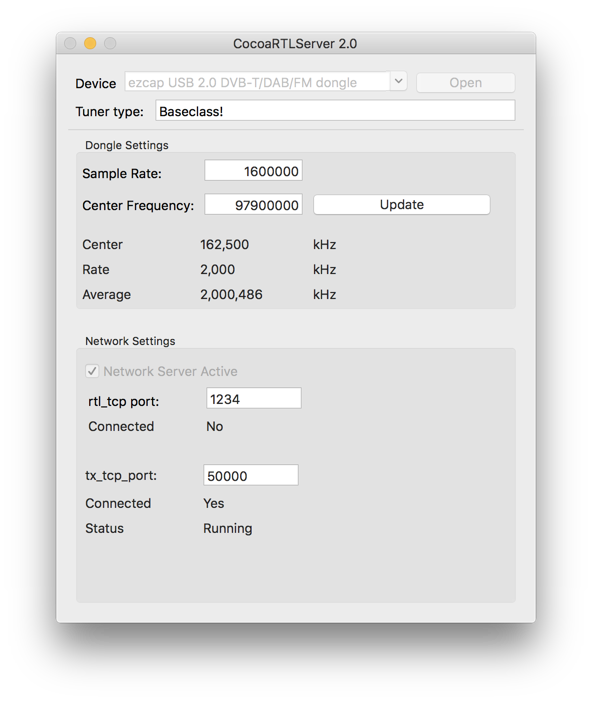
Cocoa RTL Server is a stand alone app that interfaces with an RTL dongle. It does not require you to build or install any drivers or libraries. It just works. It’s based off of an open source app called SoftShell, that I heavily extended. Cocoa RTL Server also acts like a networked SDR, following the RF Space protocol. That means it works with SdrDx, as well as any other SDR app on the Mac that supports RF Space SDRs like the netSDR. You can download a copy of the app from the Cocoa RTL Server page. Source code is included, however I am not offering any support for the project or final app.
Here’s a screenshot of the app running:
Getting up and running is easy:
1. Plug in your RTL device
2. Run CocoaRTLServer 2.0
3. Select the device from the popup menu (usually it is already selected)
4. Change the rtl_tcp or tx_tcp port values if needed
5. Click Open
6. Configure your SDR app (set the correct TCP port) and run it
I’ve run it under Mac OS X 10.6, 10.10 and 10.11, It should run under 10.7-10.9 as well.
Using SdrDx, I can tune a large portion of the FM broadcast band, click to view full size:
In this case I am tuned to 97.9 MHz. To the left of the signal meter, you can see it has decoded the station ID from the RDS data. Yes, SdrDx decodes RDS.
If you look at the lower right corner, you see the scope display of the demodulated FM audio. There are markers for the portions of interest:
You can see the main audio above the green marker to the left.
The stereo pilot at 19 kHz (red marker).
The stereo subcarrier (aquamarine)
The RDS data (orange)
The 67 kHz SCA subcarrier (purple)
The 92 kHz SCA subcarrier (yellow)
Cocoa RTL Server also includes a server that emulates rtl_tcp, so it works withCocoa1090 which decodes aircraft transponders that transmit on 1090 MHz. It should also work with any other app that gets data from rtl_tcp. Here’s a screenshot of Cocoa1090 running:
Thanks so much for developing this app, Chris!
I think I might go ahead and pull the trigger on an RTL-SDR as it would be great to run one on my Mac. I think your app will make the process much easier.



 Digital Radio FM Europe blog