Category Archives: Ham Radio

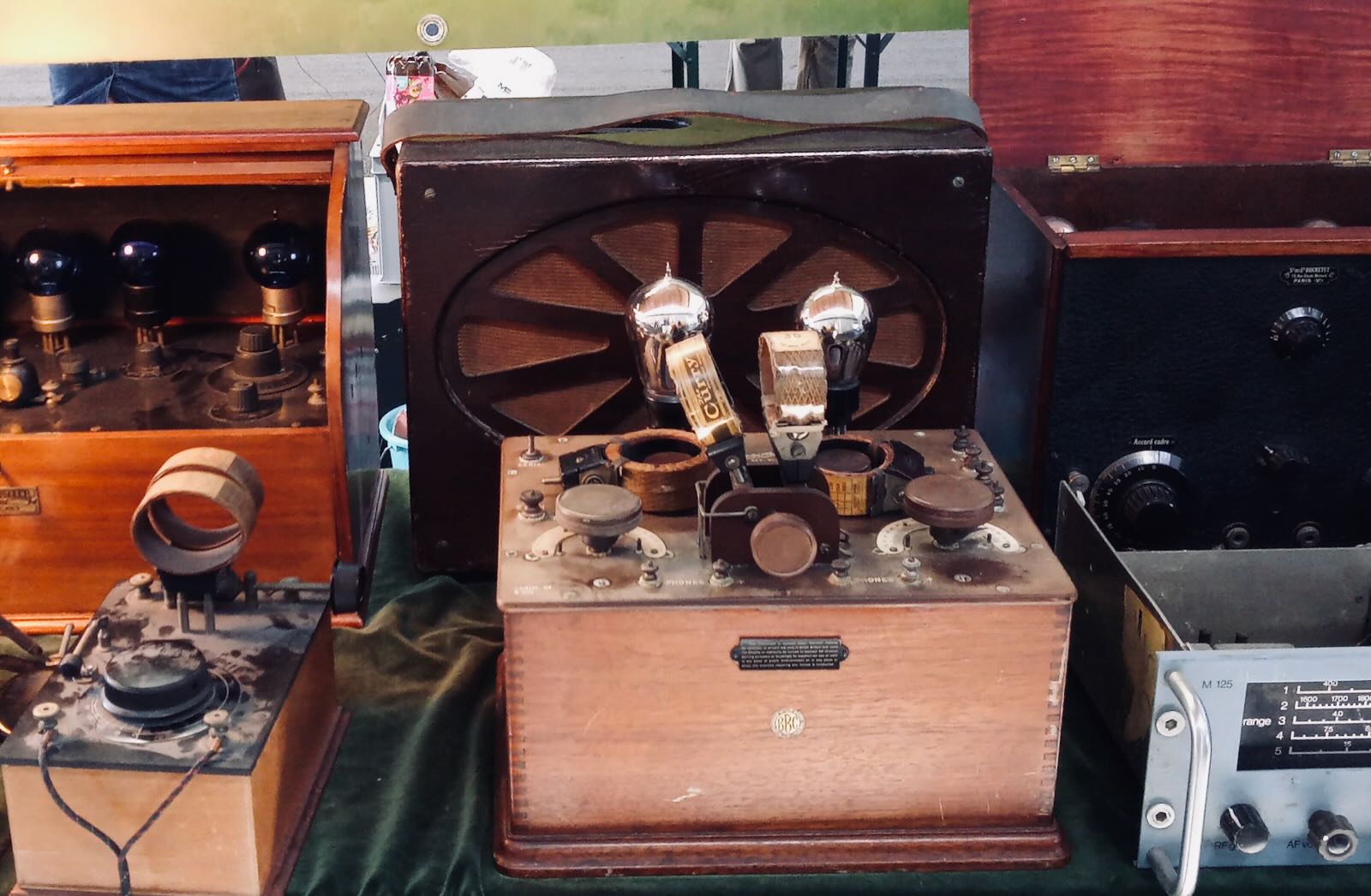
Photos from the 2022 Milton Ontario Hamfest

Many thanks to SWLing Post contributor, Mike (VE3MKX), who writes:

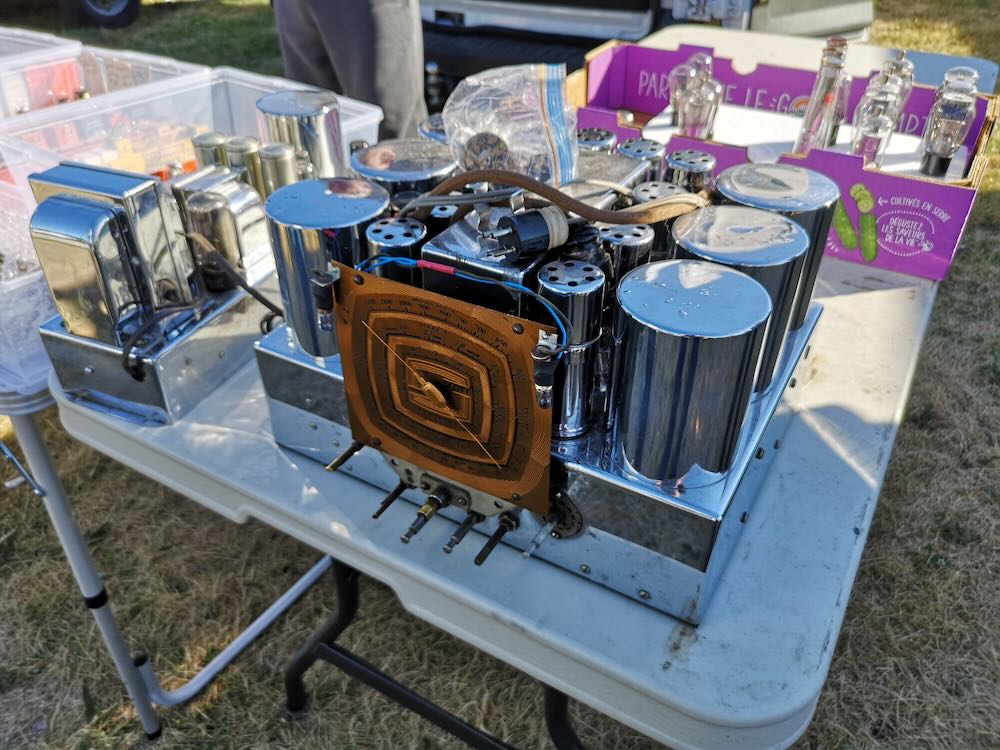
The following pictures are from a Hamfest which was held yearly at the Milton Fairgrounds in Milton Ontario, Canada. (Located 20 minutes west of Toronto).

The Burlington Amateur Radio Club organizes the event and confirms that they had 108 vendor spaces sold and over 475 general admin passed through the gates.

A great day of meeting friends, lots of deals and smiling faces!

Thank you so much for sharing this, Mike! I haven’t been to a hamfest yet this year, so it’s great to catch a glimpse of what looks like a very successful one! 

Readers: This is a large gallery of 132 photos courtesy of Kevin (VA3RCA) and Mike (VE3MKX). If you would like to view the entire image gallery click on the link to see more.  Continue reading

Radio Waves: New Yaesu FT-710 AESS, Ukraine’s Army FM, Foil 28 MHz antenna, and ATS-25 4.1 Firmware Review,

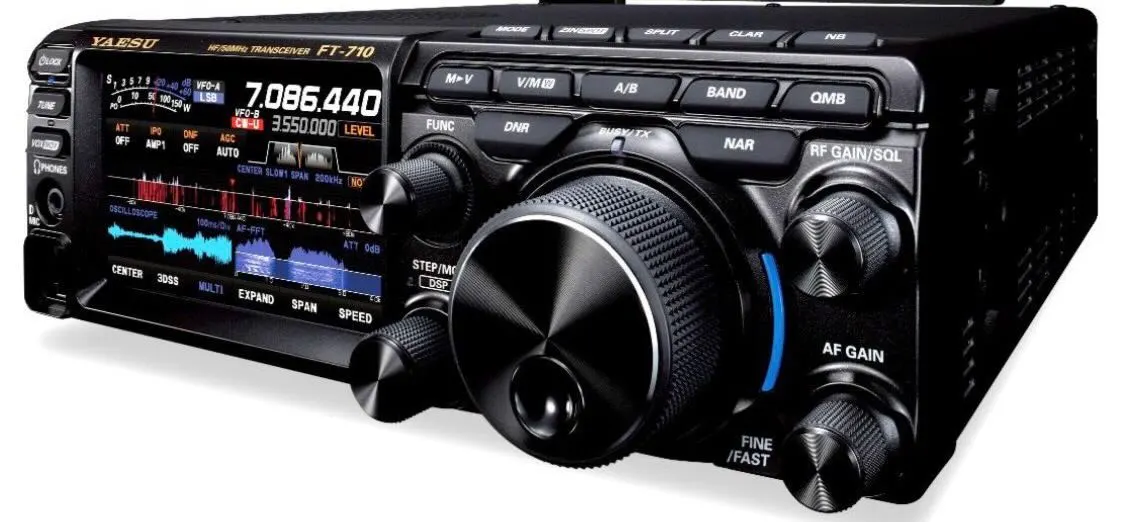
The Yaesu FT-710 AESS

Radio Waves:  Stories Making Waves in the World of Radio

Welcome to the SWLing Post’s Radio Waves, a collection of links to interesting stories making waves in the world of radio. Enjoy!

Many thanks to Eric Jon Magnuson for summarizing these news items for Radio Waves!


Yaesu Introduces the FT-710 AESS 100 SDR Transceiver (QRPer.com)

Yaesu is introducing a new 100 watt SDR transceiver to their product line: the Yaesu FT-170.

The Yaesu FT-710 will cover 160-6 meters with 100 watts output. There are two other Japanese market versions: the FT-710M and FT-710S which are 50 and 10 watt respectively.

This general coverage rig will feature “AESS”–Yaesu’s ‘Acoustic Enhanced Speaker System’ which “creates the high-fidelity audio output.” Yaesu notes that the FT-710 utilizes, “the advanced digital RF technology introduced in the FTDX101 and FTDX10 series.”

Click here to check out the published features and specifications of the new FT-710.

Ukraine’s ‘Army FM’ Radio Adapts To Full-Scale War (CoffeeOrDie)

KYIV, Ukraine — During the early morning hours of Feb. 24, as Russian missiles struck targets across Ukraine in the opening hours of the full-scale war, the Ukrainian military’s Army FM radio station went underground.

The team of seven army officers and about 10 civilian personnel abandoned their studio on the top floor of a downtown Kyiv building and relocated into a nearby basement. Inside the dank and dark underground space, they connected a mixing board and a couple of laptops to a mobile radio system, which the station’s reporters had previously used to report from the Donbas trenches.

“I just grabbed my Kalashnikov and went to work,” said Oleksandr Yurchenko, 32, a Ukrainian army second lieutenant assigned to Army FM.

While a Russian invasion force advanced to the outskirts of Kyiv in the war’s perilous first few days, the Army FM team stayed at their posts and worked in six-hour shifts to keep their programs running 24/7. They constructed makeshift beds from shipping pallets and stocked the basement studio with food and water. Body armor vests and Kalashnikovs occupied all available shelves and empty corners.

From this jury-rigged basement studio, Army FM continued to transmit information and entertainment programs to listeners across Ukraine — including into territories Russian forces invaded and occupied. [Continue reading…]

Hackaday: Homemade 28 MHz antenna made from foil (Hackaday via the Southgate ARC)

On Hackaday Chris Lott WD4OLP writes about DL1DN’s aluminum foil 20cm antenna for 28 MHz (10m) operation

David DL1DN, is an Amateur Radio enthusiast with a penchant for low-power (QRP) portable operations. Recently he was out and about, and found that 10 m propagation was wide open. Not discouraged by having forgotten his antenna, he kludges up a makeshift one using a 20 cm length of aluminum foil.

Read the Hackaday story and watch the video at
https://hackaday.com/2022/07/02/aluminum-foil-20-cm-antenna-for-10-m-operation/

Dave reviews the ATS-25 with Binns 4.1 firmware

Dave Zantow writes:

ATS-25 with Binns 4.1 firmware Review Now Posted. […] There were 7 different versions in the beta stage. New audio file added as well (Sync when it does not work so well, which is NOT all the time). Might be one more update before release (not sure right now).

Click here to check it out.


Do you enjoy the SWLing Post?

Please consider supporting us via Patreon or our Coffee Fund!

Your support makes articles like this one possible. Thank you!

Alexander shares a few photos and notes from Hamradio 2022 in Friedrichshafen

Many thanks to SWLing Post contributor, Alexander (DL4NO), who shares the following photos and notes from Friedrichshafen:


First Hamradio After Two Years

Alexander (DL4NO)

Finally the biggest amateur radio event in Europe happened again: Last weekend hams from Germany, Austria, Switzerland, France, Italy, Poland, Belgium, Netherlands, GB and more gathered in Friedrichshafen. The location is quite attractive, in Germany but near Austria and Switzerland. I could not get any numbers yet. But the event was quite a bit smaller than in 2017 when I was there the last time.

As every year amateur radio societies from Europe and the ARRL had booths. The most remarkable was from the Austrian OeVSV with their own stage. They had their own, quite interesting lectures. For example Austrian Hams have used the geostationary satellite QO-100 for LoRa experiments. They are quite active with LoRa as this technology allows to transmit data quite slowly, but quite far and with a minimum of power. Their project is called MeshCom. Continue reading

Radio Waves: Future of AM in UK, BBC and Nuclear War, SAQ Unable to Air on Alexanderson Day 2022, ITU Ham Station Celebrates 60 years, and RRI International Quiz

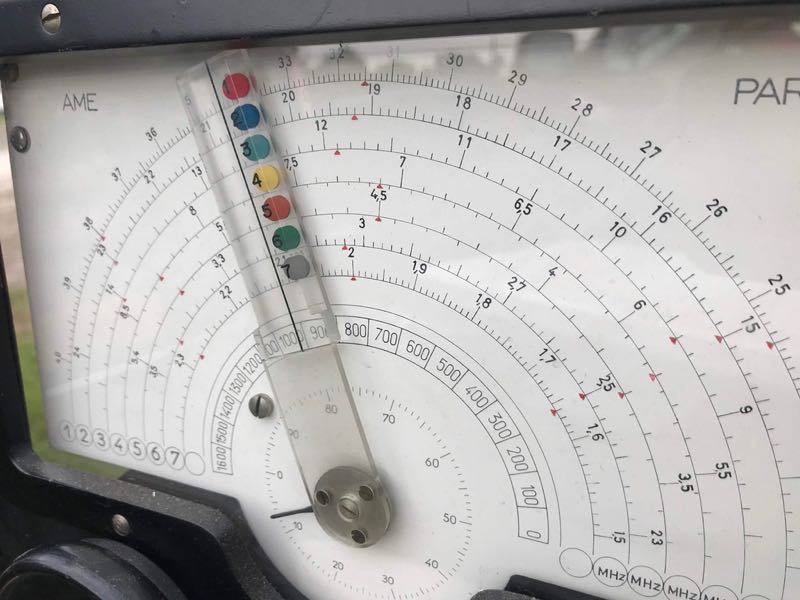
Radio dial

Radio Waves:  Stories Making Waves in the World of Radio

Welcome to the SWLing Post’s Radio Waves, a collection of links to interesting stories making waves in the world of radio. Enjoy!


Opinion: The Future of AM Radio
England, Scotland, Wales and Northern Ireland (FrequencyFinder.co.uk)

Summary

AM radio in the British Isles is now in terminal decline with audiences dropping and many transmitters closed already. The majority of the remaining transmitters will likely close by the end of 2027. Over the next few years, the BBC and major commercial broadcasters will be looking to minimise their AM transmission costs by reducing transmission powers at the high-power sites and closing some of the low-power transmitters serving small audiences.

A coordinated AM shutdown may then follow at some point, most likely in 2027, though some independent broadcasters may continue using AM beyond this. This article explores these issues in more detail.

Click here to download the full PDF of this article.

The Last Word – The BBC and Nuclear War (Atomic Hobo Podcast)

This episode of the Atomic Hobo podcast focuses on the role of the BBC before and after nuclear attack:

https://soundcloud.com/user-494087291/the-last-word-the-bbc-and-nuclear-war

Click here to listen via Soundcloud.

SAQ unable to air on Alexanderson Day (The Alexander Association)

Note: the The Alexander Association has announced that they will be unable to put SAQ on the air this year on Alexanderson Day. There are no more details other than the title of their post (the content still reads as if the transmission will happen as planned).

Check the Alexander Association website for more details.

ITU’s ham radio station celebrates 60 years on air (ITU)

By Nick Sinanis, callsign SV3SJ, President of the International Amateur Radio Club (IARC), and Attila Matas, callsign OM1AM, Vice-president and Station Manager, IARC

Did you know that the United Nations specialized agency for information and communication technologies owns and operates its very own radio station?

Residing at the headquarters of the International Telecommunications Union (ITU), the 60-year-old amateur station operates under the callsign 4U1ITU.

It started broadcasting on 10 June 1962 and was officially inaugurated the following month by then UN Secretary-General U Thant and ITU Secretary-General Gerald Gross – himself a ‘’ham” radio enthusiast known by the personal callsign W3GG.

Recognized as a unique “country” in the ham radio community, 4U1ITU operates in accordance with privileges extended by ITU and the Government of Switzerland. It has also earned the DXCC (or ham radio “century club”) award from the American Radio Relay League (ARRL), confirming air contacts with 100 or more countries.

From its long-time home on the 5th floor of the Varembé Building in Geneva’s international district, this unique broadcasting outlet still today serves as a model for the highest standards of amateur radio station operation everywhere.

From one to a million

4U1ITU’s first contact, or “QSO” in ham radio parlance, was made with a German station called DL4VK. Further QSOs followed, amounting to over 1,300 contacts worldwide in the first 24 hours.

In the six decades since, ITU’s radio station has made over a million contacts using Morse code carrier wave (CW), voice (SSB), and digital operational modes, based on more than 20,000 two-way QSOs with radio amateurs around the world.

4U1ITU can operate on most of the frequency bands allocated to amateur and amateur-satellite services as identified in Article 5 of the Radio Regulations.

Aside from letting licensed radio amateurs in ITU, its Member State representatives, and its conference and meeting delegates contact fellow radio hams, the station promotes international goodwill and cooperation across the community. It also allows hands-on demonstrations of amateur radio communications for delegates and meeting participants. [Continue reading…]

RRI Voice of Indonesia: International Quiz 2022


Do you enjoy the SWLing Post?

Please consider supporting us via Patreon or our Coffee Fund!

Your support makes articles like this one possible. Thank you!
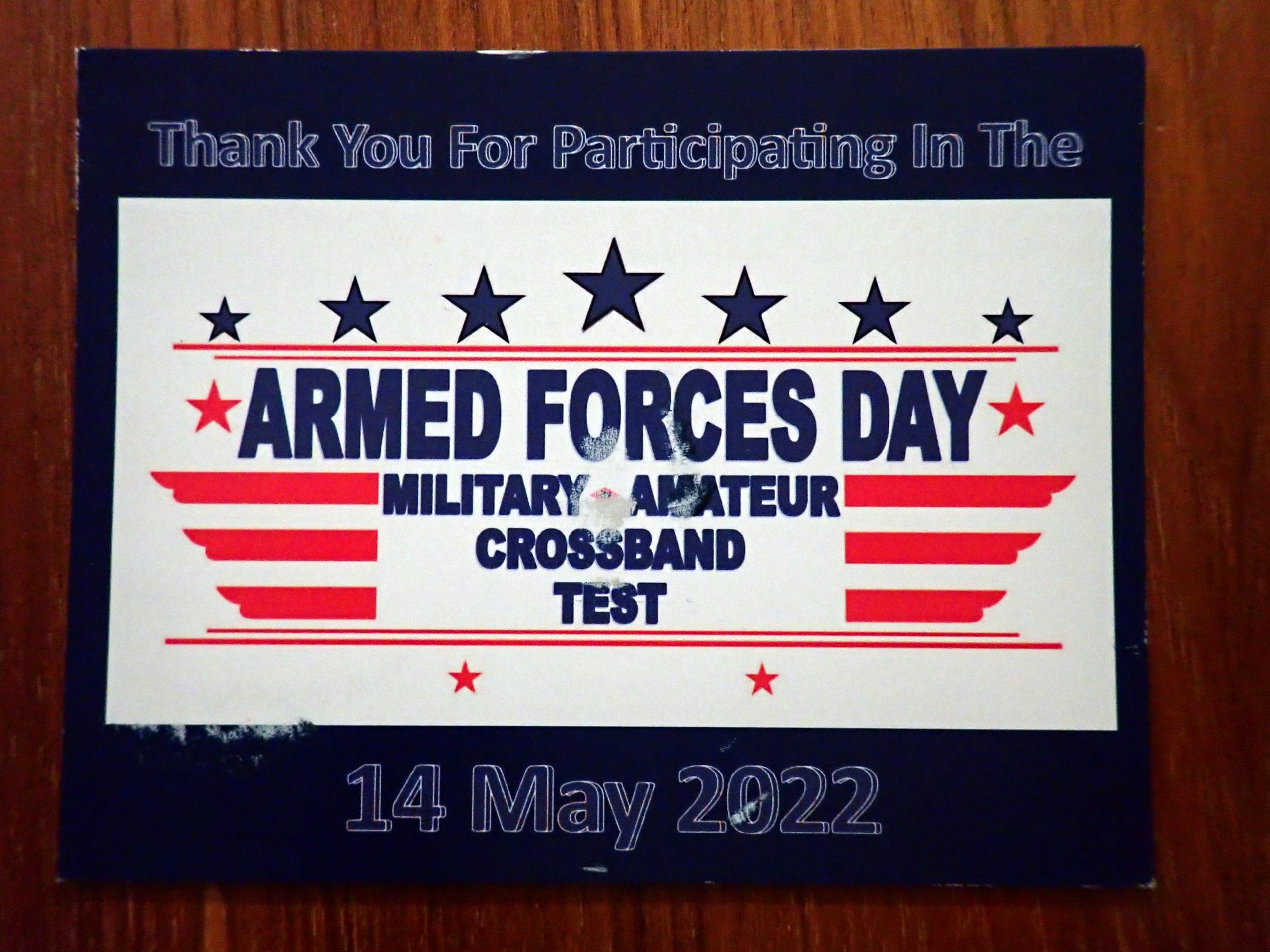
Armed Forces Day QSL Card

On May 14, 2022, this blog published an announcement of the Annual Armed Forces Day Crossband Test.

The blog included a link to a PDF file that listed all the details, such as times, frequencies, and military stations that were participating (including some that were aboard ships), and there was even a link where you could submit your information online to receive a QSL card. I thought it would be fun to see if I could hear some of the military stations.

At 3:29 pm on May 14, I posted a comment on the blog:

1850Z & 1925Z — 14.487 MHz — Station sending CW CQ CQ CQ (I can copy but not read the rest), believed to be NSS — US Naval Academy transmitting for Annual Armed Forces Crossband test.

At 3:37 pm, I posted:

1934Z — 14.487 station NSS announces in voice they are listening 14.234.0 USB. Additional contacts in SSB. “It’s raining buckets here.”

Not hearing anything further, I filled  out the QSL request for — which asked for two-way contact information. I explained that I had only heard the Anapolis station, but I gave the details. Frankly, I did not hold out much hope for receiving a card, but yesterday it arrived.

As I reported elsewhere the MFJ 1020C active antenna/preselector made it possible to hear the Armed Forces Day station.

It was a very nice surprise to received the QSL card in the mail.

Kostas explores an alternative to Morse Code that’s been used in prisons, with roots in ancient Greece

Many thanks to SWLing Post contributor, Kostas (SV3ORA), for sharing the following guest post which originally appeared on his radio website:


TAP: A Morse alternative mode for the HAM, with no need for training

by Kostas (SV3ORA)

Introduction

The thinking of this new mode, came to me when someone posted that he quit the HAM hobby because he did not learn Morse code and he did not want to use computers to do the job for him. Some time I faced a similar situation and I believe many do one day or the other. So I thought that I had to do something about it. It is too bad people quit the hobby or missing the fun of the KEY operation, because of the obstacle of Morse code. No matter what CW operators that already learnt Morse might say, the fact is that Morse requires patience, continuous practice and most importantly time. After all military had dedicated courses on it in the past, so it must be more than true. These are things not all people can, or are willing to do. An alternative that gives the same pleasure like Morse and operates with the same techniques, but requires no training and time must exist. Meet the TAP mode!

Mode description

This mode has its roots to ancient Greece. You may read the article in Wikipedia for more information on the Polybius square. A form of it, was used in the previous century in was times, for in-prison communication. A modified version is presented here by me, that fits perfectly the HAM radio. This modified TAP code scheme, is dedicated to HAM radio and includes the numbers and the letter “k”.

This is all you need to know in order to send and receive TAP. It is easy to follow and easy to generate on paper. This is a 6 by 6 table, with the first six alphabet letters placed in the first line, the next six in the second and so on. After the alphabet ends, the numbers are put in the same manner. Thats it!

Sending TAP

It is better to describe the sending procedure with an example.
To send the letter “i” you send two dots (“i” is on the second row), wait a bit and then send 3 more dots (“i” is on the third column). In other words, you first count the number of rows where the letter exists, then wait a bit and then you count the number of columns where this letter exists. Before sending the next letter, leave a bit of more time, so as to distinguish that this is a separate letter and not the time between rows and columns. Thats it!

Try it now without any transceiver! Write the TAP table on a piece of paper (you do not need to write the row and column numbers), or read it from the website. Tap on your desk with your finger and send some words to the colleague near you. See how easy it is?

There are actually four spacings involved. The spacing between adjacent dots, the spacing between the row and the column, and the spacing between letters and the spacing between words. Follow the PARIS spacing, like Morse code does, if you intent to write a software for it. However, in practice, manual operators would need to consider just two spacings, the spacing between rows and columns and the spacing between letters. These are the most important. Just make the one bigger than the other and communication should be achieved without problems.

Receiving TAP

It is better to describe the receiving procedure with an example.
To receive the letter “i” you listen two dots (“i” is on the second row), then a short scilence time and then listen 3 more dots (“i” is on the third column). In other words, you first listen for a number of dots (this is the row where the letter exists), then sense the scilence and then you listen for the next number of dots (this is the column where the letter exists). The scilence time between two letters is greater than the scilence between rows and columns and this can be distinguished easily. Thats it!

Try it now without any transceiver! Write the TAP table on a piece of paper (you do not need to write the row and column numbers), or read it from the website. Put your coleague to sent you some TAP words and you should be able to decode them by counting the rows and columns in the TAP table.

A programmer that may need to implement the mode in software, should follow the PARIS spacing to distinguish the different parts of the code, as described above.

TAP advantages

Here are some advantages I can think, of TAP in comparison to Morse.

  • No training is required, start using it imediatelly, even by non-HAM people and kids. This probably is the greatest advantage and this is why most would want to use TAP in HAM radio.
  • The encoding/decoding square can be drawn easily, it is very easy to remember how to draw it.
  • Decoding by hardware or software means, becomes very easy, as there are no dashes to account for. Dot lengths can be anything and can be even varying from dot to dot, it does not matter.
  • All you count, is how many ON-states (taps) there are and the rough timing between them, to decide between a row-column or a letter. Because of this intependency from dashes, the code can be used on any means, radio, light, pipes, walls, desks etc.
  • If dot lengths are kept very short (up to the point where channel noise allows it), RF amplifiers can be pushed beyond their limits (due to limited duty cycle), or otherwise run cooler within their limits. There are some mediums, like light communication, where bright pulses of light can be produced easily (eg. xenon tubes), but not kept for duration and TAP is ideal on them.

TAP disadvantages

Here are some disadvantages I can think, of TAP in comparison to Morse.

  • Speed limit issues probably. TAP beginners achieve for sure faster speeds than Morse beginners. However, a trained Morse HAM, can achieve greater speeds with Morse.
  • Learning the table by heart, can be tricky in comparison to Morse. However war prisoners had tricks to learn by heart the 5×5 TAP  square.
  • Not known (yet) among the HAM community, like any new mode. Why not change that by let HAMs know about it?

TAP common points to Morse

There are some common points shared between TAP and Morse code.

  • Both are relatively slow modes.
  • Both are ON/OFF keying modes, efficient class-E amplifiers can be used.
  • Both share the same channel bandwidth and noise-related characteristics.
  • Both are human-oriented, although TAP does not require training. Both share the PARIS timing when implemented in software.
  • Both allow for the “joy of the KEY”. You send TAP with the same equipment as Morse.
  • Both are ideal for homebrew QRP, due to efficiency and transceivers simplicity.