Shortwave listening and everything radio including reviews, broadcasting, ham radio, field operation, DXing, maker kits, travel, emergency gear, events, and more
One of the things I now regret is that I didn’t make more recordings of radio stations from my listening days in the 1970s and 80s. I have very few audio examples of stations operating at that time. So disappointing!
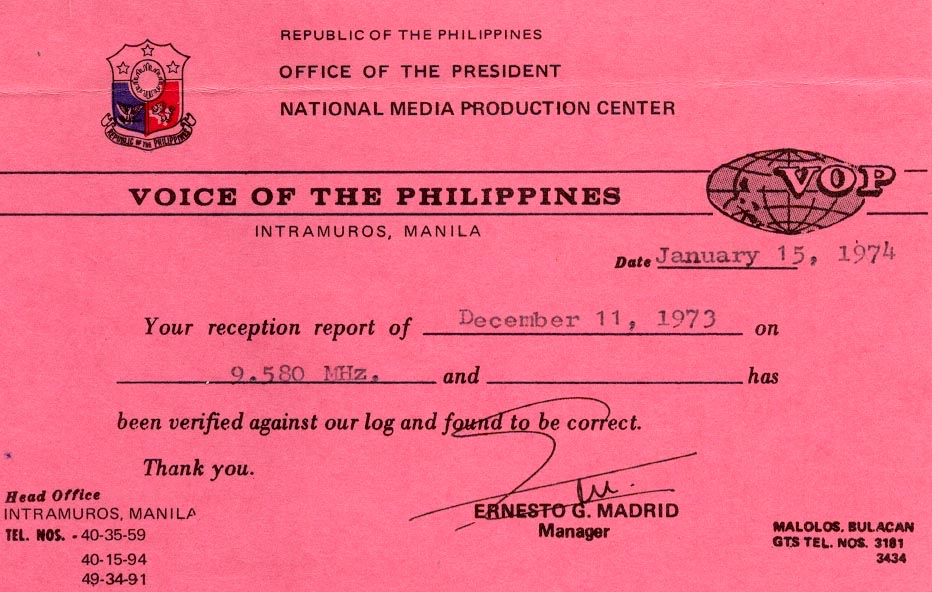
However….a few weeks ago, I stumbled across a recording I made in December 1973 of Radyo Pilipinas, The Voice of the Philippines (DZRP). After a bit of audio engineering on the deteriorating old cassette tape, I’ve managed to somewhat improve the tone quality. I also found an image of the QSL card from that exact transmission on December 11, 1973 on 9580 kHz. I’ve posted the recording on YouTube – click the embedded video below.
This is for those of you who can remember and for those who enjoy some radio history!
These days, Radyo Pilipinas still has a small presence on the shortwave bands with the following schedule:
To the Middle East in English and Tagalog from the Tinang relay site (250 kW)
0200-0330 on 15640, 17700 and 17820 kHz
1730-1930 on 9925, 12120 and 15190 kHz
73 and have a great weekend everyone!
Rob Wagner VK3BVW
Rob Wagner, VK3BVW, is the author of this post and a regular contributor to the SWLing Post. He also blogs at the Mount Evelyn DX Report.
Many thanks to SWLing Post contributor, David Iurescia (LW4DAF), who writes:
Hi Thomas:
As every year, Radio Prague has a new collection of QSL cards for its listeners.
This year, this eight different QSL cards show Means of Public Transport in the Czech Republic.
The following information was first shared with me by SWLing Post contributor, Harald Kuhl. As I looked for more details, I discovered the following note in the excellent CIDX Messenger:
From Alan Roe of Teddington, UK, here is information on new transmissions targeting Antarctica:
“Spaceline Ltd and Radio Nova News are to start transmissions to Antarctica for campaign for access of information to the Bulgarian Antractic base. Shortwave is the only media that can reach directly Antarctida at the distance of 13.000 km. Transmissions will start on 1’st of January, 01.00 – 02.00 UTC daily on frequency 11600 kHz. For more information visit www.spaceline.bg”
I couldn’t find any more information at either the Spaceline website or the Radio Nova news
website at https://nova.bg/
However, I received today the following reply (below) from Spaceline:
Hello Alan,
The information on the Facebook page is correct, and Space Line will start the transmissions of Nova News to Antarctica very soon.It was been planned to start the project on January the 1’st, but due to some logistic problems with the base, is postponed for middle or the end of January this year, but there was a test transmission on January the 1st 2017 on 11600 kHz. After the test it appeared that here may be a frequency change from the announced one, due to some propagation anomalies.
The retransmission of Radio Nova News on shortwave is a common project between Nova, Spaceline Ltd. and Bulgarian Antarctic Institute, for reaching the scientists in Bulgarian Antarctic Base on South Shetland Island with fresh news information feed about the social life in Bulgaria.
Stay tuned to the shortwave.airtime FB page for more information about the project.
Best Regards,
Ventsislav Georgiev
Manager R&D
SpaceLine Ltd. | www.spaceline.bg
Mob : +359 888 554 297
E-mail: [email protected]
James Baucher blvd 71, Fl. 6, Office 5,
1407 Sofia , BULGARIA
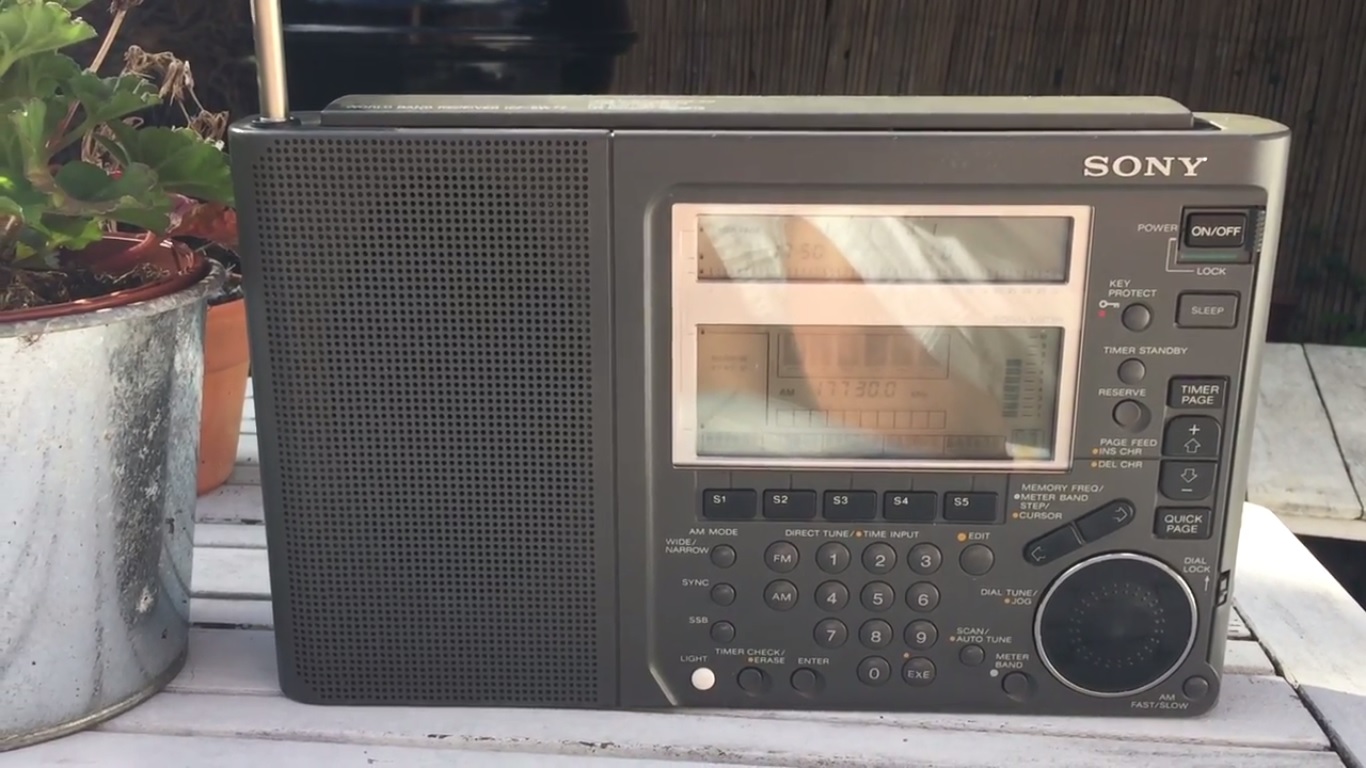
Hi there, I recently posted an article regarding a couple of recent DX catches with the Sony ICF-SW77 receiver and went on to explain the background to a multi-receiver test I had started conducting, comparing it with its stablemate of the time the ICF-SW55 and, just for the hell of it, a more modern, yet modest portable in the shape of the brilliant little Tecsun PL-310ET. Sony ICF-SW77
The initial results confirmed the performance of the Sony receivers to be very similar and thus the justification for the original price delta of £100 in the UK to remain in question. The first target signals chosen and in the original post were ABC Northern Territories on 4835 kHz and Radio Mali on 9635 kHz.
Sony ICF-SW55 Tecsun PL-310ET
The initial results reinforced my view that the PL-310ET is a great portable for relatively small money; it managed to copy both signals, something you might not expect from what is essentially a budget receiver.
Below are links to the next 6 reception videos on the Oxford Shortwave Log YouTube channel and once again, featuring all three radios. I have used two different antennas during the testing – a 75 metre longwire and the Wellbrook ALA1530 active loop, running on batteries. The accompanying text description to the videos indicates which antenna was used.
Although the PL-310ET clearly struggled with the more ‘hard-core’ DX signals amongst those detailed below, the fact is, for less than £40 in the UK (and I’m certain even less elsewhere), Tecsun have delivered us a portable radio that really is capable of real DX. With DSP, a number of audio bandwidth filter options and great sensitivity, it’s a winner for beginners to DXing and to ‘old hands’ who want a radio in their pocket when they take the dog for a walk for example (something I do all the time – you never know when you’re going to come across the next barbed wire fence!). As for the Sonys, well I’m still not convinced one way or the other that the £100 price delta on the original price of the ICF-SW77 was worth the money – the ICF-SW55 is pretty close to it in terms of delivering discernible audio across all of the below reception videos. I’d be interested in your views and note there will be a final posting on this 3-way receiver comparison to wrap things up. In the meantime, thanks for reading/watching/listening and I wish you good DX!
Clint Gouveia is the author of this post and a regular contributor to the SWLing Post. Clint actively publishes videos of his shortwave radio excursions on his YouTube channel: Oxford Shortwave Log. Clint is based in Oxfordshire, England.
Is the irony of this really lost on the ABC management? Replace shortwave radio (~$20) with a sat phone (~$700+subscription) @Malarndirri19https://t.co/kzWRDbvQ7d
Many thanks to SWLing Post contributor, Chris Kadlec, who shares the following announcement about his Seoul AM Radio Listening Guide:
After a long 14 months of work, I’m happy to present the completed Seoul AM Radio Listening Guide, a three-hour documentary broadcast exploring the Seoul AM band one frequency at a time, plus a look at the radio war on the Korean peninsula accompanied by a 115-page guide.
In addition to radio broadcasts from across East Asia, the broadcast includes Korean noise jammers and AM, FM, shortwave, and television propaganda broadcasts from both the north and the south, additionally outlined in a 25-page broadcast transcript and 115-page informational guide. It also includes:
* A comprehensive list of 260 East Asian AM stations, including station names, tower locations, distance and direction from Seoul, parallel FM frequencies, broadcast hours, and station website links.
* A full bandscan of 235 regular nightly skywave signals as heard after the sun sets over Seoul.
* Daytime groundwave bandscans taken from eleven different locations in the Seoul metro area, along the North Korean border, beside the sea, and in Korea’s mountainous interior with background information about each location.
* A guide showing stations organized by their network affiliations in addition to privately-owned stations and networks. Alternatively, stations are also shown organized by country, region, and city.
* A chart showing signal strength for each bandscan – day and night – in bar graph format.
* A full colour-coded regional station map covering both skywave and groundwave signals.
* A view of some of Korea’s signal jammers as seen on an SDR (software-defined radio).
* Plus, a complete transcript of the three-hour audio broadcast with additional information on the featured audio clips as well as the songs featured in those clips.
– Chris Kadlec
Brilliant, Chris! I can only imagine the amount of time and effort you’ve put into this guide. Thank you!
In this short exchange, which starts by Graham asking, “Would you agree with me that Radio Free Europe is outdated?” We learn that Clapper isn’t “familiar” with Radio Free Europe and both of them admit that they don’t listen to the radio (though Clapper believes it’s popular in some parts of the world).
Graham: “Is radio big in your world?”
Clapper: “Not in my world.”
Graham: “Yeah, I don’t listen to the radio so much either.”
That exchange might explain why the RFE/RL Press Room sent out this email on January 5…
Facts about Radio Free Europe/Radio Liberty:
(WASHINGTON – January 5, 2017) RFE/RL serves a measured audience of 27 million people a week in 23 nations and territories by video, social networks, mobile apps, websites, podcasts and radio – whatever media they use most. From its Prague headquarters and 18 news bureaus, it provides local news and information in 26 languages to the nations of the former Soviet Union, the Balkans, Iran, Afghanistan and Pakistan, including a round-the-clock Russian-language television channel.
Through last September, RFE/RL recorded one billion page views on its websites, 300 million views on YouTube and 225 million engaged users on Facebook, plus many more visits and views on other social networks and apps.
“RFE/RL’s audience is highly loyal, making their way to us despite efforts by some governments to jam us on the internet and over the air, and even to directly intimidate viewers and listeners,” said Thomas Kent, president and CEO of RFE/RL. “They find us an indispensable source of news and investigative journalism, constantly adapting to the most modern platforms to reach them.”
About RFE/RL
RFE/RL is a private, independent international news organization whose programs — radio, internet, television, and mobile — reach 27 million people in 26 languages and 23 countries, including Russia, Ukraine, Iran, Afghanistan, Pakistan, the republics of Central Asia and the Caucasus, and the Baltic states. It is funded by the U.S. Congress through the Broadcasting Board of Governors (BBG).




 Sony ICF-SW55 Tecsun PL-310ET