Category Archives: Mediumwave

Radio Waves: Gen Tojo’s Teeth, City Radio Review, Wearable CW Trainer, Sister Boniface, and “We Are Broadcasters” Oppose Tax

Radio Waves:  Stories Making Waves in the World of Radio

Welcome to the SWLing Post’s Radio Waves, a collection of links to interesting stories making waves in the world of radio. Enjoy!

Many thanks to SWLing Post contributors Dennis Dura and Harry Dence for the following tips:


Gen Tojo’s Teeth: Morse Code Shows Up In The Strangest Places (Hackaday)

The Baader-Meinhof effect is the common name for what scientists call frequency illusion. Suppose you are watching Star Trek’s Christopher Pike explain how he makes pasta mama, and you’ve never heard of it before. Immediately after that, you’ll hear about pasta mama repeatedly. You’ll see it on menus. Someone at work will talk about having it at Hugo’s. Here’s the thing. Pasta mama was there all along (and, by the way, delicious). You just started noticing it. We sometimes wonder if that’s the deal with Morse code. Once you know it, it seems to show up everywhere.

One of the strangest places we’ve ever heard of Morse code appearing is the infamous case of Tojo’s teeth. If you don’t remember, General Hideki Tojo was one of the main “bad guys” in the Pacific part of World War II. In particular, he is thought to have approved the attack on Pearl Harbor, which started the American involvement in the war globally. Turns out, Tojo would be inextricably tied to Morse code, but he probably didn’t realize it. [Continue reading at Hackaday…]

the CityRadio – Hear the world (TechMoan on YouTube)

A ‘radio’ that lets you listen in to broadcasts from cities around the world…but there’s a catch.

M5STICKC Turned Wearable Morse Code Trainer (Hackaday)

Have you ever felt the options for Morse code communication were too limited? Well, look no further than [marsPRE]’s open source WristMorse communicator that can connect over WiFi, can act as a Bluetooth keyboard or just be used as a Morse Code trainer.

[marsPRE] uses the M5StickC Plus as the base device and attaches a custom “hat” consisting of a 2.5 mm plug for a radio connection and two capacitive touch paddles that act as the Morse Code keyer. The add-on is housed in what looks like a custom 3D print and hangs off of the end of the M5StickC Plus, connecting the hat through an eight 0.1 inch pin header. [Continue reading at Hackaday…]

Sister Boniface episode “Dead Air” is a pirate radio-themed

Many thanks to SWLing Post contributor, Harry Dence, who writes:

Do you watch BritBox? Hope so!

Today they released Season 2, Episode 8 of the Sister Boniface mysteries, called “Dead Air.”

Set in England of the Radio Caroline era, the episode concerns a pirate radio station called Radio Catherine, a bit of humor along with the mystery, and an homage to Radio Caroline in its ending. Also a sight gag that will please Spinal Tap fans and reference to the GPO controlling the airwaves.

Thank you for the tip, Harry! 

WeAreBroadcasters: “Encourage Congress to support local radio!”

Note: this is a petition managed by WeAreBroadcasters in opposition to a proposed tax:

Encourage Congress to support local radio!

Legislation that would force local radio stations to pay new fees simply for playing music has been introduced in Congress. The American Music Fairness Act (AMFA) would put stations out of business and impact their ability to provide the news, traffic, weather, emergency information and entertainment you rely on every day. The Local Radio Freedom Act opposes new performance fees on local radio stations and recognizes radio’s vital role in every community. Please take action today and encourage your members of Congress to oppose the AMFA and cosponsor the Local Radio Freedom Act. Your voice matters!

Click here to sign.


Do you enjoy the SWLing Post?

Please consider supporting us via Patreon or our Coffee Fund!

Your support makes articles like this one possible. Thank you!

High Noon: Belka MW shootout part 2, with a review of the AFA200C active MW ferrite antenna

High Noon: Belka MW shootout part 2, with a review of the AFA200C active MW ferrite antenna

by 13dka

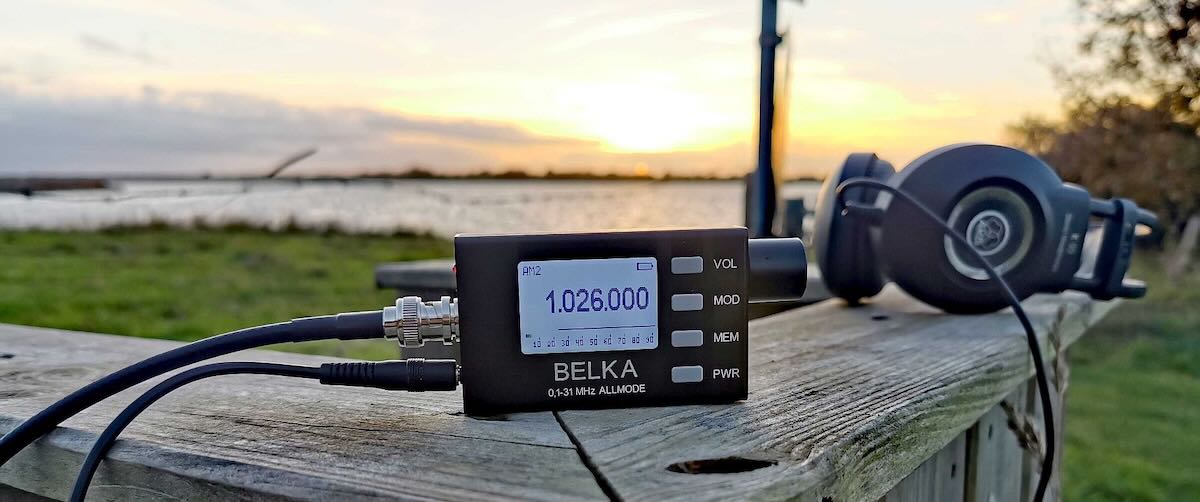
When I reviewed the updated Belka (gen3, 2022) for its MW/LW performance in October last year, I just wanted to know if it’s any good with just the whip antenna and used the XHDATA D-808 as a reference radio because it’s a Jay Allen 2.5-star average performer on MW and my expectations were not high for MW reception on a short whip.  To my surprise that average bar turned out way too low for the Belka!

That was sure asking for a comparison with the most sensitive MW radio I have and gave me hope to use the Belka for ultra-portable MW DXing on the move.  The omnidirectional whip doesn’t allow me to null out unwanted co-channel interference though, therefore I wanted to find a reasonably sized loopstick antenna to pair with the Belka.  Continue reading

A Review of Two Medium Wave Signal Boosters

By Jock Elliott, KB2GOM

It was the survey that Thomas, our Maximum Leader, conducted that got me to thinking about this.

The survey revealed that portable radios were used 38.6% of the time by SWLing Post readers as their “daily driver.” I like portable radios, too, and use them frequently. Hold that thought for a moment.

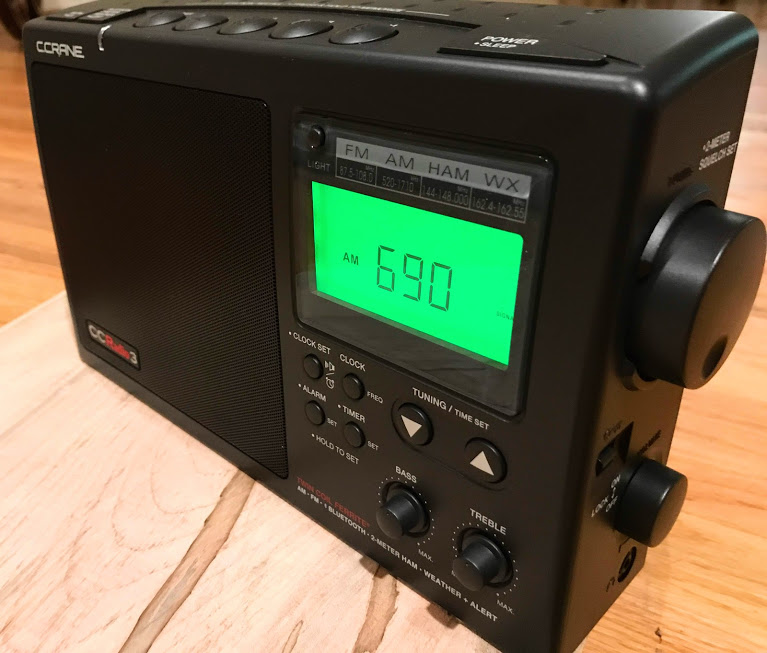
I also like medium wave DXing (content DXing, really, I enjoy tuning around for unusual programs) because, as Gary DeBock once put it: “It’s a target-rich environment.” With that in mind, I was exploring the CCrane website and found a couple of items – the Terk AM Advantage and the Twin Coil Ferrite® AM Antenna Signal Booster that looked like they might help portable radio listeners who want to pull in medium-wave signals better. I asked the CCrane folks if they would like to review both products, and they sent them to me without charge.

Bottom line: they both work for boosting reception of medium-wave signals.

The Terk AM Advantage is a nine-inch tunable loop encased in plastic, and it requires no power supply. Simply place it near your portable receiver and just the dial to the desired frequency, and you could get up to a 20 dB gain in the signal you want to hear. The loop of the Terk AM Advantage inductively couples with the ferrite antenna inside your portable radio, although the unit comes with a direct wire connector that can be used with some radios.

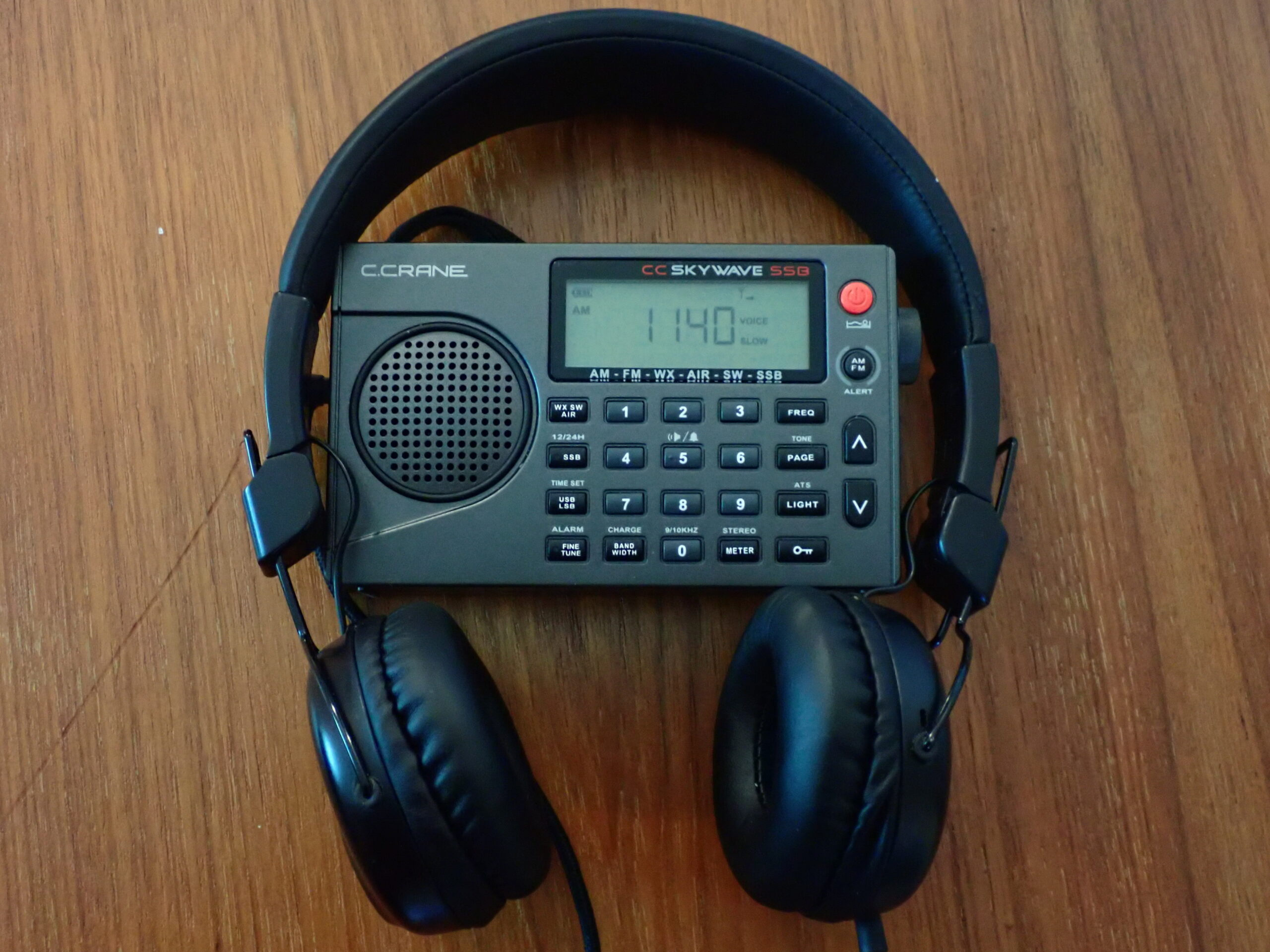
I tried the Terk AM Advantage with my CCrane Skywave SSB on an AM that was coming in with a lot of static at my location. Without the AM Advantage, I had 3 bars of signal strength. As soon as I placed the AM Advantage close to the Skywave and adjusted the tuning knob, the signal strength increase to 5 bars, and the audio was much easier to hear with less noise.

With my Tecsun PL-880, which has a numerical signal strength meter, signal strength was 11 without the AM Advantage, but with the AM Advantage, signal strength increased to 14, and it was much easier to hear. The Terk AM Advantage definitely provides a modest boost in signal strength and clarity, is easy to use, and requires no batteries or external power supply.

The Twin Coil Ferrite® AM Antenna Signal Booster is more complicated. It consists of an antenna element that measures 8.5″ W x 2.5″ H x 1.25″D, a tuner unit that measures 3.25″ W x 4.25″ H x 1.25″ D, a small ferrite stick, and some patch cords. It comes with an AC adaptor and can also be powered by a 9-volt battery. For radios with external antenna connectors, package also includes a RCA female patch cord to two bare wire ends.

Set up is pretty easy: connect the tuner unit to the antenna element with a patch cord; connect the tune to the ferrite stick with another patch, and provide power through either the AC adaptor or 9-volt battery. (I used a battery).

Here are C.Crane’s directions for how to use The Twin Coil Ferrite® AM Antenna Signal Booster with a portable radio:

  • Place the Tuner Control in a comfortable location relative to your radio. Place the Antenna Element a few feet away. If the Antenna Element is placed too close to the radio, it will cause noise on your radio.
  • Place the Ferrite Stick on top of the radio near the center. Placement will vary depending on where the internal AM antenna of the radio is located.
  • For testing purposes, tune your radio to any weak AM station. It is important that the station be weak so you can clearly detect the improvement in reception.
  • Rotate the Fine Tune control, it will click on and the red LED indicator light will come on. Turn the Coarse Tune control knob slowly and you will likely notice a change in reception at some point on the dial. Adjust the control knob until you notice the most improvement on your signal. Now you can use the Fine Tune control for further refinement.
  • Move the Ferrite Stick around the radio to find the position that affects the signal the most. This position is the “sweet spot”, or the best position. Again, adjust the Fine Tune on the Tuner Control for the best reception possible. (I used rubber band to hold the Ferrite Stick in place, but the unit comes with some double-stick foam tape to hold it in place.)
  • Now you can orientate the Antenna Element for best reception. In most cases, the Antenna Element does not have to be adjusted again. When radio noise is a problem, try rotating the Antenna Element in the direction which reduces noise to a minimum.

And The Twin Coil Ferrite® AM Antenna Signal Booster works like crazy! With same station on my CCrane Skywave SSB, it boosted signal strength from 3 bars to full scale. With my Tecsun PL-880, it increased signal strength from 11 to 38.

In my view, although The Twin Coil Ferrite® AM Antenna Signal Booster costs twice as much as the Terk AM Advantage and is more complicated to use, it is more than twice as effective in boosting medium-wave signals.

PSA: Your (new) radio’s filters may be wider than you think

AM bandwidth confusion: IF Filters today vs. yesterday

by 13dka

Whether or not a radio is a joy to listen to, or apt for difficult DX is decided to a large part by the last IF filter stage. Most radios of the past didn’t come with many IF filters to begin with, their quality varied a lot and harsh compromises had to be made in multi-purpose radios. With the advent of digital filtering and inexpensive DSP portables, we got spoiled by a rich choice of selectivity settings that came with an idiosyncrasy I had to wrap my head around first, namely a shift in how some (digital) filters are labeled now.

Continue reading

Radio Waves: AM in Ford Commercial Vehicles, History of Hornby Site, A23 DRM Broadcast Schedule, and AM Radio Importance and Action

Radio Waves:  Stories Making Waves in the World of Radio

Welcome to the SWLing Post’s Radio Waves, a collection of links to interesting stories making waves in the world of radio. Enjoy!

Many thanks to SWLing Post contributors Paul, and Dennis Dura for the following tips:


Ford to drop AM radio in new models, except commercial vehicles (Detroit Free Press)

Ford Motor Co. plans to stop putting AM radio in new gas-powered and electric vehicles beginning in 2024, including the all-electric Mustang Mach-E and F-150 Lightning pickup, the Detroit Free Press has confirmed.

“We are transitioning from AM radio for most new and updated 2024 models,” Ford spokesman Wes Sherwood told the Free Press. “A majority of U.S. AM stations, as well as a number of countries and automakers globally, are modernizing radio by offering internet streaming through mobile apps, FM, digital and satellite radio options. Ford will continue to offer these alternatives for customers to hear their favorite AM radio music, news and podcasts as we remove amplitude modulation — the definition of AM in this case — from most new and updated models we bring to market.”

Commercial vehicles will continue to offer AM radio because of longstanding contract language, Sherwood said.

Drivers often turn to AM radio for live traffic updates and weather reports, as well as emergency communication. [Continue reading…]

The history of the Hornby AM radio site, our oldest operational transmission site (CBC/Radio-Canada)

Did you know that one of our AM radio stations can also be used as a bunker? What’s more, the opening of this station was of such importance that King George VI addressed the nation during its inaugural broadcast in December 1937? Considered an engineering feat in its time, the Hornby AM radio site is the oldest transmission site owned and operated by CBC/Radio-Canada. Here are some interesting facts.

Listen to the King’s First Empire Christmas Greeting:

A little bit of history

Located in Hornby, Ontario, this AM radio site was built in 1937 for the CBL radio service (the ancestor of CBC Radio One) one year after the creation of CBC/Radio-Canada. The station contained a 50-kilowatt transmitter and a 640-foot tower, making it the tallest structure in Canada from 1937 to 1954. That’s more than twice the height of Big Ben (Elizabeth Tower, London).

Already a technological feat in itself, the site then added a second radio service (CJBC) in 1944 and became one of the rare AM sites to broadcast two services from one tower. The joint CBL-CJBC signal was so powerful that people could hear the program simply by putting an ear on nearby wire fences.

All about the bunker

Between 1946 and 1948, Canadians were seeing the beginning of the Cold War and, with it, the threat of nuclear attacks. As a result, the site underwent a “wartime expansion” during which the existing underground bunker, a reinforced underground shelter built for protection, was installed. Continue reading

Survey results: What type of radio is your daily driver?

Last week, I published a post asking SWLing Post readers what type of radio their “daily driver” is at present. Click here to read that post.

I created a survey form and left it open for about five days. In that time, we received 639 responses! If you’d like to read the results, continue scrolling or click on continue reading below.
Continue reading

Don Moore’s Photo Album: Cuenca, Ecuador (Part Two)

A Cuenca Artisan Market

Many thanks to SWLing Post contributor, Don Moore–noted author, traveler, and DXer–for the latest installment of his Photo Album guest post series:


Don Moore’s Photo Album: Cuenca, Ecuador (Part 2)

by Don Moore

In the song Por Eso Te Quiero Cuenca (That’s Why I Love You Cuenca) the singer recites a litany of the many reasons to love this city. What do I love about Cuenca? Well, unlike the song, I won’t include well-roasted guinea pig.

The elevation of 2560 meters (8,400 feet) gives Cuenca a comfortable spring-like climate year-round. Daily highs are usually around 20C/70F. Nights are chilly but not cold. Most days have at least several hours of sun, even during the rainy season (as it is now). There are numerous green parks and plazas including long tree-lined walking paths along the two main rivers that run through the city. The drinking water, which comes from high up in the mountains, is the best in South America. Yes, you can drink it right from the tap.

A walking/bike path runs along the Yanuncay River for over six kilometers through the south side of Cuenca. A similar path runs along the larger Tomebamba River in the center of town.

The people of Cuenca are among the friendliest I’ve found anywhere. It’s a well-run, educated city with lots of civic pride. The metro area population is only about a half-million so it’s small enough to easily get anywhere but large enough to have the benefits of a city. Cuenca has several good universities and theaters and the symphony orchestra gives free concerts most Friday evenings. It’s a pleasure to simply stroll through the beautiful architecture in the old centro neighborhood.

One of many beautifully restored buildings in Cuenca’s old centro.

Getting around Cuenca is easy. A ride on the excellent bus system costs just thirty cents and taxi rides usually run under two dollars. And, unlike the much larger cities of Quito and Guayaquil, Cuenca has a mass transit system. In 2013 city leaders voted to put in a light rail line. Doing so required digging up two of the main streets through the old downtown but rather than just dig up two streets they decided to dig up the entire old downtown … to replace the aging water and sewer systems, move all electric lines and cables underground, and install high-speed fiber optic Internet. (Fiber optic Internet was also run above ground in the newer neighborhoods outside the centro.) The result is one of the few places in Latin America where one can enjoy beautifully restored architecture and colonial churches without the views being marred by powerlines. And the Internet here is better than most places I’ve stayed at in the United States.

Those are just a handful of the reasons that I love Cuenca.

Early Radio in Cuenca

Radio broadcasting in Ecuador started in 1925 with Radio El Prado in Riobamba, a small city in the center of the country. Other stations soon started up in Guayaquil and Quito, including HCJB in 1931. Broadcasting came to Cuenca in 1934 when a group of friends purchased a homemade ten-watt transmitter from an engineer in Guayaquil and put it on the air as La Voz de Tomebamba. The name came from the main river flowing through Cuenca. At the time there were only four receivers in the city so the audience was rather sparse. La Voz de Tomebamba initially broadcast for only one or two hours a night and most of the musical selections were done live as there weren’t many 78 RPM records in town. Years later one early listener reminisced, “It was sixty percent noise. Only radio fanatics could be entertained by listening to such a thing.

Old studio equipment from La Voz de Tomebamba

Gradually, the owners added new equipment and expanded the daily schedule. A fifty-watt transmitter was added in 1938 and by 1947 the power had been increased to two hundred watts. The first frequency listing that I’ve found for La Voz de Tomebamba was for 4200 kHz in a 1944 FBIS newsletter. The 1947 WRTH listed it as on the air from 0000 to 0430 GMT on 4200 kHz. And that was the station’s only frequency. Until the 1960s it was very common for radio stations in Ecuador to only broadcast on shortwave and not on medium wave. For example, the 1957 WRTH lists eighty Ecuadorian stations on shortwave (not counting HCJB) but only fifty-nine on medium wave. 

Sometime in the early 1960s La Voz de Tomebamba made the switch to medium wave and left shortwave. Their 4200 kHz frequency is not listed in the 1965 WRTH, nor are they listed in any later ones. (I would be interested to hear from anyone who remembers listening to them on shortwave.) The changes may have had to do with financial problems the station was having. It closed in 1967 and remained off the air until returning under new ownership four years later. Today La Voz de Tomebamba is one of the most popular radio stations in town and has an excellent news department. Their sister station, Super Rock FM 94.9, is very popular with younger listeners.

La Voz de Tomebamba today.

The second station in Cuenca was Radio Cuenca, which began broadcasting in October 1945 on 2830 kHz with two-hundred watts.  It was included in a 1953 list of stations logged by the Universal Radio DX Club of Indiana. To the local audience, Radio Cuenca was best known for its many live music broadcasts.  Continue reading