Category Archives: Mediumwave
The “Signal Sweeper”: How to build a portable Wellbrook loop antenna
Many thanks to SWLing Post contributor, Matt Blaze, for the following guest post:


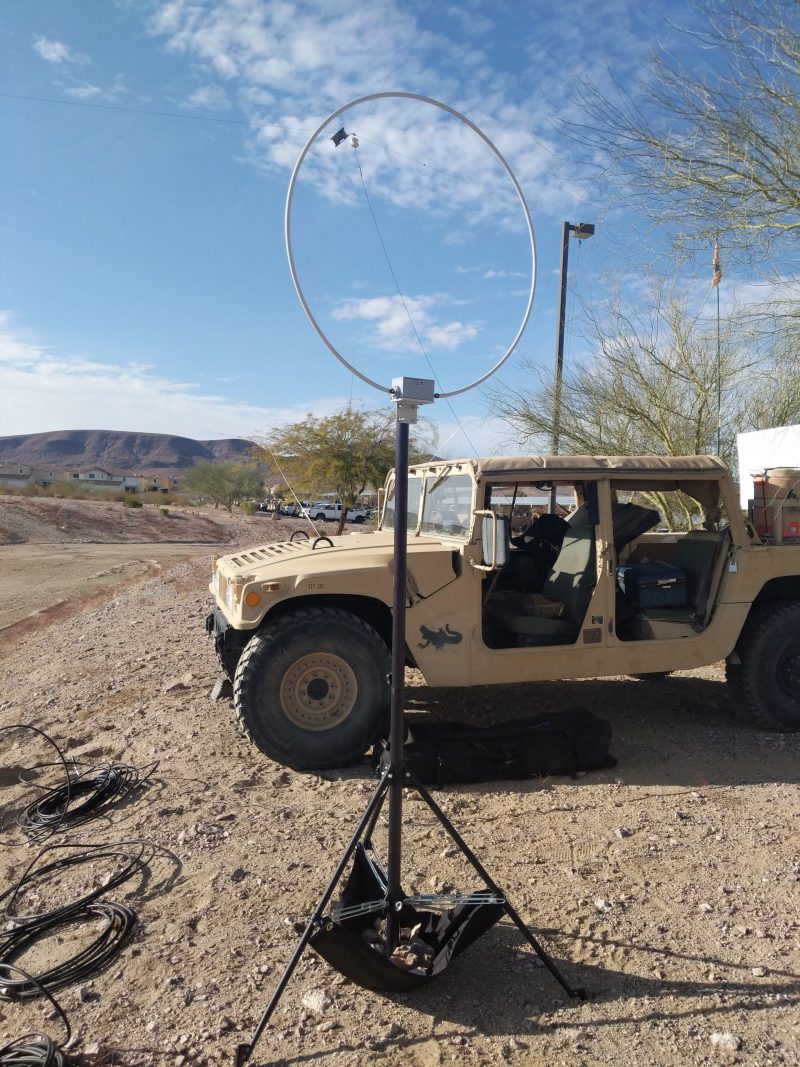
The “Signal Sweeper”, a portable Wellbrook antenna setup

by Matt Blaze

Here’s a very simple construction project that’s really improved my travel shortwave and mediumwave listening experience.

When I go somewhere interesting (whether a day trip on my bike or a longer excursion to an exotic locale), the two things I’m sure to want with me are my camera gear and at least one good receiver. Fortunately, there are plenty of good quality shortwave receivers to choose from these days; the hard part is packing a suitably portable antenna that can do justice to the signals wherever it is I’m going.

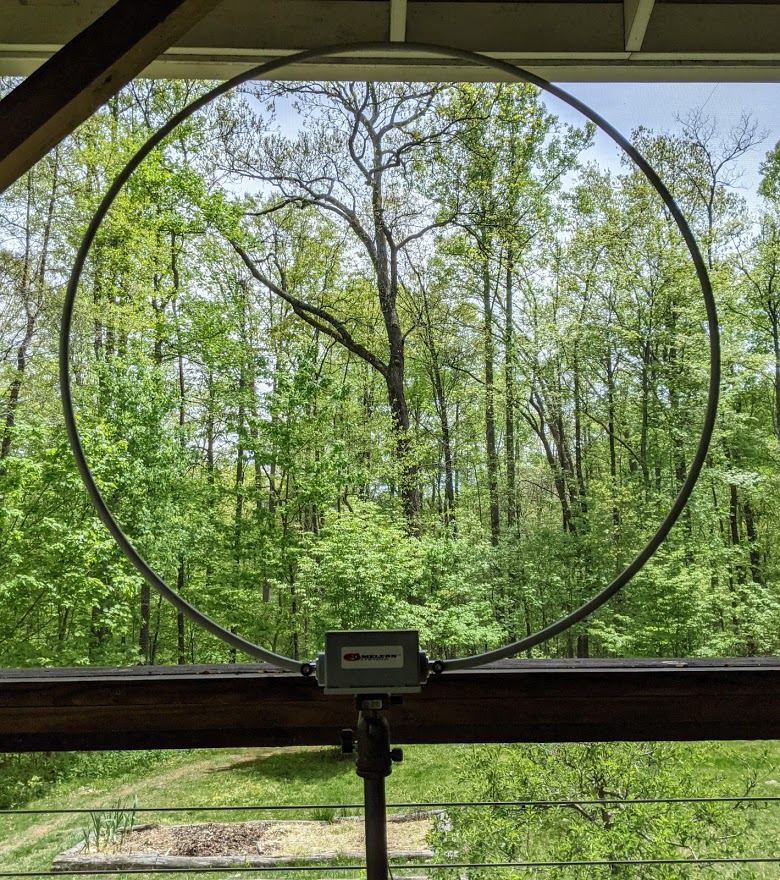
I’ve long had a Wellbrook antenna on my roof at home. These wide-band amplified loops famously enjoy a reputation for excellent intermod and noise rejection, as well as an almost magical ability to pull in signals comparable to much larger traditional HF and MF receive antennas. A portable Wellbrook – something I could pack in my luggage that performs as well as the one on my roof, would be just ideal.

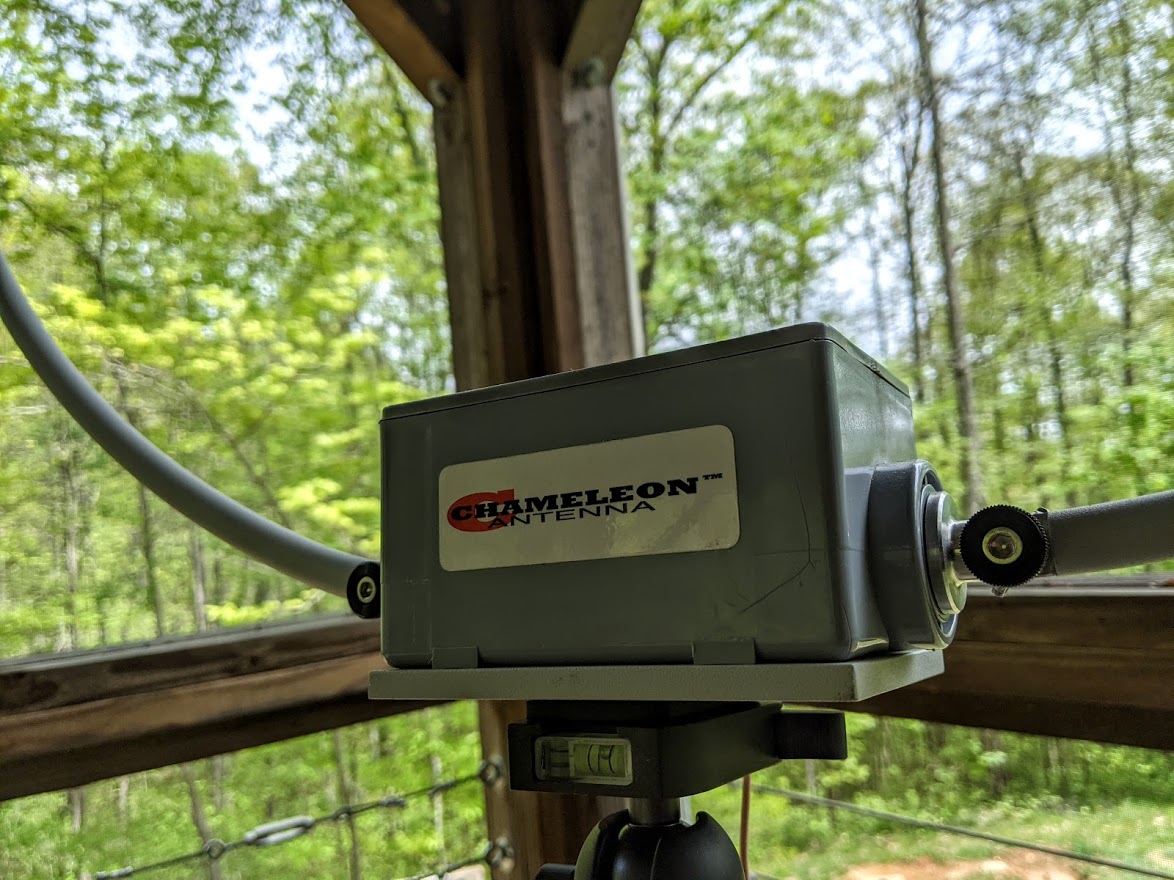
Fortunately, Wellbrook sells a “flex” version of their antenna intended for just this application, the model FLX1530LN. It’s essentially just the amplifier of their fixed-mount antennas, equipped with a pair of BNC connectors for you to attach a user-supplied ring of coaxial cable that serves as the antenna loop. This way, you don’t need to travel with the awkwardly large 1 meter diameter ring of aluminum tubing that makes up the normal Wellbrook. You can just bring a compact spool of coaxial cable and configure a loop out of it when you arrive at your destination.

The tricky part is how to actually form a stable loop out of coaxial cable without needing lot of unwieldy supporting hardware. In particularly, I wanted something that could be set up on a camera tripod to be freestanding and easily rotated wherever I happened to find myself wanting to play radio. The key would be finding or making some kind of mostly non-metalic support for the coaxial loop that could be folded down or collapsed to fit in my baggage or backpack for travel.

And then I found it: a humble 3-section telescoping broom handle sold on Amazon for about $15 that’s exactly the right size: the “O-Cedar Easywring Spin Mop Telescopic Replacement Handle“. It collapses to 22 inches (just short enough to fit in my suitcase), and extends to 48 inches (comfortably long enough for a one meter diameter loop).

Normally, a wire loop would need both vertical and horizontal supports in a cross configuration, but by using a reasonably stiff coaxial cable, I figured I could get away with just using the broom handle vertically. I found that LMR400 (the basic kind, not the “Ultraflex” version) holds its shape quite well in a one meter loop supported this way.

At this point, it was just a matter of the details of attaching and mounting everything together into a portable package.

A one meter diameter loop, which is the ideal size for the Wellbrook amp, can be made from 3.14 meters of cable (ask your middle-school math teacher). That’s about 10 feet for Americans like me. High precision is not required here, so I just cut 10 feet of LMR400.

The next step is to attach the middle of the cable to the top of the broom handle. The O-Cedar handle has a loop at the end for hanging it on a hook in your broom closet. It happens to be just the right diameter for LMR400, but not with BNC connectors attached. So you’ll have to thread the cable through before you crimp or solder on the with connectors. (See photo above). I used the Times Microwave crimp-on BNC connectors, which I had some extras of lying around. I also put some shrink wrap on the cable at either side of the broom loop, just to keep it from slipping out and becoming unbalanced, but that was probably unnecessary.

Now I needed a way to to attach the Wellbrook amplifier to the other end of the handle, as well as some way of mounting the whole thing to a camera tripod. My first thought involved a lot of duct tape. But I wanted something more permanent and reusable.

The key is something called an “L-Plate”, which is a piece of hardware intended to allow you to mount a camera to a tripod in either “landscape” or “portrait” mode. It’s basically two tripod dovetail mounts attached at a 90 degree angle. I used one that was in my junk box, but you can buy them new or used on eBay. I also needed a clamp to attach the L-plate to the broom handle. I used the Novoflex MiniClamp 26, which I got from B&H Photo. The clamp attaches to the inside of the L-plate with a captive screw. (See photos)

Next, I attached the amplifier to the other side of the L-plate using an ordinary screw-on hose clamp. Easy enough, and surprisingly sturdy.

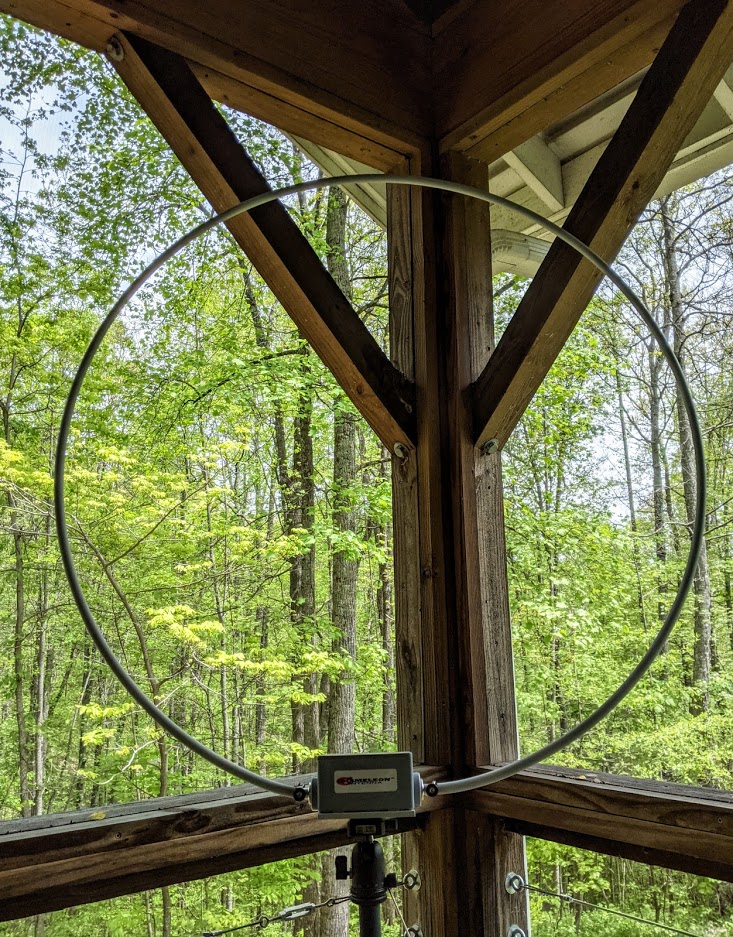
And that’s it. To assemble the antenna, just extend the broom handle to about one meter, allowing for a roughly one meter diameter loop that’s as round as you can make it with the amplifier at the bottom. Then clamp the L-plate to the bottom of the handle so that the handle is just above the base of the plate, and attach to the tripod. (See the photos).

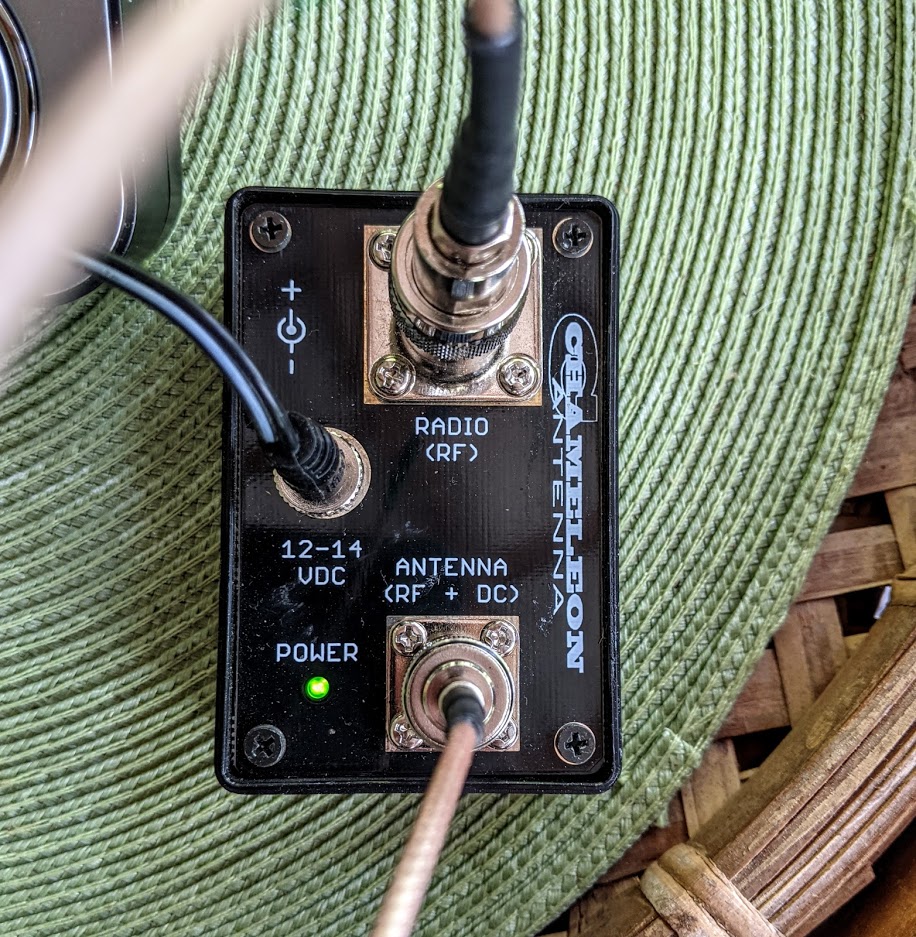
The Wellbrook is powered over the feedline with a 12VDC bias-T injector. So you need a clean source of 12 volts. I use a cheap Talent Cell battery pack (available on Amazon in various capacities). These actually deliver 11.1 VDC (3x 3.7V), rather than the 12V the Wellbrook calls for, but it works fine in practice. I can also use the same pack to power the radio and digital audio recorder.

In the photos, you can see the finished antenna setup on my roof, with my permanent base Wellbrook on the rotor in the background. The performance of the two antennas is quite comparable.

(Note that there’s an eBay seller that makes a somewhat similar travel loop. The performance is quite good under normal conditions, but it is a bit more subject to MW overload when near a transmitter site. So I prefer the Wellbrook, which is much less susceptible to overload, I’ve found.)

My usual complete travel setup is either a Reuter RDR Pocket C2 radio or a Sangean ATX-909X (recently upgraded to the X2 model). Both these radios work well with the Wellbrook. I use a Sound Devices Mixpre 3 to record airchecks in the field. In the photos, I’m on a rooftop DXpedition listening to Toronto traffic and weather from CFRX on 6070 kHz on a warm later winter afternoon.

The whole setup breaks down for travel pretty easily, and fits easily in my suitcase, backpack, or bike bag (see photos). I usually bring a larger tripod than this if I’m also taking my camera.

The Wellbrook setup has really made bringing a receiver into the field a lot easier and less uncertain. There’s no worry about finding trees or other supports for wires, and packing and unpacking is quick and easy. Have fun!

AM Dxing with the Sangean PR-D15

Guest Post by Troy Riedel

Since the demise of my Sony ICF-SW100, I’ve decided to do some AM Dx’ing. A few years ago I purchased a Sangean PR-D15 as my dedicated “AM Dx Radio”. Despite owning it for a few years, I hadn’t yet really put it through its paces.

Note: My 1994 Gründig Yacht Boy 400, with its 150mm (5.9″) ferrite rod antenna, performs splendidly on AM and until this purchase, the YB400 was the radio I grabbed for AM Dx.

At the time of my purchase – if my memory is correct – the other models I had considered were the CC Radio 2 (now discontinued), the CC Radio 2E (it was a relatively new release at the time), and the Original CC Radio EP (now discontinued & replaced by the CC Radio EP Pro).

Admittedly, part of my decision was based on cost. At the time, the CC Radio 2 & 2E were priced over 2x the cost of the PR-D15 and the CC Radio EP was $15-$20 more when shipping was added. Besides the cost, I chose the PR-D15 based on a few things I had read online. But the aspect that really appealed to me is the 200mm (7.9”) Ferrite Rod Antenna and that compared favorably with the C. Crane offerings (yes – ferrite size isn’t everything, but it is an important consideration). So after having read online comments (reviews, discussion boards, etc.) about the PR-D15, I felt very comfortable with my decision and it wasn’t based on cost alone.

Frankly, I don’t really care how well my AM radio performs during the day (I hope this isn’t sacrilege). Why? During the day whether I’m in the car, working in the garage – whatever – I’ll typically stream my favorite station (NYC) via radio.com on my iPhone so I can pause, rewind, or pick-up where I left off. Until my Sangean PR-D15 can do that, I prefer to daytime stream. My “hobby” of AM Dxing is in the evening – to relax and have fun (and isn’t that what a hobby is supposed to be?). Keep that in mind as I reveal my results.

I intended to do my AM Dx Nighttime Test in one night, but I was getting so may stations that I had to extend it over two nights. I started each session around 8PM and they lasted until 11:30PM – 12AM (over 7.5-hours of testing on consecutive nights late this week). I had my PR-D15 on a lazy susan turntable and I had two nearby laptops – one to aid as an AM Station locator and the other I used to stream. Stream? Yes – to count as a recorded station I had to get a positive station ID. However, many radio programs are syndicated. Syndicated radio (and ESPN radio) can go on seemingly forever between station IDs. If I didn’t get a station ID within 15-minutes, I used the second laptop to go to the web site of the station I believed it to be to “listen live” to see if the radio and the stream matched-up (luckily live web streams are slightly behind live terrestrial radio so the IDs were easy). Often by the time I had given-up and gone to my 2nd laptop, I’d finally get an on-air station ID. I just didn’t want to waste too much time on one station and miss other stations.

Since my test extended for 2 nights, on night two I quickly dialed-through nearly all of the stations I confirmed on night one to make a quick re-confirmation they were still audible on the 2nd night.

Since I captured so many stations, I was overwhelmed trying to finish and thus I feel this test is still incomplete. My wife typically ends all of my radio playtime (my man cave is a “sitting room” off the side of the master bedroom & there is no wall – no door – so it’s completely open). But my wife and my step-daughter have a weekend out of town in mid to late March. And that means I can stay up all night and do one non-stop test session. Is it bad to say that I cannot wait to be alone?

My QTH is ~ 35-miles east of RIC (Richmond, VA) Airport. The tables below (broken into three files) are my results. Some frequencies have multiple station IDs – since when turning the radio and nulling signals, sometimes one station disappeared and another jumped onto the dial. If/when I post an update of my all-nighter, I’ll add another column to the spreadsheet to include the transmitter strength for better context. It should also be noted that I recorded straight-line distances & not driving distances (via an online straight-line/GPS calculator).

I was impressed that I successfully captured three Iowa stations. And though I find it almost unfathomable, I truly believe I was on the verge of successfully logging a station in Sandy, UT which is over 2000-miles away (there are only six stations assigned to the 1640 frequency, and given the content I [barely] heard, all indications are that it was KBJA)!

I also believe I captured at least one Super-Clear Channel station from Mexico, but unfortunately I just couldn’t successfully verify the station ID. I hope to have a future opportunity to add it to my list.

My ultimate goal is to: (1) compile & maintain a spreadsheet of every AM station that I am able to successfully ID; and (2) maintain a record of the most AM stations I was able to ID in a single one-night, non-stop session.

Despite being somewhat incomplete, I’m impressed by my results. I’m interested to see what you think so please post your comments below!

I should note that my results are strictly off the internal ferrite antenna – no external antenna, no passive loop antenna was used to enhance any signal.

To save column space, please click on each table below. A larger & easier to read image will open in a separate window or tab (depending upon your browser setting).

Chuck’s re-capped GE Superadio II might set a new AM BCL benchmark

I recently took delivery of a better-than-new classic solid-state portable broadcast receiver: the venerable GE Superadio II.

This Superadio II was generously given to me by SWLing Post contributor, Chuck Rippel (K8HU), who has–in his spare time–been re-capping and restoring all three of the GE Superadio series models and bringing them back to life. Chuck wanted to send me one of the units he’d recently finished, knowing that it might help me when doing AM reception evaluations. He insisted “no strings attached.”

Besides thank you, all I can say is…

Wow–!

Note angels singing in the background.

When I received the Superadio II a week or so ago, I removed it from the box and it looked brand new; even sporting the original “Headset Capable” grill sticker.

This is a case, however, of a refurbished radio likely out-performing the original.  Here’s a list of the main modifications:

  • All of the original dry capacitors replaced with Nichicon Audio Grade components
  • FM AFC and AM and FM IF and RF sections have been aligned
  • Rebuilt the volume control

I’m sure there are other modifications Chuck didn’t mention.

Chuck told me each radio takes a full day to restore. Some of the alignment, rebuilding, and re-capping is surprisingly tricky and varies with each of the three models. Why is he doing this?

Chuck told me, “My enjoyment comes from giving these radios a new lease on life.”

A new lease on life, indeed!

Last weekend, we had a break in the weather–and I had a short break in my schedule–so I took the GE Superadio II, GE 7-2990A, C.Crane CCRadio3, and Panasonic RF-2200 outdoors for some fresh air.

It was late afternoon and, frankly, I didn’t have the time to do a full comparative session, but having spent the better part of an hour tuning around and comparing the characteristics of each radio, I decided to make a short video to share.

The video features the GE Superadio II, but I speak to some of the pros and cons of each model. Keep in mind, this is very much a casual/informal comparison:

Click here to view on YouTube.

The SR-II not only has the best audio fidelity in this bunch, but it’s also extremely stable and has no noise floor to speak of. No doubt, this is the result of those Nichicon Audio Grade components and a skilled technician.

Side note: Chuck is well-known in the radio world because he used to restore the Collins R390A which must be one of the most mechanically-complicated receivers ever made.

I haven’t even properly tested the SR-II on FM yet because I couldn’t pull myself away from the mediumwave dial that afternoon!

I asked Chuck if he would consider refurbishing GE Superadios for other people and I think he would.  If interested, contact me and I’ll put you in touch. Else, Chuck might leave details in the comments section of this post.

He does currently have a restored GE Superadio II on eBay. I just checked and in his listing, you’ll see a full description of the modifications made.

Click here to view on eBay.

Chuck, thank you once again for sending me this SR-II. It’ll become a permanent addition here at SWLing Post HQ. Again, I’m simply amazed at the audio fidelity of this 1980s era receiver. Honestly, I don’t think there’s anything made today that can even compare.

And thanks for doing your bit to refurbish these classic portables!

Klubrádió: Hungarian independent talk radio station leaves the airwaves

Many thanks to SWLing Post contributor, Balázs Kovács, who writes:

Hi Thomas,

As it was first announced last September as a possibility now happens: (one of?) the last major independent talk radio station in Hungary, the Klubrádió is forced off the air (92.9 MHz, Budapest region) from Monday (they will continue online).

“With the silencing of Klubrádió, it’s not just my morning commute that will suffer. Europe will have failed to stand up for its most fundamental values.”
A detailed article about the situation at the Independent from a former member of the governing party:
https://www.independent.co.uk/voices/eu-hungary-media-viktor-orban-b1799214.html

“There is a huge propaganda balloon built up by the government and Klubrádió was a little hole, a little piece of truth where the air could escape, so they had to close this little hole in the balloon and so they can construct their own propaganda world which does not reflect the realities of Hungary.”
The latest news in a shorter form at the CNN:
https://edition.cnn.com/2021/02/09/europe/hungary-klubradio-ruling-intl/index.html

“Finally, Ms. Karas says that Klubrádió still has a chance to be on air in case of a successful tender, but then right after this, she symbolically pulled the plug out of the transmitting equipment.”
Latest news release in response to the state from the radio:
https://www.klubradio.hu/adasok/klubradio-news-release-116227

with best regards,
Balazs

Balazs also shared this video which captures the last broadcast of Klubrádió:

Thank you for sharing this Balázs. I’m certain there are other SWLing Post readers in Hungary and throughout Europe who appreciated this independent voice over the air.

To listen to Klubrádió online, check out their website for details.

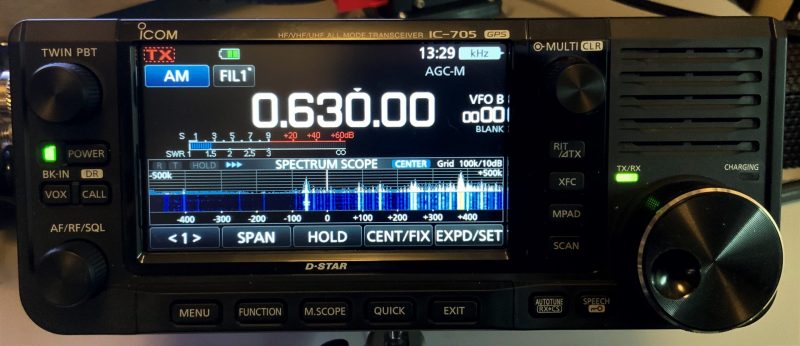
Armed with loops, fences, and an Icom IC-705, 13dka battles transatlantic MW DX

Many thanks to SWLing Post contributor, 13dka, who shares the following guest post:


Dipping my toes into transatlantic MW DX

by 13dka

Most of my SWLing life I wanted to dig into MW DX but never managed to make that really happen for some reason. Then last November, I fetched my first transatlantic station while I wasn’t even trying, in a rather surprising setting:

I have to explain that my home and neighborhood got so infested with a multitude of QRM sources that I did not put my outdoor antennas back up after a storm blew them out of the trees in winter 2018/19. I just used an ML-200 loop indoors, which also has to put up with my own additional QRM sources in my den, consisting of 3 computers running 24/7 and a couple of switching power supplies, a TV, LED lighting… allowing for very basic reception as long as my neighbors don’t watch TV or use the internet. On top of that, medium wave is badly beaten by a mowing robot’s boundary wire here, making reception on several portions of the band completely impossible.

I never expected receiving any US stations on MW in that noise, but I couldn’t sleep that night and scanned the bands a bit with the IC-705 hooked up to my new YouLoop hanging over my bed for testing. I had seen the characteristic transatlantic carriers on MW many times before on my SDRs, but for some reason I never picked up anything intelligible on them in any winter season, now a lot of these carriers were there again but on 1130 there was actually modulation and it wasn’t the only station!

Small bedside loop: SWL’s dreamcatcher!

Bloomberg Radio 1130 came in with almost enjoyable quality at times, but Bloomberg is also kind of a surefire station for MW DX over here. I also picked up a station on 1120 and another one on 880 which was briefly so strong that it surmounted the strong interference from BBC Radio Wales on 882 kHz. 1120 was confirmed the next night to be KMOX in St. Louis, 880 kHz was *not* KCBS in NY – I checked that immediately, I have a KiwiSDR set to that frequency booknarked on my cellphone in case I have a craving for the 1-877-Kars-4-Kids commercial. Powerwise likely candidates for that would be CHQT (50kW) in Edmonton, CKLQ (10kW) in Manitoba or KRVN in Nebraska (50kW class B station) but this may be hard to verify due to the dominance of the BBC on that frequency. Anyway, KMOX wasn’t a bad catch for a small, passive indoor loop, that’s 7,150km or 4,440 miles from here!

Bloomberg Radio on the YouLoop:


Here’s KMOX:


This was A) quite encouraging for nighttime DXpeditions to the dike (brrr…cold!), B) a testimony for the YouLoop’s good performance on MW and C) a testimony for the IC-705 having pretty much all one could wish for in a capable MW DX radio – notch filter, passband tuning on AM, stable ECSS, waterfall display to detect stations and last but not least loads of sensitivity to make the most out of low-output antennas down on MW.

Going to the dike

Of course I just had to put on some long johns and drive to the dike around 3:00am local a few nights later, to try my luck with my ML-200 (lacking a better idea) with an 80cm diameter rigid loop. I was mildly surprised that reception wasn’t that much better than with the YouLoop at home. The overall yield wasn’t exactly outstanding compared to other people’s logs but a lot of stations were hidden in the frequency ranges that are submerged in QRM at home. My log has US/Canadian stations on 20+ different frequencies, unfortunately most of them UNID. Here are some recordings I made that night, hunting for unambiguous station IDs from North American broadcasters:

ML-200, Nov. 16th, 2020

1130 Bloomberg Radio on the ML-200:


Presumedly WABC 770 in NYC: In MW DX, never think you ID’d something properly just because you heard a city name and the frequency has a clear-channel station located there!


This is more unambiguously 1010 WINS in NYC (with a twist described later)


1030 WBZ Boston, MA – the first part of the clip is showing how it sounds when the signal is good, the second part demonstrates how reliably propagation is taking a rest while a station identifies itself.


The grandpa of AM broadcasting, 1020 KDKA:


Moving away from the east coast, this is WHAS 840 in Louisville, KY:


760 WJR Detroit, MI


Here’s a tough one, the religious content I heard with a great signal before doesn’t warrant a proper ID alone, and as per usual the station ID’d while fading out. I could ID this only with a set of big, closed headphones, which is a mandatory accessory for all extreme DX (CHRB 1140 in High River, Alberta):


Of course I was occasionally checking other bands too and got some serviceable signals from Brazil:

Clube do Para on 4885 kHz:


VOA Pinheiro from Belem, Brazil on 4960:


Going to another dike, this time it’s personal!

Time to try something completely different: A ~1,000m/3,000′ straight (and preliminary considered continuous) stretch of mesh fence along the dike heading ~345° (NNW), pointing roughly to mid-/western mainland North America. I had briefly tried its aptitude for being a “natural” Beverage antenna before – with mixed but encouraging results: Due to the fence not being terminated at the far end it may be kind of bidirectional, and according to my latest insights a Beverage style antenna doesn’t work well over very good (conductive) ground, probably even less so close (maybe 200′) to the ocean. Also, I forgot to pack the 9:1 balun I prepared for that purpose, so I just had some wire with alligator clip to connect the fence to the radio. Boo.

Accordingly, what I saw on the waterfall display didn’t look so much different than what I got from the ML-200 before – there were clearly more stations visible (as a carrier line on the waterfall) but nothing was really booming in. However, I managed to log a few more stations, such as WRKO in Boston and (the highlight of the night) 1650 KCNZ “The Fan” in Cedar Falls, IA which has only 1kW to boot at night to make the 6,940 km/4,312 mi to my dike. This may or may not be an indication that the “Beverage sheep fence” isn’t so bad after all!

“Fence”- reception, Nov. 18th, 2020:

VOCM 590, St. Johns, New Foundland, Canada’s easternmost blowtorch is like Bloomberg an indicator station for European MW DXers:


680 WRKO, Boston, MA:


1040 kHz, presumed to be WHO, Des Moines, IA: No ID, only a matching frequency and a commercial for “Jethro BBQ”, which has locations only in and around Des Moines:


Here’s 1650 KCNZ, Cedar Falls, IA with 1KW:


To put that into some relation, this is what 1KW sounds like on a very quiet 40m band in SSB (K1KW from Massachusetts on 7156 kHz producing a 9+20 signal that morning on the “Fence antenna”):


BTW, interesting bycatch – not the first time I caught WWV and WWVH on the same frequency but that morning was the first time I could hear both on 5 MHz:


So where have you been all my life, American AM stations?

A question remains – how could I miss the existence of these stations forever, then in modern SDR times see the carriers on the spectrum scope and still miss the modulation on these carriers? Or the other way around – why did I hear them now?

To begin with, when I started out with the radio hobby many decades ago, the reason for the occasional whine and whistle on some stations (particularly past midnight) wasn’t obvious to me: The last thing I suspected was that this could be interference from across the pond, with the pitch of the whine (or “het”) having a direct relation to the 9kHz vs 10kHz difference in channel spacing. Of course these stations were there all my life! Then, with just some regular radio you’d have to pick one of very few frequencies where a strong station from across the pond coincides with a nice silent gap in the local channel allocation. But until this millennium, European medium waves had no such gaps and a lot more local blowtorches.

Since that time many MW stations were turned off and demolished and whole countries abandoned MW here in Europe, so we’re in a much better spot now for transatlantic DX. Unfortunately the opposite is true for listeners on the left side of the pond, you guys still have a very crowded AM band but less potential DX targets in Europe. On the bright side, the remaining European stations are often not restricted to 50kW and you have another ocean with very distant and rewarding DX stations that are very, very hard to catch in Europe!

Wrong time, wrong place

Another bunch of factors are – of course – propagation, season and location/latitude. The MW DX season is roughly fall to spring nights (when TX and RX are in the dark) with a period of increased absorption in the middle (the “mid-winter anomaly”), signals are potentially stronger at lower latitudes and weaker at higher ones but the distance to the noisy equator and a lack of stations interfering from the N can be a huge advantage for using over-the-pole paths on higher latitudes. The big showstopper is solar activity: Good condx on shortwave can be rather bad for skywave propagation on medium wave, so a solar minimum is the long-term hotspot for (transatlantic) medium wave DX.

I’m glad that I learned how intense that relationship is right away: When I discovered that Bloomberg is pretty good on my indoor YouLoop at home, condx were pretty down with SFI in the low 70s and very little excitement of the auroral zones. 2 weeks later the SFI was only slightly higher in the 80s-100, many of the carriers were missing on the waterfall and Bloomberg could be heard only in much bigger intervals.

Speaking of which – even with favorable condx, a proper radio and a half-proper antenna, patience is key! In my very fresh experience the fading cycles on those over-the-pond signals are long! So far I have seen everything fading in and out over the course of a few minutes to half hours or more, with less favorable conditions or a worse antenna it may take much longer until it sticks out of the noise for a while. So you may have to park on a frequency for a long time to not miss the station coming up so much that it becomes readable at the right time to ID it. Multiple DX stations on the same channel can make identification difficult unless one station really dominates the other and that all may take hours or days until it happens. Here’s a lucky example on 1010 kHz:

Lucky because in this case one station is already known – it’s WINS but it often has another station underneath and I was curious what that station might be. On this occasion, the station ID’d itself as “Newstalk 1010” (which is CFRB in Toronto, 0:05 in the clip) just in a short talking break on WINS. Again, this can’t be heard on my laptop speakers but on headphones:


Waiting for a moment like this to happen isn’t exactly fun, that’s why spectrum recordings are incredibly valuable particularly on MW – you won’t miss a possible station ID on frequency A because you were listening to frequency B, but a part of me thinks this is taking a bit of the challenge away, like blast fishing. 🙂

Fancy equipment

The IC-705 fits snuggly-wuggly into my steering wheel for extra-comfy tuning!

Fun fact: While Bloomberg NY on 1130 was (kind of) booming in at home so I knew for sure it was there, I could hear it even on the XHDAtA D-808 with its tiny loopstick and only average sensitivity on the AM band! So for “easy”, loud and undisturbed stations some persistence and a simple portable radio may suffice to catch some transatlantic DX. But most of the stations will be hit by interference from closer stations, then the radio needs at least to be capable of stable sideband reception, with a corresponding narrow filter and proper suppression of the unwanted sideband – luckily this isn’t an unusual feature on inexpensive portables anymore. So if you already have an SSB capable radio that’s all you need to address the most common issue with transatlantic DX, US and EU stations being too close in frequency. Of course passband tuning and notch filters are most helpful assets in a radio for this, rescuing reception in even more severe interference situations and the spectrum/waterfall display on an SDR helps a lot with finding the carriers and SDRs also have all the nice tools but with some more patience you may find stations with many conventional receivers.

Of course antennas are the crucial component again: If conditions are excellent, even a loopstick may bring the first stations into the log, some small magnetic (wideband) loop could dig up some more stations, from there it’s quickly going a bit esoteric – AFAIK there are no commercial offers for multi-turn (tuned) loop antennas nor are FSL antennas easy to come by, you can’t buy EWE et al antennas either and Beverage antennas for MW are quite a project – not that hard to get a kilometer of wire and there are even kits to buy but it could be much harder to find a place to roll it out in the direction you’re interested in, in an area that doesn’t have electric fences or high voltage power lines within a radius of at least several miles. I guess once you become addicted, you’ll stop asking yourself whether or not it’s worth the effort.

So it’s pretty clear what happened: For catching TA DX stations, the ionospheric conditions must be good, to receive that with a loopstick they must be ideal and that’s what they are currently – it’s winter in what’s still a deep solar minimum and on top of that, some of my radios are very apt for MX DX and I was lucky to listen on the right time on the right frequency. When I started writing this article, my enthusiastic bottom line was supposed to be something like “MW DX isn’t rocket science”, which is certainly true but I think my history with it shows that it’s not exactly trivial either. Maybe that’s why it’s so rewarding, it sure is some hardcore DX challenge that complements the shortwave activity quite nicely and may give you something to look forward to when solar activity is down.

Radio Waves: Radio Tirana’s Global Communist Voice, Sounds of Community Radio, Morse Code Phishing, and the Mission of Vatican Radio

Radio Waves:  Stories Making Waves in the World of Radio

Because I keep my ear to the waves, as well as receive many tips from others who do the same, I find myself privy to radio-related stories that might interest SWLing Post readers.  To that end: Welcome to the SWLing Post’s Radio Waves, a collection of links to interesting stories making waves in the world of radio. Enjoy!

Many thanks to SWLing Post contributors David Shannon, Dennis Dura, and David Iurescia for the following tips:


Sources on Cold War Radio, Paradoxes, Maoism, and Noise (Wilson Center)

Radio Tirana emerged as a global Communist voice in the 1970s, reaching Brazilian guerillas in Araguaia, Maoist factions across Asia, Africa, and Latin America, and many other listeners around the world. Elidor Mëhilli explains how this came to be.

“Dear Radio Tirana,” the letter begins, “here in the Alps we can hear you well, and we are especially fond of your propaganda directed at the Italian Communist Party.” The letter is dated April 12, 1976 but its Italian authors are not named. After a final greeting “Viva Mao e Viva Stalin,” they have simply signed off “a group of true Communists.”[i]

Two months earlier, in Entroncamento, Portugal, someone has penned a letter to the same station. “Camaradas,” his note begins, “I am a worker (a porter) who listens regularly to your Portuguese-language broadcasts.” The letter then proceeds with complaints about the fate of Communism in Portugal, with questions about Albania’s foreign policy, about why Radio Tirana spoke so infrequently about Portugal, about sports, about whether a trip to the Balkans might be possible.[ii]

By March, in Arequipa, Peru, a thirty-year-old places the recipient’s address on a small envelope: Señor Director, Radio Tirana, Albania.

He is among early Peruvian intellectuals who have been drawn to Mao Zedong’s ideas. Having completed a thesis on the topic, he is on his way to becoming a professor within a few years. “Unfortunately, I have to tell you that it’s been over a year that I do not receive your broadcasts,” he writes, “I think that it might due to the interference of the imperialist Yankees or perhaps the Soviet social-imperialists.”[iii]

Once a modest station, Radio Tirana had become a global Communist voice by the 1970s, reaching Brazilian guerillas in Araguaia, teeny-tiny Maoist factions across Asia, Africa, and Latin America, far-flung dots scattered across oceans and seas. This turned the station into a kind “of superpower of its kind” as author Ardian Vehbiu has put it. Officials embraced this role, broadcasting in numerous languages—English, Arabic, French, Italian, Greek, Portuguese, German, Indonesian—and beaming anti-capitalist and anti-Soviet messages day after day.[]

World Wide Waves: The Sounds of Community Radio (BBC World Service)

We think we live in a digital age, but only half the world is currently online. Across the globe, small radio stations bind remote communities, play a dazzling array of music, educate, entertain and empower people to make change. Cameroon’s Radio Taboo, in a remote rainforest village 100 miles off the grid, relies on solar power; its journalists and engineers are all local men and women, and some of its audience listen on wind-up radios. In Tamil Nadu, Kadal Osai (“the sound of the ocean”) broadcasts to the local fishing community about weather, fishing techniques—and climate change. In Bolivia, Radio Nacional de Huanuni is one of the last remaining stations founded in the 1950s to organise mostly indigenous tin miners against successive dictatorships; its transmitters are still protected by fortified walls.

For World Radio Day, we visit community stations around the globe and celebrate the enduring power, possibilities and pleasures of the airwaves.

This program will be available shortly after broadcast on Feb 14, 2021. Click here for details.

New phishing attack uses Morse code to hide malicious URLs (Bleeping Computer)

A new targeted phishing campaign includes the novel obfuscation technique of using Morse code to hide malicious URLs in an email attachment.

Samuel Morse and Alfred Vail invented morse code as a way of transmitting messages across telegraph wire. When using Morse code, each letter and number is encoded as a series of dots (short sound) and dashes (long sound).

Starting last week, a threat actor began utilizing Morse code to hide malicious URLs in their phishing form to bypass secure mail gateways and mail filters.

BleepingComputer could not find any references to Morse code being used in phishing attacks in the past, making this a novel obfuscation technique

The novel Morse code phishing attack
After first learning of this attack from a post on Reddit, BleepingComputer was able to find numerous samples of the targeted attack uploaded to VirusTotal since February 2nd, 2021.

The phishing attack starts with an email pretending to be an invoice for the company with a mail subject like ‘Revenue_payment_invoice February_Wednesday 02/03/2021.'[]

Father Lombardi: Mission of Vatican Radio in service of the Pope (Vatican News)

We reproduce excerpts from an article written on the 90th anniversary by the former Director of Vatican Radio, which were published in the latest issue of La Civiltà Cattolica.

By Fr Federico Lombardi, SJ

On 12 February 2021 it will be exactly 90 years since Pope Pius XI inaugurated the new Vatican Radio Station – built at his request by Guglielmo Marconi and entrusted to the care of Jesuit Father Giuseppe Gianfranceschi as its first director. The “mission of Vatican Radio was clear from the beginning: to be an instrument at the service of the Pope for his ministry of proclaiming the Gospel in the world and guiding the universal community of the Catholic Church. This mission has been preserved over time and has been reaffirmed several times by the Popes, guaranteeing a strong identity of the institution. […]

The voice of the Pope
Vatican Radio […] was founded in 1931, in the context of the rapid establishment of the new Vatican City State […]. The radio station built by Marconi was at the forefront of the technology of the time, and was able to provide telegraphic and radio service completely independently from Italy. Thanks to short-wave technology, in an “ether” not yet overcrowded with countless transmissions, it was possible to be heard on other continents with a rather low power. At the beginning of its existence, Vatican Radio was the instrument thanks to which the Catholics of the world could hear the voice of the Pope directly for the first time. […]

The 1930s were years of the power of totalitarianism. Pius XI’s positions were courageous and, in the thickening of the storm, he looked to the Church with confidence. The demand for broadcasts in different languages to guide and support the faithful in European countries grew rapidly. Father Filippo Soccorsi, appointed to lead the Radio in 1934 (at 34 years old!), after the untimely death of Fr. Gianfranceschi, not only dedicated himself to improving the technical structures — such as the new antenna towering over the Vatican gardens, known as “The Pope’s Finger” — but promptly grasped the expectation to make the Radio grow also in the content of its programming. Thus, in 1936, the Vatican Broadcasting Corporation was accepted into the International Broadcasting Union with a recognition of its special nature, which authorised it to carry out radio activities without any geographical limitations. Because of the limited means available, Fr Soccorsi asked for the collaboration of Jesuit brethren from various countries for the editing and presentation of the texts. The German-language broadcasts were particularly important.

In the tragedy of war: for peace and solidarity with the suffering
[…] On the eve of the war, in 1939, there were regular broadcasts in Italian, French, English, German, Spanish, Portuguese, Polish, Ukrainian, and Lithuanian, and the station was able to be a point of reference for the Church in the immense tragedy, playing its role of denouncing violence, supporting victims and members of the resistance, and encouraging hope. The “Radio-messages” of Pius XII in wartime, eagerly awaited and listened to with great attention throughout Europe, remain famous. His was the loudest and most authoritative voice rising above the warring parties in those terrible years, calling for justice and peace.

During the war, however, Vatican Radio became famous for another service: it was in fact a fundamental instrument of the great commitment desired by Pius XII with the “Information Office of the Secretariat of State,” set up in 1939 to track down missing civilians and soldiers and prisoners; to provide information to their families and, if possible, to re-establish among them at least a link of greeting and remembrance. […]

Vatican Radio devoted specific broadcasts to requesting news about the missing and broadcasting short messages from the families to the prisoners, whose names were slowly spelled out by the “metallic” voice of the speakers. These broadcasts reached 70 hours per week, with peaks of 12-13 hours per day. Between 1940 and 1946, a total of 1,240,728 messages were broadcast in 12,105 hours of actual transmission time. In some cases, the transmissions were broadcast over loudspeakers in prison camps. The testimonies of gratitude for this service were numerous and moving. This is one of the most beautiful pages in the history of Vatican Radio.

A voice for the “Church of Silence”
With the end of the war, Vatican Radio accompanied with its broadcasts the climate of moral and spiritual reconstruction of the countries devastated by the conflict, while preparations were in full swing for the great Holy Year of 1950, a time of renewed vitality of the Church.

But in the meantime, most of Eastern Europe fell under the oppression of the communist regimes, and the Catholic Church became the object of harsh persecution in many countries. This was an historic challenge for Vatican Radio, which was practically the only way through which the faithful could nurture their bond with the Pope and the universal Church and receive support for their faith. Even with limited resources, programmes in the languages of Eastern European countries became more numerous and were given more airtime. At the end of the 1940s, the programme in Polish — which together with Italian, English, French, Spanish and German had always been one of the main languages of transmission — was joined by those in Czech, Slovak, Hungarian, Lithuanian, Latvian, Russian, Croatian, Slovenian, Ukrainian, Romanian, Bulgarian, Belarusian and, shortly afterwards, Albanian. For decades, throughout the time of oppression, the broadcasts of Vatican Radio offered a regular and sure appointment for the faithful, religious, priests and bishops deprived of the freedom to express and live their faith.

There would be countless stories to tell about those years. In certain countries and in certain periods of the harshest persecution, listening to Vatican Radio was absolutely forbidden and seriously dangerous: it could be the cause of serious penalties, up to imprisonment and even — in some cases — the death sentence. For some languages, such as Polish or Slovak, the audience was high, while for others, where Catholics were a minority, there were not many listeners. But the principle that guided the fathers of the Radio, according to the Pope’s intention, was not the vastness of the audience, but the situation of need of the listeners. That is why the languages of broadcasting to Eastern countries have always represented more than half of the languages used by Vatican Radio. When, after many years, the walls fell, the gratitude of the faithful and the people could finally express itself in moving forms, such as the more than 40,000 letters that arrived at the Ukrainian Section in the first year after the fall of the Soviet regime, or the bestowal of the award of the Albanian State for the work of Vatican Radio. […]

Communication for communion
In 1970 the editorial offices and studios of Vatican Radio moved to Palazzo Pio, in front of Castel Sant’Angelo, providing adequate space in what would become the main headquarters of the station for decades. In 1973 Father Roberto Tucci […] succeeded Father Martegani in the general direction. We were on the eve of the Holy Year 1975 and the Radio was completely mobilised. It was not only a matter of broadcasting live the great papal celebrations, audiences and events, and of giving adequate information in all languages so that the universal Church felt involved, but also of providing a service for pilgrims arriving in Rome from all over the world. […]

Pasquale Borgomeo, who would become a dynamic and creative director of programmes; and Father Félix Juan Cabasés, in charge of the “Central Editorial Office,” later the “Documentation Service”: The former would greatly cultivate the valuable international relations of the station, in particular with the European Broadcasting Union (EBU); the latter would leave a lasting mark in the organisation of documentation and editorial programming. […]

Vatican Radio thus reached maturity, with increasing professional and journalistic quality, which makes it not only the beating heart of daily communication in the universal Church — “communication for communion”, as the Council hoped — but also an active protagonist in the wider world of Catholic and lay communication in the life of the Church.[]


Do you enjoy the SWLing Post?

Please consider supporting us via Patreon or our Coffee Fund!

Your support makes articles like this one possible. Thank you!

Guest Post: Using Carrier Sleuth to Find the Fine Details of DX

Many thanks to SWLing Post contributor, Nick Hall-Patch, for sharing the following guest post:


Using Carrier Sleuth to Find the Fine Details of DX

by Nick Hall-Patch

Introduction 

Medium wave DXers are not all technical experts, but most of us understand that the amplitude modulated signals that we listen to are defined by a strong carrier frequency, surrounded on either side by a band of mirror image sideband frequencies, containing the audio information in the broadcast.

Most DXers’ traditional  experience of carriers has been in using the BFO of a receiver, using USB or LSB mode, and hearing the  decreasing audio tone approaching “zero beat” of the receiver’s internal carrier compared with the DX’s carrier frequency as one tuned past it.  This was often used as a way of detecting that a signal was on the channel, but otherwise wasn’t strong enough to deliver audio.  Subaudible heterodynes,  regular pulsations imposed on the received audio from a DX station, could indicate that there was a second station hiding there, with a slightly different carrier frequency,  And, complex pulsations, or even outright low-pitched tones could indicate three or more stations potentially available on a single channel.

With the advent of software defined radio (SDR) within the last 10 years or so, the DXer has also been able to see a graphical representation of the frequency spectrum of the carrier and its associated sidebands.  (Figure 1)  Note that the carrier usually remains stable in amplitude and frequency, unless there are variations introduced by propagation, but that the sidebands are extremely variable.

Figure 1

Figure 2

In addition, by looking at a finer resolution of the SDR’s waterfall display, one might see additional carriers on a channel that are producing heterodynes (audible or sub-audible) in the received audio (Figure 2).  Generally speaking, a DX signal with a stronger carrier will be more likely to produce readable audio, although there are exceptions to that rule.

Initially, DXers wanted to discover the exact frequency of their DX, accurate to the nearest Hertz.  Although only a small group of enthusiasts were interested, they have produced a number of IRCA Reprints (https://www.ircaonline.org and click the “Free IRCA Reprints” button) over the years under the topic of “precision frequency measurement” (e.g. T-005, T-027, T-031, T-079, T-090) describing their use of some reasonably sophisticated equipment for the day, such as frequency counters.

So, why would this information be at all important?  In effect, the knowledge of the exact frequency of a carrier was used to provide a fingerprint for a specific radio station.    Usually, this detail was used by DXers who were trying to track down new DX, and wanted to determine whether a noisy signal was actually something that had been heard before, so would not waste any more time with it.  The process of finding this exact frequency has since been made much easier by being able to view the carrier graphically in SDR software, assuming that the SDR has been calibrated before being used to listen to and record the DX.   Playing back the recorded files will also contain the details of the exact frequency observed at the time of recording.  And, because the exact frequency of DX has become much easier to determine using SDRs, more and more DXers seem to be using this technique.

At present, Jaguar software for Perseus is the one being used by many to determine frequency resolution down to 0.1Hz, both in receiving and in playback.   But, if you have recorded SDR files from hardware other than Perseus, it is possible to get that resolution also, using software called Carrier Sleuth, from Black Cat Systems, available for both Mac and Windows, at a cost of US$20.

This software will presently take as input, sets of RF I/Q files generated by SpectraVue, SdrDx, Perseus (which includes files recorded by Jaguar), Studio One / SDRUno, Elad, SDR Console, and HDSDR.  It then outputs a single file with a .fft extension, that provides the user with a set of waterfalls, similar to those displayed by SDR programs.  The user decides ahead of time which frequency or set of frequencies (including all 9kHz or all 10kHz channels) will be output, and these will be displayed as individual waterfalls. one for each chosen frequency.  These waterfalls can be stepped through from low frequency to high frequency, or chosen individually from a drop down menu.

Let’s start by looking at a couple of output waterfalls and work out what can be done with them, then step back to find out how to generate them, and what other data is available from them.  Finally, we’ll do a quick comparison with two other programs that can produce similar output, and discuss the limitations in all three programs.

Example outputs from Carrier Sleuth

An example showing the original intent of Carrier Sleuth, determining precise carrier frequencies, is shown in Figure 3, a waterfall from 1287kHz on the morning of 28 November 2020.  At 1524UT, a woman mentions “HBC” and “Hokkaido” in the original recording, so, it’s JOHR, Sapporo.   Although there are a number of vertical lines representing carriers in this graphic, only one has a strong coloration, indicating at least 25dB more strength than any other carrier at the time of the ID, and about 50dB more than the background level.     The absolute values of time, signal strength, and carrier frequency precise to 0.1Hz, can be found by mousing over the desired point in the waterfall and then reading the numbers in the upper right corner of the display, (encircled in Figure 3).  In this case, the receiver’s reference oscillator had been locked to an accurate 10MHz clock, disciplined by GPS, so the frequency indicated in the software is not just precise, but should also be accurate.   Similar accuracy could be obtainable by the traditional method of calibrating the SDR to WWV on 10 or 15MHz.

Carrier Sleuth indicates 1287.0002kHz, within 0.1Hz of that observed by a contributor to the MWoffsets list about 7 weeks earlier (https://www.mwlist.org/mwoffset.php?khz=1287). If you look closely, there is a slight wobble on the frequency, but the display is precise enough that it can indicate that, despite the wobble, JOHR does not wander away from that frequency of 1287.0002kHz.

Figure 3

But let’s face it, tracking carriers to such accuracy is a specialist interest (though admittedly, the medium wave DXing hobby is full of specialist interests, and this one is becoming more mainstream, at least among Jaguar users).  However, if I played back a file from another morning, and found a strong carrier on a slightly different frequency from 1287.0002kHz, it might be an indication that some new Chinese DX was turning up, and that the recorded files would be worth a closer listen at that particular time.

Figure 4

In fact, I’ve found Carrier Sleuth to be useful in digging out long haul DX after it’s been recorded, as both trans-Arctic and trans-Pacific DX at my location in western Canada can be spotty at the best of times.  This means spotty as in a “zero to zero in 60 seconds” sort of spotty, because a signal can literally fade up 10 or 15dB to a readable level in 20 seconds, perhaps with identifiable material, then disappear just as quickly.   My best example so far this season was on 1593kHz, early in the UTC day of 16 November 2020, when a Romanian station on that channel paid a brief visit to my receiver in western Canada.  An initial inkling of that showed up in a Carrier Sleuth waterfall, a blotch of dark red at 0358UT, and indicated by the yellow arrow in Figure 4; that caused me to go back to the recorded SDR files that had generated these traces.

The dark blotch indicates a 10dB rise and fall in signal strength including about 60 seconds of rough audio, which turned out to be the choral version of the Romanian national anthem (RCluj1593.wav).  That one carrier and another one both started up at 0350UT, the listed sign-on time for Radio Cluj, which does indeed begin the broadcast day with that choral anthem.   Which one of the Radio Cluj transmitters was heard is still an open question, due to the lack of carrier sleuths (computerized or otherwise) on the ground in Romania,  but the more powerful one listed is a mere 15kw, so I will take either.

Finally, for those who have interest in radio propagation, the Carrier Sleuth displays can reveal some odd anomalies, for example, Figure 5 which displays both Radio Taiwan International (near 1557.000kHz on 28 November, but varies from day to day), and CNR2 (1557.004kHz)  carriers as local sunrise at 1542UT approached in Victoria, BC.

Figure 5

The diffuseness of the carriers is striking, as is their tendency to shift higher in frequency at local sunrise.  This doesn’t seem to be some strangeness in the original SDR recording, as there appear to be unaffected weak carriers on the channel.  For comparison, Figure 3 shows the same recorded time and date, but on 1287kHz, and JOHR’s carrier is pretty stable, but there are others on that channel that show the shift higher in frequency around local sunrise.  As one goes lower in frequency, these shifts became smaller and less common on each 9kHz channel, and disappear below about 1000kHz.    On later mornings, however, the shifts could be found right down to the bottom of the MW band.  Certainly, these observations are food for further thought.

Many of the parameters in Carrier Sleuth are adjustable by the user, for example, the sliders at the top of the screen can allow adjustment of the color palette to be more revealing of differences in signal strength.   The passband shown is also easily changed, and in fact, setting  the passband width to 400Hz, instead of my usual 50Hz , and creating another run of the program on 1557kHz, shows very clearly the sidebands of the “the Rumbler”, a possible jammer on the channel  (Figure 6).  Incidentally, a lot of the traces around 1557.000kHz in Figure 5 may well be part of “the Rumbler” signal as well, as filtering of the audio doesn’t seem to improve readability on the channel.

Although the examples here are taken from DXing overseas signals from western Canada, there is no reason why similar techniques may  not be applied to domestic DXing, particularly during the daytime, when signals can be weak, but can fade up unpredictable for brief periods.

Figure 6

How to create these waterfall displays in Carrier Sleuth?

So, how can you get these displays for yourself?  A “try before you buy” version of the program is available at http://blackcatsystems.com/software/medium_wave_carrier_display_app.html  and both the website and the program itself contain a quite detailed set of instructions.    However, the 25 cent tour can be summarized this way:

You start with a group of supported SDR data files, previously recorded, and use “Open I/Q data files” in the File drop down menu. Figure 7 shows the window that will open to allow you to choose any number of the files from your stored SDR files, by clicking the Add Files button  circled in red.  Then choose one of the options inside the green circle in Figure 7.  They are explained in more detail in the help write up; note that the “Custom Channel” can be specified to considerably more precision than just integer kHz values, e.g. 1205.952     The rest of the settings you will probably adapt to your needs as you gain experience.   Finally, set an output file name using the Set Output File button, and hit the “Process” button at the bottom of the window. There are a couple of colored bars in the upper right hand corner of the display that indicate progress, along with number of seconds left, although these are not always visible.

Figure 7

The generation of these waterfalls takes time.   A computer with a faster CPU and more memory will speed things up.  There is, however, an important limitation of the program.  It is specified for 32-bit systems, and although it will run with no problem on 64-bit systems, individual input I/Q files are therefore restricted to 2GB or less.   Many SDR users now choose to create larger files than this, and Carrier Sleuth will not handle them.  Another possible limitation can occur when processing 32M FFTs, which are useful for delivering very fine frequency resolution of the carriers displayed.   The program really requires in excess of 4GB of memory to handle the computation needed to deliver this fine a scale.  Unfortunately, both the 2GB file size limitation and insufficient memory limitation deliver generic error messages, followed by program termination, which leaves the inexperienced user none the wiser about the true problem.

This might be a good place for a word about FFT size and Resolution Bandwidth (RBW).  The FFT is a mathematical computation that takes as its input the samples of digital data that an SDR generates (or those samples that  have been saved in recorded files), and generates a set of “bins”, which are individual numbers representing signal strength at a defined number of consecutive frequencies spaced across the full bandwidth being monitored by the SDR. You could think of these bins as a series of tiny consecutive RF filters, spread across the band, each delivering its own signal strength.   As we are trying to look at fine scale differences in frequency when using a program like Carrier Sleuth, it is important that these little “RF filters”, or bins, each have a very narrow bandwidth.  This value is called “Resolution Band Width” (RBW), and preferably should be a fraction of a Hertz to get displays such as those shown in Figures 3 through 5.

The “FFT Length” is the number of bins that the FFT display contains, and is equal to the number of I/Q samples (either from the SDR or recorded file) that are used for the input to its computation.  The relationship between FFT Length, the bandwidth of the SDR or of the original recorded I/Q file, and the RBW is fairly simple:

Because the MW DXer is usually looking at data with 1MHz or more bandwidth, this equation tells us that to get a smaller than 1Hz RBW, we will need to have an FFT length of well over  one million bins, so it would be wise to use an FFT length at least 8M(illion).   If you are looking at a recorded file that is from an SDR using a lower bandwidth, then a lower FFT length will do the job to get a smaller RBW.

A downside of using a long FFT length is that the time resolution of the FFT becomes poorer, resulting in a display in Carrier Sleuth that will appear to be compressed from top to bottom compared with what was seen when recording the SDR file, and with correspondingly less response to fast changes in signal strength.   However, using a 16M FFT Length on a recording of the MW band results in a time resolution of about 12 seconds, so it should not be a deal breaker for most.

Producing signal strength plots 

A further specialist activity for some DXers is recording signal strength on specific channels, and then displaying the progress of signal strength versus time, often to indicate when openings have occurred in the past  (say, at transmitter sunset),  and perhaps allowing one to predict such openings in the future.    But, the world has come a long way from the noting down of S-meter readings at regular time intervals, both in deriving signal strength and in plotting the results.  Read on for an example.

Figure 8

Carrier Sleuth recently added the capability of creating files containing signal strength versus time for specified frequencies, and, depending on the size of RBW, to deliver that signal strength as observed in a passband as narrow as 0.05Hz, or as wide as 10Hz.   The program extracts the signal strength information from one of the FFT files that it has already generated from a selection of SDR I/Q files.   In Figure 5, two stations’ signals, from Radio Taiwan International, and from CNR2, were featured in the display.   With roughly 4Hz difference between the two signals, it is easily possible with Carrier Sleuth to derive signal strength from each one, specifying a bandwidth of, say 1.2Hz, to account for the propagation induced drifts and smearing of the carriers, not to mention any drift in either the receiver or transmitter.

The program creates a .csv file (text with comma delimiters) of signal strength versus time for all the frequencies chosen from an individual FFT file, but does not plot them.  There are several programs that can create plots from CSV files   For example, an Excel plot generated from Figure 5 is in Figure 8, showing peaks in those signals that occurred both before and after local sunrise at 15:42UTC.   Note that the user is not restricted to the signals found on just one of the waterfalls that are found in the FFT file, but can pick and choose dozens of signals found anywhere in those waterfalls.    (Note also that one can choose locations on any waterfall where there is no signal trace, in order to provide a “background level versus time” in the finished plots, if desired)

The process used to generate this CSV file involves searching through the FFT waterfalls for signal traces that are likely candidates for adding to such a file.   On the first candidate found, the user right clicks the mouse on the trace, at the exact frequency desired; this will bring up an editable window.   The window will show the chosen frequency as well as any subsequent ones that will be chosen, then the overall selection is saved to a text file after editing, so that the user can move on to generating the CSV file.

That file is created by going to the File drop down menu, and choosing “Generate CSV File”, where the text file produced earlier can be chosen.  Once that file is selected, the CSV file is immediately generated, and can then be manipulated separately as the user chooses.

Are there comparable programs?

Displaying waterfalls in SDR programs playing back their own files is nothing new, though not that many can do it at as fine a scale as Carrier Sleuth does, and most programs are not optimized to handle such a variety of input I/Q files.

One that does read a fair number of different kinds of SDR files is the SDR Console program; this includes Data File Analyser (64-bit only) which also can display carrier tracks to a high resolution, so let’s take a quick look at what Analyser does.  If you are familiar with SDR Console, and are reasonably experienced with the way it handles your SDR or plays back files from your favored SDR software, then these online instructions https://www.sdr-radio.com/analyser will help you get started with Analyser

This program will input a group of SDR files, then display an equivalent to a single one of the waterfalls output by Carrier Sleuth, displaying the carrier traces in reverse order, with time running from bottom to top of the display. Figure 9 shows the equivalent of Carrier Sleuth’s display of the 1287kHz carrier traces shown in Figure 3.    Analyser has a convenient sliding cross hair arrangement (shown in the yellow oval) to reveal time and frequency at any point in the display, but the actual signal power available at that point must be derived from the rough RGB scale along the left hand border. Analyser is apparently capable of about 0.02Hz resolution when reading from full bandwidth medium wave SDR files, but the default is to display exact frequency only to the nearest Hertz. The “Crosshairs” ribbon item has a drop down of “High-Resolution”  which displays to the nearest milliHertz however, though that will be limited by the actual RBW of the generated display.   The graphic display can be saved as a project after the initial generation of the signal traces, which allows the user to return to the display without having to generate it all over again, equivalent to opening one of Carrier Sleuth’s FFT files.

A useful facility in Analyser is the ability to click “Start” in the Playback segment of the ribbon above an Analyser display, then mouse over and click on a signal trace; this action will play back the audio for that channel in SDR Console, at that point in time.

It is possible to generate a signal strength plot of signal strength versus time for any individual frequency in the waterfall display, and to save that plot as a CSV file (“Signal History”).   But, the signal strength is that found only in a +/- 0.5Hz passband around the chosen frequency, with no other possibilities.  If you want to generate a plot for another frequency on the same waterfall, then you will need to run the process again, and if you want a plot for another frequency in the SDR files, then you need to generate another waterfall, which, depending on your computer’s capability, could take some time.   On an i3 CPU-based netbook with 4GB of memory, it took 30 minutes to produce one frequency’s worth of traces from data files scanning three hours.  On the same machine, Carrier Sleuth could deliver all 9kHz channels in 1hr20min from the 3 hours of files.  However, it also took 1hr20min to play back just one channel in Carrier Sleuth, which is not so efficient. (further note:   Nils Schiffhauer has developed a technique to speed up Data Analyser processing, by first using Console’s Data File Editor on full bandwidth MW recorded files; details will likely appear at https://dk8ok.org)

To conclude then, SDR Console’s Analyser will produce a display of a single channel faster than Carrier Sleuth will, and will play back the audio associated with that channel, while also having the capability to plot and record signal strength for a single given frequency within that display, but only on 64-bit computers.  It can also handle SDR files larger than 2GB in size, and will run more quickly if a NVIDIA graphics card has been installed.   Analyser is also strict about sequence of files.  If there is the slightest gap between one file finishing, and the next file starting in time sequence, it regards that as a new set, that will need to be processed separately.

Where Carrier Sleuth is more useful is that once an FFT file has been generated, it is easy to quickly check multiple channels for interesting openings during the recorded time period. It can also provide very precise frequencies of carriers, and is able to generate a file of signal strengths versus time from multiple frequencies, including those frequencies that are separated by barely more than the RBW.  For the MW band, that can be near 0.1Hz, often beyond the capability of transmitters to be that stable.  See Figure 10, which shows signal strength traces from JOCB and HLQH both on 558kHz, and separated in frequency by 0.1Hz.    At 1324UTC, JOCR dominates with men in Japanese, and at 1356UTC, the familiar woman in Korean dominates, indicating HLQH.

Figure 9

Figure 10

Incidentally, another program that seems to offer a similar functionality to Carrier Sleuth and SDR Console’s Analyser is, of course, Jaguar, which has made a point of displaying 0.1Hz readout resolution when using the Perseus SDR, and in playing back Perseus files, but…only Perseus.  There is a capability called Hi-Res in Jaguar Pro that can be applied when playing back files; this also displays fine scale traces of frequency versus the passage of time.  Steve VE6WZ, sent the example shown in Figure 11, zeroing in on his logging of DZAR-1026.  As with Analyser, clicking on a certain point in the display plays back the audio at that time, but it is unclear at this point whether the display can be saved, or whether it is generated only for one individual channel, and then is lost.

Figure 11

+   +   +   +   +   +   +   +   +   +   +   +

Availability

Carrier Sleuth  http://blackcatsystems.com/software/medium_wave_carrier_display_app.html

Analyser (SDR Console)   https://www.sdr-radio.com/download

Jaguar   http://jaguars.kapsi.fi/download/ (these are the Lite versions; to unlock the Pro version, purchase is needed)

(this article first appeared in International Radio Club of America’s DX Monitor)


Many thanks, Nick. This is amazing. What a brilliant tool to find nuances of a DX signal. I can’t help but marvel at the applications we enthusiasts have available today. Thank you for sharing!