Category Archives: Mediumwave

In the field with the Panasonic RF-2200

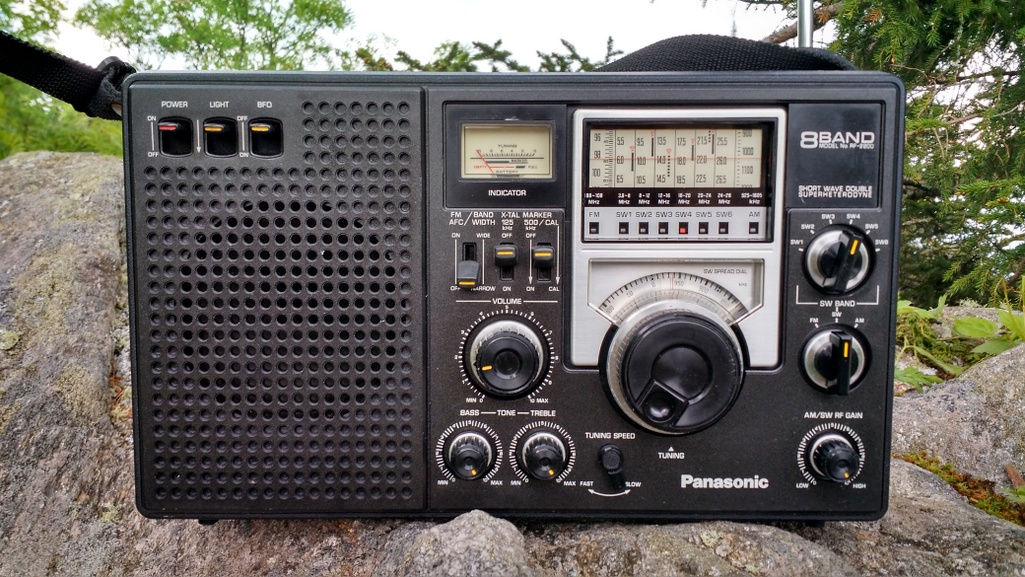
Panasonic-RF2200-MtMitchell

I’ve had the Panasonic RF-2200 for just one week, but I’ve thoroughly enjoyed getting to know this classic solid-state portable. Without a doubt I’ve been very pleased with the RF-2200, and I only have good things to say about the eBay seller, volodymyry123 from whom I bought it. Eventually I’ll take the time to calibrate the analog dial, which is about 100 kHz off-frequency.  (I’m obviously in no rush, but if readers with these rigs have suggestions for doing so, feel free to comment.)

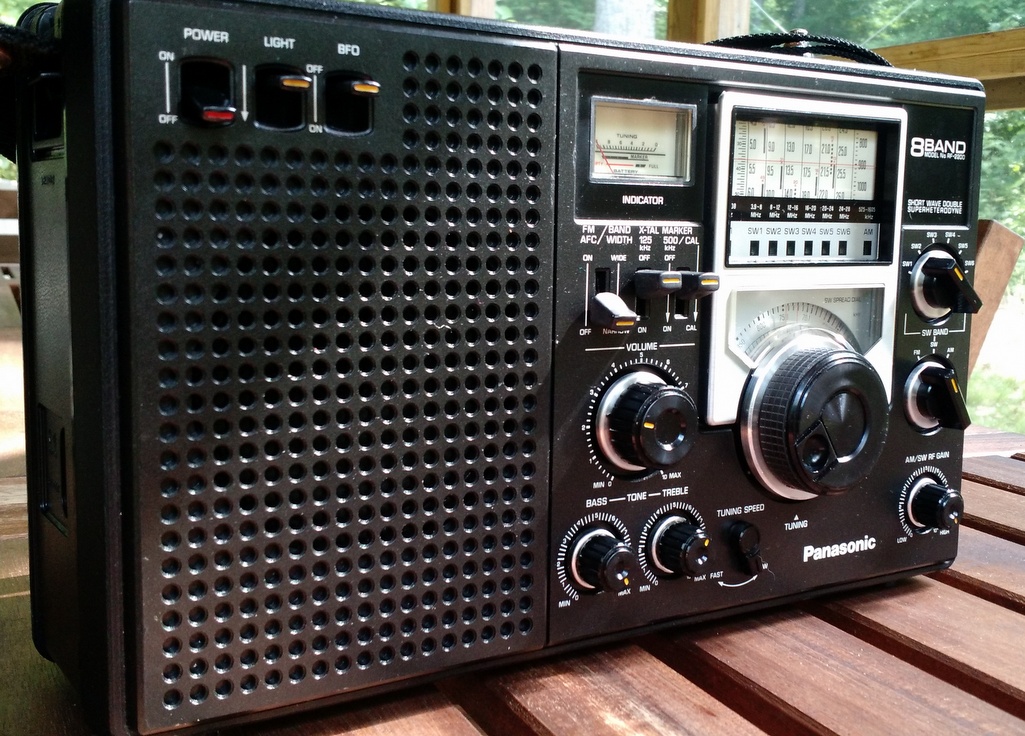
The RF-2200 is surely one of the largest, heaviest portables in my collection…still, it begs to be taken outdoors!

Last week, I drove with some friends to the highest point in eastern North America, Mount Mitchell State Park. As I left for our drive, picnic supplies and backpacks in tow, I took a glance at the RF-2200 in my office–and couldn’t resist taking it along.

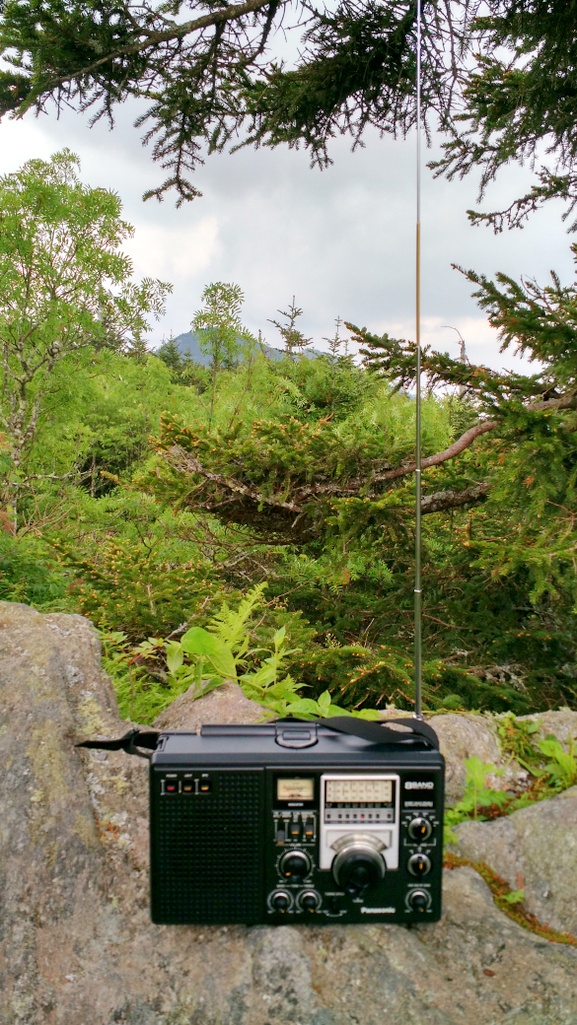
During our mountain picnic, I turned the RF-2200 on; immediately I heard Radio Exterior de España‘s interval signal on 17,715 kHz. It was loud and clear, at times pegging S9 on the signal meter.

Panasonic-RF2200-MtMitchell-2

I also tuned to the medium wave band and was instantly amazed by all of the signals it drew in. I was able to hear one of my favorites, WAIZ, on 630 kHz–the signal was very stable and sounded local, although the transmitter was easily 60 miles away.

In general, medium wave performance on the RF-2200 has been nothing short of incredible. But this shouldn’t come as much of a surprise. Indeed, just prior to purchasing the RF-2200, I consulted my buddy, Jeff McMahon (the fellow behind The Herculodge); here’s what he says about the ‘2200:

“I borrowed my friends’ RF-2200 for a month in 2008 and I loved it. It picked up stations effortlessly and had a magisterial quality about it, especially the AM sound. It reminded me of why I fell in love with radios.”

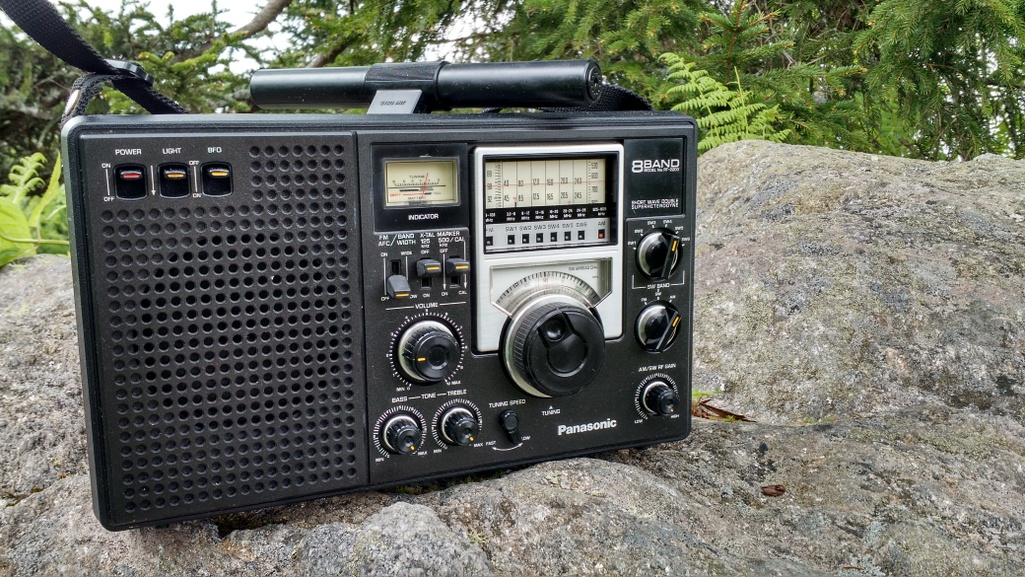
Panasonic-RF2200-MtMitchell-3But why is it that when I look at the RF-2200, I feel like I should be taking it to the field? Perhaps it’s the staunch, beefy look of the chassis, or the controls that could easily be worked even with winter gloves? Or perhaps it’s that woven carry strap?

Or perhaps the RF-2200 offers something I miss in the age of compact portables with digital displays: a radio with presence, one that lends itself to pure listening discovery. The RF-2200 demands your attention, and does so with a clear, deep voice…

Yep, the RF-2200 is a true field companion.  But don’t take my word for it:  find one, take it along, and see–or rather, hear–for yourself.

Shortwave listeners hear the Voice of Greece once again

greece

SWLing Post contributor, Moshe, writes with some good news from the Voice of Greece:

I’m listening to VOG at 9420kHz, At 11:27 local time 08:27UTC, 11/06/2015 the station identified itself as “Ezo Athina, I Foni Dis Elladas”: “This Is Athens, The Voice Of Greece”.

Immediately after receiving Moshe’s message, another Post contributor, Merkouris, provided the following details:

It would be of interest to the SWLing Post readers that, as of today June 11, the Greek public broadcaster ERT is back on the air with three TV channels and eight Radio programmes, including the “Voice of Greece”.

TV channels:
ERT1,
ERT2,
ERT3 (Thessaloniki)

Radio programmes:
Proto Programma (1st Programme),
Deftero Programma (2nd Programme),
Trito Programma (3rd Programme),
Kosmos (Musics of the world),
ERA Spor (Sports programme),
RS Makedonia (Thessaloniki),
Foni Tis Elladas (Voice of Greece)

The web site http://www.ert.gr/ is also up with news and streams of all tv and radio channels.

Right now at 10:45 UTC the Voice of Greece is on the air on 9420 kHz.

Many thanks to both Moshe and Merkouris for this information!

A little background…

If you haven’t been following the story, in June 2013, Greek National TV & Radio (ERT) was shut down and so was the Voice of Greece (well…officially, at least).  Only a few hours after VOG went off the air that night, they came back on the air with live protest coverage.

In fact, since that night–exactly two years ago today–Greece has been broadcasting on shortwave intermittently as a relay of ERT Open and/or Elliniki Radiofonia.

I hope that now VOG is officially back on the air, their shortwave broadcasts will be daily once again.  Tonight, I will certainly be tuned to 9,420 kHz!

Update: the BBC News has recently posted this excellent article with photos and videos on their website.

Art Bell’s “Midnight In The Desert” to be broadcast on shortwave via WTWW and WBCQ

MidnightInTHeDesert

Many thanks to SWLing Post reader, Mike, who informs us that Art Bell is returning to the airwaves with a new radio show called Midnight in the Desert. Like Coast to Coast AM, (which Bell retired from several years ago) Midnight in the Desert will also focus on paranormal activity.

Mike also points out that Bell has also announced Midnight in the Desert will be broadcast on WTWW (5,085 kHz).  WTWW will start airing the show July 20, 2015 from 9:00 pm – Midnight Pacific time.

Indeed, after looking at the list of radio stations rebroadcasting Midnight in the Desert, I noted that WBCQ, in Maine, will also carry the show on 7,490 and 9,330 kHz.

For more information and updates, check out Art Bell’s website.

The Panasonic RF-2200: an early birthday gift

Panasonic-RF-2200-1

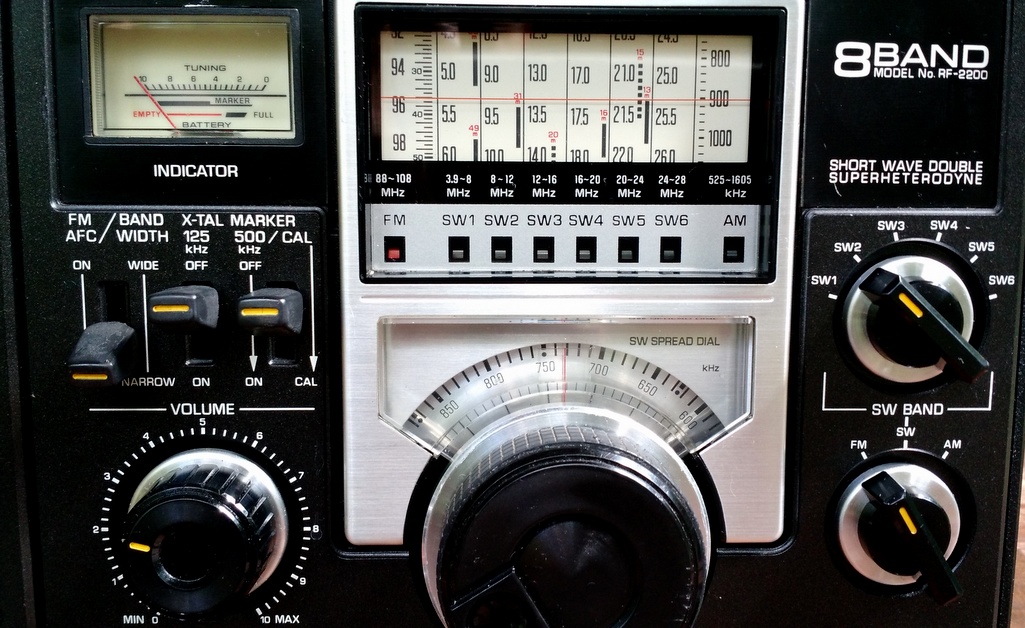
This week, I purchased a radio that I have lusted after for years: the Panasonic RF-2200.

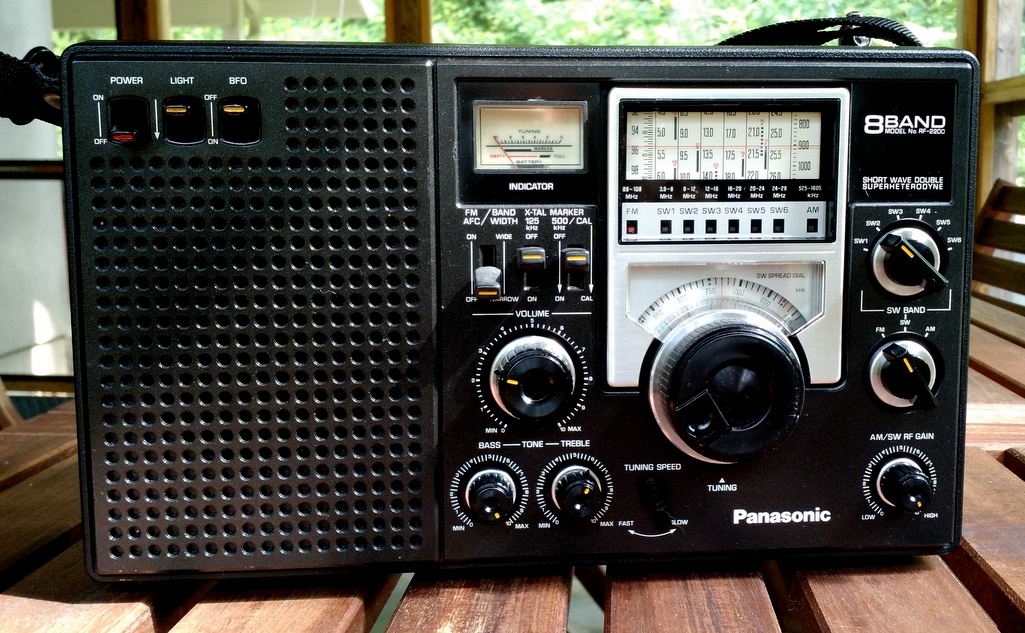
I justified this eBay purchase because June is my birthday month and…well…do I need anymore justification!?!  Just look at this beautiful analog dial:

Panasonic-RF-2200-2

In truth, I’ve been wanting a benchmark portable medium wave receiver for ages, and I believe there are few better than the venerable RF-2200.

Panasonic-RF-2200-3

I picked the RF-2200 this morning and I’ve only had it on the air a few minutes. It effortlessly picked up my local benchmark medium wave and FM stations. The audio fidelity is brilliant and the ‘2200 appears to have a very low noise floor. I haven’t had a moment to truly cruise the shortwave bands, but I plan to over the course of this week and shall report back.

James’ vintage transistor radio collection

In response to my recent post about the vintage Arvin 68R58 transistor radio, SWLing Post reader, James Patterson, has shared photos of his collection in New Zealand. James has captioned each photo below:


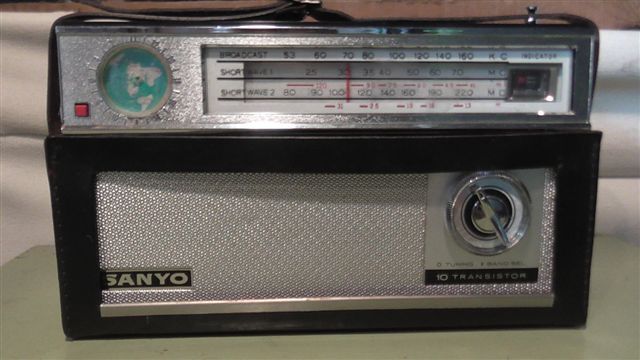
Sanyo

This portable Sanyo was bought at a “Second Hand” shop. It had badly corroded battery connections. I repaired it and it works fine now.

Very early National portable with twin speakers, broadcast [band] and [shortwave. Works very well.

Very early National portable with twin speakers, broadcast [band] and [shortwave. Works very well.

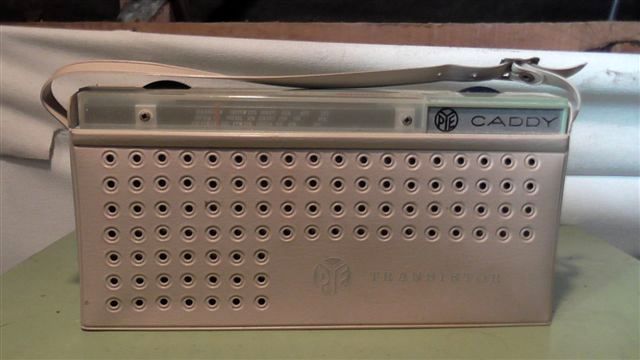
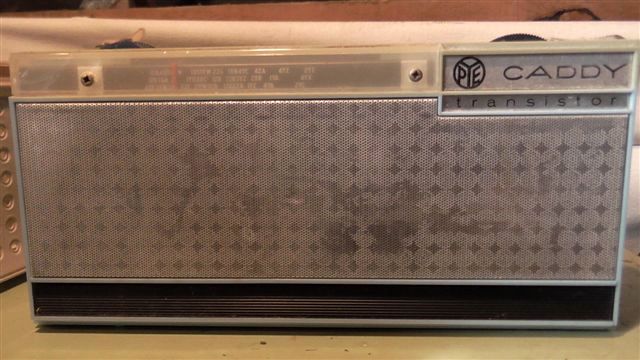
This PYE Caddy was actually made here in New Zealand. I believe the design was from the UK though. It still works very well.

This PYE Caddy was actually made here in New Zealand. I believe the design was from the UK though. It still works very well.

The PYE Caddy without the plastic cover.

The PYE Caddy without the plastic cover.

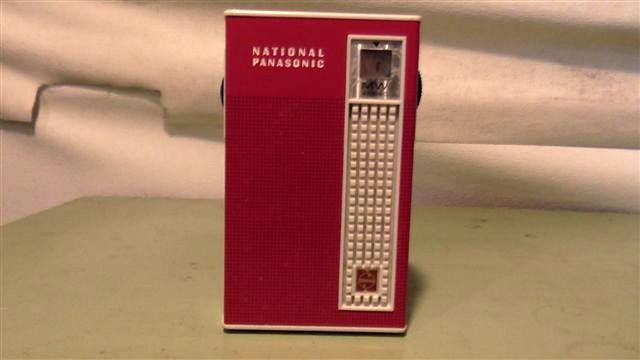
Very popular in their day, the RED National Panasonic pocket AM Transistor 6. Works well.

Very popular in their day, the RED National Panasonic pocket AM Transistor 6. Works well.

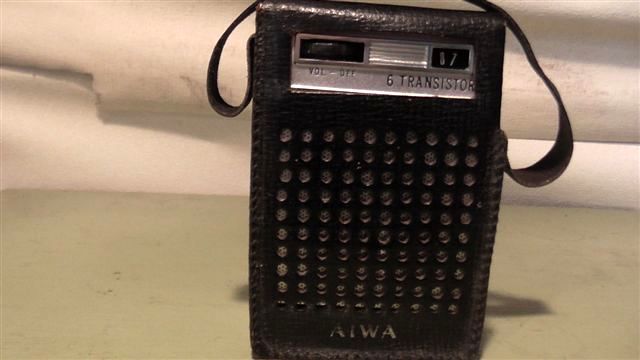
Very early AIWA pocket Transistor 6. Still works well.

Very early AIWA pocket Transistor 6. Still works well.

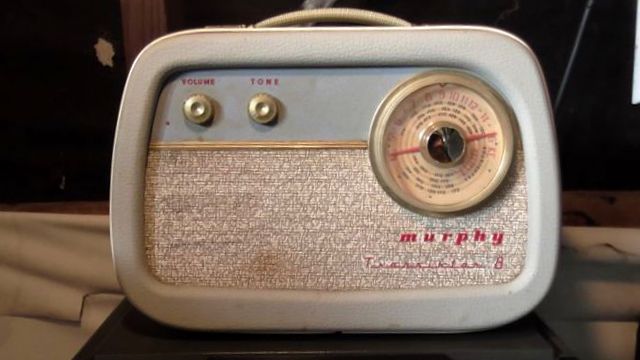
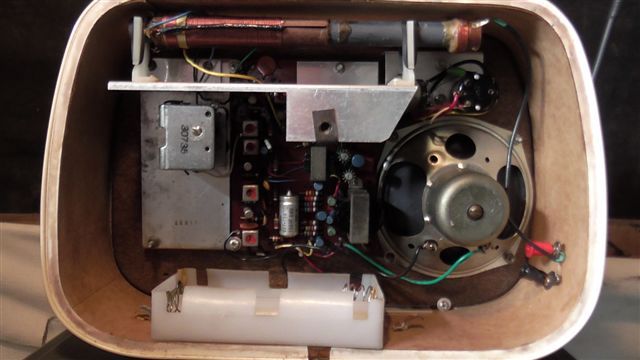
The "Murphy 8" Transistor radio. Broadcast band only. Wooden case in fab condition. Works very well.

The “Murphy 8” Transistor radio. Broadcast band only. Wooden case in fab condition. Works very well.

Murphy8-BackOpen

This is the rear view of the “Murphy Transistor 8.” I gave it a new battery holder.

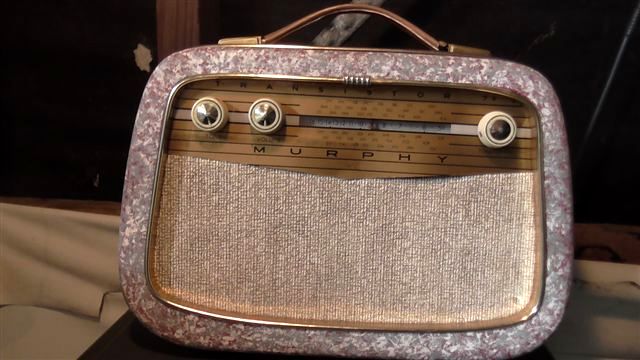
This is a "Murphy Transistor 7+"  Im not sure what the "+" means because it does have only 7 transistors. Very good performer for its age. Wooden case is identical to the previous Murphy 8.

This is a “Murphy Transistor 7+” Im not sure what the “+” means because it does have only 7 transistors. Very good performer for its age. Wooden case is identical to the previous Murphy 8.

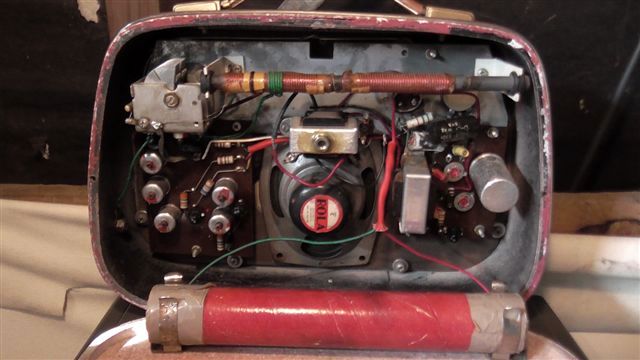
This is the rear view of the "Murphy Transistor 7 plus." All very original, and works fine.

This is the rear view of the “Murphy Transistor 7 plus.” All very original, and works fine.

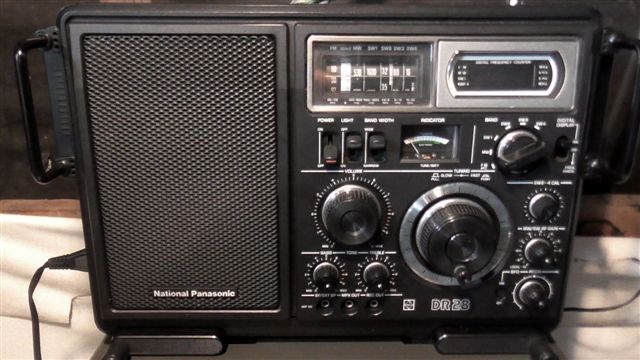
This National Panasonic DR 28 is not part of my early AM Transistor radio collection. It is, however, part of my Short Wave Radio collection.

This National Panasonic DR 28 is not part of my early AM Transistor radio collection. It is, however, part of my shortwave radio collection.


Many thanks, James, for sharing photos from your collection! You certainly have some gems in there. I was not at all familiar with the New Zealand-made PYE Caddy, in fact. I’m curious if other radios were made in New Zealand in the past.

I bet you and I might agree that the Panasonic DR-28 (a.k.a. RF-2800 in North America) hardly feels “vintage,” but at 37 years old it certainly qualifies by most standards–hard to believe. The RF-2800 pops up on eBay quite often and has certainly held its value well. (Click here to search.)

Seeing the DR-28/RF-2800, in fact, is making me lust even more after the venerable Panasonic RF-2200! Alas…so many radios!

Hamvention find: the Arvin 68R58 AM transistor radio

ARVIN-68r58-DSC_1390Though I believe I spent more money at the Dayton Hamvention this year than I have in all previous years, I only purchased one radio: the Arvin 68R58 eight-transistor.

I spent a whopping $5 on the little Arvin in the Hamvention fleamarket. To be fair, the seller sold it for this modest price because he was not sure if the radio worked.  But when I unsnapped the back leather cover, peered inside, and found the works remarkably clean, I suspected it might…

ARVIN-68r58-DSC_1373No original power supply was included, of course, and I was a bit concerned when I saw the somewhat out-of-character plastic battery holder. In the filtered fleamarket light, it appeared to me as if it required proprietary batteries–the holder appeared too small for C cells, and too large for AAs. There was no indication of the type of batteries it used, but since the spec read “6 volts,” I knew I could build a small AA battery holder, if need be.

So, at $5 (I bargained him down from $10, based on the doubt of operation) it was a very low risk purchase, and a potentially a fun project.

ARVIN-68r58-DSC_1385

Back at home, I popped open the battery holder and looked inside…And I discovered the Arvin did, indeed, take four C cells. Simple enough! After inserting fresh batteries, I turned on the radio via the tone pot, and instantly heard beautiful, rich audio.

What I thought would be a project radio ended up being fully functional, and was, moreover, in tip-top shape.

ARVIN-68r58-DSC_1369

So far, I’ve been very impressed with the Arvin’s AM sensitivity and audio fidelity. No doubt the generous ferrite rod antenna is doing the trick on medium wave.

ARVIN-68r58-DSC_1377

Last night, as I tuned through the AM broadcast band, I was able to null out unwanted stations and noise amazingly well. There is something to be said of transistor radios from this era–let’s just say, they’re classics.

ARVIN-68r58-DSC_1376The Arvin has a simple set of controls: tone, tuning, and volume. There are no filter selections, of course, but I can tell that it’s quite wide; perhaps 8 or 9 kHz.

ARVIN-68r58All in all, I’m very pleased with my little purchase, and the Arvin has become my new (vintage) bedside radio. Last night, I tuned in one of my favorite AM stations on 740 kHz, CFZM in Toronto, Canada.  CFZM (a.k.a. “Zoomer Radio”) is not only a benchmark, but a right of passage for any worthy AM radio in my household. The Arvin passed the Zoomer test with colors flying.

And, yes, it even soothed me to sleep.

ARVIN-68r58-DSC_1387

Now I only need to properly clean and restore the Arvin’s leather chassis and perhaps build a 6V-regulated linear power supply.

ARVIN-68r58-DSC_1378

Next time you pass by a 1960s/70s vintage transistor, grab it! I’m certainly happy I did.

Now, I think I’ll turn on the Arvin, sip some dark beans, and put up my feet in the Pawley’s Island hammock…Cheers! Summer’s on the way.

ARVIN-68r58-DSC_1381Want one of your own? A quick search reveals that the Arvin 68R58 can be found on eBay for quite reasonable prices. Click here to search eBay for an Arvin.

Honoring Memorial Day: The White Cliffs of Dover

Dame Vera Lynn

Dame Vera Lynn

Today is Memorial Day, and I’m feeling humbly grateful to all of those who paid the ultimate sacrifice for their country. Since I’ve been reading a lot of WWII history lately, I’ve also been playing a lot of WWII-era music here in my sanctuary to all things radio.

Few songs sum up the yearning sentiment of World War II better than Vera Lynn’s 1942 rendition of “The White Cliffs of Dover.” It’s an iconic song, one that helped British soldiers see beyond the war while mourning its painful toll. It was written in 1941 when England was taking heavy casualties, just before American allies joined the effort.

Scott-Marine-Radio-SLR-M

This morning, seeking something with a little authenticity, I played “The White Cliffs of Dover” though my SStran AM transmitter, and listened to it through “Scottie,” my WWII-era Scott Marine radio (above). I made this recording by placing my Zoom H2N recorder directly in front of the Scott’s built-in monitor speaker.

So here you go: a little radio tribute to all of those who fell–on both sides–of that infamous second world war.

And thanks to all who serve and have served in the name of “peace ever after.”

Click here to download the recording as an MP3, or simply listen below: