Category Archives: News

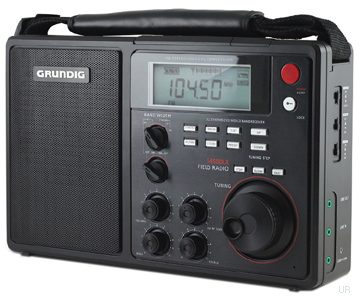
The Grundig S450DLX


The new S450DLX promises to be a capable shortwave and mediumwave radio.

Universal Radio has announced that they are taking orders for the new Grundig S450DLX–an obvious replacement/improvement on the Eton/Grundig S350DL.

I have used an S350DL extensively and find that its audio is exceptional. It is a very capable short and medium-wave receiver. Based on Universal’s description, it appears the S450DL has many improvements including:

  • An AM IF Output jack (F type) which could be used to decode DRM or SSB (similar to C.Crane Radio SW)
  • 50 Memory Presets (10 per band)
  • Dual-conversion superheterodyne circuit design
  • Uses 6 D cell batteries (guess this new radio needs more juice!)

The S450DLX could be a great radio and may even give my favorite large portable–the C.Crane Radio SW–a run for its money.

Universal Radio says that they expect to have the S450DLX in stock 30 December 2010. (Updated 12 Dec 2010)

Radio St. Helena Day 2010

[UPDATE: Radio Saint Helena Day 2010 has been canceled. Please read this updated post with info.]

Want to chase some fun DX? Radio St. Helena Day 2010 is almost here–this time being held in October. Details below:

(Source: Jaisakthivel via Hard-Core DX)

Radio St. Helena Day 2010 : Date,Times and Targets
————————————————————-
RSD 2010 will be on 11092.5 kHz USB, Saturday, 9th October 2010

Target Region Times (UTC ) Beam Heading

  • EUROPE 1900 – 2030 UTC 10 degrees
  • INDIA 2030 – 2130 UTC 70 degrees
  • JAPAN 2130 – 2300 UTC 50 degrees
  • North America 2300 – 0030 UTC 310 degrees

Gary Walters, Station Manager of Radio St. Helena, has just confirmed the above information,and, as usual, Derek Richards will operate the RSD shortwave transmitting facility. There will be a special email-address exclusively for the evening of RSD 2010. As soon as Gary sets up this special email account, will be published.

The RSD 2010 QSL cards are being sponsored by the Danish ShortWave Club International. Reception reports for RSD 2010 should be sent with sufficient return postage to RSH using thespecial Airmail address via Ascension and the United Kingdom — exactly the same procedureas for the RSD 2009 reception reports. ALL mail to RSH should use this procedure. ALL 266 QSLs for RSD 2009 have been mailed and should now be arriving around the world.The sunspot minimum between sunspot cycles 23 and 24 is the longest in history — much to the dismay of shortwave listeners everywhere. This minimum has lasted since 2007 and is still ongoing. There are not very many sunspots to “help” propagation, and there is no real sign of significant change.

The UTC-times for broadcasting to the various target area have been very carefully selected to to have the very best chance of good reception in each area. Also, we need to have the RSD broadcasts one after the other.After RSD 2009, it was decided to change the times somewhat and to move RSD from November to October (as was the case back in the late 1990’s — Thanks, John). RSH hopes that everyone around the world has excellent reception conditions during RSD 2010 and is looking forward to your emails and also, if possible, to your telephone calls.

Gary Walters , Station Manager of Radio St. Helena via Robert Kipp

Voice of Zimbabwe on Shortwave?

According to The Zimbabwean,

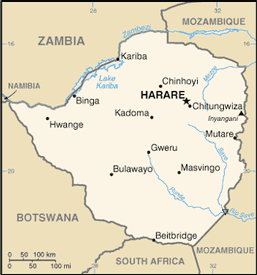
Voice of Zimbabwe, a subsidiary of the state-controlled Zimbabwe Broadcasting Holdings (ZBH) was officially launched in the Midlands capital of Gweru on 30 July 2010.

Voice of Zimbabwe was established in 2007 and broadcasts on shortwave frequency.

As Kim Elliot points out, the Voice of Zimbabwe was created to counter other shortwave broadcasts directed to Zimbabwe (BBC, VOA, Shortwave Radio Africa, etc.).

Zimbabwe has state controlled broadcast media (on all radio bands within the country)–thus, shortwave broadcasts being heard from outside of Zimbabwe are somewhat of a lifeline for listeners.

That’s what we like about shortwave radio, it freely crosses national borders without regard to the political party in power.

So far, there have been no reports verifying that the Voice of Zimbabwe is actually broadcasting.

NPR Explores Numbers Stations

This weekend, NPR’s Guy Raz interviewed Mark Stout, the official historian at the International Spy Museum. Their topic? Numbers stations. Click hear to go to NPR’s webpage, listen and/or read the full transcript. You can also download an MP3 audio file of the report by clicking here.

For even more numbers station audio, check out the piece that shortwave enthusiast, David Goren, produced by clicking here.  Also, read all of our various articles that mention numbers stations.

Slate Magazine explores how Russian spies used shortwave radio

Slate:

It may seem like the digital era of spy technology has passed the Russians by. In the Washington Post, columnist Jeff Stein tittered that “the FBI must have been clapping its collective hands when it discovered the primitive radio techniques the Russians were using.” But they aren’t the only ones using short-wave radio for espionage. Great Britain has publicly admitted that its foreign intelligence agency, MI6, still uses “numbers” stations. And scientists have tracked numbers broadcasts to transmitters at government sites in Israel and (until they went silent in the late ’90s) the United States…

…The reason this dusty method is still ideal for espionage is that, even if you locate a spy station’s transmitter, you have no idea who’s tuning in across the hemisphere. Unlike telephone or Internet connections, receiving a radio signal leaves no fingerprint, no traceable phone connection, no IP address, and no other hint as to where the recipient might be.

Read the full article on Slate Magazine’s website and my previous post about the Russian spies who were recently headline news in the US.

Listen to the FIFA World Cup 2010 on Shortwave Radio via RNW

The Netherlands will face Spain in Johannesburg on Sunday 11 July at 1830 UTC in the final of the FIFA World Cup 2010. Radio Netherlands Worldwide has posted the broadcast frequencies for this event and we have them listed below.

The following shortwave/mediumwave frequencies will will carry live coverage in Dutch, mind you (all times UTC):

* 1200-2200: 1296 kHz for Benelux
* 1800-2200: 5915 kHz to South Africa
* 1700-2200: 5935 kHz to Indonesia, Australia & Indian Ocean
* 1700-2200: 5950 kHz to Europe and Scandinavia
* 1700-2200: 9895 kHz to SW Europe
* 1800-2200: 11670 kHz to SE Europe & Middle East
* 1800-2200: 11905 kHz to US East Coast
* 1800-2200: 13640 kHz to US & Canada
* 1800-2200: 13685 kHz to Central & East Africa
* 1700-2200: 15310 kHz to Caribbean & Florida
* 1800-2200: 15475 kHz to South America
* 1700-2200: 17535 kHz to Atlantic Ocean & West Africa

Thanks to RNW Media Networks for this info.

UPDATE: Did you record the FIFA World Cup on shortwave? If so, please  send me your audio, I would be happy to post it on SWLing.com.

Russian Agents Used Shortwave Radio to Receive Coded Messages

Courtroom drawing of the suspects. Source: NY Times

Many of you may have noticed in the news yesterday that shortwave radio was used by the 11 Russian agents who were carrying out espionage within the United States. An article in the New York Times noted that one of the methods they used to communicate with the S.V.R. headquarters in Russia was via shortwave radio. The article mentioned that the agents would send “coded bursts of data” via shortwave transmitter.

The NY Times article failed to mention that the agents no doubt received messages from Russia via shortwave numbers stations.

So why is shortwave radio–a rather “low-tech” communications medium–used in modern espionage? The primary reason is it’s almost impossible to trace, thus messages leave little to no breadcrumbs for one to follow back to the source.

For decades, radio listeners have been trying to figure out from where numbers station broadcasts originate. They’ve had very little success. Indeed, the only breaks we’ve had have been when the broadcasting station makes a mistake. This has happened once with a numbers station message originating from Radio Havana Cuba. Listeners heard the faint sound of an RHC broadcast in the background–they were obviously hearing noise from across the studio hall.

Of course, another reason shortwave radio is used to relay secret messages is because it’s almost impossible to block. I wrote an article called “When shortwave radio is better than the Internet” that describes why this characteristic alone is an important reason to keep shortwave stations on the air around the world. No government or local authority can prevent you from listening to shortwave broadcasts–whether you’re a spy (like this lot) or simply living in a country where the folks in charge like to  control your access to the news and information.

One small shortwave  radio can break through all of that red tape.

UPDATE: For more information on how radio was used by these agents, check out the US Department of Justice’s website. In particular, check out pages 11-12 in this document. (Thanks to David Goren for this tip.)

For more information: