Category Archives: News

Mystery: Traders using “shortwave to cross oceans with less latency than any fiber”

Many thanks to SWLing Post contributor, London Shortwave, who shares this fascinating article which takes a look at high-frequency trading firms:

(Source: Sniper in Mahwah & Friends)

Shortwave Trading | Part I | the West Chicago Tower Mystery

Since 2014 this blog has extensively covered the wireless networks built by high-frequency trading (HFT) firms or network providers to reduce latencies between the different exchanges around the world (market makers need fast connectivity to manage risk, news traders also need to be fast, etc.). This epic investigation on microwave, which started with HFT in my backyard, will be fully reported in a book I’m currently writing (in French for now). As I’m quite busy with this writing (and other/more interesting matters about market structure), I didn’t really have the time to check out what I have been hearing about “shortwave” or “high frequency” radio. This is the way high-frequency trading firms may use shortwave radio to directly connect widely-separated locations (in short, traders are willing to use shortwave to cross oceans with less latency than any fiber – like Hibernia).

But recently I got more intel about the situation (and some fun anecdotes). With some help from the US, I found that a firm purchased a field for more than 1$M to build towers and antennas; with some help from the EU, I got hints about Germany; and I dug into UK public records. I even met, last March in Amsterdam, people involved in those projects. Not surprisingly, at least five HFT/market making firms showed up behind the shell companies/names they use to hide. The usual suspects. Above all, I have been contacted recently by someone from Chicago, Bob, who decided to investigate the “shortwave” networks in his backyard. Today I’m pleased to host Bob as a new guest writer on this blog. This first part of the “Shortwave Trading” series is released at the same time Bob is talking about what he found at the STAC Summit in Chicago. Next parts will follow soon.[…]

Read the full guest post by Bob (KE9YQ) at the blog Sniper in Mahwah & Friends.

This is a fascinating read, and it’s fun to follow Bob–who obviously knows his way around communications sites and the FCC–put all of the pieces together. I’m looking forward to his future posts.

I think it’s fascinating that while some are calling the HF/shortwave spectrum a dead, outdated medium, others are working in the background leveraging shortwave’s strong and unique properties as a communications medium:

  • Shortwave requires no infrastructure between communication points
  • Shortwave can be used to communicate over vast distances
  • Shortwave needs no permission to cross borders
  • Shortwave has no latency–signals/communications travel at the speed of light
  • Shortwave communications are relatively durable, adaptive and are difficult/costly to intentionally block

As I’ve mentioned a number of times in the past–especially in this article from almost four years ago–while we may be seeing big government broadcasts sun-setting we haven’t seen the end of shortwave communications.
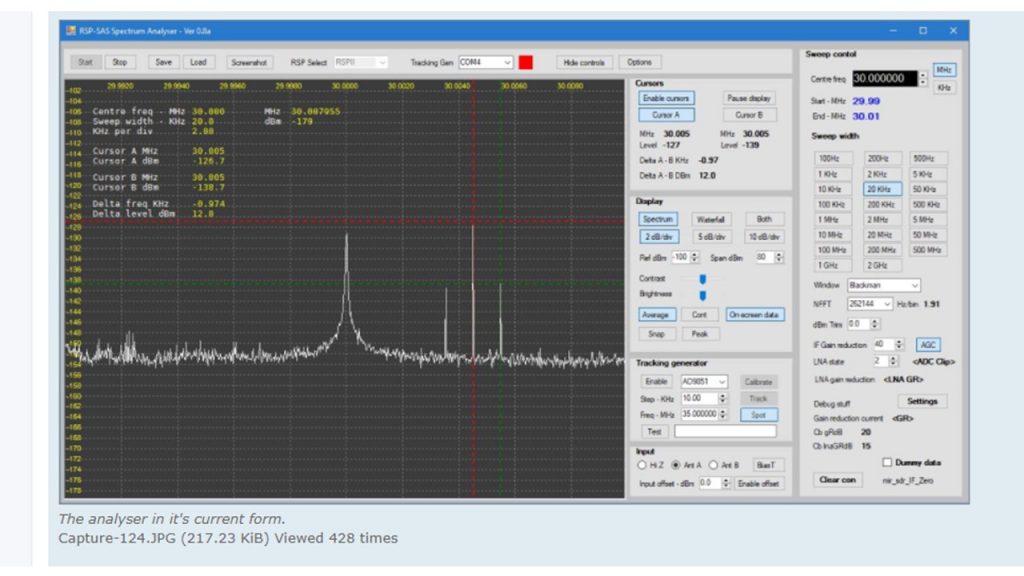

Coming soon: A Spectrum Analyzer function for SDRplay RSP series SDRs

[UPDATE: Click here for information about downloading Steve’s Spectrum Analyser tool.]

(Source: SDRplay)

Steve Andrews contacted the SDRplay forum recently to share ideas for a new Spectrum Analyser tool for use with SDRplay RSPs. A lively discussion started, with a lot of enthusiasm and encouragement from the user community, for something optimised for these devices. Steve is progressing well with the software development and hopes to have an Alpha release of the basic tool available during May. You can follow the discussion, review progress and add your comments by joining the SDRplay forum and going to: https://www.sdrplay.com/community/viewforum.php?f=12 where we have created a section especially for the Spectrum Analyser topic.

Visit Radio Caroline’s MV Ross Revenge ship

(Source: Southgate ARC)

Radio Caroline Trip 2018

The Martello Tower group will once again be running a special event station GB5RC from the Radio Caroline ship the MV Ross Revenge over a long weekend 3rd to 5th August.

This weekend we have arranged 6 trips out to visit the ship for a tour of the ship including studios, transmitter room etc. There will be 3 trips on both the Saturday and same on the Sunday and each trip can carry up to 11 visitors.

Each trip is for the whole 11 people and cost is £275 so if you fill the boat it’s just £25 per person. Sailing times are 1.30pm 4pm and 6.30pm and each trip is around 2.5 hours round trip and will be from Mersey island in Essex.

Bookings will need to be paid in full. Please note we are not taking individual bookings for spaces on trips only bookings of £275 per trip. This is on a first come paid bookings only.

To book a trip call Paul G0HWC on 07810 607766

Deutsche Welle’s 65th anniversary

(Source: Deutsche Welle)

Deutsche Welle marks 65th anniversary

For six-and-a-half decades, Germany’s international public broadcaster has been providing the world with news and information. Deutsche Welle’s offerings are more diverse and widely used than ever before.

“Dear listeners in faraway countries” — with these words from German President Theodor Heuss, Deutsche Welle (DW) began broadcasting on May 3, 1953. Germany’s foreign public radio station was charged with providing audiences abroad with a political, economic, and cultural picture of the country.

DW broadcast via shortwave and initially only in German. The first foreign languages were added in 1954. In 1992, DW expanded into television and, shortly thereafter, the internet.

“Of course the days of just shortwave were easier,” says Deutsche Welle Director General Peter Limbourg. “But thanks to the internet, social media, and our network of partners, we now have the chance to reach significantly more people than we used to. We offer a mix of news, background, and think pieces, presented in a modern fashion and oriented around the interests of our diverse and often very young target audiences.”

Limbourg has been DW’s director general for the past four and a half years.[…]

Click here to read the full article at Deutsche Welle.

“Broadcast Isolation in Japan”–no workarounds?

Many thanks to SWLing Post reader @medmouad who recently shared a link to the following article by Kenji Rikitake at Medium.com:

I’m sure Japan is one of those countries which implement the worst online broadcasting policies.

You cannot listen to Japanese internet radio stations from outside the nation, thanks to the geotagging technology for the IPv4 address; most of the major broadcasting stations do not allow access to their streaming feed outside Japan. This is a huge disservice to the expats, but the broadcasters seem not to care about it at all.

Japan’s geotagging policy against streaming broadcast is even worse within the nation; the telecom ministry enforces prefectural border limits for licensing the broadcast stations, though in some rare cases wider limits are allowed. Japan is regionally divided into 47 prefectures. So you cannot listen to Tokyo radio stations for free when you are in Osaka over internet. And vice versa. Recently a consortium of private broadcast stations, radiko.jp, announced a paid service for cross-prefectural listening of JPY300 (about USD3) per month. Isn’t this a ripoff? And it’s still not accessible from outside Japan.

Japan has a weird article in the copyright law too; the copyright owner can claim the right of making the contents being able and ready to be publicly transmitted. This right is applicable to all transmission media including internet and airwaves. So when you buy a CD, you cannot transmit without the permission of the copyright holder, usually the publisher.

[…]I hope someday I can listen to Japanese radio outside Japan over internet. The day, however, will not come soon.

Continue reading the full article at Medium.com.

If you’re an SWLing Post reader, I’m willing to bet you’re thinking: “Yeah…this is one of the downfalls of radio over the Internet.” We never have this issue with shortwave radio broadcasts since they’re built upon a medium that has, at its very core, no regard for national borders.

Of course, this article focuses on local/regional FM outlets in Japan and the firewalls that keep their online streams neatly contained.

I can’t help but think that there must be workarounds to defeat IPv4 address geotagging within Japan. Perhaps I’m wrong.

I do know that I can easily listen to local AM/mediumwave broadcasters throughout Japan using one of many web SDRs on the KiwiSDR network. Surely the same could be done for FM using a network of web accessible RTL-SDR dongles–?

Has anyone found a workaround? Mark Fahey, you know I’m looking a you!

Please comment!

Black Cat Systems’ 22 Meter Band Part 15 CW Beacon Kit

Many thanks to SWLing Post contributor, Robert Gulley (AK3Q), who notes that Black Cat Systems has developed a simple 22 meter beacon kit. The price is $20 shipped! A few details:

The kit includes the PCB and components, including a custom programmed microcontroller that will continuously transmit the ID / callsign of your choice, up to 8 characters, at about 13 wpm.

Small size – just 2 7/8 by 1 1/2 inches. Easy to build, just a few components, all through hole, no surface mount.

When ordering you note your callsign/ID to send and it will be pre-programmed.

Black Cat Systems has all kit details including full instructions on their website.

If you like the idea of building a beacon, you must also check out the beacon Dave (AA7EE) built recently–a true work of art!

Bill scores a homebrew LW/MW magnetic loop antenna

Many thanks to SWLing Post contributor, Bill Hemphill (WD9EQD) who shares the following:

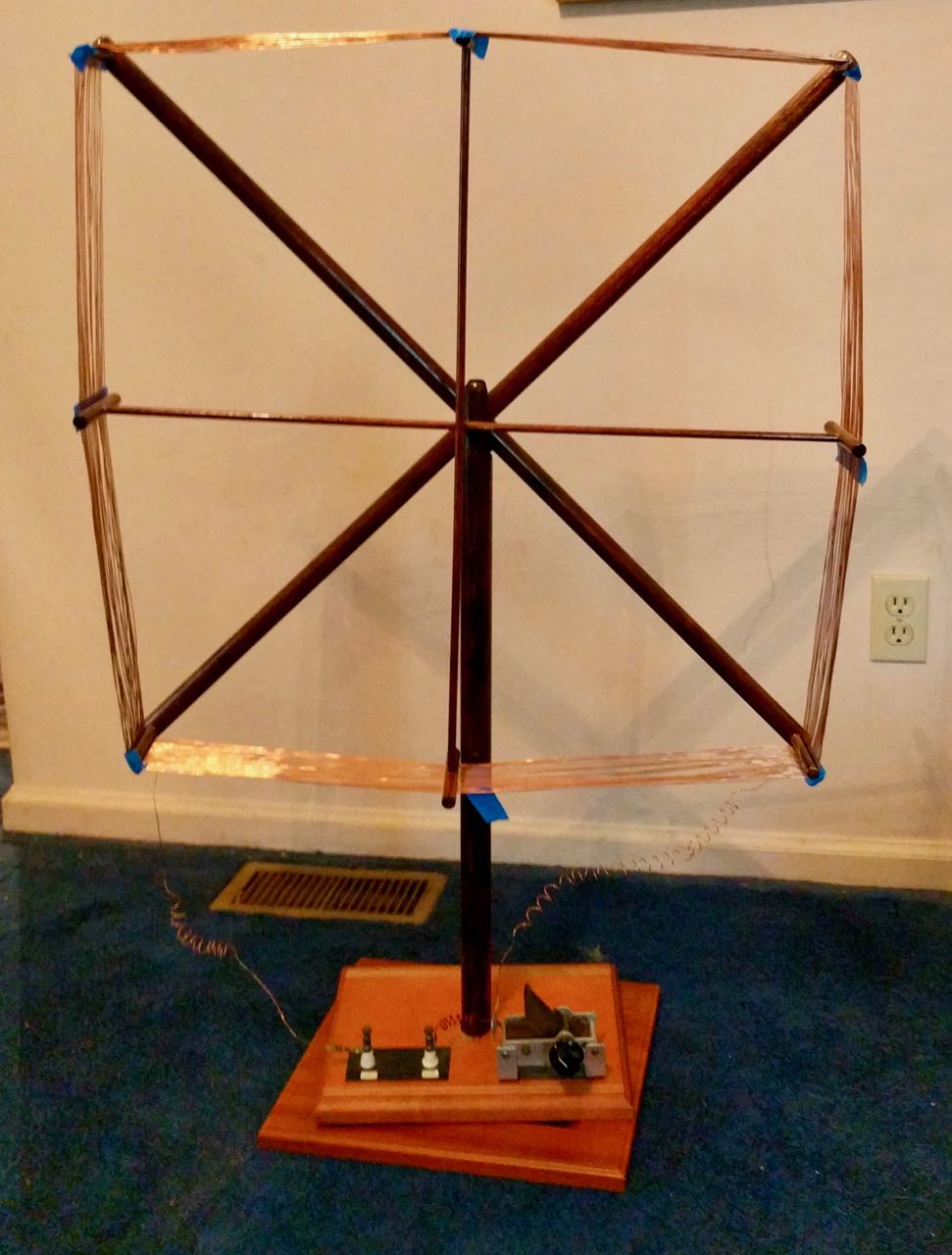
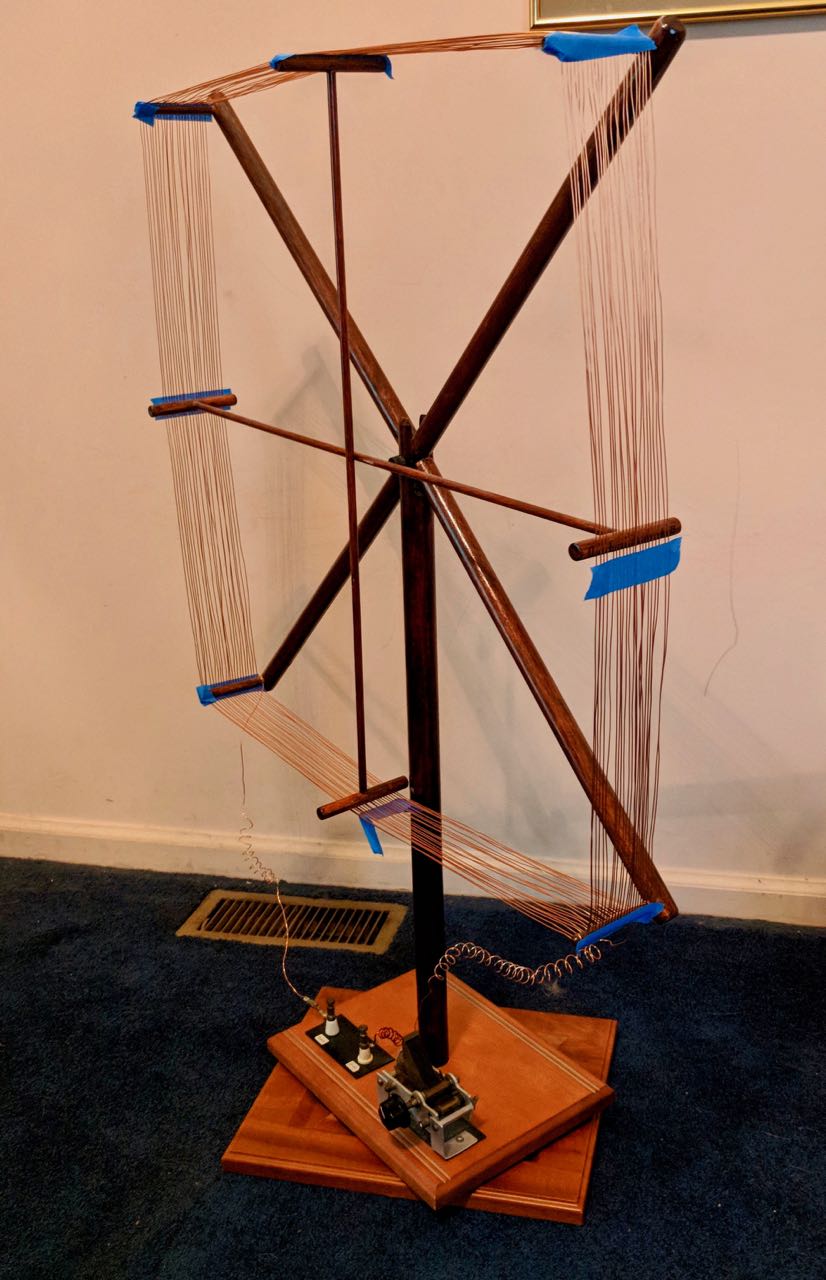
I went to the Warminster Amateur Radio Club (WARC) hamfest [yesterday] in Bucks County, PA. For some time, I have been thinking about making a loop antenna for AM DXing. It was my lucky day. When I walked to the inside tables, on the very first table was this homemade loop antenna gentleman was selling from an estate.

I snatched it up for $40.

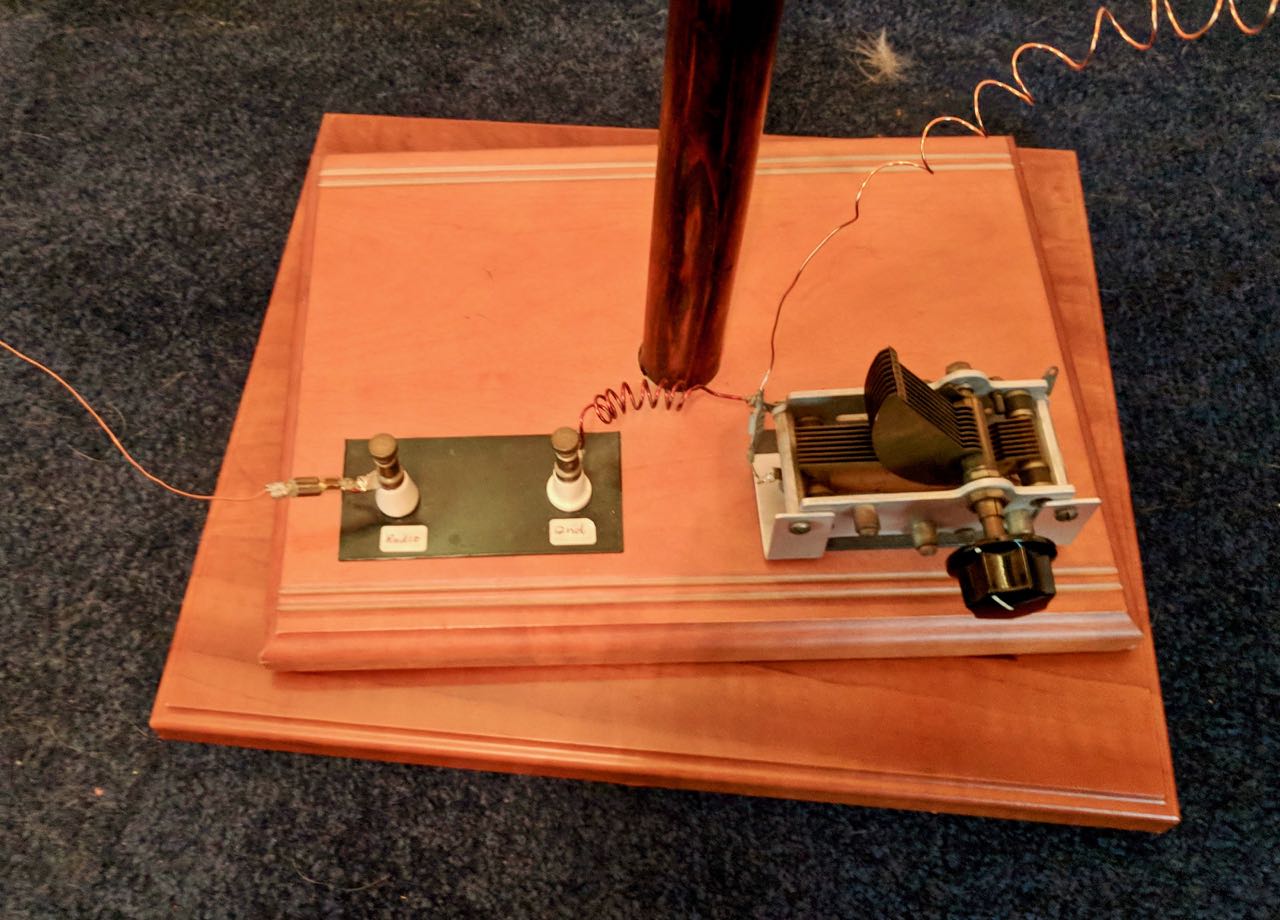
Attached are some photos of it. It’s 25” by 25”, with a swivel base. There are 23 turns of wire and I have no idea what size the capacitor is. I did some preliminary tests and it tunes from 280 kHz to 880 kHz. So it’s the covers the high half of the long wave band and the low half of the AM band.

It’s very well made and I fugue I can modify it to cover the entire AM band.

[…]I hooked the SDRplay RSP2 to it and was getting good signals of major stations all the way to 15 mHz.

That’s with it sitting on my dining room table. Of course the capacitor wouldn’t peak the signals.

So it was a great day at the hamfest!

Indeed that was a great find, Bill!  Someone spent a decent amount of time building that furniture-grade loop support. Indeed, it’s very reminiscent of 1920s-30s mediumwave loops!

What I love about your loop (and that of Thomas Cholakov) is that one can see how simple these antennas actually are to build. The only complicated bit is the support, but even that’s simple if you use the shield of a heavy coax or flexible copper tubing.

Thanks for sharing and enjoy logging DX with your new-to-you loop!