Category Archives: Nostalgia

Gary’s Arvin Model 61R35 brings back memories

Many thanks to SWLing Post contributor, Gary Wise (W4EEY), who shares the following guest post:


It’s funny how much we radio folks share in common. The recent posts on Arvin radios made me smile because I have an Arvin radio too. An Arvin transistor was my very first radio, and here she is:
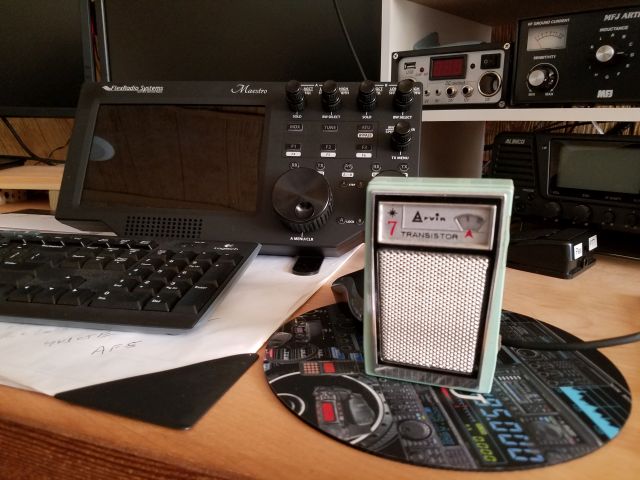
Arvin Transistor Radio

This is the Arvin Model 61R35 in Ice Blue (it also came in black). My parents bought it for me in roughly 1962 or 63. It was the first radio that was mine (though we did have an older Crosley tabletop in the living room of our house in Midland, Michigan that we all used). Mine had seven Germanium (!) transistors (as silicon transistors were not yet in wide production in the early 60s).
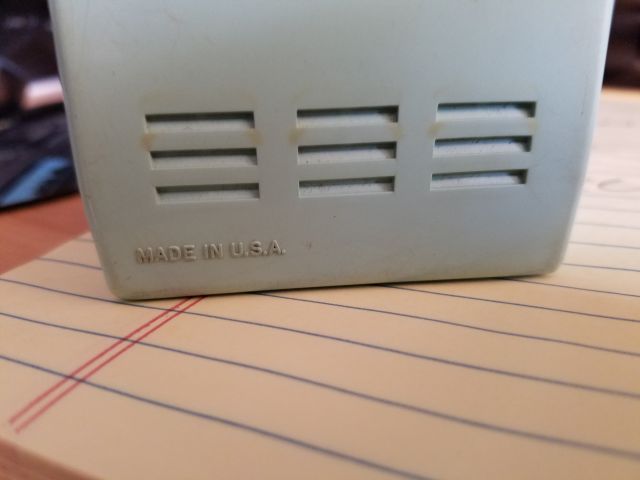
Arvin Model 61R35

And Made in America! Arvin was an Indiana company as I recall.
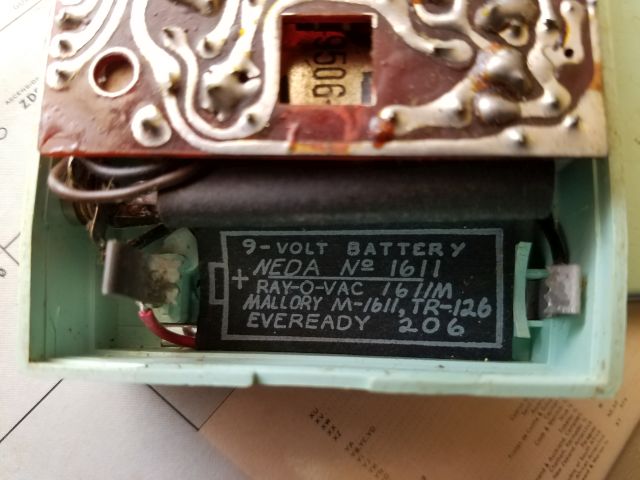
Arvin Transistor Radio

It used a Round 9V battery. They were hard to find even back then, and I expect impossible to find today.
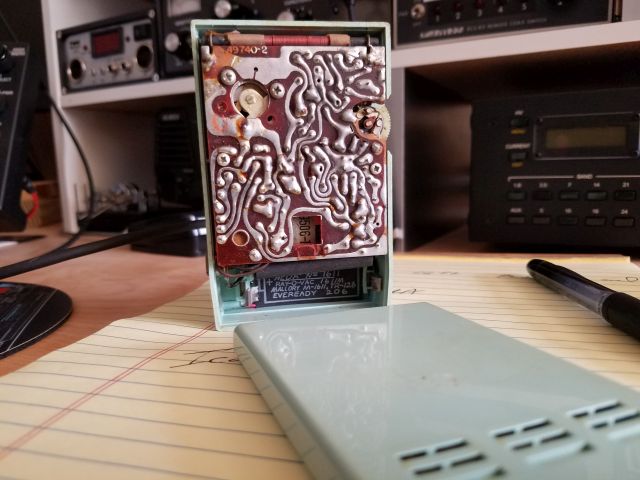
Arvin transistor radio

I used to love to put my fingers on the PC board while the radio was on and listen to the buzzes and noise that I could create. Unfortunately, I think this is what killed the radio and required my folks to mail it off to the big city (Flint, Michigan) to have it repaired. No one in my “little” town could fix solid state radios back then.
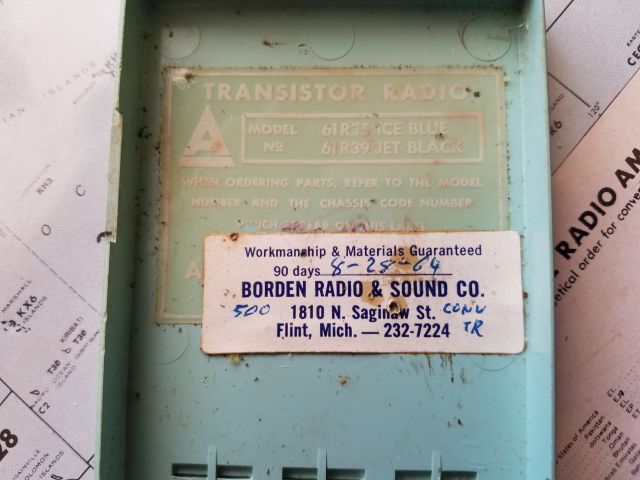
Arvin Transistor Radio Repair Tag

I was fortunate not to lose this radio in my many moves throughout the years. I display in proudly in my ham shack.
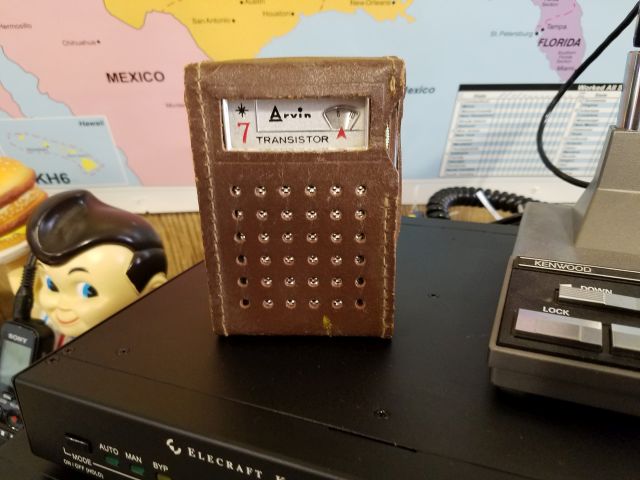
Arvin Model 61R35 in leather case

Thanks for the memories!

73,

Gary
W4EEY


And thank you for sharing your memories and the great photos of your Arvin Model 61R35, Gary! What a cute little radio–I’m glad you’ve taken care of it all of these years.
Memories and transistor radios

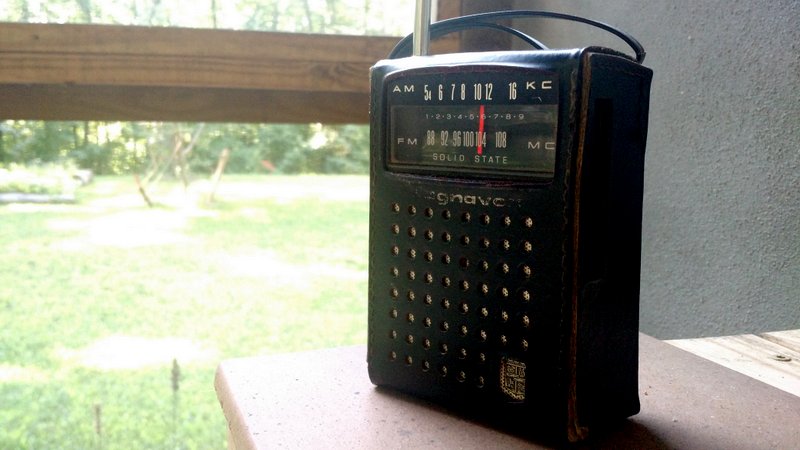
Magnovox 1R 1203I’ve always had an affinity for pocket transistor radios.
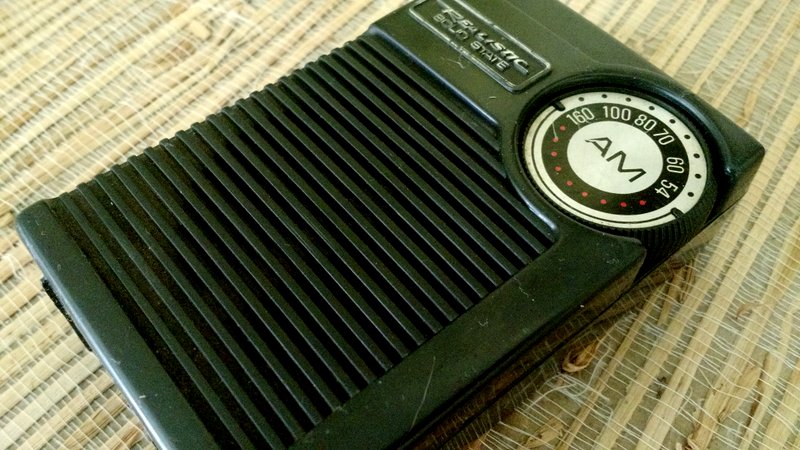
The Realistic Model 23-464.

The Realistic Model 23-464.

My first one was an AM-only model: a Realistic Model 23-464. It was about the only new pocket radio I could afford–and purchase locally–when I was a kid.

It was surprisingly sensitive on the AM broadcast band, but the dial was a far cry from accurate. At some point, I either gave this radio to someone or lost it. Last year, I happened upon one on eBay and purchased it for $9 shipped. Its plastic body shows signs of wear, but it works and reminds me of my childhood.

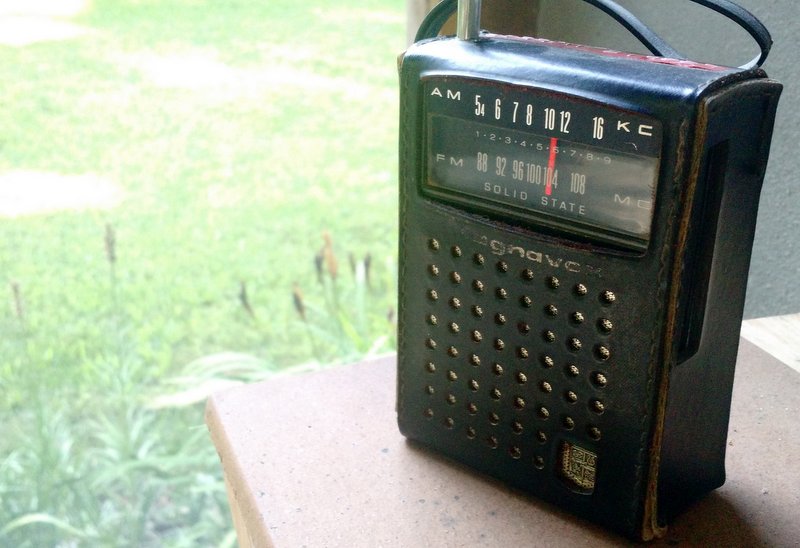
My grandpa's Magnovox 1R 1203

My grandpa’s Magnovox 1R 1203

Another pocket AM/FM radio that brings back a flood of memories is the Magnovox 1R 1203. It belonged to my dear grandpa, who also shared and conveyed a love of radio. When I was a kid, we would sit around on his front porch on hot summer days and listen to local AM stations on this little radio, cicadas whirring in the background.

I still have his Magnavox–it sits here in my radio room and brings back memories every time I look at or listen to it.

Am I a nostalgic fellow? You bet!

Anyone else have memories associated with pocket radios? Please feel free to comment and share!

Shortwave Radio Recordings: Radio Baghdad, August 8, 1990

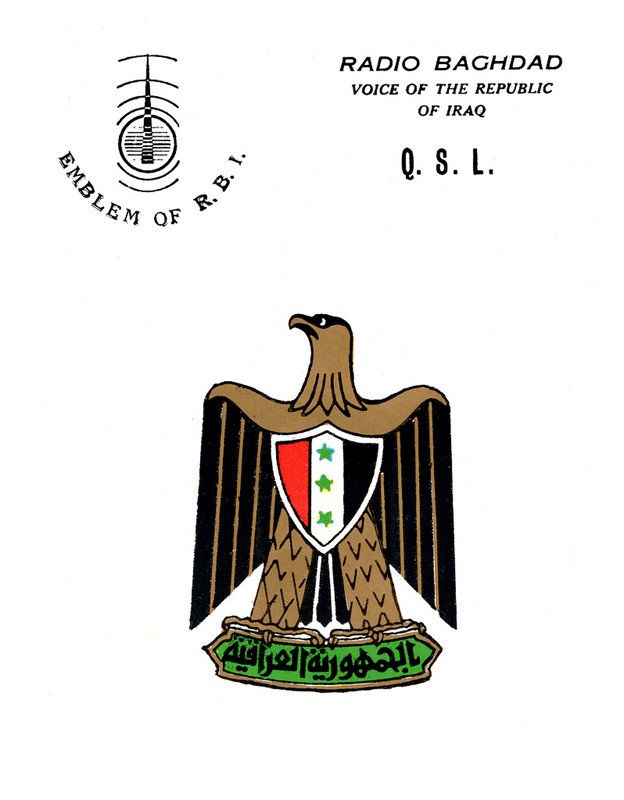
radio baghdad qsl

Many thanks to SWLing Post contributor, Al Quaglieri, who shares the following recording, QSL (above) and notes:

Here’s a nice recording I made of the first 13 minutes of Radio Baghdad’s English broadcast one day around August 8, 1990. It begins with some music and then there’s a newscast. For a couple of months, I sent such recordings down the phone line to CBS News in New York, who were eager to hear them. This, alas, is the only one I kept. Hard to believe it was nearly 26 years ago.

My how that does bring back memories! Thank you for sharing this excellent recording, Al!

Reminder: From The Radio Netherlands Archives Part 2

pcj(Source: PCJ Press Release)

August 21st and 22nd PCJ Radio International will present part 2 of From The Radio Netherlands Archives.

In the first program we played a mix bag of stuff. But in program two the focus will be on news and documentaries. You will hear Ginger Da Silva, Eric Beauchemin, Pete Myers and more.

There will be a special E-QSL issued for this program. PCJ Radio International’s partner stations will receive this program in two parts.

The program will be presented by Paulette MacQuarrie.

Europe: 0600 to 0800UTC – Frequency 7780kHz
August 21, 2016

North America: 0100 to 0300UTC – Frequency 7570kHz
August 22, 2016

For more information contact PCJ at [email protected]

RFE and the 1956 Hungarian Revolution (Part 2)

HalliDial

Many thanks to Richard Cummings of the website, Cold War Radio Vignettes, who writes:

[F]or your weekend reading pleasure, Part Two, in which I briefly examine the background to and excerpts from the RFE controversial broadcasts:

https://coldwarradios.blogspot.de/2016/08/radio-free-europe-and-1956-hungarian_5.html

Many thanks for sharing, Richard!

August 21 & 22: From The Radio Netherlands Archives Part 2

pcj(Source: PCJ Press Release)

August 21st and 22nd PCJ Radio International will present part 2 of From The Radio Netherlands Archives.

In the first program we played a mix bag of stuff. But in program two the focus will be on news and documentaries. You will hear Ginger Da Silva, Eric Beauchemin, Pete Myers and more.

There will be a special E-QSL issued for this program. PCJ Radio International’s partner stations will receive this program in two parts.

The program will be presented by Paulette MacQuarrie.

Europe: 0600 to 0800UTC – Frequency 7570kHz
August 21, 2016

North America: 0100 to 0300UTC – Frequency 7780kHz
August 22, 2016

For more information contact PCJ at [email protected]

Cold War Radio: The BBC’s plans in the event of nuclear war

BBC-AT-WAR

Many thanks to SWLing Post reader, William Lee, who shares this item from the BBC:

(Source: BBC News)

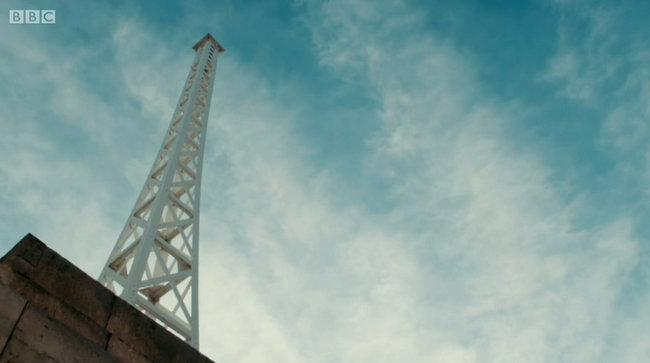
For the first time, the BBC has given detailed access to the plans it drew up in the Cold War for a Wartime Broadcasting System to operate in the event of nuclear war. Paul Reynolds, a former BBC diplomatic and foreign correspondent, has been studying the secrets of what was known as the “War Book”.

The War Book reveals a world of meticulous BBC planning. The Wartime Broadcasting System (WTBS) – referred to in the book as “Deferred Facilities” – would have operated from 11 protected bunkers spread across the UK.

Known as “Regional Seats of Government”, these would also have sheltered government ministers and staff from government departments during what is termed a “nuclear exchange”. The BBC had a studio in each, usually with five staff drawn mostly from nearby local radio stations.

The BBC’s headquarters would have been a bunker at the Engineering Training Department at Wood Norton in Worcestershire, where 90 BBC staff would have been assembled, including engineers, announcers, 12 news editors and sub-editors and ominously “two nominations from Religious Broadcasting”. Output would have been controlled by the government.

To keep the public amused during Armageddon, a collection of cassette tapes of old radio programmes including the Goon Show, Just a Minute and Round the Horne, was kept in a grey locker at Wood Norton. It was eventually realised, however, that these were redundant. If there had been a nuclear attack, radios would probably have been dependent on batteries and these would have needed to be conserved for news and important announcements.[…]

[Continue reading…]

Oh how I would love to read a copy of the “War Book”–! I hope, at some point, the BBC adds it to their online archives. Last year, we published a post with the actual statement the BBC would have broadcast in the event of a nuclear exchange. Click here to read the post.