Category Archives: Nostalgia

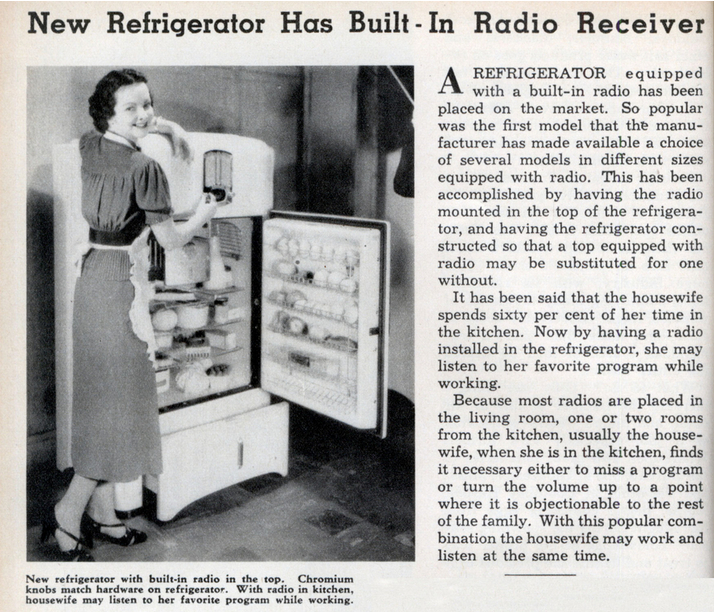
1930s refrigerator had built-in radio

Many thanks to Andy Sennitt for sharing this fascinating piece of radio nostalgia:

RefrigeratorRadio

Gizmodo columnist, Matt Novak, writes:

Jesse Walker, author of the book Rebels on the Air: An Alternative History of Radio in America, pointed me to this rather novel invention from 1937 — the refrigerator-radio combination unit. This may seem like an odd marriage of tech, but it makes perfect sense when you realise that it in the 1930s it was becoming harder to sell new radios and much easier to sell new fridges.

Despite the Great Depression, America saw an explosion of mechanical refrigerator ownership during the 1930s. In 1930, just 8 per cent of American households had a fridge. By the end of the decade, nearly half of American homes had one.

But the market for radios was pretty saturated in the late 1930s. Over 80 per cent of American households had a radio by the end of the decade. So radio set manufacturers tried to insert their products into new places that from the vantage point of the future, we can see didn’t pan out (like refrigerators) and others that did (like cars).

Continue reading on Gizmodo…

Geoff Hanley and the Radio Security Service

Geoff Hanley (Photo source: Express and Star)

Geoff Hanley (Photo source: Express and Star)

Many thanks to my friend, Phillip, for sharing this brilliant article from the Express and Star:

Researchers discover Wolverhampton man’s secret past

He was a happily married insurance agent with a secret that he took to the grave. 

Geoff Hanley was known to be a keen radio ham but nobody realised exactly what he was doing once he donned a pair of special issue headphones in his garden shed.

He would leave his family night after night to operate from the ‘radio shack’ that was specially blacked out for fear of air raids and in which he kept a sten gun, Lee Enfield 303 rifle and hand grenades.

When the siren sounded he ensured his wife, two children and dog were safe in the shelter he had dug in the garden of their Wolverhampton home but he would not join them. He stayed above ground at his post in the shed continuing to secretly monitor German military radio signals.

The operation was so hush-hush that even he may not have been entirely sure how the information he gathered was being used. But he was certain of two things – it was important and he could not speak about it to anybody outside those he worked with.

Continue reading…

Paul Litwinovich’s Vintage Radio series

SX-99-Dial

Many thanks to SWLing Post reader, Richard Cuff, for pointing out a brilliant series of articles called Vintage Radio by WSHU Chief Engineer, Paul Litwinovich.

Here are links to each article written thus far in the Vintage Radio series. If you would like to start at the beginning of the series, go to the bottom of the list first, then work your way up:

1-RadioListening

Paul Litwinovich is a shortwave listener, amateur radio operator and holds a commercial FCC license as well; here’s his bio, taken from the WSHU website:

“Paul caught the radio bug as a child. By age 12, he had taught himself the basics of vacuum tube theory.  He began repairing old, discarded radio sets, the kind that we now call vintage sets.  He loved listening, too, to local programs, DJs who picked their own music, talk shows designed to inform, not shock the listener.  But his favorite listening was to short wave radio, with its magic of music and programming from all around the world.

Hobby led to career.  Paul was a design engineer and engineering manager in the broadcast industry  for 14 years before coming to WSHU in 1990.  He holds an FCC commercial radio license, and an extra class Amateur radio license. And, oh yes, he’s still restoring and collecting vintage radio sets, for more than 45 years now, and counting.”

I’ve been in touch with Paul who tells me that an upcoming article will focus on one of my favorite WWII era receivers, the BC-348.

I can’t wait to read it!

Nothing on the bands? Check out the Shortwave Radio Audio Archive!

SWRAA-Shortwave-Archive-iTunes-LogoAlas! Lately, the sun has been playing tricks on those of us who enjoy the magic of radio wave propagation. Due to solar disruptions in the ionosphere, propagation has been fickle, albeit with a few good openings. And it’s not likely to get any better or more predictable over the next couple of days.

If you’re not hearing a lot on the bands, fear not: as history demonstrates, this solar interference will soon end, and conditions will again improve. But in the meantime, this is the perfect opportunity to listen to some of the hundreds of recordings in the Shortwave Radio Audio Archive.

Listening to the recordings and subscribing to the podcast is 100% free, and entirely void of any advertising. The fact is, I pay for this site out of my own pocket.  Not only does it serve as a historical record of radio, but it’s for listeners like us to enjoy.  We already have over 600 podcast subscribers, and invite you to subscribe–as well as to contribute content in the form of your own radio recordings.

Great content, great contributors

Speaking of contributors, check out some of Dan Robinson‘s recent offerings to the archive; many of these are very rare recordings, and all date back to the 1970s:

Brilliant stuff! I hope you will spend some time listening to these great recordings on the archive, and perhaps even join the many contributors by submitting your own recordings, too. Enjoy!

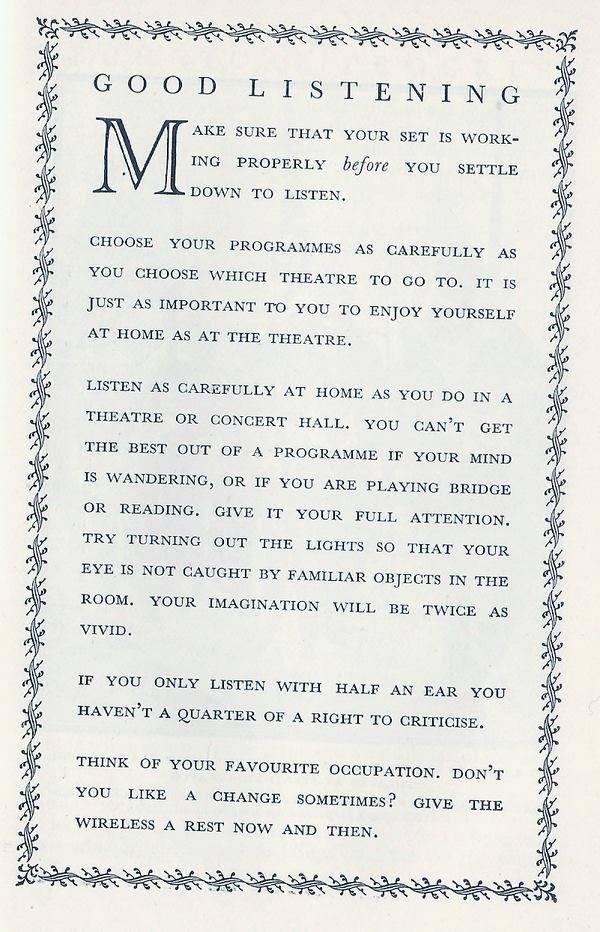
How to listen: A 1930 BBC radio manual

BBC-Radio-Manual

Many thanks to David Goren for sharing this article from Open Culture:

A comparison between the invention of radio and that of the Internet need not be a strained or superfical exercise. Parallels abound. The communication tool that first drew the world together with news, drama, and music took shape in a small but crowded field of amateur enthusiasts, engineers and physicists, military strategists, and competing corporate interests. In 1920, the technology emerged fully into the consumer sector with the first commercial broadcast by Westinghouse’s KDKA station in Pittsburgh on November 2, Election Day. By 1924, the U.S. had 600 commercial stations around the country, and in 1927, the model spread across the Atlantic when the British Broadcasting Corporation (the BBC) succeeded the British Broadcasting Company, formerly an extension of the Post Office.

Unlike the Wild West frontier of U.S. radio, since its 1922 inception the BBC operated under a centralized command structure that, paradoxically, fostered some very egalitarian attitudes to broadcasting—in certain respects. In others, however, the BBC, led by “conscientious founder” Lord John Reith, took on the task of providing its listeners with “elevating and educative” material, particularly avant garde music like the work of Arnold Schoenberg and the Second Viennese School. The BBC, writes David Stubbs in Fear of Music, “were prepared to be quite bold in their broadcasting policy, making a point of including ‘futurist’ or ‘art music,’ as they termed it.” As you might imagine, “listeners proved a little recalcitrant in the face of this highbrow policy.”

Continue reading…


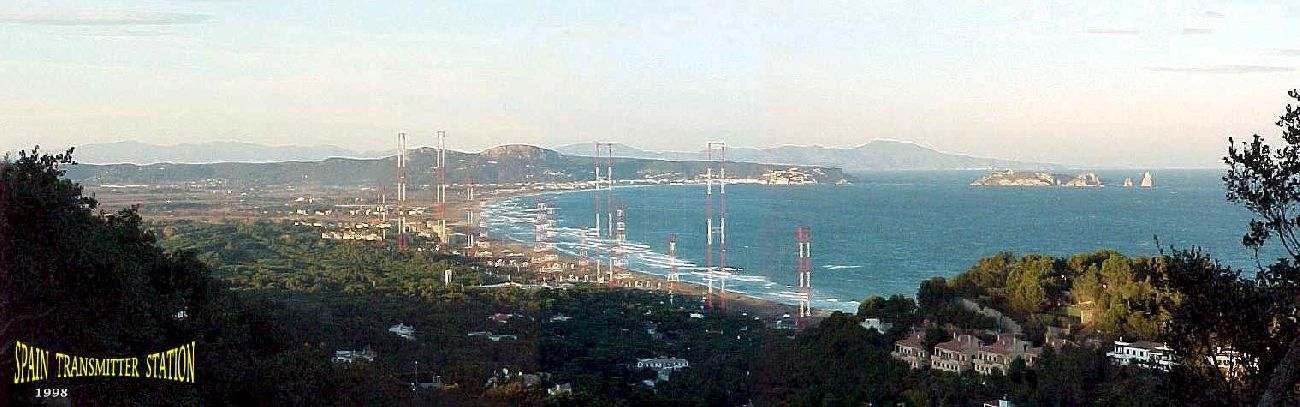
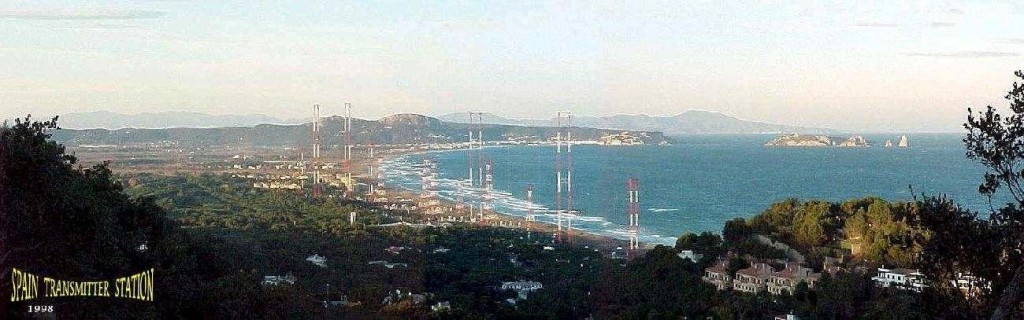
Playa de Pals transmitter site history and documentary

Photo courtesy: http://www.radioliberty.org

Photo courtesy: http://www.radioliberty.org

In response to Listening to WWV at the source, SWLing Post reader, David (EA4998URE SWL) comments:

What a “coincidence”. Hopefully, before the summer holidays officially end, I will be off to another shortwave transmitter site. Well, to the remains of it. I will be visiting the former RFE/RL (and VOA in the last years of operation) site in Playa de Pals, near the Catalan city of Girona and also very close to my main QTH in Barcelona. The Pals RFE/RL site was from where a 1MW signal was transmitted by feeding the same audio signal to 4 Continental transmitters.

Their output signals where put in phase, then the big Group D dipole curtain was divided into two “halves” by switching the feed lines in the appropriate way. Each half of the curtain received 500KW from two transmitters. So the total was 1000KW, or 1MW. If we add the antenna gain, the ERP was in the order of several megawatts. This was a signal directed to Eastern Europe, and more specifically to Moscow, via single-hop propagation. I suppose receivers in Moscow released plenty of smoke and had to be replaced every time they were tuned to a RFE/RL signal from Pals. Hahaha!

The curtains were demolished in 2006 and because the place is abandoned now and has been repeatedly sacked, the station buildings are in a very poor situation, specially in the inside. Almost no radio hardware survives, but what is still there is quite interesting. […]

There is an excellent website (www.radioliberty.org) which is a virtual museum of all things related to the Pals station. It was created and is maintained by a former worker of the station. The language in the English version of the website is a bit “macaronic” in some parts of the site, but I think this is a minor issue given the excellent amount of information kept there.

There is also a YouTube channel (https://www.youtube.com/user/PalsRadioStation) which keeps videos for the above website. Some of them are really long and very complete.

Finally, although not part of the Pals station virtual museum website, there was even a documentary made, after the demolition of the antennas, as a tribute to the station. It can be watched in the following link although parts of it have not been translated to English: https://www.youtube.com/watch?v=tJnxsSL3bbY

Many thanks, David!

After you visit the Playa de Pals site, later this year, please share your experience with us!

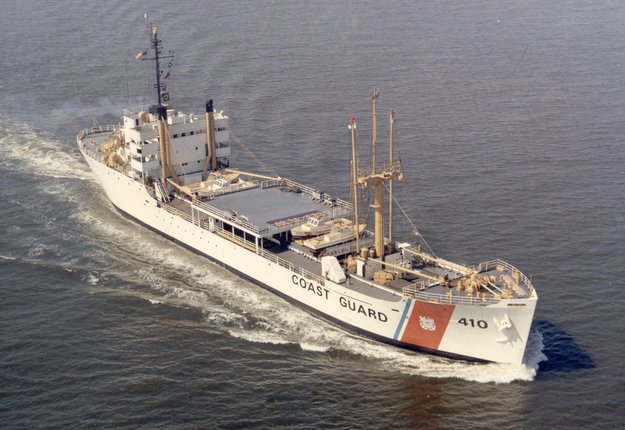
Coldwar Radio: When the VOA was an offshore broadcaster

Photo courtesy of former Courier crewman David M. Newell. Source: US Coast Guard

Photo courtesy of former Courier crewman David M. Newell. Source: US Coast Guard

(Source: VOA News)

In 1952, amidst the Cold War, a 338-foot Coast Guard Cutter was transformed into the mobile broadcasting base of the Voice of America. Its mission for more than a decade: send information beyond the Iron Curtain to counter Soviet propaganda in more than a dozen native languages. Daniela Schrier reports from an exhibit honoring the veterans and broadcasters who served aboard the ship in the waters off of Rhodes, Greece.


Click here to watch the video if the embedded player above is not visible.