Category Archives: Nostalgia

German radio museum sheds light on the WWII era Zeesen transmitting station

Many thanks to SWLing Post contributor, Jonathan Marks, who shares the following article and notes in response to our previous post regarding WWII German broadcasts into Australia. Jonathan writes:

[F]ound the attached on a German radio history site. Zeesen was well heard around the world, especially once the power was boosted to 50kW. Bearing in mind the broadcast bands were much quieter, I would expect signals to be heard in Australia/NZ.

The following article is a machine translation into English. Click here to read the full, original piece at Radio-Museum.de.


Shortwave transmitter Zeesen

Zeesen was an independent municipality until 2003, today it is a district of Königs Wusterhausen. In 1927, the German “shortwave transmitter”, the “Weltrundfunksender Zeesen”, was inaugurated in Zeesen. It was in operation until 1945. Then the facilities were dismantled by the Russians and the broadcasting houses were blown up.

Source: FunkAmateur 4/94; pp. 268-270)

From the history of German shortwave broadcasting: The “World Radio Station” Zeesen

GERHARD DAMM – DL1RWD

From 1929 to 1945, one of the most powerful shortwave radio stations of the time worked in Zeesen, on the southeastern outskirts of Berlin. Our article informs you about the prehistory, technical equipment and development of this “wide-range radio station” as well as about its political significance.

The official opening of the shortwave broadcasting service in Germany in 1929 was preceded by numerous activities to explore the usefulness of shortwaves for international operations.
This exploration also included the work of individual internationally renowned scientists, but also that of radio amateurs, primarily from the USA. The industry, including national postal administrations, including the German one, only showed interest in the use of shortwaves after their usefulness began to emerge as a result of the above-00 investigations. Until then, frequencies in the long and medium wave range were used. Fortunately for the radio amateurs, who had been granted the “useless” short waves. Who knows whether there would otherwise be shortwave amateur radio today and thus worldwide radio traffic.

Marconi conducted his first experiments with directional shortwaves in 1916, followed by Franklin in England, who experimented with shortwave voice transmissions in 1919. On the part of the radio amateurs, it was the Americans whose broadcasts were first received in Europe on 8 December 1921. Leon Deloy, a French radio amateur, bridged the Atlantic from Europe to the USA in 1923. And this without a “radio weather forecast”.

And as is so often the case in the history of technical inventions and developments, chance helped those involved to get started. On the occasion of the opening of a commercial radio station in Argentina, the reception of the German long-wave transmitter in Nauen failed due to strong atmospheric interference. A Telefunken engineer involved referred to the fact of the success of American radio amateurs in the use of shortwave. It may sound strange, but these events prompted telefunken to develop a shortwave transmitter and put it into operation in Nauen. With 800 W RF power, telegraphy connections with South America ran from July 1924.
These and other successes prompted the then Deutsche Reichspost. to deal with targeted experiments on the application of shortwaves to the broadcasting service. You have to know about that. that other European countries. e.B. in Englandthe BBC, in the mid-20s had begun with the trial broadcasting of radio programs in the shortwave range. Shortwave broadcasting therefore became not only a technical but also a national prestige issue.

From the location Königs Wusterhausen, which was previously used for radio broadcasts – the official opening of the German radio took place on 15 October 1923, the Deutschlandsender began its operation on 11 August 1925 on from 1 September 1926 radio broadcasts on shortwave.

The transmitter, built by Telefunken. radiated its power of 250 W via a simple oblique wire antenna. which was integrated into the existing antenna support masts.
Originally planned. on the then already existing central tower (popularly: the thickness) additionally put on a vertical spotlight. However, this ultimately failed due to political conditions. In the wake of the First World War, Germany was prohibited, among other things, from erecting buildings that would have exceeded the height of the Eiffel Tower. And this would have been the case in Königs Wusterhausen.

Partial view of the first KW antenna star with 70 m towers.On the far left, the 70 m wooden tower with the KW omnidirectional radiator, in the middle a 210 m mast for LW (1934)

The radio transmitter in Königs Wusterhausen was no longer expandable at that time, already the Deutschlandsender 11 (LW) had gone into operation in 1927 on the site of the aviation company SchütteLanz (airship construction and airfield) in Zeesen acquired by the Reichspost. In 1928, for example, the Reichspost commissioned the construction of a high-power shortwave transmitter on this airfield in Zeesen. The contract was awarded to Telefunken.

Telefunken built the first KW transmitter in House 4 (Houses 1 to 3 were located in Königs Wusterhausen) at the location of Deutschlandsenders 11. The power of this KW transmitter was quite respectable for those times, it was 5 kW, later 8 kW. The transmitter was built in seven stages and consisted of the crystal oscillator, followed by amplifier and multiplier stages. The power amplifier contained an RS 225 in the 5 kW version and two RS 225 in the 8 kW version, which were operated with an anode voltage of 10 kV. The modulation took place in the driver stage. The antenna part was designed for the frequency range from 3 to 20 MHz and was used to adapt the modest, 75 m long single-wire vertical antenna, which led to one of the two 210 m masts for the Deutschlandsender.

Ten machine sets (plus ten as a reserve) were required for the entire power supply of the KW transmitter. These consisted of high-voltage converters and DC generators. e.B. for heating. The end tubes were pressure-cooled with rainwater. After the official commissioning, the transmitter initially operated on two frequencies: 6.02 and 9.56 MHz. Higher frequencies were not released for broadcasting until 1932.

The wide range of the station at that time, which was in no way inferior to the stations Eindhoven (Netherlands) and Schenectady (USA), led to the naming “World Broadcasting Station” or World Broadcasting “Short Wave Transmitter” at the opening on August 26, 1929. In 1930, the antenna system underwent significant improvements. The construction of a 70 m high wooden tower(!) complemented the vertical wire spotlight. Quadruple dipoles in four directions were placed around the tower. This dipole combination achieved a favourable vertical opening angle and an elevation angle of 10′. The antenna gain is said to have been 9 dB.

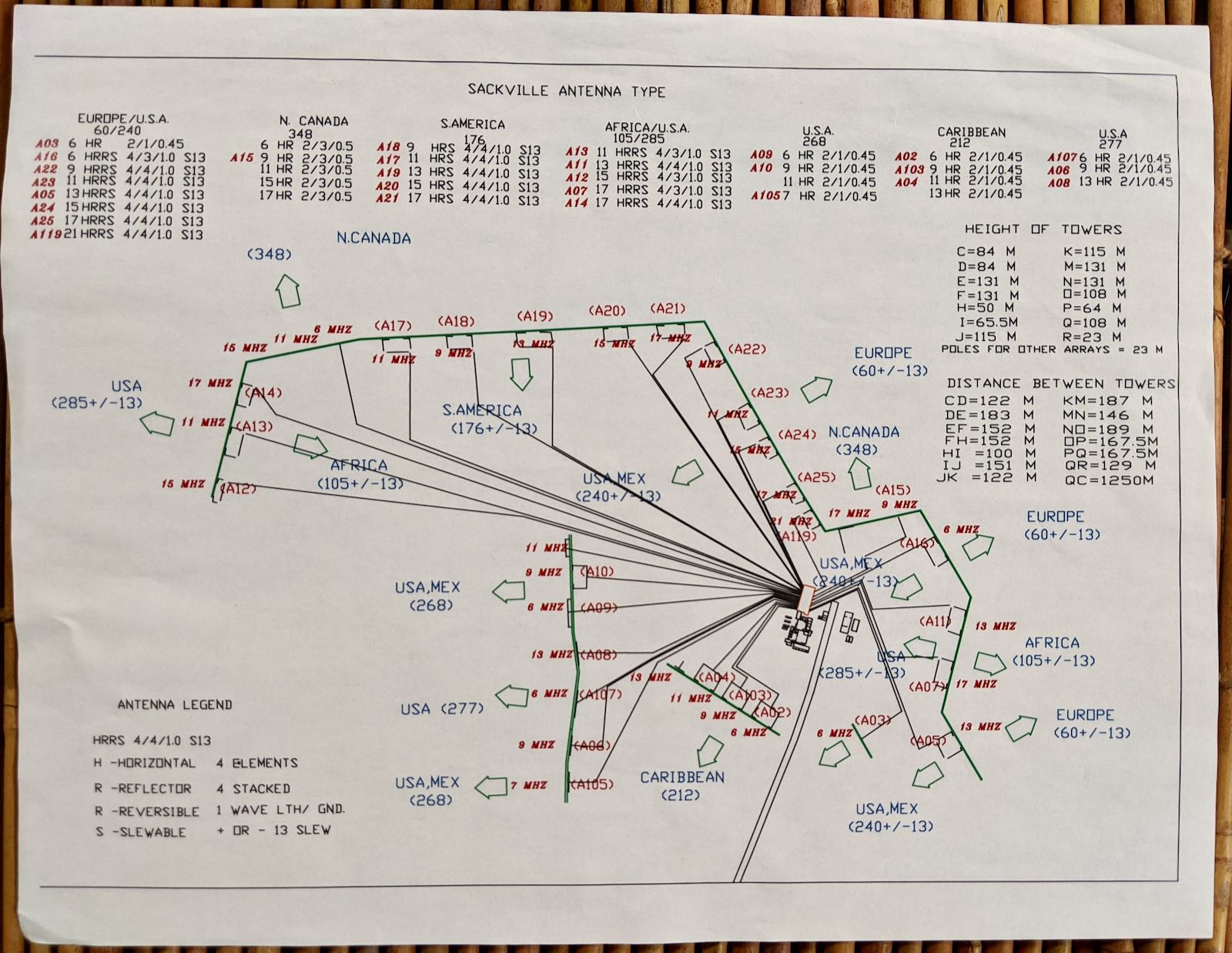
The first directional antenna, commissioned for North America in January 1932, achieved a horizontal bundling of 30′. The performance gain was just under 17 dB! It consisted of a group of 24 dipoles plus reflectors. By 1934, ten such directional antennas had been attached to eleven steel lattice towers, each with a height of 70. They supplied the areas of North, Central and South America, East Asia and Africa in the frequency range from 6 to 17 MHz.

A second quartz-controlled transmitter with 5 kW was added in 1932. It was designed in eight stages, used two RS 255 tubes and was modulated like transmitter 1 with direct current.

While the stations had previously broadcast state programs of other stations, from 1933 a separate programming was carried out by the then Reichsrundfunkgesellschaft. It was specially intended for listeners abroad and was fully dedicated to the socio-political situation in Germany.

What a miracle that this also led to the further equipment of the transmitter in Zeesen. In 1935, another KW transmitter of the type “Nauen” (50 kW) with a telephony power of 12 kW began its operation. This transmitter worked in the power amplifier with two RS 257 switched in push-pull, a further development of the previously used RS 225.

As a special feature, it had a double equipment with oscillating circuits (variometers), which had to be retuned during frequency changes. Pre-tuning significantly reduced the frequency changeover period.

The switching between day and night frequencies as well as other frequency changes suitable for the most favorable propagation were already carried out on the basis of forecasts of the Reichspostzentralamt.

The broadcasting station in Zeesen experienced a special technical upswing in preparation for the 1936 Olympic Games in Berlin. In addition to the existing transmitter house 4, houses 5 and 6 were built. Among other things, they consisted of a 500 m 2 transmitter hall, which could accommodate four transmitters with 40 kW of power, which Telefunken and Lorenz built. These bore the well-known name “OlympiaSender”. A combination of parallel and push-pull switching of four RS 257 transmitter tubes made the high transmission power possible, which was later increased to 50 kW. In addition, anode BModulation was applied. The transmitters were built in seven stages and allowed quartz and VFO operation.

Olympiasender” (50kW) in Zeesen (1935/36)

In addition to the expansion of the number of transmitters, an expansion of the antenna systems was necessary. A further 13 steel lattice towers were added, which, in contrast to the existing eleven 70 m towers, had a height of 100 in. This made it possible to achieve an even stronger vertical bundling by eightfold dipole stocking.

During the first years of the war, rhombus antennas were already being built in Zeesen, which had already been tried and tested in other radio services. Compared to the frequency-dependent dipoles, these are characterized by a relatively large frequency bandwidth and good radiation bundling.

In addition, the construction with wooden poles is possible because of the low installation height, which is probably also a question of materials in times of war. The construction also did not require the technical and material effort as with the already operated 70 and 100 in high steel lattice towers.

In 1939, the realization of a technical development in antenna construction, which was certainly spectacular for the time, was added. On one of the 70 m towers of antenna star 1, an extendable vertical radiator with self-tuning was installed, which enabled radiation over a wide frequency range (5 to 30 MHz) by changing its length. This antenna was called “Pope’s Finger” in insider circles, as such a construction had previously been erected at Vatican Radio.

In its last stage of expansion, the “World Broadcasting Transmitter Zeesen” consisted of the following systems: nine 50 kW shortwave transmitters, a 12 kW shortwave transmitter, a LW Transmitter with two 210 m masts, 24 dipole walls at eleven 70 m and thirteen 100 m towers, the vertical spotlight “Papstfinger”, the 70 m wooden tower with omnidirectional radiator and four rhombus antennas. Three transmitter houses, a diesel house and a network substation completed the technical equipment on this former airfield.

On April 26, 1945, the “Weltrundfunksender Zeesen” ceased its broadcasts. The operator removed important individual parts on command. The plants remained undamaged in order to be able to put them back into operation in the event of a “reconquest”, which, as is well known, did not come of anything. The Soviet troops dismantled the transmitters and antenna systems in the summer of 1945 and blew up the buildings.

After the founding of the GDR, a military KW broadcasting station began operation on part of the former broadcasting site, the part of the former location of sender house 4 for the long-wave Germany transmitter and the first KW antenna star, which is currently also being dismantled. The rest of the site was and is used economically.

In addition to this purely technical consideration of the world radio station of the Zeesen, by the way, a short political consideration should not be missing. While the shortwave broadcasting service and the establishment of the transmitter in Zeesen (there were also KWS broadcasting centers in Elmshorn near Hamburg, Ismaning near Munich and Oebisfelde west of Berlin) were first a technical and national prestige question – as I said, other countries within and outside Europe had already begun with the introduction of shortwave broadcasting for foreign broadcasts – it became more and more a worldwide propaganda instrument with the seizure of power by the National Socialists in 1933. Especially during the Second World War, this importance grew. All the belligerent states had recognized the role of foreign broadcasting. The international etheric war arose.

Before the Second World War, the main task was to bind Germans to their homeland abroad? thus the “German shortwave transmitter” developed into the so-called ranged gun in the ether”. One spoke of the “wave artillery of radio and its transmitter batteries”. The “Deutsche Kurzwellensender/ Weltrundfunksender Zeesen since 1936 world top performance in technical terms, was ideally suited for this political task. Some insiders I know even spoke of the “V 3″.
Reactions abroad ranged widely. They were enough, for example.B from Germans abroad: _’Do you know how a German feels. when in the evening greetings from home. from our dear fatherland, flooding through a German house in the African bush…” or: During the day we are in Brazil. but when the call sign of the German shortwave transmitter sounds, then we feel like in our heirnat” or: .. Through these broadcasts I have gained an indestructible faith in the new Germany and its leader … – up to: “This shortwave system represents the greatest potential propaganda weapon. that the world has ever seen…”

Despite all the jubilation for technical progress, it is important to consider. how it can be abused. In the case of the former “dreamy fishing village of Zeesen” south of Berlin in connection with Schütte-Lanz and airship and aircraft construction in the First World War, followed by the “world radio transmitter Zeesen- as a ranged gun” in the Second World War

Literature
(1) Archive of the author (information provided by former employees)(2) 50 Jahre Kurzwellen-Rundfunk, Sonderdruck 1979 [3] Wortschlacht im Äther, Morgen die ganze Welt, Deutsche Welle

Click here to read this and more articles on Radio-Museum.de.

RCA Radio Tours Map circa 1934

My friend, Maristella Feustle, recently shared this classic RCA “Radio Tours” map of North America. RCA printed this in 1934–during the Great Depression–when most people could not afford to travel. Their map encouraged families to use their radios to travel the world over the air and experience local culture & music.

As Maristella pointed out, the detail on this map is pretty darn amazing.

Click here to download a high resolution image of this RCA map.

Bob Colegrove on “The Joys and Challenges of Tuning Analog Radios”

Many thanks to SWLing Post contributor, Bob Colegrove, who recently shared this excellent article and has kindly allowed me to share it here in the the Post. Bob prefaced it by saying, “Being a retired technical writer, I started the attached article some time ago for my own amusement, but it quickly got out of hand.

“Got out of hand” in a very good way, Bob!

An excerpt from Bob’s article.

I love how this piece takes us through receiver history and explains, in detail, the mechanics and innovations. It’s also a very accessible piece that both the beginner and seasoned radio enthusiast can appreciate.

But don’t take my word for it, download it and enjoy!

Click here to download The Joys and Challenges of Tuning Analog Radios as a PDF.

Thank you again, Bob. This is a most enjoyable and informative read! This was obviously a labor of love. Thanks for sharing it with our radio community!

Relighting an authentic Apollo DSKY screen

Many thanks to SWLing Post contributor, Dave (N9EWO), who writes:

A current YouTube Video I accidentally came across. Ever wonder about those digital displays used in the Apollo space missions ? What were they ? Actually it’s quite a story how these Raytheon displays were developed. One has to remember we are talking about the mid 1960’s here and before the days of LED’s. Reminds me of the electro luminance nightlights still sold today.

Click here to view on YouTube.

Many thanks for sharing this, Dave. Being a massive fan of all things Apollo era, I love the deep dive into this crucial, yet very basic computer. The screen looks (and sounds!) amazing.

Radio Waves: 20K Hz & The Buzzer, Cuba Jamming, Rugby Radio Station soon a school, HRO Opens a store in FL, Police Use Morse, Tool Box Spy Radio, and “Einstein Listened”

Radio Waves:  Stories Making Waves in the World of Radio

Because I keep my ear to the waves, as well as receive many tips from others who do the same, I find myself privy to radio-related stories that might interest SWLing Post readers.  To that end: Welcome to the SWLing Post’s Radio Waves, a collection of links to interesting stories making waves in the world of radio. Enjoy!

Many thanks to SWLing Post contributors Paul, David Goren, Pete Polanyk, Ulis Fleming, Troy Riedel, Tracy Wood, Dan Robinson, and Kris Partridge for the following tips:


The Buzzer (Twenty Thousand Hertz podcast)

This episode was written and produced by Olivia Rosenman.

Since World War I, countries around the world have been broadcasting mysterious numerical messages via shortwave radio. Though concrete evidence is hard to come by, the general consensus is that these coded messages are meant for undercover agents operating abroad. And one particular Russian station may have an even more sinister purpose. Featuring computer engineer Andrus Aaslaid, historian Maris Goldmanis, and documentary photographer Lewis Bush.

Cuba Jamming Ham Radio? Listen For Yourself (IEEE Spectrum)

A public SDR network triangulates the island as the source of mystery signals

By Stephen Cass

As anti-government protests spilled onto the streets in Cuba on July 11, something strange was happening on the airwaves. Amateur radio operators in the United States found that suddenly parts of the popular 40-meter band were being swamped with grating signals. Florida operators reported the signals were loudest there, enough to make communication with hams in Cuba impossible. Other operators in South America, Africa, and Europe also reported hearing the signal, and triangulation software that anyone with a web browser can try placed the source of the signals as emanating from Cuba.

Cuba has a long history of interfering with broadcast signals, with several commercial radio stations in Florida allowed to operate at higher than normal power levels to combat jamming. But these new mystery signals appeared to be intentionally targeting amateur radio transmissions. A few hours after the protest broke out on the 11th, ham Alex Valladares (W7HU) says he was speaking with a Cuban operator on 7.130 megahertz in the 40-meter band, when their conversation was suddenly overwhelmed with interference. “We moved to 7170, and they jam the frequency there,” he says. Valladares gave up for the night, but the following morning, he says, “I realize that they didn’t turn off those jammers. [Then] we went to [7]140 the next day and they put jamming in there.”[]

New school at home of former radio station on track for autumn launch (Coventry Telegraph)

Houlton School, where Rugby Radio Station once stood, is set take its first influx of pupils in September

Plans for a new school at the historic former home of Rugby Radio Station are being fine-tuned and remain on track for a September start.

Houlton School, which will be named after the town in America that received the first transatlantic voice broadcast from Rugby Radio Station in 1927, will take its first influx of 180 Year 7 pupils this autumn.

The school, which forms part of the 6,200-home urban extension in Houlton, east of Rugby town centre, will take a new year group of 180 pupils every 12 months.

Michael McCulley, the school’s Principal Designate, said: “Whilst building a fantastic £39m new school during three lockdowns has had its challenges, we are also acutely aware that we have had a completely blank page from which to develop our exciting curriculum and pastoral programme.

“This freedom has been important as we have needed to evolve to the changing needs of our first group of students.[]

Ham Radio Outlet to open store in Florida (Amateur Radio Newsline)

Ham Radio Outlet, the nationwide amateur radio retailer in the US, has announced that its ongoing expansion plans will include a store in the state of Florida. The new store will join 12 already open in such states as California in the West, where the company is based, to Delaware in the East, Arizona and Texas in the South, New Hampshire in the North. The company’s announcement on social media set off a wave of speculation about the new location, especially on Instagram where the company wrote, “We’re not telling yet! We’re open to suggestions.” The closest Ham Radio Outlet to Florida is in Atlanta, Georgia. The company, which calls itself the world’s largest supplier of amateur radio equipment, is also known for shipping internationally.

Old is gold: In times of satellite & internet, Pune cops keep Morse Code in use as a robust stand-by communication mode (The Indian Express)

Every Sunday, an operator with Pune Police’s wireless wing sends a Morse Code message to the office of the Director General of Police, Maharashtra.

IN THE era of satellite communication, which involves transmitting signals into space and back, and internet based systems transferring gigabytes of data in a flash, police have kept alive the age-old system of Morse Code – a primitive method of sending messages in the form of dots and dashes.

Every Sunday, an operator with Pune Police’s wireless wing sends a Morse Code message to the office of the Director General of Police, Maharashtra. While this is their way of paying tributes to one of the earliest modes of telecommunication, it is primarily a way of maintaining a robust stand-by mode of message delivery in case all other means of communication fail.

Pune City police have recently started a series of tweets featuring the communication systems used by the police and their evolution till date. On Sunday, Pune Police Commissioner Amitabh Gupta tweeted, “As an ode to the beginning of wireless communications, the Commissioner’s Office still uses Morse Code to transmit Messages every Sunday.”[]

Antiques Roadshow: Spy radio disguised as toolbox found in garden shed worth huge sum (The Express)

ANTIQUES ROADSHOW saw a World War II spy radio which was disguised as a toolbox fetch a huge valuation when it travelled to Kenilworth Castle.

Antiques Roadshow’s expert Mark Smith marvelled at the ingenuity of a spy radio which was used in World War Two in a recent episode. The item, from the outside, was made to look like a toolbox but when opened, displayed a detailed radio which could be “powered by any source”. So how much was it worth? Mark put a £10,000 to £15,000 price tag on it.[]

Einstein Listened (WNYC)

Former WNYC director Seymour N. Siegel suggested that WNYC once received fan mail from Einstein. As I continue to look far and wide for evidence of this alleged bit of praise, I can’t help but wonder, what broadcast prompted the great man to write? Alas, so far, the document has eluded me. But, we do know that the father of the theory of relativity was a subscriber to both the WNYC and WQXR program guides. And we have no less than Erwin Panofsky, the noted German-American art historian and friend of Einstein’s, to thank for that.

It all began when the distinguished gang at the Institute for Advanced Study in Princeton, New Jersey decided to chip in and build the Nobel laureate a “high-fidelity” radio for his 70th birthday. The 1949 gift included subscriptions to the WNYC, WQXR, and WABF program guides.[]


Do you enjoy the SWLing Post?

Please consider supporting us via Patreon or our Coffee Fund!

Your support makes articles like this one possible. Thank you!

Santiago spots a Soviet-era portable in “The Queen’s Gambit”

Many thanks to SWLing Post contributor, Santiago Roland (CX1DR), who writes:

Hi Thomas, I’m a reader of your blog since 2015 and i was looking for movies showing shortwave radio models. I ended up in your blog again, lol, and decided to write to you and tell you that your blog is awesome. I read it many times and gathered lots of information about different topics.

The other day I was watching the last chapter of the Netflix Series Queen’s Gambit and I spotted an old classic, the Soviet VEF 206 shortwave radio. It gets a full frame cameo and it is beautiful.

The radio appears in the scene because (no spoilers) the American girl is playing chess with the world champion in the USSR and the people outside is listening the match with this radio. I send you the caption so you may add it to your collection of radios in cinema.

Oh wow! Thank you for sharing this, Santiago! That screen shot is beautiful–the Soviet VEF 206 has some serious nostalgic appeal!

We’ll add this to our ever-growing archive of radios in movies. Thank you!

Radio Cameos in Japanese Cinema

Many thanks to SWLing Post contributor, Jon, who writes:

Good day,

I regularly visit the SWLing Post and very much appreciate the breadth of content you provide on the shortwave hobby. In between the receiver reviews and stories on broadcaster activities, I much enjoy the pieces showing the radio gear that folks notice in television/films. Over the course of the COVID19 pandemic, I have been watching a lot of films from Japan, and in the process have spotted quite a few interesting receivers here and there. Below are some photos and details on some of these unsung stars of Japanese cinema. I think that JRC enthusiast Dan Robinson will agree with me that it’s the ensemble cast of JRCs in Virus that steal the show! 🙂

1. Masahiro Shinoda’s 1961 Epitaph to My Love opened with a very nice shot of a Sony TR-812 multi-band portable in a scene where a news broadcast is being heard in a bar setting.

https://www.radiomuseum.org/r/sony_tr_812_tr812.html

2. A Sony AFM-152J is shown in a contemporary home setting in Hiroshi Teshigahara’s 1966 film The Face of Another.

https://www.radiomuseum.org/r/sony_fmam_automatic_tuning_radio_esaki_diode_afm_152j.html

3. Kihachi Okamoto’s 1978 sci-fi film Blue Christmas featured a brief shot of a Sony ICF-7600 – the first of a legendary line of Sony portables that would carry “7600” in their designation.

https://www.radiomuseum.org/r/sony_icf_7600.html

4. There were several radio appearances in Kinji Fukasaku’s 1980 Virus – a film that took disaster movies to a new level by depicting both a global pandemic and a nuclear holocaust.

A range of JRC gear was captured in a scene that was set in a Japanese Antarctic base. Identifiable rigs include the NRD-10 and the NRD-71.

https://www.radiomuseum.org/r/jrc_nrd_10nrd1.html
https://www.rigpix.com/jrc/jrc_nrd71.htm

In another scene from the Antarctic base, a Trio (Kenwood) TS-820S is shown powered up.

https://www.radiomuseum.org/r/trio_kenwo_ts_820s_ts820s.html

5. Lastly, we have an unidentified tube receiver from Masahiro Shinoda’s Childhood Days – an interesting 1990 film about a school aged boy in World War II era Japan who, because of the bombing threat, is sent from his Tokyo home to live in a rural village.


Thank you for sharing this, Jon! It’s wonderful to include radio sightings from Japanese cinema in our ever-growing collection of radios in movies!