Category Archives: Radio History

Amanda Dawn Christie’s Book on the Radio Canada International Antennas

Many thanks to SWLing Post contributor, Richard Langley, who writes:


Amanda Dawn Christie’s Book on the Radio Canada International Antennas

Amanda Dawn Christie together with Thaddeus Holownia and Radio Canada International has authored a 96-page bilingual book titled “Ghost Stations = Stations Fantômes” a catalogue of an exhibition in the Upper Gallery at 50 Sussex Drive, Ottawa, home of the Royal Canadian Academy of Arts, in March and April 2022. Amanda’s film and a shortwave radio simulcast were featured during the exhibition. From the preface of the book:

“Ghost Stations was an exhibition about the remarkable — and now-demolished — shortwave antenna array on the Tantramar Marshes in Sackville, New Brunswick that Radio Canada International (RCI) used to transmit programming internationally from 1945 until 2012.”

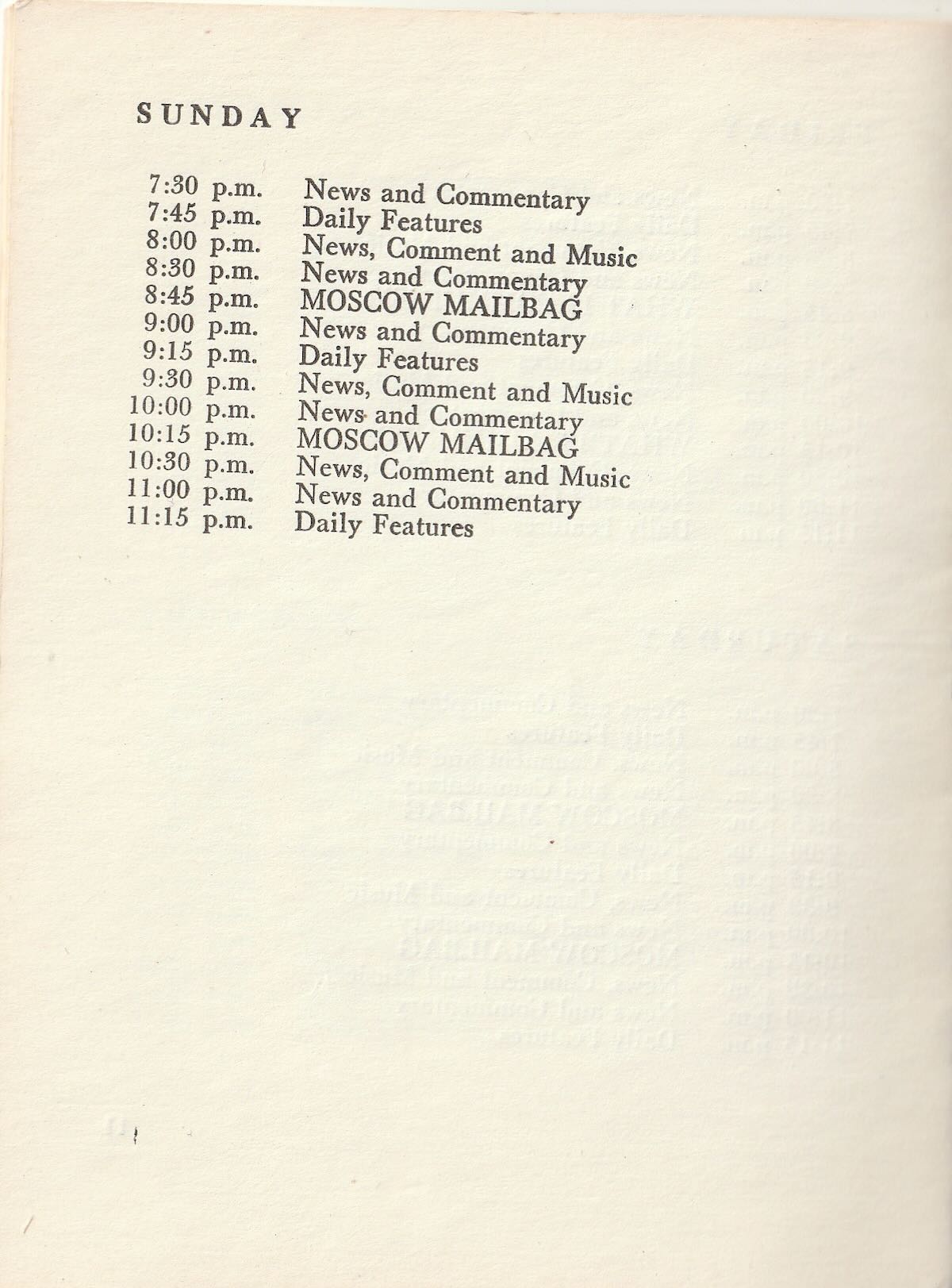
This is a true hard-cover art book with exquisite page display, typography, and binding and comes with a slip cover. Lots of great photographs and two extended essays: “Photography, Film, and Electricity” and “Radio Canada International’s Modern Spirit.” The end-pieces of the book feature images of a CBC Radio-Canada International Service QSL card.

A limited number of copies of the book are available from the Royal Canadian Academy of Arts:

Price List

Pick-up in Ottawa (no shipping)
CAD $50.85

Shipping anywhere in Canada
CAD $70.85

Shipping anywhere in US
$70.00 (U.S. Dollars)

Shipping Outside of USA/CANADA
CAD $85.00

How to Pay:

Through cheque
Send a cheque through the post:
Payable to the RCA
50 Sussex Dr
Ottawa, ON
Canada
K1M 2C9

Online
Pay through paypal link:
Follow the link paypal.me/RCAARC

Don Moore’s Photo Album: Costa Rica (Part Two)

Many thanks to SWLing Post contributor, Don Moore–noted author, traveler, and DXer–for the latest installment of his Photo Album guest post series:


Don Moore’s Photo Album: Costa Rica (Part Two)

by Don Moore

It’s been three months since the last time I put together one of these pieces because I was busy finishing my book, Tales of a Vagabond DXer [Note: SWLing Post Amazon affiliate link]. You may have seen the announcement about it here a few weeks ago. This series should appear more regularly in 2024 as I plan to concentrate on small writing projects for a while!

Back in August, we looked at five Costa Rican shortwave stations that I visited in 1990. This time I’m going to feature just one station, but a station with a very interesting story. My book has an updated and rewritten version of the article I wrote about it for Monitoring Times magazine in the early 1990s. But the book doesn’t have many photos as adding those significantly increases the price. So, here are the pictures and a little bit about the station.

This seven-and-a-half-watt transmitter was the first transmitter for TI4NRH, the first shortwave broadcast station in Latin America. It was built by Amando Céspedes Marín in Heredia, Costa Rica in 1928. Don Amando operated a small medium wave station and hoped that by using shortwave he could reach listeners in all of Costa Rica. Instead, he gained an audience all around the world. His little TI4NRH became one of the most popular radio stations for shortwave listeners throughout the 1930s until he shut it down at the beginning of World War Two. This portrait of Don Amando was made around that time.

I remembered reading about TI4NRH in an old-timer’s article, so while I was in Costa Rica I went to Heredia hoping to find someone who could tell me where the station had operated from. I wanted to get a picture of the building. Instead, I found that everything was still there in the dimly lit backroom of the family house. (The pictures are grainy as the room was very dark.) Don Amando had passed away in 1976 but his never-married daughter, Lydylia, still lived there and treated the room as a shrine to her departed father.

The Céspedes family house was on a side street a few blocks south of the main plaza in Heredia. The radio station was located in the middle section, behind the white door.

Plaque on the front door commemorating the building as the birthplace of radio in Costa Rica.

Financial support from listeners helped TI4NRH buy new transmitters and raise power. This 300-watt transmitter was the last one used.

Radio amateurs in the USA and Canada raised money to buy and ship this antenna tower to TI4NRH in the late 1930s.

Nothing was removed after the station closed down but the space became a storage room for the family. This is how it looked in June 1990.

The bottom of that original 7 ½ watt transmitter. Unfortunately, the photo came out very dark in the dimly lit room.

The walls were covered with yellowing 1930s amateur radio QSL cards.

This letter written by Arthur Kopf, an American working in the Panama Canal Zone, was the first report received by TI4NRH. That made it the first reception report ever written to a Latin American shortwave broadcast station.

Don Amando’s daughter Lydylia was the guardian of her father’s legacy.

A view showing the house and neighboring antenna tower.

TI4NRH was only a hobby for Don Amando. He made a living by operating a print shop and photography studio. With financial support from the Zenith Corporation, he published a monthly radio magazine (primarily in Spanish) for several years in the 1930s.

In 1928, Philadelphia DXer Charles Schroeder became the first North American DXer to log a Latin American SWBC station when he heard TI4NRH. He not only got a QSL for his reception, TI4NRH sent him a beautiful chair made out of Costa Rican tropical hard woods. The chair was sent in pieces with instructions for assembly and arrived in just twelve days. Mr. Schroeder passed away in 1956, but in 2005 I heard from Schroeder’s daughter, who still had the chair. She sent these photos.

Finding TI4NRH was like finding an unknown time capsule. It was one of the biggest highlights of both my DX career and my travels. And I always hoped to return. In the late 1990s I learned that Lydylia had passed away and that one of her nephews had moved into the house. Sometime around 2010 the antenna tower had become unsafe so the family had it torn down and sold for scrap. However, other than donating a few items to the city museum (something Lydylia had refused to do), the family continued to hold on to Don Amando’s legacy. In 2017, a group of Costa Rican radio amateurs visited the house and published their photos, which were much better than my old ones.

I would like to say that everything is still there for the next visiting DXers to see. But in looking for links to include in this piece I came across some very sad news. The house was demolished in July 2021. Apparently the next generation of the family (Don Amando’s great-grandchildren) had no interest in maintaining the old house and Costa Rica doesn’t have a good program to preserve historical sites. So the city of Heredia had the house torn down. The news article I found (which was very critical of the destruction) didn’t even know what had happened to the station memorabilia that had been in the house. So, unfortunately, this story does not have a happy ending.

LINKS

To see the exact location of where TI4NRH was, open Google Maps and search for the following coordinates: 9.995550958984419, -84.11618361000325 then switch from map view to satellite view.

The main house was where the shiny tin roof is today (2024). Just to the right is another building with a red roof. That is where the wing with the station and the antenna tower were.

New Series About Gibraltar Broadcasting History

An aerial view of Gibraltar. Photo by Adam Cli.

Many thanks to SWLing Post contributor, Tracy Wood, who writes about a new series featuring Gibraltar’s broadcasting history. Tracy writes:

Edition #1 launched last night celebrating 60 years of the founding of GBC.

The series’ title holds special meaning…

“Recordándote” was the name of GBC’s cross-border radio show sending family messages during the era when Franco had closed “la frontera” between Spain and Gibraltar.

https://www.gbc.gi/tv/programmes/recordandote-gbc-story-1533

Tracy

Thank you, Tracy!

“100 years of radio in South Africa – and still going strong”

Many thanks to SWLing Post contributor, John Green (ZS1JHG), who shares the following article from Tech Central:

100 years of radio in South Africa – and still going strong

Radio in South Africa turns 100 years old today. But advances in technology mean the medium is not standing still.

Today – Monday, 18 December 2023 – marks 100 years since radio was introduced in South Africa, with the first experimental broadcast going out from Railway Headquarters in Johannesburg on 18 December 1923.

Radio broadcasting began under the auspices of South African Railways, followed by the licensing of three more services: the Association of Scientific and Technical Societies in Johannesburg, the Cape Peninsular Publicity Association in Cape Town and the Durban Corporation, which began broadcasting in 1924.

These merged into the African Broadcasting Company in 1927, owned by a wealthy businessman, IW Schlesinger, but on 1 August 1936, they were sold to the SABC, established that year through an act of parliament.

The SABC took over the African Broadcasting Company’s staff and assets and maintained a state monopoly on radio until the launch in December 1979 of Capital Radio 604, and then Radio 702 in 1980.

In most of the world, reliance on the radio for communication came to an end in the 1950s and early 1960s with the advent of television – but in South Africa, where television broadcasting was not adopted until 1976 because the Nationalist government of the time considered it a threat to Afrikaner culture, reliance on radio lasted nearly two decades longer. This meant that South African programming could take advantage of the newest technological and production advances.

SABC stations included the English and Afrikaans language channels – eventually becoming SAfm and Radio Sonder Grense (RSG), respectively. Programming included news, plays and British content, and in 1950, the SABC launched Springbok Radio as a commercial, for-profit but still state-owned service. [Continue reading…]

Back When You Had to Pay: Radio Receiving Licences in Canada

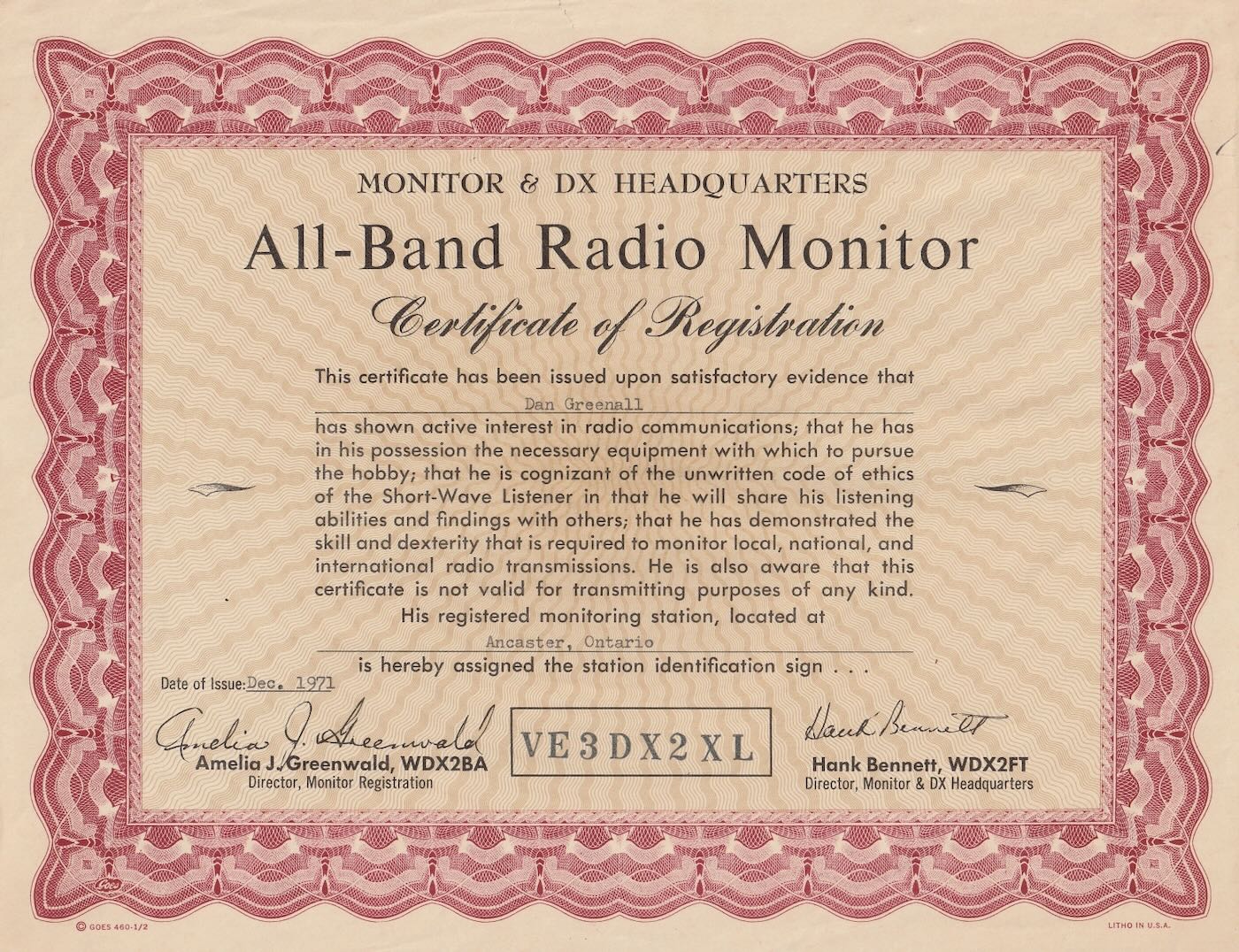
Many thanks to SWLing Post and SRAA contributor, Dan Greenall, who shares the following guest post:


THE DAY YOU HAD TO PAY: Radio Receiving Licences in Canada

by Dan Greenall

MANY of us who are licensed [Canadian] amateurs can appreciate the fact that we are no longer subject to an annual licence renewal fee. As of April 1, 2000, that practice was discontinued by Industry Canada as a new streamlined authorization procedure was put in place for the amateur radio service. This came as a pleasant surprise to many who were paying $24 per annum per licence up until that point.

What many of us may not realize is that, prior to 1953, Canada had a licensing system in place for your radio receiver. Under the Radiotelegraph Act of 1913, a government minister (for most of this period, the Minister of Marine and Fisheries) had the power to license radio broadcasting stations and to charge a $1 licence fee on each receiving set. By 1929 three hundred thousand licenses were bought at $1.00 each.

An article appearing on the Friends of Canadian Broad- casting website a few years ago stated that the annual licence fee for receiving sets doubled to $2.00 in 1930. It was also noted that this was a lot of money during the Depression days that followed and two bucks could buy more than 40 loaves of bread. As a result, so the story goes, “harassed citizens” would try to outwit approaching government collectors by passing word along in time for their neighbours to shut off their radios and lock their doors.

During much of this period, radios that were made in Canada bore a “Warning” sticker such as the one in the accompanying photo. It stated that anyone convicted of operating the receiving set without first having obtained the proper licence could be liable to be fined for up to $25 and have their equipment confiscated. As noted in the book Radios of Canada by Lloyd Swackhammer, the penalty in 1924 was $50.

As you can see from the attached copies, such licences were being issued by the Department of Marine Radio Branch in 1936. In 1937, it was the responsibility of the Department of Transport – Radio Division.

Then in 1938, the DOT upped the fee to $2.50. It was another 15 years until this practice was finally abandoned.

So the next time you sit back and flip on the switch of your receiver, you might now have a greater appreciation of a privilege that most of us now take for granted.

Radio Waves: WWFD All Digital, End of CBC Long Dash, HD Aviation Interference, NC Broadcast History Museum Plans, and Ukrainian Radio Resistant to Jamming

Radio Waves:  Stories Making Waves in the World of Radio

Welcome to the SWLing Post’s Radio Waves, a collection of links to interesting stories making waves in the world of radio. Enjoy!

Many thanks to SWLing Post contributors Dennis Dura, Mark Koskinen, Stuart Smolkin, and Ron Chester for the following tips:


AM Digital WWFD Concludes Its Test Phase (Radio World)

The Hubbard station now is a full-time, all-digital operation

WWFD in Frederick, Md., has concluded the experimental phase of its MA3 HD Radio operation. It has notified the FCC that after five years, it will now continue to operate as a full-time all-digital AM station as is allowed under commission rules.

Dave Kolesar at a meeting of SBE Chapter 37 in Wheaton, Md.
The Hubbard-owned facility was the first AM station in the United States to convert to the MA3 mode, doing so under experimental authority in 2018.

Dave Kolesar, the engineer and program director who spearheaded the initiative and has given numerous presentations at engineering conferences about it, tells me that Hubbard recently asked the FCC to conclude the special temporary authority. [Continue reading…]

The end of the long dash: CBC stops broadcasting official time signal (CBC)

Segment connected Canadians, kept the country on time for over 80 years

The beginning of the long dash indicates exactly 1 o’clock eastern standard time.

For more than 80 years the beeps and tones of the National Research Council (NRC) time signal have connected Canadians at exactly 1 p.m. ET.

But as of Monday, CBC Radio One audiences won’t be listening for the beginning of the long dash — they’ll have listened to the end of it.

Variations of the daily message and the “pips” that sound along with it have played over CBC’s airwaves since Nov. 5, 1939 — forming a link that connects Canadians from coast to coast to coast.

CBC and Radio-Canada have announced they’ll no longer carry the National Research Council (NRC) time signal.

Monday marked the last time it was broadcast, ending the longest running segment on CBC Radio.  [Continue reading and listen to the report on the CBC...]

Xperi Discussing HD Radio Power Boost Proposal With Aviation Groups (Radio World)

The Aerospace Industry Association and the Air Line Pilots Association International have voiced interference concerns

Several aviation groups have recently expressed concern about the potential for interference on navigation systems if a proposal to increase power for digital FM stations in the United States is adopted. Now, HD Radio developer Xperi said it is working to address those concerns.

In comments filed with the FCC (MB Docket 22-405), the Aerospace Industries Association (AIA) and the Air Line Pilots Association International (ALPA) raised the possibility of interference between HD Radio stations at 107.9 MHz and the adjacent Aeronautical Radio Navigation Service (ARNS) band operating from 108.0 – 117.975 MHz.

The ARNS band is occupied by safety critical navigation and landing systems essential for safety of flight, according to the groups. They include Instrument Flight Rules (IFR) needed for landing during low visibility conditions at night and during inclement weather. [Continue reading…]

State Broadcast Leaders Announce Plans for Broadcast History Museum in North Carolina (Beasley Media)

State broadcast leaders have unveiled details of a North Carolina Broadcast History Museum. Details were announced during a press conference that took place on Friday, October 13th at the Governor’s Mansion in Raleigh, NC.

The museum initiative is a 501(c) 3 non-profit corporation dedicated to preserving North Carolina’s broadcasting legacy.

North Carolina has a rich broadcast history, dating back to March 1902, when radio pioneer Reginald Fessenden transmitted a 127-word voice message from his Cape Hatteras transmitter tower to Roanoke Island. Then fast forward to July 23, 1996, when WRAL-TV became the first television station in the United States to broadcast a digital television signal. The state has been and continues to be a wealth of pioneers and innovators in industry.

North Carolina has been and continues to be a wealth of pioneers and innovators in industry. The State has numerous famous broadcast personalities, including Andy Griffith (born in Mount Airy), Charles Kuralt and David Brinkley (both from Wilmington), National Sportscaster Jim Nantz (from Charlotte), and National Public Radio Newscaster Carl Kasell (from Goldsboro).

The Museum is seeking assistance from the public and people who worked in broadcasting to collect artifacts, documents, photographs and recordings that chronicle the history of prominent radio and television stations, broadcasters, programs and events. Through exhibits and collections, the Museum seeks to highlight the contributions made by North Carolina Broadcasters in shaping the industry and the state’s culture landscape.

The Museum is guided by a distinguished group of broadcast professionals that include Caroline Beasley, CEO, Beasley Media Group; Don Curtis, CEO, Curtis Media Group; Jim Goodmon, CEO, Capitol Broadcasting Co.; Wade Hargrove, media lawyer; Harold Ballard, Broadcast Engineer; Carl Venters, Jr., Broadcast Executive; David Crabtree, CEO, North

Carolina Public Media, Dr James Carson, Broadcast Executive; Jim Babb, Broadcast Executive, Cullie Tarleton, Broadcast Executive, and former member of the NC House of Representatives; Dave Lingafelt, Broadcast Executive, Carl Davis, Jr., Broadcast Engineer, Jim Heavner,

Broadcast Executive, and Mike Weeks, Broadcast Executive.

The North Carolina Broadcast History Museum web site will serve as a digital repository accessible by the public that will grow in content and importance as items are gathered and

displayed. The museum web site is under construction and currently available online at www.NCBMuseum.com. Future plans include a brick-and-mortar facility for education, inspiration and enjoyment.

For more information, please contact Michael Weeks, North Carolina Broadcast History Museum Board Trustees Chairman, at [email protected] or call 252-721-0470.

Ukraine claims to have invented a new radio that’s immune to Russian jamming (Business Insider)

Ukrainian Deputy Prime Minister Mykhailo Fedorov announced on Tuesday the launch of radio technology that “cannot” be blocked by Russian jamming.

Fedorov, who also serves as Ukraine’s Minister for Digital Transformation, wrote on Telegram that the Himera radio is “a unique technology that works despite enemy electronic warfare,” according to Ukrainska Pravda’s translation.

“The Russians cannot block the radio’s signals or decrypt it,” he said, adding: “The radio can also be integrated into a situational awareness system or used as a GPS tracker to search for and evacuate soldiers.”

Russia’s electronic warfare capabilities have long proved a thorn in Ukraine’s side, as Michael Peck previously reported for Insider.

Russia has managed to achieve “real time interception and decryption” of the Motorola walkie-talkie systems in widespread use by Ukraine, according to a May report by the Royal United Services Institute. [Continue reading…]


Do you enjoy the SWLing Post?

Please consider supporting us via Patreon or our Coffee Fund!

Your support makes articles like this one possible. Thank you!