Category Archives: Schedules

John follows Radio Australia schedule changes

SX-99-Dial

Yesterday, John Figliozzi (editor of The Worldwide Listening Guide) followed Radio Australia schedule changes as he heard them online and over the air:

“Listening in now (1415 GMT/UTC) on 12065 kHz. and via the internet, the scheduled program (up to now) “Late Night Live” is missing with alternative rock music from Triple J taking its place at this time. On the RA web page, there is a notice stating:

“Schedule update
We are in the process of updating our radio schedule. We’re introducing some new shows and some existing ones have moved to new time slots. Please stay tuned, we’ll be publishing the full new schedule soon.”

LNL is a Radio National-sourced program, so I gather this means it’s either being moved to a new time slot or (hopefully not) dropped altogether. No doubt a bit of confusion wrought by the thoroughly precipitous manner in which the ABC has had to adjust to the government budget cut that prompted that all this, a budget cut the Coalition had claimed prior to its election that it was in no way contemplating.”

Three hours later:

“At this point, it appears that Radio Australia shortwave frequencies and online is just relaying Triple J Unearthed, one of the ABC’s all digital networks, that plays new Australian music 24/7 with occasional IDs but no DJ commentary.

Then four hours later:

“A more normalized schedule appears back in place as “Pacific Beat” was heard via the RA internet stream from just past 1900 until 2100 GMT.  This is the two hour morning edition of the program which carried a very nice tribute to the “retiring” Sean Dorney, the ABC’s and RA’s Pacific correspondent, after 40 years with the organization.  There was a reminder at the end of the program for listeners to tune into the afternoon edition of the program later in the day, which if memory serves is a shortened compilation of some of the morning content.  Perhaps the earlier relay of Triple J Unearthed is just a temporary placeholder or is intended as overnight programming (Australian time)?

Listening now (2100) via shortwave.  17860 putting in a steady listenable signal peaking at S8 albeit with the usual local late afternoon QRN.  “ABC News for Radio Australia” followed by “AM”, morning news program at 2110.”

Be sure to check out John Figliozzi’s book, The Worldwide Listening Guide online–click here for my most recent review.

Thanks for sharing this, John! 

Today: Catch and record the BBC’s broadcast to the British Antarctic Survey Team

Halley VI: The British Antarctic Survey's new base (Source: BBC)

Halley VI: The British Antarctic Survey’s new base (Source: BBC)

Every year, the BBC broadcasts a special program to the 41 scientists and support staff in the British Antarctic Survey Team.

The BBC will play music requests and send special messages to the team who winter over in this isolated post. The broadcast is guaranteed to be quirky, nostalgic and certainly DX worth catching. Click here to listen to the 2013 broadcast.

The winter program will air today, June 21, 2014 at 21:30 UTC on the following frequencies:

  • 7,350 kHz; Ascension; 207°
  • 9,890 kHz; Woofferton; 182°
  • 5,985 kHz; Dhabayya; 203°
  • 5,875 kHz; Wooferton; 184° (updated)

Readers: If you have a chance, try to record the broadcast as I’m uncertain if I’ll have a chance to catch it this year. I would like a good recording for the Shortwave Radio Audio Archive.

Many thanks!

International Radio for Disaster Relief includes special QSL: June 5 – 6, 2014

HFCC-InternationalRadioForDidsasterRelief

The High Frequency Co-ordination Conference’s (HFCC) test of the International Radio for Disaster Reduction (IRDR) broadcasts are on track for June 5-6, 2014.

Many thanks to SWLing Post reader, Mehmet Burk, who has posted the updated schedule on his website, Relief Analysis.

Mehmet also shares this message from HFCC Board member, Oldrich Cip, who mentions a special QSL card that will be issued for IRDR reception reports:

“The Trial of International Radio for Disaster Relief on June 5th and 6th during the Jakarta ABU Media Summit is approaching quickly. The last updated version of the Trial programme is available in a presentation here:
http://hfcc.org/doc/HFCC_RAD_2014-004-IRDR_Jakarta_Presentation.pdf

Let me ask all organisations taking part in the Trial to check on the Trial programme schedule and ask for any changes or additions of the technical details that might be still needed. More details about the IRDR and about the Trial and its background are here:
http://hfcc.org/humanitarian/irdrtrial.phtml

The interest in the Trial created among participants indicates that it is real to set up a world-wide system of a voluntary, disaster relief shortwave radio with tools and services that are already in place. Publicity is needed to raise awareness in the world community about it – since the on-going cuts of shortwave installations might make this increasingly difficult.

Please kindly spread the word about it and encourage people to listen to the Trial programmes. Reception reports will be confirmed by special QSL cards.”

Again, check out Mehmet Burk’s IRDR updates on Relief Analysis.

Alex updates shortwave frequency charts for summer season

AlexCharts

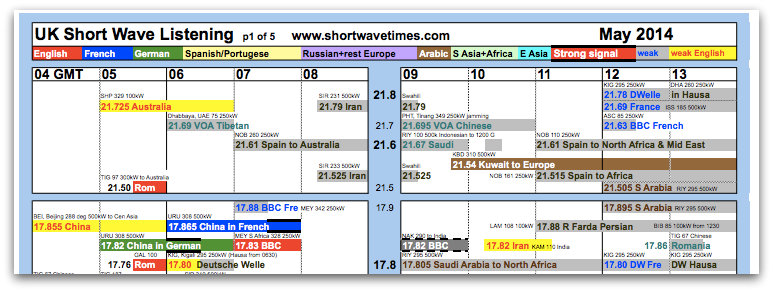
SWLing Post reader, Alex, has just informed me that he’s updated his printer-friendly shortwave frequency charts for the summer broadcasting season. Alex mentions that he posted English in Europe on one A4 sheet, plus 5 A4 sheets running through the vast majority of stations that can now be heard in Europe.

Note that Alex creates his charts based on listening to broadcasters rather than importing schedules from other sources.

You can download the free charts on his website:
Shortwavetimes.com

Many thanks, Alex!

Shortwave.am: a new online frequency guide

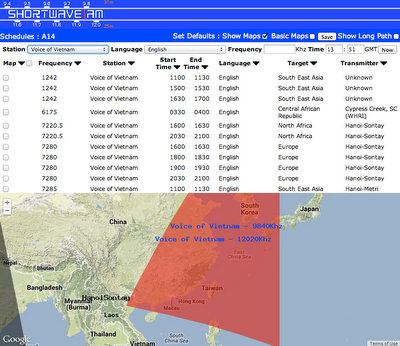
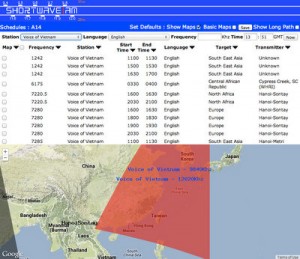
ShortwaveAMA few SWLing Post readers have recently recommended that I check out a new shortwave radio schedule site: shortwave.am.

Shortwave.am has a unique layout that lists broadcast schedules along with a map that displays broadcast footprints (both short and long path).

Fortunately, I was able to get in touch with the site developer, Stephen Cooper, who frequently comments on the SWLing Post.

Stephen kindly answered a couple of questions I posed.

My first question was why, with the number of shortwave schedule sites on the Internet, he felt motivated to create a new site.  Evidently, inspiration came from Stephen’s Android app, Shortwave Radio Schedules. He responds:

I first created the [Shortwave Radio Schedules] app to give me searchable listings on my phone which I found interfered much less with my radio than on my PC so I could turn my PC off and look at frequencies and schedules on a phone/tablet.

Since then I have just added extra features that I find useful, such as the ability to save logs including the station name, time, SINPO, a comment and a recording of the audio. I’ve used the app to then share my logs to Facebook groups, DXLD Yahoo Group etc. including the audio recordings made on the app.

The maps option I added because I had been using AOKI listings with the beam direction to try and work out favourable beam directions of broadcasts for me in the UK even if they were not targeted to Europe. I realised that it would be much easier to visualise this on a map and started looking at the Google Maps API to work out this would be possible on the app.

Once I added to the app I had noticed screenshots of the maps being posted on groups such as the Rally DX 2012 Facebook group’s and a few people who didn’t have Android asking if there was a web version. I looked into it and it wasn’t too hard to create shortwave.am after converting the Java code to PHP:and Javascript then the site was complete.”

When I asked Stephen what made his site differ from others, he responded:

“[I]t uses data from a combination of Eibi and AOKI to display the listings with maps showing the beam direction. It can also show estimate long paths of each broadcast and uses AJAX web technologies to show search results and maps without having to reload the page for each search or change of parameters.

[…]If you choose a station or language or both and click “Save” (next to the “Set Defaults” part of the site) it will set these as the default that will open each time you go to the site.

Also if you click on a transmitter it now shows all broadcasts coming from that transmitter.

[…]I am going to add some more of the features from the [Shortwave Radio Schedules] app such as the ability to add logging reports, view others reception reports from each station and the options to add recordings of a station and listen to others recordings.”

I think shortwave.am is fantastic, and I’m glad Stephen has put the time behind developing it in his spare time.

Stephen is eager to hear your comments, as he wishes to further develop the shortwave.am. Either post them here, or email Stephen directly.


Updates to the Shortwave Broadcast Schedules smart phone app

SWBC_Iphone

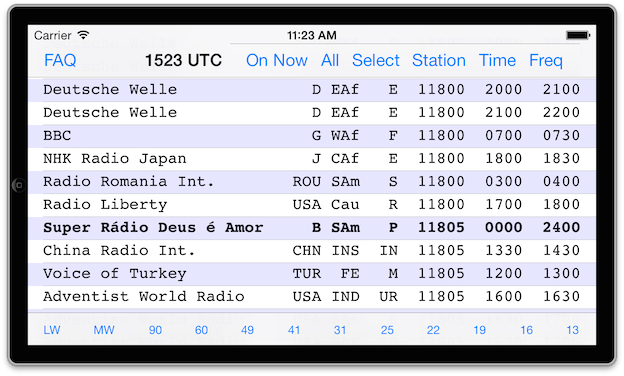
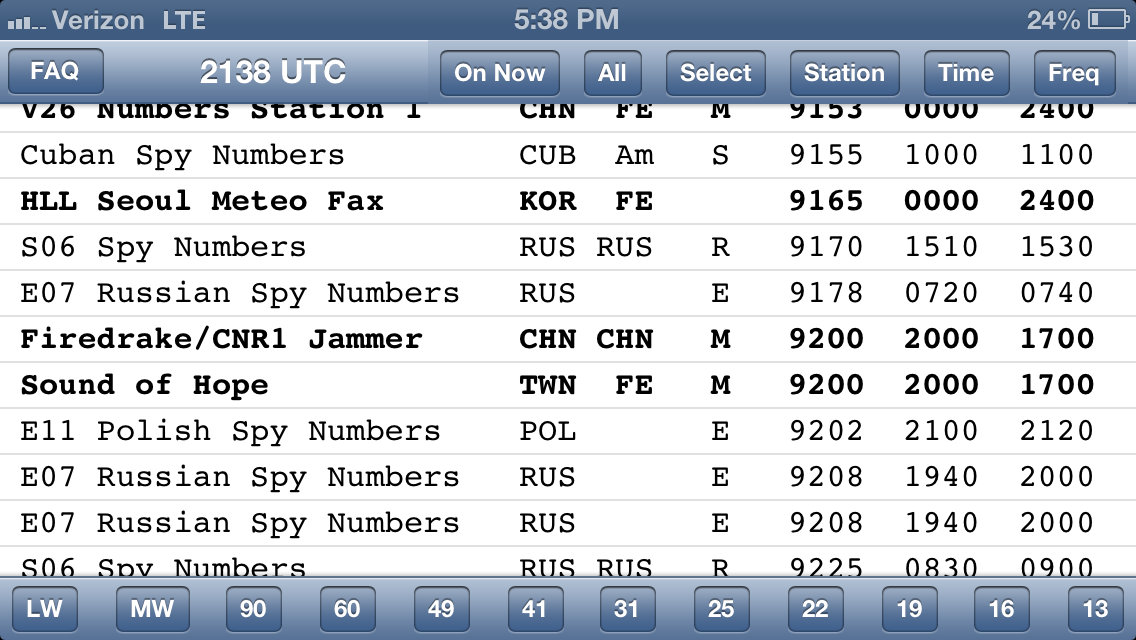
A smartphone app that I find quite useful is Shortwave Broadcast Schedules by Chris Smolinski at Black Cat Systems.

Chris has just announced an update which adds features like the ability to enable schedule reminders as well as keep track of your favorite broadcasts.

ShortwaveScheduleI’ve been using this app for a year and have noticed frequent schedule updates–indeed, A14 schedules were ready at the beginning of the season.

It’s an ideal app to use for one bag travel–indeed, you don’t even need an Internet connection to browse the listings. Admittedly, the typical smartphone screen is fairly small to display such a large amount of broadcast data, but Back Cat’s interface is designed with this in mind. I find the app easy to use and very useful while I’m on the go.

I have only used the iOS version on my iPhone. Black Cat also offers an iPad version which, I believe, would be ideal. I have not tested the Android version of the app.

Shortwave Broadcast Schedules is available on the iPhone/iPad ($2.99) and Android ($0.99) devices.

Click here to check out our comprehensive, frequently updated list of radio apps.