Shortwave listening and everything radio including reviews, broadcasting, ham radio, field operation, DXing, maker kits, travel, emergency gear, events, and more
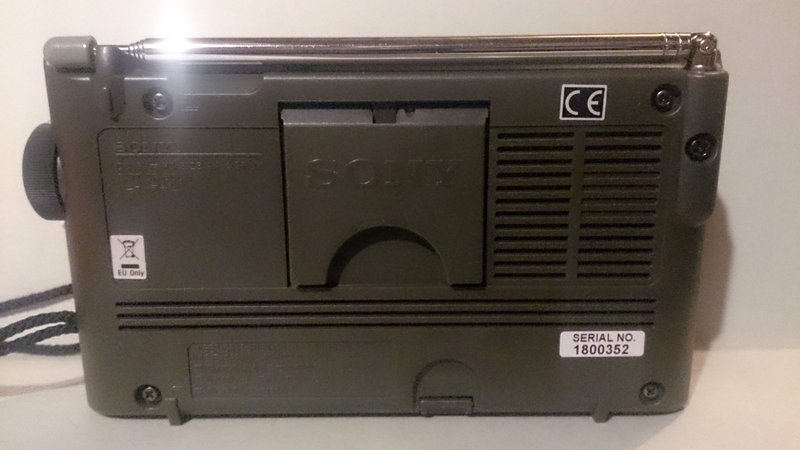
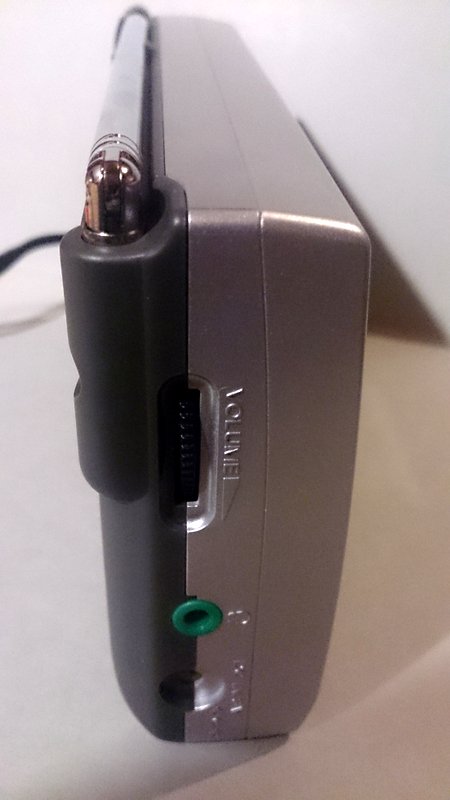
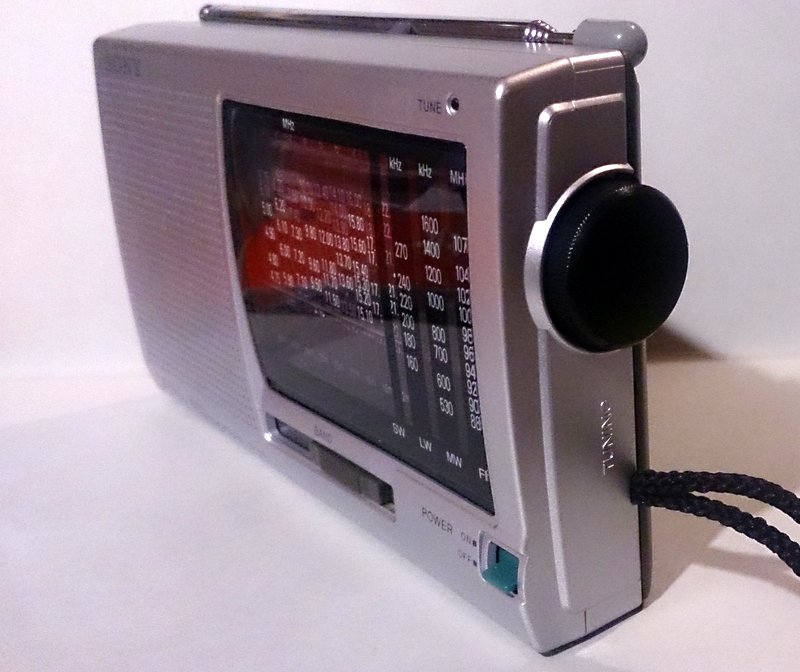
I have been using a Sony ICF-11 for 5-6 years now, still sold new at 50-70 euro. It’s analog and rather well featured: FM (stereo on earbuds), LW, AM, and 9 SW bands. It runs on 2 cheap AA batteries I get in low-cost supermarket, for sure not the best ones.
Using it at least one hour a day on the speaker, I have to change the batteries after 9-12 months. I am convinced a set of good Duracell or Energizer batteries would last some more months.
I am not a radio expert, but I am quite pleased with its audio performances, specially on LW (used most of the time ) and AM, where it is vastly superior to my Tecsun PL-660. SW looks OK for what I can say from listening quite occasionally these bands. I would be curious to see a serious review of this Sony to know how it compares with others, but I didn’t find any on the web so far (hint?). [Yes, Francis, hint taken!]
I am so pleased with this small radio that I recently bought a second one as a spare.
Thanks for your very interesting blog and reviews.
Francis
Thank you, Francis, for sharing your thoughts on the Sony ICF-SW11 and your photos as well!
It appears Amazon.com (US) has a few options for ordering a Sony ICF-SW11–click here to show search results. Prices vary between $50-$55; Amazon even has replacement telescopic whips available.
Of course, an eBay search will also uncover a number of SW11’s.
I searched the web, but couldn’t find many other retailers selling new ICF-SW11’s. It appears many of the ones on Amazon are imports from Japan.
At $50 shipped, it seems like a bargain to me, so I just pulled the trigger on one.
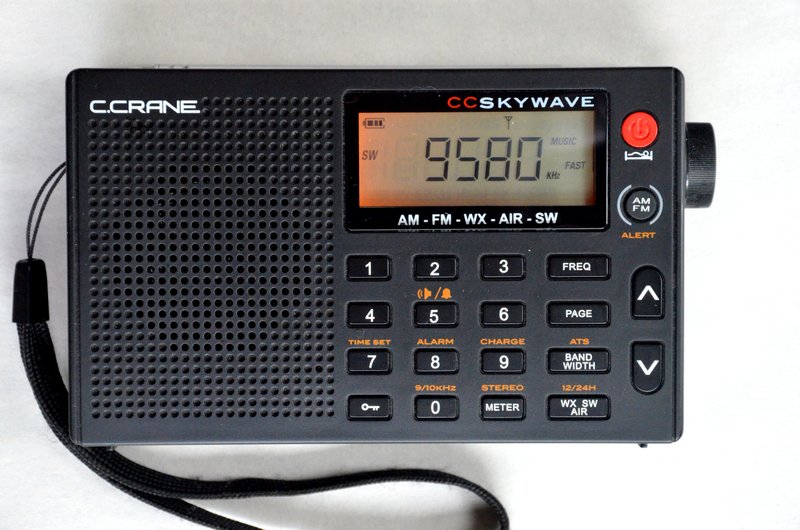
Many thanks to SWLing Post reader, Bruce Atchison, who recently shared his positive comments about the CC Skywave. Bruce writes::
This is a lot of radio for such a small size. The CC Skywave is a great travel companion because of its portability and price.
Moreover, it’s rich with features. The receiver tunes in AM and FM as well as all the shortwave bands, NOAA weather channels, and the aircraft band. The latter comes in handy while you’re waiting for flights so you can find out immediately and directly what is delaying them.
It also has a built-in alarm clock so you needn’t miss the next morning’s activities.
The Skywave runs on 2 AA cells and can be set to charge NiMH rechargeable batteries. Its mini-USB port lets you use the AC adaptor or 12 volt cigarette lighter adapter. You can even use one of those cell phone solar panels to power the set.
This radio’s reception is excellent and its filters allow for eliminating adjacent channel interference. Apart from its rather high noise floor on AM, the receiver pulls in stations at night very well.
The Skywave can also add local stations to its memory pages automatically. This comes in handy in foreign cities when you don’t have time to manually scan the AM and FM dial.
This is truly a globe trotter’s accessory. You can set it to European AM channel spacing and the Japanese FM band. The radio even has a fine tuning setting for oddly-spaced stations.
The three amber LEDs light up the dial nicely and they turn off automatically after about ten seconds to conserve battery life. In fact, the Skywave is amazingly energy efficient.
Whenever I travel, this radio is one thing I’ll be sure to pack. It’s all I need when I travel away from home.
Thanks for sharing your thoughts, Bruce. Yes, I believe the Skywave is a great little travel radio, too. One of the Skywave features I used extensively while off-grid in Canada this summer, was the weather radio function (Environment Canada and NOAA frequencies are the same). Without Internet, it was an excellent, handy source of weather information.
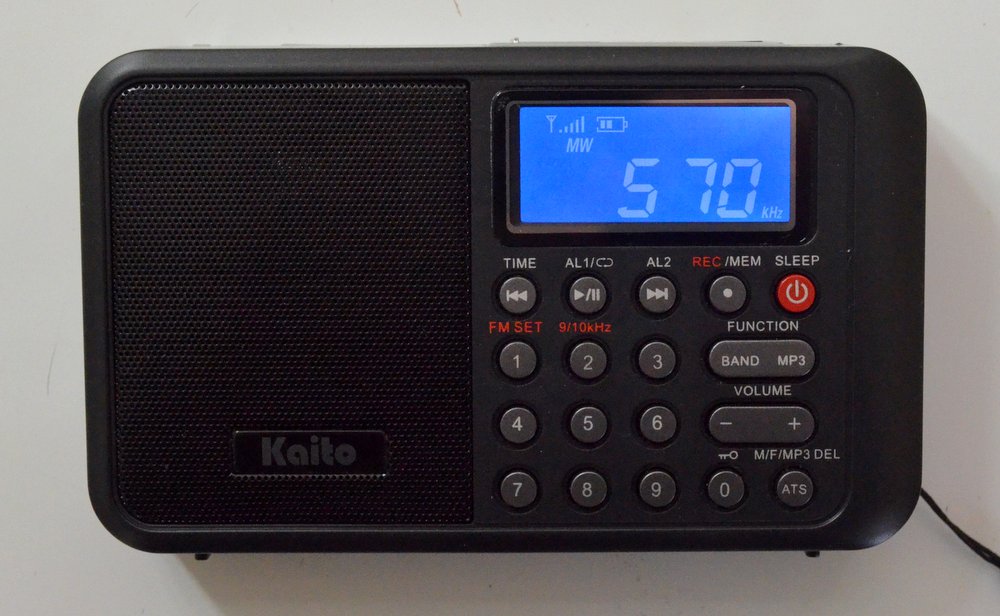
Many thanks to SWLing Post contributor, Paul Dobosz (K8PD) who shares his review of the Kaito KA108. Paul originally wrote this for the Michigan Area Radio Enthusiasts and has kindly allowed us to post it here:
Kaito KA-108 Review
by Paul Dobosz (K8PD)
Kaito just introduced a pocket sized DSP based MW/SW/FM receiver with some interesting features missing in other SW receivers its size. I just got my hands on one for the first time a couple of months ago and am getting familiar with its features, performance, and quirks. I first saw the KA-108 at the Consumer Electronics Show in early January when I visited the Kaito booth and spoke with Walter about their newest radios. There are no schematics included with the KA-108 and I haven’t cracked open the case but based on the functionality, size, and price point it appears that the KA-108 utilizes the now common DSP based receiver architecture found in most of the new portable radios.
First of all, a brief run down on the features and functions of this compact little radio.
MP3 Timer record & playback to/from a Micro SD card
Standard USB port that accepts a thumb drive.
Exceptional Bass Response for travel sized radio
“Auto Store” feature will scan and store frequencies
Battery charging via micro USB (no wall wart to carry)
Audio “line In” can be used as computer or MP3 speaker
Most radios have their good and not so good points and the Kaito KA-108 is no exception. Here is a rundown on the LA-108’s “HITS & MISSES”
The HITS
This radio is small and lightweight which makes it an ideal travel radio. The control layout features a full keyboard for frequency entry as well as up and down keys that will search for signals when held down. The fit and finish are excellent and the keys have good positive tactile feel. There are two rocker switches, one for volume up/down and the other for band/mode selection. The radio comes with a decent user manual and quick start guide. The manual’s English is a little awkward in places but is fully understandable.
The backlit LCD display is brightly lit with large white numbers on a blue background. It is easy for older eyes to read, even without glasses. The signal strength meter is actually fairly useful which is rare for radios at this price point.
The standard frequency step is matched to channel spacing for the band in use with exception of the FM band which tunes in 100 KHz increments instead of the US standard 200KHz steps when the frequency range is set to the North American band. The FM band can be set up to tune all the way down to 64 MHz if desired but since TV has migrated from analog to digital the usefulness of that coverage is minimal for North American users. AM is 9 or 10 KHz step capable with a frequency range to match all parts of the world. In addition to the standard frequency steps, the thumbwheel encoder can be used to fine adjust the frequency between the standard increments in 1 KHz steps.
The MP3 playback is very pleasant to listen to. I tested it with several different genres of music with consistently good sound quality. I haven’t tried the recording function yet but it is definitely a nice feature, especially in such a compact package. The KA-108 has a standard USB input (not mini or micro) behind a sliding door on top of the radio for external memory devices like thumb drives. MP3s can be played and audio recorded to/from this port as well as the Micro SD card slot aside of it. I’m also hopeful that the USB port may be capable of upgrading the radio firmware in the field. If not, that’s another feature that Kaito should definitely consider for future versions of the KA-108. (More on that later)
One feature I really like is the rotary tuning thumbwheel encoder on the side of the radio. It has a light detent feel that allows you to manually tune the radio in 1 KHz steps to easily allow you to move to one side of a signal. Frequency entry via the numeric keyboard is straight forward and intuitive with exception of the non-standard location of the zero key to the right of the bottom row of the numeric keys.
The FM reception is excellent with bass response that makes you wonder how such a mellow sound comes out of such a small box. Despite the 1.5” speaker, the audio has lots of bass and lacks the “tinny “sound of most travel portables with small speakers. It plays loudly without distortion.
MW reception was typical for a radio with limited space for a small ferrite antenna and I was able to hear the usual SWBC stations and time/frequency UTE’s on the HF bands. SW reception using just the 20” whip was just OK with easily listenable strong signals found on most of the active SW bands 2MHz and above. The KA-108 is AM only on the HF bands (no SSB or CW). There are some quirks with the MW and AM reception that I’ll cover in the MISSES section of this review
The MISSES
I never thought I would complain about a portable receiver with a “too tight” a bandpass filter but the KA-108 is a first. The bandpass filter for MW &SW are extremely narrow which when coupled with the KA108’s exceptionally strong bass response, reduces the intelligibility of the received audio on the MW and Shortwave bands. I have been able to mitigate the situation a little bit acoustically by covering a portion of the speaker grille with my hand or placing a small tube in front of it which seems to attenuate the bass and improve the overall audio response but the audio is still lacking in the higher frequencies that make things like music and the human voice more intelligible.
Tuning 1-2 KHz off of the carrier frequency with the thumbwheel helped improve things a little bit similar to the way you might use IF shift on a high end tabletop receiver. I also noticed that stronger stations that have a signal that spills further down the filter’s skirts had better audio response than those that lacked sufficient strength to spill over the filter response curve. I am hopeful that Kaito will offer a firmware upgrade to open up the bandwidth. If the USB port used to play thumb drives has hooks into the radio’s CPU then it might be possible to open up the bandwidth and improve the MW and SW audio without cracking open the radio case to re-flash the CPU or make a hardware change. The bandwidth issue is the largest single miss for the KA-108 in my opinion
I found a few buzzes and whistles on the MW band and you can hear the CPU clock oscillator strongly at 12MHz. I haven’t looked inside of the radio yet but I would imagine that some of the MW noise can be tamed with a bit of internal shielding.
I also found the AGC setting to be a bit too abrupt, jumping up and down in almost a step function with a signal whose level was fluctuating quite a bit. That’s another minor software adjustment to consider for the next edition.
Due to the KA-108’s small size, the whip antenna is rather short (only about 20”) which means the front end must have a lot of gain leaving it more vulnerable to overload. I was able to receive a the stronger SWBC stations while sitting in the middle of my house but I also heard another faint signal under the SW stations. The interfering signal turned out to be a local 1KW AM station on 145o KHz whose transmitter is about 4 miles from my home. It was present in the background while listening to SWBC and was heard standalone on its 2nd and 3rd harmonics which were most likely generated internally due to the high gain front end. The short SW antenna does create the need for higher front end gain but should be accompanied by a high pass filter behind the SW whip antenna or at least a 10dB attenuator. Either or both of those features would reduce AM BCB intrusion while listening to SWBC.
In the coming weeks I’d like to do some parametric measurements on the KA-108 and will also see how it behaves with a longer antenna and antenna tuner with low pass filter ahead of it. That should be a good test to see if a simple filter can eliminate the AM intrusion. Improvements to widen the AM/SW filter bandwidth and reduce the AM overload should be high priority improvements for the next version of the KA-108.
Summing It Up
I found the KA-108 easy to operate as I’ve explored the AM/SW/FM and MP3 operating modes and it’s a nice sized radio for casual listening when I’m at home or to take with me as I travel for use as an alarm clock, music player, and radio in one compact package.
The KA-108 has potential with a few software and hardware tweaks. Fixing the MW/SW bandwidth is #1. A simple high pass filter that rolls off just above the AM broadcast band behind the SW whip antenna is #2. I can live with a few buzzes and tones but why not fix them with a little inexpensive shielding while adding the other fixes.
The KA-108 will never match the performance of tabletop or lunchbox sized portables, but if you’re looking for a nice little radio that will almost fit in your shirt pocket with nothing more than a micro USB cable to tote along for battery charging, and a radio that sounds twice its size, this radio fits the bill. I hope that Kaito will address the issues I’ve noted with future software/hardware revisions to improve the performance of the KA-108 and maybe even offer a way for current owners to field upgrade their radios.
That’s a thoughtful and fair assessment of the Kaito KA108, Paul. It’s a reminder that, with a few strategic tweaks, the KA108 could be a great little portable. Thank you for sharing your review with us!
Many thanks to SWLing Post contributor, Patrick Canler who writes to us from France and shares the following guest post which he translated into English:
The number of receivers on the market is quite large, and all are sold to be the “best”. I have thought it useful to compare materials using them in the shack as a neophyte SWL; going beyond the features in the brochures to talk about everyday utility. This article does not pretend to do “scientific” testing of the four receivers–skills and special equipment are needed and some specialized laboratories already do it.
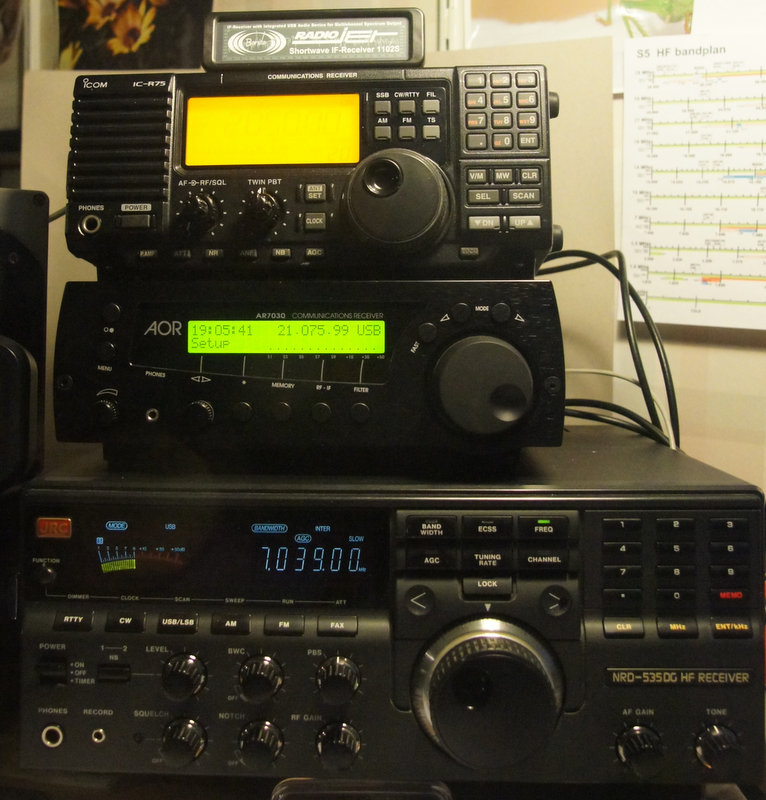
The four receivers cover thirty years of electronics manufacturing; four different brands with their own technology and specifications. Over such period, technologies and innovations have evolved. One of the questions I had was: “Does efficiency give any receiver an advantage?”.
The Contenders:
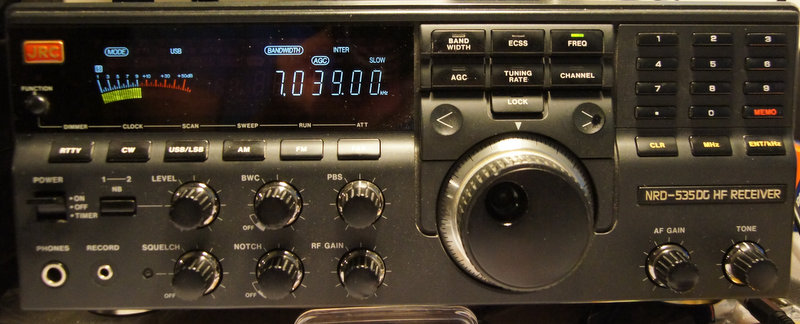
NRD-535 from Japan Radio Company.
A reference of the 90s! It received 5 stars from WRTH (which publishes annually the almanac “World Radio and TV Handook”). The NRD-535 has conventional construction with an electronic card per function and discrete and analog filters.
This is a home station receiver, weighing in at 10 kg. The NRD-535 ceased to be produced in 1996, and its value second hand is growing due to its reputation.
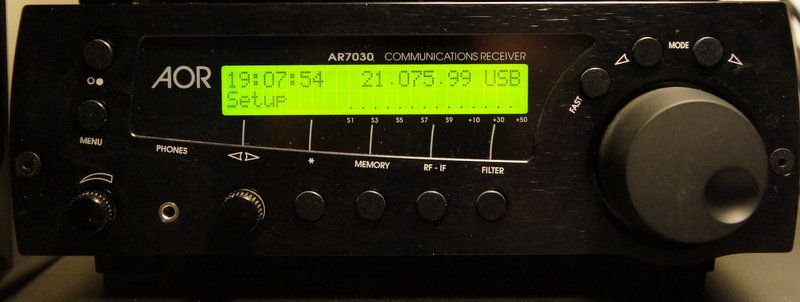
AR7030 from AOR
Designed by the engineer who developed the LOWE receiver line, the AR7030 is also famous for its reception. It uses special ergonomics and a hybrid of software menus and conventional controls. Quite small, it is easily transportable, due its design that already uses SMC but keeps the analog filters.
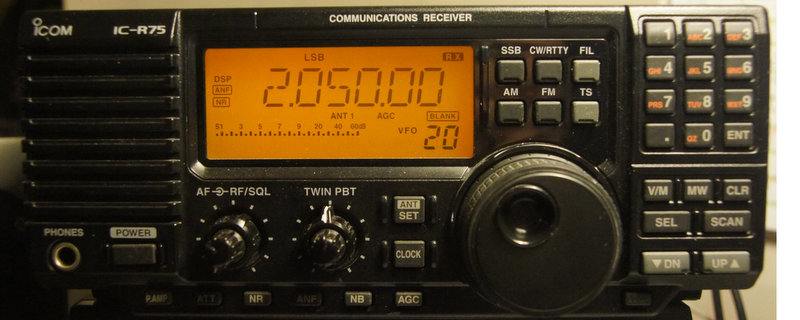
IC-R75 ICOM
Modern device, classical format and renowned–the R75 is the only receiver tested that is still in production [Note: it was recently removed from production]. It uses CMS, combines analog and DSP filtering (the DSP option is present on the device under test). Its ergonomic design is intuitive and so too are controls and menus.
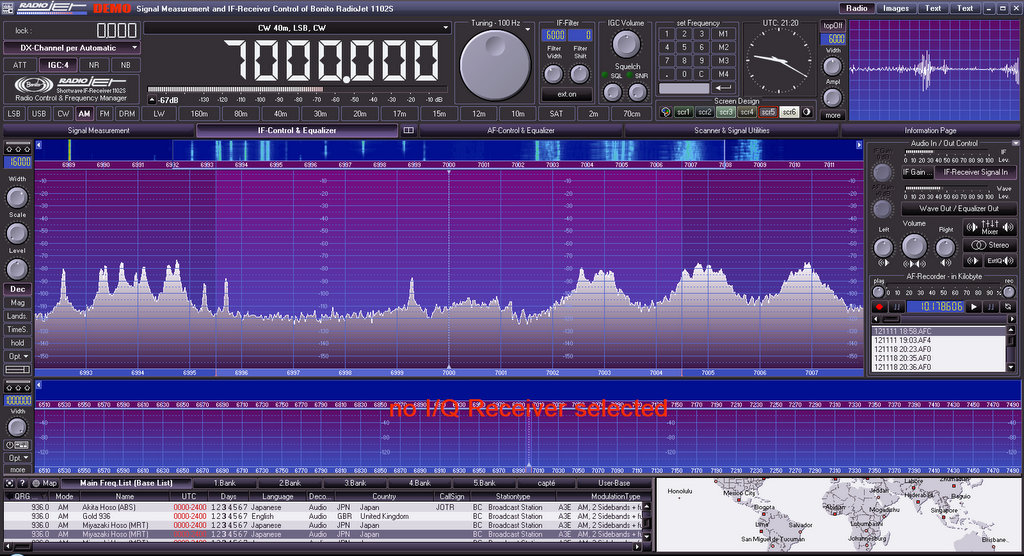
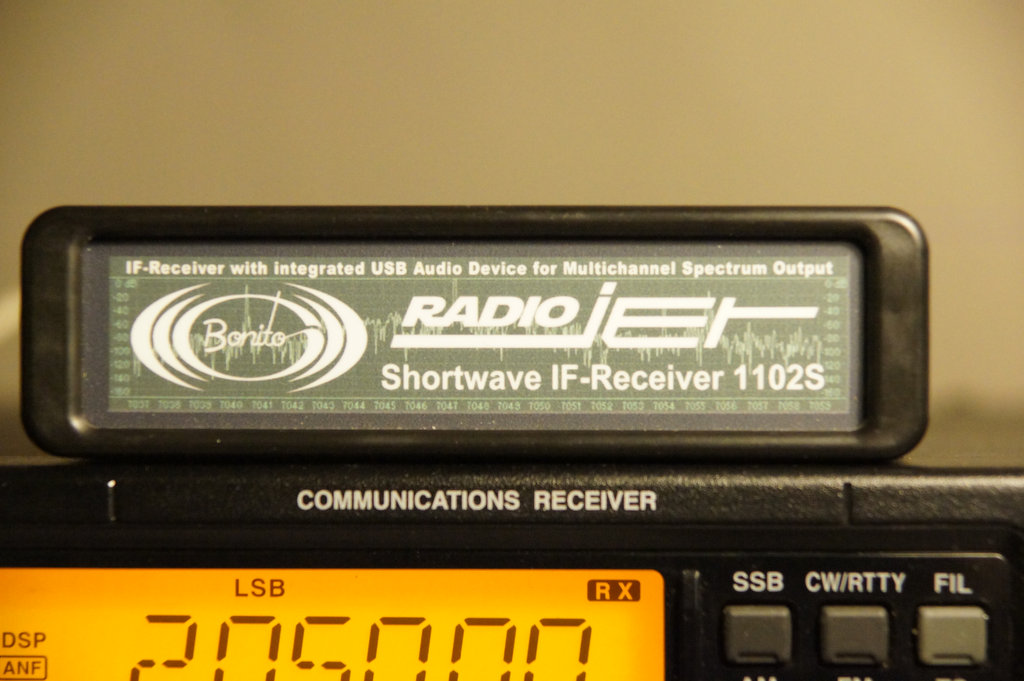
1102S RADIOJET Bonito,
The 1102S RADIOJET is the only unit in this comparison that is produced in Europe!
The Radiojet includes the latest developments in technology, its performance is simply stunning on the data/spec sheet. The application includes many tools (spectrograph, digital filters, IF and AF recorders, decoder, list of broadcast stations, etc.). It brings together all the SMC receiving electronics in a small box that can fit in a pocket.
The commands and tools are assigned to a software (highly evolved) that runs on the PC which is connected the SDR. The power of the PC also brings graphics, memory, recordings etc.
Why these four rigs?
In the beginning, and it was it which led me to be SWL, I acquired the RADIOJET based on its announced characteristics: sensitivity of “secret services”, adaptable to all cases with filters, graphics tools–“Star Wars equipment” is not it! Later I learned about 50 MHz and at the same time I was struggling to exploit the Radiojet SDR.
A good opportunity to purchase an ICOM R75 brought me back to conventional radio ergonomics. As time passed, I felt my listening skills improved with these 2 receivers and the receiver syndrome grew! A Kenwood R5000 joined the others for its VHF potential and HF reputation.
Then I discovered an NRD-525 on Ebay at a fair price point (rare)–it joined the group of receivers. The latter two were sold and replaced respectively by an AOR 7030 and by NRD-535. I really enjoyed the 525, but the 535 is even better.
In use, the RADIOJET and R75 have always posed problems with settings and sound quality. Kenwood reassured me about the fact that we could get some nice reception without fighting against the controls. validated by the AOR, the NRD 525 & 535. Perhaps I did not understand the manipulation of digital filters???
Now to the shack!
The four receivers are placed side by side, but arranged so as not to disturb each other (eg. the display of the ND535 disrupted the RADIOJET).
The antenna is a 25m random wire oriented East/West with 9:1 balun and its own ground. The passage from a receiver to the other is done by a conventional antenna switch.
All the tests were performed in one evening for constant conditions, there was a fairly present QRM which, was not too bad for comparison purposes. The tests were made in SSB or AM. Preliminary tests had shown that the results in digital modes (PSK31, JT65, ..) relied more on the decoder performance of the PC rather than the receiver. The tests increased from the lowest frequency detected this evening (Europe 1-163 kHZ) to the highest (Foreign Broadcast =15,545 MHz).
The highest frequencies, up to 30 MHz, were deserted in phone, at least for my installation.
The procedure was:
Signal is detected from the spectrograph SDR: it typically “sees” almost inaudible signals.
The candidate frequency is tuned on all four receivers
I listening to all of the signals on all receivers, seeking to get the maximum performance, using all possibilities (notch, passband, IF Shift, integrated amplifiers, attenuator, etc.)
Results are reported in the table below.
One can notice rather quickly:
that age is not a handicap
the number of functions is not always an advantage
1102S RADIOJET
Performance and capabilities above the rest (on paper) and requires being connected to a PC. At the present time, on an old Celeron 2Gb ram, the RadioJet’s application never saturated the CPU. The band spectrum display allows one to find the QSO, to filter theoretically perfectly, but it does not always equate to the understandability of the signal or give a pleasant audio. And the number of software features and functions complicates the signal manipulation. The sound is still a little metallic, perhaps due to the signal processing software. Its small size makes it a unbeatable mobile receiver for travel, functions are incredibly useful for those who master the RadioJet application.
AOR AR7030
Inherently simpler at face value–the AR7030 is ultra easy to use. It makes it easy for the user to find and tweak a candidate signal. It’s intuitive and has essential functions only. It has well-designed electronics. The AR7030 is also best receiver tested for handling strong signals without overloading (broadcasts stations or nearby hyper-kilowatted amateur radio operators) which seems to prove that it is designed for these stations. Its limit is the lack of adaptive notch filter types to clean the noise, which is still quite present when the QRM is there. (The newer version 7030+ has added features to help). Finally, it is the smallest stand-alone, portable and with 3 options of antennas connections.
ICOM R75
The R75 climbs up the frequency band all the way to 50 MHz, the only receiver tested with this frequency range. It enjoys an excellent reputation, and can be equipped with a DSP (digital signal processing) on audio. The DSP provides adaptive noise reduction and automatic notch, but has a relative effectiveness which is not always successful in clarifying the signal. Sometimes it adds an unpleasant “rattling”. In use, the interface is pretty intuitive–mixing commands by buttons and menus. Twin pass band tuning (PBT) is effective and allows for IF Shift and/or notch. The speaker is (very) small and gives an aggressive/harsh sound. This receiver is relatively small in size and lightweight. It has a mobile stand and is designed for a 12-14V power supply.
JRC NRD-535
The NRD-535 is the oldest tested–indeed, it was already discontinued before the other receivers were in production. A solid and reliable construction, good ergonomic with conventional front panel controls, good sensitivity, and a decent sized speaker have earned it status as a benchmark in its time. Very sensitive, it extracts the signals and, once found the right filter, gives it pleasant audio. Some signals are not completely cleaned but it does rarely less than others. The NRD-535 is designed for home use: it is heavy, almost 10 kg, and is contains several circuit boards which should not be too exposed to excessive shocks, especially considering they’re over 20 years old.
Summary
My ranking is as follows:
JRC NRD-535 for its ease of use and ability to dig out a usable signal from the QRM.
AOR AR7030 for its simplicity, portability and the fact that it extract good sound/audio quickly, even if a little noisy at times.
Bonito RADIOJET for its small size and its extensive feature set. It is ultra-mobile with a laptop.
ICOM R75 does the job and covers a wide frequency range. But lags in performance relative to the other receiver tested, with a “nasal” sound and a DSP that does not keep its intended promises.
About digital filters: the SDR and ICOM have them, the possibilities are extensive and allow adaptive filtering that others do not with analog filters. By cons they give a dry sound and sometimes add “snap” under whistles. Listening is overall less pleasant in comparison.
Receivers Advantages + / Disadvantages –
Bonito RADIOJET
+ Top technology, visual and many new features over the others on this point
– Complicated, metallic sound, emphasizing the sometimes painful receiver interaction with a computer mouse
Icom R75
+ Great value at the present time
– Audio and imperfect signal cleaning
AOR AR7030
+ Simple and effective
– Ideal companion if it had a notch filter: noise is present
JRC NRD-535
+ Effective sensitivity and clean audio
– Older technology, less portable
Note that this is a personal opinion: a computer geek will certainly get the most of performance and possibilities from an SDR like the Bonito RadioJet.
The NRD-535 shows its age, will one day reach the end of its useful life despite its robust construction. ICOM can cover up to 6m remaining mobile and has a good filter possibilities (DSP). The AOR is easy, fast and gives a correct listening, general purpose. It is the only one to pass the VLF.
The ideal then?
* RADIOJET for sensitivity,
* The RADIOJET for tools/features and functions
* AR7030 for the lower bands
* Icom for the higher bands
* NRD-535 for ergonomics
* AOR for portability
Personally, I use the NRD-535 for DXing (due to superior audio), the AR7030 for digital modes,
the RADIOJET to visually search for signals, and to sometimes clarify the signal even better and because it’s ultra-mobile and always in my PC case.
73,
Patrick F61112
Thank you, Patrick!
I should mention that I think you did a fine job translating your article into English for us! I would not be as successful writing an article in French!
I’ve never owned a JRC of any sort. If I ever found an NRD-535 for a good price, I would purchase one without hesitation. I’ve never spent much time on the AR7030 either. It’s simple “Lowe-like” front panel is quite appealing for field use. I found that the RadioJet audio is quite nice when paired with a good set of headphones.
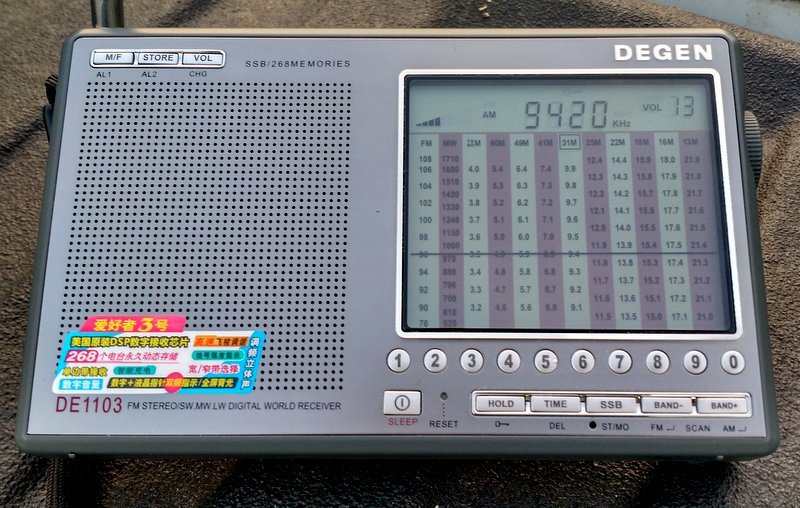
[Correction: Julio’s version of the DE1103 is the first, non-DSP (current) version.]
Many thanks to SWLing Post reader, Julio Cesar Pereira, who comments with his mostly positive impression of the DSP version of the Degen DE1103 receiver:
I’ve got a DE1103 and haven’t noticed any AM bleeding on SWL so far. I sometimes stay at one of my family’s properties located at the center of a city with lots of stations. There I use the balcony on the 9th floor and I get a lot of spurious interference from FM stations, which is normal once you’re surrounded by buildings. However, I already tuned some images on SW. I used an old SW7600G to check it out and it didn’t get any.
I kind of started to dislike DSP, for it can be annoying to hear it engage and disengage when a signal constantly drops down and recovers. It is fantastic when a signal is strong and constant for it improves audio quality whether it is MW, SW or FM.
At one time, I even thought it would be perfect for the DE1103 to have this [DSP] feature, but you know what? I’m very happy with the way mine is right now. I find this receiver to have the best FM reception compared to the others of my little collection of tabletop and portable receivers, which includes scanners ICOM IC-R20 and R5, receivers PL-660, SW7600GR, ICF-2010, etc. The DE1103 is by far the most sensitive and selective one, it even beats my old Realistic DX-440.
As for SW, I like the combination of its very good AGC and very low floor, which allows me to do DXing with the RF attenuator on and does not have any annoying filter like the PL-660. I also enjoy its audio quality, especially on the headphones, for it is more natural, not processed like the PL-660’s or over-processed like the SW7600GR’s.
You can tell I’m a big fan of this little radio. It has its flaws, but I can live with them.
Thank you for sharing your experience with the DE1103 DSP, Julio!
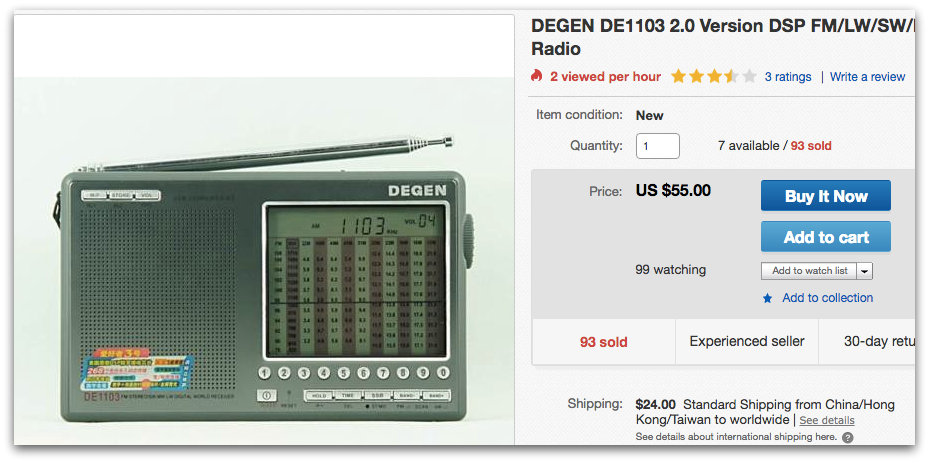
If you’ve read my DE1103 DSP review, you’ll note that I haven’t been the biggest fan of the new DSP version of the DE1103. I did review a very early model and wonder if Degen has tweaked the DE1103 DSP to provide better performance? Can any other readers comment?
Update: Several readers pointed out that the “Version 2.0” might simply be a way sellers are using to indicate that this is the DSP-based DE1103–rather than this being an improved version of the original DSP receiver I tested.
In August 2015 at the Tokyo Hamfair, Icom debuted a new type of transceiver in their product line––one featuring a direct RF sampling receiver. Essentially, it was an SDR tabletop transceiver.
At about the same time that the IC-7300 started shipping around the world, Icom pulled their venerable IC-7200 off the market. Yet the IC-7200 was established as a well-loved product, due to its highly sensitive receiver, its relatively robust front end, and its quality audio. Moreover, it was simple to operate, which made superb as a Field Day or radio club rig.
Therefore, even though the IC-7300 promised much more versatility than the IC-7200, for its price point it had a tough act to follow.
So, of course––even more so than with any other radio Icom has introduced in the past few years––I was eager to get my hands on a IC-7300. I’m very fortunate that my good friend, Dave Anderson (K4SV) was one of the first purchasers of the IC-7300, and that he didn’t mind (after only having the rig perhaps one week!) allowing me to borrow it for a several weeks for evaluation.
Note: I should state here that since this rig was loaned to me, I evaluated it based on the firmware version it shipped with, and made no modifications to it.
This review primarily focuses on the receiver’s performance, functionality and usability.
Introducing the Icom IC-7300
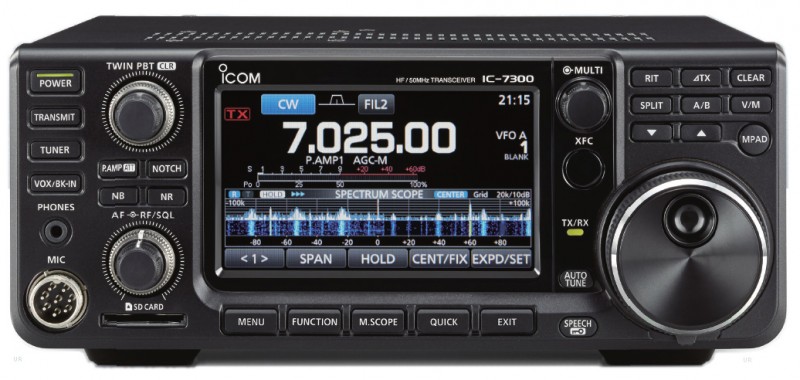
In recent years, the “big three” ham radio manufacturers have been using color displays, and––Icom most especially––touch screens. While I’m no fan of backlit touch screens in mobile applications, I think touch screen displays make a lot of sense in a base radio. If carefully designed, a touch screen can save an operator from heavily-buried menus and decrease the number of multi-function buttons on the front panel.
The challenge, of course, is making a display with intuitive controls, and one that is large enough, and with sufficient resolution, to be useful to the operator. In the past, I’ve been disappointed by many displays; the most successful have been incorporated in DX/Contest-class (i.e., pricier) transceivers, meanwhile, entry-level and mid-priced transceiver displays often seem half-baked. While the graphics may be crisp, spectrum displays at this price point are often too compressed to be useful, and if not a touch display, force the user to pause operation in order to find the correct knob or button to change settings. In such cases, I find myself wondering why the manufacturer went to the expense of a color display at all––?
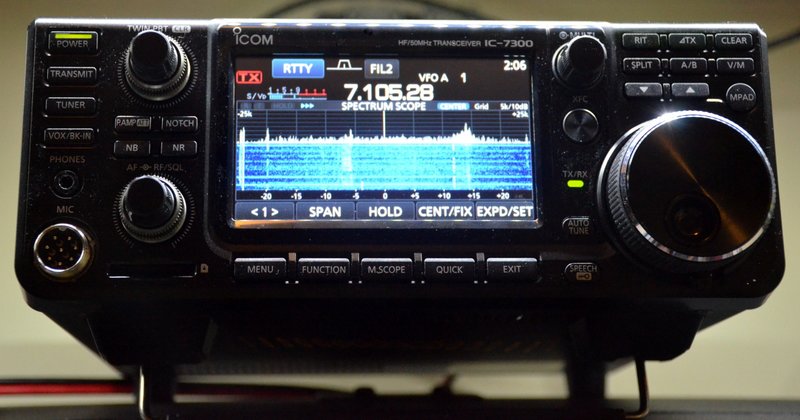
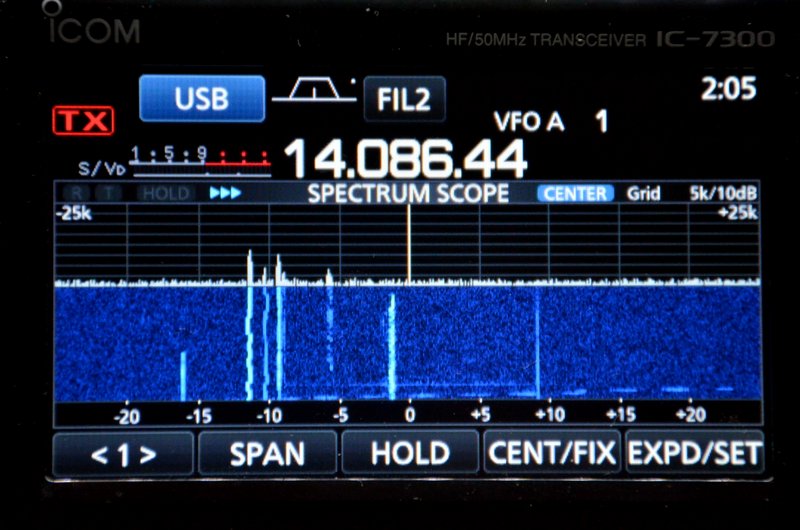
But what about the C-7300 display? I’m thoroughly pleased to report that Icom did a fantastic job of balancing utility and function in design of the IC-7300’s color touch display and front panel. There are number of ways you can chose to display and arrange elements on the screen–since I’m an SDR fan, I typically chose a display setting which gave the waterfall the most real estate. Of course, one can chose to give the frequency display priority or a number of other arrangements.
User interface
I can tell that Icom built upon their experience with the IC-7100––their first entry-level touch screen display transceiver.
I was able to get the IC-7300 on the air in very little time. Within five minutes of turning on the IC-7300, I was able to:
change the display to feature a spectrum waterfall;
change the span of the waterfall display;
adjust the TX power output;
change the filters selection and the transmit mode;
change bands and make direct-frequency entries;
adjust notch, passband, and filter width;
adjust AF and RF gain;
set A/B VFOs and operate split;
change AGC settings;
turn on Noise Reduction/Noise Blanker, and
adjust compression.
Basically, I found that all the essential functions are clearly laid out, accessible, and highly functional. Impressive.
The IC-7300 ships with a manual–– aptly titled, the “Basic” manual––and a CD with the full and unabridged operations manual. The Basic Manual covers a great deal more than the manual which accompanied the Icom ID-51a, for example. If you read through the manual, you’ll readily familiarize yourself with most of the IC-7300’s higher function operations, and especially, you’ll be able to adjust the settings to your operation style. The Manual is written in simple language, and includes a lot of diagrams and graphics.
If you’re like me, you will find you’ll also need to reference that unabridged manual, so hang on to the CD, too.
Still, I imagine there’s a large percentage of future IC-7300 owners that will never need to reference the manual––especially if they don’t care about tweaking band edges or similar settings. Yes, believe it or not, it’s that easy to use.
Operation
While I spent a great deal of time listening to CW and SSB in various band conditions and at various times of day, I spent less time on the air transmitting.
With that said, all of my transmitting time was in CW since the IC-7300 mic was accidentally left out when my friend loaned me the rig.
I’m please to report that CW operation is quite pleasant. All of the adjustments––RF Power, Key Speed, and CW Pitch––can be quickly modified using the multi-function knob. While in CW mode, you can also toggle full break-in mode, which is quite smooth, via the function button and touch screen.
SSB functions are similar. While in SSB mode, the multi-function knob allows you to change the tx power, mic gain, and monitor level. The function button opens an on-screen menu with VOX, compression, TBW, and the monitor toggle.
Of course, my smartphones’s microphone can’t accurately reproduce the audio from the IC-7300, but you probably get the idea.
The only annoyance I noted––and perhaps I’m more sensitive to this, being primarily a QRPer––is that the 7300’s cooling fan starts up each time you key up. It even comes on when transmit power is at its lowest setting. I find this a little distracting in CW. Fortunately, however, the 7300’s fan is fairly quiet and operates smoothly.
Receiver performance and reader survey results
Since our radio comparison shoot-outs have been particularly popular (and useful; check out our shoot-out between top portables, and ultra-compact radios, and others), I decided it would make sense to invite our informed readership to evaluate the Icom IC-7300’s performance in a series of blind, informal tests. (For information about these surveys, please read the first survey.)
Below, I’ve matched the labels (Radio A/Radio B) with the radio models. I’ve also included pie charts which show the results from the survey.
Based on listener comments, those of you who preferred the ‘7300 did so because the CW was more interpretable and stable.
Some of you noted that I didn’t quite have CW at the same pitch on both rigs. I believe this is because the IC-7300’s calibration was ever so slightly off. This has since been addressed.
This result was almost tied. The Excalibur’s audio––without any adjustments––has a fuller and “bassier” sound. The ‘7300 can be adjusted to have similar characteristics, but the default EQ settings produce very flat audio. Many of you commented that the IC-7300 more faithfully produced audio optimized for SSB.
Shortwave Broadcast recordings
The following recordings were made on the 31 meter broadcast band in the evening. Both radios had the same filter width: 9 kHz and 8.2 kHz.
Weak Shortwave AM (Radio Bandeirantes 31 meter band)
There was a noticeable preference for the WinRadio Excalibur in this particular audio set. Even though the Excalibur’s audio splattered a bit, the content was more interpretable. The IC-7300’s audio sounded flat in comparison––again, something that can be adjusted quite easily in the ‘7300’s audio settings.
Strong Shortwave AM (Radio Romania International, French 31 Meter Band)
Once again, the Excalibur won favor, but I imagine results would have been closer had I adjusted the ‘7300’s audio EQ.
Mediumwave Broadcast recordings
Note that the following mediumwave recordings were made during the morning hours (grayline). The strong station is the closest AM broadcaster to my home; it’s not a blow-torch “Class A” type station, merely the closest local broadcaster.
In the “weak” sample, I tuned to 630 kHz where multiple broadcasters could be heard on frequency, but one was dominant.
In this particular example, the IC-7300 could not pull the strongest broadcaster out of the pile as well as the WinRadio Excalibur. In fairness, the Excalibur was using AM sync detection, something the IC-7300 lacks.
Icom IC-7300 vs. Elecraft KX3
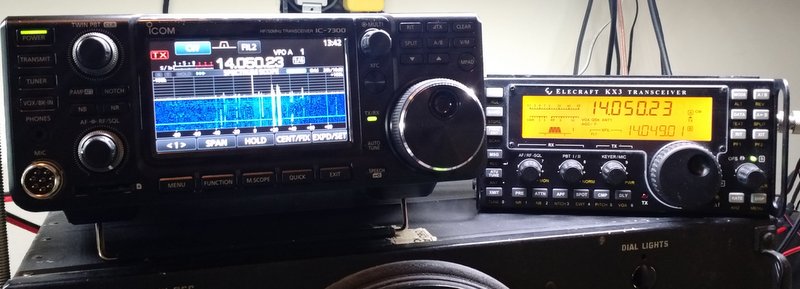
I also decided to pit the IC-7300 against my well-loved Elecraft KX3.
These results were spilt in the middle. Again, I believe this comes down to personal preference in the audio. And again––in both radios––the audio EQ can be adjusted to suit the operator.
Receiver performance summary
I enjoy producing audio clips for readers to compare and comment upon. Each time I’ve done so in the past, I’ve had listeners argue the virtues of a particular audio clip while others have the complete opposite reaction to that same clip. Not all of us prefer our audio served up in the same way. No doubt, there’s a great deal of subjectivity in this sort of test.
I’ve had the IC-7300 on the air every day since I took possession of it. I’ve listened to SSB, CW, and lots of AM/SW broadcasters.
And here’s my summary: the IC-7300 is an excellent receiver. It has a low noise floor, superb sensitivity and excellent selectivity. I even slightly prefer its audio to that of my Elecraft KX3, and I’m a huge fan of the little KX3.
I’ve written before about how difficult it is to compare SDRs; the problem is that there are so many ways to tweak your audio, filters, AGC, noise reduction, etc. that it’s hard to compare apples with apples.
In the audio samples above, the IC-7300 and WinRadio Excalibur were both set to their default audio settings. In SSB and CW, the IC-7300 excels, in my opinion. CW seems to pop out of the noise better and SSB is more pleasant and interpretable. The Excalibur has a better audio profile for AM broadcasters, though. Its default audio simply sounds fuller–more robust.
The audio from the IC-7300 on AM sounded absolutely flat. However, if I tweak the audio of the ‘7300, adding more bass, it instantly sounds more like a dedicated tabletop receiver.
I should also mention that while the IC-7300’s built-in digital recording is a fantastic and effective feature, it doesn’t produce audio true to what’s heard through headphones live. This is especially the case when you add more bass and treble response as in the RRI example above. When the audio EQ is set to a default flat, it’s quite accurate.
Cooling fan immediately starts up on CW/SSB transmit at any power setting (see pro regarding fan noise)
Occasionally you may get lost in deeper customized functions
Supplied printed basic owner’s manual, while well-written, doesn’t fully cover the IC-7300s functions and options; you must explore the digital owner’s manual in supplied CD.
Conclusion
In a nutshell: Icom has hit a home run with the IC-7300.If I didn’t already have an Elecraft KX3 and K2, I would buy the IC-7300 without hesitation.
Though the price point is a little high for an “entry level transceiver,” it’s worth every penny, in my opinion. For $1500 US, you get a fantastic general-coverage transceiver with an intuitive interface, nearly every function you can imagine, and performance that would please even a seasoned DXer.
Though I haven’t done and A/B comparison with the IC-7200, I imagine the IC-7300 would prevail in a test. The IC-7300 would certainly wipe the floor with it’s more economical brother, the IC-718.
Radio clubs, take note:
In my view, the IC-7300 has the makings of an excellent radio club rig in which performance, functionality, as well as ease of use are important. I expect that the IC-7300 will not only cope very well with crowded and crazy Field Day conditions, but it will also give any newcomers to the hobby a little experience with a proper modern transceiver. The fact that you can view signals so easily on the spectrum display means that it will be easier to chase contacts and monitor bands as they open and close. Indeed, what better way to mentor a newly-minted ham in modes, contacts, carriers, QRN, QRM, and so forth, than to simply point these out on the IC-7300’s bright, clear display––?
If your club is considering a transceiver upgrade or purchase, do seriously consider the IC-7300. I think you’ll find this rig is up to the task.
And for home? The Icom IC-7300 may be all of the rig you’ll ever need.