Category Archives: Shortwave Radio

Taming the Noise: Don Moore’s Simple, Cheap Filter Solution for Traveling DXers

Many thanks to SWLing Post contributor Don Moore–noted author, traveler, and DXer–who shares the following post:


A Cheap and Simple Noise Filter

By Don Moore

Don’s traveling DX stories can be found in his book Tales of a Vagabond DXer [SWLing Post affiliate link]. If you’ve already read his book and enjoyed it, do Don a favor and leave a review on Amazon.

My DXing career started over fifty years ago in an upstairs bedroom in tiny Milesburg, Pennsylvania. I had a consumer-grade multi-band radio and some copper wire strung from the roof to a nearby tree.  It was a simple setup but it worked very well. Do you know what I didn’t have? A noise problem. The only time I remember noise ruining my DX was when my mother was using the electric mixer and that meant she was making cookies or a cake. I never complained.

Times have changed, haven’t they? What DXer doesn’t complain about noise these days? I know people who have left the hobby because the place they lived at and DXed at for decades gradually became so noisy they couldn’t DX anymore.

Unsurprisingly, a lot has been written about how to find and eliminate noise in your home. However, most of my DXing is done as I wander the globe. I try to find places to stay at that should be good for DXing. But no matter how good a place looks beforehand, there’s no way of knowing what the noise level will be until I get there.

As a traveling DXer, I need quick, easy, and compact noise solutions. The best solution I’ve found are these CCTV distortion filters (ground loop isolators) that Brett Saylor recommended to me several years ago.

No, these weren’t designed for radio use. And they aren’t a miracle solution that will eliminate all the noise that plagues DXers. Sometimes they’re no use at all. But I’ve DXed in dozens of locations over the past ten years and there have been multiple occasions where one of these filters has turned what would have been a disappointing stay into a good DX session. I don’t go anywhere without two of these packed in my mobile DX shack.

But let me show you some results. All of these SDR screenshots were made with SDR-Console using an Airspy HF+ Discovery SDR connected to a PA0RDT mini-whip antenna.

I spent last summer in the north suburbs of Chicago and several times went to a park to test my DX equipment. Around midday, the lower shortwave frequencies were filled with noise peaks. On this first image, it’s hard to pick out WWV on 5 MHz from all the noise peaks. In the second image the filter hasn’t totally eliminated the noise, but WWV’s signal is now strong and clear.

The noise was nearly as strong on 49 meters but the filter almost totally eliminated it. CFRX’s signal on 6070 kHz was slightly weaker with the filter, but it was significantly more listenable without the noise.

Which frequencies noise affects can vary between locations. At that park the noise was gone above about 11 MHz.  While traveling across the US in mid-October, I stopped at a park just west of Kansas City to do some more DXing and equipment tests.  The noise there was bad in the middle shortwave bands, such as in the 25 meter band.

But the filter did a good job cleaning it up.

Finally, about two years ago when I was DXing in Rafina, Greece, the noise was bad on the higher bands. Here are before and after screen shots on the 16-meter band.

These filters should work with any coax-fed antenna. I’ve used them with beverages, Wellbrook loops, the PA0RDT, and the MLA-30+ loop. If the antenna has an interface, such as the last three mentioned, the filter goes between the interface and your receiver (and not between the interface and the antenna).  I’m not sure what the impedance on these is, but I’ve used them with both 50- and 75-ohm coax cable.

Sources of the Filters

An Internet search for “CCTV Ground Loop Isolator” brings up all kinds of products. They are probably all the same but I have no way of knowing that. So I recommend getting the exact ones that I have purchased. Just compare the product to the pictures of mine.

Here are links to three current sources for these exact ones on Amazon. They can also be found on eBay and other sites. [Note that all of these links are affilliate links that support the SWLing Post at no cost to you.]

A Few More Ideas

At just a couple dollars each, every DXer should have a few of these filters in their shack. But types of noise vary and at several places I’ve DXed from using one of these filters made no difference at all. When that happens I have a few other solutions to try.

The first thing I try is to either move the antenna or, if it’s directional, to point it in a different direction. On several occasions that’s all it has taken to totally eliminate what at first seemed like an impossible noise problem.

If the noise is coming in through the power lines, unplugging the laptop and DXing off of battery power might do it. (I only use SDRs powered off the USB connections on my laptop.)  If you do that, be sure to unplug the cord from the outlet and move it away from the wall.  If you unplug the cord from the laptop and leave the other end plugged into the outlet, it may act as an antenna and radiate the noise from the power lines into your SDR. And, yes, I learned that lesson the hard way!

Do you have any interesting experiences or solutions to the DX noise problem? Please leave them in the comments section. 

Michael Reviews the Choyong WT2 Multifunction Handheld Radio

Many thanks to SWLing Post contributor, Michael (BD4AAQ) who shares the following guest post:


WT2 Mini Handheld With Everything Radio

by Michael Ye (BD4AAQ)

What Exactly Is the WT2?

No exaggeration. The WT2, a recent radio developed by Choyong, includes nearly every type of radio imaginable: ham radio, traditional shortwave and medium-wave radio, internet radio and, last but not least, push-to-talk over cellular radio!

The radio is powered by the TEF6686 chip, which has an excellent track record in high-performance radios. This suggests the WT2’s performance will surpass that of the highly regarded LC90. Packing so many features into a handheld device would have been unimaginable a decade ago without state-of-the-art technology and the internet.

I’m fortunate to be among the first to get my hands on the WT2. I’d seen its picture before but was still pleasantly surprised when I unboxed the real thing and saw its actual size. The picture below shows my iPhone 12 Pro next to it for comparison. At this small size, it fits sleekly into one’s pocket. I’ve always wanted a radio to listen to while walking or jogging. Now, I have one.

Continued Success of Choyong Radio Receivers

As a young and innovative technology company, Choyong was the first to launch a radio receiver combining traditional radio with internet radio: the LC90. The LC90 has been a resounding success. An improved version, the LC95, has been launched domestically in China. Rumours suggest that the LC100 is in development to build on the success of the LC90 and LC95.

Now, powered by the TEF6686 chip, the WT2 delivers even greater sensitivity and selectivity. Its unique combination of multiple radio types in a single, compact handheld form factor makes it highly competitive. In fact, I’m unaware of any other radio that packs so many features into such a sleek design. The young team at Choyong boldly leads the way, fearlessly testing the market waters.

Internet Radio

Choyong has confirmed that the WT2, like the LC90, will be available in both export and Chinese versions.

“In terms of the stations that can be heard, the internet radio exhibits significant differences from that of the Chinese version. The Chinese version is designed to exclusively feature Chinese language stations (and a few English language stations) in China. If we liken the Chinese internet radio to a closed system such as iOS, it is stable, reliable but restrictive. In contrast, the export version could be compared to Android, offering more open, inclusive and customisable user experience.

On the export version, the MENU button provides access to the main menu, which begins with the six continents (excluding Antarctica) and allows users to navigate to the desired country and then select a specific station.”

The WT2 supports Wi-Fi for indoor use and comes with a built-in eSIM for 4G cellular connectivity. This allows you to easily carry the WT2 in hand or slip it into a pocket, making it ideal for listening to internet radio while walking or jogging.

Traditional Radio

Shortwave performance is impressive, especially considering the small antenna. Surprisingly, the 13.6cm walkie-talkie antenna extends to a full 48cm. This significantly improves shortwave reception, as well as FM reception. Unfortunately, the WT2 lacks SSB demodulation on shortwave, which is a bit disappointing.

Medium-wave reception is poor with the receiver’s whip antenna. Indeed, what can you expect from a whip antenna without a ferrite bar? However, I experimented by connecting a longer wire to the antenna’s SMA connector, and MW reception improved remarkably, much to my surprise.

Arguably, the WT2’s FM reception is outstanding. I compared this compact radio with various others, large and small, old and new, and the WT2’s FM performance is simply the best. Its sensitivity generally surpasses that of competing models, allowing me to receive stations that were inaudible on others. A prime example is Shanghai’s Classic Music Channel on 94.7 MHz, which many report as having medium to weak signal strength. Yet, the WT2 pulled it in with exceptional clarity, free of the occasional hissing I noticed on other radios.

Ham Radio and Walkie-Talkie

Amateur radio operators will appreciate the WT2, as it covers the standard Ultra High Frequency (UHF) amateur band, with a maximum transmitting power of 2 watts. It also includes the FRS/GMRS bands (not for use in China). The Very High Frequency (VHF) band is expected in future models.

Caution: When transmitting with the WT2, retract the extended antenna to avoid damaging the device.   

Although the WT2 is a compact handheld, it includes features found in other walkie-talkies, such as squelch, tone squelch and scanning, all packed into this sleek device.

PoC Talking

Push-to-talk over cellular (PoC) is not new, but it has gained popularity in recent years with the rise of 4G and 5G mobile communications.

A decade ago, taxi drivers in Shanghai used traditional walkie-talkies to communicate within their network for vehicle dispatch or casual rag-chewing. Some were radio amateurs, but I suspect others were not and were thus operating illegally without a proper license. Years later, most of them, if not all, had switched to PoC, a modern method offering legal communication with crystal-clear audio and virtually no distance limitations.

I gave it a try, and of all the people who could have answered, it was BA8BM, a fellow ham in Sichuan, China. Needless to say, the audio was excellent!

With the WT2, users can create as many groups as they like, each supporting up to 10,000 members!

Other Features

The WT2 features a TF card slot that accepts cards with a maximum capacity of 32 GB. This storage can be used for playing music or serving as an external data drive.

The Bluetooth connection supports internet radio but not traditional radio. I successfully connected my AirPods and Bose headphones. They work well for internet radio but by design not for traditional radio.

The WT2 is equipped with a 2,500 mAh rechargeable lithium battery. Unlike the LC90, the battery is not user-replaceable. For a lightweight radio like the WT2, I’d say 2,500 mAh is sufficient for most daily use.

Key Takeaways 

The WT2 is a remarkable compact radio that combines traditional and modern radio technologies. It features a 240×283 mini screen with a vibrant, high-quality colour display that’s truly impressive. The extendable antenna enhances shortwave and FM reception. The audio is crisp and clear but slightly soft. Bluetooth supports internet radio but does not work with traditional radio.

With its four-in-one radio capabilities, users can communicate or listen however they prefer. Want to make a CQ call with a fellow ham? You have amateur radio. Craving crystal-clear conversation? PoC is available. Feel like tuning into nostalgic, sometimes noisy broadcasts over the airwaves? Shortwave, medium-wave, and FM are ready. Eager to explore internet-based radio? There’s a wealth of stations from across the country or around the world.

The WT2 is much smaller (though slightly thicker) than an iPhone and can be used handheld or, via Bluetooth, slipped into a pocket for walking or jogging.

The WT2 has a voice assistant to help you navigate its internet radio and other features with ease.

A versatile little gadget for radio hams, shortwave listeners (despite lacking SSB), and broadcast listeners alike!

Dial S for Shortwave

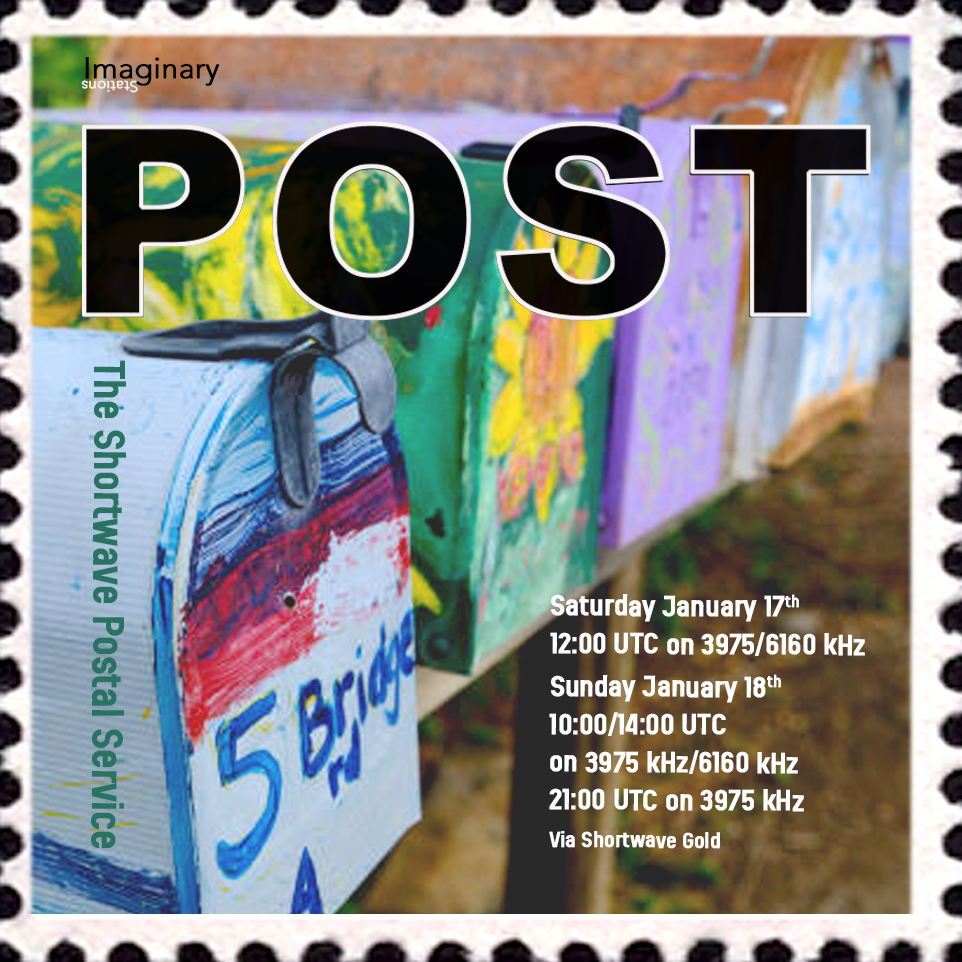
Greetings all SWLing Post community, here’s more about what the Imaginary Stations crew will be sending up to the ionosphere this week. On Saturday 25th October 2025 at 1100 hrs UTC on 6160 kHz and then again on Sunday 26th October 2025 at 0900/1300 hrs UTC on 6160 kHz and at 2100 UTC on 3975 kHz and 6160 kHz, we’ll be bringing you a telephone tribute via the shortwaves called Skybird Telegraph & Telephone Co. 

There will be lots of phone related tunes, a shortwave first in a live on-air attempt of trying to break the world record of ripping two telephone directories at the same time and an interview with someone who used to say “thank you” to the speaking clock (*subject to availability and if our phone lines are working). Tune in and join us in a celebration of the “dog and bone” (as it’s known in cockney rhythming slang).

On Wednesday 29th October 2025 at 0200 UTC via WRMI  we bring you another Ancient Analogue Archive.  This is the show where we dig deep into forgotten music on archive.org). Expect all sorts of everything (and more).

More on Skybird Telegraph & Telephone Co. below:

For more information on all our shows, please write to us at [email protected] and check out our old shows at our Mixcloud page here.

FastRadioBurst23

November 2025 Schedule Updates: From the Isle of Music & Uncle Bill’s Melting Pot

Many thanks to SWLing Post contributor, Bill Tilford, who shares the following update:

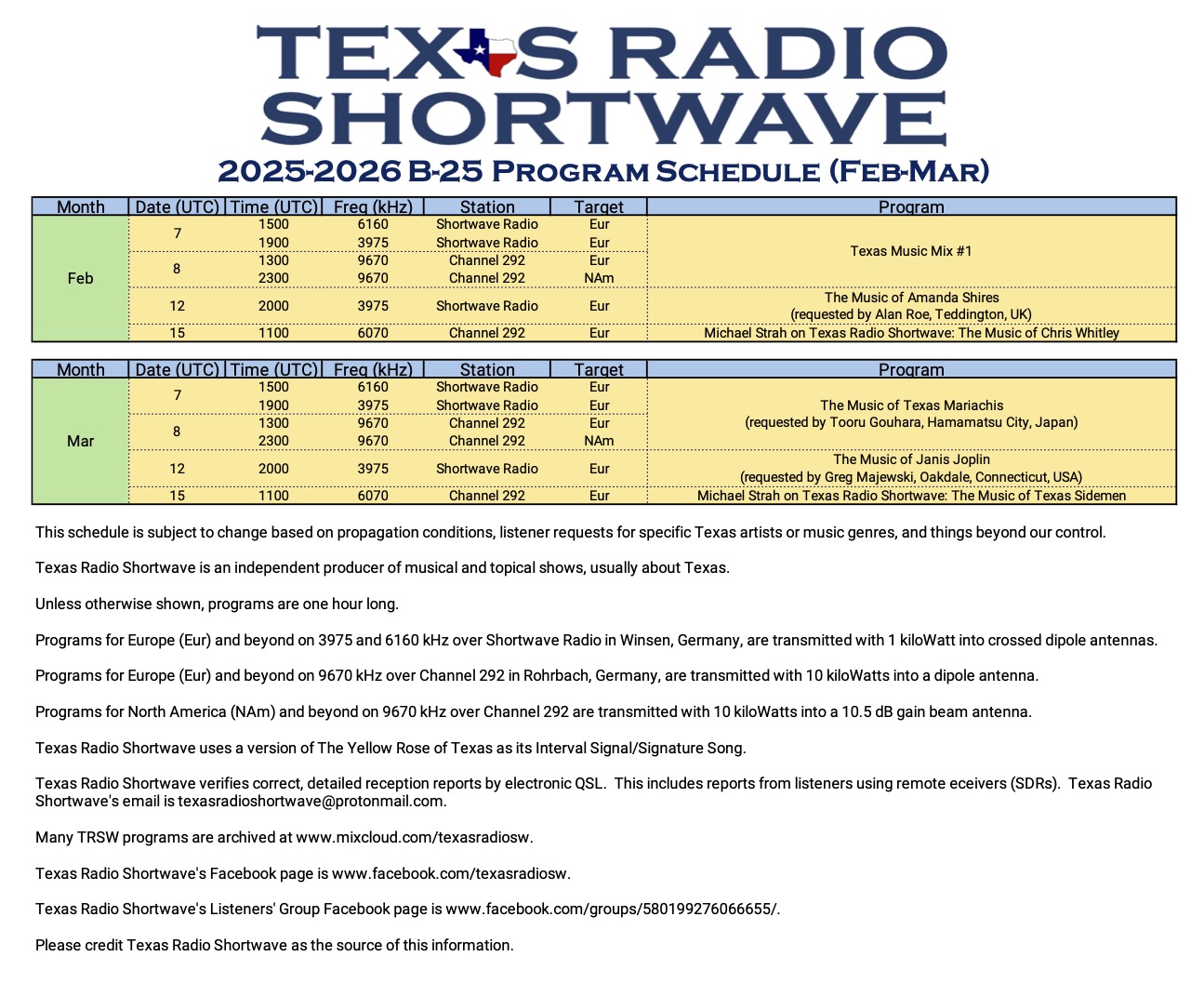
The semiannual time and season changes always bring challenges to FTIOM and UBMP on 6070 and 9670, and we will be pausing our shows on those two frequencies for a month or two until things sort themselves out.  We will have two transmissions of each show on 3955 on Radio Channel 292 from Germany during the interim as follows:

From the Isle of Music

November’s show will feature some Cuban music recordings that entered the Latin and regular GRAMMY competitions this year (it will be too soon to tell if any of them won either.)
Friday, November 14:
3955 kHz at 1700 UTC, repeats 2200 UTC

Uncle Bill’s Melting Pot

November’s show will be a polka party featuring Polish-American bands from the northeast US and Chicago. If you think you don’t like polkas, you just haven’t listened to the right bands.
Friday, November 21:
3955 kHz at 1700 UTC, repeats 2200 UTC

In addition to direct radio reception, we do honor reception reports using remote SDRs as long as the whole program is described and which SDR is specified. All QSLs are e-QSLs only.

Thanks for all you do for radio. Contrary to what some its critics are fond of chanting, shortwave can still be a voice of and for peace, and in these times, that is more important than ever.

Radio World: The World Is at Your Mouse Click

Many thanks to SWLing Post contributor Fred Waterer who shares this article from Radio World that takes a closer look at how online SDR networks have transformed shortwave listening. Even for those of us who regularly use Web SDRs, it’s an interesting perspective on how these global receiver networks continue to evolve and expand the reach of radio in the 21st century.

Click here to read the full article at Radio World.

Bob’s Radio Corner: Shortwave Multiplex?

Reported by Bob Colegrove

Incurable DXers are always looking for new challenges.  So it was, I recently did some scanning between 42 and 45 meters (~6600 to 7000 kHz).  Trenton Military on 6754 kHz and the MARS net on 6913 kHz are regulars here, as are a selection of pirates above 6900 kHz.  However, I have never experienced anything like this.  It took me a while to sort things out.  A pirate on 6930 kHz was quickly detected on the upper sideband, but there was some garble slightly lower.  It turned out to be a few folks having a QSO in Spanish on the lower sideband of 6930 kHz.

Two transmissions both squatting on the same frequency.  The irony was, sans carriers, there was absolutely no mutual interference.  Each signal was clearly received by alternately pressing the USB and LSB buttons.  Likely the QSO folks were somewhat out of band for 40 meters, and it goes without saying that the pirate shouldn’t have been there.  Nevertheless, I would call that efficient use of the spectrum.

Date:  October 11, 2025

Time:  0030 until 0100 UTC

Receiver:  Tecsun PL-880

Antenna:  Bob’s Updated Passive, Resonant, Transformer-Coupled Loop Antenna for Shortwave

Carlos’ Illustrated Radio Listening Report and Recording of Radio ELWA (October 17, 2025)

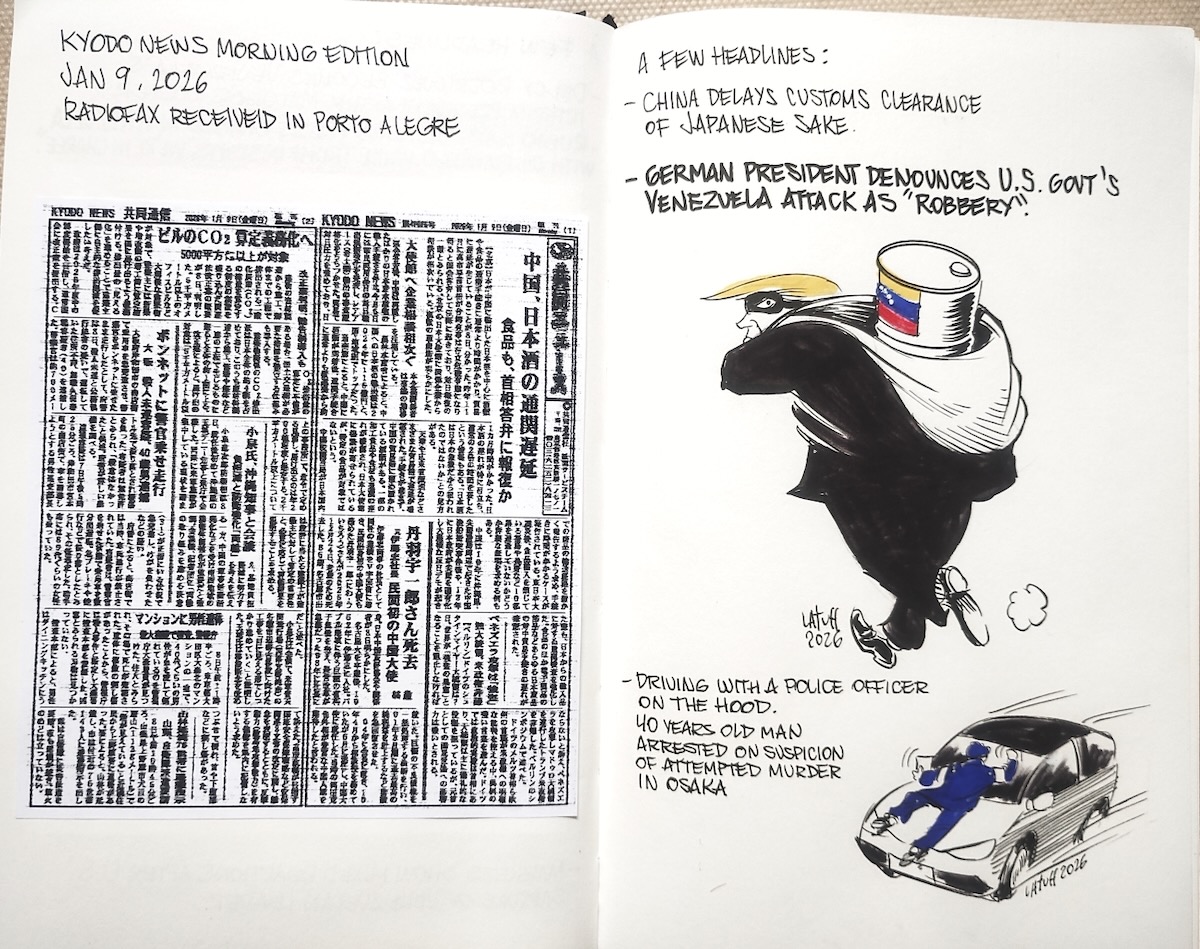
Many thanks to SWLing Post contributor and noted political cartoonist, Carlos Latuff, who shares the following illustrated radio listening report of a recent Radio ELWA broadcast.


Carlos notes:

Radio ELWA, Monrovia, Liberia, 6050 kHz

Click here to view on YouTube.